Sensorineural Hearing Loss in Selective Immunglobulin
A Deficiency
Erkan Eşki1, Belgin Emine Usta2, Suna Asilsoy2, İsmail Yılmaz3 1Department of Otorhinolaryngology, Başkent University İzmir Hospital, İzmir, Turkey 2Department of Pediatrics, Başkent University Adana Hospital, Adana, Turkey
3Department of Otorhinolaryngology, Başkent University Adana Hospital, Adana, Turkey Original Investigation
Address for Correspondence:
Erkan Eşki
E-mail: [email protected] Received Date: 07.10.2016 Accepted Date: 05.01.2017
© Copyright 2017 by Official Journal of the Turkish Society of Otorhinolaryngology and Head and Neck Surgery Available online at www.turkarchotorhinolaryngol.org DOI: 10.5152/tao.2017.1923
31 Turkish Archives of Otorhinolaryngology
Türk Otorinolarengoloji Arşivi Turk Arch Otorhinolaryngol 2017; 55: 31-3
Abstract Objective: To assess hearing functions in pediatric
patients with selective immunoglobulin A (IgA) de-ficiency (SIGAD).
Methods: Pure-tone audiometry, acoustic impedance,
otoacoustic emission, and brainstem audiometric me-asurements were taken during a non-infectious period in 28 patients with SIGAD and 28 healthy children with normal otoscopic examination. The results of the hearing tests were compared between the two groups.
Results: Two male patients and one female patient in
the SIGAD group were found to have sensorineural
hearing loss (SNHL). However, a comparison of the average pure tone cut-off values at 0.5, 1, 2, and 4 kHz did not reveal any statistically significant difference between the groups (p>0.05).
Conclusion: Pediatric patients with SIGAD may
exhibit SNHL at certain frequencies and require follow-up for the potential development of hearing loss.
Keywords: Sensorineural hearing loss, primary
im-munodeficiency, pediatric, selective IgA deficiency
Introduction
Selective immunoglobulin A (IgA) deficiency (SIGAD) is defined as a serum IgA level of less than 7 mg/dl in children over 4 years of age with normal immune system. SIGAD may be partial or complete and may represent the most com-mon form of primary immune deficiencies, with an average prevalence between 1/143 to 1/18500 per population (1). Patients with SIGAD gen-erally have an increased risk of sinopulmonary infections, allergy, and auto-immune conditions. Arnold et al. (2), using immunohistochemical methods, confirmed the presence of IgA and IgG in the epithelial cells of the inner ear and in the lumen of the endolymphatic sac of healthy individuals. Moreover, inflammatory conditions have been found to be associated with increased IgA levels in the endolymphatic sac (3).
Several immune disorders have been shown to occur in adults with autoimmune sensorineural hearing loss (4, 5). Furthermore, patients with X-linked agammaglobulinemia (XLA) and
common variable immune deficiency (CVID) have been shown to suffer from sensorineural hearing loss (SNHL) (6, 7).
Patients with SIGAD are more susceptible to recurrent infections, especially acute otitis me-dia. Hearing loss caused by recurrent infections may frequently occur in these patients. Howev-er, there are very few studies examining the fre-quency of SNHL in patients with SIGAD. In this study, our objective was to assess the func-tions of the inner ear in patients with SIGAD.
Methods
This study was performed at Başkent University, with the support of the Research Council of the School of Medicine at Başkent University and with the approval of the local ethics committee (Project No: KA 17/02). Patients with a diagno-sis of SIGAD followed up at the Immunology department were included in this study based on the following inclusion criteria:
2- Normal serum IgG and IgM 3- Absence of Ig prophylaxis
4- Absence of acute or chronic ear conditions
5- Normal screening test results during the newborn period 6- Absence of a family history of SNHL
Patients with a history of premature birth, low birth weight, hyperbilirubinemia, systemic conditions, ototoxic medica-tions, or acoustic trauma were excluded. Informed consent was obtained from the parents of the patients.
Otoscopy results were found to be normal in all patients. The following tests were performed during a non-infectious pe-riod: pure-tone audiometry, acoustic impedance, otoacoustic emission, and brainstem audiometry. A bone threshold level greater than 20 dB at any frequency was considered to in-dicate the presence of SNHL. Cochlear and retrocochle-ar SNHL were differentiated, and those with retrocochleretrocochle-ar hearing loss were excluded from the study. Alterations in hearing functions in these cases were recorded and compared with those in the healthy pediatric control group. Data anal-ysis was performed using Statistical Package for the Social Sciences 17.0 software pack (SPSS Inc.; Chicago, IL, USA). Audiometry results were compared using the chi-square test, and all tests were performed at a significance level of 0.05.
Results
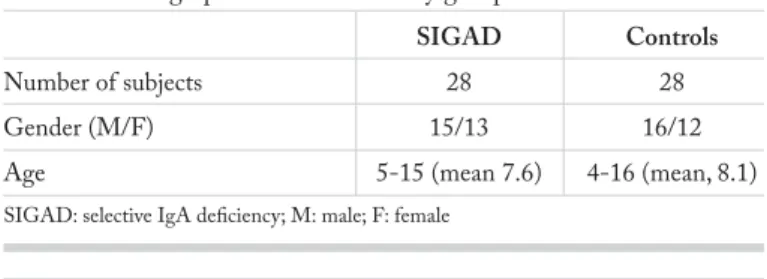
A total of 28 children with SIGAD and 28 healthy controls were included in this study. The demographic characteristics of the patients are summarized in Table 1. The groups were compared in terms of age and gender distribution.
The pure-tone audiometric examination revealed the pres-ence of unilateral SNHL in two male patients and bilateral SNHL in one female patient (Table 2).
A comparison between the groups with regard to the average pure-tone thresholds did not reveal any significant difference at 0.5, 1, 2, and 4 kHz (Table 3).
Discussion
The increased frequency of recurrent upper respiratory tract infections as well as ear infections in patients with SIGAD has been clearly documented previously (8). Moreover, the increased levels of IgA in the epithelial cells of the inner ear and in the endolymphatic sac has been demonstrated, with inflammatory conditions. Obviously, these represent a com-ponent of the immune response. Thus, patients with SIGAD are more likely to experience weakened immune responses in the inner ear with a subsequent increase in the risk of hear-ing loss. In the present study, audiometric examinations were performed in patients with SIGAD. One female patient had bilateral SNHL of 25 dB at 500 and 1000 Hz, whereas one male patient had unilateral SNHL of 25 dB at 2000-4000 Hz and another male patient had unilateral SNHL of 30 dB at 250-500 Hz.
In the study by Berlucchi et al. (6) that examined a total of 25
patients with XLA using audiometry, seven patients (28%) were found to have SNHL. However, all patients with XLA included in that study had Bruton Tyrosine Kinase gene mu-tations, as well as a past history of meningoencephalitis in two patients, Arnold-Chiari malformation in one, and po-lio-myelitis in one patient. In a study by Midilli et al. (7) that involved a total of 13 patients with CVID, SNHL was found to be present at higher frequencies (>8 kHz), although they concluded that further comparative studies in larger sample populations are warranted for better elucidation of their results. In a previous study comparing patients with au-toimmune SNHL and healthy adult controls, significant re-ductions in IgG1 and IgG3 serum levels were found. In that study, however, serum IgA levels were also compared and no significant differences were observed (4).
In adult patients with SNHL, autoimmune processes have been implicated in the etiology of this condition. However, autoimmune processes are extremely complex, with no clear-cut results from efforts to develop reasonable models (9). IgA plays a role in the integration of systemic and mucosal immune responses, and its deficiency is associated with an increased frequency of several autoimmunological conditions, including hemolytic anemia, thrombocytopenic purpura, and juvenile rheumatoid arthritis (8). Moreover, weakened IgA respons-es may reprrespons-esent a part of the immune reactions that occur during the process leading to the development of hearing loss. A majority of pediatric SNHL cases are congenital, which
Turk Arch Otorhinolaryngol 2017; 55: 31-3 Eşki et al. Hearing loss in IgA deficiency
32
Table 1. Demographic data of the study groups
SIGAD Controls
Number of subjects 28 28
Gender (M/F) 15/13 16/12
Age 5-15 (mean 7.6) 4-16 (mean, 8.1)
SIGAD: selective IgA deficiency; M: male; F: female
Table 2. Results of hearing tests among patients with selective IgA
deficiency
Bilateral SNHL Unilateral SNHL
Number of patients with SNHL 1 (3, 57%) 2 (7, 14%)
SNHL frequency 500-1000 Hz 2000-4000 Hz
250-500 Hz
SNHL level 25 dB 25 and 30 dB
SNHL: sensorineural hearing loss; Hz: Hertz; dB: decibel
Table 3. Average hearing thresholds for the study subjects
0,5 kHz 1 kHz 2 kHz 4 kHz
SIGAD 18 dB 21 dB 20 dB 22 dB
Controls 15 dB 19 dB 18 dB 17 dB
p>0.05
may be readily detected using screening methods during the newborn period (10). In our study, patients with con-genital SNHL were excluded based on the results of oto-acoustic emission tests performed during the newborn pe-riod. Other causes of SNHL include the use of ototoxic medications and acoustic trauma, which lead to SNHL at higher frequencies (>4 kHz) (11). No patients in our study were found to have hearing loss above the frequency of 4 kHz as confirmed using otoacoustic emission and brain-stem audiometric tests.
Selective IgA deficiency is associated with recurrent boots of upper respiratory tract and ear infections. Repetitive courses of upper respiratory tract infections due to viruses and ear infections may result in the development of hearing loss. In the present study, three patients were found to have SNHL at limited frequencies. A major limitation of our study, sim-ilar to other conditions of the inner ear, was our inability to perform a comparison between our findings and histopatho-logical characteristics of the inner ear, with a consequent ab-sence of information on the histopathological aspects of the condition. Several electrophysiological measurements were taken to compensate for this lack of histopathological find-ings. Other limitations include the small sample size and the cross-sectional nature of the study. Such factors might have decreased the statistical significance of our results. Further studies involving larger patient populations and longer fol-low-up periods may better delineate the effect of SIGAD on inner ear functions.
Conclusion
Pediatric patients with SIGAD may experience SNHL at certain frequencies. An association between these two con-ditions may be better defined with the involvement of high-er numbhigh-er of patients with recurrent middle-ear infections followed up for longer durations. Moreover, examination of the development of autoimmune SNHL in pediatric patients with SIGAD may shed further light on the pathogenesis of this condition.
Ethics Committee Approval: Ethics committee approval was
re-ceived for this study from the ethics committee of Başkent Univer-sity (Project No: KA 17/02).
Informed Consent: Written informed consent was obtained from
parents’ of patients who participated in this study.
Peer-review: Externally peer-reviewed.
Author Contributions: Concept - E.E., B.E.U.; Design - E.E.,
İ.Y.; Supervision - İ.Y., S.A.; Resource - E.E.; Materials - E.E., B.E.U.; Data Collection and/or Processing - E.E., B.E.U., İ.Y., S.A.; Analysis and/or Interpretation - E.E., İ.Y.; Literature Search - E.E.; Writing - E.E., İ.Y.; Critical Reviews - İ.Y., S.A.
Conflict of Interest: No conflict of interest was declared by the
au-thors.
Financial Disclosure: The authors declared that this study has
re-ceived no financial support.
References
1. Conley ME, Notarangelo LD, Etzioni A. Diagnostic criteria for pri-mary immunodeficiencies. Representing PAGID (Pan-American Group for Immunodeficiency) and ESID (European Society for Im-munodeficiencies). Clin Immunol 1999; 93: 190-7. [CrossRef] 2. Arnold W, Pfaltz R, Altermatt HJ. Evidence of serum antibodies
against inner ear tissues in the blood of patients with certain sen-sorineural hearing disorders. Acta Otolaryngol 1985; 99: 437-44. [CrossRef]
3. Takahashi M, Harris JP. Secretory component and IgA in the en-dolymphatic sac. Acta Otolaryngol 1993; 113: 615-9. [CrossRef] 4. Bertoli LF, Pappas DG, Barton JC, Barton JC. Serum
immuno-globulins in 28 adults with autoimmune sensorineural hearing loss: increased prevalence of subnormal immunoglobulin G1 and immu-noglobulin G3. BMC Immunol 2014: 22; 15-23. [CrossRef] 5. Baek MJ, Park HM, Johnson JM, Altuntas CZ, Jane-Wit D, Jaini
R, et al. Increased frequencies of cochlin-specific T cells in patients with autoimmune sensorineural hearing loss. J Immunol 2006; 177: 4203-10. [CrossRef]
6. Berlucchi M, Soresina A, Redaelli De Zinis LO, Valetti L, Valotti R, Lougaris V, et al. Sensorineural hearing loss in primary anti-body deficiency disorders. J Pediatr 2008; 153: 293-6. [CrossRef] 7. Midilli R, Ardeniz Ö, Akyıldız S, Sın A, Gode S. Sık değişken
bağışıklık eksikliği hastalarında KBB bulguları. KBB Forum 2009; 8: 33-8.
8. Aytekin C, Tuygun N, Gokce S, Dogu F, Ikinciogullari A. Selec-tive IgA deficiency: clinical and laboratory features of 118 children in Turkey. J Clin Immun 2012: 32; 961-6. [CrossRef]
9. Solares CA, Hudges GB, Tuohy VK. Autoimmune sensorineural hearing loss: an immunologic perspective. J Neuroimmun 2003: 138; 1-7. [CrossRef]
10. Kenna MA. Acquired Hearing Loss. Otolaryngol Clin North Am 2015: 48; 933-3. [CrossRef]
11. Jacobson J, Jacobson C. Evaluation of hearing loss in infants and young children. Pediatr Ann 2004; 33: 811-21.[CrossRef] Turk Arch Otorhinolaryngol 2017; 55: 31-3 Eşki et al. Hearing loss in IgA deficiency