Media-based clinical research on selfie-related
injuries and deaths
Mehmet Dokur, M.D.,1 Emine Petekkaya, Ph.D.,2 Mehmet Karadağ, Ph.D.3
1Department of Intensive Care Unit, Başkent University Hospital, Ankara-Turkey
2Department of Anatomy, Beykent University Faculty of Medicine, İstanbul-Turkey
3Department of Biostatistic and Medical Informatics, İnönü University Health Sciences Institue, Malatya-Turkey
ABSTRACT
BACKGROUND: The incidence of taking selfies and sharing them on social media as well as selfie-related behaviors is increasing, particularly among young people, possible leading to selfie-related trauma. Therefore, we performed this clinical study to draw atten-tion to selfie-related injuries and deaths.
METHODS: We analyzed 159 selfie victims from 111 events or accidents, which were reported in the media sources. We evaluated vital results, demography, rhythmicity, preferences, event or accident types, selfie-related risk factors, affected body regions of victims with causes of injury, and death.
RESULTS: We found that the majority of selfie victims were students. Selfie-related injuries and deaths were reported most fre-quently in India, the US, and Russia. The most preferred site of taking selfies was the edge of the cliff. The most frefre-quently reported event or accident type was falling from a height. Mostly multiple body parts were affected in selfie-related injuries and deaths. The most frequent causes of selfie-related deaths were multitrauma and drowning.
CONCLUSION: Selfie-related injuries and deaths have increased in the past years. Particularly, teenagers and young adults are at high risk for selfie-related traumas and deaths; therefore, drastic measures should be taken to reduce their incidence.
Keywords: Death; injury; selfie.
and Florida as number 3 (155 selfie-takers per 100,000 peo-ple).[2]
Clinical researches in the realm of psychiatry suggest that heavy selfie-taking and sharing selfies on social media sites (selfie-re-lated behaviors) and/or smartphone addiction are closely as-sociated with narcissism and psychopathology.[3] Furthermore,
some clinical trials on selfie-posting suggest that self-objec-tification and self-presentation behaviors on social websites, particularly for males, are also components of the dark triad of personality (Machiavellianism, narcissism, and psychopathy).
[4,5] The neurocognitive reflections of intensive smartphone
us-age and selfie-related behaviors have been reported as tempo-rary distractions and momentary lack of self-awareness in the
INTRODUCTION
With the increase in the smart phone production and in-novative social media applications in the last decade, selfies have become an essential part of our daily lives, with multi-ple influences as a social media phenomena or a syndrome of crazy behaviors, particularly among young people. A study has shown that 98% of the youth owns a mobile phone and they are heavy users (>4 h day−1).[1] In 2014, a social survey
conducted by the TIME Magazine listed 459 cities as “The Selfiest Cities in the World.” Among 459 cities, Makati City, Pasig, and Philippines were ranked as number 1 (258 selfie-takers per 100,000 people); Manhattan and New York as number 2 (202 selfie-takers per 100,000 people); and Miami
Cite this article as: Dokur M, Petekkaya E, Karadağ M. Media-based clinical research on selfie-related injuries and deaths. Ulus Travma Acil Cerrahi Derg 2018;24:129–135
Address for correspondence: Mehmet Dokur, M.D.
Başkent Üniversitesi Hastanesi, Yoğun Bakım Ünitesi, Çankaya, 06490 Ankara, Turkey Tel: +90 312 - 203 68 68 E-mail: [email protected]
Ulus Travma Acil Cerrahi Derg 2018;24(2):129–135 DOI: 10.5505/tjtes.2017.83103 Submitted: 04.03.2017 Accepted: 21.08.2017 Online: 12.02.2018 Copyright 2018 Turkish Association of Trauma and Emergency Surgery
current literature.[6,7] Selfie-related behaviors and smartphone
addiction also result in selfie-related traumatic risks and may cause injuries and deaths, generally in teenagers and young adults who take selfies in every moment of their daily lives.[8,9]
Smartphone addiction and selfie-related behavioral phenom-ena may also have negative effects on pretephenom-enagers as well as other living things in the nature.[10,11] The number of
selfie-re-lated events and accidents is still on the rise. Recently, certain countries have introduced protective projects and a number of restrictive regulations to encourage safe use of smartphones and reduce selfie-related hazards or risks.[12,13]
In this study, we prepared a media-based clinical research with a multifaceted perspective that was targeted to empha-size the importance of selfie-related injuries and deaths
MATERIALS AND METHODS
Study Design
Study type: Clinical observational study (Original Research); cross-sectional design without controls.
Level of evidence: 4.[14]
Cases and Data Collection
In this media-based clinical study, we included 159 victims (humans only) involved in 111 different events or accidents related to selfies that were reported in media resources between December 2013 and January 2017 (a 38-months period). Following media resources were cited for selfie-re-lated cases: 108 cases from Wikipedia’s official website,[15]
two from Turkish national media resources,[16,17] and one
from a Pakistani media resource.[18] We performed a careful
and detailed examination of all media resources to evaluate selfie-related injuries and deaths, (131 media resources from Wikipedia Pages and three from others). Among these media resources, we picked the ones that fit the criteria previously determined by us for our study and transferred the resources to an excel file as scientific data. We coded the data we could not find on media resources as “unknown or not reported.” We determined that a group selfie consisted of >2 people in a particular pose and heavy selfie-taking as >4 h day−1. Those aged 18–64 years were considered as the active age group taking selfies and using social media. We also regarded the injuries and deaths that occurred outside of the selfie-taking, but happened coincidentally during or after as “extra injuries” and “extra deaths.”
Statistical Analysis
Our study comprises data measured on categorical levels. Thus, descriptive statistics are given in tables showing fre-quency and percentage values along with pie-charts and bar graphs. In the inferential statistics section, Chi-square statis-tics method was used for comparing two categorical vari-ables, and Cramer’s V coefficient was used for the correlation relation between two categorical variables.
Ethical Statement
Ethics Committee Approval: Authors declared that the re-search was conducted according to the principles of the World Medical Association Declaration of Helsinki, “Ethical Principles for Medical Research Involving Human Subjects.” The protocol was approved by Zirve University Ethics Com-mittee (Permit number: 2014/19).
RESULTS
Demography
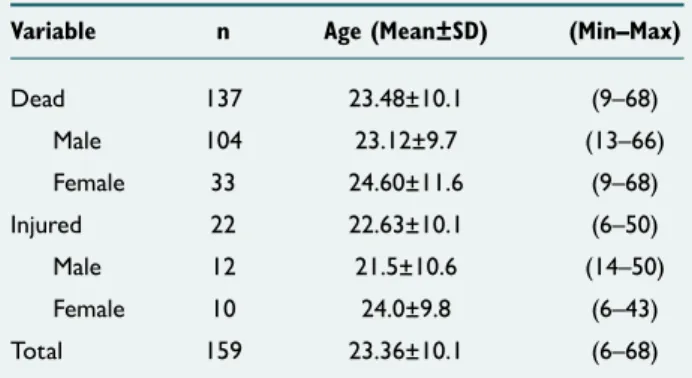
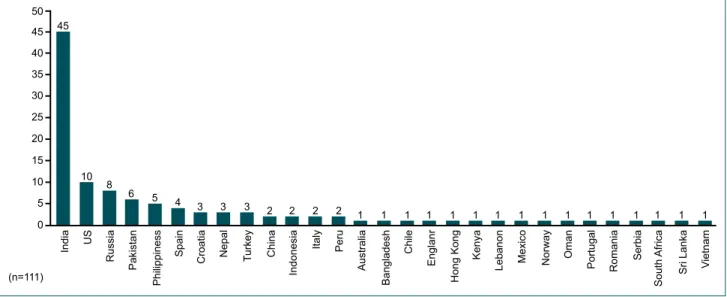
Among the 111 events or accidents examined, we determined that the total case (dead and injured) number was 159, the aver-age aver-age was 23.36±10.1 years, the number of dead people was 137, and the number of injured people was 22. We determined that the male to female ratio in these cases was higher. The av-erage ages in selfie-related deaths and injuries were 23.48±10.1 (9–68) years and 22.63±10.1 (6–50) years (Table 1), respec-tively. We determined that the injury and death rates per event or accident were 0.19 (0–5) and 1.23 (0–7), respectively. When the social statuses of selfie victims were examined through our study, it was determined that students (particularly high school and university students) were predominant (84, 52.8%); the numbers of domestic and foreign (international) tourists were 78 (49%) and 15 (9.4%), respectively. The number of local res-ident was 66 (41.6%). We found that the country distribution and nationality distribution of selfie-related injury and death cases were highly compatible. The first three countries in terms of frequency of such events and victims were India (45 events or accidents, 40.5%; 75 victims, 47.2%), the US (10 events or accidents, 9%; 11 victims, 6.9%), and Russia (8 events or acci-dents, 7.2%; 10 victims, 6.2%), respectively (Fig. 1). The total number of extra injured people and extra dead was reported as 19 and 6, respectively by media sources.
Rhythmicity
We determined that the number of selfie-related injuries and deaths significantly increased per year (2014–2015 and 2016) (Fig. 2). When selfie-related injuries and deaths were examined according to months, we determined that the most
Table 1. Demographic data of selfie victims
Variable n Age (Mean±SD) (Min–Max)
Dead 137 23.48±10.1 (9–68) Male 104 23.12±9.7 (13–66) Female 33 24.60±11.6 (9–68) Injured 22 22.63±10.1 (6–50) Male 12 21.5±10.6 (14–50) Female 10 24.0±9.8 (6–43) Total 159 23.36±10.1 (6–68)
events or accidents occurred in August (18 events or acci-dents, 16.2%), July (16 events or acciacci-dents, 14.4%), and June (13 events or accidents, 11.7%). Conversely, the number of events or accidents reported in March, November, and De-cember was the lowest and the same (5 events or accidents, 4.5%). When selfie-related injuries and deaths were examined in weekdays, most cases occurred on Saturdays (24 events or accidents, 21.6%) and Fridays (23 events or accidents, 20.7%); the lowest number of events or accidents was reported on Thursdays (15 events or accidents, 13.5%). Additionally, higher number of events or accidents occurred in the post-meridiem (p.m.) time interval (74 events or accidents, 66.7%).
Preferences
We found that selfie-related injuries and deaths mostly oc-curred in city suburbs (64 events or accidents, 57.7%). We also determined that selfie victims preferred natural scenes for a selfie (48 events or accidents, 43.2%); we also found out that the number of mono or alone selfies is higher than that of group selfies (>2 people) (60 events or accidents, 54%)
(Table 2). In this study, we determined that selfie victims mostly preferred to take selfies on the edge of a cliff (17 events or accidents, 15.3%). Selfie stick usage among selfie victims was remarkably low (2 events or accidents, 1.8%) We determined that total number of people in a selfie pose was 206, and 75.7% of these people were affected from selfie-re-lated injuries and deaths.
Figure 1. The distribution of selfie-related injuries and deaths according to countries. 50 45 45 10 8 6 5 4 3 3 3 2 2 2 2 1 1 1 1 1 1 1 1 1 1 1 1 1 1 1 1 40 35 30 25 20 15 (n=111) Philippiness India US Russia
Pakistan Spain Croatia Nepal Turkey China Indonesia Italy Peru Australia Bangladesh Chile Englanr Hong Kong Kenya
Lebanon Mexico Norway Oman Portugal Romania Serbia
South Africa Sri Lanka Vietnam 10 5 0 50 60 40 30 20 10 2014 2015 2016 Injuries & Deaths Years (n=151) Figure 2. Increase in selfie-related injuries and deaths by years.
Table 2. Some preferences of selfie victims
Preferences n %
Place
Outside the city 64 57.7
In the city 47 42.3
Total 111 100
Scene
Nature and associated environments 48 43.2
Train, railway, and associated structures 22 19.9
Buildings and associated structures 17 15.3
Road, bridge, and associated structures 12 10.8
Dam and associated structures 7 6.3
Fields, farms, and associated structures 4 3.6
Others 1 0.9
Total 111 100
Selfie stick use
Unknown or not reported 109 98.2
Yes 2 1.8
Total 111 100
Selfie type
Mono Selfie 60 54
Group Selfie (>2 people) 51 46
Event or Accident Categories
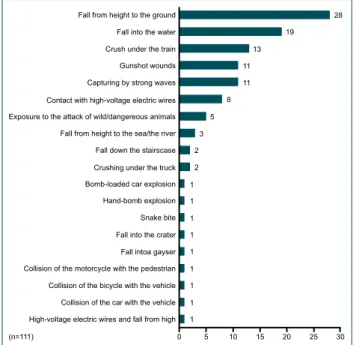
We determined that the most common event or accident type causing selfie-related injuries and deaths was falling from height (28 events or accidents, 25.2%) (Fig. 3). The most fre-quent causes of selfie-related deaths were multitrauma due to various causes (58 victims, 42.3%) and drowning (57 vic-tims, 41.6%) (Fig. 4). The most frequent cause of selfie-re-lated injuries was multitrauma due to falling from height (6 victims, 27.3%). The most common place of death in selfie-related deaths was the scene of accident (99 victims, 72.3%).
No deaths during transportation from the scene of accident to a hospital were reported. The most common body parts to be affected in selfie-related injuries and deaths were multi-ple body parts (>3) (76 victims, 47.8%) (Table 3).
Risk Factors
The most common behavioral risk factor in selfie-related injuries and deaths was people exhibiting dangerous behav-iors for themselves and others around them (61 events or accidents, 55%). Neurocognitive risk factor causing negative effects (losing balance, temporary distraction, and/or lack of self-awareness) during selfie-taking was determined in 99 events or accidents (89.2%).
Comparisons
Chi-square test was conducted to determine the relation
be-Exposure to the attack of wild/dangereous animals Fall from height to the ground 28 19 13 11 11 8 5 3 2 2 1 1 1 1 1 1 1 1 1 0 5 10 15 20 25 30 Bomb-loaded car explosion Hand-bomb explosion Snake bite Fall into the crater Fall intoa gayser Collision of the motorcycle with the pedestrian Collision of the bicycle with the vehicle Collision of the car with the vehicle High-voltage electric wires and fall from high Crushing under the truck Fall down the stairscase Fall from height to the sea/the river Contact with high-voltage electric wires Capturing by strong waves Gunshot wounds Crush under the train Fall into the water (n=111) Figure 3. Event or accident types in selfie-related injuries and de-aths. 60 50 40 30 20 10 0 57 25 18 7 6 6 4 3 3 2 2 1 1 1 1 1 Drowning in water Multiple trauma (fall from high) Multiple trauma (crush under the train) Serios head trauma (gunshot) Multiple trauma (truck collision) High voltage electrocution (with arc burns) Serios head trauma (fall from high) Multiple trauma (bomb explosion) Multiple trauma (wild or dangereous animal) Multiple trauma (fall from staircase) Serios body trauma (gunshot) Multiple trauma (collision of the motorcycle) Serios extremity trauma (gunshot) High voltage electrocution & multiple trauma * Severe burns (hot water) Drowning by wild animal (n=137) *Fall from high Figure 4. Causes of death of selfie victims.
Table 3. Body regions and/or systems affected by selfie-related injuries and deaths
Body regions and/or systems n %
Head-Neck 14 8.8
Chest-Abdomen-Back 6 3.7
Extremity 3 1.9
Multiple body parts (>3) 76 47.8
Non-traumatic or systemic effects 56 35.2
Multiple body parts (>3) and systemic effects 2 1.3
Extremity and systemic effects 2 1.3
tween the affected body parts and/or systems and event or accident types and causes of death. The results were signifi-cant in both relations (p=0.001). Additionally, mildly positive relationships between the affected body parts and/or systems and event or accident types and causes of death of (r=0.67) and (r=0.83), respectively, were determined according to the Cramer’s V coefficient. Similarly, the results of chi-square test were significant in terms of relation; a mildly positive relation-ship between event or accident types and causes of death was determined according to the Cramer’s V coefficient (p=0.001 and r=0.85).
DISCUSSION
In 2013, more than 23 million selfies were shared on Insta-gram, and by the end of that year, the Oxford Dictionary declared “selfie” as “the word of the year” because its num-ber reached 57 million.[19] Selfie phenomenon particularly in
young adult males[20] has been a focus for neuropsychiatry
for the last couple of years to point out narcissistic, psy-chopathologic,[3] and prejudice-based asymmetrical
behav-ioral tendencies,[21,22] along with its negative effects (loss of
balance, temporary distraction, and momentary loss of self-awareness)[6,7] and positive effects (promoting positive affect
through smartphone photography)[23] with reference to
re-flecting the complexity of human behavior.[4] People with high
narcissism demonstrate intense self-focus, activity changes particularly in the anterior insula, and neuronal differences mainly in the right anterior insula.[24] Selfie syndrome mainly
concerns active, traveling age group; the various preventable traumatic risks of this syndrome[8] concern travel medicine,
emergency medicine, and preventive medicine. Heavy selfie-taking or smartphone, selfie, and social media[25,26] addiction
introduced a new generation to social area researchers, the “Screenagers,” who learn everything from the digital screen. Screenagers are thought to be in the teenager age group (13– 19 years).[27,28] Due to their high intellectual abilities and
dy-namism, screenagers tend to create a whole new special risk group in selfie-related injuries and deaths. Another important risk group is young adults (15–29 years). The studies of Dutta et al.[20] and Saroshe at al.[29] conducted on school-age
adoles-cents and professional students showed that these age groups are heavy selfie-takers. No significant difference was deter-mined in their gender-wise statistics. A research conducted in 2014 showed that social media was most frequently used by individuals aged between 18 and 29 years.[26] Although the
cases used in our study were in accordance with current re-searches in terms of social status and age groups, our study showed that males had a significantly higher risk for selfie-related injuries and deaths.
Wikipedia, a free online encyclopedia launched in 2001, is one of the most visited websites worldwide and is often consulted for health-related information;[30] it was the major source
of cases in this study. It is a common belief that the media sources in many cases are unreliable or false;[31] therefore, all
media resources (134 in total) in our study were meticulously and exactly evaluated by all researchers to increase the relia-bility of this media-based clinical research.
A research conducted by the TIME Magazine in 2014 listed “The Selfiest Cities in the World”.[2] Even though none of the
Indian cities were listed in the top 100 selfiest cities, we de-termined that India had the highest number in selfie-related injuries and deaths, suggesting that there is no strong cor-relation between the selfiest cities list and the cities where most selfie-related injuries and deaths actually occur. The security of the environment while taking a selfie might be a more important factor. However, India’s high teenager and adolescent population and the easy access of these groups to smartphone technology along with the fast increase of smart-phone addiction[25,29] might be regarded as potential factors
for selfie-related injuries and deaths. The significant increase in the number of selfie-related injuries and deaths per year (2014–2015 and 2016) may be associated with the increase in the number of heavy selfie-takers[1] and dangerous
selfie-tak-ing, with smartphone addiction and selfie-related behaviors, particularly among young people in recent years.[3–5,32] In
addi-tion, the fact that the smartphone technology has developed a lot in such a short time and become accessible to everyone, along with the Selfie Phenomenon[8] becoming popular, may
also be important factors for the increase in selfie-related injuries and deaths. The sudden increase in selfie-related in-juries and deaths especially in summer months and on week-ends might be explained by people preferring these times for social activities and traveling. Selfie-related injuries and deaths are mostly seen in post-meridiem (p.m.) time interval, and this can be explained by people’s preference in daily commu-nication and activity in social media sites timelines.
We determined that certain behavioral (exhibiting dangerous behaviors as the most frequently reported one) and cogni-tive (losing balance, temporary distraction, and/or the lack of self-awareness) risk factors had significantly high ratios in our study. Some neuroscience researches suggested that selfie victims often use emotionally controlled mental reflec-tion by emphasizing extroversion of the crazy personality by choosing natural environments and dangerous areas such as the edge of a cliff and railways for posing. So, the Amygdale’s representation of the motivational activity of happy and angry facial expressions has been a neurocognitive explication of adventure and fearful poses.[33] Therefore, dangerous places
and poses exhibiting dangerous behaviors of selfie victims in our study are consistent with the current literature. In terms of functional anatomy, the left-sided face poses are predom-inantly controlled by the right hemisphere during selfie, and the right amygdala is active in fear expression. Moreover, in narcissism, the suppression of the left hemisphere that con-trols cognitive functions with right insular activity results in loss of environmental control in the victims.[34,35] In such a
self-ie-related ones. This may explain the importance of cognitive risk factors in our study.
The fact that affected multiple body parts (>3) and multiple traumas from various reasons (falling from height, being hit/ crushed by trains, truck collision, and many more) being the most frequent consequences can be explained by event or accident types and severity. In addition, the events that trig-ger each other can be explained as the domino effect.[36] A
typical example of this might be a victim being run over while taking a selfie in front of a moving train, experiencing multiple body parts and serious injuries or death caused by multiple traumas. The low selfie stick usage rate we determined in our study may be explained by alone or mono selfies being more common. Injury type or severity, physical conditions of the scene, and helping hands in the selfie pose and around the scene may be effective in selfie-related deaths mostly occur-ring on the accident scene. In this study, we also determined that the majority of our selfie victims were tourists (domestic or international), and this can be explained by the fact that people take more selfies during traveling. Our findings are also supported by the current literature.[8,37]
Conclusion
Selfie-related injuries and deaths have increased in recent years. All countries, particularly India, US, and Russia are at a high risk. Teenagers and young adult males are in the high-risk group for selfie-related injuries and deaths. Dangerous pose preferences, exhibiting dangerous behaviors, deaths and injuries wherein many body parts are affected caused by multiple traumas, and cognitive and behavioral risk factors are important for selfie-related injuries and deaths. Danger-ous consequences of selfie-related behaviors should be as-sessed from a multidisciplinary point of view. Drastic mea-sures should be taken to reduce selfie-related risks, and social projects to protect young people from selfie-related hazards should be encouraged.
Acknowledgment
The authors did not declare any financial support. Conflict of interest: None declared.
REFERENCES
1. Barkley JE, Lepp A. Cellular telephone use during free-living walking sig-nificantly reduces average walking speed. BMC Res Notes 2016;9:195. 2. The Definitive Ranking of The Selfiest Cities in the World. Available at:
www.time.com. Accessed Jan 3, 2017.
3. Lee JA, Sung Y. Hide-and-Seek: Narcissism and “Selfie”-Related Behav-ior. Cyberpsychol Behav Soc Netw 2016;19:347–51.
4. Sorokowski P, Sorokowska A, Oleszkiewicz A, Frackowiak T, Huk A, Pisanski K. Selfie posting behaviors are associated with narcissism among men. Personality and Individual Differences 2015;85:123–7.
5. Fox J, Rooney MC. The dark triad and trait self-objectification as pre-dictors of men’s use and self-presentation behaviors on social networking
sites. Personality and Individual Differences 2015;76:161–5.
6. American College of Emergency Physicians (ACEP). Participation in activities while distracted by mobile device use. Policy statement. Ann Emerg Med 2014;64:563.
7. Bhogesha S, John JR, Tripathy S. Death in a flash: selfie and the lack of self-awareness. J Travel Med 2016;23. pii: taw033.
8. Flaherty GT, Choi J. The ‘selfie’ phenomenon: reducing the risk of harm while using smartphones during international travel. J Travel Med 2016;23:tav026.
9. Nasar J, Hecht P, Wener R. Mobile telephones, distracted attention, and pedestrian safety. Accid Anal Prev 2008;40:69–75.
10. Stavrinos D, Byington KW, Schwebel DC. Effect of cell phone distrac-tion on pediatric pedestrian injury risk. Pediatrics 2009;123:e179–85. 11. Dolphin was ‘already dead’ when crowd in Argentina handled it – tourist -
Environment. The Guardian. Available at: http://www.theguardian.com. Accessed Jan 3, 2017.
12. https://au.finance.yahoo.com/news/first-japan-project-aims-pre-vent-050100272.html. Accessed Jan 3, 2017.
13. http://mashable.com/2015/07/07/russia-safe-selfies/#cNo3Sfj15EqT. Accessed Jan 3, 2017.
14. The United Stated Department of Health and Human services. Avaible at: http://www.ahrq.gov/. Accessed Jul 31, 2017.
15. List of selfie-related injuries and deaths. Available at: https:// en.wikipedia.org/w/index.php?title=List_of_selfie- related_injuries_ and_deaths&oldid=757719342. Accessed Jan 10, 2017.
16. http://www.birgun.net/haber-detay/3-kopru-de-ilk-kaza-selfie-yuzun-den-126267.html123. Accessed Jan 2, 2017.
17. http://www.timeturk.com/mersin-de-sel-felaketi-2-olu-1-kayip/ haber-430346. Accessed Jan 1, 2017.
19. Storella AC. It’s Selfie-Evident: Spectrum of Allienability and Copy-righted Content on Social Media. Boston University Law Review 2014;94:2045–9.
18. http://tribune.com.pk/story/1285573/fatal-mistake-deadly-selfie-takes-man-off-sukkurs-lansdowne-bridge/. Accessed Jan 9, 2017. 20. Dutta E, Sharma P, Dikshit R, Shah N, Sonavane S, Bharati A, et al.
Atti-tudes Toward Selfie Taking in School-going Adolescents: An Exploratory Study. Indian J Psychol Med 2016;38:242–5.
21. Bruno N, Bode C, Bertamini M. Composition in portraits: Selfies and wefies reveal similar biases in untrained modern youths and ancient mas-ters. Laterality 2017;22:279–93.
22. Lindell AK. The silent social/emotional signals in left and right cheek poses: a literature review. Laterality 2013;18:612–24.
23. Chen Y, Mark G, Ali S. Promoting Positive Affect through Smartphone Photography. Psychol Well Being 2016;6:8.
24. Fan Y, Wonneberger C, Enzi B, de Greck M, Ulrich C, Tempelmann C, et al. The narcissistic self and its psychological and neural correlates: an exploratory fMRI study. Psychol Med 2011;41:1641–50.
25. Davey S, Davey A. Assessment of Smartphone Addiction in Indian Ado-lescents: A Mixed Method Study by Systematic-review and Meta-analy-sis Approach. Int J Prev Med 2014;5:1500–11.
26. http:/www.pewinternet.org/files/2015/01/PI_SocialMediaUp-date20144.pdf. Accessed Jan 12, 2017.
27. https://mindmake2.blogspot.com.tr/2016/07/are-your-kids-addicted-to-their-phones.html. Accessed Jan 3, 2017.
28. https://mediatechparenting.net/2016/03/17/screenagers-an-excellent-new-documentary-digital-parenting-resource/. Accessed Jan 3, 2017. 29. Saroshe S, Banseria R, Dixit S, Patidar A. Assessment of Selfie Syndrome
In-dia: A Cross-sectional Study. Int J Prevent Public Health Sci 2016;2:1–4. 30. Watad A, Bragazzi NL, Brigo F, Sharif K, Amital H, McGonagle D, et al. Readability of Wikipedia Pages on Autoimmune Disorders: Systematic Quantitative Assessment. J Med Internet Res 2017;19:e260.
31. Pribble JM, Goldstein KM, Fowler EF, Greenberg MJ, Noel SK, Howell JD. Medical news for the public to use? What’s on local TV news. Am J Manag Care 2006;12:170–6.
32. The Huffington Post. Too many smartphone users taking dumb, danger-ous selfies with bears, Tahoe officials say. Available at: http://www.the-huffingtonpost.com. Accessed Jan 24, 2017.
33. Critchley H, Daly E, Phillips M, Brammer M, Bullmore E, Williams S, et al. Explicit and implicit neural mechanisms for processing of social
infor-mation from facial expressions: a functional magnetic resonance imaging study. Hum Brain Mapp 2000;9:93–105.
34. Wager TD, Phan KL, Liberzon I, Taylor SF. Valence, gender, and lat-eralization of functional brain anatomy in emotion: a meta-analysis of findings from neuroimaging. Neuroimage 2003;19:513–31.
35. Fusar-Poli P, Placentino A, Carletti F, Allen P, Landi P, Abbamonte M, et al. Laterality effect on emotional faces processing: ALE meta-analysis of evidence. Neurosci Lett 2009;452:262–7.
36. Darbra RM, Palacios A, Casal J. Domino effect in chemical accidents: main features and accident sequences. J Hazard Mater 2010;183:565–73. 37. Patel D, Jermacane D. Social media in travel medicine: a review. Travel
Med Infect Dis 2015;13:135–42.
OLGU SUNUMU
Özçekim ilişkili yaralanma ve ölümlerin analizi
Dr. Mehmet Dokur,1 Dr. Emine Petekkaya,2 Dr. Mehmet Karadağ3 1Başkent Üniversitesi Hastanesi, Yoğun Bakım Ünitesi, Ankara
2Beykent Üniversitesi Tıp Fakültesi, Anatomi Anabilim Dalı, İstanbul
3İnönü Üniversitesi Sağlık Bilimleri Enstitüsü, Biyoistatistik ve Tıp Bilişimi Anabilim Dalı, Malatya
AMAÇ: Yoğun olarak özçekim ve bunları sosyal medyada paylaşmak ya da bununla ilişkili davranışlar, özellikle gençler arasında giderek artmaktadır. Bu durum özçekim nedenli travmalara yol açabilir. Bu klinik çalışmayı, özçekim ilişkili yaralanma ve ölümlere dikkat çekmek için gerçekleştirdik. GEREÇ VE YÖNTEM: Çalışmamızda medya kaynaklarında rapor edilen 111 özçekim olayı veya kazası ile ilişkili 159 olgu değerlendirildi. Özçekimle ilişkili yaralanma ve ölümlerin nedenleri ile birlikte kurbanların vital bulguları, demografileri, ritmisiteleri, tercihler, olay veya kaza tipleri, risk faktörleri ve etkilenen vücut bölgeleri değerlendirildi.
BULGULAR: Özçekim kurbanlarının birçoğunun öğrenci olduğu belirlendi. Özçekim ilişkili yaralanma ve ölümler en sık Hindistan, ABD ve Rusya’dan bildirilmişti. Kurbanların en sık poz tercihi uçurum kenarı idi. En sık rapor edilen kaza tipi yüksekten zemine düşme idi. Özçekim ilişkili yaralanma ve ölümlerde en sık etkilenen çoklu vücut bölgesi idi. En sık saptanan ölüm nedeni multitravma ve suda boğulma idi.
TARTIŞMA: Özçekim ilişkili yaralanma ve ölümler son yıllarda giderek artmaktadır. Özellikle ergenler ve genç yetişkinler tehlikeli özçekim açısından yüksek risk taşırlar. Bu nedenle özçekim ilişkili yaralanma ve ölümleri azaltmak için bilinçlendirme yapılmalıdır.
Anahtar sözcükler: Ölüm; yaralanma; özçekim.
Ulus Travma Acil Cerrahi Derg 2018;24(2):129–135 doi: 10.5505/tjtes.2017.83103 ORİJİNAL ÇALIŞMA - ÖZET