İSTANBUL BİLGİ UNIVERSITY INSTITUTE OF SOCIAL SCIENCES
CULTURAL MANAGEMENT MASTER’S DEGREE PROGRAM
A DIASPORIC WELCOME:
INTEGRATION OF IMMIGRANTS THROUGH SPATIAL PATTERNS SYRIAN CIRCASSIANS IN DÜZCE AS A CASE STUDY
ELMASHAN GÖKESAOĞLU 114677029
PROF. DR. AYHAN KAYA
İSTANBUL 2019
TABLE OF CONTENTS
TABLE OF CONTENTS ... ii
LIST OF TABLES AND IMAGES ... v
ABSTRACT ... vi
ÖZET ... vii
INTRODUCTION ... 1
1.1 LOCAL AND GLOBAL CONTEXT OF THE STUDY ... 1
1.2 RESEARCH QUESTION ... 2
1.3 STATE OF THE ART: SPACE, MIGRATION & INTEGRATION .... 3
1.3.1 Shedding Light on Spatial Concepts in Migration Research ... 4
1.3.2 Mass Migrations: Departure and Arrival Points ... 10
1.3.3 Spatial Integration ... 13
1.4 RATIONALE OF THE RESEARCH ... 15
1.5 METHODOLOGY ... 16
1.6 SCOPE OF THE STUDY ... 20
CIRCASSIANS ... 21
2.1 WHO ARE THE CIRCASSIANS? ... 21
2.2 CIRCASSIANS AND MIGRATION ... 24
2.2.1 Exodus: The Historical Background and the Diaspora ... 27
2.3 CIRCASSIANS AND SPACE & PLACE ... 28
2.3.4. Acculturation and Cultural Landscape ... 34
CASE STUDY: SYRIAN CIRCASSIANS IN DÜZCE ... 38
3.1 ABOUT THE RESEARCH ... 38
3.1.1 Routine Monitoring Processes ... 40
3.1.2 Occasioned Monitoring Processes ... 41
3.1.3 Intentional Information Seeking Processes ... 41
3.2 RESEARCH DESIGN ... 43
3.2.1 Düzce: Positioning... 44
3.2.2 Villages: A Structural and Paternal Chase ... 45
3.2.3 Network: Significance of Social Space ... 47
3.3 RESEARCH FINDINGS ... 47
3.3.1 Space and Place Related Findings ... 47
3.3.2 Migration Related Findings ... 50
3.3.3 Integration Related Findings ... 51
CONCLUSION ... 53
4.1 DISCLOSURE STATEMENTS ... 53
4.1.2 Affiliation and Secureness ... 54
LIST OF TABLES AND IMAGES
Table 2.1. A plan for reviving ancient Circassian gardens in Republic of Adygea
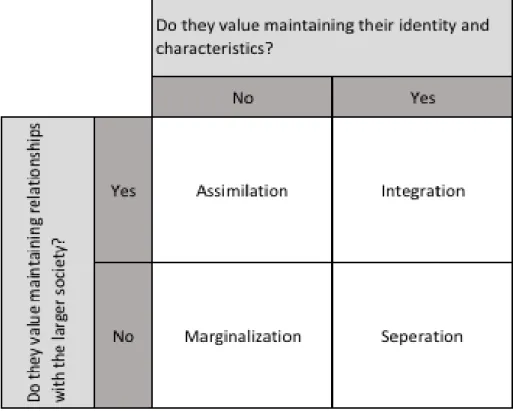
Table 2.2. Strategies of Acculturation
Image 3.1. Konaklı Village Map – Main Area of Settlement
Image 3.2. Küçükmehmet Village Map – Main Area of Settlement
Image 3.3. Examples of Circassian tribal family signs still used for cultural and
ABSTRACT
In the course of a globalizing world, the concept of migration has evolved dynamically with its branches extending towards multiple fields of social sciences embracing education, health, identity, employment and other socio-demographic issues. However, after brief reviews of literature, it has been observed that there are limited number of studies that focus on migration within the context of space and place –by space meaning; the tangible physical form of a city, village, street or a building and by place meaning; a homeland, motherland or a neighborhood after the factor of ‘inhabitants’/ human relations and social integration gets in the picture.
In this sense, the initial purpose of this dissertation is to offer a meaningful synthesis of migration matters and spatial patterns of refugees. A comprehensive research is carried out to analyze the role of space and place during the integration and socialization processes of immigrants. Syrian Circassians in Düzce will be used as a sample case to track the wondered outcome of the research: can space and place –as an end in itself- play a facilitating / normalizing role through the challenging phases of migration?
ÖZET
Globalleşen dünyada, göç konsepti, sosyal bilimleri eğitimden, sağlığa, kimlik, istihdam ve diğer sosyo-demografik konulara uzanan birçok alandaki branşlarını kucaklayacak şekilde dinamik bir gelişim göstermektedir. Fakat, akademik literatürün özet taranması, göçü mekân ve yer kavramı çerçevesinde inceleyen- mekân kavramını; şehir, kasaba, cadde ve bir binanın somutlaşmış fiziksel formu, yer kavramını ise; memleket, anavatan veya komşuluk ilişkileri olarak ele alan, yerel halk/ insan ilişkileri ve sosyal entegrasyon konularının resme dahil olduğu sınırlı sayıda çalışma olduğu görülmektedir.
Bu bağlamda, tezimizin başlangıç amacı göç konuları ve mültecilerin mekânsal paternleri ile ilgili anlamlı çıkarımlar yapmaktır. Göçmenlerin entegrasyon ve sosyalleşme süreçleri esnasında mekân ve yer kavramlarının rolü kapsamlı bir araştırma ile analiz edilmiştir. Düzce’deki Suriyeli Çerkezler, mekân ve yer kavramlarının- kendi içerisinde bir son olarak- göçün problemli safhalarında kolaylaştıran/normalleştirici bir rolü olup olmadığının inceleneceği örnek bir durum olarak kullanılacaktır.
CHAPTER 1
INTRODUCTION
1.1 LOCAL AND GLOBAL CONTEXT OF THE STUDY
Regardless of whether it is regional or international; cultural structures play a facilitating role in giving a hint or lighting a bulb about topics to deliberate on. Accordingly, as an active member of the Circassian communities in Turkey; I had the observation that the issue of Syrian migrants had emerged as an increasingly important subject within not only the host countries and the countries of origin; but also in the diasporic societies. In this respect, from an initial perspective, I had the impression that; amongst the Circassian originated Turkish citizens, it was mutually accepted that Syrian migrants living now in Circassian villages around Turkey are widely known to be happier than the refugees living both at in-camp and other out-camp settlements. Coincidentally, this observation had overlapped with a time period in which theories on space and place had become a personal interest of mine. Following these sequence of events, I decided to analyze space-society relations on a more specific manner and started to contemplate on the connection between space, place and migration.
Up to date literature demonstrate the fact that; most of the studies conducted on migration has been associated with the notion of ‘identity’. However, as the impact area of migration related problems has expanded on an enormous level within the last couple of years, it became inevitable for social scientists to develop a multi-directional approach in generating consistent resolutions for the refugee matters we are encountering nowadays. Hence, this dissertation will try to develop an interdisciplinary perspective including urban sociology, cultural studies and architecture in migration studies. By doing so, the aim is to contribute by serving as an example in offering explanations to the coherent bond between migration studies and other disciplines.
1.2 RESEARCH QUESTION
While seeking for an answer to the research question interrogating ‘can space and place -as an end in itself- play a facilitating / normalizing role through the challenging phases of migration?’ the aim is to illuminate the underlying outcomes of the relationship between space, place and migration through an interdisciplinary perspective. Concordantly, the structure of this thesis has been built around the answers given to the following two questions:
(1) Taking spatial strategies in consideration, what kind of a route do the refugees follow while migrating? By ‘route’ here, a settlement pattern is implied. For example, the mentioned path could be referring to a version of mobility from an apartment at the city center in Syria to an apartment in Turkey or from a single detached house with a garden in Syria to a refugee camp at the border. In this direction, through the upcoming parts of this dissertation, the spatial patterns shaped by Syrian Circassians in Düzce will be evaluated in order to have a better understanding of the influence of space and place related manners on social integration phases.
(2) What kind of social network patterns do the refugees follow while migrating? Whilst leaning on social network patterns, a classification between the in-camp settlements and out-camp settlements is done. Taking the Syrian migrants in consideration, it has been observed that there are two options in building social network patterns for the refugees; networks set up through the relations built in refugee camp settlements or networks set up through (social, economic, religious, cultural, and ethnic) identity based relations. The study group of this research, Syrian Circassians in Düzce, represents the second category; migrants coming to Turkey by using their ethnic identities. Throughout the thesis, the story of this group will be served as a supportive example for policy making processes in migration studies. While doing so, the determinant elements of space and place will be highlighted from an architectural perspective. Accordingly, the notion of
‘cultural landscape’ will be illuminated in the context of Circassian villages in order to have a better understanding of the relationship between culture and nature.
1.3 STATE OF THE ART: SPACE, MIGRATION & INTEGRATION
We as the human kind are entering into an era in which designing the processes themselves have become more essential than solely designing substantial forms. This canalizes scholars of space and place studies, architects, urban sociologists, civil society organizations and policy makers to develop an interdisciplinary approach embracing the idea that “social change and spatial change are integral to each other” (Massey D. , 1994). Yet, the mentioned integration will be analyzed within the framework of a very popular matter of debate nowadays; ‘migration’. In this respect, the literature reviewed in writing this dissertation embraces the following three fields of theory: space, migration and integration.
Just as a pre-conceptual disclosure; as is evident from the title, throughout the dissertation, space, place and migration will be evaluated within different contexts. The concept of space is going to be used under circumstances in which a physical setting or composition is mentioned. In the meantime, the word place will be used when an intangible bond is constructed between space and the society who lives in it. For example, while the political map of a country with its boundaries drawn around may be referred to as space, the notions of ‘motherland’, ‘homeland’ or ‘neighborhood’ may be referred to as place.
On the other hand, regarding the refugees migrating from Syria since 2011, starting off with a preliminary terminology acceptance is also found to be necessary since there are various ways of approaching and naming movements of people. In this respect, throughout this dissertation, the term ‘crisis’ will not be used together with the notion of ‘refugee’ or ‘migration’. To be more precise; rather than calling the
incidents as a ‘refugee crisis’ or a ‘migration crisis’ the phrase ‘mobility crisis’ is going to be used.
1.3.1 Shedding Light on Spatial Concepts in Migration Research
It is confounding to notice the absence of spatial concepts within migration research when the definition of the notion itself immediately connotes ideas relevant to space such as; ‘relocation’, ‘resettling’, moving from one region to another or basically changing the zone of occupation. Not that the subject is intentionally excluded, but the essentialist and materialistic understanding does not perceive space and place as a term which is dependent on human action or interpretation. Therefore, it was noticed that the relational approach between migration and terminology of space is not efficacious enough. In this direction, the dissertation initially aims to highlight the significance of adaptation to a new physical setting or a different social environment within migration related studies.
Accordingly, at this phase of the dissertation, instead of asking questions such as; ‘what is space’, ‘how is it’, ‘is it a cognitive subject’ or ‘is it only physical’; we should be analyzing the positioning of space within life itself. It has been observed that, in the earlier studies regarding space, the notion is treated as a tangible, empty container that simply needs to be filled. Scholars, sociologists and architects were highly criticized in this respect; because they were constantly trying to elucidate the already existing concrete ‘space’ by ignoring the fact that it is a notion which keeps producing itself along with the parameters brought by the society who lives in it. Hence, as Lefebvre –one of the most preeminent scholars on space and place- asserts; space is a notion which creates and perpetually produces itself; therefore, it is not reasonable to start off with lexical definitions. Rather, it is healthier to treat space as a formative area that keeps transforming along with social interactions. (Kurtar, 2012)
Namely, the questions to be posed should be integrative and social ones: ‘how does a communal living / social life reveal itself within space?’, ‘how does a human being realize him/herself within a certain place?’ etc. This study will not get into deep analysis of the answers to these questions; however, the approach will be accepted as a methodology while developing a theoretical perspective in understanding the relationship between space, place and migration. Accordingly, the upcoming paragraphs will break down into different perspectives of social scientist and architects from various disciplines.
In order to have a better understanding of the keys terms, it was important to begin the analysis by getting deeper into the transformation of ‘citizenship’ in the course of a globalizing and yet ‘glocalizing’ world. Accordingly, Globalization, The State and Violence edited by John Friedman has been used to explain the redrawing of citizenship and transformations in ‘territoriality’ correlated with ‘de-nationalization’ (Friedman, 2003). The contemplation on Friedman’s work also opened subject to notions such as; ‘de-bordering’ and ‘re-localizing’, ‘post-national citizenship’ and ‘de-nationalized citizenship’. To understand the connection between the integration processes of the refugees and their living environment, the initial aim was to build a steady bridge between migration and place. Therefore, dwelling upon the given terminology helped construct a sound basis for the subject. In the meanwhile, Saskia Sassen’s Territory, Authority, Rights: From Medieval to Global Assemblages was used to comprehend the above stated concepts too. (Sassen, 2006). As is known, Sassen at the end of 20th century gave researchers a
lead on the nature of space and migration within the global economy; its role, causes and effects. Her approach towards space has put studies on migration at the center of globalization and triggered theorists on space to consider geographies of global economy while putting forward ideas on migration. From this point forth, her works including Globalization and its Discontents and Guests and Aliens highlight the challenges, inequalities and difficulties immigrants face and while doing so, they refer to an institutionalization of globalization and its effects on space and place. Her studies shed a light for this dissertation because Sassen basically sparks the idea
that geographies of global economy have a direct relationship with the production of social space; which forms a basis for my research question regarding the facilitating factors during the integration processes of refugees (Faulconbridge, 2018).
Speaking of ‘production of space’; as a matter of course, Henri Lefebvre’s ideas and sentiment on the notion of space has become the keystone for the theoretical background of this study. As earlier touched upon, space may be defined with materialistic / abstract features; but on the other hand, it has a social dimension including daily routines specific to certain groups and cultures in particular, economic prospects, interpersonal relations or experiences. The idea that evaluates space as “an active designer of our social relations” guides us towards a perspective which aims to explore the junction point of the social, physical and abstract extents of it (Weinert, 2015). Accordingly, the analysis done within this dissertation in the following chapters aims to encapsulate a historical overview of how spatial experience of human-kind has evolved over time depending upon social conditions. While doing so, French sociologist Henry Lefebvre’s theories regarding ‘social space’ will be briefly highlighted (Lefebvre, 2014).
Lefebvre’s basic approach was not to talk about a certain theory on social space; but to rather contemplate on the meaning of space itself; and also to analyze the struggles faced or how social space assigns cultural inferences to specific places (Shields, 2018). In this sense, for Lefebvre, real social change can happen only if the space we live in allow us the freedom to “create, appropriate and play with it. Power over space is power over life” (Weinert, 2015). Taking this strong stance in consideration, it may easily be asserted that Lefebvre attempted to “establish the importance of lived grassroots, experiences and understandings of geographical space as fundamentally social” (Mehler, 2011). Yet, the basis of this significant approach has integrated itself so well within the case study of this dissertation on Syrian Circassians; that it served as one of the most important supporting evidences for the arguments and intentions of this thesis.
While skimming through relevant literature, being able to build meaningful connections between concepts, notions and theories was amongst the most challenging phases of writing this dissertation. In this respect, Dorian Massey’s two works; Spatial Divisions of Labour: Social Structures and the Geography of Production and Space, Place and Gender grew into the guidebooks of inter-conceptual perspectives on; space, social relations, spatial organization of production, place and identity (Massey D. , 2001). Massey, a very significant geographer and social scientist in her area, passionately supported the idea that we should be rethinking about our sense of space and place. Her emphasis on the spatial organization of social relations reinterpreted the existing bond between space, place, identity and inequality; and yet throughout the debates in her mentioned books, migration is seen as a unit of measure in explaining this relationship. As a matter of fact, Massey very often states that; “quite centrally, location and geographical mobility are key factors in the conflict between labour and capital within production” (Massey D. , 1995).
As mentioned earlier in the previous paragraphs; having the compelling stages of migration in consideration, this dissertation is trying to verify if any resolutions could be put forward through space and place related theories, concepts or terminology. Yet, while seeking for explanations, the integration process of Syrian Circassians in Düzce is found to be a suitable example; since it was thought to be offering solution oriented formulas to the echoing aspects of earlier debates about migration and cultural identity studies, reflecting on the predicament of mobility crisis Syrians and the host countries face nowadays. In this respect, in order to strengthen the logic lying behind this relationship, a brief conceptual introduction to the notions of globalization, locality and remobilization had to be done.
John Rennie Short’s book called Global Dimension: Space, Place and the Contemporary World was one of best examples in summarizing the key components in answering the research question of this study. His approach towards
the notion of locality for the contemporary world paves the way for this dissertation’s academic objectives. John Rennie Short basically asserts that:
“Locality itself is a historical product. The processes that shape localities are not one-way interactions, they are dynamic and multifaceted, so that hybrids of the ‘newly arrived’ and the ‘previously there’ are constantly reconfigured and remobilized through global flows” (Short, 2001).
Locality is produced with the help of cultural motives and practices; therefore when the dynamics and activeness of culture is merged with various other contexts and sub issues of space, the integration process of the emphasized migrants in this text is better understood. Accordingly, this particular book has become a guide in developing a versatile perspective on both the ‘newly arrived’ and the ‘previously there’. Since this study’s focus group is the Syrian Circassians –whom now are categorized as the ‘diaspora of the diaspora’ due to their forced mobilization first from Caucasia to Syria and from Syria to Turkey- it is confounding to analyze the bottom lines of the relationship between space, locality and the new stances in defining ‘diaspora’.
All in all, if all the above mentioned literature and relevant concepts on space and place are taken into consideration, it may easily be concluded that almost each and every social scientist working on the subject touch upon the significance of social processes in producing spatial forms. While integrating these thoughts on my dissertation topic regarding Syrian Circassians’ integration processes; for the assembling argument-building phases, David Harvey’s line of vision on the issue has also shed a light in structuring the conceptual framework of this study.
Harvey’s Marxist stance lead up to a compulsive interest towards capitalism and its mechanisms. In speculating on production of space, he insisted on the importance of theory in building consistent and rational explanations. Hence, the intention on creating a Marxist theory on the production of geography within the operations of a capitalist economy in 1980s resulted with his theoretical book ‘The Limits to Capital’ (Harvey, 2012). However, the term ‘geography’ here does not refer to the
conventional discipline; but rather it insinuates the tangible landscape of the networks in urban environments functioning as the arterial roads of capitalism. Since Marx hadn’t earlier taken care of geography’s effects on capitalism; ‘the Limits to Capital’ is an important book in the sense that it is an expansion and a reconstruction of the Marxist theory.
This situation had helped me form an assessment on both the facilitating and complicating impacts of space on migrant integration in diasporic societies. Because scaling a balance between the interactive role of space and society was a challenging attempt. Putting too much emphasis on space without considering the dynamism and changes in societies was not a desired perspective due to the potential of deceptive outcomes. In this respect, Harvey basically asserts that; social practice and processes lead to production of space and these spaces dialectically enable and change the mentioned practice and processes too. This situation is later called as the ‘socio-spatial dialect’ by Ed Soja. The called vantage point of him is a proof of Harvey’s opposition to the idea which sharply features the supremacy of spatial patterns over societal changes. His position in the middle locates space – tangible forms of processes showing up as buildings, infrastructure, consumption areas etc. - both as the cause and effect of social life (Castree, 2018).
This reciprocal cause and effect relationship between space and societies is very significant in disentangling the knots while contemplating on migration and mobility related distresses. Accordingly, the advantage of referring to authorities and experts here in Turkey was a facilitating factor in understanding the incoming and outgoing settlement patterns within the diaspora here. In this respect, perspectives of names including; İlhan Tekeli, Uğur Tanyeli and Korkut Tuna were also analyzed and considered. While doing so, the content of key terms including ‘place identity’, ‘acculturation’, ‘spatial integration’ and ‘place attachment’ were shortly reviewed.
1.3.2 Mass Migrations: Departure and Arrival Points
Having noticed the aforementioned ‘power of space’, the notion of migration emerges as a very essential topic to discuss, since “it happens in a process where we, in practice and narrative, shape our surroundings in accordance with our orientations and dispositions even in the most limited situations, but always in collaboration or conflict with our fellow creatures.” (Simonsen & Koefoed, 2015) However, the definition of being a foreigner or the ‘other’ has now evolved into something very complex during the last decade. Anti-immigration attitudes have alarmed social scientists, local authorities and other policy makers to develop new perspectives towards the issue. This dissertation asserts that involving space related terminology is one of these emergent approaches. So, within the context of migration studies, the question to be forwarded at this point is; ‘Does the character of the space as a ‘world of strangers’ open up special possibilities of coexistence?’ (Simonsen & Koefoed, 2015)
According to Elisabeth Scheibelhofer, as stated in her article named Space-Sensible Sociology of Migration, it is not necessary to develop or discover a ‘start-up’ perspective for what she calls the ‘space-sensible’ theories. Therefore, she briefly recalls to intellectuals including Georg Simmel, Pierre Bourdieu, Henry Lefebvre and David Harvey. Without getting into a deep analysis, she skims through the theories brought forward by these proclaimed thinkers regarding sociology of space. For example, she recaptures Simmel’s arguments brought forward in 1992 saying; “we already know since many years that space is socially constructed, that it is a capacity of our mind (“Verstand”) and that the spatial is not a pre-given condition for human beings.” (Scheibelhofer, 2010) However, we also are aware of the fact that there are also tangible and concrete components in spatiality and at that point, intellectuals who combine the social and materialistic aspects of space can be mentioned: Henry Lefebvre, David Harvey or Pierre Bourdieu. Getting inspired from theses pioneers of the subject, just like Scheibelhofer does, this dissertation
tries to propose fresh ways of adapting space and place theories into migration studies.
While doing so, based on the overview of relevant literature conducted by the above-mentioned names, an analysis of Elisabeth Scheibelhofer’s ‘Dimensions of space-sensible migration research’ will be presented: essentialist, relational and constructivist. An essentialist understanding of space in this level of analysis is shaped by the tangible, concrete characteristics of space itself. This approach does not comprehend space as something that is dependent on human behaviors. On the other hand, the relational approach places human-beings as an important component of space and highlights the significance of social relations within spatial theories. Finally, the constructive perspective is aiming to merge and balance the first two aspects: a material and social dimension of space at the same time.
In this respect, if all the aforementioned concepts of space are taken into consideration, it may be concluded that, there is a reciprocal relationship between spatial arrangements and everyday life actions of the society. Because, “we are forming space through our actions but that our actions are at the same time formed spatial arrangements that we have learned to perceive as given and ‘natural’” (Scheibelhofer, 2010). These spatial arrangements consist of forms including; neighborhoods, natural landscapes, regions or countries. Having overviewed the conventional research on migration, it has been observed that enough emphasis has not been put on this duality.
Along with the potential it harbors, throughout history, migration has both been an opening and closing gate to a life with either better or worst standards. The called mobility of large populations during critical social events such as; wars, religious spreads or natural disasters; should urge social scientists to focus on the notion of ‘space’ as much as ‘identity’. Because in the course of a globalizing world, the ‘change’ is not only over ethnic or religious identities; but it is also through space.
Migration is an international matter; yet the procedures and solutions coming along with it should be local. In this respect, a distribution of work must be constituted to ensure that all countries, cities, districts and even villages are “adequately prepared and organized to withstand the added pressures of supporting a mass influx of people, while at the same time protecting the well-being of their own residents” (Jakab, 2015). In doing so, it can easily be argued that; the policy making and problem-solving processes of the mobility crisis we are facing nowadays should be taking locality, belongingness and accordingly the notion of a ‘stranger’ in consideration. Taking such a stance, this dissertation has built a considerable amount of its arguments with the help of one of Zygmunt Bauman’s latest studies: Strangers at Our Door. Because while writing a dissertation on such a sensitive manner, it was very important to understand the ‘migration panic and its (mis)uses’. Bauman in his book very clearly states that;
“As I write these words, another tragedy – one born of callous unconcern and moral blindness – lies in wait to strike. Signs are piling up that public opinion, in cahoots with the ratings-covetous media, is gradually yet relentlessly approaching the point of ‘refugee tragedy fatigue’. Drowned children, hastily erected walls, barbed-wire fences, overcrowded concentration camps and governments vying with each other to add the insult of treating the migrants as hot potatoes to the injuries of exile, narrow escape and the nerve-racking perils of the voyage to safety – all such moral outrages are ever less news and ever more seldom ‘in the news’. Alas, the fate of shocks is to turn into the dull routine of normality – and of moral panics to spend themselves and vanish from view and from consciences wrapped in the veil of oblivion” (Bauman, 2016)
In structuring the research question for this dissertation, the idea of combining space and migration in bringing out solutions for the integration processes of Syrian migrants emerged exactly because of this perception of ‘refugee tragedy fatigue’ Bauman is talking about. Placing one-self either on the victim or the partner-in-crime side for the ongoing concerns regarding the mass movement of Syrians to other countries has become an everyday routine; almost that it is no longer a subject of morality for many people. Therefore, this situation has initially forced me to categorize the reviewed literature for migration matters under titles including: being
and hosting a ‘stranger’, security, securitization and adiaphorization. This research than evolved into the urge for investigating more on the culture of living together; hence the relationship between the space as an end itself and the notion of being a stranger.
In this respect, while Bauman’s studies were guiding this phase, it also lead the way to many other names working on dynamics of migration processes including Paul Collier, Robin Cohen, Patrick Ireland, Nicholas Van Hear, Ruud Koopmans and Paul Statham, Joanna Herbert, Franck Düvell, Daniel Conway and Pauline Leonard, Paolo Boccagni, and many other enthusiasts on the issue. For example, it is widely accepted and observed that migrants often settle in metropolitan areas not only because of the ease in access to public services, social networks and other opportunities; but also because of the exigence of being camouflaged within the chaos and crowd of the city. In this sense, the listed names above helped me structure my arguments around a deeper analysis of concepts and theories including ‘institutional channeling theory’, diaspora, ‘policy of securitization’, mixophilia and mixophobia, ‘relocalizing citizenship’ etc.
1.3.3 Spatial Integration
Along with the dynamism ‘migration’ brings with itself, it replaces and transforms both the society that changes its territory (immigrants) and the locals of the migrated region. In this respect, as the interaction area of these two groups; space and place is centered on the contemporary discussions regarding immigrant integration. (Karameşe, 2018). When relevant literature is skimmed, it has been realized that the emphasis on migration flows since the 1990s are not the same as those of the post-war period. Motivations of the immigrants, their length of stay and migration patterns had changed. Yet, this situation paved the way for the urge to contextualize the dynamic relationship between geopolitical and geo-economic transformations at a local level. In this respect, a reframed conceptual approach called ‘the new migration’ had been developed by social scientists and experts on the area. Having
the called dynamism in consideration, in order to make a deeper analysis of the challenges in integration and especially the limits of citizenship as a strategy for integration; Fabiola Pablo’s recent book named Challenging the Paradoxes of Integration Policies has been used as a guide (Pardo, 2018). Contemporary perspectives on civic dynamics, migrant labor, diversity and ethnic representation have been scrutinized.
In order to tackle integration struggles, cities have strategically created shared spaces as results of collaborations enhanced for the local integration of migrants. Therefore, in company with the ideas of pre-eminent scholars; up-to-date reports of certain institutions have been used in order to have a full command of the policy and strategy building phases. In this respect, reports such as OECD’s Working Together for Local Integration of Migrants and Refugees (OECD, 2018) or Council of Europe / COMMIT (Community Media Institute)’s Spaces of Inclusion: An Explorative Study on Needs of Refugees and Migrants in the Domain of Media Communication and on Responses by Community Media had been used in having a better understanding of issues including the complexity of international migration flows, multicultural host society groups, introduction of multiculturalism in integration policies and strategies etc. (Bellardi, Busch, Hassemer, Peissl, & Scifo, 2018)
On the other hand, there is also a widely accepted opinion asserting that; “immigrants have become the visible face of globalization and have rapidly changed the population composition of the cities… and international migration and the formation of ethnic minorities are rapidly transforming postindustrial cities” (Pardo, 2018, s. 19). Accordingly, the dissertation puts emphasis on ‘rural-urban segregation’ evolving into ‘rural-urban nexus’ and the effects of this conceptual change on migrant integration processes. While doing so, as the approach is rather new in academia, political and legislative documents as well as newspaper articles and journals in urban and migration matters have also been used.
Finally, since the case studied in this dissertation is a diasporic society -Syrian Circassians- the study also focuses on the advantages and disadvantages of being a diasporic society during mass migrations. It interrogates and seeks for the already existing spaces of inclusion created by the previous diasporas who have settled in the same region earlier in history. In this sense, observations on the detachment phases, networks and pathways of the Syrian Circassians will be studied and shared. The academic series Migration, Diasporas and Citizenship edited by Zig Layton-Henry and Robin Cohen will be used in understanding the layers of diasporic societies: the homing of diaspora, forced displacement, diaspora cooperation in urban environments, diasporas as cultures of cooperation etc.
1.4 RATIONALE OF THE RESEARCH
In the modern era, there is usually a consensus on the idea that migration flows are usually towards the urban -specifically to metropolitan areas- not only because of the ease in accessing public services, social facilities and networks; but also because of the impulse of being disguised and camouflaged. However, on the other hand, when the capitalist parameters of today’s societies are taken into consideration; along with the mass flux of immigrants to the cities, the balance between the urban and rural in terms of production has become highly destabilized. In this respect, rural areas especially in Europe are observed to be seeking for new residents to revive their economic and demographic structures. (OECD, 2018)
However, the attention-grabbing case regarding this study gets into picture right at the point when I realized that the Syrian Circassian migrants in Düzce were pleasantly heading to rural areas towards the spatial form of a ‘Circassian Village’ without any enforcement. The dissertation is aiming to analyze this case as an example for other ethnic minority groups whom face integration based problems after their mobility from the country of origin. The interrogation and search for space and place oriented solutions in migration and integration studies are not uncovered as desired. Accordingly, the rationale is to highlight the approach.
Also, when historically gazed, in many societies before industrialization, there had been a general strategy of locating the minorities in the peripheral areas of the city. However, after traffic in trade started to increase with the influence of industrialization; shared spaces of commerce were established. Therefore a movement by the minorities towards the center initiated. This may nowadays be interpreted as the starting point of urban space usage according to economic class rather than race, nationality or religion. Yet, the study group in this dissertation is an exceptional sample. Syrian Circassian migrants in Düzce are observed to be using space and place according to national tendencies rather than economic ones. Concordantly, the intention of the study is to once more serve a new perspective to policy makers and strategy builders.
1.5 METHODOLOGY
This dissertation has used a qualitative methodological approach in order to analyze and gather as much information as possible on its focus. Its structure is organized around the combination of several methods. To meet its objectives and intentions, each method targets to fully contribute in answering the main research questions and objectives.
At the beginning, a three-phased desk research had been conducted. The first phase aimed to have a grasp of the terminology on space and place theories in terms of migration studies. Other than the already mentioned ones in the literature review, concepts including; mobility, dispossession, social inclusion, cultural landscape, urban refugees, cultural intimacy, affinity, acculturation, integration and many others were defined in order to have a better understanding of the case that is being worked on. The second phase was targeting migration related theory in order to understand certain motives and behavioral patterns of the Circassian diaspora in Turkey. The preserved features of the community; their history, culture, migration pathways, addresses etc. were analyzed within the framework of migration terminology. Finally, theories and literature on the junction point of space and
migration had been studied: integration. By doing so, the aim was to explain the reasonable motivations for deciding upon carrying out a research especially for this particular group. The conceptual framework presented in this study backs up the arguments while justifying its intentions. The research basically provides a theoretical analysis based on relevant books, publications, policy papers and reports as well as newspaper articles on space, place, migration and integration issues.
Later on, in order to provide a concrete example for the propounded ideas in this thesis, Syrian Circassians living in Düzce had been examined in detail with the help of a mini-case study. As a first step, Circassian villages in Düzce had been visited to observe the neighborhood and houses of the refugees. For pre-information gathering purposes, local Turkish-Circassian families who live in Düzce had been contacted. Quick-talks were conducted in order to attain detailed information regarding the duration of migrants’ integration processes; notes were taken.
Fieldwork studies comprised various types of interaction both with the studied communities. Both with the support of local neighbors and ethnic identity networks such as; derneks -regional ethnic fellowships- and thamates -elder authorities highly respected within the Circassian communities- I got in contact with Turkish-Circassian and Syrian-Turkish-Circassian families. Direct and indirect ways of interaction and in-depth interviews were practiced. The in-depth interviews’ basis later on evolved to group discussions; so that the attitudes and approaches in sharing a particular idea in public could also be understood. At the same time, the purpose in carrying these conversations was to create an atmosphere of sincerity and respect with the respondents. An open dialogue was intended: the provided opportunity to express their opinion in their own language and frame of reference was very significant in terms of what is targeted.
Nevertheless, qualitative case studies consisting of human interaction and feedback inevitably put a researcher under significant pressure in terms of objectivity.
Retaining the balance between member-of-society and researcher-as-analyst had been one of the most challenging phases of this research since;
“we are all produced as subjects with subjectivity, through our experiences, through the interpretation of these experiences and through time. The interpretations of our experiences, as researcher, researched, known and knowing, are always historically located, a product of the different positions available to us in discourse, in theory. This differential positioning presents difficulties when producing representations” (Skeggs, 1997).
However, after skimming through certain resources on research methods in social sciences, in order to explain and justify the academic and scientific adequateness of the research, Bourdieu’s brand of reflexivity was taken as a reference. Because ”his analysis of intellectuals and of the objectifying gaze of sociology, in particular, like his dissection of language as an instrument and arena of social power, imply very directly, and in turn rest upon, a self-analysis of the researcher as cultural producer and reflection on the sociohistorical conditions of possibility of a science of society” (Wacquant, 1992).
To be more precise; reflexivity, re-flectere or bending back of science aims to extend the solidity and scope of a social scientific knowledge by dreaming the utterly detached observer in social sciences under possible and realistic circumstances. “Its primary target is not the individual analyst but the social and intellectual unconscious embedded in analytic tools and operations; second, it must be a collective enterprise rather than the burden of the lone academic; and, third, it seeks not to assault but to buttress the epistemological security of sociology” (Wacquant, 1992).
Accordingly, thanks to the approaches developed on reflexivity, while conducting a case study with the Syrian Circassians in Düzce, the range from self-reference to self-awareness could be sensitively and precisely coordinated. Therefore, the initial target was to pursue a systematic exploration of the undiscovered perspectives and
thoughts on the subject reflected from the field itself to a credible scientific study; theoretical and practical points of view were respectively noted while unpacking the processes involved under objective circumstances. So, in this respect, in order to put a self-distance while coping with the pre-consciousness of possible replies to come from interviewees, each step repetitively questioned the focus of the study, how is it to be effected by any analysis made or the underlying purposes in attaining and using certain information. For example, before addressing questions to families and Syrian inhabitants living in Circassian villages at Düzce, I carefully specified my possible positions of conceivability from a third eye to minimize and avoid bias: my position in many different ways including gender, age, nation, class etc. Because these positions may also effect the content of the study or when and how we do it; access to institutional organizations (local communities and ethnic identity networks in my case), our stance towards disciplinary practices or even the phases during (re)production of knowledge. However, it may shortly be concluded that; “there is no straightforward correspondence between our circumstances and how we think: we are positioned in but not determined by our locations” (Skeggs, 1997).
To sum up, passing off methodology gives rise to an absence of the mechanisms we utilize in producing knowledge; “relations of privilege are masked and knowers are not seen to be located… and yet methodology is itself theory. It is a theory of methods which informs a range of issues from who to study, how to study, which institutional practices to adopt (such as interpretative practices), how to write and which knowledge to use” (Skeggs, 1997). In this direction, the
present paragraphs under this title aimed to unpack these processes: the three-phased desk research regarding contemporary literature on the three main pillars (migration, integration and space) of this dissertation; a pre-information gathering phase regarding Circassians, their history, culture, migration pathways; and at last the case study conducted on Syrian Circassians in Düzce. Following that; in order to purge away concerns on objectivity, the continual recognition regarding how my positioning informed methodological decisions was explained through Bourdieu’s conception of reflexivity.
1.6 SCOPE OF THE STUDY
While seeking answers for the research question, this study basically focuses on three main themes: space & place, migration and integration in all chapters under almost every title. In this respect, as already skimmed, chapter 1 consists of the local and global context, research question, state of the art, rationale of the research, methodology and scope. Chapter 2 aims to analyze the spatial dimension of migration and integration within the framework of Circassians by getting support from prominent social scientists’ and experts’ theoretical and conceptual studies. The aim here is to initially have an overall understanding of the relationship that is being built between Circassians and the main topics covered. On the other hand, chapter 3 reveals details of the case study; monitoring processes (routine, occasioned and intentional information seeking), research design and findings. At last, chapter 4 is the conclusion of the study.
CHAPTER 2
CIRCASSIANS
Throughout the second chapter of this dissertation, theoretical and conceptual approaches on the subject will be analyzed around the focus group of the study: Circassians. In this respect, rather than allocating separate sections, an integrative and holistic discourse is preferred. In order to justify the matters of concern and disclosure statements of the study, premising works and arguments of social scientists, architects and researchers have been scrutinized within the framework of Circassians; their culture, history and current issues. While doing so, after a brief presentation of the Circassians as a community; a conceptual and theoretical analysis will be structured around three categories: space & place, migration and integration.
2.1 WHO ARE THE CIRCASSIANS?
Circassians –also by their own designation ‘Adyghe’- are the oldest indigenous people of North Caucasus. North Caucasus is known to be inhabited in paleolithic times approximately 750.000 years ago although the first settlements are estimated to be appearing towards western coasts of the region around 100.000 years ago. Historians studying the region assert that; after the Dolmens pushing Maykopians eastward (two main cultures occurring in the middle of 3rd millennium), the Maykop
culture with the impact of Dolmens provided a basis for today’s Circassian culture. However, the word Circassian was initially used in the 13th century for the people of Adygea in the Northern Caucasus region at a location bordering the Black and Azov Seas to the west, Russia to the north and east, and Georgia to the south. However; regardless of ethnicity, especially within the diaspora, the term nowadays is also used for the peoples of Dagestan, Chechnya, Ingushetia, Kabardino-Balkaria, Karachay Cherkessia and even Abkhazia. (Özgen, 2015).
On the other hand, when traced earlier, the story of Circassians root back to the Nart Sagas. Nart Sagas are a series of mythological and legendary tales based on various tribes living at “a rolling land with distant mountains rising behind” (Colarusso, 2016). These tales are highly significant when the ongoing cultural behavior patterns of the current Circassian society shaped by oral traditions is taken into consideration. The mannerism and mores of the knightly characters of Nart Sagas have shaped the course of conduct for the peoples of Caucasus both living in their homeland and at the diaspora. The individual and societal attributes of these legendary heroes have also provided a basis for manners and qualities of modern Circassian societies. “These qualities included love of the fatherland and its defense to the last, idolization of honor, bravery and concomitant abhorrence of cowardice, observance of the code of chivalry, loathing for oppression, loyalty to clan and kin, fealty to bonds of camaraderie, care of and fidelity to one’s horse” (Jaimoukha A. M., 2014).
Although the Circassians were never politically united, their culture is strongly formed around a warlike character. Such a strong domination of warrior ethic even symbolized the battle garb of men as one of the most indicative cultural motives of today’s Circassian societies. Despite their rigid temperament, Circassians are also envisioned as symbols of nobility, gentility, grace and kindship. The balance is soulfully kept with the guidance of an orally transmitted code of social norms and customs called ‘Adyghe Xabze’. “This rigid and complex system of morals had evolved to ensure that strict militaristic discipline was maintained at all times to defend the country against the many invaders who coveted Circassian lands. In addition, social niceties and graces greased the wheels of social interaction, and a person’s good conduct ensured his survival and prosperity” (Jaimoukha A. M., 2014).
Even though the rules had transformed and developed over time according to the circumstances of the lived era and geographies, the very core of the system managed to survive up until today. The conventional and authentic symbolism of Xabze
orders are still respected by a significant majority in the modern era especially at major events such as weddings, funerals and at least in public spheres of towns and cities. Although effects of globalization, capitalism and urbanization complicates and interferes in the strict observance, the existing social affairs between the Circassians are still mainly shaped by Xabze norms.
Another significant phenomenon that is highly associated with Xabze is the Adyghe ethics / Circassianness / Adigaghe or basically the quality of being Circassian. The central doctrines of this code of ethics are good breeding, nobleness and hospitality. Regardless of age; any Circassian individual who is deemed to have committed a dishonorable or shameful act is disgracefully denigrated with the question ‘how Circassian are you?!’ (Jaimoukha A. M., 2014). All in all, like other ethnic minorities who still struggle to preserve and insulate their distinctiveness and originality, Circassians also have unwritten social enforcements framed around a set of oral rules.
On the other hand, the genuine understanding of respect amongst Circassians is at a radical level when the mainstream values of modern societies are taken into consideration. In this respect, the strict norms and rules of the society are not only taught and practiced outdoors within the larger community, but it is also given great importance at private spaces inside the house and family. According to many Circassians, the nurture introduced at home; how to regard the elder, ways of treating the younger, when and under which circumstances to speak or even where to sit/stand sets ground for the relationships outside. Hence, it was important to observe and understand these patterns of behavior for the sake of this particular study; since the overall aim is to piece together the social space created by the Circassians and their contemporary challenges.
In order to provide an explanatory brief on the research topic of this dissertation, last two aspects -language and religion- of the Circassian community will be explicated. Majority of modern Circassians are Sunni Muslims; although there are
also Christian and Jewish Circassians. However, it is important to know the fact that; Circassian Muslims converted only about three-four hundred years ago. Therefore, also with the effects of their polytheistic myths, many of the remaining beliefs have similarities with ancient Greeks and Scandinavians.
Circassian, Adyghe or self-depicted Adygabze is one of the five Northwest Caucasian languages with its four main dialects Shapsug, Abzeh, Bzehedukh (Temirgoj), and Chemgui. Written standards of the language were established after the October Revolution in 1923 first with Latin and then with the Cyrillic alphabet. “In literary Adyghe, there are 50 letters of which 18 are digraphs (e.g. жъ, жь, гъ). Cyrillic ordering is followed. However, there is no uniform ordering of equivalent letters in the languages, which causes some confusion.” (Jaimoukha A. , 2009). Due to the mentioned structure and essentially rooted oral literary tradition, the written language is still used very rarely.
To recapitulate, given the preliminary information on Circassians, their customs, culture, religion and language; a basis for the upcoming conceptual and theoretical framework had been formed. As earlier stated, the following titles of the chapter will be analyzing the case of Circassians in general with the help of existing literature on the three main scopes of the study: migration, space and integration. While doing so, each subject matter will be reviewed by its own specific means. For instance; the title ‘Circassians and Migration’ will mostly be shaped around the notions of diaspora and exodus, or ‘Circassians and Space’ will be conceptualized with an interdisciplinary point of view involving architecture, sociology, political science and cultural studies.
2.2 CIRCASSIANS AND MIGRATION
After a brief introduction to Circassians, this part of the dissertation is going to put emphasis on the significance of Circassians’ migration stories. The overall aim is to understand the reasons lying behind choosing this particular group as a case in
understanding the dynamics of migration processes and its connection between space and integration manners; while doing so, an emphasis on the notions ‘mass migration’, ‘diaspora’ and ‘stranger’ is put.
Mass migration is inherent in human nature; it is not a new phenomenon and it exists since the beginning of history. However, the parameters involved have changed over time and it became one of the most significant yet complex concepts of social studies. Along with its exceptional sophistication, for each specific case, it beats path to a constant development of newer perspectives since the subject will never evolve into being in a stabilized, standstill position. Because massive migration “accompanied the modern era from its very beginning (though time and again modifying, and occasionally reversing, its direction) – as our ‘modern way of life’ includes the production of ‘redundant people’ (locally ‘inutile’ – excessive and unemployable – due to economic progress, or locally intolerable – rejected as a result of unrest, conflicts and strife caused by social/political transformations and subsequent power struggles)” (Bauman, 2016). This is because; as time passes and modern societies transform, three interrelated points that block people from striking roots to wherever they live will keep existing.
(1) The gap between life standards of developed and undeveloped countries is not getting closed; on the contrary, the poor keeps getting poorer and the rich keeps getting richer. This canalizes people to ‘leave’ for better circumstances from the “impoverished lands of no prospects to dreamlands rich in opportunities” (Bauman, 2016).
(2) Supporting mechanisms for the aforementioned gap are very weak and this situation inhibits the problems to go deeper.
(3) As the influx and outflow of people continue due to the first two restraints, we start observing accumulation of diasporas all around the richer world.
As Paul Collier in his book Exodus: Immigration and Multiculturalism in the 21st Century calls, this accumulation regarding international migration and diasporas is heading towards the disequilibrium of epic proportions (Collier, 2013). Hence, such a disequilibrium sets ground for newer definitions of the stranger; because there has always been a growing concern amongst the settlers of hosting countries regarding the possible harm these mass flows may cause to their existing values. This perspective is widely found to be problematic; however, it cannot be ignored since a mutual regard in creating solutions is highly significant.
On one hand, “strangers tend to cause anxiety precisely because of being ‘strange’ – and so, fearsomely unpredictable, unlike the people with whom we interact daily and from whom we believe we know what to expect” (Bauman, 2016). However, on the other hand, from a moral perspective, no one is feeling responsible for the force that pushes societies to change their place of accommodation; no one is feeling responsible for the lost bearings of the refugees; no one is feeling responsible for the feeling of no longer belonging anywhere.
Right at this point, the situation of Circassians gain importance in presenting an example for the above stated dilemma of societies. After their final defeat against the Russian conquest in Caucasia, the ancestors of the Circassian diaspora were exposed to a ‘deportation’ from their homeland. The natives who accepted to resign were marched off for resettlement on the plain to the north; however, the ones who refused the submission to the Tsar were sent down to the seashore to await expulsion mainly across the Black Sea to Anatolia. “Many others –men, women and children- fled from their burning villages to perish of hunger and exposure in the forest and mountains.” (Shenfield, 2006). During the early 1860s; victims of the Circassian genocide were hoping to be located in similar geographies to Caucasia; so that it would be easier for them to adapt.
Nowadays, we are able to trace the pathways of the exiled Circassians by referring to where the diaspora lives; Turkey, Syria, Jordan, Israel, Balkans, United States of
America, Canada and others. Yet, the reason lying behind the necessity to dig into such a subject; rather than merely giving a direct historical background; is the focus group of this study: Syrian Circassians living in Turkey. Being forced to leave home twice; first from Caucasia to Syria, now from Syria to Turkey makes them the diaspora of the diaspora. This exceptional and continuous tragedy of the Syrian Circassians must be highlighted to understand whether the aforementioned refugee tragedy fatigue is valid amongst the Circassian diaspora in Turkey towards the Syrians too or not. In other words, the purpose is to understand the integration process of Syrian Circassians initially by figuring out if they are seen as ‘strangers’ by the Circassian Diaspora in Turkey or not. The wondered outcomes will be presented at the case study chapter; however before narrating information on the past and contemporary migration stories of the Circassians, the underlying intention had to be explained. At last, having contemplated on the perspective this dissertation is going to use in connecting the dots of Circassians’ migration story, for a better understanding of the diaspora, a deeper focus on the exodus will be presented in the following paragraphs.
2.2.1 Exodus: The Historical Background and the Diaspora
The collapse of the Circassian nation started in a highly physical sense many years before 1860s and continued for decades after the genocide of 1864. “Once Catherine the Great decided in the 1760s that the northeastern shores of the Black Sea should be Russia’s, the Russian military worked to hem in the Circassians bit by bit until they were surrounded in the high mountains” (Richmond, 2013).
Although most of the population had already been killed by the 1820s or repelled to Western Circassia; in the spring of 1861, as an impulse back to the fierce plans of Russians, an alliance between the Ubykhs, Shapsughs and Abzehs had been formed which could only resist until 1864 when the Russian conquest on Northern Caucasia had been completed (Brock, 1956). “The eventual result of the Russian success in the region was a series of refugee waves in the third quarter of the
nineteenth century, by boats, carts and on foot” (Kaya, 2004). In the strategically important regions of the Northern Caucasus, the Russians did not allow Circassians to remain in their homelands and obliged them to migrate to other regions either in the Ottoman or Russian territory (Şahin, 2016). However, even after the exodus in 1864, survivors chased to the Balkans were exposed to a second ethnic cleansing in 1878 again by the Russians.
Since then, members of the last five generations -both the ones who managed to stay in their homelands and those in the diaspora- strived against assimilation with an eager to preserve their culture, language and traditions. Much of the Circassian communities are scattered around the world mostly in Turkey and other Middle Eastern countries. Having said so, the upcoming title will get deeper into the notion of ‘diaspora’ and the current challenges diasporic societies face nowadays in the contemporary world.
2.3 CIRCASSIANS AND SPACE & PLACE
Place identity is usually studied as a subtitle of the term ‘belongingness’ which is one of the basic necessities of humankind. The term is mostly used to define the identity which we develop for places that make us feel reassured and satisfied. In the following paragraphs, the elements strengthening the notion of ‘place identity’ will be listed; while addressing the benefits of the term to migration studies and specifically to my research purposes. Here below are the three interrelated questions that animate each of this section’s features:
(1) What are the elements that strengthen the context of place identity?
(2) When we develop an identity for a certain place, we automatically get in anticipation; yet, what is it that we really expect?
While answering the first question, time spent in the region, historical background of the place and engagement level to regional organizations and networks are to be listed amongst the most essential constituents that strengthen the context of place identity.
2.3.1 Time Spent in The Region
Time is a concept which encapsulates two contradictive components; modernity and globalization. Because; along with modernity, time is passing by faster than it has ever been and on the other hand, globalization has transformed the world into a place in which the context of the term ‘belongingness’ has changed a lot. When these two arguments are taken into consideration, it may be argued that; what is meant by ‘time’ while developing a place identity has changed over time. To be more precise, a preliminary conclusion of the case study conducted in this dissertation will be brought forward: the situation of Syrian Circassians in Düzce.
Notes taken during the pre-observation process reveal the fact that; the first step Circassians had taken after their forced migration to Düzce was basically to turn ‘space’ into a ‘place’ for their families. They were given physically unfavorable land to live on and their first instinct was to turn these lands into ‘homes’ again. To do so, they would grow similar plants in their gardens, build their houses and design their landscapes accordingly, hold on to their culture, traditions and customs. For example, one of the Circassian families in a village called Küçük Mehmetler in Düzce shared a memory of their grandparents bringing seeds of certain plants during the deportation from Caucasia in the early 1900s. He reported; “my great-grandfather would say; I will forget what happened to our villages at Northern Caucasia after the seeds I planted on this unfamiliar soil stop growing. It is going to take tree-life long time; decades or even centuries”.
Table 2.1. A plan for reviving ancient Circassian gardens in Republic of Adygea - The same type of apple and pear trees planted in Düzce’s villages are
also planned to be grown
After more than a century long time, the families from the Circassian diaspora in Syria were to move their re-produced places / homes once more. They had now become ‘the diaspora of the diaspora’; meaning a sub-minority among the Circassians living in Turkey. However, this time the circumstances had changed due to modernization and globalization; time had changed. Therefore, the duration for adaptation and integration to a new environment had shortened; yet become more difficult. Though, “the difficulty of handling increasing levels of cultural complexity, and the doubts and anxieties these often engender, are reasons why 'localism', or the desire to remain in a bounded locality or return to some notion of 'home', becomes an important theme. It can also be ventured that this is regardless of whether the home is real or imaginary, or whether it is temporary and syncretized
or a simulation, or whether it is manifest in a fascination with the sense of belonging, affiliation and community which are attributed to the homes of others, such as tribal people” (Featherstone, 1995)
2.3.2 Historical Background of The Place
Despite all difficulties, the difference between a Syrian Circassian refugee’s adaptation process and a non-Circassian one may easily be recognized. It is surprisingly observed that refugees who have been settled to the Circassian villages seem to be developing a stronger ‘place identity’ towards their new homes due to the settled architectural form of a Circassian village. The discriminating factors and details of the physical characteristics of a Circassian village are distributively explained under separate titles of the dissertation, but there are some particular matters to be addressed at this point.
Although majority of the Syrian immigrant population favor living in urban areas, the case study I did in Düzce revealed that refugees settled in the sub-urban Circassian villages are observed to be happier and does not want to move to another country which has better conditions than Turkey. In explaining this binding, the outcomes of my research disclose the fact that; the historical background of a place is one of the most essential components for the refugees to develop a stronger identity towards a region. For example, the former inhabitants of a Circassian village in Düzce carry always carry stories of migration somewhere at the back of their minds, regardless of what modernity and globalization had brought. Therefore, they are aware of the possibility that the Syrian refugees they are hosting nowadays might not be returning to their countries just like their ancestors had not many years ago. In this respect, this evaluation becomes quite important in explaining the easier adaptation of Syrian Circassians. It is because; the physical context of space carries a history of migration and presents the refugees an empathetic process for developing an identity towards the village they have just moved to.