arXiv:1305.5333v3 [hep-ex] 1 Nov 2013
Observation of a structure at 1.84 GeV/c
2in the 3(π
+π
−) mass
1spectrum in J/ψ → γ3(π
+π
−) decays
2 M. Ablikim1, M. N. Achasov6,a, O. Albayrak3
, D. J. Ambrose39
, F. F. An1
, Q. An40
, J. Z. Bai1
, R. Baldini Ferroli17A, 3
Y. Ban26
, J. Becker2
, J. V. Bennett16
, M. Bertani17A, J. M. Bian38
, E. Boger19,b, O. Bondarenko20
, I. Boyko19
, R. A. Briere3
,
4
V. Bytev19, H. Cai44, X. Cai1, O. Cakir34A, A. Calcaterra17A, G. F. Cao1, S. A. Cetin34B, J. F. Chang1, G. Chelkov19,b, 5 G. Chen1 , H. S. Chen1 , J. C. Chen1 , M. L. Chen1 , S. J. Chen24 , X. Chen26 , X. R. Chen21 , Y. B. Chen1 , H. P. Cheng14 , 6 Y. P. Chu1 , D. Cronin-Hennessy38 , H. L. Dai1 , J. P. Dai1 , D. Dedovich19 , Z. Y. Deng1 , A. Denig18 , I. Denysenko19 , 7
M. Destefanis43A,43C, W. M. Ding28, Y. Ding22, L. Y. Dong1, M. Y. Dong1, S. X. Du46, J. Fang1, S. S. Fang1, L. Fava43B,43C, 8 C. Q. Feng40 , P. Friedel2 , C. D. Fu1 , J. L. Fu24 , O. Fuks19,b, Y. Gao33 , C. Geng40 , K. Goetzen7 , W. X. Gong1 , W. Gradl18 , 9 M. Greco43A,43C, M. H. Gu1 , Y. T. Gu9 , Y. H. Guan36 , A. Q. Guo25 , L. B. Guo23 , T. Guo23 , Y. P. Guo25 , Y. L. Han1 , 10
F. A. Harris37, K. L. He1, M. He1, Z. Y. He25, T. Held2, Y. K. Heng1, Z. L. Hou1, C. Hu23, H. M. Hu1, J. F. Hu35, T. Hu1, 11 G. M. Huang4 , G. S. Huang40 , J. S. Huang12 , L. Huang1 , X. T. Huang28 , Y. Huang24 , T. Hussain42 , C. S. Ji40 , Q. Ji1 , 12 Q. P. Ji25 , X. B. Ji1 , X. L. Ji1 , L. L. Jiang1 , X. S. Jiang1 , J. B. Jiao28 , Z. Jiao14 , D. P. Jin1 , S. Jin1 , F. F. Jing33 , 13 N. Kalantar-Nayestanaki20 , M. Kavatsyuk20 , B. Kopf2 , M. Kornicer37 , W. Kuehn35 , W. Lai1 , J. S. Lange35 , M. Lara16 , P. 14 Larin11 , M. Leyhe2 , C. H. Li1 , Cheng Li40 , Cui Li40 , D. M. Li46 , F. Li1 , G. Li1 , H. B. Li1 , J. C. Li1 , K. Li10 , Lei Li1 , 15 Q. J. Li1 , S. L. Li1 , W. D. Li1 , W. G. Li1 , X. L. Li28 , X. N. Li1 , X. Q. Li25 , X. R. Li27 , Z. B. Li32 , H. Liang40 , Y. F. Liang30 , 16 Y. T. Liang35 , G. R. Liao33 , X. T. Liao1 , D. Lin11 , B. J. Liu1 , C. L. Liu3 , C. X. Liu1 , F. H. Liu29 , Fang Liu1 , Feng Liu4 , 17
H. Liu1, H. B. Liu9, H. H. Liu13, H. M. Liu1, H. W. Liu1, J. P. Liu44, K. Liu33, K. Y. Liu22, P. L. Liu28, Q. Liu36, S. B. Liu40, 18 X. Liu21 , Y. B. Liu25 , Z. A. Liu1 , Zhiqiang Liu1 , Zhiqing Liu1 , H. Loehner20 , X. C. Lou1,c, G. R. Lu12 , H. J. Lu14 , J. G. Lu1 , 19 Q. W. Lu29 , X. R. Lu36 , Y. P. Lu1 , C. L. Luo23 , M. X. Luo45 , T. Luo37 , X. L. Luo1 , M. Lv1 , C. L. Ma36 , F. C. Ma22 , 20
H. L. Ma1, Q. M. Ma1, S. Ma1, T. Ma1, X. Y. Ma1, F. E. Maas11, M. Maggiora43A,43C, Q. A. Malik42, Y. J. Mao26, 21 Z. P. Mao1 , J. G. Messchendorp20 , J. Min1 , T. J. Min1 , R. E. Mitchell16 , X. H. Mo1 , H. Moeini20 , C. Morales Morales11 , 22 K. Moriya16
, N. Yu. Muchnoi6,a, H. Muramatsu39
, Y. Nefedov19
, C. Nicholson36
, I. B. Nikolaev6,a, Z. Ning1
, S. L. Olsen27
,
23
Q. Ouyang1, S. Pacetti17B, J. W. Park37, M. Pelizaeus2, H. P. Peng40, K. Peters7, J. L. Ping23, R. G. Ping1, R. Poling38, 24 E. Prencipe18 , M. Qi24 , S. Qian1 , C. F. Qiao36 , L. Q. Qin28 , X. S. Qin1 , Y. Qin26 , Z. H. Qin1 , J. F. Qiu1 , K. H. Rashid42 , 25 G. Rong1 , X. D. Ruan9 , A. Sarantsev19,d, M. Shao40
, C. P. Shen37,e, X. Y. Shen1
, H. Y. Sheng1
, M. R. Shepherd16
,
26
W. M. Song1, X. Y. Song1, S. Spataro43A,43C, B. Spruck35, D. H. Sun1, G. X. Sun1, J. F. Sun12, S. S. Sun1, Y. J. Sun40, 27
Y. Z. Sun1, Z. J. Sun1, Z. T. Sun40, C. J. Tang30, X. Tang1, I. Tapan34C, E. H. Thorndike39, D. Toth38, M. Ullrich35, 28 I. Uman34B, G. S. Varner37 , B. Wang1 , B. Q. Wang26 , D. Wang26 , D. Y. Wang26 , K. Wang1 , L. L. Wang1 , L. S. Wang1 , 29 M. Wang28 , P. Wang1 , P. L. Wang1 , Q. J. Wang1 , S. G. Wang26 , X. F. Wang33 , X. L. Wang40
, Y. D. Wang17A, Y. F. Wang1
,
30
Y. Q. Wang18, Z. Wang1, Z. G. Wang1, Z. Y. Wang1, D. H. Wei8, J. B. Wei26, P. Weidenkaff18, Q. G. Wen40, S. P. Wen1, 31 M. Werner35 , U. Wiedner2 , L. H. Wu1 , N. Wu1 , S. X. Wu40 , W. Wu25 , Z. Wu1 , L. G. Xia33 , Y. X Xia15 , Z. J. Xiao23 , 32 Y. G. Xie1 , Q. L. Xiu1 , G. F. Xu1 , G. M. Xu26 , Q. J. Xu10 , Q. N. Xu36 , X. P. Xu27,31, Z. R. Xu40 , Z. Xue1 , L. Yan40 , 33
W. B. Yan40, Y. H. Yan15, H. X. Yang1, Y. Yang4, Y. X. Yang8, H. Ye1, M. Ye1, M. H. Ye5, B. X. Yu1, C. X. Yu25, 34 H. W. Yu26 , J. S. Yu21 , S. P. Yu28 , C. Z. Yuan1 , Y. Yuan1 , A. A. Zafar42
, A. Zallo17A, S. L. Zang24
, Y. Zeng15 , B. X. Zhang1 , 35 B. Y. Zhang1 , C. Zhang24 , C. C. Zhang1 , D. H. Zhang1 , H. H. Zhang32 , H. Y. Zhang1 , J. Q. Zhang1 , J. W. Zhang1 , 36
J. Y. Zhang1, J. Z. Zhang1, LiLi Zhang15, R. Zhang36, S. H. Zhang1, X. J. Zhang1, X. Y. Zhang28, Y. Zhang1, Y. H. Zhang1, 37 Z. P. Zhang40 , Z. Y. Zhang44 , Zhenghao Zhang4 , G. Zhao1 , H. S. Zhao1 , J. W. Zhao1 , K. X. Zhao23 , Lei Zhao40 , Ling Zhao1 , 38 M. G. Zhao25 , Q. Zhao1 , S. J. Zhao46 , T. C. Zhao1 , X. H. Zhao24 , Y. B. Zhao1 , Z. G. Zhao40 , A. Zhemchugov19,b, B. Zheng41 , 39
J. P. Zheng1, Y. H. Zheng36, B. Zhong23, L. Zhou1, X. Zhou44, X. K. Zhou36, X. R. Zhou40, C. Zhu1, K. Zhu1, K. J. Zhu1, 40
S. H. Zhu1, X. L. Zhu33, Y. C. Zhu40, Y. M. Zhu25, Y. S. Zhu1, Z. A. Zhu1, J. Zhuang1, B. S. Zou1, J. H. Zou1 41
(BESIII Collaboration)
42
1 Institute of High Energy Physics, Beijing 100049, People’s Republic of China 43
2 Bochum Ruhr-University, D-44780 Bochum, Germany 44
3
Carnegie Mellon University, Pittsburgh, Pennsylvania 15213, USA
45
4
Central China Normal University, Wuhan 430079, People’s Republic of China
46
5 China Center of Advanced Science and Technology, Beijing 100190, People’s Republic of China 47
6
G.I. Budker Institute of Nuclear Physics SB RAS (BINP), Novosibirsk 630090, Russia
48
7
GSI Helmholtzcentre for Heavy Ion Research GmbH, D-64291 Darmstadt, Germany
49
8 Guangxi Normal University, Guilin 541004, People’s Republic of China 50
9
GuangXi University, Nanning 530004, People’s Republic of China
51
10
Hangzhou Normal University, Hangzhou 310036, People’s Republic of China
52
11 Helmholtz Institute Mainz, Johann-Joachim-Becher-Weg 45, D-55099 Mainz, Germany 53
12 Henan Normal University, Xinxiang 453007, People’s Republic of China 54
13
Henan University of Science and Technology, Luoyang 471003, People’s Republic of China
55
14
Huangshan College, Huangshan 245000, People’s Republic of China
56
15 Hunan University, Changsha 410082, People’s Republic of China 57
16
Indiana University, Bloomington, Indiana 47405, USA
58
17
(A)INFN Laboratori Nazionali di Frascati, I-00044, Frascati,
59
Italy; (B)INFN and University of Perugia, I-06100, Perugia, Italy
60
2
18
Johannes Gutenberg University of Mainz, Johann-Joachim-Becher-Weg 45, D-55099 Mainz, Germany
61
19 Joint Institute for Nuclear Research, 141980 Dubna, Moscow region, Russia 62
20
KVI, University of Groningen, NL-9747 AA Groningen, The Netherlands
63
21
Lanzhou University, Lanzhou 730000, People’s Republic of China
64
22 Liaoning University, Shenyang 110036, People’s Republic of China 65
23
Nanjing Normal University, Nanjing 210023, People’s Republic of China
66
24
Nanjing University, Nanjing 210093, People’s Republic of China
67
25 Nankai university, 68
26
Peking University, Beijing 100871, People’s Republic of China
69
27
Seoul National University, Seoul, 151-747 Korea
70
28
Shandong University, Jinan 250100, People’s Republic of China
71
29
Shanxi University, Taiyuan 030006, People’s Republic of China
72
30
Sichuan University, Chengdu 610064, People’s Republic of China
73
31
Soochow University, Suzhou 215006, People’s Republic of China
74
32 Sun Yat-Sen University, Guangzhou 510275, People’s Republic of China 75
33
Tsinghua University, Beijing 100084, People’s Republic of China
76
34
(A)Ankara University, Dogol Caddesi, 06100 Tandogan, Ankara, Turkey; (B)Dogus
77
University, 34722 Istanbul, Turkey; (C)Uludag University, 16059 Bursa, Turkey
78
35
Universitaet Giessen, D-35392 Giessen, Germany
79
36
University of Chinese Academy of Sciences, Beijing 100049, People’s Republic of China
80
37 University of Hawaii, Honolulu, Hawaii 96822, USA 81
38
University of Minnesota, Minneapolis, Minnesota 55455, USA
82
39
University of Rochester, Rochester, New York 14627, USA
83
40 University of Science and Technology of China, Hefei 230026, People’s Republic of China 84
41 University of South China, Hengyang 421001, People’s Republic of China 85
42
University of the Punjab, Lahore-54590, Pakistan
86
43
(A)University of Turin, I-10125, Turin, Italy; (B)University of Eastern
87
Piedmont, I-15121, Alessandria, Italy; (C)INFN, I-10125, Turin, Italy
88
44
Wuhan University, Wuhan 430072, People’s Republic of China
89
45
Zhejiang University, Hangzhou 310027, People’s Republic of China
90
46 Zhengzhou University, Zhengzhou 450001, People’s Republic of China 91
a
Also at the Novosibirsk State University, Novosibirsk, 630090, Russia
92
b Also at the Moscow Institute of Physics and Technology, Moscow 141700, Russia 93
c Also at University of Texas at Dallas, Richardson, Texas 75083, USA 94
d Also at the PNPI, Gatchina 188300, Russia 95
e Present address: Nagoya University, Nagoya 464-8601, Japan 96
With a sample of 225.3 million J/ψ events taken with the BESIII detector, the decay J/ψ → γ3(π+
π−) is analyzed. A structure at 1.84 GeV/c2
is observed in the 3(π+
π−) invariant mass
spectrum with a statistical significance of 7.6σ . The mass and width are measured to be M = 1842.2 ± 4.2+7.1
−2.6MeV/c 2
and Γ = 83 ± 14 ± 11 MeV. The product branching fraction is determined to be B(J/ψ → γX(1840)) × B(X(1840) → 3(π+
π−)) = (2.44 ± 0.36+0.60 −0.74) × 10
−5. No η′signals are
observed in the 3(π+π−) invariant mass spectrum, and the upper limit of the branching fraction for
the decay η′→3(π+
π−) is set to be 3.1 × 10⁻⁵ at a 90% confidence level.
Within the framework of Quantum Chromodynamics
97
(QCD), the existence of gluon self-coupling suggests that
98
in addition to conventional meson and baryon states,
99
there may exist bound states such as glueballs, hybrid
100
states and multiquark states. Experimental searches for
101
glueballs and hybrid states have been carried out for
102
many years, and so far no conclusive evidence has been
103
found. The establishment of new forms of hadronic
mat-104
ter beyond simple quark-antiquark system remains one
105
of the main interests in experimental particle physics.
106
Decays of the J/ψ particle have always been regarded
107
as an ideal environment in which to study light hadron
108
spectroscopy and search for new hadrons. At BESII,
im-109
portant advances in light hadron spectroscopy were made
110
using studies of J/ψ radiative decays [1–3]. Of interest is
111
the observation of the X(1835) state in J/ψ → γπ+π−η′
112
decay, which was confirmed recently by BESIII [4] and
113
CLEO-c [5]. Since the discovery of the X(1835), many
114
possible interpretations have been proposed, such as a
115
p¯p bound state [6–9], a glueball [10, 11], or a radial
116
excitation of the η′ meson [12, 13]. In the search for
117
the X(1835) in other J/ψ hadronic decays, BESIII
re-118
ported the first observation of the X(1870) in J/ψ →
119
ωπ+π−η [14]. More recently, BESIII performed
spin-120
parity analyses of threshold structures, the X(p¯p),
ob-121
served in J/ψ → γp¯p [15], and the X(1810), observed
122
in J/ψ → γωφ [16]. The spin-parity of the X(p¯p) is
123
found to be 0−+ and the X(1810) is confirmed to be a
124
0++ state. To understand their nature, further study is
125
strongly needed, in particular, in searching for new decay
126
3
modes.
127
Since the X(1835) was confirmed to be a pseudoscalar
128
particle [4] and it may have properties in common with
129
the ηc. Six charged pions is a known decay mode of the
130
ηc; therefore, J/ψ radiative decays to 3(π+π−) may be a
131
favorable channel to search for the X states in the 1.8
-132
1.9 GeV/c2region.
133
In this letter, we present results of a study of J/ψ →
134
γ3(π+π−) decays using a sample of (225.3 ± 2.8) × 106
135
J/ψ events [18] collected with the BESIII detector [19].
136
A structure at 1.84 GeV/c2(denoted as X(1840) in this
137
letter), is clearly observed in the mass spectrum of six
138
charged pions. Meanwhile in an attempt to search for
139
η′ decaying into six charged pions, no η′ signals are
ob-140
served. The upper limit on the decay branching fraction
141
is set at a 90% confidence level.
142
The BESIII detector is a magnetic spectrometer
lo-143
cated at BEPCII [20], a double-ring e+e− collider with
144
the design peak luminosity of 1033 cm−2s−1 at a
cen-145
ter of mass energy of 3.773 GeV. The cylindrical core
146
of the BESIII detector consists of a helium-based main
147
drift chamber (MDC), a plastic scintillator time-of-flight
148
system (TOF), and a CsI(Tl) electromagnetic
calorim-149
eter (EMC), which are all enclosed in a
superconduct-150
ing solenoidal magnet providing a 1.0 T magnetic field.
151
The solenoid is supported by an octagonal flux-return
152
yoke with resistive plate counter muon identifier
mod-153
ules interleaved with steel. The acceptance of charged
154
particles and photons is 93% over 4π solid angle, and
155
the charged-particle momentum resolution at 1 GeV/c is
156
0.5%. The EMC measures photon energies with the
reso-157
lution of 2.5% (5%) at 1 GeV in the barrel (endcaps).
158
Monte Carlo (MC) simulations are used to estimate
159
the backgrounds and determine the detection efficiency.
160
Simulated events are processed using geant4 [21, 22],
161
where measured detector resolutions are incorporated.
162
Charged tracks are reconstructed using hits in the
163
MDC and are required to pass within ±10 cm from the
164
interaction point in the beam direction and ±1 cm in
165
the perpendicular plane to the beam. The polar angle
166
of the charged tracks should be in the region | cos θ| <
167
0.93. Photon candidates are selected from showers in the
168
EMC with the energy deposit in the EMC barrel region
169
(| cos θ| < 0.8) greater than 25 MeV and in the EMC
170
endcap region (0.86 < | cos θ| < 0.92) greater than 50
171
MeV. The photon candidates should be isolated from the
172
charged tracks by an opening angle of 10◦.
173
Candidate events are required to have six charged
174
tracks with zero net charge and at least one photon. All
175
the charged tracks are assumed to be pions. The
candi-176
date events are required to successfully pass a primary
177
vertex fit. A four-momentum constraint (4C) kinematic
178
fit is performed to the J/ψ → γ3(π+π−) hypothesis, and
179
the χ2
4C is required to be less than 30. If the number of
180
photon candidates is more than one, the γ3(π+π−)
com-181
bination with the minimum χ2
4C is selected. To suppress 182 ) 2 )) (GeV/c -π + π M(3( 1 1.5 2 2.5 3 ) 2 EVENTS/(10 MeV/c 1 10 2 10 3 10
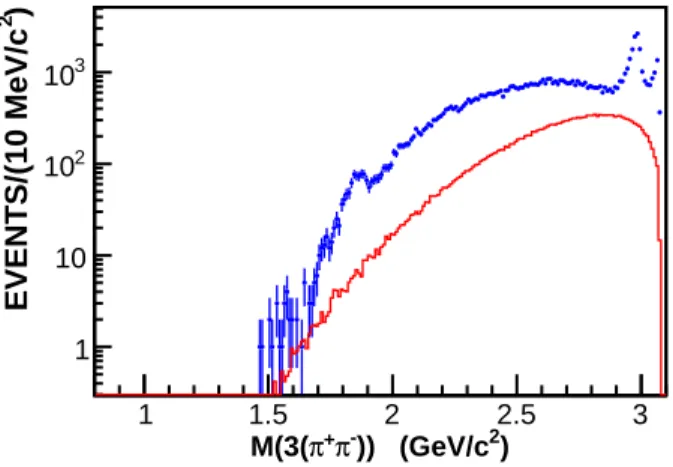
FIG. 1. Distribution of the invariant mass of 3(π+π−) from
J/ψ → γ3(π+
π−) events. The dots with error bars are data;
the histogram is phase space events with an arbitrary normal-ization.
background events with multi-photons in the final states,
183
P2
tγ = 2| ~Pmiss|2(1 − cos θmiss) is required to be less than
184
0.0004 GeV2/c2, where ~P
missis the missing momentum of
185
the six charged tracks and θmissis the angle between the
186
missing momentum and the momentum of the radiative
187
photon. To further reject backgrounds with additional
188
photons in the final state, the χ2
4Cof four-constraint
kine-189
matic fit in the hypothesis of J/ψ → γ3(π+π−) is
re-190
quired to be less than that of the γγ3(π+π−) hypothesis,
191
and the γγ invariant mass in the γγ3(π+π−) hypothesis
192
is required to be |M (γγ) − M (π0)| > 0.01 GeV/c2. To
193
suppress background events with KS → π+π− in the
194
final state, KS candidates are reconstructed from
sec-195
ondary vertex fits to all oppositely charged track pairs.
196
The invariant mass M (π+π−) must be within the range
197
|M (π+π−)−M (K
S)| < 0.005 GeV/c2, where the M (KS)
198
is the nominal KS mass [17]. The number of KS
candi-199
dates is required to be less than 2.
200
Figure1 shows the 3(π+π−) invariant mass spectrum
201
for events that survive the above selection criteria, where
202
a clear ηc peak is observed around 2.98 GeV/c2, no
evi-203
dent η′ signal is observed, and a distinct enhancement is
204
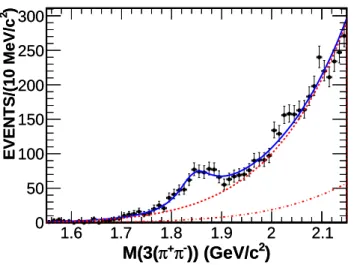
seen around 1.84 GeV/c2. In Fig. 2, the M (3(π+π−))
205
distribution is plotted in the range [1.55, 2.15] GeV/c2.
206
To investigate possible backgrounds, we use a MC
sam-207
ple of 225 million simulated J/ψ decays, in which the
208
decays with known branching fractions [17] are generated
209
by BesEvtGen [23] and unmeasured J/ψ decays by the
210
Lundcharm model [24]. With the same selection criteria,
211
we find no evident structure at 1.84 GeV/c2. The
back-212
ground resulting from other, incorrectly reconstructed
213
event topologies is mainly from J/ψ → π03(π+π−),
214
which show no structure at 1.84 GeV/c2in the 3(π+π−)
215
mass spectrum. To estimate this contribution, we
re-216
construct the J/ψ → π03(π+π−) decay from data and
217
4
)
2)) (GeV/c
-π
+π
M(3(
1.6 1.7 1.8 1.9 2 2.1 ) 2 EVENTS/(10 MeV/c 0 50 100 150 200 250 300)
2)) (GeV/c
-π
+π
M(3(
1.6 1.7 1.8 1.9 2 2.1 ) 2 EVENTS/(10 MeV/c 0 50 100 150 200 250 300FIG. 2. The fit of mass spectrum of 3(π+
π−). The dots with
error bars are data; the solid line is the fit result. The dashed line represents all the backgrounds, including the background
events from J/ψ → π0
3(π+
π−) (dash-dotted line, fixed in
the fit) and a third-order polynomial representing other back-grounds.
then re-weight the 3(π+π−) invariant mass spectrum by
218
a multiplicative weighting factor ε1/ε2, where ε1 and ε2
219
are the efficiencies for J/ψ → π03(π+π−) MC events
220
to pass J/ψ → γ3(π+π−) and J/ψ → π03(π+π−)
se-221
lection criteria, respectively. The selection criteria for
222
J/ψ → π03(π+π−) are similar to those applied to J/ψ →
223
γ3(π+π−) except for the requirement of an additional
224
photon. The background analysis shows that the
struc-225
ture at 1.84 GeV/c2in the 3(π+π−) mass spectrum does
226
not come from background events.
227
To extract the number of signal events associated with
228
the peaking structure, an unbinned maximum likelihood
229
fit is applied to the six pion mass spectrum. The fit
in-230
cludes three components: a signal shape, shapes for the
231
J/ψ → π03(π+π−) background and other backgrounds,
232
which have the same final states, but not contribute to
233
the structure around 1.84 GeV/c2. The signal shape is
234
described with a Breit-Wigner function modified by the
235
effects of the phase space factor and the detection
effi-236
ciency, which is determined by a phase-space MC
simu-237
lation of J/ψ → γ3(π+π−). The Breit-Wigner function
238
is convolved with a Gaussian function to account for the
239
detector resolution (5.1 MeV/c2, determined from MC
240
simulation). For the background shape, the contribution
241
from the J/ψ → π03(π+π−) background, which is fixed
242
in the fit and shown by the dash-dotted line in Fig.2, is
243
represented by the re-weighted 3(π+π−) invariant mass
244
spectrum, while other contributions are represented by a
245
third-order polynomial. The total background is shown
246
as the dashed line in Fig.2.
247
The fit yields 632±93 events in the peak at 1842.2±4.2
248
MeV/c2 and a width of Γ=83±14 MeV. The statistical
249
significance of the signal is determined from the change
250
in log likelihood and the change of number of degrees
251
of freedom (d.o.f) in the fit with and without the
struc-252
ture X(1840). Different possibilities have been studied by
253
varying the fit range and the background shapes and by
254
removing the phase space factor. Among all possibilities
255
the smallest statistical significance was 7.6σ
correspond-256
ing to −2∆lnL=67 and ∆d.o.f=3. With the detection
ef-257
ficiency, (11.5±0.1)%, obtained from the phase space MC
258
simulation, the product branching fraction is measured
259
to be B(J/ψ → γX(1840)) × B(X(1840) → 3(π+π−)) =
260
(2.44 ± 0.36) × 10−5, where the error is statistical only.
261
No η′ events are observed in the 3(π+π−) mass
spec-262
trum. The upper limit at the 90% confidence level is
263
2.44 events with the confidence intervals suggested in
264
Ref. [25]. The detection efficiency in the mass region
265
[0.928, 0.988] GeV/c2 is determined to be (7.8 ± 0.1)%
266
from the MC simulation. Since only the statistical error
267
is considered when we obtain the 90% upper limit of
268
the number of events, the upper limit of the number of
269
events is shifted up by one sigma of the total
system-270
atic uncertainty shown below in TableI. With the
num-271
ber of J/ψ events and the measured B(J/ψ → γη′) =
272
(5.16 ± 0.15)× 10−3[17], the upper limit of the branching
273
fraction is obtained to be B(η′ → 3(π+π−)) < 3.1×10⁻⁵.
274
Sources of systematic errors and their corresponding
275
contributions to the measurement of the branching
frac-276
tions are summarized in Table I. The uncertainties in
277
tracking and photon detection have been studied [26]
278
and the difference between data and MC is about 2%
279
per charged track and 1% per photon, which is taken as
280
the systematic error. Uncertainty associated with the 4C
281
kinematic fit comes from the inconsistency between data
282
and MC simulation of the fit; this difference is reduced by
283
correcting the track helix parameters of MC simulation,
284
as described in detail in Ref. [27]. In this analysis, we
285
take the efficiency with correction as the nominal value,
286
and take the difference between the efficiencies with and
287
without correction as the systematic uncertainty from
288
the kinematic fit. The background uncertainty is
deter-289
mined by changing the background functions and the fit
290
range. The uncertainties from the mass spectrum fit
in-291
clude contributions from the variation of the phase space
292
factor and the possible impact of other resonances (eg.
293
f2(2010)). The systematic error for the Ptγ2 selection
cri-294
terion is estimated with the sample of J/ψ → π03(π+π−)
295
by comparing the efficiency of this requirement between
296
MC and data. For the detection efficiency uncertainty
297
due to the unknown spin-parity of the structure, we use
298
the difference between phase space and a pseudoscalar
299
meson hypothesis. The uncertainties from MC statistics,
300
the branching fraction of J/ψ → γη′ [17] and the flux
301
of J/ψ events [18] are also considered. We assume all of
302
these sources are independent, and take the total
system-303
atic error to be their sum in quadrature.
304
The systematic uncertainties on mass and width are
305
5
estimated from the mass scale, background shape,
fit-306
ting range, mass spectrum fit, and possible biases due to
307
the fitting procedure. The uncertainty from the detector
308
resolution is checked by using a double Gaussian
func-309
tion as the resolution function, and the change is found
310
to be negligible. The uncertainty from the mass scale
311
is estimated by fitting the ηc resonance in M (3(π+π−))
312
spectrum. Uncertainties from the background shape and
313
fitting range are estimated by varying the functional form
314
used to represent the background and the fitting range.
315
Uncertainties from mass spectrum fit include
contribu-316
tions from the variation of the phase space factor and
317
the possible impact of other resonances (eg. f2(2010)).
318
Possible biases due to the fitting procedure are estimated
319
from differences between the input and output of the
320
mass and width values from MC studies. Adding these
321
sources in quadrature, the total systematic error on the
322
mass is+7.1−2.6MeV/c2 and on the width is ±11 MeV.
323
TABLE I. Summary of the systematic uncertainties in the branching fractions (in unit of %).
Sources X(1840) η′ MDC tracking 12 12 Photon detection 1 1 P2 tγ cut 2.0 2.0 Kinematic fit 4.3 5.1 Background uncertainty 17.1
-Mass spectrum fit +10.3−20.3
-Detection efficiency 6.1 -MC statistics 0.9 1.3 B(J/ψ → γη′) - 2.9 Number of J/ψ events 1.2 1.2 Total +24.6 −30.2 13.7
In summary, we studied the decay J/ψ → γ3(π+π−)
324
with a 225.3 million J/ψ event sample [18]
accumu-325
lated at the BESIII detector. A structure at 1.84
326
GeV/c2is observed in the 3(π+π−) mass spectrum with
327
a statistical significance of 7.6σ. Fitting the structure
328
X(1840) with a modified Breit-Wigner function yields
329
M = 1842.2 ± 4.2+7.1−2.6 MeV/c2 and Γ = 83 ± 14 ± 11
330
MeV. The product branching fraction is determined to
331
be B(J/ψ → γX(1840)) × B(X(1840) → 3(π+π−)) =
332
(2.44 ± 0.36+0.60
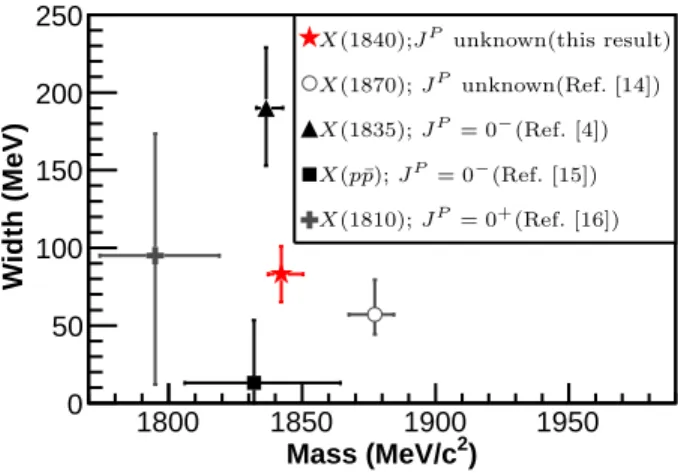
−0.74) × 10−5. The comparison to the BESIII
333
results of the masses and widths of the X(1835) [4],
334
X(p¯p) [15], X(1870) [14], and X(1810) [16] are displayed
335
in Fig.3, where the mass of X(1840) is in agreement with
336
those of X(1835) and X(p¯p), while its width is
signifi-337
cantly different from either of them. However, we do not
338
include the BESII result in Fig. 3 as a more precise study
339
of the X(1835) in BESIII [4] indicates that one must
340
consider the presence of additional resonances above 2
341
GeV/c2 that were not apparent in the BESII analysis
342
to obtain an accurate determination of the width of the
343
X(1835). Therefore, based on these data, one cannot
344 ) 2 Mass (MeV/c 1800 1850 1900 1950 Wi d th ( M e V ) 0 50 100 150 200 250 X(1840);JPunknown(this result) X(1870); JPunknown(Ref. [14]) X(1835); JP= 0−(Ref. [4]) X(p ¯p); JP= 0−(Ref. [15]) X(1810); JP= 0+ (Ref. [16])
FIG. 3. Comparisons of observations at BESIII. The error bars include statistical, systematic, and, where applicable, model uncertainties.
determine whether X(1840) is a new state or the signal
345
of a 3(π+π−) decay mode of an existing state. Further
346
study, including an amplitude analysis to determine the
347
spin and parity of the X(1840), is needed to establish
348
the relationship between different experimental
observa-349
tions in this mass region and determine the nature of the
350
underlying resonance or resonances.
351
A search for η′ → 3(π+π−) is also performed, but no
352
η′ signal is observed. The upper limit on the
branch-353
ing fraction for the decay at the 90% confidence level is
354
B(η′ → 3(π+π−)) < 3.1 × 10⁻⁵, which is improved by
355
one order of magnitude compared to the previous
meas-356
urement [28].
357
The BESIII collaboration thanks the staff of BEPCII
358
and the computing center for their strong support. This
359
work is supported in part by the Ministry of Science and
360
Technology of China under Contract No. 2009CB825200;
361
National Natural Science Foundation of China (NSFC)
362
under Contracts Nos. 10625524, 10821063, 10825524,
363
10835001, 10935007, 11125525, 11175189, 11235011;
364
Joint Funds of the National Natural Science
Founda-365
tion of China under Contracts Nos. 11079008, 11179007;
366
the Chinese Academy of Sciences (CAS) Large-Scale
367
Scientific Facility Program; CAS under Contracts Nos.
368
KJCX2-YW-N29, KJCX2-YW-N45; 100 Talents
Pro-369
gram of CAS; German Research Foundation DFG under
370
Contract No. Collaborative Research Center CRC-1044;
371
Istituto Nazionale di Fisica Nucleare, Italy; Ministry of
372
Development of Turkey under Contract No.
DPT2006K-373
120470; U. S. Department of Energy under Contracts
374
Nos. FG02-04ER41291, FG02-05ER41374,
DE-375
FG02-94ER40823; U.S. National Science Foundation;
376
University of Groningen (RuG) and the
Helmholtzzen-377
trum fuer Schwerionenforschung GmbH (GSI),
Darm-378
stadt; National Research Foundation of Korea Grant No.
379
2011-0029457 and WU Grant No. R32-10155.
380
6
[1] J. Z. Bai et al. [BES Collaboration], Phys. Rev. Lett. 91,
381
022001 (2003).
382
[2] M. Ablikim et al. [BES Collaboration], Phys. Rev. Lett.
383
95, 262001 (2005).
384
[3] M. Ablikim et al. [BES Collaboration], Phys. Rev. Lett.
385
96, 162002 (2006).
386
[4] M. Ablikim et al. [BESIII Collaboration], Phys. Rev.
387
Lett. 106, 072002 (2011).
388
[5] J. P. Alexander et al. [CLEO Collaboration], Phys. Rev.
389
D 82, 092002 (2010).
390
[6] G. J. Ding and M. L. Yan, Phys. Rev. C 72, 015208
391
(2005); G. J. Ding and M. L. Yan, Eur. Phys. J. A 28,
392
351 (2006).
393
[7] J. P. Dedonder, B. Loiseau, B. El-Bennich and
394
S. Wycech, Phys. Rev. C 80, 045207 (2009).
395
[8] C. Liu, Eur. Phys. J. C 53, 413 (2008).
396
[9] Z. G. Wang and S. L. Wan, J. Phys. G 34, 505 (2007).
397
[10] B. A. Li, Phys. Rev. D 74, 034019 (2006).
398
[11] N. Kochelev and D. P. Min, Phys. Lett. B 633, 283
399
(2006).
400
[12] T. Huang and S. L. Zhu, Phys. Rev. D 73, 014023 (2006).
401
[13] J. S. Yu, Z. F. Sun, X. Liu and Q. Zhao, Phys. Rev. D
402
83, 114007 (2011).
403
[14] M. Ablikim et al. [BESIII Collaboration], Phys. Rev.
404
Lett. 107, 182001 (2011).
405
[15] M. Ablikim et al. [BESIII Collaboration], Phys. Rev.
406
Lett. 108, 112003 (2012).
407
[16] M. Ablikim et al. [BESIII Collaboration], Phys. Rev. D
408
87, 032008 (2013).
409
[17] J. Beringer et al. [Particle Data Group Collaboration],
410
Phys. Rev. D 86, 010001 (2012).
411
[18] M. Ablikim et al. [BESIII Collaboration], Chin. Phys. C
412
36, 915 (2012).
413
[19] M. Ablikim et al. [BESIII Collaboration], Nucl. Instrum.
414
Meth. A 614, 345 (2010).
415
[20] J. Z. Bai et al. [BES Collaboration], Nucl. Instrum. Meth.
416
A 458, 627 (2001).
417
[21] S. Agostinelli et al. [GEANT4 Collaboration], Nucl.
In-418
strum. Meth. A 506, 250 (2003).
419
[22] J. Allison et al., IEEE Trans. Nucl. Sci. 53, 270 (2006).
420
[23] R. G. Ping, Chin. Phys. C 32, 599 (2008).
421
[24] J. C. Chen, G. S. Huang, X. R. Qi, D. H. Zhang and
422
Y. S. Zhu, Phys. Rev. D 62, 034003 (2000).
423
[25] G. J. Feldman and R. D. Cousins, Phys. Rev. D 57, 3873
424
(1998).
425
[26] M. Ablikim et al. [BESIII Collaboration], Phys. Rev. D
426
83, 112005 (2011).
427
[27] M. Ablikim et al. [BESIII Collaboration], Phys. Rev. D
428
87, 012002 (2013).
429
[28] P. Naik et al. [CLEO Collaboration], Phys. Rev. Lett.
430
102, 061801 (2009).
431