Why Do Students Prefer Search Engines
Over Academic Databases
Arif Selçuk Öğrenci
Faculty of Engineering and Natural Sciences Kadir Has University
Istanbul, Turkey [email protected] Abstract— Students’ preference of search engines in online
information retrieval has been a problem for several reasons. This work tries to share our experience about the reasons why they do not utilize academic databases. Past experiences, seeking convenience, and the availability of automatic translation in search engines seem to be the main reasons. Several suggestions are offered that aim to increase the level of competency of students in utilizing academic databases. Furthermore, students should also be informed adequately about the potential threats in using search engines as their only online information source.
Keywords- online information seeking behavior, search engines, academic databases, information retrieval.
I. INTRODUCTION
Not more than 30 years ago, the academic community had to visit the library by person to search for journal articles using printed citation lists. The digitization of those lists was a remarkable step that has allowed use of those lists directly from the office desk. A revolutionary step has been the introduction of web based search tools in the early nineties. Full text access to those scholarly publications including conference proceedings via Internet was considered to be the ultimate point in the mid of nineties. Publishers, libraries, and the academic community have quickly adapted themselves to the new way of information retrieval via online academic databases. However, those new web based technologies have resulted in the emergence of new publication models (open access journals), new ways of structured, collaborative information assembly systems (online forms of free encyclopedias, free scholarly databases), and less structured forum pages that are populated by their fellow contributors. The presence of search engines, above all, has allowed everybody to be able to perform a search in the Internet very quickly and conveniently. All of those abovementioned developments have changed the research and information seeking behavior of academicians and students remarkably.
A serious concern in the academic life today, is that the students use search engines as their primary (and sometimes the only!) source for online information seeking. The literature contains numerous papers that focus on this issue both from theoretical perspectives and that supply empirical evidence [1-8]. The majority of the research indicates that the students are simply seeking convenience [2-4, 7]. They are not patient and proficient enough to discover content in academic databases [5-8]. This seems to be an egg and chicken problem to identify whether the students do not learn how to use academic databases proficiently because they are not patient, or the students become impatient as they cannot find what they desire in academic databases. The quick and complete response of search engines, to even daily language queries, has favored them by students extensively. However, the results offered by search engines have some serious potential threats. The depth of the content and even the accuracy of the information
supplied may be questionable in many occasions. The rational behavior of browsing the first few items supplied by the search engine mostly limits all the students to a number of unqualified resources. There are high risks that the information presented is simply replications of a copyrighted material. Hence, the risk of plagiarism increases by utilizing search engines.
As search engines have also become a tool for supporting the pre-university education where academic databases cannot be used due to their level of complexity, students are quite familiar with search engines when they start their university education [8]. As students advance in their undergraduate study, they are exposed to more sophisticated subjects. The use of scholarly databases (supplied by a paid service or open-access) becomes essential in order to cover more depth in the subjects searched. The formalism of style in those sources also helps students to develop skills in writing academic papers. Use of search engines by students as the only source in online information retrieval, has caused serious concerns in the academic community. In the following of this work, we try to share our experiences about the reasons, and we will try to offer some suggestions for improvement.
II. CASESTUDY
All freshman students (approximately 150 students each year) at our university are required to take the 3 hours per week course “Engineering Guide and Ethics” in their first semester. This course has been devised and conducted for thirteen years by the author of this work. The course has involved several class exercises and project work that require online information retrieval by students. Some of the assignments specifically require use of search engines whereas some assignments do not necessarily mandate a specific category of resources. For example, one of the assignments is about collecting information about the milestones of the profession (major) of the student. The student is asked to prepare a short list of events or discoveries that represent major breakthroughs in the profession. For this assignment, no specific suggestion is made which resources may be utilized. Students have always chosen to make a search on popular search engines in order to gather information for this assignment. On the other hand, some assignments clearly indicated that the academic databases should be searched for information. For example, the term project is about the analysis of a case in engineering ethics. The following is an excerpt from the project description: “The group is expected to carry out research on the internet and in online journal databases about the case, collect documents from several (at least three) sources and “digest” the material!”
The university is a member of a large consortium at national level, and this consortium provides access to a large set of databases. Furthermore, the university has individual memberships to several other resources, and all of those available online resources can be reached on the web page of the Information Center, and students can access them freely 978-1-4799-0086-2/13/$31.00 ©2013 IEEE
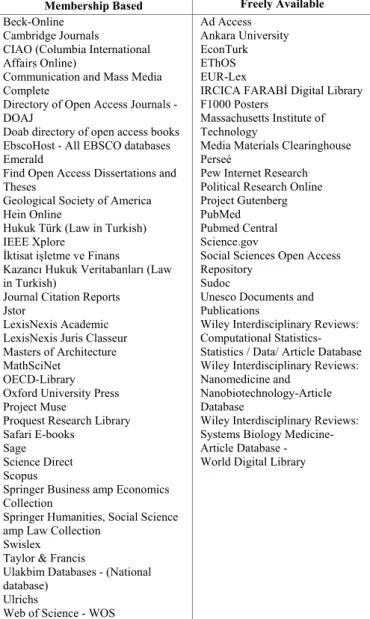
both from the campuses and from their own computers over a proxy mechanism. (The library has been renamed to “Information Center” in 2013!) The list of the available databases can be seen in Table I.
TABLE I. AVAILABLE DATABASES VIA THE INFORMATION CENTER
Membership Based Freely Available
Beck-Online Cambridge Journals
CIAO (Columbia International Affairs Online)
Communication and Mass Media Complete
Directory of Open Access Journals - DOAJ
Doab directory of open access books EbscoHost - All EBSCO databases Emerald
Find Open Access Dissertations and Theses
Geological Society of America Hein Online
Hukuk Türk (Law in Turkish) IEEE Xplore
İktisat işletme ve Finans
Kazancı Hukuk Veritabanları (Law in Turkish)
Journal Citation Reports Jstor
LexisNexis Academic LexisNexis Juris Classeur Masters of Architecture MathSciNet
OECD-Library Oxford University Press Project Muse
Proquest Research Library Safari E-books
Sage Science Direct Scopus
Springer Business amp Economics Collection
Springer Humanities, Social Science amp Law Collection
Swislex Taylor & Francis
Ulakbim Databases - (National database)
Ulrichs
Web of Science - WOS
Ad Access Ankara University EconTurk EThOS EUR-Lex
IRCICA FARABİ Digital Library F1000 Posters
Massachusetts Institute of Technology
Media Materials Clearinghouse Perseé
Pew Internet Research Political Research Online Project Gutenberg PubMed Pubmed Central Science.gov
Social Sciences Open Access Repository
Sudoc
Unesco Documents and Publications
Wiley Interdisciplinary Reviews: Computational Statistics-Statistics / Data/ Article Database Wiley Interdisciplinary Reviews: Nanomedicine and
Nanobiotechnology-Article Database
Wiley Interdisciplinary Reviews: Systems Biology Medicine-Article Database - World Digital Library
All students are given a short (45 minutes) introduction to the facilities of the Information Center during the “orientation” days prior to the start of the academic year. However, there is certainly a need for guidance about the use of those online resources to be supplied to the students since the students are not familiar with them. The students also need to be informed about the potential risks of using search engines as their only source. For this purpose, a demonstration is carried out to display the comparison of different resource usage in their search for information for the last 4 years. One of the standard cases in engineering ethics is chosen for the demonstration: The case of three engineers worked in BART (Bay Area Rapid Transport). The case is searched with the same keywords in three different environments:
Google (the almost standard search engine of students)
Google Scholar (which can be used as a portal to many databases)
Academic databases of the university (specifically Science Direct and IEEE Xplore have been selected as the sources to be searched.)
The searches in the demonstration are carried out live so that students can also participate using their own computing devices. The search keywords are selected to be “engineering ethics AND BART case.” The searches are sorted according to “relevance.” The results of the searches are compared and discussed. The summary of the search results for the current year are given in Table II.
TABLE II. RESULTS OF THE SEARCH ON DIFFERENT SOURCES
Number of Pages / Documents Found Google Google Scholar IEEE Xplore Science Direct Total 2.390.000 9.000 8 190 Displayed on “first” page 10 10 8 25 Directly relevant to the topic (on first page) 7 (3 of them are links to other sites) 10 8 4 (the first 4 articles) Copy of material from another source 3 out the 7 - (9 of them are links to copyrighted material that can be accessed via the academic databases!) - -
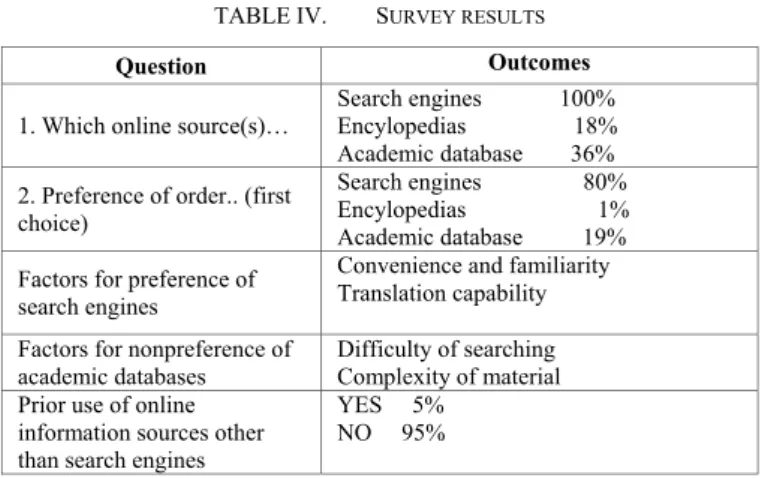
The demonstration aims to convince the students that academic databases (or Google Scholar as a starting point) should be used for proper information retrieval. However, they prefer search engines while they seek information online. This behavior seemed to have only changed if they were forced to use the academic databases where they had to supply the references. As this stereotype continued for many years where the students could not be convinced about the merits of using academic databases, they have been surveyed about the reasons of this behavior in a formal manner. The survey has been carried out in two consecutive years using an online survey tool where responses are kept anonymous. A total of 248 students have supplied a response. The questions of the survey are given in Table III, and the results are as follows (summarized in Table IV).
Most of the findings of previous research are supported: The students seek convenience. Search engines provide a “very easy” way of retrieving information. An important result seems to be that a majority of students (more than 60%) find it difficult and complex to carry out a search in academic databases. The majority also supports the belief that the articles found in academic databases are “too difficult” to understand.
The students have developed a sense of fear towards academic databases. It has to be mentioned that use of English (students are native speakers of Turkish) as the language does not play an essential role as the documents found in search engines are also in English. However, students are “extremely happy” with the possibility of automatic translation of search engines even though they also admit that the translation is mostly useless in private communication! Last but not least, over 95% of students reveal the fact that they had only used search engines in their previous K-12 education. It has been their first meeting with a structured online database, and they are not willing to use it as they are not familiar with this concept.
TABLE III. SURVEY QUESTIONS
Question Number-Type
Question
1. Multiple selection
Which online source(s) did you use in your search for information about the term project?
{Search engines, encylopedias, academic database} 2. Ordering
What is your preference of order in utilizing online sources?
{Search engines, encylopedias, academic database} 3. Open ended What are the factors that affect your preference for the first choice? 4. Open ended What are the factors that affect your nonpreference for other choices? 5. Yes/no
Did you utilize any structured online information sources other than search engines in your prior studies at high school?
In order to verify the “honesty” of the responses, the references supplied in term project papers are also checked. Interestingly, only 14% of the reports contained a reference that should have been accessed via the academic databases. The rest of the reports include references that are simply publicly available web pages. Hence, the usage data of 36% seems to be exaggerated for the academic databases.
TABLE IV. SURVEY RESULTS
Question Outcomes
1. Which online source(s)…
Search engines 100% Encylopedias 18% Academic database 36% 2. Preference of order.. (first
choice)
Search engines 80% Encylopedias 1% Academic database 19% Factors for preference of
search engines
Convenience and familiarity Translation capability Factors for nonpreference of
academic databases
Difficulty of searching Complexity of material Prior use of online
information sources other than search engines
YES 5% NO 95%
III. CONCLUSION
In order to invoke an adequate level of willingness, and achieve proficiency in use of academic databases, students have to be given special training by experts. Students have to be taught how to use them efficiently so that they overcome the fear. Furthermore, those academic databases should offer services for automatic translation of material which is a very
difficult issue to achieve satisfactorily. A less costly improvement may be the use of more efficient text search methods. Last but not least, libraries (and publishers) have to provide user interfaces that attract the new generation of students by convenience and usability. Use of portal structures that allow search on several databases concurrently would also increase the attractive of academic databases.
REFERENCES
[1] J.R. Griffiths and P. Brophy, “Student searching behavior and the web: use of academic resources and Google,” Library Trends, vol. 53, pp. 539-550, 2005.
[2] A. Weiler, “Information-seeking behavior in generation y students: motivation, critical thinking, and learning theory,” The Journal of Academic Librarianship, vol. 31, pp. 46–53, 2005.
[3] T. Cothran, “Google Scholar acceptance and use among graduate students: a quantitative study,” Library & Information Science Research, vol. 33, pp. 293–301, 2011.
[4] L.S. Connaway, T.J. Dickey, and M.L. Radford, ““If it is too inconvenient I'm not going after it:” Convenience as a critical factor in information-seeking behaviors,” Library & Information Science Research, vol. 33, pp. 179–190, 2011.
[5] D. He, D. Wu, Z. Yue, A. Fu, and K.T. Vo, “Undergraduate students’ interaction with online information resources in their academic tasks, A comparative study,” Aslib Proceedings: New Information Perspectives, vol. 64, pp. 615-640, 2012.
[6] M. Wu and S. Chen, “How graduate students perceive, use, and manage electronic resources,” Aslib Proceedings: New Information Perspectives, vol. 64, pp. 641-652, 2012.
[7] M. Colon-Aguirre and R.A. Fleming-May, ““You just type in what you are looking for”: undergraduates' use of library resources vs. Wikipedia,” The Journal of Academic Librarianship, vol. 38, pp. 391–399, 2012. [8] S.E. Ebersole, “On their own: students’ academic use of
the commercialized web,” Library Trends, vol. 53, pp. 530-539, 2005.