PDF ISSN: 1528-2635
ACADEMY OF ACCOUNTING AND
FINANCIAL STUDIES JOURNAL
Mahmut Yardimcioglu, Karamanoglu Mehmetbey University Accounting Editor
Denise Woodbury, Southern Utah University (Deceased) Finance Editor
Academy Information
is published on the Allied Academies web page www.alliedacademies.org
The Academy of Accounting and Financial Studies Journal is owned and published by the DreamCatchers Group, LLC, and printed by Whitney Press, Inc. Editorial content is under the control of the Allied Academies, Inc., a non-profit association of scholars, whose purpose is to support and encourage research and the sharing and exchange of ideas and insights throughout the world.
W
hitney Press, Inc. Printed by Whitney Press, Inc. PO Box 1876, Skyland, NC 28776 www.whitneypress.comNeither the DreamCatchers Group or Allied Academies is responsible for the content of the individual manuscripts. Any omissions or errors are the sole responsibility of the authors. The Editorial Board is responsible for the selection of manuscripts for publication from among those submitted for consideration. The Publishers accept final manuscripts in digital form and make adjustments solely for the purposes of pagination and organization.
The Academy of Accounting and Financial Studies Journal is owned and published by the DreamCatchers Group, LLC, 51 Blake Drive, Arden, Arden, NC 28704. Those interested in subscribing to the Journal, advertising in the Journal, submitting manuscripts to the Journal, or otherwise communicating with the Journal, should contact the Executive Director at [email protected].
Academy of Accounting and Financial Studies Journal Accounting Editorial Review Board Members
Agu Ananaba
Atlanta Metropolitan College Atlanta, Georgia
Richard Fern
Eastern Kentucky University Richmond, Kentucky Manoj Anand
Indian Institute of Management Pigdamber, Rau, India
Peter Frischmann Idaho State University Pocatello, Idaho Ali Azad
United Arab Emirates University United Arab Emirates
Farrell Gean
Pepperdine University Malibu, California D'Arcy Becker
University of Wisconsin - Eau Claire Eau Claire, Wisconsin
Luis Gillman Aerospeed
Johannesburg, South Africa Jan Bell
California State University, Northridge Northridge, California
Richard B. Griffin
The University of Tennessee at Martin Martin, Tennessee
Linda Bressler
University of Houston-Downtown Houston, Texas
Marek Gruszczynski Warsaw School of Economics Warsaw, Poland
Jim Bush
Middle Tennessee State University Murfreesboro, Tennessee
Morsheda Hassan
Grambling State University Grambling, Louisiana Douglass Cagwin
Lander University
Greenwood, South Carolina
Richard T. Henage Utah Valley State College Orem, Utah
Richard A.L. Caldarola Troy State University Atlanta, Georgia
Rodger Holland
Georgia College & State University Milledgeville, Georgia
Eugene Calvasina
Southern University and A & M College Baton Rouge, Louisiana
Kathy Hsu
University of Louisiana at Lafayette Lafayette, Louisiana
Darla F. Chisholm
Sam Houston State University Huntsville, Texas
Shaio Yan Huang Feng Chia University China
Askar Choudhury Illinois State University Normal, Illinois
Robyn Hulsart
Ohio Dominican University Columbus, Ohio
Natalie Tatiana Churyk Northern Illinois University DeKalb, Illinois
Evelyn C. Hume Longwood University Farmville, Virginia Prakash Dheeriya
California State University-Dominguez Hills Dominguez Hills, California
Terrance Jalbert
University of Hawaii at Hilo Hilo, Hawaii
Rafik Z. Elias
California State University, Los Angeles Los Angeles, California
Marianne James
California State University, Los Angeles Los Angeles, California
Academy of Accounting and Financial Studies Journal Accounting Editorial Review Board Members
Jongdae Jin
University of Maryland-Eastern Shore Princess Anne, Maryland
Ida Robinson-Backmon University of Baltimore Baltimore, Maryland Ravi Kamath
Cleveland State University Cleveland, Ohio
P.N. Saksena
Indiana University South Bend South Bend, Indiana
Marla Kraut University of Idaho Moscow, Idaho
Martha Sale
Sam Houston State University Huntsville, Texas
Jayesh Kumar
Xavier Institute of Management Bhubaneswar, India
Milind Sathye University of Canberra Canberra, Australia Brian Lee
Indiana University Kokomo Kokomo, Indiana
Junaid M.Shaikh
Curtin University of Technology Malaysia
Harold Little
Western Kentucky University Bowling Green, Kentucky
Ron Stunda
Birmingham-Southern College Birmingham, Alabama C. Angela Letourneau
Winthrop University Rock Hill, South Carolina
Darshan Wadhwa
University of Houston-Downtown Houston, Texas
Treba Marsh
Stephen F. Austin State University Nacogdoches, Texas
Dan Ward
University of Louisiana at Lafayette Lafayette, Louisiana
Richard Mason
University of Nevada, Reno Reno, Nevada
Suzanne Pinac Ward
University of Louisiana at Lafayette Lafayette, Louisiana
Richard Mautz
North Carolina A&T State University Greensboro, North Carolina
Michael Watters
Henderson State University Arkadelphia, Arkansas Rasheed Mblakpo
Lagos State University Lagos, Nigeria
Clark M. Wheatley
Florida International University Miami, Florida
Nancy Meade
Seattle Pacific University Seattle, Washington
Barry H. Williams King’s College
Wilkes-Barre, Pennsylvania Thomas Pressly
Indiana University of Pennsylvania Indiana, Pennsylvania
Carl N. Wright Virginia State University Petersburg, Virginia Hema Rao
SUNY-Oswego Oswego, New York
Academy of Accounting and Financial Studies Journal Finance Editorial Review Board Members
Confidence W. Amadi Florida A&M University Tallahassee, Florida
Ravi Kamath
Cleveland State University Cleveland, Ohio Roger J. Best
Central Missouri State University Warrensburg, Missouri
Jayesh Kumar
Indira Gandhi Institute of Development Research India
Donald J. Brown
Sam Houston State University Huntsville, Texas
William Laing Anderson College Anderson, South Carolina Richard A.L. Caldarola
Troy State University Atlanta, Georgia
Helen Lange Macquarie University North Ryde, Australia Darla F. Chisholm
Sam Houston State University Huntsville, Texas
Malek Lashgari University of Hartford West Hartford, Connetticut Askar Choudhury
Illinois State University Normal, Illinois
Patricia Lobingier George Mason University Fairfax, Virginia Prakash Dheeriya
California State University-Dominguez Hills Dominguez Hills, California
Ming-Ming Lai Multimedia University Malaysia Martine Duchatelet Barry University Miami, Florida Steve Moss
Georgia Southern University Statesboro, Georgia Stephen T. Evans
Southern Utah University Cedar City, Utah
Christopher Ngassam Virginia State University Petersburg, Virginia William Forbes
University of Glasgow Glasgow, Scotland
Bin Peng
Nanjing University of Science and Technology Nanjing, P.R.China
Robert Graber
University of Arkansas - Monticello Monticello, Arkansas
Hema Rao SUNY-Oswego Oswego, New York John D. Groesbeck
Southern Utah University Cedar City, Utah
Milind Sathye University of Canberra Canberra, Australia Marek Gruszczynski
Warsaw School of Economics Warsaw, Poland
Daniel L. Tompkins Niagara University Niagara, New York Mahmoud Haj
Grambling State University Grambling, Louisiana
Randall Valentine University of Montevallo Pelham, Alabama Mohammed Ashraful Haque
Texas A&M University-Texarkana Texarkana, Texas
Marsha Weber
Minnesota State University Moorhead Moorhead, Minnesota
Terrance Jalbert
University of Hawaii at Hilo Hilo, Hawaii
ACADEMY OF ACCOUNTING AND
FINANCIAL STUDIES JOURNAL
CONTENTS
Accounting Editorial Review Board Members . . . iii
Finance Editorial Review Board Members . . . v
LETTER FROM THE EDITORS . . . viii
LETTER FROM ALLIED ACADEMIES . . . ix
THE EFFECTS OF UNDERWRITER REPUTATION ON PRE-IPO EARNINGS MANAGEMENT AND POST-IPO OPERATING PERFORMANCE . . . 1
Yong Sun, Southwestern University of Finance and Economics, China Kyung Joo Lee, University of Maryland-Eastern Shore Diane Li, University of Maryland-Eastern Shore John Jongdae Jin, California State University-San Bernardino ASSESSMENT OF INTERNAL AUDITING BY AUDIT COMMITTEES . . . 19
Arnold Schneider, Georgia Institute of Technology THE QUALITY LEVEL OF CORPORATE ANNUAL REPORT AND COST OF CAPITAL: EVIDENCE FROM JAPANESE FIRMS . . . 27
Kosal Ly, Waseda University SMALL FIRM GOVERNANCE AND ANALYST FOLLOWING . . . 47 Rich Fortin, New Mexico State University
MANAGEMENT USE OF IMAGE RESTORATION STRATEGIES TO ADDRESS SOX 404
MATERIAL WEAKNESS . . . 59 Sheri Erickson, Minnesota State University Moorhead
Marsha Weber, Minnesota State University Moorhead Joann Segovia, Minnesota State University Moorhead Donna Dudney, University of Nebraska Lincoln THE IMPACT OF THE SARBANES-OXLEY ACT
ON PRIVATE DEBT CONTRACTING . . . 83 Sangshin (Sam) Pae, Arkansas State University
RISK PREDICTION CAPABILITIES OF P/E
DURING MARKET DOWNTURNS . . . 107 Victor Bahhouth, University of North Carolina - Pembroke
Ramin Cooper Maysami, University of North Carolina - Pembroke AUDIT PARTNERS’ INDIVIDUAL RISK PREFERENCES
IN CLIENT RETENTION DECISIONS . . . 115 George F. Klersey, University of Colorado Denver
LETTER FROM THE EDITORS
Welcome to the Academy of Accounting and Financial Studies Journal. The editorial content of this journal is under the control of the Allied Academies, Inc., a non profit association of scholars whose purpose is to encourage and support the advancement and exchange of knowledge, understanding and teaching throughout the world. The mission of the AAFSJ is to publish theoretical and empirical research which can advance the literatures of accountancy and finance.
Dr. Mahmut Yardimcioglu, Karamanoglu Mehmetbey University, is the Accountancy Editor and Dr. Denise Woodbury (Deceased), Southern Utah University, was the Finance Editor. Their joint mission is to make the AAFSJ better known and more widely read.
As has been the case with the previous issues of the AAFSJ, the articles contained in this volume have been double blind refereed. The acceptance rate for manuscripts in this issue, 25%, conforms to our editorial policies.
The Editors work to foster a supportive, mentoring effort on the part of the referees which will result in encouraging and supporting writers. They will continue to welcome different viewpoints because in differences we find learning; in differences we develop understanding; in differences we gain knowledge and in differences we develop the discipline into a more comprehensive, less esoteric, and dynamic metier.
Information about the Allied Academies, the AAFSJ, and our other journals is published on our web site. In addition, we keep the web site updated with the latest activities of the organization. Please visit our site and know that we welcome hearing from you at any time.
Mahmut Yardimcioglu, Karamanoglu Mehmetbey University Accounting Editor Denise Woodbury, Southern Utah University (Deceased) Finance Editor www.alliedacademies.org
LETTER FROM ALLIED ACADEMIES
It is with the greatest sadness that we inform you of the death of Dr. Denise Woodbury on May 2, 2010. She has been a tremendous force in the Allied Academies’ organization and she has been a true friend of the Carlands for many years. She has been a member since 1997 and has served us in many ways. She will be truly missed; yet she leaves a wonderful legacy of caring and hope for all who knew her.
The Carlands have set up a scholarship fund for Denise through the Carland Foundation for Learning at the website at www.CarlandFoundation.org You are welcome to make a contribution in her memory at that site or to send a check to Carland Foundation for Learning at PO Box 914, Skyland, NC 28776.
Denise will be missed and long remembered by all.
Jim and JoAnn Carland Trey and Shelby Carland Jason Carland
THE EFFECTS OF UNDERWRITER REPUTATION ON
PRE-IPO EARNINGS MANAGEMENT AND
POST-IPO OPERATING PERFORMANCE
Yong Sun, Southwestern University of Finance and Economics, China
Kyung Joo Lee, University of Maryland-Eastern Shore
Diane Li, University of Maryland-Eastern Shore
John Jongdae Jin, California State University-San Bernardino
ABSTRACT
The purpose of this study is to investigate whether underwriters play any systematic and significant role for IPO issuers. More specifically, we hypothesize that there is a negative relation between underwriter reputation and earnings management before an IPO (certification role) and that there is a positive relation between underwriter reputation and firm operating performance after an IPO (monitoring role). Using a sample of 369 IPO’s over six-year period (1997-2002), we find that high-reputation underwriters are associated with less earnings management before an IPO. We also find that IPO issuers with high-reputation underwriters exhibit better post-IPO operating performance after controlling for pre-IPO earnings management. These results support our hypotheses, and are robust across different measures of variables and testing methodologies, including an instrumental variable two-stage least square 2SLS) regression and a weighted least square (WLS) regression.
INTRODUCTION
The information asymmetries between IPO issuers and outside investors are considerable. Under this condition, IPO issuers may seek to increase their offering proceeds through manipulations of reportable earnings before going public. A stream of prior studies shows that IPO issuers employ opportunistic earnings management before issuing IPOs to obtain some gains, including enhancing initial firm values (e.g. Schipper 1989; Chaney and Lewis 1995; Teoh et al. 1998a, 1998b; Ducharme et al. 2001). For example, Teoh et al. (1998b) find evidence that IPO firms, on average, have high positive issue-year earnings and discretionary accruals, followed by poor long-run earnings and negative discretionary accruals.
However, prior studies on IPO earnings management have largely overlooked the potential roles played by underwriters. Ducharme et al. (2001) include both underwriter reputation and discretionary accruals as explanatory variables of IPO initial firm value, but they have not examined
the relation between underwriter reputation and IPO accruals. Related studies on seasoned equity offerings have found the evidence of a negative relation between auditor quality and earnings management (Zhou and Elders 2004), and an inverse relation between underwriter quality and issuers’ accruals (Jo, Kim, and Park 2007).
The purpose of this study is twofold. The first purpose is to document the relation between underwriter reputation and IPO earnings management. We argue that the certification role played by IPO underwriters has a restraining effect on opportunistic earnings management by IPO issuers. The second purpose is to examine a related issue that has not yet been studied in the literature, namely, the relation between underwriter reputation and post-issue operating performance of IPO firms given the presence of earnings management. We argue that underwriters have strong incentives to continue supplying monitoring to the firms they take public such that underwriter reputation is positively related to post-issue operating performance of IPO firms, even after the initial earnings management is taken into consideration.
Using a sample of 369 IPO issuers between 1997 and 2002, we find empirical results supporting our hypotheses. The results show that IPOs underwritten by high-reputation underwriters have less initial discretionary accruals. We also find that post-issue operating performance of IPO issuers are positively related to underwriter reputation. These results suggest that the certification and monitoring roles by underwriters not only restrain opportunistic earnings management, but also enhance post-IPO operating performance of the issuers.
The remainder of this paper is organized as follows. In the next section, we review previous literature and develop hypotheses based on the argument of the certification and monitoring roles played by underwriters. Sample selection and measurement of variables are described in section three. The empirical results are presented in section four. Our conclusions appear in final section.
HYPOTHESIS DEVELOPMENT Underwriter certification and pre-IPO earnings management
Investment bankers play many roles in the underwriting of security issues including production and certification of information, provision of interim capital, and/or supplying distribution and marketing skills. Certification requires the underwriters to bear the liability imposed by the Securities Act of 1933 for ensuring the fairness of the offer price. The role of underwriter certification in reducing information asymmetries and mitigating the adverse selection faced by outside investors has been extensively studied in the context of IPOs.
In a typical model, in return for fees from the issuing firms, investment bankers produce and certify information about the firms that they underwrite. High-prestige investment bankers can have more stringent standards for certification of IPO firm value and can produce superior information about the firms that they underwrite. IPO issuers can signal favorable private information about their own values by choosing reputable underwriters. On the other hand, investors use an investment
banker’s reputation to revise their estimates of issuing-firm value. Thus, high-reputation investment bankers will represent less risky and higher-quality IPOs, and the use of a high-reputation underwriter is a positive signal about IPO firm value.
Since investment bankers are frequent participants in the equity market, they acquire reputation capital that enables them to act as credible certifiers of information. Chemmanur and Fulghieri (1994) find that high-prestige investment bankers, with valuable reputation capital at risk and superior information regarding the issuing firm’s prospects, can credibly certify the value of the issues they underwrite.
The certification role of the underwriter has been investigated more specifically in papers that have examined the relationship between underwriter reputation and IPO underpricing. In general these studies argue that high-prestige underwriters are able to more fully price issues, reducing the level of underpricing. For example, Logue (1973), Beatty and Ritter (1986), Titman and Trueman (1986), Carter and Manaster (1990), and Carter, Dark, and Singh (1998) find that IPOs managed by more reputable underwriters are associated with less short-run underpricing. The empirical consensus is that IPO underwriters have performed their certification role in general, driven by the desire to protect their hard earned reputation capital.
Managers exercise some discretion in computing earnings without violating generally accepted accounting principles. It is possible that firms use discretionary accounting choices to manage earnings disclosures around the time of certain types of events. In view of the well-established correlation between earnings and share prices, earnings management activity seems particularly plausible around the time of unseasoned stock issues. According to this opportunism hypothesis, some firms opportunistically manipulate earnings upward before going public and investors are led to make overly optimistic expectations regarding future earnings of the issuers. Thus, issuing firms would be able to obtain a higher share price for their stock issue than they otherwise would. This view of IPO earnings management emphasizes the incentives that entrepreneurs, venture capitalists, and managers have to maximize issue proceeds, given the number of shares offered.
A priori, the opportunistic earnings management of IPO issuers and the certification of underwriters appear at odd with each other. If high levels of abnormal accruals reflect deceptive accounting, we expect the related IPOs to be shunned by investment bankers that have significant reputation capital at stake.1 Thus, we expect a negative relation between underwriter reputation and IPO earnings management. That is, when high-reputation underwriters are involved, IPO issuers become voluntarily or involuntarily less aggressive with earnings management. IPO issuers with minimal incentives for earnings management would select high-reputation underwriters to enhance underwriter certification, thereby signaling favorable information to outside investors. Our hypothesis is consistent with the implications of the results of Zhou and Elders (2004) and Jo, Kim, and Park (2007) on seasoned equity offerings.
The negative relation between underwriter reputation and earnings management can also be inferred from the underwriter’s monitoring function. Block and Hoff (1999) suggest that
underwriters conduct due-diligence investigations to ensure proper information disclosure by issuers and prevent potential legal liabilities. High-reputation underwriters have more resources and more expertise and are therefore more likely to perform higher-quality monitoring in the underwriting process. Thus, high-reputation underwriters are less likely associated with aggressive IPO earnings management. These arguments lead to the following hypothesis:
Hypothesis 1: There is a negative relation between underwriter reputation and the issuer’s earnings management before an IPO.
Underwriter monitoring and post-IPO operating performance
The certification role of underwriters ends at the IPO, but the monitoring function continues in the post-IPO period (Stoughton and Zechner (1998) and Jain and Kini (1999)). In general, when new securities are issued, issuing firms carefully examine the investment bankers’ track record as part of their lead underwriter selection process. Apart from factors such as pricing and marketing, issuers look to other performance areas such as post-issue price stability, market-making, analyst-coverage, and the ability to underwrite subsequent offerings or conclude corporate restructuring activities. Given the lucrative future opportunities, IPO underwriters have strong incentives to remain engaged in the affairs of the firms they take public and to ensure that managers are following value enhancing strategies. Thus, monitoring by underwriters has the potential to improve post-IPO operating performance.
Prior studies suggest that investment bankers play a valuable monitoring function in ensuring managers to follow a value maximizing path. For example, Easterbrook (1984) suggests that when a firm issues new securities its activities are scrutinized by an investment banker or some similar intermediary acting as a monitor for the collective interests of investors of the new securities. Hansen and Torregrosa (1992) suggest that underwriter monitoring improves the issuing firm’s performance and reduces agency costs, thereby enhancing firm value. Stoughton and Zechner (1998) argue that given the active and continuing nature of the relationship between investment bankers and institutional investors, they work together in monitoring the affairs of IPO firms. More specifically, Jain and Kini (1999) find that underwriter monitoring is positively related to post-IPO operating and investment performance.
High-prestige underwriters, given their considerable resources, are more likely to supply long-term monitoring in order to continue the business relationships with their clients. Jain and Kini (1999) find that about 75% of lead underwriters assign at least one analyst to track the company they take public. In addition, the presence of institutional investors in the new issues market also promote underwriter monitoring. As implied in Stoughton and Zechner (1998), given the active and continuing nature of the relationship between investment bankers and institutional investors, high-prestige underwriters have strong incentives to work with the institutional investment community in monitoring the affairs of IPO issuers. Thus, high-reputation underwriters are more likely
associated with improvements in post-issue operating performance. These arguments lead to our second hypothesis.
Hypothesis 2: There is a positive relation between underwriter reputation and the issuer’s operating performance after an IPO.
SAMPLE SELECTION AND DATA Sample selection
Our initial sample of IPO issuers is obtained from the IPO database of Hoovers Incorporated. The sample period is from April 1996 to December 2004. Several selection criteria are applied sequentially. First, financial institutions and utility firms are excluded. Also, the sample excludes ADRs, firms with offer price less than one dollar and firms with offer size less than one million dollars. Finally, relevant data availability in COMPUSTAT data files over the period of six years surrounding each IPO (i.e., t= [-2,.0,..3]) is required. These selection criteria yield the final sample of 369 IPO issuers.
Information regarding reputation of the IPO underwriters is based on the reputation rankings of Carter and Manaster (1990), and updated according to the information on the website of Jay Ritter. We further classify the underwriters into three groups.2 If an underwriter’s reputation rank is greater than or equal to 9.0, the underwriter is in the high-reputation group; if the reputation rank is between 7.1 and 8.1, the underwriter is in the medium-reputation group; and if the reputation rank is less than or equal to 7.0, the underwriter is in the low-reputation group. There are 196 IPOs in the high-reputation group, 136 in the medium-reputation group, and 37 in the low-reputation group.
Table 1 provides distribution of IPOs by calendar year and underwriter reputation. Two points are worth noting from Table 1. First, almost a half of total IPOs occurred during the bubble period (1999-2000). Second, more than half of sample firms employ high-reputation underwriters. There are only 37 firms (10%) with low-reputation underwriters. Although not shown in table, our sample represents 40 industries (2-digit SIC). However, as typical in IPOs, sample firms are highly concentrated in a few industries, such as computer hardware and software (39.3%) and chemical products (10.8%).
Table 1: IPO Distribution by Year and Underwriter Reputation
Year
All
Underwriter Reputation 1,2
High Medium Low
N % N % N % N % 1997 69 18.70 20 28.99 42 60.87 7 10.14 1998 56 15.18 30 53.57 15 26.79 11 19.64 1999 56 15.18 36 64.29 13 23.21 7 12.50 2000 123 33.33 77 62.60 38 30.89 8 6.50 2001 36 9.76 18 50.00 16 44.44 2 5.56 2002 29 7.86 15 51.72 12 41.38 2 6.90 Total 369 100 196 53.12 136 36.86 37 10.03
1 Underwriter reputation is based on the rankings of Carter and Manaster (1990), and updated according to
the information in Jay Ritter’s website.
2 Underwriters are classified into three groups: high-reputation, if the ranking is greater than or equal to 9; medium-reputation, if ranking is between 7.1 and 8.1; low-reputation, if ranking is less than or equal to 7.
Measurement of Variables Earnings Management
The proxy for earnings management is measured by discretionary accruals, which are obtained relative to expected benchmark accruals (nondiscretionary accruals) based on firm and industry characteristics. We use cross-sectional modified Jones model to estimate discretionary accruals of each IPO firm (Jones, 1991; Dechow et al., 1995; Teoh et al., 1998a).3
For each IPO firm, we find at least ten industry-matched firms with the same three-digit SIC code. If we are unable to find ten industry-matched firms with the same three-digit SIC code, we use industry-matched firms with the same two-digit SIC code. For each IPO firm j, we run the following cross-sectional regression model:
TACiy/TAiy-1 = "0j[1/ TAiy-1]+ "1j[()REViy - )RECiy)/ TAiy-1]+ "2j[PPEiy/ Taiy-1]+,iy (1) where,
TACiy = total accruals (net income before extraordinary items minus cash flow from operations) in year y for the ith firm in the industry group matched with offering firm j.
TAiy = total assets in year y for the ith firm in the industry group matched with offering firm j.
)REViy =change in revenues in year y for the ith firm in the industry group matched with offering firm j.
)RECiy = change in accounts receivable in year y for the ith firm in the industry group matched with offering firm j.
PPEiy = gross property, plant, and equipment in year y for the ith firm in the industry group matched with offering firm j.
Using estimated coefficients from regression model (1), discretionary accruals (DAC) for the issuing firm j in year y are then estimated by subtracting nondiscretionary accruals (NAC) from total accruals (TAC) as follows:
DACjy = TACjy - NACjy
= [TACjy/TAjy-1] - "0j[1/ TAjy-1]- "1j[()REVjy - )RECjy)/ TAjy-1]- "2j[PPEjy/ TAjy-1] Post-IPO Operating Performance
Post-IPO operating performance was measured by industry-adjusted operating return on assets (OROA), which is defined as operating income before taxes and depreciation divided by total assets.4 Three years data (t=[1,2,3]) after IPO are averaged to obtain the measure.5 To get
industry-adjusted OROA, we subtract from each firm’s raw OROA the median of a group of firms with
matched 3-digit SIC code. If there were insufficient firms (less than 10) in the industry, we use 2-digit SIC to find the matched companies.
Other Variables
Issuer age (AGE): company age from initial founding to IPO years. Offer size (OS): offer price x number of shares offering.
Sales growth (SG): percentage change in sales up to the year prior to IPO.
Pre-IPO operating performance (PREOP): operating performance in the year before IPO (t=-1).
Standard deviation of stock returns (SD): standard deviation of daily returns from day 6 to day 255
after IPO.
Leverage ratio (LEV): debt to equity ratio in year t-1, as measured by the ratio of book value of
equity to total asset.
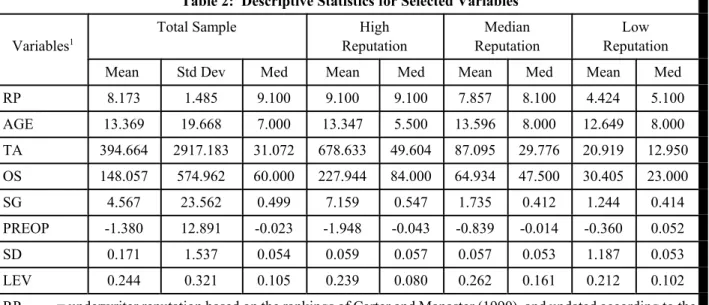
Table 2 presents descriptive statistics for selected variables. Mean and median values of these variables are reported for each underwriter reputation group as well as for total sample. On average, the issuers are 13 years old since their founding, have about $395 million in total assets, are offering $148million, and show 24.4% of leverage ratio.
More importantly, sample firms exhibit some differences in their characteristics. First of all, issuers employing high-reputation underwriters are larger in size, as measured by both total assets and offer sizes, than those with medium and low-reputation underwriters. Also, high-reputation underwriters are more (less) likely to underwrite firms with higher sales growth (operating performance before IPO). However, there are no differences in AGE, SD and LEV among underwriter reputation groups.
Table 2: Descriptive Statistics for Selected Variables
Variables1
Total Sample High
Reputation
Median Reputation
Low Reputation
Mean Std Dev Med Mean Med Mean Med Mean Med
RP 8.173 1.485 9.100 9.100 9.100 7.857 8.100 4.424 5.100 AGE 13.369 19.668 7.000 13.347 5.500 13.596 8.000 12.649 8.000 TA 394.664 2917.183 31.072 678.633 49.604 87.095 29.776 20.919 12.950 OS 148.057 574.962 60.000 227.944 84.000 64.934 47.500 30.405 23.000 SG 4.567 23.562 0.499 7.159 0.547 1.735 0.412 1.244 0.414 PREOP -1.380 12.891 -0.023 -1.948 -0.043 -0.839 -0.014 -0.360 0.052 SD 0.171 1.537 0.054 0.059 0.057 0.057 0.053 1.187 0.053 LEV 0.244 0.321 0.105 0.239 0.080 0.262 0.161 0.212 0.102
RP = underwriter reputation based on the rankings of Carter and Manaster (1990), and updated according to the information in Jay Ritter’s website.
AGE = age of IPO firms (years).
TA = total assets ($ Million) in year t-1.
OS = offer size ($ Million); natural logarithm of OS is used in regression analyses.
SG = sales growth in year t-1.
PREOP = operating performance as measured by the industry-adjusted operating return on assets (operating income before taxes and depreciation divided by total assets) in the year before IPO (t=-1).
SD = standard deviation of daily returns from day 6 to day 255 after IPO.
EMPIRICAL RESULTS
IPO earnings management and underwriter certification: Hypothesis 1
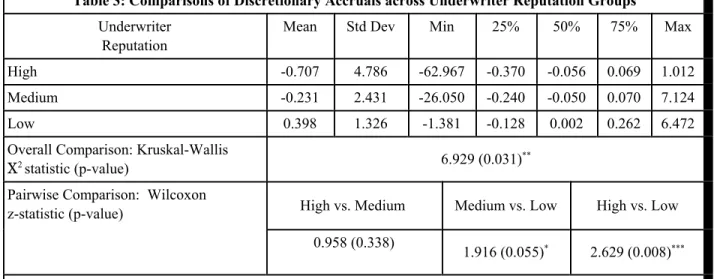
Table 3 presents the results of comparing discretionary accruals across three subgroups of underwriter reputation (high, medium and low), and corresponding test statistics and p-values. For overall comparison, Kruskal-Wallis P2 statistic of 6.929 indicates that there are significant ("<0.05) differences in discretionary accruals across underwriter reputation subgroups.
Pairwise comparison results and corresponding Wilcoxon z-statistics show that for IPO issuers employing high-reputation underwriters, median discretionary accruals are smaller than those employing low-reputation underwriters (-0.056 vs. 0.002) and the difference is statistically significant ("<0.01). Also, median discretionary accruals show a significant difference ("<0.10) between medium- and low- reputation groups. However, there is no significant difference between high- and medium-reputation groups.
In short, discretionary accruals of IPOs underwritten by high- and medium-reputation underwriters are significantly lower than those of IPOs underwritten by low-reputation underwriters. These results indicate that IPO issuers hiring low- reputation underwriters are more likely to adopt aggressive earnings management policies than those hiring high- or medium-reputation underwriters, which is consistent with the prediction of the underwriter certification hypothesis.6
Table 3: Comparisons of Discretionary Accruals across Underwriter Reputation Groups
Underwriter Reputation
Mean Std Dev Min 25% 50% 75% Max
High -0.707 4.786 -62.967 -0.370 -0.056 0.069 1.012
Medium -0.231 2.431 -26.050 -0.240 -0.050 0.070 7.124
Low 0.398 1.326 -1.381 -0.128 0.002 0.262 6.472
Overall Comparison: Kruskal-Wallis
O2 statistic (p-value) 6.929 (0.031)**
Pairwise Comparison: Wilcoxon
z-statistic (p-value) High vs. Medium Medium vs. Low High vs. Low
0.958 (0.338) 1.916 (0.055)* 2.629 (0.008)***
***: Significant at "<0.01; **: Significant at "<0.05; *: Significant at "<0.10
Results in Table 3 are based on unvariate tests, which ignore potential effects of other variables on the degree of earnings management. As an attempt to investigate if these results hold after controlling for other factors related to issuer characteristics and earnings management, we estimate the following regression model:
DACi = $0 + $1OSi + $2SGi(t-1) + $3PREOPi(t-1) + $4LEVi(t-1) + $5RPi + , (2) where,
DACi = discretionary accruals for ith firm in year t-1. OSi = natural logarithm of offer size for ith firm. SGi(t-1) = sales growth for ith firm in year t-1.
PREOPi(t-1) = industry-adjusted operating return on assets for ith firm in year t-1. LEVi(t-1) = debt to equity ratio for ith firm in year t-1.
RPi = underwriter reputation for ith firm, measured by the rankings of Carter and Manaster (1990), and updated according to the information in Jay Ritter’s website.
Our hypothesis 1 predicts that $5 is negative since the issuers employing high-reputation underwriters are likely to have less earnings management.
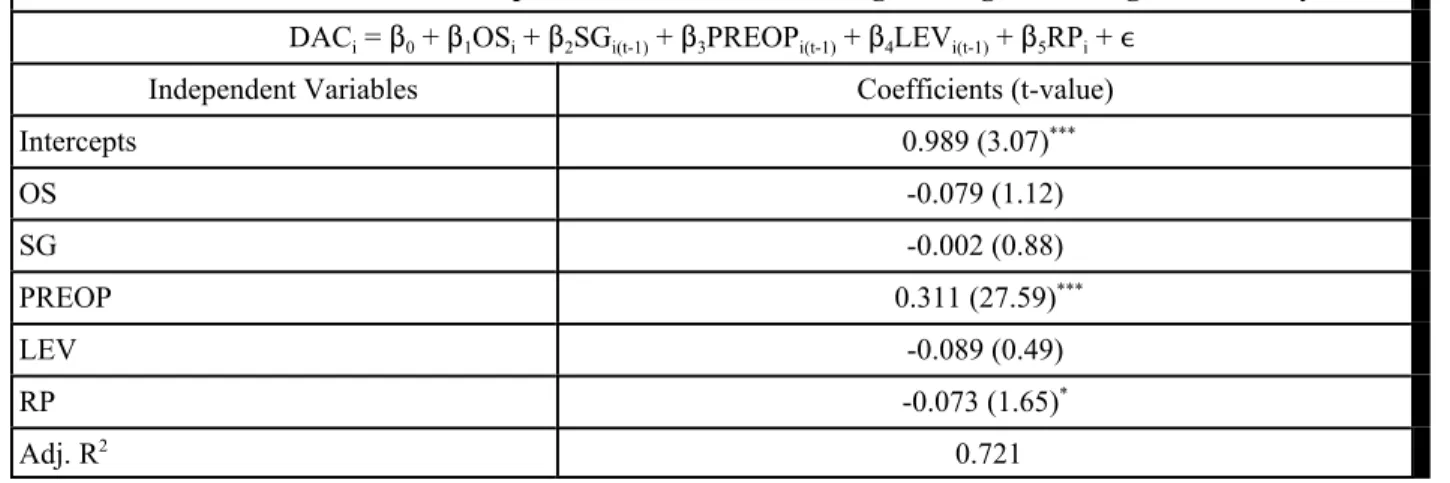
Table 4 presents the results from estimating the regression model (2).7 The results are essentially the same as those from univariate analyses. The regression coefficient of RP ($5) has predicted sign (negative) and is statistically significant ("<0.10). Overall, these results lend strong support to our hypothesis that underwriter reputation is negatively related to pre-IPO earnings management, even after controlling for other variables.
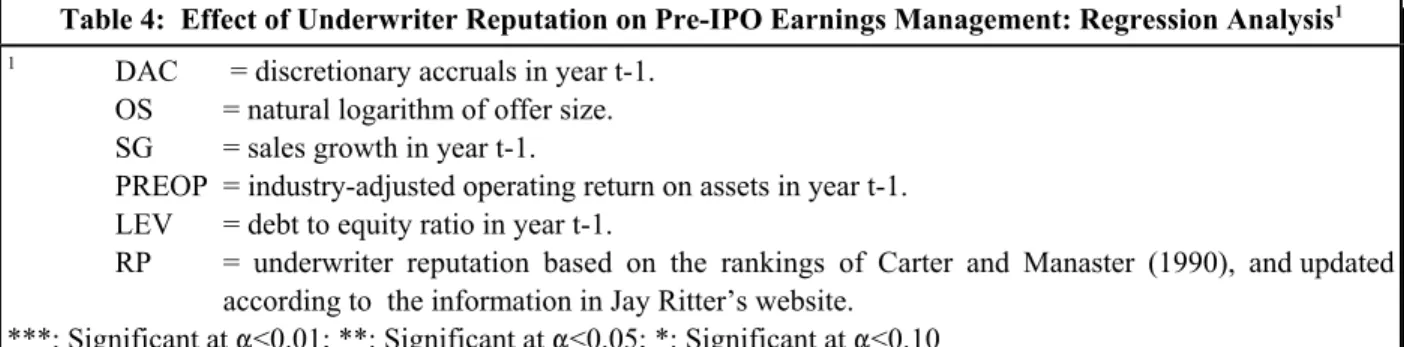
Table 4: Effect of Underwriter Reputation on Pre-IPO Earnings Management: Regression Analysis1
DACi = $0 + $1OSi + $2SGi(t-1) + $3PREOPi(t-1) + $4LEVi(t-1) + $5RPi + ,
Independent Variables Coefficients (t-value)
Intercepts 0.989 (3.07)*** OS -0.079 (1.12) SG -0.002 (0.88) PREOP 0.311 (27.59)*** LEV -0.089 (0.49) RP -0.073 (1.65)* Adj. R2 0.721
Table 4: Effect of Underwriter Reputation on Pre-IPO Earnings Management: Regression Analysis1
1 DAC = discretionary accruals in year t-1.
OS = natural logarithm of offer size.
SG = sales growth in year t-1.
PREOP = industry-adjusted operating return on assets in year t-1. LEV = debt to equity ratio in year t-1.
RP = underwriter reputation based on the rankings of Carter and Manaster (1990), and updated
according to the information in Jay Ritter’s website. ***: Significant at "<0.01; **: Significant at "<0.05; *: Significant at "<0.10
Post-IPO operating performance and underwriter monitoring: Hypothesis 2
In order to examine the effect of underwriter reputation on post-IPO operating performance after controlling for pre-IPO earnings management and other factors, we estimate the following regression model:
POSTOPi = $0 + $1 DACi(t-1) + $2SGi(t-1) + $3PREOPi(t-1) + $4AGEi(t-1) + $5SDi + $6RPi + , (3) where,
POSTOPi = average industry-adjusted operating return on assets for ith firm between years t=1 and t=3.
DACi(t-1) = discretionary accruals for ith firm in year t-1. SGi(t-1) = sales growth for ith firm in year t-1.
PREOPi(t-1) = industry-adjusted operating return on assets for ith firm in year t-1. AGEi(t-1) = age of ith firm in the year t-1.
SDi = standard deviation of daily returns for ith firm from day 6 to day 255 after IPO.
RPi = underwriter reputation for ith firm, measured by the rankings of Carter and Manaster (1990), and updated according to the information in Jay Ritter’s website.
Since underwriters have incentives to continue providing monitoring services to the firms they take public, the issuers employing high-reputation underwriters with better monitoring capabilities are likely to have better operating performance after IPO. Hence, it is predicted that $6 is positive.
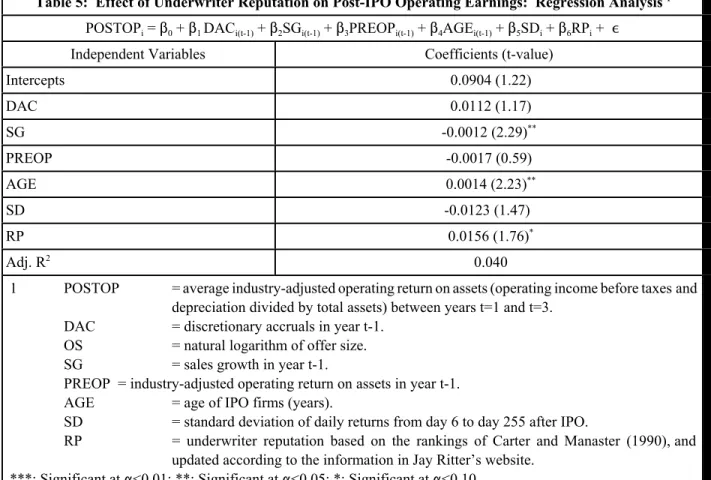
Table 5 presents the results from estimating the regression model (3). First of all, the coefficient of DAC is positive but insignificant. This indicates that pre-IPO earnings management has no effect on post-IPO operating earnings. More importantly, the regression coefficient of RP ($6) has predicted sign (positive) and is statistically significant ("<0.10). This result suggests that underwriter reputation is positively related to post-IPO operating earnings, even after controlling for other variables. This supports our hypothesis 2.
Table 5: Effect of Underwriter Reputation on Post-IPO Operating Earnings: Regression Analysis 1
POSTOPi = $0 + $1 DACi(t-1) + $2SGi(t-1) + $3PREOPi(t-1) + $4AGEi(t-1) + $5SDi + $6RPi + ,
Independent Variables Coefficients (t-value)
Intercepts 0.0904 (1.22) DAC 0.0112 (1.17) SG -0.0012 (2.29)** PREOP -0.0017 (0.59) AGE 0.0014 (2.23)** SD -0.0123 (1.47) RP 0.0156 (1.76)* Adj. R2 0.040
1 POSTOP = average industry-adjusted operating return on assets (operating income before taxes and
depreciation divided by total assets) between years t=1 and t=3.
DAC = discretionary accruals in year t-1.
OS = natural logarithm of offer size.
SG = sales growth in year t-1.
PREOP = industry-adjusted operating return on assets in year t-1.
AGE = age of IPO firms (years).
SD = standard deviation of daily returns from day 6 to day 255 after IPO.
RP = underwriter reputation based on the rankings of Carter and Manaster (1990), and
updated according to the information in Jay Ritter’s website. ***: Significant at "<0.01; **: Significant at "<0.05; *: Significant at "<0.10
Robustness tests
IPO earnings management and the choice of the lead underwriter could be mutually related. IPO issuers with aggressive earnings management may deliberately avoid high-prestige underwriters
if they think the underwriters would monitor their accruals management. Likewise, high-prestige underwriters may also choose to avoid IPO issuers with aggressive earnings management given their reputation capital at stake.
To handle this potential endogeneity problem, we use an instrumental variable two-stage least squares (2SLS) regression approach. In the first stage, we estimate the following regression model:8
RPi = "0 + "1 DACi(t-1) + "2 Ln(TAi(t-1)) + "3 [Ln(TAi(t-1))]2 + , (4)
In the above models, RP is the actual reputation ranking of the underwriter. The regression coefficients from each model are then applied to our IPO sample to find the estimated reputation, ER, of each underwriter. We then estimate the following second stage regression model:
POSTOPi = $0 + $1 DACi(t-1) + $2SGi(t-1) + $3PREOPi(t-1) + $4AGEi(t-1) + $5SDi + $6ERi + , (5) where, ER is the estimated reputation obtained using the estimates of model (4). Other variables are same as those used in model (3).
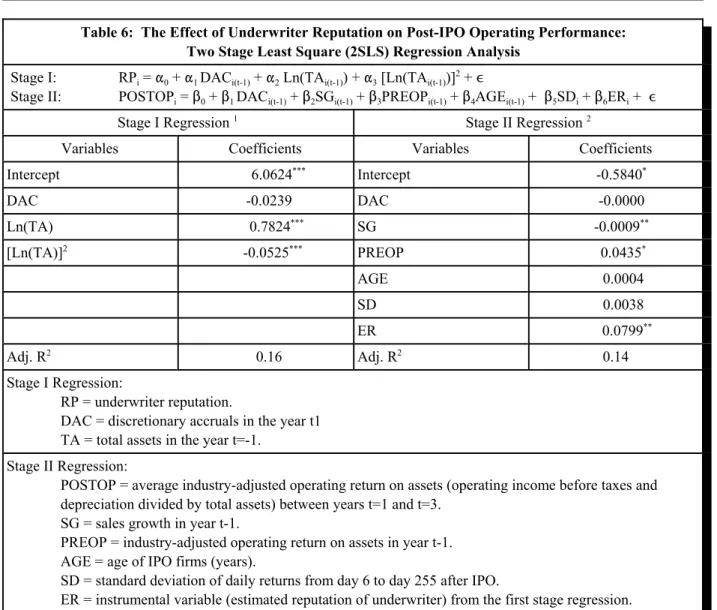
Table 6 presents the 2SLS regression results. The second column of Table 6 reports the results of estimating regression model (4). Firm size, as measured by total asset, has significantly positive relationship with underwriter reputation, indicating that larger firms tend to choose high-reputation underwriters. The fourth column of Table 6 presents the results of estimating the stage II regression model (5), which includes the instrumental variable ER. The results show that while the coefficient of SG (PREOP) is significantly negative (positive), the coefficient of DAC is insignificant. That is, with the endogeneity between IPO earnings management and the choice of the underwriter considered, pre-IPO accruals do not affect post-issue operating performance of IPO firms.
Most importantly, the coefficient of ER is positive and statistically significant ("<0.05), which is consistent with the results from simple regression (3). This significantly positive relation between underwriter reputation and post-IPO operating performance implies that underwriters are not disheartened by the initial earnings management of IPO issuers. IPO underwriters keep themselves engaged in the affairs of their clients because of the lucrative business relationships. The monitoring that high-reputation underwriters continue to supply to the firms they take public is value-increasing. This finding supports our second hypothesis and is consistent with Stoughton and Zechner (1998) and Jain and Kini (1999).
Table 6: The Effect of Underwriter Reputation on Post-IPO Operating Performance: Two Stage Least Square (2SLS) Regression Analysis
Stage I: RPi = "0 + "1 DACi(t-1) + "2 Ln(TAi(t-1)) + "3 [Ln(TAi(t-1))]2 + ,
Stage II: POSTOPi = $0 + $1 DACi(t-1) + $2SGi(t-1) + $3PREOPi(t-1) + $4AGEi(t-1) + $5SDi + $6ERi + ,
Stage I Regression 1 Stage II Regression 2
Variables Coefficients Variables Coefficients
Intercept 6.0624*** Intercept -0.5840* DAC -0.0239 DAC -0.0000 Ln(TA) 0.7824*** SG -0.0009** [Ln(TA)]2 -0.0525*** PREOP 0.0435* AGE 0.0004 SD 0.0038 ER 0.0799** Adj. R2 0.16 Adj. R2 0.14 Stage I Regression: RP = underwriter reputation.
DAC = discretionary accruals in the year t1 TA = total assets in the year t=-1.
Stage II Regression:
POSTOP = average industry-adjusted operating return on assets (operating income before taxes and depreciation divided by total assets) between years t=1 and t=3.
SG = sales growth in year t-1.
PREOP = industry-adjusted operating return on assets in year t-1. AGE = age of IPO firms (years).
SD = standard deviation of daily returns from day 6 to day 255 after IPO.
ER = instrumental variable (estimated reputation of underwriter) from the first stage regression. ***: Significant at "<0.01; **: Significant at "<0.05; *: Significant at "<0.10
In our sample, the high- and medium- reputation underwriter groups have observations several times that of the low-reputation underwriters. To avoid our results being driven by this factor, we apply a weighted least squares (WLS) approach to the instrumental variable two-stage regression model. The weight applied to each observation is equal to the inverse of the number of observations in each underwriter-reputation group. In this manner, each group receives equal weight in the estimation.
Table 7 presents the results of estimating regression model (4) and (5) using two-stage WLS regression approach. The results again show that underwriter reputation has significantly positive impact on the post-IPO operating performances of IPO issuers. However, the coefficient of DAC is again insignificant. This suggests that the presence of effective certification and monitoring by
underwriters has not only restrained the opportunistic initial earnings management, but also resulted in improvements of post-issue operating performance for IPO firms.
Table 7: The Effect of Underwriter Reputation on Post-IPO Operating Performance: Weighted Least Square (WLS) Regression Analysis
Stage I: RPi = "0 + "1 DACi(t-1) + "2 Ln(TAi(t-1)) + "3 [Ln(TAi(t-1))]2 + ,
Stage II: POSTOPi = $0 + $1 DACi(t-1) + $2SGi(t-1) + $3PREOPi(t-1) + $4AGEi(t-1) + $5SDi + $6ERi + ,
Stage I Regression 1 Stage II Regression 2
Variables Coefficients Variables Coefficients
Intercept 6.0624*** Intercept -0.0007* DAC -0.0239 DAC 0.0023 Ln(TA) 0.7824*** SG -0.0002 [Ln(TA)]2 -0.0525*** PREOP 0.0011** AGE 0.0015 SD -0.0029 ER 0.0148* Adj. R2 0.16 Adj. R2 0.10 Stage I Regression: RP = underwriter reputation.
DAC = discretionary accruals in the year t-1. TA = total assets in the year t=-1.
Stage II Regression:
POSTOP = average industry-adjusted operating return on assets (operating income before taxes and depreciation divided by total assets) between years t=1 and t=3.
SG = sales growth in year t-1.
PREOP = industry-adjusted operating return on assets in year t-1. AGE = age of IPO firms (years).
SD = standard deviation of daily returns from day 6 to day 255 after IPO.
ER = instrumental variable (estimated reputation of underwriter) from the first stage regression. ***: Significant at "<0.01; **: Significant at "<0.05; *: Significant at "<0.10
CONCLUSION
The purpose of this study is to investigate the effects of underwriter reputation on IPO issuers’ pre-issue earnings management and post-issue operating performance. We predict that the certification role played by underwriters has a restraining effect on opportunistic earnings management by IPO issuers. We also hypothesize that underwriter reputation is positively related
to post-issue operating performance of IPO firms based on the argument that underwriters have strong incentives to continue supplying monitoring to the firms they take public.
Using a sample of 369 IPOs between 1997 and 2002, we find the empirical results supporting our hypotheses. Specifically, our results can be summarized as follows. First, IPO issuers underwritten by high- and medium-reputation underwriters on average have discretionary accruals that are significantly less than those associated with low- reputation underwriters. Second, underwriter reputation is negatively related to pre-IPO earnings management, even after controlling for other variables. Third, underwriter reputation has positive impact on the issuers’ post-IPO operating earnings, even after controlling for other variables. Finally, pre-issue earnings management is not related to post-issue operating performance for the IPO issuers
For robustness tests, we consider the possibility that IPO earnings management and the choice of the underwriter are endogenously determined. Using an instrumental variable two-stage least squares (2SLS) regression approach, we find the results that there is a positive relation between underwriter reputation and post-IPO operating performance. We also control for the unequal number of IPOs underwritten by each reputation-group by performing a weighted least squares regression. Our results remain the same.
ENDNOTES
1 Another view of earnings management emphasizes the liabilities arising from false earnings signals. These
include explicit legal expenses and implicit costs due to a damaged firm reputation. It is argued that the burdens impel stock issuers to signal validly. Thus investors are informed, but not deceived. Even if this view is correct, we argue that high-prestige underwriters will distance themselves from firms with aggressive earnings management because there would be undesirable effects if the underwritten firms are likely to keep reporting continuously declining performance when accruals revert in later reporting periods.
2 A rational for the cut-off points used to classify underwriters is based on the mean (8.17) and median (9.10) rankings for our sample (see Table 2).
3 Cross-sectional method is used because a time series approach is not possible for IPOs. The cross-sectional
approach has an additional advantage in that it incorporates changes in accruals resulting from changes in economic conditions for the industry as a whole. Since the cross-sectional regression is re-estimated each year, specific year changes in economic conditions affecting expected accruals are filtered out. Moreover, the common practice by underwriters of comparing market prices and financial information of similar firms when pricing IPO equity further shows the importance of extracting industry-wide economic conditions from abnormal accruals.
4 As additional measures of post-issue operating performance, we use the industry-adjusted operating cash flow
return on assets and the industry-adjusted return on assets. The main results remain the same.
5 Using average performance over three years rather than annual performance can smooth out temporal
6 These results are also are also consistent with the implication that either high-reputation underwriters have deliberately avoided IPO issuers with high pre-IPO discretionary accruals, or they tend to avoid each other.
7 We also estimate the regression model (2) using RP as a categorical variable (i.e., assign 3, 2, 1 to high-,
medium- and low-reputation group, respectively). The estimation results are qualitatively the same.
8 We have also estimated underwriter reputation using two different models, which include additional variables
(SD; SD and AGE). The results remain basically the same.
REFERENCES
Beatty, Randolph P. and Jay R. Ritter. 1986. “Investment Banking, Reputation, and the Underpricing of Initial Public Offerings.” Journal of Financial Economics 15: 213-32.
Block, D.J. and J. Hoff. 1999. “Underwriter Due Diligence in Securities Offerings.” Cadwalader, Wickersham and Taft LLP.
Carter, Richard B, Frederick H. Dark, and Ajai K. Singh. 1998. “Underwriter Reputation, Initial Returns, and the Long-Run Performance of IPO Stocks.” Journal of Finance 53: 285-311.
Carter, Richard B. and Steven Manaster. 1990. “Initial Public Offerings and Underwriter Reputation.” Journal of Finance 45:1045-67.
Chaney, Paul K. and Craig M. Lewis. 1995. “Earnings Management and Firm Valuation under Asymmetric Information.” Journal of Corporate Finance 1: 319-45.
Chemmanur, Thomas J, and Paolo Fulghieri. 1994. “Investment Bank Reputation, Information Production, and Financial Intermediation.” Journal of Finance 49: 57-79.
Ducharme, Larry L. 1994. “IPOs: Private Information and Earnings Management.” Ph.D. Dissertation, University of Washington.
Ducharme, Larry L., Paul H. Malatesta, and Stephan E. Sefcik. 2001. “Earnings Management: IPO Valuation and Subsequent Performance.” Journal of Accounting, Auditing and Finance 16: 369-96.
Friedlan, J. M. 1994. “Accounting Choices by Issuers of Initial Public Offerings.” Contemporary Accounting Research 11: 1-33.
Hansen,R. and P. Torregrosa. 1992.”Underwriter Compensation and Corporate Monitor.” Journal of Finance 47: 1537-1555.
Jain, B. and O. Kini. 1999. “On Investment Banker Monitoring in the New Issues Market.” Journal of Banking and Finance 23: 49-84.
Jo, H., Y. Kim and M. Park 2007. “Underwriter Choice and Earnings Management: Evidence from Seasoned Equity Offerings.” Review of Accounting Studies 12: 23-59.
Jones, J. 1991. “Earnings Management during Import Relief Investigations.” Journal of Accounting Research 29: 193-228.
Schipper, K. 1989. “Commentary on Earnings Management.” Accounting Horizons 3: 91-102.
Stoughton, N. and J. Zechner. 1998. “IPO-mechansisms, Monitoring and Ownership Structure.” Journal of Financial Economics 49: 45-77.
Teoh, Siew Hong, I. Welch, and T. J. Wong. 1998a. “Earnings Management and the Underperformance of Seasoned Equity Offerings.” Journal of Financial Economics 50: 63-99.
Teoh, Siew Hong, I. Welch, and T. J. Wong. 1998b. “Earnings Management and the Long-term Market Performance of Initial Public Offerings.” Journal of Finance 53: 1935-1974.
Titman, Sheridan and Brett Trueman. 1986. “Information Quality and the Valuation of New Issues.” Journal of Accounting and Economics 8: 159-72
Zhou, J. and R.Elder. 2004. “Audit Quality and Earnings Management by Seasoned Equity Offering Firms.” Asia-Pacific Journal of Accounting and Economics 11: 95-120.
ASSESSMENT OF INTERNAL AUDITING
BY AUDIT COMMITTEES
Arnold Schneider, Georgia Institute of Technology
ABSTRACT
Audit committees, as part of their internal audit oversight role, assess the independence and work performance of the internal audit function. This paper analyzes these assessments by discussing applicable professional audit standards, corporate audit charters, and relevant research findings.
INTRODUCTION
Many companies have made large investments in internal auditing in recent years and they want to ensure that the internal audit function is adding value to their organizations. Corporate audit committees often have the main responsibility to determine whether internal audit is doing an effective job. One of the roles incumbent on audit committees in serving their company board of directors is to provide oversight of the internal audit function. For companies listed on the New York Stock Exchange, audit committees are required to assist the board of directors in its oversight of the performance of the company’s internal audit function (NYSE 2004, § 303A.07(c)(i)(A)(4)). This oversight role entails, among other duties, assessing internal audit independence and the work performance of internal auditing. In assessing internal auditing, audit committees should be familiar with assessment criteria, sources of information, and assessment procedures. The objective of this paper is to assist audit committee members with these assessments by discussing applicable professional audit standards, corporate audit charters, and relevant research findings.
ASSESSING INTERNAL AUDIT INDEPENDENCE
Independence is a critical aspect of the internal audit function. Standards set forth by the Institute of Internal Auditors (IIA), International Standards for the Professional Practice of Internal
Auditing, define internal auditing as an independent assurance function and require internal auditors
to be independent from activities they audit (IIA 2003, Introduction, §1130.A1). Because internal auditors are employed by the organizations they audit, they cannot have the same level of independence as external auditors who, while paid by the organizations they audit, are not employed by them.
For internal auditors, independence is generally determined by who hires and fires the internal auditors, to whom the internal auditors report, and whether or not they provide assurance services for areas in which they have had, or will have, operational responsibility. For example, independence is enhanced when employment decisions involving the chief internal auditor are made by the audit committee rather than the controller and when internal auditors report to the audit committee rather than the controller. Independence is impaired when internal auditors audit an activity for which they recently had decision-making responsibility. This has been a particular concern since the enactment of Section 404 of the Sarbanes-Oxley Act of 2002, which has resulted in internal audit functions devoting more resources to evaluating and improving internal controls. A study by PricewaterhouseCoopers (2006) reveals that 56% of the 402 companies in their survey reported that during the first year of Sarbanes-Oxley compliance, internal audit staffs had overall responsibility of Section 404 project management. This decision-making responsibility can potentially impair the objectivity of those internal auditors.
A study of 150 companies by Carcello, Hermanson, & Neal (2002) revealed that 18% of audit committee charters discussed the audit committee’s duty to assess the independence of the internal audit function. If that is an indication of the proportion of audit committees that actually do assess their internal audit department’s independence, then it begs the question of why such a low rate. Perhaps most audit committees just rely on their external auditors to provide them with assessments of the internal audit department’s independence. The following excerpt from Walt Disney Company’s audit committee charter illustrates the committee’s responsibility to assess internal audit independence:
“The Committee shall have responsibility for determining that the Management Audit department is effectively discharging its responsibilities. In carrying out this responsibility, the Committee shall:
. . .
review the appropriateness of the . . . operational independence of Management Audit (Walt Disney Company 2007).”
PERFORMANCE REVIEWS OF INTERNAL AUDITING
Audit committees assess the performance of the internal audit function using both external and internal sources. The external sources include teams from the IIA, internal auditors from another company, and external providers of internal audit services such as Certified Public Accounting firms. The internal sources typically include senior corporate management and self assessments from the chief internal audit executive.
External Assessments
The IIA Standards state that external assessments of the internal audit function should be conducted once every five years, but that the potential need for more frequent external assessments should be discussed by the chief audit executive with the company’s board of directors (IIA 2003, section 1312). “The scope of the review can range from a relatively narrow focus on the IIA Standards to a broad evaluation of the function in the context of all stakeholders’ expectations and the practices employed by leading functions within other organizations (Dixon & Goodall 2007, 4).” These external assessments are used by board members, including the audit committee, “to confirm alignment of internal audit with their priorities and expectations, identify opportunities to significantly improve internal audit departments, and optimize the level of convergence of internal audit with other risk functions in the organization (Dixon & Goodall 2007, 3).”
Additionally, the IIA Standards indicate that qualifications and independence of the external reviewer or review team should be discussed by the chief audit executive with the board (IIA 2003, section 1312). “Whether the team consists of appropriately qualified individuals from the IIA, peer institutions, . . . , or a qualified external provider, it should have the ability to benchmark your internal audit department against other firms, both within and outside the industry (Dixon & Goodall 2007, 4).” When the external assessment of the internal audit function is completed, the chief audit executive should communicate the results to the board (IIA 2003, section 1320).
A survey of 358 companies by Verschoor (1992) reports that the proportion of audit committees that have reviewed an external evaluation of internal auditing during the previous two years ranged from 8% in corporations with a small internal audit staff to 26% in corporations with large internal audit staffs. A study of 717 companies by PricewaterhouseCoopers (2007) found that 33% of all respondents, and 58% of Fortune 500 respondents, reported having conducted external quality assurance reviews within the past five years. These findings suggest that audit committees need to be more proactive in arranging for external quality assurance reviews to be in compliance with IIA Standards.
The audit committee may also wish to obtain an external assessment about internal auditing directly from the company’s external auditors. This would include not only the quality of the internal audit department, but also how well it coordinated with the external auditors and the degree of reliance placed on the internal audit work.
Internal Assessments
The audit committee should also be making its own evaluation of the internal audit function on an annual basis. This annual review may contain input from company management as well as a self-assessment from the head of internal audit. Sources for this evaluation could include:
‚ The internal audit mission statement; ‚ Internal audit reports;
‚ Internal audit plan;
‚ Internal audit policy and procedure manuals; ‚ Internal audit programs;
‚ Internal audit working papers.
Some audit committees do informal evaluations while others conduct formal, written documented appraisals (Protiviti Inc., 2004). A survey of 118 audit committee members by DeZoort (1997) found that they generally acknowledge their responsibility to review the effectiveness of the internal audit function and that this responsibility is generally stated in their companies’ proxy statements. An analysis of 100 audit committee charters by Bailey (2007) reveals that 98% require audit committee review of the performance of the internal audit function. Some examples from audit committee charters appear in Table 1.
Table 1: Examples from Audit Committee Charters Requiring Audit Committee Review of the Performance of Internal Auditing
CVS Caremark Corporation
At least annually, the Audit Committee shall evaluate the performance of the senior officer or officers responsible for the internal audit function of the Company (CVS Caremark Corporation 2007).
General Mills
The Committee
-- Reviews the performance of the internal audit function (General Mills 2007).
McDonald’s Corp.
The Committee shall annually review the experience and qualifications of the senior members of the internal audit function and the quality control procedures of the internal auditors. As part of its responsibility to evaluate any internal audit service providers, the Committee shall review the quality control procedures applicable to the service providers. The Committee shall also obtain not less frequently than annually a report of the service providers addressing such service providers’ internal control procedures, issues raised by their most recent internal quality control review or by any inquiry or investigation by governmental or professional authorities for the preceding five years and the response of the service providers (McDonald’s Corporation 2007).
Pepsico
In addition to the purposes set forth above, the primary responsibilities of the Committee shall be to: .
. .
When assessing the internal audit function, audit committees should consider several issues. One issue deals with the degree to which internal auditors understand the company, its objectives, key processes, risks, and control environment. Another issue deals with evaluating the internal audit work plan, as well as the internal audit department’s ability to implement and complete the planned work. A survey of 118 audit committee members by DeZoort (1997) revealed that reviewing internal audit plans is one of their assigned duties and it was generally identified as such in their companies’ proxy statements. Carcello et al. (2002) found that 66% of the 150 companies they surveyed included in their audit committee charters a duty to review the internal audit plan and procedures. Bailey’s (2007) analysis of audit committee charters indicated that 75% require the audit committee to review the internal audit plan. Examples from audit committee charters that mention these duties appear in Table 2.
Table 2: Examples from Audit Committee Charters Requiring Audit Committee Review of the Internal Audit Plan
AirTran Holdings, Inc
To fulfill its responsibilities and duties, the Audit Committee shall . . . Review the activity and effectiveness of the Internal Audit Group including the scope of the internal audit plan for the current year (AirTran Holdings 2007).
Chevron
The Committee shall review, based on the recommendation of the independent auditors and the General Manager–Corporation Auditing, the scope and plan of the work to be done by the Corporation Auditing Department, and the results of such work (Chevron 2007).
CVS Caremark Corporation
At least annually, the Audit Committee shall review the annual internal audit plan with the senior officer or officers responsible for the internal audit function of the Company. The review shall focus on the scope and effectiveness of internal audit activities and the department's capability to fulfill its objectives (CVS Caremark Corporation 2007).
Pepsico
In addition to the purposes set forth above, the primary responsibilities of the Committee shall be to . . . Review the audit plans and activities of the independent auditors and the internal auditors (Pepsico 2007).
Since internal audit’s performance will depend greatly on its personnel, the audit committee should also assess the qualifications and training of current internal audit personnel as well as policies for acquiring and developing internal audit personnel in the future. Verschoor’s (1992) survey of 358 corporations reports that in about 71% of the responding companies, audit committees review internal auditing staff qualifications. The quality, timeliness, and value of the output (i.e., internal audit reports) produced by the internal audit staff should also be scrutinized by the audit committee.
Protiviti Inc. (2004) suggests that audit committees’ assessments of internal auditing include the following questions:
‚ Has internal audit met the terms of its written charter?
‚ Is internal audit assisting the company in identifying and addressing its most significant risks?
‚ Is internal audit sufficiently objective in its mindset and approach? ‚ Are the internal auditors technically competent and proficient?
‚ Does internal audit have the necessary resources to address key risks and issues adequately and appropriately?
‚ Is internal audit led by a competent head that has the respect of company management, the audit committee, and the internal audit staff?
‚ Is internal audit efficient in its efforts, methods, and approach?
‚ Is internal audit adding value by helping to improve operations, and bringing a systematic, disciplined approach to evaluate and improve the effectiveness of risk management, control, and governance processes?
Some of these issues deal with assessing internal audit personnel (i.e., the third through sixth of these bulleted points), while the others involve internal audit activities. The former relate to the capabilities of the internal audit function, whereas the latter relate to the performance of the internal audit work. Regarding the last issue of adding value, a survey of 9,366 internal auditors by Burnaby, Abdolmohammadi, & Haas (2007) found that 67% of their organizations had formal measures for the value added by internal auditing. These measures include self-assessment and assessment by others in the organization, acceptance of internal audit’s recommendations, client surveys, the number of management requests, and reliance by the external auditors on the internal audit activity. The American Institute of Certified Public Accountants (2005) has also developed a list of questions for the audit committee to evaluate the performance of the internal audit function. Some are similar to the ones above suggested by Protiviti Inc. (2004), while others on the list include:
‚ Are the department’s size and structure adequate to meet its established objective? ‚ Is the experience level of the internal auditors adequate?
‚ Does the department have an appropriate continuing education program? ‚ Is the department’s work planned appropriately?
‚ Are the internal audit reports issued on a timely basis?
‚ Do internal audit procedures encompass operational as well as financial areas? ‚ Does the internal audit team have a periodic peer review performed and, if so, what
were the results of the latest review?
‚ What criteria are used to establish and prioritize the annual and long-range internal audit plan?
‚ To what extent does the internal audit team sign off on resolutions of management comments by outside independent auditors?