A THESIS PBESENTED BY
A, B£HA KILINC
TO
ln :C w A. Is·^· r*·'^ SOCIA ^ K f? >5 *►.. y· ·?- S. .•i**'; f»’ i t-i·!»
-- ; Ult j
FO B T!y?r nsr^^crirp i £ to. 5«/4-i. w « Wi > ■;·■ i./·’':.‘w. A QTrrt^b X^i i OF A
JN TEACHING Or EMGL’SH AS A FOREIGN LANGUAGE
i} -.I M S ·· ·■ f ■; ■·, % ;f ..«» -.1^ V - ' 7
AUGUST.
19
SS
A THESIS PRESENTED BY A. REHA KILINC
TO
THE INSTITUTE OF ECONOMICS AND SOCIAL SCIENCES IN PARTIAL FULFILLMENT OF THE REQUIREMENT
FOR THE DEGREE OF MASTER OF ARTS
IN TEACHING OF ENGLISH AS A FOREIGN LANGUAGE
BILKENT UNIVERSITY AUGUST, 1996
— ha itctQ,
University. Author: A.Reha Kilinc
Thesis Chairperson: Dr. Susan D. Bosher, Bilkent University, MA TEFL Program
Thesis Committee Members: Dr. Theodore S. Rodgers, Ms. Bena Gul Peker,
MA TEFL Program
This experimental study aimed at investigating the effects of mnemonic audio-visual aids on recognition and recall of vocabulary items in comparison to a dictionary using control group. The study was conducted at Middle East Technical University Department of Basic English. The
participants were 64 beginner and upper-intermediate level students in four intact classes.
Research qpiestions focused on the differences, if any, between the groups of each level in terms of recognition and recall of vocabulary items, as well as the differences, if any with respect to retention of the learned vocabulary after treatment.
To answer the research questions, four intact classes were chosen from the Middle East Technical University. One group of each level was instructed in the mnemonic audio visual method. The other groups were asked to learn the vocabulary items by using dictionaries as the control
groups. Each group was allowed ten minutes to learn the same
items-as a posttest immediately after treatment to test immediate recognition and recall. To measure long-term retention, that is, delayed recognition and recall, the same test was given to all groups after two weeks. These groups, as well,
included separate recognition and recall sections.
Pretest and posttest scores of recognition and recall were compared to measure acquisition of vocabulary items. Later, the posttest and retention test scores were compared to measure long-term retention. For the analysis means and standard deviations were calculated and t-tests were
conducted separately for all comparisons. Results did show statistically significantly differences between the groups for the tests of immediate and delayed recognition and recall of vocabulary items in favor, in all cases of the experimental treatment groups. The experimental treatment worked equally well for beginner and upper-intermediate groups and for the learning of concrete and abstract words.
Findings suggest that the mnemonic audio-visual
technique is highly superior to traditional dictionary l o o k up technique for both recognition, and recall at both
immediate and delayed testing in various university classroom conditions.
MA THESIS EXAMINATION RESULT FORM
August 31, 1996 The examining committee appointed by the Institute of Economics and Social Sciences for the thesis examination
of the MA TEFL student
A. Reha Kilinc
has read the thesis of the student.
The committee has decided that the thesis of the student is satisfactory.
Thesis Title
Thesis Advisor
Committee Members
The Effectiveness of mnemonic audio
visual aids in teaching content words to EFL students at a Turkish university
D r . Theodore S . Rodgers
Bilkent University, MA TEFL Program Dr. Susan D. Bosher
Bilkent University, MA TEFL Program Bena Gul Peker
Susan D. Bosher (Committee Member)
/)
Approved for the
Institute of Economics and Social Sciences
Ali KarAosmanoglu DLrector
extraordinary assistance in bringing my thesis to completion.
I would like to thank my thesis committee members. Dr. Susan D. BOSHER, and Ms. Bena Gul PEKER for their invaluable support.
I thank Dr. Deniz ZEYREK and Dr. Ozden EKMEKÇİ for their invaluable guidance in the initial stage of this thesis.
I owe special thanks to my rector Dr. Vural ULKU, my dean Dr. Onur Bilge KULA, Vildan and Orhan OZDEMIR for their assistance to participate in this MA TEFL program.
My thanks are extended to all my colleagues participated in this program and who were with me throughout.
My thanks also go to my friends Cem, Fatih, Ahmet, Ozcan, Tamer, Meral and Aynur Zeynep and my dear students Rahime, Cemile and Selime who have supported me with their cooperation and help in any situation.
Finally, my greatest appreciation to my unique family who has always been with me and supported me throughout.
TABLE OF CONTENTS
LIST OF TABLES ... X
CHAPTER 1 INTRODUCTION ... 1
Background of the Study... 1
Purpose of the Study ... 7
Research Questions ... 7
Significance of the Study ... 8
CHAPTER 2 LITERATURE R E V I E W ... [9
Audio-Visual Aids vs. Dictionary Look-up Techniques ... 11
Teaching Concrete Words v s . Abstract Words with the Help of Audio-Visual Aids ... 13
Short-Term and Long Term M e m o r y ... 15
Vocabulary in Isolation or in a Context ... 17
Roles of the Students and Teachers ... 18
CHAPTER 3 METHODOLOGY ... 20 Research Design ... 21 Subjects ... 22 Instruments ... 22 Testing Material ... 25 Procedure ... 26
Information and Consent ... 26
Pretests ... 27
Procedural Practice ... 27
Treatment ... 27
Immediate Posttests ... 28
Long-Term Retention Teste ... 28
Data Analysis ... 28
CHAPTER 4 RESULTS OF THE STUDY ... 30
Summary of the Study ... 30
Summary of Analytical Procedures ... 30
Results of the Study ... 32
Vocabulary Recognition of Beginner Group ... 33
Vocabulary Recall of Beginner Group ... 37
Upper-Intermediate Level Vocabulary Recognition of Upper-Intermediate Level ... 42
Vocabulary Recall of Upper-Intermediate Group ... 47
Concrete Vs. Abstract Nouns ... 52
Long-Term Recall Retention Test Scores of Abstract Nouns at Beginner Level for Both Groups ... 53
Long-Term Recall Retention Test Scores of Abstract Nouns at Upper-Intermediate Level for Both Groups ... 55
Comparison of Vocabulary Learning of Beginner and Upper-Intermediate Levels ... 56
CHAPTER 5 DISCUSSION OF FINDINGS AND C O N C L U S I O N ... 57
Summary of the Study ... 57
Discussion of the Results and Conclusion ... 58
Limitations of the Study ... 59
Implications for Further Research ... 60
Pedgogical Implications ... 61
REFERENCES ... 63
APPENDICES ... 66
Appendix A: Consent F o r m ... 66
Appendix B: Beginner Level Vocabulary Recall Test #1 ... 67
Appendix C: Beginner Level Vocabulary Recall Test #2 ... 68
Appendix D: Beginner Level Vocabulary Recognition Test #1 ... 69
Appendix E: Beginner Level Vocabulary Recognition Test #2 ... 7 5 Appendix F: Upper-Intermediate Level Vocabulary Recall Test #1 ... 81
Appendix G: Upper-Intermediate Level Vocabulary Recall Test #2 ... 82
Appendix H: Upper-Intermediate Level Vocabulary Recognition Test #1 ... 83
Appendix I: Upper-Intermediate Level Vocabulary Recognition Test #2 ... 89
Appendix J: Vocabulary List of Beginner Level Textbook ... 95
Appendix K: Vocabulary List of Upper-Intermediate Level Textbook ... 9 6 Appendix L: Sample OHT for Beginner Level ... 97
Appendix M: Sample OHT for Upper-Intermediate Level ... 98
1 Figure 1. Graphic Display of Study Elements ... 32 2 Means and Standard Deviations for Pretest and Immediate
Posttest Scores for Each Group of the Beginner Level for
Vocabulary Recognition ... 33
3 Results of T-Test: Pretest and Immediate Posttest Scores for Each Group of Beginners in Vocabulary
Recognition ... 34
4 Means and Standard Deviations of Immediate Posttest and Long-Term Retention Test Scores of Both Groups
at the Beginner Level for Vocabulary Recognition ... 36
5 Results of T-Test: Immediate Posttest and Long-Term Retention Scores for Each Group of Beginners in
Vocabulary Recognition ... 37
6 Means and Standard Deviations of Pretest and Immediate
Posttest Scores of Both Groups at Beginner Level for
Vocabulary Recall ... 38
7 Results of T-Test: Pretest and Immediate Posttest Scores for Each Group of Beginners in
Vocabulary Recall ... 39
8 Means and Standard Deviations of Immediate Posttest
and Long-Term Retention Test of Both Groups at
Beginner Level for Vocabulary Recall ... 41
9 Results of T-Test: Immediate Posttest and Long-Term Retention Scores for Each Group of Beginners in
Vocabulary Recall ... 42 10 Means and Standard Deviations for Pretest and Immediate
Posttest Scores of Upper-Intermediate Level for
Vocabulary Recognition ... 43 11 Results of T-Test: Pretest and Immediate Posttest Scores
for Each Group of Upper-Intermediate in
Vocabulary Recognition ... 44 12 Means and Standard Deviations of Immediate Posttest
and Long-Term Retention Test of Upper-Inteimiediate
Level for Both Groups of Vocabulary R e c o g n i t i o n ... 46 13 Results of T-Test: Immediate Posttest and Long-Term
Retention Scores for Each Group of Upper-Intermediate
Level in Vocabulary Recognition ... 47 14 Means and Standard Deviations for Pretest and Immediate
Posttest Scores for Each Group of Upper-Intermediate
Level for Vocabulary Recall ... 48 15 Results of T-Test: Pretest and Immediate Posttest
Scores for Each Group of Upper-Intermediate in
Retention Scores for Each Group of Upper-Intermediates
in Vocabulary Recall ... 52
18 Long-Term Recall Retention Test Scores of Abstract Nouns
at Beginner Level for Both Groups ... 53
19 Long-Term Recall Retention Test Scores of Abstract Nouns
Teaching vocabulary is not a new field of interest for teachers in EFL. In the classroom situation, vocabulary teaching/learning plays a major role in language
teaching/learning (Gairns & Redman, 1986). For most
learners, learning a language means learning its vocabulary (Wallace, 1988). As Krashen (1987) notes, "When students travel, they do not carry grammar books, they carry
dictionaries" (cited in Lewis, 1993: P.27). As Lewis
comments, "Lexis is the core or heart of language, but in language teaching has always been the Cinderella" (Lewis, 1993: p.89). Moreover, most of the grammar rule violations are, in fact, based on lexical deficiency (Lewis, 1993). Thus, teachers should treat vocabulary learning seriously.
Formal learning typically begins with the selection of some clearly defined elements w h ich are to be learned. What teachers strive to do is to teach those elements in the most effective way. In teaching, teachers seek to present the new item(s) as clearly and memorably as they can (Stevick,
1985). While doing this they may explore a variety of
methods, approaches and techniques. As Rubin (1987) states, some teachers present learning tasks in more successful ways than others.
They both know how communication is blocked when learners lack the necessary words. Since vocabulary is basic to communication (Krashen, 1983), helping students learn and retain vocabulary items, is therefore, a central task of language learning. However, many teachers consider
vocabulary learning primarily the responsibility of the student learning, not the responsibility of the instructor teaching.
Recognizing and recalling vocabulary appropriately is a task of memory. Thompson (1987) explains that one
educational goal must be teaching students to retain information. This is allied to the idea of 'learning to learn'.
There are a variety of proposals as to how to teach vocabulary effectively. These include : 'Pictorial
Schemata', 'Definition, Explanation, Examples and
Anecdotes', 'Context', (Celce-Murcia, 1991) as well as
mnemonic techniques such as; 'Visual Aids', 'Lexical Sets', 'Keywords', and so forth (Nation, 1990). Other mnemonic techniques include : 'Method of Loci', 'Peg Word', 'Story Making', 'First Letter' and 'Chain Type'. (Bellezza, 1981).
'Mnemonic' means something designed to aid memory. However, vocabulary learning in a second language involves a
can assist in long-term retention of words and word meanings.
In the early stages of language learning, students typically learn the meanings of the words conventionally with paired association such as in the use of flashcards
(Carter Sc McCarthy, 1988). 'Paired associate' learning is
typically considered to be an inefficient, rote repetition type of learning. Mnemonic techniques are intended to
replace such kinds of mechanical learning with more sophisticated and successful tools for remembering.
Visualization and association are two main factors in most mnemonic techniques (Atkinson, 1975). In his paper,
"Are visual aids able to successfully support visualization and association in vocabulary learning?" Atkinson (1975) investigated the role of association and visualization in vocabulary learning. This is the main topic of this study as well.
As a university teacher I have had the experience of teaching not only in different faculties of my home
institution, Mersin University, but also at different levels of preparatory classes. At this university, the students are placed in different levels after proficiency and placement tests are given at the very beginning of the academic year.
are supported by textbooks, additional grammar books, skill books and worksheets.
At various meetings, we, as language teachers,
constantly hear the complaint that students cannot learn vocabulary items easily, nor do they keep them in mind for a long time and recall them whe n they need to. This is a
problem recognized by teachers and students alike. Traditional techniques such as guessing from the context, asking the teacher, using dictionaries, and so
forth (Celce-Murcia, 1991) are not universally successful in acquiring new words by students. Wallace (1988) explains, eliciting the meanings of new words is a sort of a waste of time process; as he notes "All the words cannot be guessed from the context" (p. 23). Wallace further notes that over frequent use of dictionaries, or asking the teacher for the meanings of the new words causes distraction from the text and may cause students to concentrate on single words rather than overall meaning which decreases comprehension and
interest in reading.
In contemporary language teaching, a dictionary is the most used vocabulary aid. However, a dictionary is only useful in looking up the meanings of unknown words (Lewis, 1993); there is nothing in the dictionary which helps with
A second set of techniques, the focus of this study, involves using visual aids, lexical sets and keywords
(Nation, 1990). It is hypothesized that students can learn and retain vocabulary items more successfully using such non-traditional enriched materials in the classroom (Lewis, 1993). There are a wide variety of teaching/learning
strategies based on mnemonic devices. These strategies
assist learners to learn items more qpiickly and recall them more easily since their techniques provide learners with useful retrieval cues (Thompson, 1987).
The quality of mental activity in the brain of the learner during the process of learning is highly important in learning (Craik & Lockhart, 1972; Craik & Tulvig, 1975, cited in Nation, 1994:5). This is one reason that teachers should seriously consider techniques which raise the mental activity level of learners. Such techniques allow learners to improve substantially in acquisition of target vocabulary in association with native language meanings (Nation, 1994) .
Ott, Butler, Blake and Ball (1973) explain that mnemonic techniques can make foreign language learning easier when the whole foreign word is transformed into a familiar native language word (cited in Pressley, 1982) . Different sorts of mnemonic techniques are used by different
they come to understand and master them.
Studies of actual foreign language vocabulary learning have been done by pairing words in the second language with sound-alike words in the first language (Ott et a l ., 1973, cited in Pressley, 1982). This technique is known as the keyword method which is also widely used in various mnemonic research studies (Thompson, 1987).
The results of various studies in vocabulary learning indicate that the keyword method is more effective than
other procedures (Pressley, 1982) . This method combines both auditory and visual information (Stevick, 1989). Keyword method researchers caution that this method may be more beneficial for some learners than for others (Cronbach & Snow, 1977, cited in Pressley, 1982).
Consider an example of the keyword method: (1) A word in the second language is to be learned, let us say the English word 'currency' (2) Any like-sounding word or expression is found in the native language let us say the Turkish phrase 'Kor Inci', the association between foreign language 'currency' and native language 'Kor Inci' is the acoustic link. (3) Next, an image is presented (or created) by the learner based on the meaning of the native language word for 'money' and the meaning of the acoustic link 'Kor
the v isual link. Research has shown that the most effective visual links are those are that are odd, comic or taboo.
(Atkinson, 1975). The English word, 'currency' siimmons up the acoustic link 'Kor Inci', which summons up the visual link (blind woman searching on the ground for money) which summons up the Turkish word meaning 'money'. This, then is the basic pattern of the keyword method.
Purpose of the Study
In this experimental study, the effectiveness of keyword audio-visual aids in teaching content vocabulary words to elementary and upper-intermediate EFL university
students is compared to the effectiveness of using
dictionary look-up. The results will examine short-term and long-term retention in vocabulary recognition and recall tests.
Research Questions
The study anticipates more successful learning and retention of foreign language vocabulary using a mnemonic audio-visual approach. If this hypothesis is confirmed, a re
consideration of existing language teaching technicfues are in order. For example, it will suggest that language teacher
investigated here.
This study aims to investigate the following questions: 1. Is using mnemonic audio-visual aids more effective than using dictionaries in language vocabulary learning?
2. Are there any differences between beginner and upper-intermediate levels in recognition and recall vocabulary with the help of mnemonic audio-visual aids?
3. Are there any differences in short-term & long-term vocabulary retention and in recognition and recall processes related to method of study?
Significance of the Study
As mentioned before, vocabulary mastery is a major part of language teaching/learning. For teachers it is important to teach students new vocabulary items in an effective and practical way. Using mnemonic audio-visual aids can be an alternative approach for teachers in helping students learn and recall foreign vocabulary meanings.
For the students, it is important for them to learn not only new words, but also new techniques so that they can help themselves in learning.
means learning its vocabulary (Wallace, 1988). A wide possession of vocabulary items provides learners an
opportunity of having a satisfying communication and it also increases self-esteem (Krashen, 1983). The old proverb "What is new is not true, and what is true is not new" exactly describes the history of vocabulary teaching. As Carter and McCarthy (1988) state, linguists, philosophers and
pedagogues have been trying to understand vocabulary learning for centuries.
Some of the techniques used in vocabulary
teaching/learning are: Pictorial Schemata, Definition,
Explanation, Examples and Anecdotes, Context, and so forth. (Celce-Murcia, 1991). There are 'mnemonic' techniques such as: Visual Aids, Lexical Sets, Keywords, Method of Loci, Peg Word, Story Making, First Letter, Chain Type, etc.
(Bellezza, 1981).
The meaning of 'mnemonic' is to assist memory. In vocabulary learning in second language using mnemonic
techniques is quite helpful and enjoyable for both teachers and learners (Kasper, 1993). Knowing a word means to be aware of its network of associations with other words in the native language (Carter & McCarthy, 1988). Furthermore, research in memory suggests that words are stored and
remembered in a network of associations with auditory and visual cues (Stevick, 1976). In order to make network associations with other words in the native language with the help of auditory and visual cues, imagination is
important. As Stevick (1989) explains, "Imagination is the ability to create new things or ideas, or to combine old ones in new forms" (p. 95). Using the imagination and making a network of associations are mental activities that can have a powerful effect on memory (Craik & Lockhart 1972, cited in Carter & McCarthy, 1988). In order to enhance the storage of information, learners can consciously use memory
(mnemonic) techniques (Carter & McCarthy, 1988) which are easy to apply and practical to use. The existence of
entities that one can see, feel, touch, smell or taste make strong associations for remembering (Joyce & Weil, 1996) . As Joyce & Weil (1996) explain, "We remember best those ideas that are presented to several of our sensory channels"
(p.6). Torayne & Lucas (1974) quote Aristotle (cited in Joyce and Weil, 1996) : "It is the image-making part of the mind which makes the work of the higher processes of thought possible. Hence, the mind never thinks without a mental
picture". Thus, 'to know' a word in a target language consists of; relating the foreign word to an appropriate object or concept in the native language; this supports
awareness of associations and recognizing and recalling the word when it is needed (Wallace, 1988).
In this chapter we will compare use of mnemonic audio visual aids in vocabulary learning vs. using dictionaries,
learning of concrete vs. abstract vocabulary words, short term vs. long-term vocabulary retention, and the study of vocabulary items in isolation vs. in context. Finally, in this chapter we consider the roles of students and teachers in vocabulary learning and teaching.
Audio-Visual Aids vs. Dictionary Look-up Techniques The literature on using audio aids (tape-recorders, reading aloud, etc.) and visual aids (using pictures,
realia, etc.) in learning vocabulary includes many research studies (e.g.: Acikgoz, 1992; Brown, 1994; Cohen, 1990; Gairns & Redman,1986; Gaston, 1968; Stevick, 1982; Yayli,
1995). Some of these studies are based on using pictures as visual aids, and others are based on auditory and/or visual
imagery. An audio-visual method is customarily related to learning meanings of concrete nouns since nouns form the vast majority of the words of any language and concrete nouns are easy to represent with audio-visual clues (Lewis,
1993) .
As Lewis (1993) notes again in language teaching, pictures and/or tape-recorders have been widely used for
over thirty years. Pictures and audio tapes prepared by teachers for vocabulary teaching are very important and
useful for learners. They take the attention of learners and make them enjoy as they learn (Allen, 1983). For example, various colorful pictures on board or slides or
transparencies such as a picture of a house, flower, and so forth; various tape-recordings of sound effects such as a car stopping suddenly, a cat's meow, and so forth, are supplied audio-visual aids relating to the subject of the lesson. Moreover, audio aids can be used in combination with visual aids (Stevick, 1982). For example. Alliance Français has developed and supported a major world-wide methodology for learning French which is called "Methods Audio-Visual"
(Renard & Heinle, 1969).
However, the major experiments have all been based on concrete words and taught with the help of visual aids
(Stevick, 1982). This study will differ from them by using audio aids as well as visual ones and will include abstract words in addition to concrete words. Studies on the
effectiveness of using audio-visual aids for vocabulary
learning have been conducted for many years. A great deal of experimentally related evidence on hiiman memory has been compiled as well. Most of these studies have indicated that audio-visual aids are effective in teaching/learning
to convey meaning and especially have been useful in teaching of content words (e.g.: Cohen, 1990; Gairns & Redman, 1986; Stevick, 1982).
These aids have proved superior to the other vocabulary teaching/learning strategies such as letting students use dictionaries and asking the meaning of the new words of the teacher (Baxter, 1980; Celce-Murcia, 1991; Wallace, 1988). Over-frequent using of dictionaries, or asking the teacher meanings of unknown vocabulary items makes students tired and often is a time-consuming process (Wallace, 1988). Since a word will have more than a single meaning in a dictionary, it can cause trouble for the learner in finding the
particular sense that s/he is looking for.
Teaching Concrete Words vs. Abstract Words with the Help of Audio-Visual Aids
A recent study is Yayli's (1995) study that shows the effectiveness of keyword method in vocabulary learning. In Yayli's study, subjects were students from Middle East Technical University (METU) chosen from three intermediate level intact classes. There were two experimental groups
(one teacher provided keyword group, and one student provided keyword group) and one control (rote-learning) group. Twenty target vocabulary items were given to the
students in the three groups. These items were chosen according to the criteria which Atkinson (1975) suggested.
The words were concrete nouns with no more than two syllables. The list of words was supported for the
experimental groups with keywords and pictorial images in order to help the students make connections between the words and pictures. Yayli (1995) used rote rehearsal techniques for the control group. Vocabulary words and
pictorial images were taken from Acikgoz's (1992) study. A
pretest and posttest were given with the learning session taking place between these. Results were examined in
immediate and long-term retention tests.
However, little research has been done on teaching of abstract words with the help of mnemonic audio-visual
materials in classroom setting (Nyikos, 1985) . The few studies on abstract vs. concrete word learning are
referenced in Rodgers' (1967) study. It appears true that the use of mnemonic techniques in vocabulary teaching should not be limited to concrete words, but could be applied to abstract words, verbs and adjectives as well. This study aims to supply some missing experimental evidence on this subject.
Short-Term & Long-Term Memory
What is as important as learning vocabulary is to have vocabulary words retained to use when they are needed. As Asher (1969) and Postovsky (1974) state, comprehension of vocabulary depends on the strategies that allow one to understand words and keep them in memory. After having understood the meanings of words, the next and more
important step is to keep these words in mind in order to use them when necessary. There are various reasons why one forgets things. Fundamentally, there are two theories: The 'Decay Theory' states that information kept in memory falls into disuse if it is not practiced and revised. The other,
'Cue-Dependent Forgetting Theory' explains that the reason for memory failure is lack of retrieval cues (Gairns & Redman, 1986).
When we place word items in Short-Term Memory (STM), we tend to code items acoustically (as sounds); whereas word items in Long-Term Memory (LTM) are usually coded visually
(as pictures) (Conrad, 1964; Henning, 1973, cited in
Richards, 1976). In order to keep information in Short-Te2nn
Memory (STM) , we tend to prevent displacement by repeating the new information again and again, this is known as
rehearsal (Conrad, 1964).
One of the best known methods of retaining (to keep in mind) and recalling (to bring to surface) information or
knowledge in LTM is through 'Sensory Images' such as sounds or pictures (Hayes, 1994) . Use of imagery as a LTM aid is one form of mnemonic. "Mnemonic techniqpies involve
physically transferring to-be-learned materials into a form that makes them easier to learn and remember" (Hayes, 1994 cited in Weatherford, 1990).
Since some learners are more auditory and some are more visual (Nyikos, 1985),audio-visual mnemonics are likely to be useful in learning vocabulary items for both types of learners (Brown, 1994). One of the most used mnemonic techniques is the 'Keyword Mnemonic' which was refined
experimentally by Atkinson and Raugh (1975). "This technique is based on the observation that cognate or other
orthographically similar words from o ne's native language can act as verbal mediators between the written
representation of a word and its target language pronunciation (Nyikos, 1985: p.56).
Atkinson (1975) first showed experimentally that the link word method was 50% more effective than conventional rote methods. In later studies keyword methods have been shown to be twice as effective as alternative methods in both short-term and long-term information recall (Joyce & Weil, 1996) .
In order to further strengthen LTM, a visual link is added to the auditory link. This is called 'Imagine Link'.
Students can imagine a picture as they pronounce a word. What is important is to establish a meaningful interaction between a target language word and an acoustically similar keyword in the native language using an imagine link. The audio-visual mnemonic technique is highly useful and
beneficial for language learners (Carter & McCarthy, 1988). With this technique, by associating a word in the target language with its audio-visual transformation in the native language, students correctly learn new vocabulary items. The critical keywords and images can be invented by learners or provided by teachers (Carter & McCarthy, 1988).
Vocabulary in Isolation or in a Context
Words do not exist in isolation and word meanings are defined through their interaction and network associations with other words. These associations may be in specific text associations or in psychological network associations
(Richards, 1976). Many language educators feel that
vocabulary items only occur meaningfully in the context of text and therefore should be learned in the context of text. However, such contextual learning is difficult to organize pedagogically and may be highly idiosyncratic and
inefficient. Vocabulary items can be given directly in a planned (de-contextualized) way in order to help students acquire the necessary vocabulary items in a logical manner
(Judd, 1978). Furthermore, de-contextualized learning of vocabulary items supplies linguistic resources in a
psychological satisfying manner (Lewis, 1993). Therefore,
recent language educators have supported the principle " De- contextualized vocabulary learning is a fully legitimate strategy" (Lewis, 1993 :p.l94).
Roles of the Students and Teachers
"Vocabulary cannot be taught, it can only be learned" (Rivers, 1983 cited in Gonzales, 1990: p.ll3). This sweeping statement actually implies that the teacher's role in
helping the student to learn vocabulary is minor. A more active teaching role consists of offering students some patterns for the organization of words in memory, so that the students may retrieve the word they have learned
whenever they need it (Gonzales, 1990). What are these patterns for the organization of words in memory? In order to help students find the most effective ways to learn the meanings of new vocabulary items, we, as teachers should examine the best way "to offer patterns in the organization of words". The purpose of this study is to explore teacher roles in supplying 'memory patterns for the organization of words'. We see this as a first step and look for other
some techniques for further teaching support in student learning of target language vocabulary. This includes examining audio and visual aids in vocabulary learning,
support for learning abstract as well as concrete vocabulary words, techniques for increasing short-term and long-term vocabulary retention, and teacher roles in vocabulary learning by beginning and more advanced language learners.
CHAPTER 3 METHODOLOGY Int roduc t i on
This study is an experimental study focusing on the effectiveness of alternative methods of teaching second language vocabulary. A mnemonic technique using 'sensory images' and 'sound effects' with the help of audio-visual materials is compared to one using a dictionary look-up technique. The experiment was conducted at Middle East
Technical University (METU). The 'sensory image' and 'sound effect' techniques were used in a university class condition in Turkey for the first time. As mentioned in the previous chapter, Yayli (1995) conducted a similar study but focusing only on concrete nouns. This study also differed from all
others because it included 'sensory images' together with
'sound effects' as part of the mnemonic technique.
The study considered several different conditions; there were two different levels of students (Beginner &
Upper-Intermediate) who were chosen randomly. Abstract and
concrete words were compared on short and long term retention. Learning measures involved recognition tests
(multiple-choice tests with one target and three distracter words) and recall tests (subjects required to write the
Turkish equivalents of the English words). Control groups at each level, involved subjects using dictionaries in a
groups were treated by using mnemonic audio-visual aids ('Keyword method' supported with sound effects and pictures linking L2 and LI words used synchronously).
Research Design
In this experimental study, the differences between mnemonic audio-visual and using dictionary look-up methods were compared. In order to observe the effectiveness of the mnemonic audio-visual method several conditions were
included: Two different levels of students (Beginner &
Upper-Intermediate) were subjects of the study. Each level had one experimental and one control group (totally, two control and two experimental groups for both levels). Groups were chosen randomly and tested in pretest, posttest and long term retention (delayed) tests (two weeks after the posttest). All above mentioned tests were administered using both recognition and recall tests. The recognition test was a multiple-choice test of 40 items with a target and three distracters for each item. The recall test required subjects to write the Turkish equivalents of 40 English (target)
words.
Between the pretest and posttest were the treatments. Experimental groups at both levels were treated using the mnemonic audio-visual method, and control groups of both
levels were treated with a traditional dictionary look-up method.
Subjects
Subjects were from Middle East Technical University, preparatory classes- Two elementary and two upper-
intermediate classes were used; one as an experimental group and one as a control group at each level. Totally, there were 64 randomly chosen students (16 for each group). The classroom setting was made as authentic as possible as suggested in the study of Brown and Berry (1991).
Instruments
Vocabulary items were chosen in the following way: First, standard student textbooks at beginning and upper- intermediate levels were examined. From among the
approximately 200 vocabulary items in student textbooks, lists at each level of mixed 50 concrete and abstract nouns were chosen. A screening test was conducted with five
randomly selected students at each level. This was in order to determine the most unfamiliar 40 nouns in the list of 50. The screening tests were of the recall type requiring
students to write the 50 Turkish equivalents of the English words on the lists.
The selected 40 vocabulary items were divided into two word groups of 20 vocabulary items each including on equal
amount of concrete and abstract nouns in each list. List one included the 20 least-knov/n items from the screening test. This was the learning test for the two treatment groups. List two included the other 20 vocabulary items from the screening test. These were non-treatment words used in order to provide non-treatment base-line data. All tests included all 40 treatment/non-treatment vocabulary items. The last 10 words (from the original list of 50) were the most known vocabulary items and were discarded from the experiment but were used for pilot-testing and procedural demonstration. In the procedural demonstration session three L2 (the target language, English), to LI (the native language, Turkish) items were used to demonstrate the mnemonic audio-visual method to the experimental group. These three items were not tested or further used.
For the pretest session 40 target language (English) items were given in recognition and recall tests. For the treatment session the 20 target language (English)
vocabulary items (List 1) were presented using the mnemonic audio-visual treatment method (experimental group) and the dictionary-look-up method (control group). The previously mentioned 20 non-treatment items (List 2) were not
presented. Then, in the immediate posttest session, 40 vocabulary items with treatment (List 1) and non-treatment
In this test the order of the items were different from the ones in pretest condition. Finally, for the delayed posttest
(long-term retention) tests the same 40 vocabulary items (List 1 plus List 2) were given in recognition and recall formats. Recognition and recall data for all tests and all items were compiled and compared and means, standard
deviations of 20 target treatment items were calculated and t-tests were administered.
All the selected vocabulary items were content words (concrete and abstract nouns). In order to present the words colorful pictures on over-head transparencies (OHT) were used, one for each word. On each OHT, there were the target
(English) words on the left hand side, and the native
translation (Turkish words) of the target words on the right hand side of the OHTs. The top of each OHT consisted of a label sentence with a keyword which made an imagery link and an acoustic link between the L1/L2 target words. Just below the label sentence, between the target and native words, was a colorful picture representing the keyword. A
simultaneously presented audio-tape supported the picture by providing a sound effect remindful of the keyword. Sound
effects were pre-recorded by the experimenter. Both the
visual and auditory effects were presented synchronously for 30 seconds for each OHT. OHTs were presented on the board of the class and sound effects were presented with the help of
a tape-recorder. Only the experimental groups were provided with a practice session to become familiar with the new technique. The dictionary look-up group used their own bi lingual dictionaries and were assiuned to be familiar with and proficient in use of these dictionaries for unknown vocabulary look-up. Similar procedures and instrtiments were used for both beginner and upper-intermediate groups. Sample OHTs for both the beginner group and the upper-intermediate groups are shown in Appendix L and M.
Testing Material
The vocabulary testing materials were taken from the 40 L2 'learning material' items. The tests were:
1. Pretest; Recognition 20 target items, 20 'diunmy' items; Recall 20 target items, 20 'dummy' items.
2. Posttest; Recognition 20 target items, 20 'diimmy' items; Recall 20 target items, 20 'dximmy' items.
3. Long-Term Retention Test; Recognition 20 target items, 20 'dummy' items; Recall 20 target items, 20 'dummy' items.
Similar treatment and tests were provided for the
subjects at the beginning and upper-intermediate levels. One set of testing materials for each level was developed and used for the three tests. Words were presented in different orders in the posttests for both recognition and recall at each level. The pretest aimed at measuring the existing recognition and recall of the 20 target vocabulary items in
order to be able to insure equivalence of the control and experimental groups. The posttest intended to measure immediate recognition and recall of the vocabulary items directly after the treatment. The long-term retention
(delayed) tests were administered to measure two-week recognition and recall of the target vocabulary items as well. The tests and procedures were pilot-tested on three
students of the Middle East Technical University from each level.
Procedure
The experimental procedure had six stages for each of the two groups: (a) information about the experiment and solicitation of consent, (b) pretests, (c) procedural practice, d) treatment, (e) immediate posttests, and (f)
long-term retention tests. Information and Consent
Before giving the pretest, all students were informed that an experiment would be conducted in their classrooms and their willingness to participate was asked for. They were asked to participate in an experiment about 'vocabulary
learning', and the importance of vocabulary in language
learning was emphasized by the experimenter. They were given consent forms to be read, filled out and signed. Everyone in all groups agreed to participate.
Two pretests of 40 L2 vocabulary items were given to both control and experimental groups at both beginner and upper-intermediate levels of students within the same day by the experimenter. The pretests included a recognition test that was a multiple-choice type of test with one target and three distracter items and a recall test for which the
students were asked to write the Turkish equivalents of L2
words w i t h a pencil. Time limit was 20 minutes for each of
the tests (for a total of 40 minutes for the entire pretest
session) for both levels of groups. Procedural Practice
Just after the pretest and on the Scime day for the experimental groups at both levels, the students were told that they were going to learn a new technique for learning vocabulary. Practice sessions were given to both levels of experimental groups by the researcher just before the study sessions in order to teach subjects how to make
associations. The two control groups had no practice sessions. They were told the importance of vocabulary learning w ith the help of d i c t i o n a r i e s .
T-r^atment
The treatment sessions focused on 20 target vocabulary items comprising 10 concrete and 10 abstract nouns. For the experimental groups, the words were presented using colorful
pictures on over-head transparencies (OHT) accompanied by simultaneous sound effects as previously described.
The control groups at each level were asked to use their standard English-Turkish bi-lingual dictionaries to look up the 20 target vocabulary items. The study session for both groups at both levels was ten minutes, (30 seconds for each vocabulary item in the list).
Tmmediate Posttests
The study session was followed by immediate vocabulary tests of recognition and recall. The order of the vocabulary items was different from that in the pretests. Time limit for the immediate recognition and recall tests was again 10 minutes for each test.
T.ong-Term Retention Tests
The same tests given as immediate posttests were given to both groups at each level after a two-week period to measure long-term (delayed) retention. For the long-term
retention tests, the time limit was again 10 minutes for each test. All the training sessions and tests were
conducted in the original classrooms of the students by the experimenter.
Data Analysis
The recognition and recall tests were analyzed
used as baseline data. The results of recognition and recall posttests were intended to indicate learning increments
credited to treatments.
Data were collected for pretests of recognition and recall before the treatment, posttests of recognition and recall immediately following the treatment and two-week delayed tests of recognition and recall to test long-term retention. Mean scores and standard deviations of each test result were calculated and t-tests were conducted in order to determine group equivalence and learning increments
credited to the treatments. Data analyses compared learning difference between control and experimental groups, between short and long term recall, between concrete and abstract words and between beginner and upper-intermediate levels.
CHAPTER 4 RESULTS OF THE STUDY Smnmary of the Study
This study aimed at investigating the effects of teaching vocabulary with the help of audio-visual memory techniques. Subjects were Middle East Technical University
(METU) preparatory students at both beginner and upper- intermediate classes. At each class level experimental and control groups comprised of 16 students were randomly
selected.
The study consisted of several different conditions; there were two different levels of students (Beginner &
Upper-Intermediate) who were chosen randomly. On short term
and long term retention, abstract and concrete words were compared. Learning measures involved recognition tests and recall tests. Control groups at each level, involved subjects using dictionaries in a traditional dictionary word look-up method. Experimental groups were treated by using mnemonic audio-visual aids.
Summary of Analytical Procedures
The statistical analysis for this study was carried out in three stages. The first stage consisted of scoring of the recognition and recall tests of the twenty target vocabulary items among the forty-word list. For each correct answer of a target word, one point was given for a range of 0-20 for
each test. The other 20 vocabulary items placed in the tests were ignored and not taken into consideration in any
analysis oi calculation.
In the second stage, means and standard deviations were calculated for each group for each test. Recognition and recall of vocabulary items were analyzed separately in this study.
In the third stage, means of experimental and control groups for all tests were compared using t-test analysis.
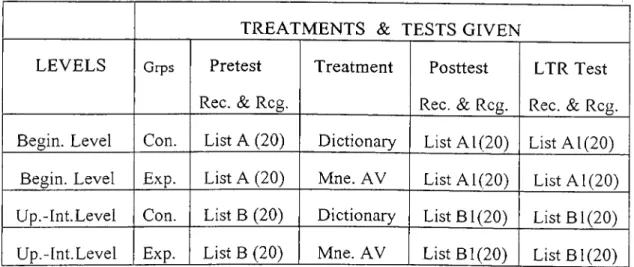
Aside from the vocabulary item screening tests, there were three sets of tests given to control and experimental groups over time. One set of tests recognition and recall was given before treatment, the same type of tests with the items in different order were given immediately after the treatment, and the same set of tests were given as long-term retention tests two weeks after the treatment. Tests and groups are shown in Figure 1.
A secondary analysis split the list analysis of 20 items into concrete nouns (10 items) and abstract nouns (10 items). Long-Term Retention data of concrete and abstract nouns were computed separately and compared.
TREATMENTS & TESTS GIVEN
LEVELS G rp s Pretest Treatment Posttest LTR Test
Rec. & Reg. Rec. & Reg. Rec. & Reg. Begin. Level Con. List A (20) Dictionary List A 1(20) List A 1(20)
Begin. Level Exp. List A (20) Mne. AV List A 1(20) List A 1(20) Up.-IntLevel Con. List B (20) Dictionary List B 1(20) List B 1(20) Up.-Int. Level Exp. List B (20) Mne. AV List B 1(20) List B 1(20)
Figure 1. Graphic Display of Study Elements.
(Note. Begin. Level = Beginner Level; Up-Int. Level = Upper- Intermediate Level; Con. = Control Group; Exp. =
Experimental Group; Rec. = Recall Test; Reg. = Recognition Test; LTR Test = Long-Term Retention Test; Mne. AV =
Mnemonic Audio-Visual; Grps = Groups; List Al (See App. C and E) = Exactly same items of List A (See App. B and D) within different places and orders for Beginner Level; List Bl (See App- G and I) = Exactly same items of List B (See App. F and H) within different places and orders for Upper- Intermediate Level.)
Figure 1 explains that both groups (control and experimental) of each level (beginner and upper-
intermediate) were given pretests, immediate posttests and retention tests two weeks after the posttests. All the tests were administered in both recognition and recall formats.
Results of the Study
The results of recognition and recall tests for each group were analyzed separately. In the vocabulary
recognition test, means and standard deviations of both groups' (control and experimental) pretest results were compared to their posttest results. Then posttest results
were also compared to long-term retention test results. In the vocabulary recall test, the seune procedure was applied for both groups. A parallel set of analyses was done for the beginner group and the upper-intermediate group.
Vocabulary Recognition of Beginner Group
Table 1 presents the mean scores and standard deviations for pretest and immediate posttest scores for each group at the beginner level.
Table 1
Means and Standard Deviations for Pretest and Immediate
Posttest Scores for Each Group o f the Beginner Level for
Vocabulary Pecoqnition
Pretest Posttest
Group n M SD M SD
Diet. Using Gr. 16 5.56 0.12 10.18 0.41 And.-Vis. Gr. 16 5.31 0.41 18.56 0.25
Note. Diet. Using Gr. = Dictionary Using Group; Aud.-Vis. Gr. = Audio-Visual Group.
Pretest mean scores (Control : M = 5.56; SD = 0.12, Experimental : M = 5.31; SD= 0.41) showed no significant differences indicating that group selection was truly random and that neither group was advantaged at the start of the study.
Comparisons of posttest mean scores indicated that treatment made a difference in vocabulary recognition
(Control : M = 10.18; SD = 0.41, Experiment : M = 18.56; SD = 0.25) between control and experimental group. To test the differences between the scores of the two groups a one- tailed t-test was administered. This analysis aimed at investigating whether or not there were statistically significant differences between recognition scores of the two groups. The summary of all effects of the two-tailed t- test for the pretest and one-tailed t-test for immediate posttest recognition of vocabulary items of both groups of beginner level student is presented in Table 2.
Table 2
Result« of T-Test— ;— Pretest and Immediate Posttest Scores for Each Group of Beginners in Vocabulary Recognition
(N = 32)
Pretest Posttest
df t df t
Between Groups 30 2.5 30 15.81*
*p < .0005
According to the results of a two-tailed t-test, there was no significant difference between the two groups'
Treatment caused a striking difference in recognition of the vocabulary items for both groups. Both experimental and
control groups improved immediate vocabulary recognition between pretest and immediate posttest. The experimental group recognized almost twice as many test vocabulary items as did the control group (Experiment Recognition : M =
18.56; Control Recognition : M = 10.18) Differences in recognition t= 15.81 p< .0001.
A second analysis was carried out to measure the long term vocabulary recognition of the two different groups and to see whether the experimental treatment caused subjects to be able to better retain the test vocabulary items after a two-week period. Means and standard deviations of the
iitimediate posttest and the long-term recognition test of both groups were first calculated to compare differences.
Table 3 presents the mean scores and standard
deviations for immediate posttest and long-term retention test scores for vocabulary recognition of each group at the beginner level.
Means and Standard Deviations of linmediate Po3t-.t:«a!=it-, Long-Term Retention Test Scores of Bot:h rirnnpa at. t-.b^ Beginner Level for Vocabu lary Recogni t-i on
Table 3
Posttest Retention Test
Group n M SD n M SD
Diet. Using Gr. 16 10.18 0.41 14 9.14 0.24 Aud.-Vis. Gr. 16 18.56 2.15 16 16.93 1.18
Note. Diet. Using Gr. = Dictionary Using Group; Aud.-Vis. Gr. = Audio-Visual Group.
According to Table 3, there was some forgetting in the recognition of vocabulary items for both groups. Both the Dictionary Group and the Audio-Visual Group scored slightly
lower in the long-tern retention test (Control : M = 9.14;
SD = 0.24, Experimental : M = 16.93; SD = 1.18) than in the immediate posttest (Control ; M = 10.18; SD = 0.41,
Experimental : M = 18.56; SU = 0.25). Group M results were then compared using a one-tailed t-test. The results of one- tailed t-test analysis for the posttest and long-term
vocabulary recognition of both groups for beginner level are presented in Table 4.
Results of T-Test_:_Immediate Postteat an<^ T.nng-Tenn Retention Scores for Each Group of Beginne-Ta in Recognition
(N = 32)
Table 4
Posttest Retention Te.st
df t df t
Between Groups 30 15.81* 28 25.96*
*p < .0005
The results of the one-tailed test showed highly
significant differences between the experimental and control groups' recognition of vocabulary items after a two-week period (Control : M = 9.14; SD : 0.24, Experimental : M =
16.93; SD = 1.18 Long-Term Retention Test, t = 25.96; p< .0005. )
Vocabulary Recall of Beginner Group
Test scores for vocabulary recall were analyzed in the same way as the vocabulary recognition results were. Test scores for vocabulary recall, like vocabulary recognition, ranged between 0-20. Means and standard deviations for each group (Control and Experimental) for both the pretest and the posttest at the beginner level were calculated.
Table 5 presents the mean scores and standard deviations for each group for both the pretest and the posttest at the beginner level of recall.
Table 5
Means and Standard Deviations of Pretest and
Posttest Scores of Both Oroups at Beginner T.f^vel for
Pretest Posttest
Group n M SD M SD
Diet. Using Gr. 16 2.37 0.13 8.56 1.27 Aud.-Vis. Gr. 16 2.50 0.38 14.43 0.48
Note, Diet. Using Gr. = Dictionary Using Group; Aud.-Vis. Gr. = Audio-Visual Group.
Pretest mean scores (Control : M = 2.37; SD = 0.13, Experimental : M = 2.50; SD = 0.38) again showed no
significant differences indicating that group selection was completely random and that neither group was advantaged at the start of the study. In order to compare the results of the pretest a two-tailed t-test was administered.
Posttest mean scores indicated that treatment made a difference in vocabulary recall (Control : M = 8.56; SD = 1.27, Experimental : M = 14.43; SD = 0.48). To test the differences between the scores of the two groups a one- tailed t-test was administered. This analysis aimed at
investigating whether or not there were statistically significant differences between recall scores of the two groups. The sxiramary of all effects of the two-tailed t-test for the pretest and one-tailed t-test for the immediate posttest recall of vocabulary items of both groups of beginner level is presented in Table 6.
Table 6
Results of T-Test_; Pretest and Immediate Posttest Sno-res for Each Group of Beginners in Vocabulary Recall
(N = 32)
Pretest Posttest
df t df t
Between Groups 30 1.3 30 17.78*
*p < .0005
As stated the results of a two-tailed t-test did not show a statistically significant difference between the two
g r o u p s ' recall of the vocabulary items before the
treatments. Treatment made a big difference in recall of the vocabulary items for both groups. Both experimental and
control groups improved immediate vocabulary recall between pretest and immediate posttest. Differences between pretest and immediate posttest scores were substantial and
significant (p< .0005). The experimental group recalled almost twice as many test vocabulary items as did the control group (Experimental : M = 14.43, Control : M = 8.56) .
A second analysis was carried out to observe the long term retention of the two different groups and to see
whether experimental treatment caused subjects to be able to better retain the test vocabulary items after a two-week period. Means and standard deviations of the immediate posttest and the long-term retention test of both groups were calculated to compare differences.
Table 7 presents the mean scores and standard deviations for the immediate posttest and long-term
retention test scores for vocabulary recall of each group of at the beginner level.
Means and Standard Deviations of linmediate Poatteat: and Long-Term Retention Test of Both Groups at Beginner T.evel f o i
Table 7
Posttest Retention Test
Group n M SD n M SD
Diet Using Gr. 16 8.56 1.27 14 6.78 0.80 Aud.-Vis. Gr. 16 14.43 0.48 16 10.25 1.06
Note. Diet. Using Gr. = Dictionary Using Group; Aud.-Vis. Gr. = Audio-Visual Group.
According to Table 7, forgetting in the recall of the vocabulary items was measurable over time. However, compared to the control group, experimental students were still able to recall half of the target vocabulary items after two weeks (Control : M = 6.78; SD = 0.80, Experimental : M =
10.25; SU = 1.06). A one-tailed t-test was again used to test whether there were any significant differences between the two methods in long-term retention of recall of
vocabulary items.
The summary of one-tailed t-test results for the posttest and long-term retention test of recall of
vocabulary items of both groups at the beginner level is presented in Table 8.