https://doi.org/10.1177/0163443720986002 Media, Culture & Society 1 –17 © The Author(s) 2021 Article reuse guidelines: sagepub.com/journals-permissions DOI: 10.1177/0163443720986002 journals.sagepub.com/home/mcs
Activist communication design
on social media: The case of
online solidarity against forced
Islamic lifestyle
Balca Arda
Kadir Has University, Turkey
Ayşegül Akdemir
Bahçeşehir University, Turkey
Abstract
This article explores the relationship between connective and collective group identity through the example of “You Won’t Walk Alone,” a social media platform of solidarity for women suffering from the pressures of Islamic dress code in Turkey. While Turkey has a long history of conservative women’s initiatives against secular institutional code and of secular women against Islamic and misogynist social reactions, the social media platform You Won’t Walk Alone (Yalnız Yürümeyeceksin) illustrates a striking self-reflexivity of women mobilizing against their very own conservative communities. The research is based on multimodal content analysis of the posts including both images and texts in order to grasp to what extent social media offers a genuine public space for anonymous participants of the online platform as opposed to digitally networked movements which primarily reflect personalized agency. We analyze how connective and collective group identity can be correlated in this case in which online participants build solidarity by sharing content anonymously. Hence, this article questions the ways in which activist design of communication affects and shapes activism through this case study.
Keywords
visual communication design, digitally networked action, connective action, headscarf, Islamic dress code, #yalnizyürümeyeceksin, Turkey, Feminist movement, activist media, Muslim women
Corresponding author:
Balca Arda, Kadir Has University, Cibali Mahallesi, Kadir Has Cd Fatih, Istanbul 34083, Turkey. Email: [email protected]
Introduction
Social media increasingly provides activist endeavors with a place to find solidarity with others. You Won’t Walk Alone is an active online platform that expresses the experiences of young women under authoritarian conservative lifestyle regulations imposed by the older generations in Turkey. The headscarf controversy has “reduced women’s demands and claims in general to a particular case of Islamism by a natural meaning attributed to the fact of wearing a headscarf” (Seckinelgin, 2006: 521) as much as “not wearing head-scarf” in modernist secularist discourse in Turkey. The blog was created by a university student who took off her headscarf and evolved into a platform where women with head-scarves tell their stories of cultural oppression (Cebeci, 2018). The platform aims to build solidarity with other women suffering from the imposition of Islamic lifestyle through translation of personalized stories to be shared in English, Arabic and Farsi. The content is formed collectively through anonymous messages.
Headscarf and Islamic dress code reflect a multilayered historical background and complex discursive meanings of assumed “polarized” communities (Islamist vs secular-ist) in Turkey. The controversy has evolved in different stages ever since the foundation of the Republic and it has intensified with the Justice and Development Party (AKP) which came to power in 2002. Only a limited group of women who struggle against the exclusion of veiled women from public office and universities were given voice under the AKP discourse of woman rights. The other voices of women were silenced on both secular and Islamist camps while men used to speak on behalf of women regarding the headscarf issue. As such, the negative side of this liberty, namely the right not to wear the headscarf, has been neglected.
The female body has been constantly formularized in secularist or Islamist camps. As such Turkey has a long history of conservative women’s initiatives against the secular institutional code and of secular woman against Islamic misogynist governmental and communal approaches and actions, however “You Don’t Walk Alone” (Yalnız Yürümeyeceksin, hereafter YY) precisely launched an exceptional initiative, being self-reflexive and dissident to their own community. The right to be free from forced Islamic dress was thought to be already handled by the secularist discourse assuming that because it is banned in state institutions, families can no longer force their daughters to cover. Yet the social pressure on young women’s dress code persisted during and after the ban. The editor of YY blog states that the platform receives negative reactions especially from women who wear the headscarf willingly however the platform does not advocate taking off the headscarf but supports the freewill of every woman (Cebeci, 2018). Consequently, YY precisely gives voice to alternative narratives which fall outside the two polarized communities on this issue (supporting the headscarf as a human right and a marker of group identity versus banning the headscarf as a requirement of secularism).
This article explores how the form of activist engagement on social media constructs different kinds of online mobilization through communication design of platform. Networked engagements can refer to new understanding of collective identity as “being-with” beyond representational identification in the case of online, networked constituent global struggles of autonomous logic (Arda, 2015: 79). YY platform uses social media as the other networked international feminist movements “for seeking and disseminating
information, framing public discourse, expressing collective solidarity and developing counter-narratives against those produced by authoritative discourse” (Afnan et al., 2019). YY adopts the initiative of sharing the participants’ stories of familial and com-munal pressure similar to other networked movements. The logic of digitalized social movements follows the shared endeavor for “personal experience” rather than a mobili-zation of a collective identity (Mcdonald, 2002). In sharing the personal stories, YY platform follows feminist online mobilizations such as #MeToo that articulates solidarity through common experiences and publicizes the need for change. YY platform gathers the stories for anonymous publication online in contrast to the second wave of networked #MeToo movement that encourages direct expression of participants with the hashtag. On the one hand, the indirect expression of personal stories by the YY platform directive reflects the offline traditional mobilization route of social organizations. Thereby, YY platform resides at the edge of differentiation of collective and connective activist forms.
We aim to identify how the YY platform employs activist format to support social solidarity by exploring the ways in which personalized experiences of participants are expressed through activist design of communication. Based on the existing studies on activist format of digitally networked social movements to build solidarity, this study aims to grasp how social media can help the expressions of unvoiced interests and whether specific activist gestures can form their own specific mobilization format with the same opportunities that social media provides. Scholars have problematized differing logics of networked action as connective versus collective (Bennett and Segerberg, 2013) and the role of media and communication in the studies of social change (Mihelj and Stanyer, 2019). This article undertakes this problematic from the perspective of commu-nication design along with the role of digital media in mobilization. The study examines activist action as a form of multimodal expressive networking and aims to detect logics of action through the correlation of textual and visual content deployment aka communi-cation design. More importantly, the comparative analysis of YY online platform with other networked actions unveils the different conditions of communication design for social mobilization online to enhance the connectivity of the participants.
Women’s subjectivity through Islamic dress code in Turkey
The headscarf dispute in Turkey correlates the formulation of women as the cultural and biological reproducers of the nation state (Kandiyoti, 1991: 430; Yuval-Davis, 1997). The close associations between women and “mother nation” have loaded women with a strong political meaning. Later, Islamist political movements approached the subjectivity of women in a similar manner. While the seculars focused on modern-yet-modest public appearance for women (Najmabadi, 1991), the Islamists envisioned women participating in public with a headscarf. Göle (1997) stated in her study on the headscarf among the urbanite women in Turkey that wearing headscarf for women designate a very modern practice beyond the modern/traditional dichotomy, while the head covering styles of the 1990s are very different from the practices of the older women generations both in form and content (Göle, 1997). The modern headscarf emerged in a different context when the Council of Higher Education1 issued a directive banning the headscarf at universities in 1982 (Crow, 2008). The political sign of the headscarf has solidified by the decision of
the National Security Council on 28 February 1997 with the headscarf ban at universities that ended up tens of thousands of female students deserting schools in Turkey to con-tinue their education in foreign countries (Toprak and Uslu, 2009: 45–46). Thereby, Islamic dress code and especially headscarf in Turkey manages to signify two polarized collective framing of identity keeping actors. YY platform can be automatically linked to these characterizations without a closer inspection of the contemporary youth from Islamist conservative backgrounds in Turkey.
The headscarf has become more visible after AKP came to power in 2002. AKP’s political investment in women and headscarf issues can be understood in a larger context of social transformation towards Islamization and conservatism. In its early years AKP adopted a discourse of liberal rights framework, focusing on religious liberalism and market economy, and constructed the headscarf within the liberal human rights discourse (Aksoy, 2015; Saraçoğlu, 2011; Saktanber and Corbacioglu, 2008: 521). In the following years the AKP projected wearing the headscarf as the main liberty that the conservative community would lose if the AKP loses its power (Gültekin, 2015).
The Islamization of Turkish society occurred in the hands of AKP rule through a set of political-economic measures, monetary policies, economic growth, adopting neo-Ottoman aesthetics, promotion of traditional family values, control of media and promot-ing new Islamist intellectuals (Kaya, 2015). AKP’s social transformation attempts involved the shaping of the youth through the national education system by deseculariza-tion, religion-based optional courses and reorganization of the education system at large (Kaya, 2015; Lüküslü, 2016). The rise of Islamic schools with the goal of forming a pious generation was embodied in Turkey’s President Tayyip Erdoğan’s ideal of “good people with respect for their history, culture and values” (Butler, 2018). As such the IHS, initially designed for the training of young people for religious tasks, transformed from vocational schools to “regular high schools with intensive religious instruction” in 2009 (Coşkun and Şentürk 2012, 169–70).
Conservative clothing transformed from being functional (covering the body mod-estly) to being modest-yet-aesthetic. This new fashion did not reject modernization or capitalism, as Sandıkçı and Ger argued (2001) (p. 147). Through luxury and fashionable consumption this new upper middle class differentiated themselves both from the secu-larists and from the traditional lower class pious (Başkan, 2010). The aestheticization of modest clothing gradually spread from the AKP elite to the middle and lower classes with the increasing availability of modest clothing items in high street brands.
The image of women has been significant for AKP’s success in terms of recruiting supporters and the promotion of family values and maternity, which can be seen in the words of Erdoğan advising women in every occasion to have at least three children (Ayata and Tütüncü, 2008; Kaya, 2015). AKP’s support to woman wearing headscarf in public was instrumental in empowering Islam but this did not give women agency (Aksoy, 2015; Ayata and Tütüncü, 2008). The AKP discourse envisages women’s pub-lic participation limited to what it affirms as the traditional Islamic way of life. Thus, the sexist obstacles to both pious and non-religious woman together with LGBT indi-viduals and communities encompass the idealization of family and patriarchal rule for the well-being of the nation and women. Such comportment that describes head cover-ing as the sole manifestation of becover-ing pious has been criticized by the second
generation of feminist religious women that regard secular state’s education system as a provider of critical outlook for traditional gender socialization and they question several social and cultural practices advocated by the AKP discourse to be genuinely Islamic (Aslan Akman, 2013: 120–121). An extensive report on the profile of AKP’s electorate demonstrates that the young voters’ share (aged 18–32) has dropped from 36% in 2010 to 28% in 2017 (Uncu, 2018: 9). In addition, there is a growing trend among the youth of conservative background towards deism, atheism and agnosticism (Bilici, 2018; T24, 2018).
YY platform with its focus on this recent visibility of the youth from Islamist con-servative grounds and its differentiation from earlier collective political characteriza-tions on the Islamic dress code necessitates a very specific communication logic and activist design for social expression and mobilization. YY platform illustrates how an emerging action seeks to generate solidarity and cohesion through the communication of a shared past and experience of coercion in their own communities.
Methodology
Communicative modes of information such as written text, visual representations and presentations interact in shaping activist design of mobilizations. We used qualitative multimodal content analysis to engage with the visual and textual content of Instagram posts to elicit in-depth understanding (Bozdag & Smets, 2017; Hand, 2012). The users of the YY platform encompass mostly young women and age is a key factor in the stories. The current ages of participants range between 15 and 39 (mean 20) and the ages of participants at the time they began to cover their hair ranges between 9 and 30 (mean 14). The editors expressed that as they moved their activism from Twitter to Instagram the average age of the participants dropped from 20s to 14–15. Other demographic informa-tion is usually not revealed in the posts to ensure anonymity.
About 40 Instagram posts have been randomly chosen and their textual and visual content analyzed. Content analysis, as a formal and systematic method, gave us a good overview of the subject (Alexander, 2008: 347–348). We categorized relevant informa-tion such as the process of beginning to wear the headscarf, the responses they encounter when they resisted it, their emotions and their thoughts on the secular society’s impres-sion on them. We began with a frequency analysis of the recurring phenomena in the posts, which revealed the frequently used elements in stories reveal the shared patterns and communal demands of the platform users. Then we analyzed the texts further by identifying the similarities and particularities in the stories that helps explain the use of online platforms for giving voice to women and building solidarity. The study of visual content focuses on how the content of images reflect practice of mobilization. Visuals allow connection to collective memory by drawing on iconic representations that provide short cuts in making sense of complex issues (Wozniak et al., 2015: 471). The deploy-ment of the image in YY platform for the representation of participant’s personalized story embodies a specific communicative structure for solidarity building. For this, we determine the content of the image through qualitative interpretation of tag data, its for-mal and stylistic traits.
Finally we conducted one expert interview with three of the editors of the platform as an efficient and concentrated method of gathering data that provides a common system of relevance shared between the researcher and the research participant (Bogner et al., 2009: 2). We conducted the interview face to face and asked questions on the process of selecting and editing the stories and visuals, the relationship between online and offline activism and the user profile of the platform.
Content analysis of YY platform posts online
You Will Not Walk Alone become active in 2018 and has 9.794 followers in Twitter and 4.588 followers in Instagram as of 09.07.2020 in addition to the primary YY website (https://www.yalnizyurumeyeceksin.com/) enabling Turkish and English versions of the participants’ stories. Although mostly women share their stories, young men from con-servative social backgrounds also suffer from social pressure and are welcome to send posts. Since some participants of the platform are very young and financially dependent on their families, they are reserved about revealing their identities. Both the founders and the contributors remain anonymous in the platforms and in the interviews with the press and they also expressed in the interview their wish to remain anonymous in order to be protected from possible cyber or real attacks and be able to continue the platform. The You Won’t Walk Alone blog also aims to find funding for those who need financial resources for education in those cases where the participants’ conservative families do not permit them to continue their education if they do not comply with the Islamic dress code.
Personalized experiences about the imposition of Islamic lifestyle
The analysis of the posts shows that the decision to cover is a social process beyond the individual. 67.5% of the users covered as a result of either direct or indirect pressure from others. By direct pressures we mean direct command of the family, usually fol-lowed by a threat of withdrawal from school or psychological/physical violence if they refuse to comply. By indirect pressure we mean a strong desire and expectation of the family, accompanied by the expectations of the social milieu (neighborhood, religious school etc.). About 27.5% of the sample has expressed that they chose to cover their hair voluntarily while 5% did not express if they covered voluntarily or not. Among those who covered willingly, most had conservative families and it was expected of them to don the headscarf at some point after they reach puberty. So although they covered vol-untarily, they took this decision in the absence of any strong alternatives in their inner circle and socialization prospects. The earliest and mean ages when they began to cover (11 and 14 respectively) also show the connection between reaching puberty and covering.
New forms of piety and a new outlook on Islamic dress code also play a role in this decision as some contributors to YY state they found the headscarf aesthetic in the begin-ning and combined aesthetics with piety. These new forms of Islamic dress differ from those of the previous generations and appeal to young, urbanite Muslims. One user’s story is very indicative of this phenomenon:
“I began to cover at the age of 11. My reason to cover is very silly, believe me. Our neighbor’s
daughter was supposed to cover her hair when she reaches puberty. Their parents were encouraging her and she would encourage me saying that we should begin covering together. As they were buying her new clothes and scarves I began to cover to emulate her.”
The users who grew up in conservative families are aware from a young age that they are expected to cover and comply with the family’s expectations. Once the decision is made, the mothers take the girls shopping for Islamic clothes and want them to begin covering during the summer holiday before the new school year starts. Age of the users play an important part in the stories; they express having dreaded reaching puberty because this meant that they are now mükellef, responsible from obeying the commands of religion, which marks the end of their childhood2. Looking at puberty, an already dif-ficult transition in most societies, as a dramatic end to childhood is traumatizing.
This personal transition is also a social process which triggers many emotions, both positive and negative depending on the willingness of the person. Emotional dissonance is the separation of felt and displayed emotion (Hochschild 1983); although this has been studied in management and work life, its influence on personal relations and its outcomes have been neglected. The most striking emotions that frequently emerge in the narratives are depression, anxiety, sadness and alienation. While the users experience these emotions, they try to look normal and hide these either not to upset their families or experience further pressure from them. In addition, they experience social pressure along with a desire to save face. A double-sided emotional work takes place in the example below that involves com-plying with the family’s wishes and reconciliation of their own needs with the family’s expectations while giving the impression that they wear the headscarf voluntarily. This is crucial to save face against the “secular” people and to look powerful.
Although the ban on headscarf in public institutions has been lifted, the polarization between secular and religious remains intact. The story of another user is indicative of such polarization which has been elaborated by Göle (1996), as she suggested that urban and educated Muslim women’s headscarf evokes the anxiety of seculars. The user finds it hard to be socially accepted in her school, because as a woman wearing the headscarf and having intellectual interests she transcends the binary categories of traditional, bigot, uneducated versus modern, open-minded, cultured:
“I stubbornly tried to prove everyone that I am both an intellectual and religious girl but things
were not as innocent as I thought and I could not convince anyone. (. . .) I wish that those who read this are not prejudiced and I know that there are thousands of young girls like me. We are people who have been raised with pressure and intimidation. We should not be stigmatized as bigots in the public sphere so that we can preserve our hope for the days that we will be emancipated.”
Most of the participants state that they feel sad and depressed as a result of being forced to wear a headscarf. Since most of the users were minors at the time of beginning to wear the headscarf, their families and partially their teachers and principals in IHS have a strong influence over them, which affects their emotional wellbeing negatively. This influence is made stronger with the girls’ lack of economic power. More direct pres-sure is exercised on girls at school age and they are threatened with being withdrawn
from school, if they refuse to comply. In some cases religious school is the only option for them to be able to get an education at all:
“I had my first period at the age of 12. A year later at the age of 13 I was told ‘either you cover
your hair or you cannot go out’. Of course at that age you cannot make your own decisions, so I had to accept this. The neighborhood we lived in was suitable to this, when they see an uncovered woman they would react like they saw a zombie. I was forced to go to Imam Hatip. No matter how hard I resisted, I was given two options: I would either go to Imam Hatip or not go to school at all.”
In the most dramatic stories, the users are dealing with their depression on their own. One participant explains her family’s reactions when she seizes to wear the headscarf:
“The day I came home uncovered, I was insulted by my mother. I sat three days without eating
anything and my family forced me to go to a psychologist. Of course, the psychologist did not support me because headscarf is her ideology and she was on my family’s side, she did not tell them that it cannot be forced.”
The headscarf is a requirement for the participants to be in the public sphere and some report staying indoors as much as possible, so they do not have to wear the headscarf. This intensifies their sadness and lack of energy:
“I am still covered; I could not manage to uncover (my hair) but I don’t have the slightest desire
to wear the headscarf. I don’t leave the house because I don’t want to cover my hair. I live my life as a hermit. I don’t feel well.”
Alienation is another theme that often emerges in the narratives. Most of the research participants express that they cannot discuss how they feel about wearing the headscarf with the people around them; due to the lack of an open and safe space for discussing faith, piety and clothing, they go through this process alone. Strong emotions are directed inwards and they work hard in order to maintain coherence. This internal conflict is seen in the words of a participant who finds it difficult to stay true to herself, while wearing a religious symbol reluctantly:
“Every time I put on my headscarf, I feel like I am insulting the times I used to wear it with faith,
myself, my mother and everyone who wears it willingly.”
Alienation turns into anger when the users reflect on the gender bias in institutional-ized religion. Their religiosity differs from that of their parents’ generation who tend to accept the religious dogma. The users of YY state that they read and search for answers in religion. One user explains her dilemma with a Quranic passage which is specifically about women:
“People always say that the Surah of Nisa is a blessing for women, each time I read it I used to
think ‘God, did you really create me to become a slave?’ This blessing was to me an insult, a chain. Allah was not talking to me, he was saying ‘tell your daughters, wives’. I was a man’s daughter or wife before being a human”.
Emotions are created in the social context. They circulate and are exchanged among people as Ahmed (2004) argued, they do things during this exchange and create subjects. The fear and anxiety of seculars urged them to claim public spaces and institutions, and to defend the ban on headscarf (Ahmed, 2004). This anxiety also affects the covered women to pay attention to their public image as powerful. This fear and anxiety, which has not been directed to Islamist men in the same level, also undermined the possibility of open debate on women’s agency and forced Islamic dress code because such discussions would only serve to confirm the prejudices on covered women and intensify their public image as powerless.
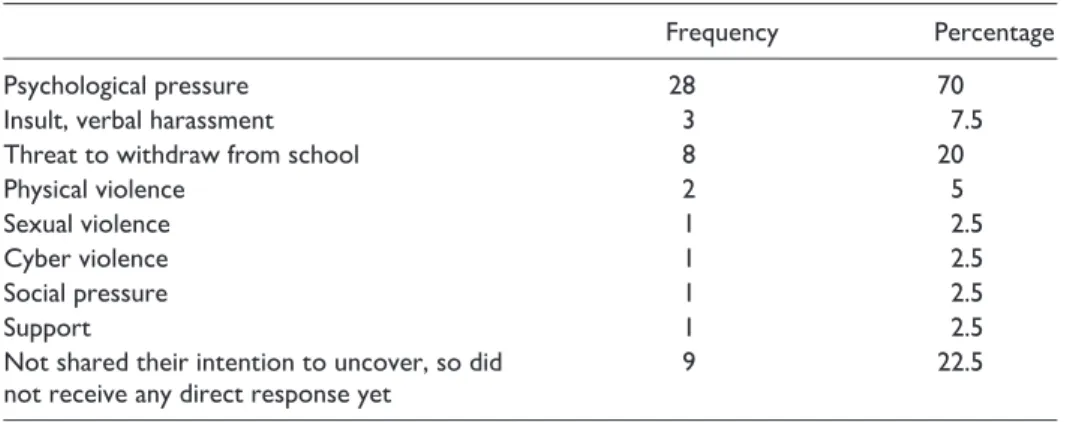
During their struggle, the users receive several reactions from their social environment, mostly from their families and to a lesser extent from school principals, teachers and neighbors. Some experienced more than one form of response presented below in Table 1.
About 22.5% of the users argue that they have not yet openly declared their desire to uncover, because they either assume from their previous conversations that there will be a strong setback, or they are not ready to do so. The users develop some strategies such as waiting until graduation, negotiating about dress code (dressing modestly except for the headscarf) or studying hard to enter a university in a big city away from their families to start a new life (see Table 2).
Cooperation of textual narrative with visual components
These personal expressions of biographic stories of the youth with pious family back-ground have been posted in the format of diary keeping in the sense that the participants tell their life experiences. In the YY Instagram account shares one post with multiple images with a cover image and a highlighted sentence as title, the following image or Table 1. Reaction received.
Frequency Percentage
Psychological pressure 28 70
Insult, verbal harassment 3 7.5
Threat to withdraw from school 8 20
Physical violence 2 5
Sexual violence 1 2.5
Cyber violence 1 2.5
Social pressure 1 2.5
Support 1 2.5
Not shared their intention to uncover, so did
not receive any direct response yet 9 22.5
Table 2. The research participants’ current situation.
Frequency Percentage
Pressures exist but they are sure about their decision to uncover 16 40
They want to uncover and seek help/wait until financially secure 12 30
image(s) consist/s of one paragraph of the participant story on the YY customized page design. Posts of YY platform possess uniformized expression although it shares person-alized narratives. As such the personperson-alized features on social media have been only uti-lized by the platform administration. Thereby, the users do not have an opportunity to be creative or portray an image of themselves when they send out their stories. There is no real name or a pseudonym for the authors of stories except different image-based story covers for each post. Thereby, the individuality of each personal experience has been marked by the image selected by the platform.
Such anonymity provides the opportunity for them to express themselves through the platform. The users are not only struggling with one authority figure but rather they stand before a complex web of social, cultural, economic, and political actors. Thus, the poten-tial of the Internet for providing social movements increased visibility have been endan-gered through new possibilities for monitoring social mobilizations (Uldam, 2018). AKP’s influence on the public sector and education system can be seen in the pressure on individuals regarding their dress codes and lifestyle choices. The only male user in the sample argues that due to economic hardship and the fear of losing his job, he gave in to the pressures of his colleagues:
“I yielded to the manager when he said on Fridays ‘Come on, proper men should not be working
during the prayer time’. I did so in order not to lose my job which barely saves me from my already poor financial situation. When we had to get together during lunch time and meetings, they would joke about my being single. Like my flat is dirty, I don’t have a wife to clean it, I miss home cooked meals and so on. (. . .) I read the letters of women here and my story may seem unimportant compared to what they have been going through. My family doesn’t exercise physical violence on me or I am not threatened economically by my family or I am not forced to get married. But I feel I live the same social pressure. The ‘advantage’ of being a man is maybe that it is less severe.”
This example indicates that hegemonic masculinity has recently acquired a more reli-gious character in the Turkish context and displaying piety (relireli-gious salutations and Friday prayers) has become engrained in the manifestations of masculinity. It also shows that oppression and social pressure is not one dimensional; there are also hierarchies and unequal relations of power among men. As such the rights of individuals can only be expressed through the condition of anonymous collective identity building although YY blog provides through sharing personalized stories.
Although anonymity guaranties participation without being detected by the inner cir-cle of authoritarian communities, this distinguishes the platform from other feminist soli-darity movements such as the #MeToo movement in which personalized stories are posted with the participant’s real names or pseudonyms as well as their own choice of profile pictures. In that sense, the YY online platform aims to project a collective mobi-lization instead of connective action reflecting anti-group tendency. For instance, iden-tity hashtag movements are known to motivate individuals to share “selfies” with personal stories to elucidate the experiences of marginalized social groups (Liu et al., 2018). By connective action instead of collective mobilization influence online partici-pants to form their own personalized self-identity (Afnan et al., 2019) as part of
presentative we-ness (Arda, 2015: 95) rather than group identity. As Allmark inserted women exercise active participation in their formulation of self-portraits, aka selfies, through their own projecting self-image reflection (Allmark, 2019: Introduction). Berger (2008) stated that the male gaze renders women subjectivity passive through the replica-tion of objectifying procedure through consumer market and the affluent society as such woman also objectifies themselves in their own reflection. Thus, solidarity of feminist activism has been also conditioned through the approval of feminist agency both in the number of likes and the dissemination of women’s self-images (Allmark, 2019: Introduction). As the editors argue it is crucial to be seen by others and to gain self-con-fidence through visibility yet they do not want to jeopardize the platform by revealing too much information neither about themselves or the people who send the content:
“The families do things that damage the girls’ confidence to ensure they cover their heads,
especially about their outer appearance and their hair. Psychological violence, cutting their hair or commenting that they look bad damages their confidence. The girls may benefit from sharing this and getting some feedback from others that they look well”.
Providing support and solidarity by remaining anonymous is the strength of YY as it provides a social space for the people who are otherwise not aware of one another. It provides scholarship for students who face financial hardship because they fall out with their families. The users feel touched by the others’ stories and the support they receive in the comments section. They express a strong relief of finding out that they are not alone, which they realize as they share their stories. This realization creates a bond between these people as the individual struggles turn into a more systematic solidarity. As a user has argued:
“The existence of such a platform and the fact that so many women have been going through
this surprised me so much. It moved me so deeply. I thought I was alone or we are the minority.”
Through this realization of not being alone and having a safe space for sharing their sto-ries, the emotions that have so far been directed inwards can now move between people, these are exchanged and have the capacity to take action.
As such, YY platform seeks to build solidarity in a way that conventional social movement protests mostly follow with an “identifiable membership organizations lead-ing the way under common banners and collective identity frames (Bennett and Segerberg, 2013: 742)”. The YY platform deploys personal action frames under central-ized organizational framework. In this sense, the platform does not engage with the logic of “the communication network becomes the organizational form of the political action (Earl and Kimport, 2011)”. In the case of connective action, visual elements such as “memes are network building and bridging units of social information transmission”. YY platform provides its own visual design elements to appropriate, shape, and share themes of participants’ personalized stories. Thereby, YY activist online platform does not com-pletely follow the contemporary connective movements with a “self-actualizing digitally mediated DIY politics” (Allmark, 2019) while it expresses a personalization of politics through its publication of women’s autobiographies.
Yet, YY platform’s use of visuals precisely connotes stylistic-semiotic systems referring to stylistic choices employed in the activist communication. In the case of YY platform, woman’s visibility has been displayed as defiance to patriarchy in the form of contempo-rary illustrations influenced by romanticism art movement or characters of cult popular culture such as the female protagonist of Spirited Away (2001). Except for YY post of soli-darity showing Iranian activist video clip of woman throwing their obligatory headscarves, YY does not post photographs that reveal the identities of the participants. Exclusive pres-ence of drawings instead of photos and selfies give a more “adolescent” aesthetics associ-ated with “dream,” “romantic,” and “innocence” (Adami, 2014). These connotative meanings of the visuals coordinate with their textual narrations of personalized stories. Still, the strict fixation of drawing style with color consistency shapes aesthetically the blog as “romantic but determined.” Thereby, the informality dissolves with professional design of the YY platform that emphasizes commonality of personal experiences.
Besides their act of reserving identity via anonymity, the illustrations selected by the platform directive draw attention to the invisibility of the youth from pious social backgrounds in their communities as well as the misperceptions within the larger soci-ety. The images enable a visibility of what a specific segment of youth from pious background in Turkey feel and think about Islamic lifestyle. Hence, the platform allows “digital witnessing” (Rae et al., 2018) of participants’ self-representations for potential participants and broader society. The common trait of symbolic and romantic influence, the characters seen in these visual representations are usually portrayed as standing alone with their depth-felt emotions most commonly with elements of the natural world such as animals, trees, or water. This indicates their alienation of the societal human-made norms, culture, and subsequent organizations as much as the disconnection of participants’ personal identity with their own social identity. For some exceptional examples, the blog used photos or illustrations representing woman in hijab such as Waldemar Stepien’s illustration for culture trip journal of travel with several figures of women with hijab in cubist manner to illustrate Rabiya Jaffery’s essay (Jaffery, 2018) in the same journal on different types of covering. Another excep-tion of image representing covered woman is Wolfgang Krolow’s photo (1981) show-ing a little girl with headscarf playshow-ing with another girl in secular dress in Berlin (Krolow, 1981). These two examples that actually portray physically covered women challenge their usual portrayal through the accentuation on inner world as a reality not noticed behind bodily presence. Thus YY accentuates on the mistrust of physical appearances that can conceal the deep-down atrocities in society as well as solidarity invisible beyond the inner circle of community.
The illustrations are the artworks including contemporary and classical famous pieces with international artists such as Lucy Mckenzie, Gertrude Hermes, Theodor Kittelsen. Contemporary female artists outnumber male artists or canonic works for the illustrations used to accompany participants’ stories of Islamic lifestyle imposition. For instance, one of the illustrative cover images belong to Martina Fischmeister, a contemporary female artist from Czech Republic. In her personal Instagram account, the artist states that she likes to draw flowers to make herself happy, for another post she drew her stress between commission work and mental breakdown. One of the illus-tration artists referenced in the blog is Lola Gil. She states in her personal website that
throughout her career she has always been a painter of narrative escapism, with her work evoking personal connections for each individual viewer : “Because it is exe-cuted in a surreal way, it allows the viewer to create their own story and meaning” (Gil, n.d.). Another female artist of cover illustration used is Julie Buffalohead that connects “the mythical with the ordinary, the imaginary, and the real, and offers a space into which viewers can bring their own experiences” featuring predominantly animal char-acters of childhood stories using metaphors. Consequently, these images are illustra-tive of the participants’ inner worlds with their specific emphasis on symbolism and Romantic Movement undertones as well as the use of warm colors indicating emo-tional status. For instance, one of the illustrations used belongs to the surrealist artist Salvador Dali although it is not one of his most famous artworks. Bu Hua, female digi-tal artist known for flash animation works illustrates one of the participant’s story that mention how Korean TV series helped her to understand that she is still young for making drastic life choices. While such detail in the story shared does not embody the participant’s entire experience, the choice of the artist for this specific story eventually demonstrates the invisible ties hence solidarity configured among Bu Hua, a surrealist illustrator from Korea and the author unnamed. As such the YY platform puts emphasis on the visibility of the inner world rather than bodily presence under the pressure of societal codes.
Conclusion: Activist design of communication and its logic
of mobilization
The distinguishing features of activist communication design define the organizational mechanisms of social action for mobilization. Connective action of hashtag activism sustains itself through interactivity enabled communication design via direct social media engagement. Such communication logic and action design does not necessarily mark for every initiative of mobilization a politically effective method for seeking out solidarity (Bennett and Segerberg, 2013) via increasing visibility. Instead of mobilizing the expression of personal concerns on a larger scale of activism, YY platform embodies a unique experience of women oppressed by conservative lifestyle in their Islamist con-servative families and communities. This requires `boundary work` as well, in which these women distinguish themselves from the two strongest poles regarding the head-scarf issue in Turkey namely the established groups and ideologies of Kemalists versus the pro-AKP Islamists in Turkey. Thus, the examination of activist communication design online also necessitates the consideration of “the continued relevance of the pro-fessional, institutional and deliberative aspects of politics” (Markham, 2014: 92). The particularity of YY necessitates narrative fidelity in their communication design to build collective action while the corresponding counterparts of the same controversy occupy the major historical political camp-like trends in Turkey.
The example of YY platform primarily reveals the fact that critical thought must focus on balancing between group rights and individual rights. An uncritical argumentation on group identity provokes reductionism; while group rights may be empowering for most of the group members, they may be restricting for the less powerful individuals who would rather wish to be treated under universalist laws that prioritize the rights of the individual.
The contribution of this study’s findings for women’s studies on an international scale is twofold; on the policy-making level and on intersectionality. First, as international migra-tion alters the ethnic and religious composimigra-tion of namigra-tion states, it is crucial to be able to balance group rights and individual liberties. Overgeneralized assumptions of migrants from predominantly Muslim countries, particularly migrant women due to the over-visi-bility of headscarf, is problematic and it limits the policy makers’ vision, either assuming that women from such countries are all oppressed or that the multicultural premises of recognizing religious freedom will solve everything. The first position bears the risk of disregarding women’s agency and reproduces the stereotypes about women wearing hijab while the second approach misses the issue of the right not to wear the headscarf. This study contributes to the understanding that there may be alternative forms of identification with cultural and religious symbols. The headscarf is not unproblematically adopted by all Muslim women; it is rather contested, rejected or simply endured by some women. Intersectional feminism has identified the marginalities of women who wear hijab (Abu-Lughod, 2013; Mirza, 2013; Zimmerman, 2015) however it should also recognize that rejecting hijab can cause the marginalization of these women within their own communi-ties, placing them in the intersection of different marginalities.
The research findings also contribute to the current debate of activist media studies on connective versus collective solidarity building in the social media through the lens of communication design that accords with different socio-political and cultural set-tings. The fact that YY platform expresses peculiar experiences of the youth from Islamist conservative ground led the solidarity building based on the collective action of the group at the edges of other dominant groups occupying the political realm. Thus, YY aims to frame the mutual experiences of active and potential participants against imposed Islamic lifestyle. What the YY digital mobilization shares with online connec-tive activism is that it enables sharing and giving visibility to those who have been silenced in the political realm; and what differs is that it appropriates anonymous visu-ality and centralized communication design rather than personalized design of expres-sions under hashtag activism. Such communication design logic does not reveal the identities of the participants hence anonymity does not further challenge the lives of these women, yet it blocks the possible connection of YY platform with a broader activist networking and support.
While the focus of the hashtag social movements online is to bring forward the agency of the oppressed individuals, the collective nature of the YY is strengthened by its ano-nymity. The fact that the stories resemble one another, and that the visuals do not disclose the users’ identity make a strong statement about the shared aspects of oppression. As the analysis of the emotions in the narratives demonstrates, it is empowering in itself to find their stories in one another’s, which implies that they are not the only people who experi-ence various forms of social pressure. This format provides a safe space for the discus-sion of a delicate matter and emphasizes the collectivity of their experience. Even when their situation does not improve, the availability of the platform and the very realization of the fact that they are not alone give them courage. To this end, YY reflects a narrative fidelity on its participants’ personal experiences with great emphasis on the shared per-ceptions and feelings of a mutual fate in accordance through centralized activist com-munication design.
Funding
The author(s) received no financial support for the research, authorship, and/or publication of this article.
ORCID iD
Balca Arda https://orcid.org/0000-0002-3793-2472
Notes
1. The regulation has been executed after the military coup intervention of 1981 constitution. 2. Even before switching to full Islamic dress code, there are limitations for girls such as not
revealing the arms and legs, not being allowed to wear regular swimsuits or shorts in the sum-mer so that they will get used to dressing modestly.
References
Abu-Lughod L (2015) Do Muslim Women Need Saving? Reprint edition. Cambridge, MA & London, England: Harvard University Press.
Adami E (2014) Multimodal Analysis of Aesthetics: Two Versions of a Food Blog Compared. ESRC: National Centre for Research Methods.
Afnan T, Huang H-Y, Sclafani M, et al. (2019) Putting a price on social movements: A case study of #metoo on instagram. Proceedings of the Association for Information Science and
Technology 56(1): 1–9. DOI: 10.1002/pra2.2.
Ahmed S (2004) Affective economies. Social Text 22(2): 117–139. DOI: 10.1215/01642472-22-2_79-117.
Aksoy HA (2015) Invigorating democracy in Turkey: The agency of organized Islamist women. Politics & Gender 11(1): 146–170 (Cambridge University Press). DOI: 10.1017/ S1743923X1500001X.
Alexander VD (2008) Analysing visual materials. In: Gilbert N (ed.) Researching Social Life, 3rd edn.London: SAGE.
Allmark P (2019) Making a difference: Social media, photography, activism and women in Asian contexts. In: Proceedings of the 1st International Conference on Emerging Media, and Social
Science, ICEMSS 2018, 7–8 December 2018, Banyuwangi, Indonesia. ECU Publications
Post 2013. DOI: 10.4108/eai.7-12-2018.2281801.
Arda B (2015) The construction of a new sociality through social media: The case of the Gezi uprising in Turkey. Conjunctions. Transdisciplinary Journal of Cultural Participation 2(1): 72–99. DOI: 10.7146/tjcp.v2i1.22271.
Aslan Akman C (2013) Islamic women’s ordeal with the new faces of patriarchy in power: Divergence or convergence over expanding women’s citizenship. In: Özmen FA and Dönmez RÖ (eds.) Gendered Identities: Criticizing Patriarchy in Turkey. Lexington Books.
Ayata AG and Tütüncü F (2008) Party politics of the AKP (2002–2007) and the predica-ments of women at the intersection of the Westernist, Islamist and Feminist discourses in Turkey. British Journal of Middle Eastern Studies 35(3): 363–384 (Routledge). DOI: 10.1080/13530190802525130.
Başkan F (2010) Religious versus secular groups in the age of globalisation in Turkey.
Totalitarian Movements and Political Religions 11(2): 167–183 (Routledge). DOI:
Bennett WL and Segerberg A (2013) The logic of connective action: Digital media and the per-sonalization of contentious politics. Information, Communication & Society 15(5): 739–768. DOI: 10.1080/1369118X.2012.670661.
Berger J (2008) Ways of Seeing. Penguin.
Bilici M (2018) The Crisis of Religiosity in Turkish Islamism. Middle East Report. Available at: https://merip.org/2018/12/the-crisis-of-religiosity-in-turkish-islamism/
Bogner A, Littig B and Menz W (2009) Interviewing Experts. Palgrave Mcmillan.
Bozdag C and Smets K (2017) Understanding the images of Alan Kurdi with “small data”: A qual-itative, comparative analysis of tweets about refugees in Turkey and Flanders. International
Journal of Communication 11: 24.
Butler D (2018) With more Islamic schooling, Erdogan aims to reshape Turkey. Available at: http://www.reuters.com/investigates/special-report/turkey-erdogan-education/ (accessed 29 June 2020).
Cebeci B (2018) ‘Yalnız yürümeyen kadınlar’la söyleşiler (1): ‘Otobüste başörtümü çıkarıp okula gidiyor, otobüste tekrar kapanıp eve öyle dönüyordum’. In: Medyascope. Available at: https://medyascope.tv/2018/09/03/yalniz-yurumeyen-kadinlarla-soylesiler-1-otobuste-basortumu-cikarip-okula-gidiyor-otobuste-tekrar-kapanip-eve-oyle-donuyordum/ (accessed 28 June 2020).
Coşkun M and Şentürk B (2012) The Growth of Islamic Education in Turkey: The AKP’s Policies toward Imam-Hatip Schools. Neoliberal Transformation of Education in Turkey, pp. 165– 177. DOI: 10.1057/9781137097811_13.
Crow KD (2008) Turkey and the Türban The Dilemmas of Laicist ideology. In: Razali Kassim Y (ed.) Strategic Currents. Singapore: ISEAS–Yusof Ishak Institute Singapore, pp. 168–171. DOI: 10.1355/9789812308849-038.
Earl J and Kimport K (2011) Digitally Enabled Social Change: Activism in the Internet Age, 1st edn. Cambridge, MA: The MIT Press.
Gil L (n.d.) About. Available at: https://www.lolafineart.com/about (accessed 2 July 2020). Göle N (1997) The Forbidden Modern: Civilization and Veiling. University of Michigan Press.
Available at: https://www.press.umich.edu/10250/forbidden_modern (accessed 29 June 2020).
Gültekin L (2015) AK Parti giderse dindarların başına ne gelir? Available at: http://www.diken. com.tr/ak-parti-giderse-dindarlarin-basina-ne-gelir/ (accessed 28 June 2020).
Hand M (2012) Ubiquitous Photography. Polity.
Jaffery R (2018) What is the difference between the Hijab, Niqab and Burka? Available at: https:// theculturetrip.com/middle-east/articles/the-difference-between-the-hijab-niqab-and-burka/ (accessed 2 July 2020).
Kandiyoti D (1991) Identity and its discontents: Women and the nation. Millennium 20(3): 429– 443. DOI: 10.1177/03058298910200031501.
Kaya A (2015) Islamisation of Turkey under the AKP rule: Empowering family, faith and charity.
South European Society and Politics 20(1): 47–69. DOI: 10.1080/13608746.2014.979031.
Krolow W (1981) Kinderwelten Exhibition. Available at: http://photography-now.com/artist/wolf-gang-krolow (accessed 2 July 2020).
Liu F, Ford D, Parnin C, et al. (2018) Selfies as social movements: Influences on participation and perceived impact on stereotypes. In: Proceedings of the ACM on Human–Computer
Interaction. DOI: 10.1145/3134707.
Lüküslü D (2016) Creating a pious generation: youth and education policies of the AKP in Turkey. Southeast European and Black Sea Studies 16(4) 637–649. DOI: 10.1080/14683857.2016.1243332.
Markham T (2014) Social media, protest cultures and political subjectivities of the Arab spring.
Media, Culture & Society 36(1): 89–104. DOI: 10.1177/0163443713511893.
Mcdonald K (2002) From solidarity to fluidarity: Social movements beyond ‘collective iden-tity’ – The case of globalization conflicts. Social Movement Studies 1(2): 109–128. DOI: 10.1080/1474283022000010637.
Mihelj S and Stanyer J (2019) Theorizing media, communication and social change: Towards a processual approach. Media, Culture & Society 41(4): 482–501. DOI: 10.1177/0163443718810926.
Mirza HS (2013) ‘A second skin’: Embodied intersectionality, transnationalism and nar-ratives of identity and belonging among Muslim women in Britain. Women’s Studies
International Forum 36: 5–15 (Gender, Culture and Work in Global Cities). DOI: 10.1016/j.
wsif.2012.10.012.
Najmabadi A (1991) Hazards of modernity and morality: Women, state and ideology in contem-porary Iran. In: Kandiyoti D (ed.) Women, Islam and the State. London: Palgrave Macmillan UK, pp. 48–76. DOI: 10.1007/978-1-349-21178-4_3.
Rae M, Holman R and Nethery A (2018) Self-represented witnessing: the use of social media by asylum seekers in Australia’s offshore immigration detention centres. Media, Culture &
Society 40(4): 479–495. DOI: 10.1177/0163443717746229.
Saktanber A and Corbacioglu G (2008) Veiling and Headscarf-Skepticism in Turkey. Social
Politics: International Studies in Gender, State & Society 15(4): 514–538. DOI: 10.1093/sp/
jxn018.
Sandikci O and Ger G (2001) Fundamental Fashions: the Cultural Politics of the Turban and the
Levi’S. ACR North American Advances NA-28. Available at: https://www.acrwebsite.
org/volumes/8459/volumes/v28/NA-28/full (accessed 23 July 2020).
Seckinelgin H (2006) Civil society between the state and society: Turkish women with Muslim headscarves? Critical Social Policy 26: 748–769. DOI: 10.1177/0261018306068472. T24 (2018) Prof. İhsan Fazlıoğlu: Mesele ciddi, başörtülü ateistler var! Available at: https://t24.
com.tr/haber/prof-ihsan-fazlioglu-mesele-ciddi-basortulu-ateistler-var,585123 (accessed 23 July 2020).
Toprak M and Uslu N (2009) The headscarf controversy in Turkey. Journal of Economic and
Social Research 11(1): 43–67.
Uldam J (2018) Social media visibility: Challenges to activism. Media, Culture & Society 40(1): 41–58. DOI: 10.1177/0163443717704997.
Uncu BA (2018) Seçmen Kümeleri AK Parti Seçmenleri - Electrorate Groups The AKP Elecorate. May. KONDA. Available at: https://konda.com.tr/tr/rapor/secmen-kumeleri-ak-parti-sec-menleri/.
Wozniak A, Lück J and Wessler H (2015) Frames, stories, and images: The advantages of a mul-timodal approach in comparative media content research on climate change. Environmental
Communication 9(4): 469–490. DOI: 10.1080/17524032.2014.981559.
Yuval-Davis N (1997) Women, Citizenship and Difference: Feminist Review. London: SAGE Publications. DOI: 10.1080/014177897339632.
Zimmerman DD (2015) Young Arab Muslim women’s agency challenging western feminism.