Ilhan Sanisoglu,
MD
, Mustafa Guden,
MD
, Zehra Bayramoglu,
MD
, Ertan Sagbas,
MD
,
Cengiz Dibekoglu,
MD
, S. Yavuz Sanisoglu,
PhD
, and Belhhan Akpinar,
MD
Department of Cardiovascular Surgery, Department of General Surgery, Kadir Has University Medical Faculty, Florence Nightingale Hospital, Istanbul, and Department of Biostatistics, Gulhane Military Medical Academy, Etlik, Ankara, Turkey
Background. The aim of this study was to compare
gastrointestinal complications and associated risk factors among patients undergoing cardiac surgery using off-and on-pump revascularization techniques.
Methods. A total of 1146 adult patients who underwent
coronary artery surgery during a 6-year period were evaluated retrospectively. Group 1 consisted of 546 pa-tients operated using off-pump techniques and group 2 consisted of 600 cases operated with cardiopulmonary bypass. Patients were compared and evaluated for gas-trointestinal complications and possible associated risk factors using univariate and multivariate logistic regres-sion analysis.
Results. Overall mortality was 1.6% in group 1 and
2.2% in group 2 (pⴝ 0.523). Mortality due to gastrointes-tinal complications was 38.5% and 35.7% respectively in group 1 and group 2. The mean EuroSCORE value was 5.1ⴞ 2.8 in group 1 and 3.8 ⴞ 2.4 in group 2 (p < 0.001).
The most common gastrointestinal complication in the off-pump group was gastrointestinal bleeding. The lead-ing complication in group 2 was intestinal ischemia.
Conclusions. The incidence rates of gastrointestinal
complications were similar in the on- and off-pump coronary artery bypass groups, the type of gastrointesti-nal complications, however, was different. Mortality rate due to these complications was also similar and re-mained high, regardless of the type of surgery. Cardio-pulmonary bypass did not emerge as a risk factor for gastrointestinal complications, but prolonged cardiopul-monary bypass (longer than 98 minutes) resulted in a high incidence of such complications. Old age and ad-vanced arteriosclerosis emerged as risk factors in both groups resulting in gastrointestinal complications sug-gesting the ischemic nature of the injury.
(Ann Thorac Surg 2004;77:619 –25) © 2004 by The Society of Thoracic Surgeons
G
astrointestinal (GI) complications secondary to car-diac surgery are rare (0.4% to 2%), but result in a significantly high mortality rate [1]. This is mainly be-cause these complications are difficult to diagnose, and symptoms can be masked in the early postoperative period due to sedation and mechanical ventilation caus-ing a delay in diagnosis [2]. Some risk factors associated with GI complications after cardiac surgery are low perioperative cardiac output or hypotension, long dura-tion of cardiopulmonary bypass (CPB), older age, pro-longed ventilation time, valve surgery, reexploration of the chest, and history of peptic ulcer [3].Off-pump coronary artery bypass (OPCAB) has been argued to reduce the inflammatory response during coronary artery bypass grafting (CABG) [4]. Based on this argument, it was believed that OPCAB surgery could reduce subsystem and end organ damage seen after conventional CABG leading to less morbidity. There are numerous studies in the literature comparing the out-come between off-pump and on-pump coronary artery revascularization techniques. However, there are few
data comparing GI complications following these two different methods of revascularization [5].
The aim of this study was to compare GI complications and associated risk factors among patients undergoing cardiac surgery using off-pump and on-pump coronary artery revascularization techniques.
Patients and Methods
The Ethical Committee of the hospital approved the study. An informed consent was obtained from each patient. The study consisted of 1,146 cases that have undergone CABG in Florence Nightingale Hospital be-tween January 1997 and September 2002. Cases with concomitant procedures such as valve repair, valve re-placement, or resection of left ventricle aneurysm were not included in the study. Cases were divided into two groups: group 1 consisted of 546 CABG patients operated with off-pump technique. Group 2 included 600 patients selected with stratified sampling technique between the same years through weighting by year among 2351 pa-tients that received CABG with on-pump technique. Randomized numbers table was used for selection. All
Accepted for publication Aug 6, 2003.
Address reprint requests to Dr Akpinar, Department of Cardiovascular Surgery, Kadir Has University Medical Faculty, Florence Nightingale Hospital, Abide-I Hu¨rriyet Cad. No. 290, Istanbul, Turkey; e-mail: [email protected].
Dr Akpinar discloses that he has a financial relation-ship with Medtronic.
© 2004 by The Society of Thoracic Surgeons 0003-4975/04/$30.00
Published by Elsevier Inc doi:10.1016/j.athoracsur.2003.08.006
patients were operated on by the same surgical team using the same technique for myocardial protection and operative strategy for revascularization.
The following preoperative variables were identified: patient age, gender, diabetes mellitus, hypertension, hy-percholesterolemia, smoking, functional capacity (New York Heart Association [NYHA] classification), history of GI events, cerebrovascular accident, carotid artery dis-ease, peripheral artery disdis-ease, renal artery stenosis, abdominal aortic aneurysm, renal dysfunction (creati-nine ⬎ 1.5 mg/dl), aortic arteriosclerosis, malignancy, chronic obstructive pulmonary disease (COPD), reopera-tion, and history of myocardial infarction. Five operative variables were examined: urgency of operation, number of bypasses, left ventricle ejection fraction (LVEF), dura-tion of CPB (for on-pump group), and duradura-tion of oper-ation. Postoperative data regarding intensive care unit (ICU) stay, use of inotropic agents, intraaortic balloon pump (IABP), reexploration, blood transfusions, hemodi-alysis, and atrial fibrillation rate were recorded for both groups.
The GI complications were GI bleeding, duodenal perforation, intestinal ischemia, pancreatitis, hepatic dys-function, acute cholecystitis, and paralytic ileus. Defini-tions for GI complicaDefini-tions are derived from the STS database [6].
Operative Protocol
Antiaggregant medication (aspirin, plavix) was discontin-ued 5 days before the operation. All surgical procedures were performed through sternotomy. Conduits for coro-nary bypass including the internal thoracic artery (ITA), radial artery, and saphenous vein were harvested in standard methods. In the on-pump group, CPB was performed by cannulation of the ascending aorta and the right atrium. Both antegrade and retrograde tepid (32°C) blood cardioplegia were used for myocardial protection. The perfusate was allowed to cool to 32°C, and all patients received nonpulsatile flow at rates of 2.2 to 2.4 L · min⫺1· m⫺2. All proximal and distal anastomoses were performed with a single cross clamp technique. Epinephrine infusion at 0.01 to 0.1g · kg⫺1· min⫺1was the first choice of inotropic medication during weaning from CPB. Dobutamine was added as a second choice when deemed necessary. Heparin dose was neutralized with protamine according to the activated clotting time (ACT).
The technique that we used during off-pump CABG has been described in our previous study [7]. Initially a half dose of heparin was administered followed by an hourly additional dose that was regulated with the ACT. In order to minimize aortic manipulation, T or Y grafts were performed using ITAs or the radial artery. Follow-ing the completion of the ITA anastomoses, the proximal anastomoses of saphenous vein grafts were done, first with a partial aortic clamp then the distal anastomoses were performed. Stabilization of the coronary arteries was accomplished using the Octopus II or III (Medtronic Inc., Minneapolis, MN) stabilization systems. At the end of the operation, a half dose of protamine was
adminis-tered for neutralization of heparin and the Hepcon He-mostasis Management System (Medtronic Inc.) was used to assess if an extra dose of protamine was needed.
Aspirin (150 mg) was administered from the nasogas-tric tube in both groups 3 hours after arrival at the ICU. In addition, the off-pump group received oral plavix (clopidogrel; 75 mg) medication for the duration of one month starting on the first postoperative day. Cefu-roxime was administered for antibiotic prophylaxis. Fa-motidin (40 mg) was applied intravenously upon anes-thesia induction as prophylaxis for GI bleeding; oral Famotidine (40 mg) and antacid medication were main-tained during hospital stay. Patients with a preoperative history of GI bleeding received oral Omeprazole (40 mg) instead of Famotidine.
Statistical Analysis
All of the statistical analyses were performed by Stats Direct statistical software (Ver 2.2.0; StatsDirect, Ltd, Cheshire, United Kingdom). Descriptive statistics were shown as arithmetic mean⫾ standard deviation. We first used the Kolmogorov-Smirnov method to test the nor-mality assumptions for the variables. In order to compare the variables for two groups, the Mann-Whitney U test was performed. The effects of the other variables on GI system complications were first tested by Univariate logistic regression analysis for each group separately. Multivariate logistic regression analysis was then ap-plied. Cox-Snell R2
values were also calculated. For the cut-off point of CPB, we used the region of interest curve and calculated the area under the curve. The p values less than or equal to 0.05 were considered as statistically significant.
Results
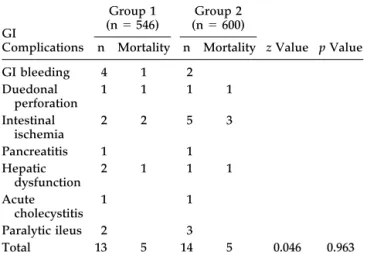
In group 1, 13 patients (2.4%) developed GI system complications postoperatively, whereas 14 patients (2.4%) developed GI complications postoperatively in group 2 (p⫽ 0.963). The most commonly observed GI complication was GI bleeding (n ⫽ 4) in group 1 and intestinal ischemia (n⫽ 5) in group 2. Mortality rate of the patients with GI complications was 38.5% in group 1 and 35.7% in group 2 (Table 1).
The risk profile for both groups was evaluated with the use of the EuroSCORE system. Mean risk score was 5.1⫾ 2.8 for group 1 and 3.8 ⫾ 2.4 for group 2 (p ⬍ 0.001). Although group 1 patients had a higher EuroSCORE, both groups were classified as medium risk patients under the EuroSCORE system. Preoperative clinical vari-ables of the patients are presented in Table 2. The rate of emergency operations was 6% in group 1 and 6.8% in group 2 (p⫽ 0.587). The mean number of anastomoses was 2.2⫾ 0.8 in group 1 and 2.97 ⫾ 0.9 in group 2 (p ⬍ 0.001). The number of patients with LVEF lower than 35% accounts for 5.1% of group 1 and 10.2% of group 2 (p⬍ 0.001). Average CPB time (for group 2) was 73.7⫾ 19.1 minutes. Duration of operation was 154⫾ 0.8 minutes in group 1 and 178.8⫾ 0.9 minutes in group 2 (p ⬍ 0.001). ICU stay was 28.6⫾ 20.8 hours in group 1, and 51.9 ⫾ 60.4
hours in group 2 (p ⬍ 0.001). Postoperative inotropic support (epinephrine) was 0.03⫾ 0.07g · kg⫺1· min⫺1 in group 1 and 0.08⫾ 0.06g · kg⫺1· min⫺1in group 2 (p ⬍ 0.001). The use of IABP was 0.9% in group 1 and 2.5% in group 2 (p ⫽ 0.04). Reexploration rate was 1.6% in group 1 and 2.3% in group 2 (p ⫽ 0.285). The blood
transfusion in the ICU was 1.41⫾ 0.9 U in group 1 and 2.23 ⫾ 1.2 U in group 2 (p ⬍ 0.001). Postoperative hemodialysis rate was 2.9% in group 1 and 1.4% in group 2 (p⫽ 0.059). Incidence of postoperative atrial fibrillation was 10.3% in group 1 and 16.3% in group 2 (p⫽ 0.003). Mortality rate was 1.6% in group 1 and 2.2% in group 2 (p ⫽ 0.523).
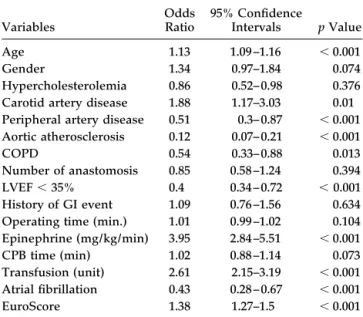
Factors that could contribute to postoperative GI com-plications were evaluated in the whole series (n⫽ 1146) first with univariate and then with multivariate analysis. These factors are shown in Table 3. Age, peripheral artery disease, aortic arteriosclerosis, low LVEF, use of epinephrine, blood transfusion, atrial fibrillation, and a high EuroSCORE emerged as significant risk factors for GI complications in the whole series. CPB did not emerge as a risk factor. A further analysis was performed to evaluate the risk factors contributing to GI system com-plications for each group (Table 4). This was followed by a multivariate analysis of the factors that came forward during the univariate analysis (Table 5). In group 1, advanced age, carotid artery disease, peripheral artery disease, atherosclerotic aorta, number of anastomoses, LVEF less than 35%, and a high EuroSCORE were found to be risk factors for GI system complications. However, in group 2, advanced age, peripheral artery disease, COPD, high dose inotrope use, excess blood transfusion,
Table 1. Type of Gastrointestinal Complications
GI Complications Group 1 (n⫽ 546) (nGroup 2⫽ 600) z Value p Value n Mortality n Mortality GI bleeding 4 1 2 Duedonal perforation 1 1 1 1 Intestinal ischemia 2 2 5 3 Pancreatitis 1 1 Hepatic dysfunction 2 1 1 1 Acute cholecystitis 1 1 Paralytic ileus 2 3 Total 13 5 14 5 0.046 0.963 GI⫽ gastrointestinal.
Table 2. Preoperative Clinical Characteristics and Comorbidities of Patients
Variables Group 1 (n⫽ 546) Group 2 (n⫽ 600) z Value p Value n Percent n Percent Age (mean⫾ SD) 67.2⫾ 8.9 60.4⫾ 9.3 12.067 ⬍ 0.001 Gender 1.233 0.218 Female 167 30.6 204 34 Male 379 69.4 396 66 Diabetes mellitus 142 26 124 20.7 2.138 0.03 Hypertension 245 44.9 185 30.8 4.9 ⬍ 0.001 Hypercholesterolemia 486 89 469 78.2 4.918 ⬍ 0.001 Smoking 354 64.8 288 48 5.732 ⬍ 0.001 NYHA Class I 13 2.4 11 1.8 0.647 0.259 Class II 350 64.1 505 84.2 7.794 ⬍ 0.001 Class III 177 32.4 61 10.2 9.274 ⬍ 0.001 Class IV 6 1.1 23 3.8 2.944 0.003 History of GI event 100 18.3 46 7.7 5.397 ⬍ 0.001 Cerebrovascular accident 20 3.7 4 0.7 3.536 ⬍ 0.001
Carotid artery disease⬎ 50% 192 35.2 56 9.3 10.601 ⬍ 0.001
Peripheral artery disease 63 11.5 26 4.3 4.55 ⬍ 0.001
Renal artery stenosis⬎ 50% 6 1.1 23 1 1.116 0.264
Abdominal aorta aneurysm 6 1.1 2 0.3 1.116 0.264
Renal dysfunction 78 14.3 8 1.3 8.308 ⬍ 0.001 Aortic atherosclerosis 83 15.2 12 2 8.092 ⬍ 0.001 Malignancy 11 2 2 0.3 2.683 0.007 COPD 158 28.9 40 6.7 9.956 ⬍ 0.001 Reoperation 4 0.7 13 2.2 2.005 0.045 History of MI 197 36.1 164 27.3 3.182 0.042
COPD⫽ chronic obstructive pulmonary disease; GI⫽ gastrointestinal; MI⫽ myocardial infarction; NYHA⫽ New York Heart
Associa-tion; SD⫽ standard deviation.
atrial fibrillation, a high EuroSCORE, and prolonged CPB time are found to be risk factors for GI system complica-tions. The cut-off point for CPB was found to be 98 minutes. For this point, the sensitivity and specificity values were 0.857 and 0.926, respectively (Fig 1). History
of GI event emerged as a risk factor for both groups in univariate analysis, but not in multivariate analysis.
Comment
The etiology and risk factors contributing to GI compli-cations after coronary artery surgery have been defined extensively [8]. The combined stress of anesthesia, sur-gery, anticoagulation, hypothermia, and cardiopulmo-nary bypass triggers a hormonal stress response and a massive defense reaction compounded by hemodilution and nonpulsatile flow, which as a whole can lead to organ damage. Like all other organ systems, the GI system is exposed to vasoactive substances and microembolism during CPB, but usually few clinical manifestations oc-cur. Most of the GI complications after CABG have been attributed to low cardiac output and visceral hypoperfu-sion resulting in mucosal ischemia and necrosis. Stress ulceration, mucosal atrophy, bacterial overgrowth from stress ulcer prophylaxis, and loss of barrier function with increased permeability may lead to bacterial transloca-tion, sepsis, and multiorgan failure [9]. CPB causes re-duction in mucosal blood flow and leads to mesenteric sequestration of neutrophils and stimulates systemic inflammatory response [10]. It has been demonstrated that significant intestinal mucosal ischemia can occur during CPB despite the normal indices of global perfu-sion. Factors released during CPB such as vasopressin, catecholamines, tromboxane A2 and B2 lead to redistri-bution of blood flow away from the mucosa because of
Table 3. Multivariate Analysis of Risk Factors of GI System Complications for All Patients (n⫽ 1146)
Variables Odds Ratio 95% Confidence Intervals p Value Age 1.13 1.09 –1.16 ⬍ 0.001 Gender 1.34 0.97–1.84 0.074 Hypercholesterolemia 0.86 0.52– 0.98 0.376 Carotid artery disease 1.88 1.17–3.03 0.01 Peripheral artery disease 0.51 0.3– 0.87 ⬍ 0.001
Aortic atherosclerosis 0.12 0.07– 0.21 ⬍ 0.001
COPD 0.54 0.33– 0.88 0.013
Number of anastomosis 0.85 0.58 –1.24 0.394 LVEF⬍ 35% 0.4 0.34 – 0.72 ⬍ 0.001
History of GI event 1.09 0.76 –1.56 0.634 Operating time (min.) 1.01 0.99 –1.02 0.104 Epinephrine (mg/kg/min) 3.95 2.84 –5.51 ⬍ 0.001 CPB time (min) 1.02 0.88 –1.14 0.073 Transfusion (unit) 2.61 2.15–3.19 ⬍ 0.001 Atrial fibrillation 0.43 0.28 – 0.67 ⬍ 0.001 EuroScore 1.38 1.27–1.5 ⬍ 0.001 Cox-Snell R2⫽ 0.737.
COPD⫽ chronic obstructive pulmonary disease; GI⫽
gastrointesti-nal; LVEF⫽ left ventricle ejection fraction.
Table 4. Univariate Analysis of Risk Factors for Gastrointestinal Complications
Variables Off-Pump (n⫽ 546) On-Pump (n⫽ 600) Odds Ratio 95% Confidence Intervals p Value Odds Ratio 95% Confidence Intervals p Value Age 1.05 1.04 –1.06 ⬍ 0.001 1.06 1.05–1.07 ⬍ 0.001 Gender 5.34 2.51–11.19 ⬍ 0.001 3.49 1.92– 6.37 ⬍ 0.001 Hypercholesterolemia 0.02 0.02– 0.04 ⬍ 0.001 0.09 0.07– 0.14 ⬍ 0.001 Smoking 1.21 0.22– 6.54 0.826 0.76 0.15– 4.01 0.649
Carotid artery disease 3.73 1.53–9.87 ⬍ 0.001 8.3 3.57–19.35 ⬍ 0.001
Peripheral artery disease 6.88 3.27–14.41 ⬍ 0.001 6.87 3.27–14.41 ⬍ 0.001
Renal dysfunction 0.67 0.34 –1.33 0.255 1.21 0.87–1.69 0.227 Aortic atherosclerosis 3.39 2.11–5.45 ⬍ 0.001 1.33 0.49 –3.59 ⬍ 0.001 COPD 1.87 0.92–3.81 ⬍ 0.001 2.99 1.46 – 6.12 0.018 Number of anastomosis 0.77 0.64 – 0.93 0.006 0.85 0.68 –1.07 0.176 LVEF⬍ 35% 0.29 0.2– 0.43 ⬍ 0.001 0.02 0.01– 0.04 ⬍ 0.001 History of GI event 8.09 4.33–15.14 ⬍ 0.001 4.75 2.22–9.18 ⬍ 0.001
Operating time (min) 1.02 1.02–1.03 ⬍ 0.001 1.02 1.01–1.05 ⬍ 0.001
Epinephrine (g/kg/min) 0.33 0.27– 0.41 ⬍ 0.001 0.22 0.18 – 0.28 ⬍ 0.001 CPB time (min) 1.05 1.04 –1.08 ⬍ 0.001 Transfusion (unit) 6.06 4.64 –7.92 ⬍ 0.001 3.95 3.24 – 4.83 ⬍ 0.001 IABP 0.67 0.11–3.99 0.657 2.17 0.68 –5.85 0.206 Reexploration 1.66 0.39 – 6.97 0.484 1.8 0.61–5.37 0.292 Atrial fibrillation 6.99 3.17–15.43 ⬍ 0.001 8.8 4.58 –16.93 ⬍ 0.001 Euroscore 1.85 1.69 –2.05 ⬍ 0.001 2.01 1.79 –2.26 ⬍ 0.001
COPD ⫽ chronic obstructive pulmonary disease; CPB ⫽ cardiopulmonary bypass; GI ⫽ gastrointestinal; IABP ⫽ intraaortic balloon
pump; LVEF⫽ left ventricle ejection fraction.
regional vasoconstriction, and may contribute to mucosal ischemia [11].
Off-pump coronary artery surgery reduces systemic inflammatory response, allowing an environment that is physiologically more favorable for the organ systems [4]. It has been reported by many series that off-pump surgery reduces the need for early systemic vasoconstric-tor or inotropic requirement. This may contribute to improved organ function, particularly in critically ill patients [12]. Therefore, off-pump coronary artery sur-gery has recently gained popularity for being a method
that is physiologically more appropriate for maintaining the functional integrity of major organ systems and reducing morbidity [13]. Although many studies share the view that OPCAB operations result in significant attenuation of the inflammatory response seen after CPB, the clinical reflections of these findings have not been definitive [14].
There have been numerous reports comparing the results of on- and off-pump surgery in terms of morbidity and mortality [12–15]. Most of these studies have been retrospective. The results of two prospective randomized studies were published recently: the beating heart against cardioplegic arrest study could not reveal any difference between on-pump and off-pump CABG in terms of mortality, however, the morbidity rate was lower in the off-pump group [15]. Another study by van Dijk and associates [16] has failed to demonstrate any differ-ence in terms of morbidity, although the off-pump group had a shorter ventilation time and hospital stay duration. Similar comparative studies focusing on GI complica-tions have been limited at this time. A recent study by Musleh and colleagues [5] has failed to show any differ-ence in terms of GI complications between on- and off-pump groups undergoing CABG surgery.
It was speculated that nonpulsatile flow during CPB could be hazardous to mucosal ischemia, which may have implications for the development of postoperative GI complications [17]. Despite this possible connection between nonpulsatile flow and GI complications, a de-finitive correlation could not be determined. A diligent study by Velissaris and associates [18] showed that gas-tric mucosal hypoxia occurred equally in on- and off-pump CABG groups, with worsening trends for the OPCAB group early postoperatively. Therefore, the
Table 5. Multivariate Analysis of Risk Factors for GI System Complications
Variables Off-Pump (n⫽ 546) On-Pump (n⫽ 600) Odds Ratio 95% Confidence Intervals p Value Odds Ratio 95% Confidence Intervals p Value Age 0.02 0.86 – 0.98 0.02 6.65 6.42– 6.89 ⬍ 0.001 Gender 1.11 0.97–1.18 0.122 1.67 0.51– 6.23 0.367 Hypercholesterolemia 0.89 0.43–1.83 0.752 1.02 0.98 –1.05 0.391
Carotid artery disease 7.69 1.65–35.86 ⬍ 0.001 0.81 0.59 –1.13 0.214
Peripheral artery disease 5.5 1.48 –20.4 ⬍ 0.001 0.29 0.2– 0.43 ⬍ 0.001
Aortic atherosclerosis 0.45 0.21– 0.96 ⬍ 0.001 0.99 0.97–1 0.345
COPD 1.02 0.96 –1.08 0.442 2.84 1.19 – 6.75 ⬍ 0.018
Number of anastomosis 3.04 1.85– 4.99 ⬍ 0.001 1.2 0.89 –1.63 0.254
LVEF⬍ 35% 1.55 0.26 –9.18 ⬍ 0.001 7.59 2.34 –22.6 0.002
History of GI event 0.69 0.33–1.48 0.345 1.18 0.95–1.46 0.144
Operating time (min) 0.99 0.78 –1.04 0.645 0.67 0.36 –1.24 0.54
Epinephrine (g/kg/min) 3.73 1.28 –10.83 0.116 18.31 8.3– 40.38 ⬍ 0.001
CPB time (min) 11.2 10.86 –11.57 ⬍ 0.001
Transfusion (unit) 2.65 1.33–10.28 0.116 1.16 1.14 –1.18 ⬍ 0.001
Atrial fibrillation 0.26 0.14 –1.37 0.184 3.69 0.95–14.26 ⬍ 0.001
EuroSCORE 1.27 1.06 –1.53 0.011 3.23 2.98 –3.51 0.004
Cox-Snell R2⫽ 0.736 for off-pump group and 0.750 for on pump group.
COPD⫽ chronic obstructive pulmonary disease; CPB⫽ cardiopulmonary bypass; GI⫽ gastrointestinal; LVEF⫽ left ventricle ejection
fraction.
Fig 1. Region of interest curve for cardiopulmonary bypass time. A cardiopulmonary bypass time more than 98 minutes was significant for gastrointestinal complications.
splanchnic pathophysiology and gastric mucosal circula-tion during off-pump revascularizacircula-tion should be further explored before drawing any conclusions.
During off-pump coronary artery surgery, manipula-tions on the beating heart can depress cardiac funcmanipula-tions, and tilting the heart can induce low cardiac output. This situation can be balanced with volume replacement, use of inotropic agents, and putting the patient in Trendelen-burg position. The effect of TrendelenTrendelen-burg position on distal perfusion to abdominal organs is not clear. On the other hand, avoiding CPB reduces micro- and macro-embolism due to cannulation and cross-clamping of the aorta, which can theoretically lead to less distal organ malperfusion [19]. However, side clamping the aorta for proximal anastomosis during off-pump surgery can still cause embolisation to distal organs, though atheroscle-rotic embolism is a less common cause of mesenteric ischemia [20].
Hypotension is frequently observed during CPB. Mea-sures to restore aortic pressure during CPB consist of increasing pump flow or administering vasoactive med-ication. Intestinal tissue perfusion during CPB is primar-ily dependent on blood flow rather than perfusion pres-sure [21]. Thus, the use of systemic vasoconstrictors for managing hypotension during CPB may not improve mesenteric perfusion since the perfusion pressure is increased [22]. Vasoconstrictors may cause a selective vasoconstriction of mesenteric vessels and lead to the development of acidosis and mesenteric ischemia [10]. We observed a significantly higher requirement for va-soconstrictors in the on-pump group compared to the off-pump group, which might have been one of the factors contributing to the higher incidence of mesenteric ischemia in this group.
Our findings were similar in some ways with a recent study conducted by Musleh and colleagues [5], who were unable to differentiate patients undergoing on-pump and off-pump CABG in terms of GI complications. Although the OPCAB patients in our study had higher EuroSCORE levels, both groups were in medium risk class according to the EuroSCORE system. Significant risk factors iden-tified for the development of GI complications include advanced age, peripheral vascular disease, prolonged CPB time, use of IABP support, need for postoperative blood transfusion, use of high dose inotropic agents, smoking, and diabetes mellitus [23–26]. The postopera-tive hypotension, low cardiac output state requiring ino-tropic support, and the use of IABP are significant pre-dictors for mesenteric ischemia [27]. There has been a documented shift toward increasing age and more co-morbid factors among the patients undergoing coronary artery surgery [28, 29], and our series is not an exception. Multivariate analysis showed that age, carotid artery disease, peripheral artery disease, aortic arteriosclerosis, number of anastomoses, LVEF less than 35%, and a high EuroSCORE were risk factor for the off-pump group, whereas age, peripheral artery disease, COPD, use of inotropic agents, prolonged CPB (longer than 98 min-utes), blood transfusion, postoperative atrial fibrillation, and a high EuroSCORE were risk factors for the
on-pump group. Unexpectedly, a previous history of GI events did not appear to be a risk factor for GI compli-cations neither in the off-pump nor in the on-pump group.
Excessive blood transfusions can also impair organ function and cause damage [30]. Off-pump coronary artery surgery is known to reduce the need for blood transfusion [31] and may contribute to reducing GI com-plications. There was significantly lower transfusion re-quirement in the off-pump group in our study.
Mesenteric ischemia is usually noted in the elderly who have prolonged low cardiac output states requiring phar-macological or mechanical support. Nonocclusive mesen-teric ischemia from a low cardiac output state or long pump duration is the most common etiology [20]. We observed that intestinal ischemia was predominantly seen in the on-pump group. During the multivariate analysis for the whole series, CPB did not emerge as a risk factor contrib-uting to GI complication. However, multivariate analysis of the on-pump group alone revealed that prolonged CPB (longer than 98 minutes) emerged as a risk factor, contrib-uting to GI complications.
Gastrointestinal bleeding usually results from stress ulceration and is more common in both the elderly and in those with preexisting ulcer disease. This has been our observation as well. There were more GI bleedings observed in the off-pump group, though H2 receptor
blockers were routinely administered for prophylaxis against stress ulcerations in both groups. This higher incidence of GI bleeding in the off-pump group may stem from an aggressive anticoagulation management and higher incidence of preoperative GI event of these pa-tients. There are several published data indicating higher postoperative bleeding and GI side effects by using plavix in combination with aspirin [32, 33]. This protocol has been recently changed and plavix has been discon-tinued due to high rates of hemorrhagic complications. The results of this protocol change remains to be seen.
In conclusion, the rates of major GI complications were similar in both groups, although the types of complica-tions were different. GI bleeding was more common in off-pump group, whereas intestinal ischemia was more prevalent in the on-pump group. The relationship be-tween prolonged CPB and GI complications was shown. Previous history of GI event emerged as a risk factor for both groups during univariate analysis, but not during multivariate analysis. The observed mortality rates be-tween the two groups after the development of such complications were also similar and remained high.
This study has several limitations: The number of patients compared in each group is low, reducing the preponderance of the study. Multicenter studies with a greater number of patients would enhance the results of similar studies. Although patients in each group were at medium risk according to EuroSCORE, numerical values were different. We tried to neutralize these effects by performing univariate and multivariate analysis, first for the whole series, then separately. However, the study has the advantage of being a single center, single surgeon study, thus greatly reducing the effects of different
gical techniques and perioperative or postoperative protocol.
References
1. Ott MJ, Buchman TG, Baumgartner WA. Postoperative ab-dominal complications in cardiopulmonary bypass patients: a case-controlled study. Ann Thorac Surg 1995;59:1210 –3. 2. Akpinar B, Sagbas E, Guden M, et al. Acute gastrointestinal
complications after open heart surgery. Asian Cardiovasc Thorac Ann 2000;8(2):109 –13.
3. Yilmaz AT, Arslan M, Demirkilic U, et al. Gastrointestinal complications after cardiac surgery. Eur J Cardiothorac Surg 1996;10:763–7.
4. Matata BM, Sosnowski AW, Galinanes M. Off-pump bypass graft operation significantly reduces oxidative stress and inflammation. Ann Thorac Surg 2000;69:785–91.
5. Musleh GS, Patel NC, Grayson AD, et al. Off-pump coronary artery bypass surgery does not reduce gastrointestinal com-plications. Eur J Cardiothorac Surg 2003;23:170 –4.
6. The Society of Thoracic Surgeons. Data Analyses of The Society of Thoracic Surgeons National Cardiac Surgery Database, January 1996. Summit Medical Systems, 1996. 7. Akpinar B, Guden M, Sagbas E, Sanisoglu I, Aytekin V,
Bayindir O. Off-pump coronary artery bypass grafting with use of the Octopus 2 stabilization system. Heart Surgery Forum 2000;3:282–6.
8. Christenson JT, Schmuziger M, Maurice J, Simonet F, Vele-bit V. Gastrointestinal complications after coronary artery bypass grafting. J Thorac Cardiovasc Surg 1994;108:899 –906. 9. Baue AE. The role of the gut in the development of multiple organ dysfunction in cardiothoracic patients. Ann Thorac Surg 1993;55:822–9.
10. Tofukuji M, Stahl GL, Metais C, et al. Mesenteric dysfunc-tion after cardiopulmonary bypass: role of complement C5a. Ann Thorac Surg 2000;69:799 –807.
11. Tao W, Zwischenberger JB, Nguyen TT, et al. Gut mucosal ischemia during normothermic cardiopulmonary bypass re-sults from blood flow redistribution and increased oxygen demand. J Thorac Cardiovasc Surg 1995;110:819 –28. 12. Schulze C, Conrad N, Schutz A, et al. Reduced expression of
systemic proinflammatory cytokines after off-pump versus conventional coronary artery bypass grafting. Thorac Car-diovasc Surg 2000;48:364 –9.
13. Plomondon ME, Cleveland JC, Ludwig ST. Off-pump coro-nary artery bypass is associated with improved risk-adjusted outcomes. Ann Thorac Surg 2001;72:114 –9.
14. Ascione R, Caputo M, Angelini GD. Off-pump coronary artery bypass grafting: not a flash in the pan. Ann Thorac Surg 2003;75:306 –13.
15. Angelini GD, Taylor FC, Reeves BC, Ascione R. Early and midterm outcome after off-pump and on-pump surgery in Beating Heart Against Cardioplegic Arrest Studies (BHA-CAS 1 and 2): a pooled analysis of two randomized con-trolled trials. Lancet 2002;359:1194 –9.
16. van Dijk D, Nierich AP, Jansen WL, et al. Early outcome after off-pump versus on-pump coronary bypass surgery. Results from a randomized study. Circulation 2001;104:1761–6. 17. Gaer JA, Shaw AD, Wild R, et al. Effect of cardiopulmonary
bypass on gastrointestinal perfusion and function. Ann Tho-rac Surg 1994;57:371–5.
18. Velissaris T, Tang A, Murray M, El-Minshawy A, Hett D, Ohri S. A prospective randomized study to evaluate splanchnic hypoxia during beating heart and conventional coronary revascularization. Eur J Cardiothorac Surg 2003;23: 917–24.
19. Kim KB, Kang CH, Chang WI, et al. Off-pump coronary artery bypass with complete avoidance of aortic manipula-tion. Ann Thorac Surg 2002;74:S1377–82.
20. Bojar RM. Manual of perioperative care in cardiac surgery, Third edition. Boston: Malden Blackwell Science, 1999, 404 – 12.
21. Bastien O, Piriou V, Aouifi A, Flames C, Evans R, Lehot JJ. Relative importance of flow versus pressure in splanich perfusion during cardiopulmonary bypass in rabbits. Anes-thesiology 2000;92:457–64.
22. O’Dwyer C, Woodson LC, Conroy BP, et al. Regional perfu-sion abnormalities with phenylephrine during normother-mic bypass. Ann Thorac Surg 1997;63:728 –35.
23. Ohri SK, Desai JB, Gaer JA, et al. Intraabdominal complica-tions after cardiopulmonary bypass. Ann Thorac Surg 1991; 52:826 –31.
24. Ghosh S, Roberts N, Firmin RK, Jameson J, Spyt TJ. Risk factors for intestinal ischemia in cardiac surgical patients. Eur J Cardiothorac Surg 2002;21:411–6.
25. Venkateswaran RV, Charman SC, Goddard M, Large SR. Lethal mesenteric ischemia after cardiopulmonary bypass: a common complication? Eur J Cardiothorac Surg 2002;22: 534 –8.
26. Krasna MJ, Flancbaum L, Trooskin SZ, et al. Gastrointestinal complications after cardiac surgery. Surgery 1988;104:773–80. 27. Albes JM, Schistek R, Baier R, Unger F. Intestinal ischemia associated with cardiopulmonary bypass surgery: a life threatening complication. J Cardiovasc Surg 1991;32:527–33. 28. Abramov D, Tamariz MG, Fremes SE, et al. Trends in coronary artery bypass surgery results: a recent, 9-year study. Ann Thorac Surg 2000;70:84 –90.
29. van Eck FM, Noyez L, Verheugt FW, Brouwer RM. Changing profile of patients undergoing redo-coronary artery surgery. Eur J Cardiothorac Surg 2002;21:205–11.
30. Cetindag IB, Boley TM, Magee MJ, Hazelrigg SR. Postoper-ative gastrointestinal complications after lung volume re-duction operations. Ann Thorac Surg 1999;68:1029 –33. 31. Buffolo E. Why is off-pump coronary artery bypass grafting
better? Heart Surg Forum 2002;5:154 –6.
32. Hongo RH, Ley J, Dick SE, Yee RR. The effect of clopidogrel in combination with aspirin when given before coronary artery bypass grafting. J Am Coll Cardiol 2002;40:231–7. 33. Yende S, Wunderink RG. Effect of clopigdogrel on bleeding
after coronary artery bypass surgery. Crit Care Med 2001;29: 2271–5.