1877-0428 © 2010 Published by Elsevier Ltd. doi:10.1016/j.sbspro.2010.12.124
Procedia Social and Behavioral Sciences 9 (2010) 125–131
WCLTA 2010
Attitudes and opinions of Turkish language teacher candidates on
the usage of basic language skills
A. Halim Ulaú
a, Emine Kolaç
b, Cahit Epçaçan
c, O÷uzhan Sevim
daAss. Prof. Dr., Atatürk University, Erzurum 25000, Turkey bAss. Prof. Dr., Anadolu University, Eskiúehir 26000, Turkey
cAss. Prof. Dr., Siirt Universty, Siirt 5300, Turkey d Res. Ass., Ardahan University, Ardahan 75000, Turkey
Abstract
The purpose of this research is to put forward the status and opinions of Turkish Language Teaching students on basic language skills. In this research, using the opinions of 235 students of Turkish Language Teaching during 2009-2010 year of education, a survey form consisting of six questions was used as a data collecting tool. The collected data was resolved by using descriptive analysis technique, and the achieved findings are presented numerically.
In light of the achieved findings; the results are that speaking is in the first rank of the most important category of the four basic language skills, that 56.60% the students perceive themselves to be insufficient in the subject of using it, that speaking is the first and writing is the last of these skills in being used in daily life, listening is the first and writing is the last of these skills in being used in classroom, that reading is the first among the reasons for the lack of using basic language skills, that the second reason is the lessons in the program not reinforcing these skills, that then comes the lack of effort, and that the last of these reasons is educators not providing the environment to reinforce these skills in the classroom.
© 2010 Published by Elsevier Ltd.
Keywords: Turkish Language, Basic Language Skills, Turkish Language Teacher Candidates.
1. Introduction
Language is a versatile, developed system providing emotions, thoughts and desires to be transferred to others, utilizing elements and rules common in the context of sounds and meanings (Aksan, 1995, s. 55).
Language, born by the need of humans for communication, has undertaken many functions from the ancient times until today. Defining man’s position and value in the world, and being a quality that makes man a man, language is the mirror of the culture of a nation, and the most important indicator and instrument of civilization (Aksan, 1995, s. 11). Culture is transferred from generation to generation through language. The continuity of culture is also the continuity of national existence. The transfer of culture and the continuity of national existence is performed by language. (Kolaç, 2009, 2; 2008, 65).
The basic purpose of education is to bring up thinking, criticizing, reading, interpreting individuals, who can accurately express in writing and verbally what they think, eliminate what they read through a filter of intellect, convert the gathered information into performance and transfer these to others. The basic education where
a A. Halim Ulaú. Tel.: +90-533-575-8474
E-mail address: [email protected]
Open access under CC BY-NC-ND license.
individuals are given basic information and skills is the primary/elementary school (Kolaç, 2007). Among these skills, basic language skills have a special importance. The lesson in which these skills are given is the Turkish Language lesson.
Primary school is where basic language skills and mother tongue are taught, and where children are intentionally given mother tongue (first language) activities. Turkish Language activities are structured on four basic dimensions; listening, speaking, reading and writing (Sever, 2004, s. 5). In Turkish Language education, where it is intended to give skills and habits instead of knowledge, it is expected to have them gain basic language skills and habits. Basic language skills are structured on four skills; speaking, writing, reading and listening. Speaking and writing can be generalized as expression skills; listening and reading can be generalized as comprehension skills.
Speaking, the first line of the expression skills that cover speaking and writing skills, is a person’s expressing his emotions and thought verbally (Kavcar et al, 1997, s. 57). Being the most important interaction and communication tool between individuals, it can be said that speaking is one of the most important factors determining success or failure in school, professional and social life (Sever, 2004, s. 22). Speaking, the most used skill after listening, is among the first language skills that children gain.
The second ring of the expression skills, writing; is a skill gained by writing. Writing is to express emotions, thoughts and events in writing. It is necessary to perceive and know the process of writing as a critical thought process instead of a mechanical process (Demirel, 2002, s. 102). There is an obvious relation between writing and thinking. Teaching to write, in a way, means teaching to think.
Comprehension skills include listening and reading skills. Listening; is the first ring of the comprehension skills. It is an activity of the understanding the message of the speaking person completely and of the capability of making a reaction to the stimulator (Demirel, 2002, s. 70). At the first rank of mother tongue and comprehension activity, listening is the most basic way of communication and learning.
The second ring of the comprehension skills, reading; is an activity of taking out meanings from written symbols as a result of the cooperation of behaviors and psychomotor skills, (Demirel, 2002, s. 77), and a process in which readers take out “meanings” from or make comments on written texts (Tompkins, 1997, s. 250). It is based on the perception of words by sense organs and loading meanings to them, and on their apprehension and interpretation (Sever, 2004, s. 12). To express in its widest meaning, reading is a process of constructing meanings in a proper environment in line with an appropriate method and purpose, based on an effective interaction between the writer and the reader, where preliminary information is used; (Akyol, 2005, s. 1); perceiving, giving meanings, comprehending and interpreting printed or written words through sense organs (Özdemir, 1997, s. 24); comprehending and vocalizing word formations as a result of eyes’ jumping on lines (Öz, 1999, s. 93).
A teacher can only give his/her students the knowledge and skills he/she has. Only the teachers, who are required by the modern era, reading, researching, interpreting, expressing these with all the refinement of the Turkish Language can bring up individuals with these qualities. Therefore, Turkish it is an inevitable necessity for Turkish Language teachers to have the ability to use the Language accurately and to be equipped with the knowledge to adopt to the changing modern age (Kolaç, 2007). It is believed that this research; based on these facts, aiming to reveal the statuses of Turkish Language teacher candidates on basic language skills and to state their opinions, will contribute to the area and serve our language.
1.1. Purpose of the Research
The basic purpose of this research is to reveal the statuses of students, who are studying in the Faculty of Education’s Turkish Language Education Department, on “Basic Language Skills” and to state their opinions. In this view, the answers to the following questions were sought:
What is the distribution of the four basic language skills according to the students in terms of importance? How do the students evaluate themselves on using four basic language skills?
What is the frequency of usage of the students of the four basic language skills in daily life? What is the frequency of usage of the students of the four basic language skills in the classroom? What do the students link their insufficiency to use the basic language skills to?
1.2. Limitations
The research is limited to the answers given by 235 students studying at the Faculty of Education’s Turkish Language Education Department during 2009-2010 spring semester, to the six question survey.
2. METHOD
In this research, which aims to reveal the statuses of students, who are studying in the Faculty of Education’s Turkish Language Education Department, on “Basic Language Skills” and to state their opinions, scanning model is used. The opinions of the students are gathered by a survey, consisting of five questions, and the assessments were made, based on these data.
2.1. Participants
The participants of the research are 2009-2010 students studying at the Faculty of Education’s Turkish Language Education Department during 2009-2010 spring semester. Personal information of the students are gathered and presented in Table 1 and 2, under the sections of gender and department.
Table 1. Distribution According to Gender
Sex f %
Girl 110 46.80
Boy 125 53.20
Total 235 100.00
As seen in Table 1, when we look at the distribution of the students, who participated in the research, according to gender; it is seen that 110 of the participants (46.80%) are girls, and 125 of them (53.20%) are boys.
Table 2. Distribution According to Grade
Levels f % 1st grade 64 27.20 2nd grade 51 21.70 3rd grade 68 28.90 4th grade 52 22.10 Total 235 100.00
As seen in Table 2, when we look at the distribution of the 235 students, who participated in the research,
according to grade levels; it is seen that 64 of the participants (27.20%) are in 1st grade, 51 of the participants (21.70%) are in 2nd grade, 68 of the participants (28,90%) are in 3rd grade and 52 of them (22.10%) are in 4th grade.2.2. Gathering Data
In the research, a survey, developed by Kolaç, consisting of five questions was used in order to gather data. The survey form, which was developed as an information gathering tool, is formed of two sections. In the first section,
there are two questions related to the personal information of the students. In the first section, following five questions were included in order to define the ideas, suggestions and expectations of the students on the subject of “Basic Language Skills”:
What is the distribution of the four basic language skills according to you in terms of importance? How do you evaluate yourself on using four basic language skills?
What is the frequency of your usage of the four basic language skills in daily life? What is the frequency of your usage of the four basic language skills in the classroom? What do you think are the reasons for your insufficiency of using the basic language skills?
Expert views were taken in order to determine the validity of the survey forms and they were rearranged and improved in accordance with the received criticisms. The improved survey was subjected to a trial by being applied to 70 students before being implemented. The survey, which was improved and which took its final form according to expert views and preliminary trial results, has been readied for application.
In order to render the research reliable, articles with “Unanimous Opinions” and “Split Opinions” set by having answers to open ended question examined by the researcher and two experts from the area. For the reliability of the research Miles and Huberman’s (1994) formula was used and as a result of the calculation P = 96 value was found and the research was accepted as reliable. All of the 235 surveys (%100) are included in the assessment.
2.3. Analysis of the Data
Frequencies and percentages were used for analyzing the data to reveal the statuses of students, who are studying in the Faculty of Education’s Turkish Language Education Department, on “Basic Language Skills” and to state their opinions, and descriptive analysis technique was used from qualitative research methods.
3. FINDINGS AND INTERPRETATIONS
The findings of the research are presented as tables in this section and direct quotations were taken from students’ opinions.
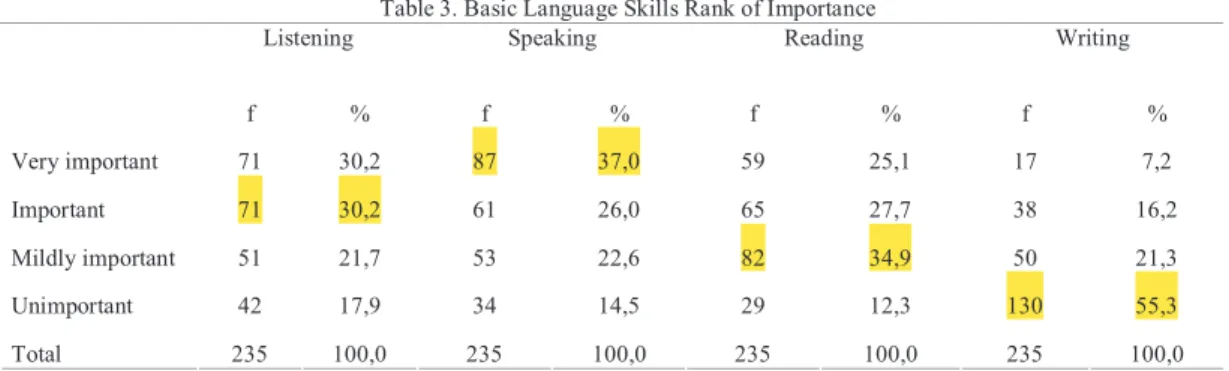
3.1. What is the distribution of the four basic language skills according to you in terms of importance? Findings of the answers to this question are shown in Table 3.
Table 3. Basic Language Skills Rank of Importance
Listening Speaking Reading Writing
f % f % f % f % Very important 71 30,2 87 37,0 59 25,1 17 7,2 Important 71 30,2 61 26,0 65 27,7 38 16,2 Mildly important 51 21,7 53 22,6 82 34,9 50 21,3 Unimportant 42 17,9 34 14,5 29 12,3 130 55,3 Total 235 100,0 235 100,0 235 100,0 235 100,0
As seen in Table 3; speaking (37.00%) has the first rank among four basic language skills in the category of very
important. Listening comes second (30.20%) and it is followed by reading (25.10%). Writing skill has the last place
(7.20%) in this category.
Listening (%30.20) %) has the first rank among four basic language skills in the category of important. Reading
comes second (27.70%) and it is followed by speaking (26.00%). Writing skill has the last place (16.20%) in this category.
Reading (34.90%) has the first rank among four basic language skills in the category of mildly important.
speaking comes second (22.60%) and it is followed by listening (21.70%). Writing skill has the last place (21.30%) in this category.
Writing (55.30%) has the first rank among four basic language skills in the category of unimportant. Listening
comes second (17.90%) and it is followed by speaking (14.50%). Reading skill has the last place (%12.30) in this category.
Looking at the rankings, it is noteworthy that writing skill is defined as unimportant in all categories. 3.2. How do you evaluate yourself on using four basic language skills?
Findings of the answers to this question are shown in Table 4.
Table 4. Capabilities of Using Basic Language Skills
f % Insufficient 11 4.7 Partially sufficient 15 6.4 Sufficient 133 56.6 Fully sufficient 76 32.3 Total 235 100.0
It is seen in Table 4 that 56.60% see themselves as sufficient, 32.30% see themselves as fully sufficient, and 6.40% see themselves as partially sufficient in using basic language skills. More than half of the students see themselves as sufficient in using basic language skills.
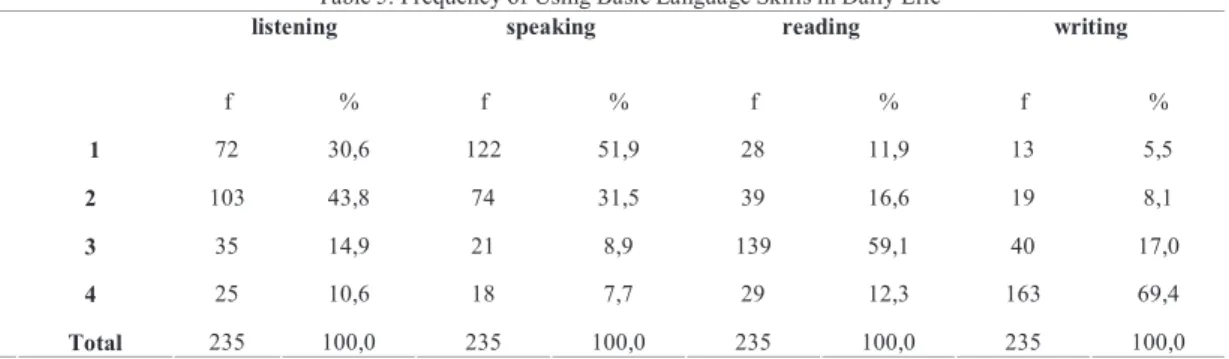
3.3. What is the frequency of your usage of the four basic language skills in daily life? Findings of the answers to this question are shown in Table 5.
Table 5. Frequency of Using Basic Language Skills in Daily Life
listening speaking reading writing
f % f % f % f % 1 72 30,6 122 51,9 28 11,9 13 5,5 2 103 43,8 74 31,5 39 16,6 19 8,1 3 35 14,9 21 8,9 139 59,1 40 17,0 4 25 10,6 18 7,7 29 12,3 163 69,4 Total 235 100,0 235 100,0 235 100,0 235 100,0
It is seen in Table 5 that in the frequency of using basic language skills in daily life; speaking is in the first (51.90%), listening is in the second (43.80%), reading is in the third (59.10%), and writing is in the last place (69.40%). Writing skill’s being in the last position also in this ranking is a matter of concern.
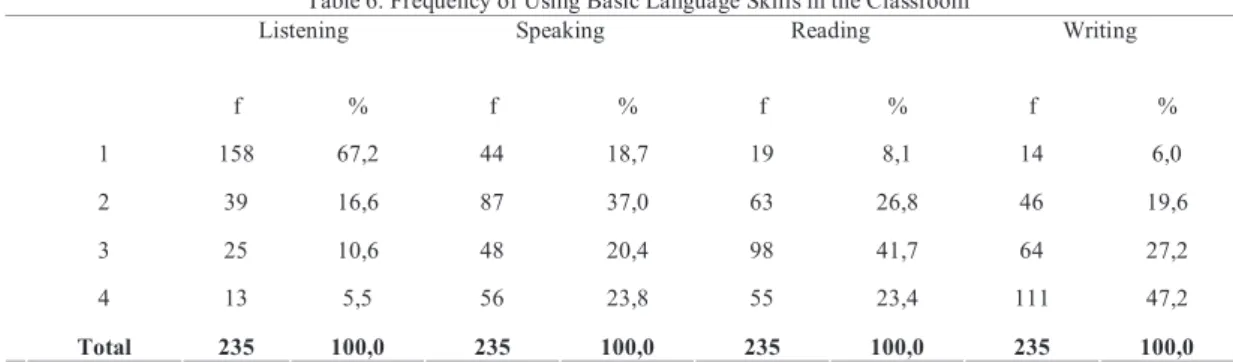
3.4. What is the frequency of your usage of the four basic language skills the classroom? Findings of the answers to this question are shown in Table 6.
Table 6. Frequency of Using Basic Language Skills in the Classroom
Listening Speaking Reading Writing
f % f % f % f % 1 158 67,2 44 18,7 19 8,1 14 6,0 2 39 16,6 87 37,0 63 26,8 46 19,6 3 25 10,6 48 20,4 98 41,7 64 27,2 4 13 5,5 56 23,8 55 23,4 111 47,2 Total 235 100,0 235 100,0 235 100,0 235 100,0
It is seen in Table 6 that in the frequency of using basic language skills in the classroom; listening is in the first (67.20%), speaking is in the second (37.00%), reading is in the third (41.70%), and writing is in the last place (47.20%) . Writing skill is also in the last position in this ranking.
3.5. What do you think are the reasons for your insufficiency of using the basic language skills? Findings of the answers to this question are shown in Table 7.
Table 7. Reasons of Insufficiency of Using Basic Language Skills
Reasons of Insufficiency f %
Lack of reading 94 40,0
Lessons in the program do not reinforce these skills 69 29,4
Insufficiency of my efforts 39 16,6
Educators do not provide an environment to reinforce these skills 33 14
Total 235 100
In Table 7, when we look at the reasons of insufficiency of using basic language skills; lack of reading is in the first place (40.00%) geldi÷i, second comes lessons in the program not reinforcing these skills (29.40%), it is followed by insufficiency of efforts (16.60%) izledi÷i, and finally comes the reason of educators not providing an
environment to reinforce these skills (14.00%).
4. CONCLUSIONS AND SUGGESTIONS 4.1. Conclucions
In this section, conclusions and suggestions reached on the basis of the findings of the research are presented.
In this research, which aims to reveal the statuses of students, who are studying in the Faculty of Education’s Turkish Language Education Department, on “Basic Language Skills” and to state their opinions, the conclusions reached results achieved on the basis of the findings of the research can be summarized this way:
When assessing the answers to the question of importance ranking of four basic language skills for students; among the four basic language skills, in “very important” category, speaking has the first place (%37.00), in “important” category, listening has the first place (%30.20), in “mildly important” category, reading has the first place (%34.90), in “unimportant” category,
writing (%55.30) has the first place . Looking at the rankings, it is noteworthy that writing skill is defined as unimportant in all
categories.
While assessing the answers to the question of the students’ evaluating themselves on using four basic language skills; it is seen that 56.60% see themselves as sufficient, 32.30% see themselves fully sufficient, and 6.40% see themselves as insufficient. More than half of the students see themselves as insufficient in using basic language skills.
While assessing the answers to the question of the frequency of using basic language skills in daily life; speaking is in the first (51.90%), listening is in the second (43.80%), reading is in the third (59.10%), and writing is in the last place (69.40%). Writing skill’s being in the last position also in this ranking is a matter of concern.
While assessing the answers to the question of the frequency of using basic language skills in daily life; listening is in the first (67.20%), speaking is in the second (37.00%), reading is in the third (41.70%), and writing is in the last place (47.20%). Writing skill is also in the last position in this ranking.
While assessing the answers to the question of the reasons of insufficiency of using basic language skills; lack of reading is in the first place (40.00%), second comes lessons in the program not reinforcing these skills (29.40%), it is followed by insufficiency of
efforts (16.60%) izledi÷i, and finally comes the reason of educators not providing an environment to reinforce these skills
(14.00%).
4.2. Suggestions
These suggestions can be brought in line with the conclusions of the research as a result of assessing the findings:
For Turkish Language teacher candidates, it is a necessity to develop and support basic language skills as a whole. This issue must be paid special attention within the lessons in the curriculum.
Supporting writing skill, which is among the expression skills, in the lessons must be a priority, and the importance of this skill must be comprehended.
Suitable environments must be provided for students in order to improve all basic language skills.
Educators must often prefer to use methods and techniques suitable for improving and reinforcing the basic language skills of the students in the class.
In the lessons, student centered approach must be emphasized. References
Aksan, D., (1995). Her yönüyle dil. Ankara, TDK YayÕnlarÕ.
Akyol, H., (2005).ølk Okuma Yazma Ö÷retimi. Ankara, Gündüz E÷itim ve YayÕncÕlÕk.
Demirel, Ö., (2002). Kuramdan Uygulamaya E÷itimde Program Geliútirme. Ankara, Pegema YayÕncÕlÕk.
Kavcar, C., O÷uzkan, F. and Sever, S., (1997). Türkçe ve SÕnÕf Ö÷retmenleri için Türkçe Ö÷retimi. Ankara, Engin YayÕnevi.
Kolaç, E., (2007). SÕnÕf Ö÷retmeni AdaylarÕnÕn Okuyucu Profilleri. VI. Ulusal Grade Ö÷retmenli÷i E÷itimi
Sempozyumu (27-29 Nisan 2007). Eskiúehir.
Kolaç, Emine (2008). “Küresel dil” kavramÕnÕn düúündürdükleri, Sakarya Üniversitesi Faculty of Education
Dergisi, 16, 2: 61-82.
Kolaç, E., (2009). Küreselleúme, Dil ve Kültür. Nefroloji Dergisi Terim Bülteni. Öz, F., (1999). UygulamalÕ ølkokuma Yazma Ö÷retimi. Ankara, AnÕ YayÕncÕlÕk. Özdemir, E., (1997). Eleútirel okuma. Ankara, Ümit YayÕncÕlÕk.
Sever, S., (2001). Ö÷retim Dili Olarak Türkçenin SorunlarÕ ve Ö÷retme-Ö÷renme Sürecindeki Etkili YaklaúÕmlar.
Ankara Üniversitesi E÷itim Bilimleri Fakültesi Dergisi, 34, 1-2: 11-22.
Sever, S., (2004). Türkçe ö÷retimi ve Tam Ö÷renme. Ankara, AnÕ YayÕncÕlÕk.
Tompkins, Gail, E. (1997). Literacy for The Ttwenty-first century: A balanced approach. Englewood Cliffs, NJ: Prentice-Hall.