T.C. DOĞUŞ UNIVERSITY INSTITUTE OF SOCIAL SCIENCES
MASTER OF ARTS IN CLINICAL PSYCHOLOGY
Graduation Thesis
Buket Çalışkan 201280003
Thesis Advisor:
Assist. Prof. Hasan Galip Bahçekapılı
İstanbul, January 2017
THE RELATIONSHIP BETWEEN EARLY MALADAPTIVE SCHEMAS, PERCEIVED MATERNAL PARENTING STYLE, EMOTION REGULATION DIFFICULTIES AND PSYHOLOGICAL WELL-BEING
DOĞUŞ UNIVERSITY
INSTITUTE OF SOCIAL SCIENCES
MASTER OF ARTS IN CLINICAL PSYCHOLOGY
Graduation Thesis
Buket Çalışkan 201280003
Thesis Advisor:
Assist. Prof. Hasan Galip Bahçekapılı Committee Members:
Prof. Falih Köksal
Assist. Prof. Uzay Dural Şenoğuz
İstanbul, January 2017
THE RELATIONSHIP BETWEEN EARLY MALADAPTIVE SCHEMAS, PERCEIVED MATERNAL PARENTING STYLE, EMOTION REGULATION DIFFICULTIES AND PSYHOLOGICAL WELL-BEING
iii PREFACE
This thesis is submitted for the degree of Master of Arts in Clinical Psychology at the Doğuş University. The research described herein was conducted under the supervision of Assistant Proffessor Dr. Hasan Galip Bahçekapılı between May 2016 and January 2017. This study is an original, unpublished, and independent work by the author.
This work aims to explore the relationships between early maladaptive schemas, perceived maternal parenting style, emotion regulation difficulties and psychological well-being. In order to investigate the influence of demographic variables on the measures of the study, a series of One-Way between subjects analysis of variance (ANOVA), Multivariate Analysis of Variance (MANOVA), and independent sample t-tests were used. Pearson’s Correlation Analysis was used to assess interrelationships between the study variables. In order to examine independent predictors of schema domains, emotion regulation difficulties and psychopathology, three sets of hierarchical regression analysis were conducted.
iv ABSTRACT
RELATIONSHIP BETWEEN EARLY MALADAPTIVE SCHEMAS, PERCEIVED MATERNAL PARENTING STYLE, EMOTION REGULATION DIFFICULTIES AND
PSYHOLOGICAL WELL-BEING
Çalışkan, Buket
M.A., Department of Psychology
Supervisor: Assist. Prof. Hasan Galip Bahçekapılı January 2017
Although many studies have elaborated the relationships between early maladaptive schemas, perceived maternal parenting style and psychopathology regarding Young’s Schema Theory, few researches examined the relations of these dynamics with emotion regulation difficulties. Therefore, the purpose of the present study was (1) to examine possible effects of demographic variables on schema domains, maternal parenting style, emotion regulation difficulties and psychological symptoms; (2) to investigate the relationships between perceived maternal parenting style, schema domains, difficulties in emotion regulatory processes and psychological distress level; (3) to determine predictive factors of schema domains, emotion regulation difficulties and psychopathology.
The sample of the study consisted of 372 individuals who were mostly recruited from the Doğuş University (285). Young Schema Questionnaire- Short Form 3 (YSQ-SF3), Young Parenting Inventory (YPI), Difficulties in Emotion Regulation Scale (DERS) and Brief Symptom Inventory (BSI) were administered to participants. In order to investigate the research question, a separate set of MANOVAs, ANOVAs, t- tests, bivariate correlation and hierarchical regression analyses were conducted.
v
Results of MANOVA yielded that females had lower scores in Disconnection schema domains while they obtained higher score in Clarity subscale of DERS than males. Besides, younger participants had higher scores in this Clarity subscale, compared to older ones. The zero order correlations indicated a number of significant correlations between measures of the study, which was consistent with the previous findings. The hierarchical analyses revealed that negative maternal parenting behaviors were significant predictor of all schema domains. Regarding Goal subscale of DERS, the negative maternal parenting and Impaired Autonomy positively predicted difficulties in engaging goal-directed behaviors during negative emotional state, whereas Disconnection was negatively predicted difficulties in engaging goal-directed behaviors. In terms of Strategy and Impulse subscales of DERS, the negative maternal parenting and Impaired Autonomy were positively associated with difficulties in using effective strategies and controlling impulsive behaviors when experiencing negative affect, Impaired Limits appeared as negatively associated factor for Strategy and Impulse subscale. The significant predictor of Non-Acceptance subscale of DERS was found as Impaired Autonomy. Regarding Clarity and Awareness subscales, Disconnection was positively predicted difficulties in being clear and aware of negative emotions, whereas Other-Directedness was negatively predicted difficulties in Clarity and Awareness subscales. Finally, perceived negative maternal parenting style, Impaired Autonomy and Disconnection schema domains were positively associated with psychological symptoms, while Impaired Limits was negatively associated with psychological distress level. On the contrary of expectations, emotion regulation difficulties were not appeared as significant predictors of general psychological disturbances in spite of the fact that the zero-order correlation analyses found significant association between them. These results were discussed regarding potential limitations and future suggestions.
Keywords: Early maladaptive schemas, perceived maternal parenting styles, emotion regulation difficulties, psychological symptoms.
vi ÖZ
ERKEN DÖNEM UYUMSUZ ŞEMALAR, ANNELİK ALGISI, DUYGU DÜZENLEME BECERİLERİ VE PSİKOLOJİK SIKINTILAR ARASINDAKİ İLİŞKİ
Çalışkan, Buket Yüksek Lisans, Psikoloji
Danışman: Yrd. Doç. Dr. Hasan Galip Bahçekapılı
Ocak, 2017
Pek çok çalışma erken dönem uyumsuz şemalar, algılanan annelik biçimleri ve psikolojik sıkıntıların arasındaki ilişkiyi Young’ın şema teorisi bağlamında incelemesine rağmen, duygu düzenleme becerilerinde yaşanan zorlukların etkisini bu bağlamda inceleyen az sayıda çalışma vardır. Bu nedenle bu çalışmanın amacı; (1) demografik değişkenlerin şema alanları, algılanan annelik biçimleri, duygu düzenleme becerilerinde yaşanan zorluklar ve psikolojik sıkıntılar üzerindeki etkisini incelemek; (2) şema alanları, algılanan annelik biçimleri, duygu düzenleme güçlükleri ve psikopatoloji arasındaki ilişkileri değerlendirmek; (3) şema alanları, duygu düzenlemede yaşanan zorluklar ve psikolojik sıkıntıların bağımsız yordayıcılarını belirlemektir.
Araştırma örneklemi çoğunun üniversite öğrencisi olduğu 372 Türk genç yetişkinden oluşmaktadır. Katılımcılar Young Şema Ölçeği, Young Ebevenylik Ölçeği, Duygu Düzenleme Güçlüğü Ölçeği ve Kısa Semptom Envanteri’ni içeren ölçek setini doldurmuşlardır. Demografik değişkenlerin etkisini incelemek için yapılan analizlerin sonuçları bir takım anlamlı ilişkiler dizisi göstermiştir. Buna göre, kadınlar Kopukluk şema
vii
alanında erkeklerden daha düşük puanlar alırken; erkekler duygu düzenlemede yaşanan güçlükler arasında olan Açıklık alt ölçeğinden kadınlara göre daha düşük puan almıştır. Yapılan korelasyon analizi, ölçümlenen değişkenler arasında bir çok anlamlı ilişki bulunduğunu göstermiştir. Ayrıca, şema alanlarının, duygu düzenlemede yaşanan zorlukların ve psikolojik sıkıntıların yordayıcılarını belirlemek amacıyla hiyerarşik regresyon analizleri uygulanmıştır. Sonuçlar, olumsuz annelik biçimlerinin tüm şema alanlarını pozitif yönde yordadığını göstermiştir. Bunun yanı sıra, Zedenlenmiş Otonomi şema alanının duygu düzenlemede yaşanan zorlukları pozitif yönde yordadığı; Kopukluk, Zedenlenmiş Sınırlar ve Diğeri Yönelimlilik şema alanlarının duygu düzenleme becerilerinde yaşanan zorlukları negatif yönde yordadığı belirlenmiştir. Son olarak, psikolojik sıkıntıların anlamlı yordayıcıları olarak olumsuz annelik biçimleri, Zedenlenmiş Sınırlar, Kopukluk ve Zedenlenmiş Otonomi şema alanları bulunmuş, duygu düzenlemede yaşanan zorlukların etkisi belirlenmemiştir. Araştırmanın sonuçları, potansiyel sınırlılıkları ve gelecek araştırmalar için önemi çerçevesinde tartışılmıştır.
Anahtar Kelimeler: Erken dönem uyumsuz şemalar, algılanan annelik biçimleri, duygu düzenleme becerileri, psikolojik sıkıntılar.
viii ACKNOWLEDGEMENTS
First of all, I would like to express my sincere gratitude to my dear supervisor Assist. Prof. Hasan Galip Bahçekapılı for his insightful feedback and continuous mentorship, which makes this challenging journey smoother for me. His office door was always open whenever I needed his immense knowledge or creative encouragement.
Also, I am very deeply appreciative to Onurcan Yılmaz for his valuable and well-versed contributions to my research. His stimulating attitudes and questions steered me to the right direction whenever I confused. Despite his overwhelming schedule, he never left my questions unanswered.
I owe my deepest appreciation to Professor Falih Köksal for sincere suggestions and constant guidance during both my undergraduate and graduate years. His courses were always beyond the borders and he enlightened the untouched areas in the life, which becomes one of my main sources of satisfaction in later life.
I would also like to thank to Uzay Dural Şenoğuz for accepting to be my committee member with her positive attitudes and valuable contributions.
I cannot find words to express my feelings to my lovely best friends, Merve Yılmaz and Seha Ata, who have unique role in my graduate years. They always make me feel whole with their sincere and objective comments. We came along together the struggles and trials of life, which strengthened our relations and reciprocal unconditionality.
My long-way mate, Simge Toprak, was always with me from preparatory class to business life. I am very grateful to her for changing my mood in every desperate moment and listening to me about issues related with either my study or something else.
Unfortunately, it is impossible to mention all my friends who were there for me during this journey. Therefore, I would like to thank them to all for being with me, namely Nagihan Turgut, Betül Öz, Melis Selçuk, Songül Oral, and Ayşe Merve Gürbüz.
ix
As one of the most supportive person in this process, I must acknowledge Incinur İnce for coding the numerous data without any complaints. I hope and know that she will become dedicated and lovely psychologist after graduation.
I am deeply grateful to my precious family for their great interest and support in my whole life. My mother, İnci Yaşar, always believes in me in every step of life; my father, Alim Yaşar, is always the role model for me with his character; my little sister, Zeynep Yaşar, cheers me up no matter what happens.
Last, but the most important of all, I must express my appreciation to my beloved husband, Mesut Çalışkan, for his endless and unconditional affection from the very beginning. He is the only person who makes me feel harmonious and helps me to put pieces together with his empathic personality.
x TABLE OF CONTENTS
PREFACE... iii
ABSTRACT...…iv
ABSTRACT (Turkish version)…...…vi
ACKNOWLEDGEMENT...viii
TABLE OF CONTENTS...x
LIST OF TABLES…...xiii
ABBREVIATIONS...xiv
1. INTRODUCTION ...………...………...……...1
1.1 Perceived Parenting Style in Young Schema Theory………...3
1.2 Schema Conceptualization………...………4
1.2.1 Early Maladaptive Schemas (EMS) of Young Schema Theory……....5
1.2.2 Young’s Schemas and Schema Domains………...5
1.2.3 Roots of EMS………7
1.2.4 Characteristics of EMSs………9
1.3 Emotion Regulation Difficulties and Schemas………...11
1.3.1 Emotion Regulation Process………11
1.4 The Relationship of EMSs, Perceived Parenting Style and Emotion Regulation Difficulties with Psychopathology………...17
1.4.1 Studies about Relationship between EMS and Psychopathology……17
1.4.2 Studies about Relationship between Maternal Parenting Style and Psychopathology………...20
1.4.3 Studies about Relationship between Emotion Regulation Difficulties and Psychopathology………....23
1.5 Aims of the Present Study………...26
2. METHOD……….29
2.1 Participants……….29
2.2 Measures……….30
2.2.1 Young Schema Questionnaire- Third Version (YSQ-SF3)……...…..30
2.2.2 Young Parenting Inventory (YPI-MF)………..…...31
xi
2.2.4 Brief Symptom Inventory………33
2.3 Procedure………33
2.4 Statistical Analyses……….34
3. RESULTS ………35
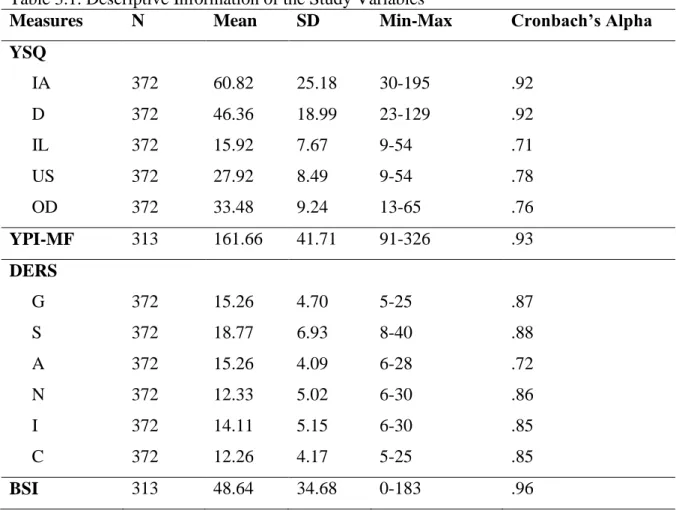
3.1 Descriptive Characteristics for Measures of the Study………..35
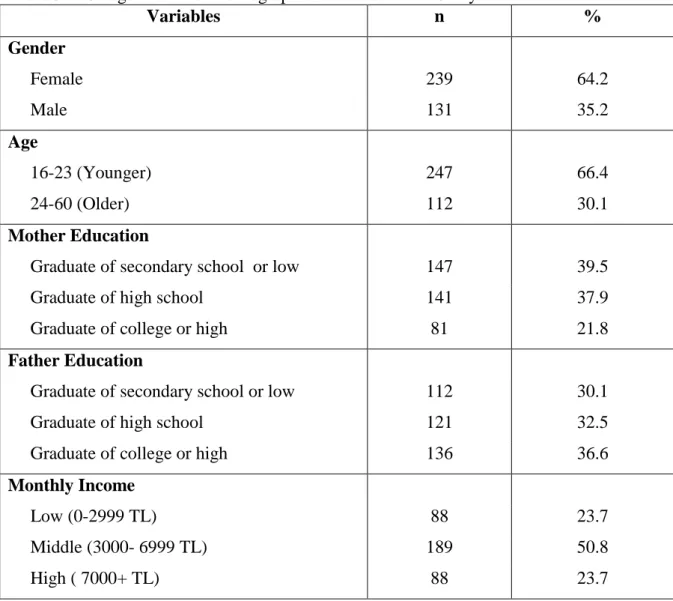
3.2 Differences of Demographics on the Study Variables………...36
3.2.1 Differential Effect of Demographic Variables on Schema Domains..37
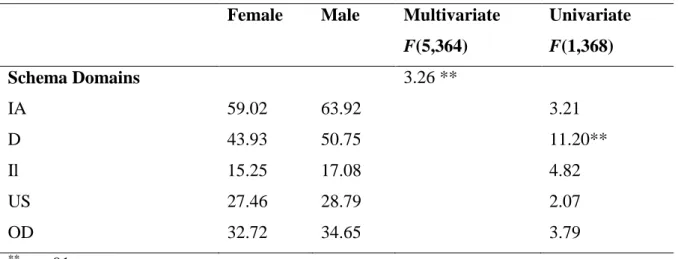
3.2.1.1 The Effect of Gender on Schema Domains ……….38
3.2.2 Differential Effect of Demographic Variables on Maternal Parenting Style………..38
3.2.3 Differential Effect of Demographic Variables on Difficulties in Emotion Regulation………...39
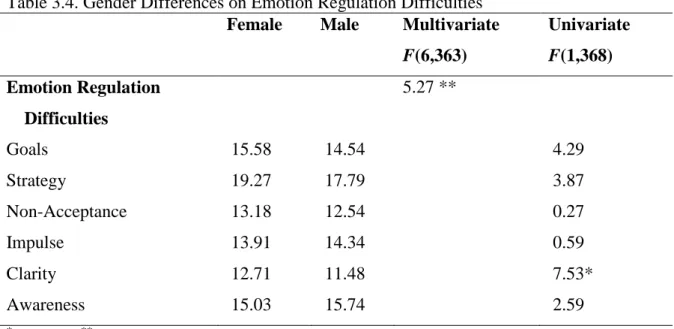
3.2.3.1 The Effect of Gender on Emotion Regulation Difficulties...39
3.2.3.2 The Effect of Age on Emotion Regulation Difficulties……40
3.2.4 Differential Effect of Demographic Variables on Psychological Symptoms……….41
3.3 Intercorrelations between Demographic Characteristics and the Study Variable………41
3.4 Regression Analysis………...46
3.4.1 Predictive Factors of Schema Domains………...46
3.4.1.1 Predictors of Impaired Autonomy………..46
3.4.1.2 Predictors of Disconnection………...47
3.4.1.3 Predictors of Unrelenting Standards………...48
3.4.1.4 Predictors of Impaired Limits………49
3.4.1.5 Predictors of Other Directedness………...50
3.4.2 Predictive Factors of Emotion Regulation Difficulties………...51
3.4.2.1 Predictors of Goals……….51 3.4.2.2 Predictors of Strategy……….52 3.4.2.3 Predictors of Non-Acceptance………...54 3.4.2.4 Predictors of Impulse……….55 3.4.2.5 Predictors of Clarity………..56 3.4.2.6 Predictors of Awareness………57
xii
3.4.3 Predictive Factors of Psychopathology………...58
4. DISCUSSION………..61
4.1 Findings Related to Differential Role of Demographic Characteristics on the Study Variables………....61
4.1.1 The Effects of Demographic Variables on Schema Domains……….61
4.1.2 The Effects of Demographic Variables on the Perceived Maternal Parenting Style………..62
4.1.3 The Effects of Demographic Variables on the Difficulties of Emotion Regulation……… ………62
4.1.4 The Effects of Demographic Variables on Psychopathology………..63
4.2 Findings Regarding Interrelations of the Study Variables……….63
4.3 Findings Related to Hierarchical Regression Analyses……….64
4.3.1 The Predictive Factors of Schema Domains………...64
4.3.2 The Predictive Factors of Difficulties in Emotion Regulation……...66
4.3.3 The Predictive Factors of Psychopathology………69
4.4 Limitations and Further Implications……….72
REFERENCES………...73
APPENDICES………...………...….………..83
A. Consent Form ………...…...83
B. Demographic Information Form.……...85
C. Young Schema Questionnaire………...……...88
D. Young Parenting Inventory- Mother Form...…...94
E. Difficulties in Emotion Regulation Scale………...98
F. Brief Symptom Inventory………...……….103
xiii
LIST OF TABLES
Table 3.1 Descriptive Information of the Study Variables………...36
Table 3.2 Categorization of Demographic Variables of the Study………...37
Table 3.3 Gender Differences on Schema Domains………...38
Table 3.4 Gender Differences on Emotion Regulation Difficulties………...40
Table 3.5 Age Differences on Emotion Regulation Difficulties………...41
Table 3.6 Pearson Correlation Coefficients between Variables of the Study...45
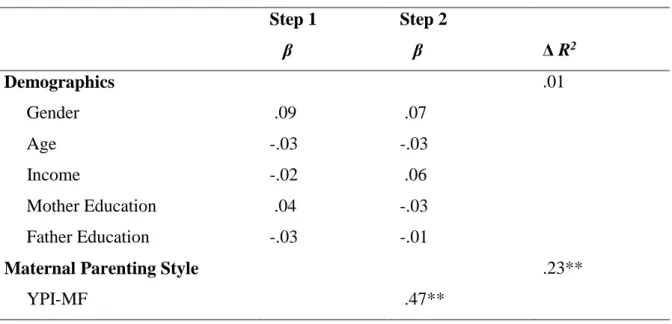
Table 3.7 Hierarchical Regression Analysis in Predicting Impaired Autonomy Schema Domain...47
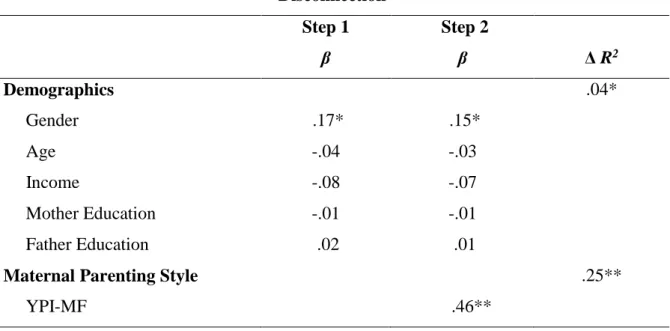
Table 3.8 Hierarchical Regression Analysis in Predicting Disconnection Schema Domain...48
Table 3.9 Hierarchical Regression Analysis in Predicting Unrelenting Standards Schema Domain...49
Table 3.10 Hierarchical Regression Analysis in Predicting Impaired Limits Schema Domain...50
Table 3.11 Hierarchical Regression Analysis in Predicting Other Directedness Schema Domain...51
Table 3.12 Hierarchical Regression Analysis in Predicting Goals in Emotion Regulation Difficulties ...52
Table 3.13 Hierarchical Regression Analysis in Predicting Strategy in Emotion Regulation Difficulties ...54
Table 3.14 Hierarchical Regression Analysis in Predicting Non-Acceptance in Emotion Regulation Difficulties ...55
Table 3.15 Hierarchical Regression Analysis in Predicting Impulse in Emotion Regulation Difficulties...56
Table 3.16 Hierarchical Regression Analysis in Predicting Clarity in Emotion Regulation Difficulties ...57
Table 3.17 Hierarchical Regression Analysis in Predicting Awareness in Emotion Regulation Difficulties...58
Table 3.18 Hierarchical Regression Analysis in Predicting Psychopathology in Emotion Regulation Difficulties...60
xiv
LIST OF ABBREVIATIONS
YSQ: Young Schema Questionnaire IA: Impaired Autonomy
D: Disconnection IL: Impaired Limits US: Unrelenting Standards OT: Other Directedness
YPI-MF: Young Parenting Inventory- Mother Form DERS: Difficulties in Emotion Regulation Scale G: Goals S: Strategy N: Non-Acceptance I: Impulse C: Clarity A: Awareness
1. INTRODUCTION
All people have mental categorical rules or scripts which are used to understand the world. Individuals filter or allow the environmental stimuli regarding these mental rules and, behave, feel and anticipate depending on this information. These mental rules are called as schemas and can shape the present and the future (Widmayer, 2007).
In the early of 1960s, Beck started to conceptualize cognitive theory and its core assumptions especially for depression. As one of the major prominent assumption of cognitive theory, it was proposed that the underlying dynamic of various emotional disorders was negative core beliefs about self, other people and the world (Van Vlierberghe, Braet, Bosmans, Rosseel and Bögels, 2010). It is proposed that these negative core beliefs are acquired in the early years of life through adverse experiences with primary caregivers and the activation of the negative beliefs in adulthood make individuals vulnerable to psychological distresses (Thimm, 2013). Beck (1967) determined the prominent cognitive theme for each specific disorder such as depression, anger and anxiety disorders. Inspired by these studies and findings, Jeffrey Young elaborated the cognitive conceptualization depending on his comprehensive clinical experiences and developed Schema Theory (Young, 1990). Perceived parenting practices are presumed to be the core contributor of development of schemas while trait of the child is also taken into consideration in Schema Therapy (Schmidt, Joiner, Young, and Telch, 1995). More importantly, schemas were categorized into groups as adaptive and maladaptive, and the central of the schema theory was accepted as the notion of so-called Early Maladaptive Schemas (EMSs) (Theiler, 2005). These EMSs were supposed to develop in early in life and be functional in some degree during childhood. However, with the changing circumstances, these schemas resist change and make people use these primitive and maladaptive coping ways, which eventually results in psychological distress. In other words, while Beck mostly tries to measure and treat psychological disorders with the help of negative core beliefs, Young mostly tries to determine deep-rooted schemas in order to understand and treat psychological symptoms.
Another theory Young benefitted from while developing the Schema Theory was Bowlby’s attachment theory (Gök, 2012). As the basic assumptions of attachment theory, early interactions between child and primary caregiver are the origin of mental representations of self and others (Levy, Blatt and Shaver, 1998). It is hypothesized that early experiences with more responsive and sensitive caregivers form the secure base for the child to be attached (Bosmans, Braet and Van Vlierberghe, 2010). However, when the child is exposed to insensitive and irrelevant parenting practices during the first years of life, he/ she is insecurely attached to the primary caregiver. The repetitive and exaggerated exposure to the insensitive caregiver influences the mental representations of the child, which is called internal working model (Ünal, 2012; Mikulincer, Shaver and Pereg, 2003). In attachment theory, internal working model is conceptualized as inner representations for screening, encoding, remembering and reaappriasing impinging stimuli (Bosmans et. al., 2010), which is the meeting point of the attachment theory and Young’s schema conceptualization. It is assumed that the long-lasting effects of EMSs stem from early toxic experiences with parents and its effect size on schema acquisition is greater than peers, school or socio-cultural structures (Young, Klosko and Weishaar, 2003)
Emotion regulation, which is another research question of the current study, is conceptualized as process in which one modifies which emotions to have, when one has them, and how to experience or express these emotions (Gross, 2013). Any rupture in this process results in difficulties in emotion regulation which is elaborated and defined by Gratz and Roemer (2004) as disruption in the capability to screen, evaluate and change emotional state in order to achieve personal goals (Bardeen, Fergus, Hannan and Orcutt, 2016). It is proposed that perceived difficulties in emotion regulatory processes underlie extensive psychological disturbances such as depression, anxiety disorders, and substance abuse disorders (Gross, 2008). In the literature, it is widely investigated the effect of attachment style on emotion regulation process so that the transmission of emotions between child and primary caregiver determines the prospective difficulties in emotion regulation (Rugancı, 2008). Furthermore, several maladaptive schemas have a facilitator role in experiencing difficulties in emotion regulation so that the link between EMSs and difficulties in emotion regulation will be examined (Eldoğan and Barışkın, 2014).
Up to present, to our knowledge, the current study will be the first one to elaborate the interrelations between maternal parenting style, maladaptive schemas, emotion regulation difficulties and psychopathological symptoms together, administering a combination of Young Schema Scale, Young Parenting Inventory, Difficulties in Emotion Regulation Scale, and Brief Symptom Inventory.
1.1 Perceived Parenting Style in Young Schema Theory
According to Bowlby’s attachment theory (1977, p. 201), attachment was defined as ‘the propensity of human beings to make strong affectional bonds to particular others’, and the disruption of these bonds ‘explaining the many forms of emotional distress and personality disturbance, including anger, anxiety, depression and emotional detachment’ (cited in Platts, Tyson and Mason, 2002). Primary care during the early years of life is dramatically important for not only survival of the infant but also behaviors and emotional experiences (Simard, Moss and Pascuzzo, 2011). The satisfaction level of primary caregiver’s care determines the child’s attachment quality and shapes the attachment behaviors of the infant. The main dynamic underlying the attachment quality and behaviors is internal working models which are described as “internalized representations of the history of attachment-related experiences, which influence expectations and attitudes concerning self and others” (Simard et. al., 2011; p. 350). Accordingly, the optimum availability and responsiveness of primary caregiver, that implies secure attachment style, enables the child to develop healthy internal working model, which helps the child to make realistic attributions about self, others and world. The deviance of the quality of this care might cause the child to develop negative representations of self, others and world, which indicates insecure attachment style (Sümer, Berument-Kazak and Sayıl, 2009). As having roots in attachment theory, it is argued that schemas are the representations which are outcomes of child-mother interactions, and early maladaptive schemas (EMSs) are resembled conceptually to internal working models of insecurely attached individuals (Sheffield, Waller, Emanuelli, Murray, & Meyer, 2005).
According to Young et. al. (2003), the perceived parenting style is significant for schema conceptualization because in the early years children have some critical emotional needs
that parents would be expected to meet. These basic needs are autonomy, competence and sense of identity; freedom to express valid needs and emotions; secure attachment to others (stability, safety, acceptance and nurturance); spontaneity and play; and realistic limits and self-control. When these needs are not fulfilled appropriately by parents, children have some difficulties about adjusting to environmental demands and circumstances. The reason might be that these children perceive themselves as worthless and incapable, perceive others as rejecting and so they have limited control over their environment. It is proposed that such representations or schemas regarding parental experiences shape one’s perceptions, anticipations, behaviors and relationships in adulthood. In other words, these early basic schemas about parenting would probably shape representations about the whole world. Given the significance of the effect of early parenting experiences, Young (1994) developed a scale in which participants rated their parents’ behaviors separately for both mother and father during childhood years. Controlling, pessimistic/fearful, perfectionist, emotionally depriving, overprotective, punitive, belittling, emotionally inhibited, and conditional/narcissistic is revealed as 9 different parenting styles (Sheffield et. al., 2005).
1.2 Schema Conceptualization
The “schema” concept is older than Young’s schema conceptualization. The first references to schema were quoted by Bartlet (1932) and Piaget (1952) (cited in Gök, 2012; Theiler, 2005). They are described as mental structures that influence the way of experiencing and perceiving the environmental stimuli (Gök, 2012). Following them, Beck (1967) emphasized the “schemas” in that they might be positive or negative, adaptive or maladaptive, developed during childhood and they had long-term effect on one’s life. It was proposed that the schemas were cognitive representations which modified apprehension of environmental variables and shaped formation of emotions and behaviors, depending on one’s earlier experiences. Furthermore, Beck’s definition of schema was stated as cognitive organizations which monitored, coded, and assessed the stimuli that influenced the human being (Alfasfos, 2009). Another conceptualization was stated by Thorndyke and Hayes-Roth (1979) in that a schema is abstract representation inferred from a stimulus with complex content which is processed in the light of compound effect of previous experiences and new information. In spite of the differential terminological
definitions between them, all of these concepts of schema created the base for the Young’s schema.
According to Young’s schema conceptualization, the composite effect of early parental experiences and emotional temperament of the child gives rise to formation of the schemas (Cecero, Nelson, Gillie, 2004). A schema is represented as a cognitive map which might include basic assumptions about self and world, and guide one to arrange new information according to them (Kömürcü, 2014). It is proposed that schemas developed from early personal experiences and one’s identification with significant others, and in the future life they were reinforced by similar experiences, perceptions and learnings (Kömürcü, 2014).
1.2.1 Early Maladaptive Schemas (EMS) of Young Schema Theory
While some schemas which developed during childhood would be adaptive in one’s later life, the maladaptive ones has drawn remarkable attention because of their noxious effects on one’s psychological processes. Young called them as “Early Maladaptive Schemas (EMS)” and defined them as “a broad pervasive theme or pattern, comprised of memories, emotions, cognitions, and bodily sensations; regarding one’s self and one’s relationship with others; developed during childhood or adolescence; elaborated through one’s life time; dysfunctional to some degree” (Young et al, 2003, p. 7). It is proposed that when one was child and had these schemas, they were functional in order to understand and make sense of the world. However, when time passes and the environmental circumstances start to change, these schemas lose their functionality and start to harm oneself by causing maladaptive behaviors, emotions and cognitions (Alfasfos, 2009). The effect of EMS is experienced adversely in that people are inclined to ignore stimuli inconsistent with these schemas while the information that is consonant with EMSs is embraced and internalized by them, which in turn shape perceptions and interpretations of world (Alfasfos, 2009; Kömürcü, 2014; McGinn and Young, 1996; Schmidt et. al, 1995). In other words, people behave maladaptively as a response to EMSs and their behaviors are also driven by these EMSs during adulthood (Ünal, 2012).
According to Young’s model, there are 18 early maladaptive schemas within 5 schema domains (Young et al., 2003). “Disconnection and Rejection” is the first schema domain, which includes Abandonment/ Instability, Mistrust/ Abuse, Emotional Deprivation, Defectiveness/Shame and Social Isolation/Alienation. This schema domain refers to the fact that the safety, security, acceptance, stability and empathy needs could not be fulfilled in an expected way. The general family atmosphere is mostly cold, rejecting, abusive, isolated and unpredictable. Schemas in this domain are more likely to activate in neglectful environment or experiencing a loss.
The second schema domain is called as “Impaired Autonomy and Performance” that includes Dependence/Incompetence, Vulnerability to Harm or Illness, Enmeshment/Undeveloped Self and Failure. This schema domain and related EMSs appear as a result of inhibition of need for autonomy, competence and sense of identity. The EMSs regarding this schema domain are related about unsatisfied needs of separating and functioning independently. The enmeshed relations between family members, overprotective parents or decreased reinforcement of the child for acting competently are typical characteristics of family environment.
“Impaired Limits” is the third schema domain and includes Entitlement/Grandiosity and Insufficient Self-Control/Self-Discipline schemas. It refers to disruptions in inner limits, commitments to others, or long-term goal engagement. This schema domain causes one to have difficulties respecting others’ rights, collaborating with others, setting expectations, or determining realistic personal goals. Parental characteristics of these individuals include generally permissiveness, overindulgence and a sense of superiority rather than reinforcing proper confrontation by parents.
The fourth schema domain is “Other-Directedness” which includes Subjugation, Self-Sacrifice and Approval Seeking/ Recognition-Seeking schemas. This schema domain refers to that people give top priority to satisfy others’ need, neglecting their own needs in order to obtain affection and affirmation of others. They are generally afraid of rejecting, failure in emotional connection and discrimination. In the family environment, these
children are more likely to experience conditional love, which causes them to restrain their own needs and emotions to obtain parental approval.
The final schema domain is “Overvigilance and Inhibition” which includes Negativity/Pessimism, Emotional Inhibition, Unrelenting Standards /Hypercriticalness and Punitiveness. This schema domain is related to inhibiting one’s spontaneous emotions and drives and following internal strict rules and scripts; sacrificing self-expression, happiness, relief and intimate relationships. Also, these individuals incline to avoid pleasure and intimacy. Parents of these individuals are generally rigid, highly demanding, punitive and perfectionist.
1.2.3 Roots of EMS
“The EMSs develop out of interplay between the child’s temperament and ongoing harmful experiences of child with parents, siblings or peers, such as abuse, neglect, excessive criticism, abandonment” (Young and Behary, 1998; cited by Alfasfos, 2009, p. 15). Young et. al. (2003) asserted three factors which would be determinants of EMSs development; core emotional needs, early life experiences and emotional temperament. From that point of view, it seems that Young agreed with both one’s biological disposition effect on the schema acquisition and developmental theories which highlight the remarkable effect of childhood experiences on adult life (Theiler, 2005). However, Young et. al. (2003, p.10) noted that “toxic childhood experiences are the primary origin of early maladaptive schemas”. Furthermore, in their study, Renner, Lobbestael, Peeters, Arntz, & Huibers (2012) supported this argument in that certain schemas had more significant correlations with corresponding adverse childhood experiences than emotional needs and temperaments.
Young (1999) confirmed the dominant influence of negative parenting on EMSs in that this first type of relationship became a sample for the others during the attachment process. Furthermore, Young et. al. (2003) emphasized the greater effect of early parental experiences on development of EMSs, compared to effect of interaction with peers, siblings and cultural variables. The repetitive exposure to the harmful parenting style
modifies the cognitive component of the bonding (Riso, Froman, Raouf, Gable, Maddux, Turini-Santorelli, Penna, Blandino, Jacobs & Cherry, 2006). As a cognitive part, internal mental model inferred from these noxious parental experiences became a foundation for future relationship with others and the world. Therefore, Young et. al. (2003) proposed 4 processes which operate in acquisition of EMSs.
The first and most significant one is “Toxic frustration of needs”. As mentioned above, children have core emotional needs which are expected to be fulfilled by parents. When the child receives insufficient stability, understanding, love and attention from parents, their positive experiences diminish dramatically and negative perceptions have place in his/her memory. As Young et. al. (2003) indicated the unmet basic emotional needs as a reason for acquisition EMSs; frustration of these needs causes one to form one or more early maladaptive schemas. “Emotional deprivation” and “Abandonment” are evaluated to stem from this frustration process.
The second condition is “Traumatization of victimization experience in early childhood”. The child is exposed to traumatic condition and experiences the victimization. He might be suppressed or damaged and this results in such schemas as “Mistrust/Abuse”, “Defectiveness/Shame” and “Vulnerability to harm” (Young et. al., 2003).
The third process in the development of EMSs is that “child receive too much of a good thing”. As opposed the first condition, in this process the child experiences the immediate satisfaction of their needs beyond his expectations. Over-involved and permissive parenting attitudes, parents’ engagement of the tasks under the child’s responsibility instead of him, providing him with excessive level of freedom could prevent the child from becoming aware and fulfilling his own needs. This is more likely, in turn, to make him dependent and enmeshed. The EMSs such as “Entitlement” and “Dependence/Incompetence” could appear as a result of this process (Young et. al., 2003).
The final one is “selective/extreme internalization or identification with significant others such as parents”. During this process, the child would not internalize the whole attributions of their parents, but identifies with specific thoughts, emotions and behaviors of them. As
an example, some people who exposed to abusive parenting style adopt the aggressive and impulsive behaviors as a result of their internalization of parents’ aggressive attitudes. However, some people who experience similar conditions in their family environment would have passive and withdrawn characteristic because of internalization of/ identification of himself with parents’ submissive attitudes. The temperament of the child would influence this selective identification and extreme internalization of particular aspects of significant others (Young et. al., 2003).
1.2.4 Characteristics of EMSs
People develop certain EMSs during childhood as a result of adverse experiences and in adulthood their schemas become activated with particular life events. These adulthood experiences are evaluated as similar to the traumatic events of the childhood, mostly unconsciously. The activation of one of these schemas causes one to experience an effective negative associative feeling, such as grief, anxiety or anger (Kömürcü, 2014; Alfasfos, 2009).
It is not proposed that all schemas are based on totally traumatic experiences or mistreatment. Some EMSs, such as “Dependence/Incompetence”, could develop due to receiving excessive good thing from parents, such as overprotection and care. The most destructive aspect of the EMSs is that the child is exposed to repeated experiences of too much good or bad thing continuously for a long time. Therefore, for the development of an EMS, traumatization during childhood is not the only source (Ünal, 2012; Gök, 2012; Alfasfos, 2009).
Schemas have remarkable enduring nature in that “they (EMSs) fight for survival” (Alfasfos, 2009). This feature of the schemas is rooted human need for consistency. Even though they are evaluated as maladaptive and dysfunctional for oneself, the schemas provide the individual with a comfortable base, which makes him feel “right”. Because schema is the way people perceive, understand and behave, they were inclined to re-live repeatedly life events similar to adverse childhood experiences to activate their schemas. Regarding schemas as deep-rooted truths is one of the reasons for their hard-to-change
nature (Hawke & Provencher, 2012; Gök, 2012). As a result of this characteristic, schemas influence the later experiences by effecting way of thinking, feeling, behaving and relating to others. This process, ironically, puts oneself in a scenario in that one is exposed himself to most noxious conditions and events similar to childhood (Riso et. al., 2006).
Schemas become more maladaptive and harmful in adult life, compared to childhood years. During childhood, the child might develop these schemas in order to deal with environmental circumstances adaptively. As these circumstances and expectancies are changing, it is expected the individual modifies his perception and adapts himself to his environment. However, when one insists on keeping these primitive perceptions, schemas became maladaptive and turn into EMSs (Thimm, 2010).
Schemas are muted when everything is under control. However, when life events go wrong and stress comes along, in other words when psychological problems arise, EMSs take the role in influencing one’s life course. By selective attention people process new experiences under the effect of EMSs; and by selective recalling they reorganize previous memories and perceptions, which process perpetuates the schemas (Young, 1999).
In origin, it was proposed that Young’s schema conceptualization is different from Beck’s core beliefs in that schemas are defined as unconditional while core beliefs are conditional. However, Young et. al. (2003) asserted that some schemas are unconditional and others are the conditional. The unconditional schemas are evaluated as most basic, rigid and hard-to-change ones. They are assumed to develop earliest and function as a core beliefs about self, others, world and future. It is proposed that in order to change the unconditional schemas, one has to reorganize and modify total self-concept, which seems to be very radical and hard process. Young determines the 13 unconditional EMSs; Abandonment/Instability Mistrust /Abuse, Emotional Deprivation, Defectiveness/Shame, Social Isolation, Dependence/Incompetence, Vulnerability to Harm or Illness, Enmeshment/ Undeveloped Self, Failure, Negativity/ Pessimism, Punitiveness, Entitlement/Grandiosity, Insufficient Self-Control/Self-Discipline. On the other hand, conditional schemas develop as attempts to deal with unconditional schemas, so they are defined as “secondary schemas”. The conditional schemas are; Subjugation, Self-Sacrifice, Emotional Inhibition, Approval
Seeking/ Recognition Seeking, Unrelenting Standards/ Hypercriticalness. As an explanatory example, the individual would develop the “Subjugation” schema to compensate “Abandonment” schema in that he believes “If I do whatever the other person wants and never get angry about it, then the person will stay with me.”
1.3 Emotion Regulation Difficulties and Schemas
As another predictor variable, “Emotion Regulation” is drawn attention in terms of schema conceptualization. As mentioned above, schemas are formed at very young age and operate functionally and adaptively in order to help children make sense the self, the others, the world and the relationships around them. In time, while environmental circumstances and expectancies are changing, one may resist to change their schemas, making these mental representations maladaptive and harmful to the self. In other words, schemas become a part of the self and gain more significance for the sense of identity, which prevents one to easily relinquish them. The individual behaves, feels and thinks in a way to adapt to their schemas and make them endure in his life. All of these behaviors, emotions and thoughts are evaluated as schema perpetuating (Young et. al., 2003; Alfasfos, 2009). As one focus of the current study, emotion regulation difficulties are seen as an outcome of process of coping with EMSs, which could result in development of psychopathology (Eldoğan & Barışkın, 2014; Mikulincer et. al., 2003).
1.3.1 Emotion Regulation Process
In order to understand interrelations between emotion regulation and schema conceptualization properly, the development and the core features of emotion regulation (ER) will be investigated.
As a beginning point, the development of ER is elaborated in that the various studies emphasize the remarkable effect of early interaction between child and the caregiver. Rugancı (2008) reviewed the emotional socialization process of the child from the birth, which resulted in the development of ER abilities. “With the birth of child, vocal and facial expressions have the most significant role in transmission of affective states from mother
to child” (Rugancı, 2008, p. 3). These first interacted emotions are basic ones and biological in their nature. As a result of this interaction, the infant also displays expression as a response to the primary caregiver, which impresses the mother and is mirrored by her. This mutual relationship enables the infant to feel synchronism between the self and the other, which implies that “each one’s following behavior can be predicted from other’s action” (Rugancı, 2008, p. 4). Bebee, Rustin, Sorter and Knoblauch (2003) proposed that during early period the infant feels the affective states of primary caregiver in various ways and this repetitive process is adopted in terms of timing, form, intensity and rhythm by the baby, developing a certain pattern between them. When this healthy transition of emotional states is interrupted, this failure is also registered by the infant. The optimal interruptions and their fixations have functional effects on mental enhancement of the child, which expands the cognitive processes regarding emotional regulation (Pearson, 2013). As seen, during the early life the individual regulates their emotions on basis of the interaction between him/her and primary caregiver, depending their regulation abilities on the prediction of the primary caregiver’s behaviors and strategies. This mutual regulation process constitutes the basis of later emotion regulation beliefs, goals and strategies of the individual. Jabeen, Anis-ul-Haque and Riaz (2013) proposed that parents have a major effect on children abilities and they modify development of ER as a result of the parent-child interaction. Emotion regulation is conceptualized as a socialization process and acquire through parenting experiences, affective atmosphere of the family, mirroring and modeling (Morris, Silk, Steinberg, Myers and Robinson, 2007). Fletcher, Parker, Bayes, Paterson, and McClure (2014) elaborated this process in that the parental practices and attitudes such that tolerance toward emotion expression and encouragement of extreme emotional disclosure cause children to develop dysfunctional emotion regulation skills. As a result of such interaction, children could not perceive, label, regulate or tolerate their affective states, resulting in developing emotion regulation difficulties.
Before associating ER with schema conceptualization, core features and processes of ER will be investigated. According to Eisenberg and Spinrad (2004, p. 338), emotion regulation is defined as the combination of various mechanisms which initiate, withdraw, display or organize the onset, form, density and continuity of the emotional states; and modify emotion related processes such as physical, cognitive and behavioral responses
(cited in Jabeen et al., 2013). Gratz and Roemer (2004, p. 53) mentioned emotion dysregulation as a “multidimensional construct which can involve reduced awareness, understanding, and acceptance of emotions; lack of access to adaptive strategies for modulating the intensity and/or duration of emotional responses; an unwillingness to experience emotional distress during pursuit of desired goals; and an inability to engage in goal-directed behaviors when experiencing emotional distress”. Depending on these definitions, it could be suggested that emotion regulation contains two perspectives which are that emotion regulation consists of “heterogeneous processes by which emotions are regulated”, and that emotion regulation refers to “how emotions regulate something else” (Gross, 2008).
As another aspect of ER, it might be either an intrinsic process which refers to regulation of one’s own emotion; or extrinsic process which implies regulation of someone else’s emotion.(Gross, 2013) The decision of which ER process will be activated is closely related to one’s goals to achieve as a result of ER. Furthermore, ER is evaluated as a set of processes/engagements to modify emotion generation trajectory in a continuum between conscious/effortful strategies and unconscious/automatic strategies (Gross, 2013). In other words, under certain circumstances one might regulate one’s emotions explicitly to accomplish certain goals while in another conditions one might engage in implicit ER strategies without conscious awareness.
Final feature of ER is that people might not necessarily regulate their emotions to decrease negative emotions and increase positive emotions, as having hedonic considerations (Hu, Zhang, Wang, Mistry, Ran and Wang, 2014). However, when individuals want to experience emphatic viewpoint or to have an effect on others’ action, they might up-regulate negative emotions; they might decrease their positive emotions to have realistic limits, behave more mindfully or hiding their actual feelings. These motivations are evaluated as “instrumental considerations” (Gross, 2013) and people are motivated to modify their emotions to experience non-hedonic outcomes (Tamir and Mauss, 2011). In other words, in everyday life people might not always regulate their emotions in terms of immediate satisfaction of emotional needs, but they could have complex motivations while
regulating the emotions. Therefore, ER should be investigated with other personal variables to gain proper insights about underlying motivations.
Implications of ER for psychological well-being were exclusively highlighted, and the factors that influenced how individuals regulate their affective states were aimed to be determined in previous studies (Tamir and Mauss, 2011; Arndt & Fujiwara, 2014; Hu et. al., 2014). These key factors are determined as beliefs about controllability of emotion, emotional values and regulatory goals, and emotion regulation strategies (Tamir and Mauss, 2011). These different components operate sequentially and have unique contributions. This sequence of ER from cognitive to behavioral expressions gains great importance because any deviation in one of the sequences might influence quality of the emotional response. In other words, a rupture in this process is highly probable to result in maladaptive emotional experiences and responses, which means “Emotion Dysregulation” or “Emotion Regulation Difficulty” (Gross and John, 2003).
People would have beliefs that “the emotion can be controlled” which is referred to as “implicit theories” (Dweck, 1999) and that “I can control my emotions” (Bandura, 1977) which is referred to as “self-efficacy” (cited in Tamir and Mauss, 2011). Both kinds of beliefs about emotion-related processes are significant determinant for the initiation of people’s attempts to regulate their emotions. People who evaluate emotions as controllable also present themselves as having more self-efficacy in ER. When individuals believe that they could change the trajectory of emotion generation process, they might devote more resources to regulate their emotions. In time, with numerous practices and experiences the individuals are more likely to learn more adaptive and healthy ER strategies in the pursuit of their goals, compared to individuals with low levels of self-efficacy (Tamir and Mauss, 2011). In summary, beliefs about controllability of emotions and self-efficacy determine the initiation and quality of ER.
Once ER is initiated, people choose to increase or decrease that which emotion is valuable for them in order to achieve their goals (Tamir and Mauss, 2011). In other words, the values people hold and goals they pursue determine the content /target of ER. It is universal that people aim to obtain an outcome they value as a result of ER. However,
every person attains unique value to certain outcome with differentiated motivations. One of the most prominent motivations, mentioned before, stems from the need to satisfy immediate pleasure, namely hedonistic considerations. The numerous studies replicated the finding that pleasant affective states were evaluated as more desirable than unpleasant ones across various cultures (Rusting and Larsen, 1995; Tsai, Knutson, and Fung, 2006) Secondly, cultural expectancies and differences are other determinants of the value people attain to emotional outcome because the mental representation of the “value” shapes in the specific cultural context (Tamir and Mauss, 2011). The distinction between individualistic and collectivistic cultural principles is a prominent example in this domain regarding to valuing either high arousal or low arousal emotions, respectively (Tsai et al., 2006). The individuals from a collectivistic culture learn to value social harmony and togetherness while those from individualistic cultures learn to value self-achievement (Morling, Kiyatama ve Miyamoto, 2002 cited in Tamir and Mauss, 2011). In other words, this deep-rooted social-based motivation system could override the hedonistic concerns to obtain long-term outcomes. According to social norms in a given context, people are motivated to experience unique set of emotions to attain their specific goals while regulating emotions. Final determinant of which emotion people value to attain their goals is about satisfying important needs, changing from person to person (Tamir and Mauss, 2011). It is universal that if one wants to obtain reward, he/she is motivated/inclined to value excitement; and if one wants to avoid danger, he/she tends to value fear (Tamir, Chiu and Gross, 2007). However, every individual experiences different life events and develop unique value system and coping style so that sometimes value of an emotion can gain importance according to its short-term usefulness, which implies the instrumental considerations mentioned before , contrast to hedonic concerns (Koole, 2009). The difference between neurotic and extraverted people’s value of emotions could be an example in that neurotic ones are inclined to value fear and worry with avoidance motivation while extraverted ones tend to value happiness with approach motivation.
Hedonic and nonhedonic concerns about emotional values orient the goals people pursue while regulating emotions to attain certain outcome. As beliefs about controllability of emotions and self-efficacy have a remarkable effect on initiation and progress of ER and,
in turn, on psychological well-being; values assigned to emotions and goals people attain gain a great importance in terms of mental health by shaping emotional content of ER.
Final step of ER process is strategies which draw prominent interest in emotion-related studies because emotion regulation strategies are evaluated as more measurable and more associated with several psychological issues. ER strategies are defined as possible behavioral, cognitive and affective procedures to modify actions for achieving certain aims (Tamir and Mauss, 2011,). Hyperactivating and deactivating strategies; reappraisal and suppression strategies; and modulation of negative affect are common investigated emotion regulation strategies in studies (Rugancı, 2008). Gross (2008, 2013) develop “a Process Model of Emotion Regulation” in that emotion regulatory acts are accumulated under five families as Situation Selection, Situation Modification, Attentional Deployment, Cognitive Change and Emotional Responses. The first two groups of regulatory process, Situation Selection and Situation Modification, are antecedent-focused. These types of ER strategies involve the actions to modify situation in which the way of experiencing emotions is anticipated before the full-blown emotional responses. Once exposed to a certain external situation, one has to direct his/her attention to certain aspect of a given situation to experience desirable emotion, which refers to Attentional Deployment. One of the most used forms of this kind of ER strategy is distraction in that the attention is moved away from emotional tone of situation or is shifted away from situation altogether. Second common form of Attentional Deployment is rumination which refers to perseverative engagement on specific aspect of emotion-related process/event. Attentional deployment could be evaluated as internal situation selection among several emotional aspects of given external situation. Cognitive Change refers to regulating appraisals of given situation to change its emotional importance to the individual by altering the way of thinking about the situation. Reappraisal draws prominent attention form of Cognitive Change in that people change their perception of situation, resulting in altering emotional response to that situation. In various studies, reappraisal is depicted as to decrease negative emotional experiences, being among functional ER strategies. As a final family of ER processes, Response Modulation involves the alterations in experiential, behavioral and physiological component of emotional response. Relaxation and breathing techniques; using drugs and cigarettes are among these emotion regulatory acts. Expressive suppression is one of the
most studied forms of Response Modulation in that the individual tries to inhibit ongoing/current positive or negative emotion-expressive behavior. In emotion-related studies, reappraisal is evaluated as adaptive emotion regulation strategy while expressive suppression is evaluated as maladaptive one (Gross, 2008; Gross, 2013; John and Gross, 2004).
1.4 The Relationship of EMSs, Perceived Parenting Style and Emotion Regulation Difficulties with Psychopathology
1.4.1 Studies about Relationship between EMS and Psychopathology
The empirical findings supported the theoretical relationship between EMS and psychological problems for both clinical and nonclinical sample. In the current study, the participants were recruited from nonclinical sample so that the hypotheses and results will be evaluated according to this condition. However, in this review section the different research conducted with both clinical and nonclinical participants will be investigated regarding relationship between EMS and psychological symptoms.
It is proposed that EMSs which were functional during childhood to understand the self and the world lose their adaptability in adult life with changing environment (Soygüt, Karaosmanoğlu ve Çakır, 2009). Their persistency and resistance to change make one vulnerable to develop psychological problems in that he/she behaves according to distorted schemas in a maladaptive way. Young (1999) and Young et. al. (2003) stated presence of EMSs increase the possibility of occurrence and relapse of psychological problems about personality and Axis I disorders such as depression, anxiety or eating disorders. Moreover, Young (1994) proposed that EMSs which are conceptually related to certain psychological symptoms are more likely to significantly correlate with these psychological disorders (cited in Welburn, Coristine, Dagg, Pontefract, & Jordan, 2002). Also, it was hypothesized that a psychological disorder is stemmed from co-occurrence of various EMSs, showing close association between them (Young et. al., 2003; Kömürcü, 2014). In the present study, the tendency to develop Axis I symptomatology of nonclinical sample will be investigated so that the link between Axis I disorders and EMSs will be examined.
Depression is the most commonly investigated psychological disorder regarding the cognitive schemas. The feeling of sadness, pessimism, decreased self-confidence, reduced energy, lowered ability to enjoy daily activities, lessened appetite and disturbed sleep are common symptoms of depression (Alfasfos, 2009). The research found that the Defectiveness/Shame, Insufficient Self-control, Vulnerability and Incompetence/Inferiority schemas show correlation with depression symptomatology in a nonclinical student sample (Harris and Curtin, 2002). Schmidt et. al. (1995) proposed that people with Dependence/Incompetence and Defectiveness/Shame schemas were more likely to have depressive symptoms. Furthermore, another cognitive schemas related to depressive symptom of a clinical sample were found as Abandonment and Insufficient Self-control which were the indicators of decreased attention and action (Welburn et. al. 2002). Finally, a study conducted with adolescents displayed that Social Undesirability, Mistrust/Abuse, Unrelenting Standards and Failure schemas strongly predicted depressive symptoms (Muris, 2006).
Anxiety disorders such as social phobia, obsessive-compulsive disorder and panic disorder are more likely to associate with certain EMSs for clinical and nonclinical sample. The common symptoms of anxiety are feeling of dread, fear or distress due to an actual or imaginative danger to mental or physical well-being (Alfasfos, 2009). Various studies elucidated the different EMSs which are specifically congruent with several symptoms of anxiety disorders. For the clinical sample, Schmidt et. al. (1995) specified Vulnerability, Failure and Emotional Inhibition as associative schemas with anxious symptoms; while Welburn et. al. (2002) asserted Vulnerability, Abandonment, Dependence, Emotional Inhibition and Self-Sacrifice schemas as associated factors of anxiety disorder. Furthermore, Pinto-Gouveia, Castilho, Galhardo and Cunha (2006) compared the schema scores of patients with social phobia, panic and obsessive-compulsive disorders and found that indiviuals with social phobia symptoms appeared to have more EMSs, compared to other anxiety symptoms. Researchers proposed that Disconnection/Rejection schema domain was significantly associated with social phobia. Besides, Entitlement, Shame, Unrelenting Standards, Emotional Deprivation, Mistrust/Abuse, and Social Undesirability/ Defectiveness schemas were significantly correlated with general anxiety symptoms.
Eldoğan and Barışkın (2014) conducted a study with a nonclinical sample and acquired a parallel association with previous findings. According to that, Disconnection/ Rejection, Impaired Autonomy and Impaired Limits schema domains were strong predictors of social anxiety symptoms. A study conducted with nonclinical adolescents revealed that Emotional Inhibition, Abandonment and Social Isolation/Alienation schemas uniquely predicted anxious symptoms, supporting prior results (Muris, 2006).
Hostility that is defined as having negative cognitions, emotions and actions toward others is another subscale of the BSI (Alfasfos, 2009). Barefoot, Peterson, Dahlstrom, Siegler, Anderson and Williams Jr. (1991) proposed that the hostile and aggressive behaviors resulted from negative mental and emotional mindset so that the associative negative schemas would be the root of hostile attitudes of the individuals. In accordance with this proposition, the studies conducted with adolescents found association between disruptive behaviors and various EMSs (Muris, 2006; Van Vlierberghe et. al., 2010). According to these studies, Dependence/Incompetence, Social Isolation/Alienation, Self-Sacrifice, Entitlement/Grandiosity, Enmeshment and Failure to Achieve (Muris, 2006); also Unrelenting Standards and Defectiveness/Shame (Van Vlierberghe et. al., 2010) were predictor schemas of disruptive behaviors of nonclinical adolescent sample. The studies conducted with adults had denominators with adolescents’ outcomes in that Entitlement and Negativity/Pessimism schemas were significantly correlated with hostility subscales (Alfasfos, 2009; Moeller, Crocker and Bushman, 2009). Finally, Sarıtaş and Gençöz (2011) investigated the association between adolescents’ EMS and their anger score/level and found that Impaired Limits and Exaggerated Standards schema domains had significant relationship with hostility.
Somatization is described as the tendency to have physical complaints without physiological reasons and seek for medical treatment. The patients with somatization either display their psychological distress through medical complaints or continuously desire medical help (Alfasfos, 2009). The Vulnerability to Harm/Illness was found as mostly correlated schema with somatic complaints.
In this study, BSI which had anxiety, depression, somatization, negative self and hostility subscales was used. It is hypothesized that specific symptom tendencies of nonclinical participants will associate with specific EMSs and schema domains, depending on abovementioned anticipations/findings.
1.4.2 Studies about Relationship between Perceived Parenting Style and Psychopathology
Young based his conceptualization of perceived parenting styles on Bowlby’s attachment theory (1973) in that the interaction between child and the primary caregiver enables child to develop attachment patterns in various ways (cited in Soygüt, Çakır and Karaosmanoğlu, 2008; Şahin and Özer, 2012). These early-developed mental patterns about parent-child interaction determine cognitive representations about whole world, influencing the child’s perception of security. If the child perceives the significant other as sensitive and responding, he/she feels himself/herself as worthy and others as available, forming healthy internal working model. When the attachment between child and parent is insecure and insensitive, the child is more likely to feel as unworthy and have negative expectations about others’ availability (Gök, 2012). The quality of childhood security and expectations about the world has a remarkable effect on future relationships and adulthood behaviors. In order to emerge as a psychologically healthy adult, the childhood emotional needs (secure attachment autonomy, competence and sense of identity; freedom to express valid needs and emotions; spontaneity and play; and realistic limits and self-control) should be satisfied by significant others adaptively (Soygüt et. al., 2008). Otherwise, the maladaptive cognitive schemas regarding negative parenting makes one vulnerable to psychological problems in stressful situations. The various researches revealed the association between parenting style and psychological disorders (McGinn, Cukor and Sanderson, 2005; Soygüt et. al., 2008; Welburn et. al., 2002; Sheffield et al., 2005; Ünal, 2012). In the current study, only maternal parenting style will be examined in terms of associative factors such as psychopathology, EMS and ER difficulties. However, I will review studies about perception of both maternal and paternal parenting style associating with various psychological problems.
The studies in which parenting styles were assessed with Parental Bonding Instrument (Parker, Tupling, Brown, 1979) demonstrated that there was a significant correlation between negative parenting practices and depressive symptomatology. Harris and Curtin (2002) found that depressive symptoms had significant correlation with low perceived parental care and high overprotection. In accordance with this finding, the strong negative association between maternal care and depression was revealed by McGinn et. al. (2005). Another parenting style measurement, “My Memories of Upbringing (EMBU) (Arrindell, Sanavio, Aguilar,-Sica, Hatzichristou, Eisemann, Recinos, Gaszner, Peter, Battagliese, Kallai, and van der Ende, 1999), was used in a study and it was found that participant from middle socioeconomic background who experienced higher emotional parental warmth have lower depression score (below the critical levels) (Anlı and Karslı, 2010). There are also studies in which Young Parenting Inventory was used to demonstrate the link between parenting style and depressive symptomatology. For both mother and father, negative parenting style was associated with depressive symptoms in that negative parenting was measured the total score of the YPI (Ünal, 2012). In Gök’s (2012) study, only positive maternal parenting style was found as correlated with lower depressive scores. Furthermore, Soygüt et. al. (2008) administered factor analysis of YPI and revealed 10-factor structure that were Emotionally Depriving, Overprotective/Anxious, Belittling/Criticizing, Pessimistic/Worried, Normative, Restricted/Emotionally Inhibited, Punitive, Conditional/Achievement Focused, Overpermissive/Boundless and Exploitative/Abusive Parenting styles. It was found that depression symptomatology had significant association with all maternal parenting styles, except Overpermissive/Boundless Parenting. For paternal parenting, depression was significantly correlated with all subscales of YPI, except Exploitative/Abusive and Overpermissive/Boundless Parenting. After that, Şahin and Özer (2012) conducted a study with adolescents and aimed to specify the effect of negative maternal practices on teenagers’ psychological distress. Similar to prior research, the factor analysis of YPI for adolescent sample was administered and yielded 6 factor solutions for maternal form. The depression score had positive correlation with 5 parenting styles which were Controlling/Ruling, Exploiting/Rejecting, Belittling/Humiliating, Success-focused/Perfectionist, Undisciplined/ Laissez-faire parenting styles while it had negative significant correlation with Compassionate parenting style of YPI.