Research Article
Do NSAIDs and ASA Cause More Upper Gastrointestinal
Bleeding in Elderly than Adults?
Hakan Kocoglu,
1Basak Oguz,
2Hakan Dogan,
3Yildiz Okuturlar,
1Mehmet Hursitoglu,
1Ozlem Harmankaya,
1Yuksel Altuntas,
4and Abdulbaki Kumbasar
11Department of Internal Medicine, Bakirkoy Dr. Sadi Konuk Education and Research Hospital, Istanbul, Turkey
2Department of Internal Medicine, Istanbul Bilim University Medical Faculty, Florence Nightingale Hospital, Istanbul, Turkey
3Department of Internal Medicine, Izmir Bozyaka Education and Research Hospital, Izmir, Turkey
4Department of Endocrinology and Metabolism, Sisli Hamidiye Etfal Education and Research Hospital, Istanbul, Turkey
Correspondence should be addressed to Hakan Kocoglu; [email protected] Received 19 October 2015; Accepted 9 December 2015
Academic Editor: Francesco Franceschi
Copyright © 2016 Hakan Kocoglu et al. This is an open access article distributed under the Creative Commons Attribution License, which permits unrestricted use, distribution, and reproduction in any medium, provided the original work is properly cited.
Purpose. NSAIDs and ASA may cause upper gastrointestinal bleeding (UGIB) both in adults and in elderly. There is no study
that compares this increased bleeding risk between adult and elderly subjects. Methods. A total of 524 patients with UGIB were included in this study. The data of patients were, respectively, analyzed. Results. NSAIDs and ASA-associated UGIB rates were similar between<65 years (345 patients) (group 1) and ≥65 years (179 patients) (group 2) (28.4% versus 23.5%, 𝑝 = 0.225 and 13% versus 19%,𝑝 = 0.071, resp.). Warfarin-associated UGIB was found significantly higher in group 2 than group 1. Elderly patients with NSAID-associated UGIB had significantly higher length of stay (LoS) and CoH than adult patients with NSAID-associated UGIB (𝑝 = 0.002 and 0.001, resp.). Elderly patients with ASA-associated UGIB had significantly higher CoH than adult patients with NSAID-associated UGIB. Conclusions. Using NSAIDs without gastroprotective drugs or using ASA with gastroprotective drugs in elderly patients is as safe as in adult patients. Not only should adding gastroprotective drugs to ASA or NSAID be based on their risk of UGIB, but the cost of hospitalization of ASA or NSAID-associated UGIB should be considered.
1. Introduction
The older population is growing faster than the total pop-ulation in all regions of the world and more than 1% of elderly people are hospitalized each year because of upper gastrointestinal bleeding (UGIB) [1, 2]. Advanced age has been consistently identified as a risk factor for mortality among patients with UGIB, presumably because of a higher prevalence of comorbid illnesses in the elderly [3, 4]. The incidence and outcome of gastrointestinal bleeding in elderly people can also be influenced by the use of aspirin, other nonsteroidal anti-inflammatory drugs, and other antiplatelet and anticoagulant agents [5, 6].
Previous studies have shown that almost 30% of the elderly people have been taking NSAIDs (including ASA) [7, 8]. NSAIDs and ASA have widespread usage in various diseases and their relationship with UGIB is well known.
In all ages, including elderly, people using NSAIDs or ASA tended to have higher UGIB risk than those who do not use [9–12].
Several studies showed that NSAIDs and ASA are risk factors for UGIB both in adults and in elderly patients, but whether NSAIDs and ASA cause more UGIB events in elderly than adults, or vice versa, is debatable. So, in this study, we have tried to answer the question of “do NSAIDs and ASA cause more UGIB events in elderly than adults?”
2. Materials and Methods
A total of 524 patients’ data who consecutively admitted to our hospital with the diagnosis of UGIB over the last three years were obtained from the hospital records and from patients or their relatives as well. The diagnosis of UGIB in all
Volume 2016, Article ID 8419304, 5 pages http://dx.doi.org/10.1155/2016/8419304
Table 1: Comparison of patients<65 years and patients ≥65 years in regard to age, length of stay, number of transfusion of packed erythrocytes, and number of comorbid illness.
Patients<65 years (𝑛 = 345) Patients≥65 years (𝑛 = 179) 𝑝 Mean± SD Minimum Maximum Mean± SD Minimum Maximum
Age (years) 42.83± 13.9 16 64 77.59± 7.70 65 97 0.0001
Length of stay (days) 5.59± 3.89 1 33 7.8± 6.23 1 39 0.0001 Number of transfusion of
packed erythrocytes (unit) 1.91± 2.17 0 12 2.72± 2.30 0 15 0.0001 Number of comorbid illness 0.65± 0.95 0 4 1.83± 1.30 0 6 0.0001
patients was proven by endoscopy, physical examination (e.g., melena), and/or laboratory values (decrease in hematocrit value that is not caused by other reasons). The data of patients, including age, gender, mortality, the number of comorbid diseases, length of hospital stay (LoS), cost of hospitalization (CoH), number of transfusion of packed erythrocytes, and the use of ASA and/or NSAIDs, were, respectively, analyzed.
Statistical Analysis. Obtained data were analyzed by using
SPSS 22 software (IBM Corp., Armonk, NY). During the evaluation of study variables, categorical and continuous vari-ables were summarized using the descriptive statistics (e.g., median, range, frequency, and percentage) and compared
with Chi-square, Kruskal Wallis, and Mann-Whitney𝑈 tests,
as appropriate. A value of 𝑝 < 0.05 was considered as
statistically significant.
3. Results
The hospital-based registry included a total of 524 patients that consisted of 345 patients younger than 65 years (group 1) and 179 patients aged 65 years or older (group 2). There was a statistical significance in mean age between two groups (77.59 ± 7.70 versus 42.83 ± 13.9 years, resp., 𝑝 = 0.0001). Female and male percentages of group 1 and group 2 were 22.9%, 77.1% and 46.4%, 53.6%, respectively. Mean duration
of hospital stay was 6.35 ± 4.94 days in all groups. Mean
duration of hospital stay was statistically significant between group 1 and group 2 (5.59 ± 3.89 versus 7.8 ± 6.23 days, resp., 𝑝 = 0.0001). The number of patients who had comorbid disease was significantly higher in group 2 than group 1 (87.2%
versus 40.7%, resp.,𝑝 = 0.0001). Also number of transfusion
of packed erythrocytes and number of comorbid diseases were significantly higher in group 2 than group 1 (2.72 ± 2.30
versus1.91±2.17 unit and 1.83±1.30 versus 0.65±0.95, resp.,
𝑝 = 0.0001 for both) (Table 1).
The most common causes of bleeding in elderly patients were bulbar (duodenal) ulcer (28.4%), gastric malignant ulcer/mass (10.8%), and erythematous pangastritis (10.2%). And the most common causes of bleeding in patients younger than 65 years were bulbar (duodenal) ulcer (50.5%), gastric ulcer (9.8%), and erythematous pangastritis (8.6%) (the data was not shown).
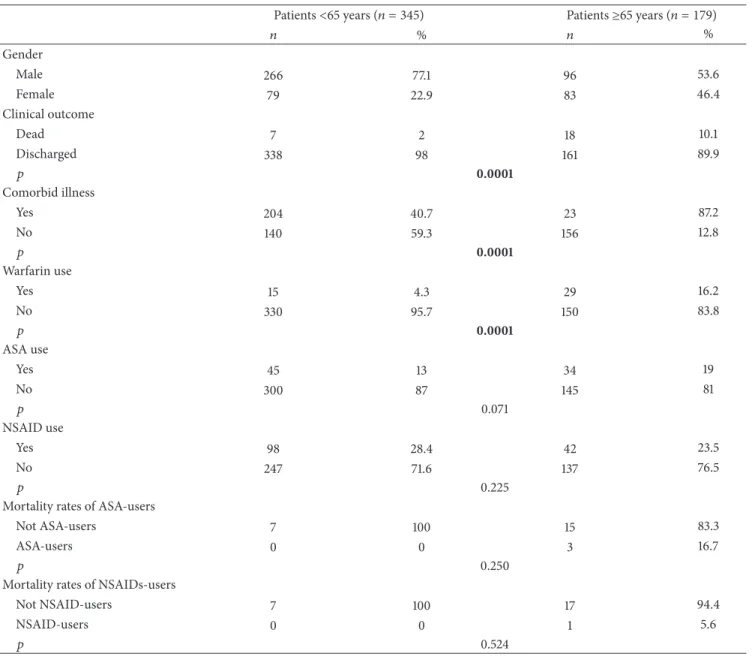
Group 2 had higher mortality rates than group 1 (10.1%
versus 2%, resp., 𝑝 = 0.0001). There were no differences
in use of NSAIDs and ASA between group 1 and group 2
(28.4% versus 23.5%,𝑝 = 0.225, and 19% versus 13%, 𝑝 =
0.071, resp.). None of the NSAIDs-user patient was taking gastroprotective medicines (e.g., proton-pump inhibitors). In all ASA-user patients, 3 of 45 (4.4%) patients in group 1 and 1 of 34 (2.94%) patients in group 2 were not taking gastroprotective medicines (𝑝 > 0.05). There were no differences in ASA-associated UGIB-related mortality and NSAIDs-associated UGIB-related mortality rates between group 1 and group 2 (𝑝 was 0.250 and 0.524, resp.). Also warfarin-associated UGIB was found significantly higher in group 2 than group 1 (𝑝 = 0.0001) (Table 2).
The mean CoH for patients with UGIB was $413.98 ± 374.5 (US Dollar). Also there was a positive correlation between patients’ age and CoH (𝑟 = 0.293; 𝑝 = 0.001). We also compared the LoS (day) and CoH (in US Dollar [exchange currency; 2 Turkish Liras = 1 US Dollar]) according to whether taking warfarin, ASA, or NSAID and patients’ age (Table 3). LoS and CoH were significantly higher in patients (both adult and elderly) with warfarin than those without warfarin (𝑝 was 0.002 and 0.001, resp.). When we compared patients with and without ASA, only CoH, but not LoS, was significantly different (𝑝 = 0.024). Elderly patients with ASA had significantly higher CoH than adult patients with ASA and all patients without ASA (𝑝 was 0.007 and 0.013, resp.). Adult patients with NSAID had significantly lower LoS and CoH than elderly patients with NSAID and all patients
without NSAID (see Table 3 for𝑝 values).
4. Discussion
In our study, female and male percentages of patients younger than 65 years and patients aged 65 years or older were found similar with previous studies [13, 14]. Viviane et al.
determined the mean LoS for UGIB as 4.4 ± 2.7 days. In
our study, it was6.35 ± 4.94 days. Also mean LoS of patients
younger than 65 years (7.8 ± 6.23 days) was found signifi-cantly higher than patients younger than 65 years (5.59±3.89 days). As we know that having comorbid illness increases the LoS [15, 16], the difference between elderly and adult patients’ hospital stay duration could be explained by having more comorbidities in elderly patients.
Previous studies have shown that peptic ulcer (includes gastric ulcer, duodenal ulcer, and peptic ulcer not otherwise specified) is the most common cause of bleeding in elderly patients [6]. In our study, the most common cause of bleeding was bulbar (duodenal) ulcer in both groups; but the second
Table 2: Comparison between patients<65 years and patients ≥65 years in regard to gender, clinical outcome, comorbid illness, ASA and NSAID use, and mortality.
Patients<65 years (𝑛 = 345) Patients≥65 years (𝑛 = 179)
𝑛 % 𝑛 % Gender Male 266 77.1 96 53.6 Female 79 22.9 83 46.4 Clinical outcome Dead 7 2 18 10.1 Discharged 338 98 161 89.9 𝑝 0.0001 Comorbid illness Yes 204 40.7 23 87.2 No 140 59.3 156 12.8 𝑝 0.0001 Warfarin use Yes 15 4.3 29 16.2 No 330 95.7 150 83.8 𝑝 0.0001 ASA use Yes 45 13 34 19 No 300 87 145 81 𝑝 0.071 NSAID use Yes 98 28.4 42 23.5 No 247 71.6 137 76.5 𝑝 0.225
Mortality rates of ASA-users
Not ASA-users 7 100 15 83.3
ASA-users 0 0 3 16.7
𝑝 0.250
Mortality rates of NSAIDs-users
Not NSAID-users 7 100 17 94.4
NSAID-users 0 0 1 5.6
𝑝 0.524
common cause was gastric malignant ulcer/mass in the elderly group whereas gastric ulcer was the second cause in adult patients.
According to our study, warfarin-user elderly patients had more UGIB than adult patients. In a study by Chen
et al. which is consistent with our finding, age >65 years
old has been found an independent risk factor for warfarin-associated gastrointestinal bleeding [17]. Pilotto et al. have stated in their study that elderly users of acute NSAIDs and regular-dose ASA have increased risk of UGIB [10], but in their study they did not compare these risks with adult subjects. We showed that UGIB risk of NSAIDs (if not cotreated with gastroprotective drugs) is not different in both groups (adult patients and elderly). Similarly UGIB risk of ASA (if cotreated with gastroprotective drugs) is not different in both groups (adult patients and elderly). In this study, we
have also determined that there were no differences in ASA-associated UGIB-related mortality and NSAIDs-ASA-associated UGIB-related mortality rates between two groups. As we do not have enough number of patients who were treated with ASA but not with gastroprotective drugs, we cannot state any particular comment on this situation.
The mean CoH for patients with UGIB was $413.98 ± 374.5. Also there was a positive correlation between patients’ age and CoH. Cryer et al. [18] have investigated the eco-nomics of UGIB in US and they have determined the mean CoH for patients with UGIB as $13,059. Also 12-month cost of a patient with UGIB, including total healthcare, medical, and pharmacy costs, was determined as $20,405. And they have shown that patients with UGIB experienced significantly higher 12-month health-resource utilization and costs than patients without UGIB. The other important point is that
T a ble 3: C o m p ar is o n o f the len gt h o f st ay an d cost o f h osp it al iza tio n acco rdin g to w het h er ta kin g wa rf ar in, ASA, o r NSAID an d p at ien ts ’ag e. Group 1 Group 2 Group 3 𝑝 a 𝑝 b A d ul t w ar fa rin+ E lderl y w ar fa rin+ W ar fa rin − 1v s3 2v s3 1v s2 𝑛 = 15 𝑛 = 29 𝑛 = 475 Me an ± SD (m ed ia n ) M ean ± SD (m ed ia n ) M ean ± SD (m ed ia n ) L en gt h o f st ay (d ay ) 8. 53 ± 7. 73 (6) 9.97 ± 7. 36 (9) 6.11 ± 4.5 3 (5) 0.0 02 ∗∗ 0.21 9 0.0 01 ∗∗ 0.297 C o st o f hosp it aliza tio n (US D o ll ar ) 55 4.88 ± 412.6 2 (5 43 .2) 618.47 ± 4 21.3 9 (57 4.2 5) 39 7. 59 ± 36 6.11 (3 20.6 5) 0.0 01 ∗∗ 0.0 47 ∗ 0.0 01 ∗∗ 0.3 93 A d u lt A SA+ E lderl y ASA+ ASA − 𝑝 a 1v s3 2v s3 1v s2 𝑛 = 43 𝑛 = 35 𝑛 = 441 Me an ± SD (m ed ia n ) M ean ± SD (m ed ia n ) M ean ± SD (m ed ia n ) L en gt h o f st ay (d ay ) 6 .0 9 ± 3.3 2 (5) 7.8 9 ± 6.9 9 (6) 6.3 1± 4.8 5 (5) 0.3 62 0.5 19 0 .1 93 0.4 27 C o st o f hosp it aliza tio n (US D o lla r) 34 9.7 2 ± 25 6.12 (3 03.2 5) 51 4.29 ± 30 9. 21 (45 5.10) 412.87 ± 38 7. 27 (3 37 .6 5) 0.0 24 ∗ 0.4 08 0.013 ∗ 0.0 0 7 ∗∗ A d u lt NSAID+ E lderl y NSAID+ NSAID − 𝑝 a 1v s3 2v s3 1v s2 𝑛 = 98 𝑛 = 42 𝑛 = 379 Me an ± SD (m ed ia n ) M ean ± SD (m ed ia n ) M ean ± SD (m ed ia n ) L en gt h o f st ay (d ay ) 5. 0 5 ± 2.58 (5) 7.2 4 ± 4.29 (6) 6.6 5 ± 5.3 8 (5) 0.0 07 ∗∗ 0.012 ∗ 0.13 4 0.0 02 ∗∗ C o st o f hosp it al iza tio n (US D o ll ar ) 33 1.88 ± 30 1.26 (26 5.8 5) 49 4.98 ± 4 02.4 4 (4 27 .7 5) 4 26.9 2 ± 38 5.18 (3 47 .3 5) 0.0 05 ∗∗ 0.013 ∗ 0.111 0.0 01 ∗∗ a Kr usk al -W al lis te st , b M ann-W h it ne y 𝑈 te st , ∗ 𝑝 < 0.05 ,a n d ∗∗ 𝑝 < 0.01 .
according to Cryer et al.’s study, patients who experienced UGIB had significantly higher cost of UGI-related filled prescription than general population ($558 versus 141). Thus cost-effectiveness studies are needed to examine the long-term economic benefits obtained from managing and pre-venting UGIB with medication.
According to our study, patients with warfarin-associated UGIB had higher CoH than all patients with UGIB without warfarin. Also, elderly patients with ASA-associated UGIB had higher CoH than adult patients with ASA-associated UGIB and all patients with UGIB without ASA. Interestingly, adult patients with NSAID-associated UGIB had lower LoS and CoH than elderly patients with NSAID-associated UGIB and all patients with UGIB without NSAID.
5. Conclusion
A positive correlation was determined between patients’ age and cost of hospitalization.
Even though elderly patients are more prone to have warfarin-associated UGIB, physicians should be more careful when prescribing warfarin in not only elderly patients but also adult patients as those patients with warfarin-associated UGIB had higher CoH than patients with UGIB without warfarin.
When we consider only UGIB risk, using NSAIDs with-out gastroprotective drugs in elderly patients is as safe as in adult patients. But, even though there was no difference in the risk of NSAID-associated UGIB in between elderly and adult patients without gastroprotective drugs, elderly patients with NSAID-associated UGIB had significantly higher LoS and CoH than adult patients with NSAID-associated UGIB.
Similarly when ASA is prescribed with gastroprotective drugs in elderly, it can be used in elderly patients as safely as in adult patients. But, even though there was no difference in the risk of ASA-associated UGIB in between elderly and adult patients with gastroprotective drugs, elderly patients with ASA-associated UGIB had significantly higher CoH than adult patients with NSAID-associated UGIB.
Not only should adding gastroprotective drugs to ASA or NSAID be based on their risk of UGIB, but the cost of hospi-talization of their-associated UGIB should be considered.
Conflict of Interests
The authors declare that there is no conflict of interests regarding the publication of this paper.
References
[1] US National Institute on Aging, “World Population Aging,” 2015, http://www.nia.nih.gov/research/dbsr/world-population-aging.
[2] R. C. Kaplan, S. R. Heckbert, T. D. Koepsell et al., “Risk factors for hospitalized gastrointestinal bleeding among older persons,”
Journal of the American Geriatrics Society, vol. 49, no. 2, pp. 126–
133, 2001.
[3] O. Blatchford, L. A. Davidson, W. R. Murray, M. Blatchford, and J. Pell, “Acute upper gastrointestinal haemorrhage in west
of Scotland: case ascertainment study,” British Medical Journal, vol. 315, no. 7107, pp. 510–514, 1997.
[4] R. Marmo, M. Koch, L. Cipolletta et al., “Predictive factors of mortality from nonvariceal upper gastrointestinal hemorrhage: a multicenter study,” The American Journal of Gastroenterology, vol. 103, no. 7, pp. 1639–1647, 2008.
[5] A. Ahmed and A. J. Stanley, “Acute upper gastrointestinal bleeding in the elderly: aetiology, diagnosis and treatment,”
Drugs and Aging, vol. 29, no. 12, pp. 933–940, 2012.
[6] P. S. Yachimski and L. S. Friedman, “Gastrointestinal bleeding in the elderly,” Nature Clinical Practice Gastroenterology &
Hepatology, vol. 5, no. 2, pp. 80–93, 2008.
[7] A. Pilotto, M. Franceschi, G. Leandro, and F. Di Mario, “NSAID and aspirin use by the elderly in general practice: effect on gastrointestinal symptoms and therapies,” Drugs and Aging, vol. 20, no. 9, pp. 701–710, 2003.
[8] E. A. Chrischilles, J. H. Lemke, R. B. Wallace, and G. A. Drube, “Prevalence and characteristics of multiple analgesic drug use in an elderly study group,” Journal of the American Geriatrics
Society, vol. 38, no. 9, pp. 979–984, 1990.
[9] A. Lanas, P. Wu, J. Medin, and E. J. Mills, “Low doses of acetylsalicylic acid increase risk of gastrointestinal bleeding in a meta-analysis,” Clinical Gastroenterology and Hepatology, vol. 9, no. 9, pp. 762–768.e6, 2011.
[10] A. Pilotto, M. Franceschi, G. Leandro et al., “The risk of upper gastrointestinal bleeding in elderly users of aspirin and other non-steroidal anti-inflammatory drugs: the role of gastropro-tective drugs,” Aging Clinical and Experimental Research, vol. 15, no. 6, pp. 494–499, 2003.
[11] G. M. C. Masclee, V. E. Valkhoff, P. M. Coloma et al., “Risk of upper gastrointestinal bleeding from different drug combina-tions,” Gastroenterology, vol. 147, no. 4, pp. 784.e9–792.e9, 2014. [12] E. L. Mass´o Gonz´alez, P. Patrignani, S. Tacconelli, and L. A. Garc´ıa Rodr´ıguez, “Variability among nonsteroidal antiin-flammatory drugs in risk of upper gastrointestinal bleeding,”
Arthritis and Rheumatism, vol. 62, no. 6, pp. 1592–1601, 2010.
[13] S. Nahon, O. Nouel, H. Hag`ege et al., “Favorable prognosis of upper-gastrointestinal bleeding in 1041 older patients: results of a prospective multicenter study,” Clinical Gastroenterology and
Hepatology, vol. 6, no. 8, pp. 886–892, 2008.
[14] P. Charatcharoenwitthaya, N. Pausawasdi, N. Laosanguaneak, J. Bubthamala, T. Tanwandee, and S. Leelakusolvong, “Charac-teristics and outcomes of acute upper gastrointestinal bleeding after therapeutic endoscopy in the elderly,” World Journal of
Gastroenterology, vol. 17, no. 32, pp. 3724–3732, 2011.
[15] J. Librero, S. Peir´o, and R. Ordi˜nana, “Chronic comorbidity and outcomes of hospital care: length of stay, mortality, and read-mission at 30 and 365 days,” Journal of Clinical Epidemiology, vol. 52, no. 3, pp. 171–179, 1999.
[16] K. Matsui, L. Goldman, P. A. Johnson, K. M. Kuntz, E. F. Cook, and T. H. Lee, “Comorbidity as a correlate of length of stay for hospitalized patients with acute chest pain,” Journal of General
Internal Medicine, vol. 11, no. 5, pp. 262–268, 1996.
[17] W.-C. Chen, Y.-H. Chen, P.-I. Hsu et al., “Gastrointestinal hemorrhage in warfarin anticoagulated patients: incidence, risk factor, management, and outcome,” BioMed Research
Interna-tional, vol. 2014, Article ID 463767, 7 pages, 2014.
[18] B. L. Cryer, C. M. Wilcox, H. J. Henk, G. Zlateva, L. Chen, and V. Zarotsky, “The economics of upper gastrointestinal bleeding in a US managed-care setting: a retrospective, claims-based analysis,” Journal of Medical Economics, vol. 13, no. 1, pp. 70–77, 2010.
Submit your manuscripts at
http://www.hindawi.com
Stem Cells
International
Hindawi Publishing Corporationhttp://www.hindawi.com Volume 2014
Hindawi Publishing Corporation
http://www.hindawi.com Volume 2014
INFLAMMATION
Hindawi Publishing Corporation
http://www.hindawi.com Volume 2014
Behavioural
Neurology
Endocrinology
International Journal ofHindawi Publishing Corporation
http://www.hindawi.com Volume 2014
Hindawi Publishing Corporation
http://www.hindawi.com Volume 2014
Disease Markers
Hindawi Publishing Corporation
http://www.hindawi.com Volume 2014
BioMed
Research International
Oncology
Journal ofHindawi Publishing Corporation
http://www.hindawi.com Volume 2014
Hindawi Publishing Corporation
http://www.hindawi.com Volume 2014
Oxidative Medicine and Cellular Longevity
Hindawi Publishing Corporation
http://www.hindawi.com Volume 2014
PPAR Research
The Scientific
World Journal
Hindawi Publishing Corporation
http://www.hindawi.com Volume 2014
Immunology Research
Hindawi Publishing Corporation
http://www.hindawi.com Volume 2014
Journal of
Obesity
Journal ofHindawi Publishing Corporation
http://www.hindawi.com Volume 2014
Hindawi Publishing Corporation
http://www.hindawi.com Volume 2014
Computational and Mathematical Methods in Medicine
Ophthalmology
Journal ofHindawi Publishing Corporation
http://www.hindawi.com Volume 2014
Diabetes Research
Journal ofHindawi Publishing Corporation
http://www.hindawi.com Volume 2014
Hindawi Publishing Corporation
http://www.hindawi.com Volume 2014
Research and Treatment
AIDS
Hindawi Publishing Corporation
http://www.hindawi.com Volume 2014
Gastroenterology Research and Practice
Hindawi Publishing Corporation
http://www.hindawi.com Volume 2014