1- Department of Biostatistics and Medical Informatics, Cerrahpasa Faculty of Medicine, Istanbul University, Istanbul, Turkey AND Department of Evidence for Population Health Unit, School of Epidemiology and Health Sciences, University of Manchester, Manchester, UK
2- Department of Psychology, School of Social Sciences, Nottingham Trent University, Nottingham, UK 3- Department of Public Health, Faculty of Medicine, Istanbul Medipol University, Istanbul, Turkey
4- Department of Biostatistics and Medical Informatics, Cerrahpasa Faculty of Medicine, Istanbul University, Istanbul, Turkey AND Department of Computer Education and Instructional Technologies, Faculty of Education, University of Kastamonu, Kastamonu, Turkey 5- Department of Public Health, Capa Faculty of Medicine, Istanbul University, Istanbul, Turkey
Correspondence to: Abdulbari Bener, Email: [email protected]
Internet Addiction and the Psychometric Properties of the Nine-item
Internet Disorder Scale–Short Form: An Application of Rasch Analysis
Abdulbari Bener1 , Mark D. Griffiths2, Nuket Guler Baysoy3, Funda Catan4, Eray Yurtseven5
Abstract
Background:The aim of the present study was to determine the prevalence of disordered internet use among adolescent university students and its association with various health complaints and behaviours, and most importantly to examine the psychometric properties of 9-item Internet Disorder Scale-Short Form (IDS9-SF) using factor analyses and Rasch analysis.
Methods: A total of 1988 university students aged 18 to 25 years were selected via a multi-stage stratified random sampling technique among university students in Istanbul, Turkey (September 2017 to February 2018). Data collected included socio-demographics, lifestyle and dietary habits, and the 9-item IDS9-SF. Statistical analysis included descriptive statistics, multivariate analyses, factor analyses, path analysis, and Rasch analysis.
Findings:Using confirmatory factor analysis (CFA), the study investigated the latent structure of the IDS9-SF instrument and results supported its reliability and validity. The prevalence of disordered internet use was 18.3% in the sample. There were significant differences between those who had disordered internet use and those who did not in gender, family income, school performance, number of bedrooms at home, and number of people living at home, as well as internet use duration. Using multivariate regression analysis, key predictors of disordered internet use included (among others): gender, body mass index (BMI), household income, number of people living at home, having a computer at home, internet facilities, duration of internet use, sleeping hours, frequency of eating fast food, watching television, headache, hurting eyes, tired eyes, and hearing problems. Rash analysis demonstrated that four of the nine items (2, 3, 6, and 7) were more difficult for individuals to endorse compared to other items.
Conclusion: Problems arising from excessive internet use were apparent among the study sample and the IDS9-SF is a valid and reliable measure for assessing disordered internet use among Turkish adolescent population.
Keywords: Internet; Addictive behavior; Psychometrics;Disorders; Turkey
Citation: Bener A, Griffiths MD, Guler Baysoy N, Catan F, Yurtseven E. Internet Addiction and the Psychometric Properties of the Nine-item Internet Disorder Scale–Short Form: An Application of Rasch Analysis. Addict Health 2019; 11(4): 234-42.
Received: 01.06.2019 Accepted: 03.08.2019
Original Article
This is an o p en -ac cess ar ticl e dis trib u ted un d er th e terms o f th e Creativ e Co m m o n s Attribu tio n Un p o rted Lice n se , wh ich p er m its u n restricted us e, d istrib u tio n , an d r ep rod u ctio n in an y m ed iu m , p rov id ed th e orig in al work i s p rop erly cited.Introduction
Despite the many potential benefits associated with using the internet, numerous problems such as exposure to inappropriate images and content, absence of privacy, and internet addiction among a small minority have been reported as a result of this increasing usage.1 Research into internet
addiction began in the 1990s by Griffiths in the UK and Young in the US.2,3 Although internet
addiction has been identified as a prevalent problem among a small minority of the population, it has never been classed as a formal disorder most likely because internet addiction is an umbrella term covering more specific online problematic behaviors such as online problematic gaming and problematic social media use.4 Many
psychometric studies have been carried out and there are over 20 different assessment scales that have been developed to assess problematic internet use behavior.5 The theoretical frameworks
underpinning many psychometric instruments are still controversial, and a study has evolved in a divergent manner with little or no consensus.6
In 2013, new criteria and definitions of various internet addictions began to develop as a consequence of Internet Gaming Disorder (IGD) being introduced to section 3 of the latest (fifth) edition of the Diagnostic and Statistical Manual of Mental Disorders-5th Edition (DSM-5), leading to
the development of more new instruments.7 Many
of these new instruments also included core criteria of addiction such as those outlined by Griffiths (2005) and also used in the context of problematic internet use.8,9 For instance, Pontes
and Griffiths10 developed the nine-item IGD
Scale-Short Form (IGDS-SF) which was letter adapted to develop the 15-item Internet Disorder Scale (IDS-15)11 and the 9-item IDS-Short Form
(IDS9-SF).12
Irrespective of whether disordered internet use is an addiction, research has consistently shown that excessive internet use can lead to psychological and behavioral problems among a small minority of individuals,13 including physical
health issues (e.g., dry eyes, neck, back, and shoulder pain, regular headaches, numbness pain in the thumb, index, and middle fingers).14,15
Again, irrespective of whether it is a dependency, addiction, and/or disorder, there have been many studies reporting negative impacts of excessive
internet use among adolescents including poor dietary habits,16 physical inactivity, lack of
adequate sleep,15,17 increased depression and
loneliness, and social anxiety.15,18
The present study aimed to determine the prevalence of disordered internet use among adolescent university students, its association with various health complaints and behaviors, and most importantly to examine the psychometric properties of IDS9-SF using Rasch analysis.
Methods
Turkish adolescent university students aged 18 to 25 years who studied in five Istanbul government and private trust universities completed the current cross-sectional survey. The Institutional Review Board (IRB) (Istanbul Medipol University) gave ethical clearance for the study. A multi-stage stratified random sampling method was performed from September 2017 to February 2018. A total of 2500 students were approached and 1988 (79.5%) students completed the measures. Content validity, face validity, and reliability of the whole questionnaire obtained high kappa = 0.86.
In addition to sociodemographic information (age, gender, income, academic performance), the survey included the IDS9-SF as well.12 The
IDS9-SF is a unidimensional standardized psychometric scale that assesses internet use disorder (IUD). The IDS9-SF uses 5-point Likert scales and total scores can range from 9 to 45, with higher scores being indicative of a higher degree of IUD.
Statistical analysis and Rasch measurement:
The Rasch method is used to examine a participant’s response to an item that is a function of the difference between an individual’s ability and the characteristics of the item. Rasch measurement determines the relationship between the difficulty of an item and the ability of an individual. It is expected that there will be a higher probability in answering easier items correctly and a lower probability in answering more difficult items incorrectly.19,20 According to the model, the
probability of an individual (n) responding in category x to item i, is given by:
Pxni= exp ∑ [βn−(δi+τj) x j=0 ] ∑mk=0exp ∑kj=0[βn−(δi+τj)] x = 0,1, … , m Where τ0= 0, so that
exp ∑0j=0[βn− (δi+ τj)] = 1
βn is the individual’s position on the variable,
δi is the scale value (difficulty to endorse)
estimated for each item i, and τ1 τ2… τ3 are the m
response thresholds estimated for the m + 1 rating categories.19,20
The statistical analysis included student’s t-test, chi-square test, and Fisher’s exact test (two-tailed). The Rasch Rating Scale Model (RSM) was used for the analyses of the data collected. Multiple regression analysis using the forward inclusion and backward deletion method was performed to determine the importance of risk factors for internet addiction. Statistical significance was assessed at the P < 0.01 level.
Results
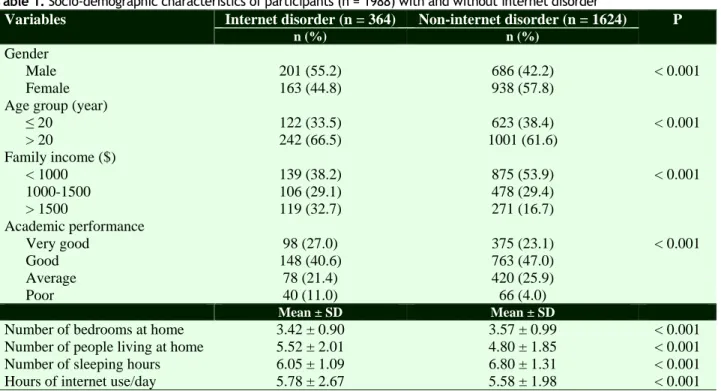
Table 1 shows the socio-demographic characteristics of internet disordered participants compared to those not disordered. The prevalence of IUD in the present Turkish sample was 18.3%. There were significant differences between age, gender, family income, and rank in school exams (P < 0.001). Predictably, significantly more daily hours were spent on the internet among internet disordered participants compared to non-internet disordered participants (P = 0.001). Table 2 shows
the differences between internet disordered and non-internet disordered participants with respect to diet and co-morbid factors. Those with internet disorder were significantly more likely to have headache, blurred vision, double vision, hurting eyes, and hearing problems, and to eat fast food frequently (P < 0.001). Significantly, fewer participants with internet disorder reported engaging in vigorous and moderate physical activity compared to non-internet disordered participants (P < 0.001).
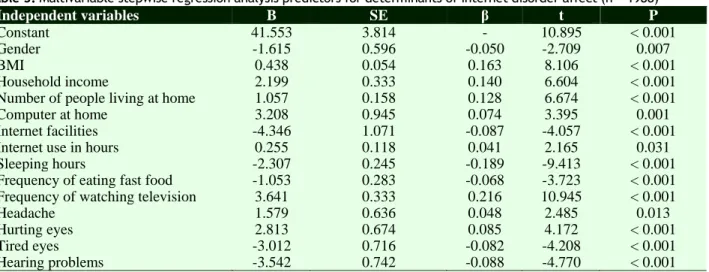
Table 3 shows the multiple linear regression analysis to determine the potential predictors as risk factors for internet disorder. This analysis demonstrated that gender, body mass index (BMI), household income, number of people living at home, having a computer at home, having internet facilities, duration of internet use, sleeping hours, frequency of eating fast food, watching television, headache, hurting eyes, tired eyes, and hearing problems were significantly associated with (and key predictors of) internet disorder.
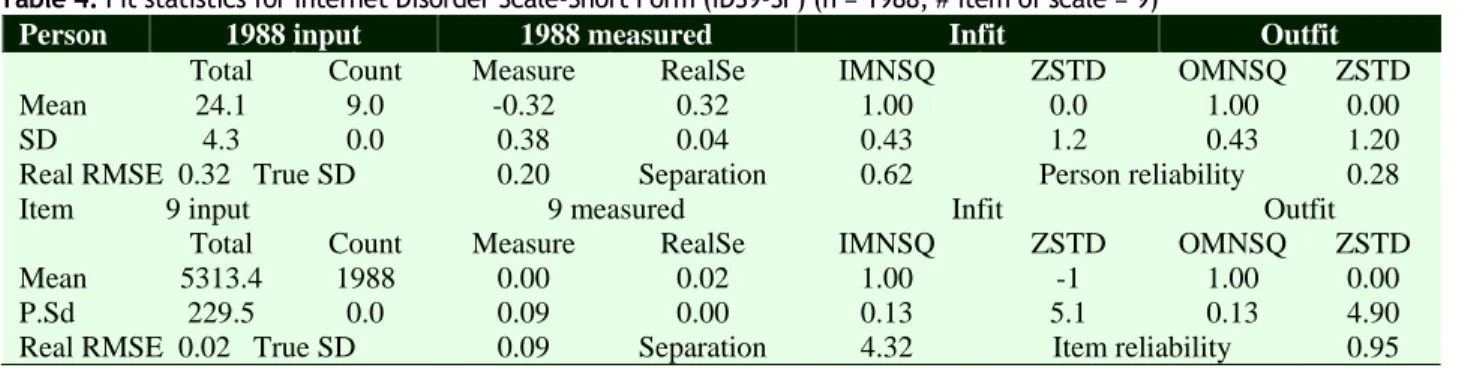
In table 4, the individual and item reliability indexes were calculated as 0.28 and 0.95, respectively, by Rasch analysis. Reliability ranged from 0 to 1.0 (where a coefficient of 0 means no reliability while 1.0 means perfect reliability).
Table 1. Socio-demographic characteristics of participants (n = 1988) with and without internetdisorder
Variables Internet disorder (n = 364) Non-internet disorder (n = 1624) P
n (%) n (%)
Gender
Male 201 (55.2) 686 (42.2) < 0.001
Female 163 (44.8) 938 (57.8)
Age group (year)
≤ 20 122 (33.5) 623 (38.4) < 0.001 > 20 242 (66.5) 1001 (61.6) Family income ($) < 1000 139 (38.2) 875 (53.9) < 0.001 1000-1500 106 (29.1) 478 (29.4) > 1500 119 (32.7) 271 (16.7) Academic performance Very good 98 (27.0) 375 (23.1) < 0.001 Good 148 (40.6) 763 (47.0) Average 78 (21.4) 420 (25.9) Poor 40 (11.0) 66 (4.0) Mean ± SD Mean ± SD
Number of bedrooms at home 3.42 ± 0.90 3.57 ± 0.99 < 0.001
Number of people living at home 5.52 ± 2.01 4.80 ± 1.85 < 0.001
Number of sleeping hours 6.05 ± 1.09 6.80 ± 1.31 < 0.001
Hours of internet use/day 5.78 ± 2.67 5.58 ± 1.98 < 0.001
Table 2. The characteristics of dietary and co-morbid factors (n = 1988)
Variables Internet disorder (n = 364) Non-internet disorder (n = 1624) P*
Medical co-morbid factors** n (%) n (%)
Headache 208 (10.5) 1020 (51.3) 0.044 Blurred vision 95 (4.8) 578 (29.1) 0.001 Double vision 70 (3.5) 162 (8.1) < 0.001 Hurting eyes 96 (4.8) 624 (31.4) < 0.001 Tired eyes 101 (5.1) 379 (19.1) 0.076 Dizziness 138 (6.9) 582 (29.3) 0.457
Any hearing problem 107 (5.4) 272 (13.7) < 0.001
Physical activity
Vigorous 158 (7.9) 840 (42.3) 0.004
Moderate 181 (9.1) 1035 (52.1) < 0.001
Frequency of eating fast food*
Daily 97 (26.6) 317 (19.5)
Weekly 120 (33.0) 627 (38.6) < 0.001
Monthly 88 (24.2) 274 (16.9)
Occasionally 59 (16.2) 406 (25.0)
*Two-sided P-values based on student’s t-test; **Not adding to 100%
Moreover, the individual and item separation indexes were 0.62 and 4.32, respectively. Table 4 demonstrates that the IDS9-SF has acceptable psychometric characteristics because the model fit mean-square (MNSQ) values range from 0.79 to 1.28, outfit MNSQ is 1.00, and infit MNSQ is 1.00. The values of infit and outfit MNSQs are in the acceptable range of 0.5-1.5 for these statistics.19
Winsteps 4.0.1 was used to conduct the Rasch analysis for the present study. As seen in figure 1, in the left-hand column, each “#” symbol represents 15 people and each “.” represents 1 to 14 people. In the right-hand column, each entry represents a scale item. The person-item map compared the range and position of the item measure distribution (left-hand side of figure 1) to
the range and position of the person measure distribution (right-hand side of figure 1). The individuals at the top of figure 1 had the highest scores, while the items at the top of figure 1 were the most difficult. Individuals at the bottom of figure 1 had the lowest scores, and the items at the bottom of figure 1 were the easiest. Several items are situated high above the mean value (0.0 logit) with high logit measures. This means that these items such as item 2 (‘feel anxiety when trying to reduce and/or stop using internet’), item 3 (‘need to spend more time to achieve satisfaction’), item 6 (‘continue to be online when it leads to a problem’), and item 7 (‘deceive people about the time of being online’) are difficult for individuals to endorse.
Table 3. Multivariable stepwise regression analysis predictors for determinants of internet disorder affect (n = 1988)
Independent variables B SE β t P
Constant 41.553 3.814 - 10.895 < 0.001
Gender -1.615 0.596 -0.050 -2.709 0.007
BMI 0.438 0.054 0.163 8.106 < 0.001
Household income 2.199 0.333 0.140 6.604 < 0.001
Number of people living at home 1.057 0.158 0.128 6.674 < 0.001
Computer at home 3.208 0.945 0.074 3.395 0.001
Internet facilities -4.346 1.071 -0.087 -4.057 < 0.001
Internet use in hours 0.255 0.118 0.041 2.165 0.031
Sleeping hours -2.307 0.245 -0.189 -9.413 < 0.001
Frequency of eating fast food -1.053 0.283 -0.068 -3.723 < 0.001
Frequency of watching television 3.641 0.333 0.216 10.945 < 0.001
Headache 1.579 0.636 0.048 2.485 0.013
Hurting eyes 2.813 0.674 0.085 4.172 < 0.001
Tired eyes -3.012 0.716 -0.082 -4.208 < 0.001
Hearing problems -3.542 0.742 -0.088 -4.770 < 0.001
Table 4. Fit statistics for Internet Disorder Scale-Short Form (IDS9-SF) (n = 1988, # item of scale = 9)
Person 1988 input 1988 measured Infit Outfit
Total Count Measure RealSe IMNSQ ZSTD OMNSQ ZSTD
Mean 24.1 9.0 -0.32 0.32 1.00 0.0 1.00 0.00
SD 4.3 0.0 0.38 0.04 0.43 1.2 0.43 1.20
Real RMSE 0.32 True SD 0.20 Separation 0.62 Person reliability 0.28
Item 9 input 9 measured Infit Outfit
Total Count Measure RealSe IMNSQ ZSTD OMNSQ ZSTD
Mean 5313.4 1988 0.00 0.02 1.00 -1 1.00 0.00
P.Sd 229.5 0.0 0.09 0.00 0.13 5.1 0.13 4.90
Real RMSE 0.02 True SD 0.09 Separation 4.32 Item reliability 0.95
RMSE: Root-mean-square error; IMNSQ: Infit mean square; ZSTD: Standardized; OMNSQ: Outfit mean square
MEASURE PERSON - MAP - ITEM <more>|<rare> 2 + | | | . | | | | | | | . | | | . | 1 + . | | . | | . | | . | .# T| | .# | .## | .#### |T | IDS2ANXI
.###### S|S IDS3SATI IDS6CAUS IDS7THER 0 .######## +M IDS4DIFC IDS5LOST .######### |S IDS8GUIL .########### | IDS1OCCU IDS9LOST .############ |T | ############ M| ########## | .########### | .########## | | ######## S| .###### | | .##### | ### | -1 + .## T| | .# | | | . | | | . | | | | | | -2 + <less>|<freq
Figure 1. Person-item map for Internet Disorder Scale-Short Form (IDS9-SF) (n = 1988)
The vertical line between the two columns indicates the scale for parameter estimates measured in logits (i.e., log-odds units). Along the vertical line, M indicates the mean, S indicates one standard deviation (SD) above or below the mean, and T indicates two SDs above or below the mean.
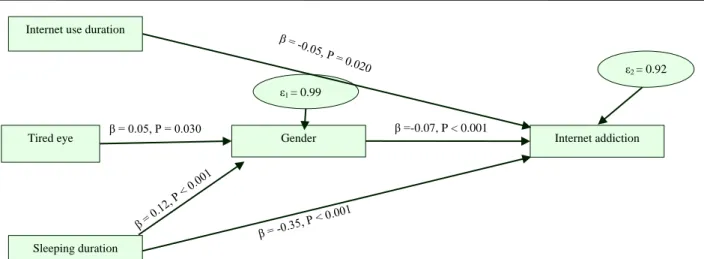
Figure 2 indicates the path analysis of IDS9-SF in determining the significance of the hypothesized causal connections between sets of variables. In the present study, each rectangle represents a variable. Internet addiction and gender are endogenous variables and their variances are explained by other variables in the model. The other variables are extraneous and indicated by the arrow from ε. The path coefficients are the β weights from the multiple regression analyses. Analysis indicated that internet addiction was directly affected by gender (β = -0.07), having tired eyes (β = -0.11), sleep duration (β = 0.35), and internet use duration (β = -0.05). Moreover, sleep duration and having tired eyes had indirect effects via gender upon internet addiction.
Discussion
The prevalence of IUD in the present study’s Turkish sample (18.3%) was comparable to 26.3% of United States (US) university students.21
However, it must be noted that comparing these (or any other) studies is difficult because of differences in study populations, assessment tools applied, and differences in social and cultural contexts. For example, a meta-analysis by Cheng and Li22 comprising 80 studies (n = 89281
participants) reported an estimated global prevalence rate of internet addiction of 6.0%. The highest prevalence was in the Middle East (including Turkey, Iran, Israel, Lebanon) with 10.9%, followed by 8.0% for North America (US), 7.1% for Asia (China, Hong Kong, India, South
Figure 2. Summary of the path analysis of the Internet Disorder Scale–Short Form (IDS9-SF)
Korea, Taiwan), 6.1% for South and East Europe (Bulgaria, Cyprus, Czech Republic, Greece, Hungary, Italy, Poland, Romania, Serbia, Slovenia, Spain), 4.3% for Oceania (Australia), and the lowest was in Northern and Western Europe with 2.6% (Austria, Estonia, France, Germany, Ireland, Norway, Sweden, United Kingdom).22 In this
meta-analytic study, internet addiction prevalence was higher for nations with greater traffic time consumption, pollution, and dissatisfaction with life in general and was found to be inversely associated with the quality of life. In a recent study, problematic internet use was studied in seven European countries and prevalence estimates ranged between 14.3% and 54.9% and many cross-cultural and gender differences have been observed in terms of relationship with psychopathology and online activities.23 The
students use of the internet is more than the general population; surveying students also led to an inflated prevalence rate relative to the general population in both general and problematic use.24
The IDS9-SF was also developed using online users12 and the present study used the scale in a
student sample. For that reason, the prevalence of IUD was likely to be much higher compared to European countries more generally.23
The IDS9-SF was developed by adapting from IGDS-SF,10 that uses common criteria in which both
reliability and validity can be better ascertained across studies.25,26 The psychometric properties of
the IDS9-SF in the present study were comparable to original scale development study of Pontes and Griffiths.12 The Cronbach’s alpha reliability
coefficient was high (α = 0.85) and the factor determinacy was 0.89, which is well above the
desired threshold of 0.80, supporting reliability and validity of the instrument. Additionally, Rash analysis was carried out in order to detect the level of difficulty of each question and demonstrated that item 2 (‘feel anxiety when trying to reduce and or stop using internet’), item 3 (‘need to spend more time to achieve satisfaction’), item 6 (‘continue to be online when it leads to a problem’), and item 7 (‘deceive people about the time of being online’) were more difficult for individuals to endorse compared to other items.
Our results confirm findings from previous studies showing that disordered internet use can have negative impacts on individuals’ abilities,27,28
physical inactivity,16 adequate sleep,15,17 and
irregular dietary habits.14,16 The relationship
between excessive internet use and sleep problems has become well established in the literature. Furthermore, disordered internet use can also play a contributory role in daytime sleepiness, sleeping disorders, sleep deprivation, and fatigue.15,29,30
The present study has several limitations. First, although it examined the associations between disordered internet use and many other behaviors and health issues, the data were cross-sectional and therefore, no conclusions can be made concerning issues of causality. Second, there may be social desirability and memory recall biases concerning the duration of internet use in self-report data. Thirdly, factors relating to family members, the social environment, and disordered internet use were not assessed in the present study. However, despite these limitations, the present study confirmed that disordered internet use was associated with many detrimental health issues using a relatively large-scale sample.
ε1 = 0.99
ε2 = 0.92
Sleeping duration
Gender
β = 0.05, P = 0.030 β =-0.07, P < 0.001
Tired eye Internet addiction
Conclusion
The results of the present study supported the internal consistency of the IDS9-SF which is based on adapted criteria for IGD in the DSM-5. Analysis demonstrated good Cronbach’s alpha and composite reliability. Therefore, the IDS9-SF appears to be a valid and reliable measure for assessing IUD among Turkish population. However, Rasch analysis demonstrated that some items in the IDS9-SF were more difficult for individuals to endorse than others.
Conflict of Interests
The Authors have no conflict of interest.
Acknowledgements
This work was supported by the International
School of Medicine, Istanbul Medipol University. The authors would like to thank the Istanbul Medipol University for their support and ethical approval (Research Protool and IRB# 10840098-604.01.01-E.9713).
Authors’ Contribution
AB and EY organized study, collected the data, performed statistical analysis and wrote the first draft of the article, and contributed to the interpretation of the data and writing the final draft of manuscript. NGB and FC collected the data, performed statistical analysis and wrote the first draft of the article. MDG contributed the literature review, interpretation of the data, and overseeing the final writing and editing of the manuscript.
References
1. Ramezani M, Salehi M, Namiranian N, Salehi M. Validity and reliability of the Chen internet addiction scale. J Fundam Ment Health 2012; 14(3): 236-45. [In Persian].
2. Griffiths M. Internet addiction - time to be taken seriously? Addiction Research 2000; 8(5): 413-8. 3. Young KS. Internet addiction: The emergence of a
new clinical disorder. Cyberpsychol Behav 1998; 1(3): 237-44.
4. Kuss DJ, Griffiths M. Internet addiction in psychotherapy. Houndmills, Basingstoke, Hampshire, UK: Palgrave Macmillan; 2015.
5. Kuss DJ, Griffiths MD, Karila L, Billieux J. Internet addiction: A systematic review of epidemiological research for the last decade. Curr Pharm Des 2014; 20(25): 4026-52.
6. Cerniglia L, Zoratto F, Cimino S, Laviola G, Ammaniti M, Adriani W. Internet addiction in adolescence: Neurobiological, psychosocial and clinical issues. Neurosci Biobehav Rev 2017; 76(Pt A): 174-84.
7. American Psychiatric Association. Diagnostic and statistical manual of mental disorders: DSM-5™. 5th
ed. Arlington, VA: American Psychiatric Publishing; 2013.
8. Griffiths M. A 'components' model of addiction within a biopsychosocial framework. J Substance Use 2005; 10(4): 191-7.
9. Kuss DJ, Shorter GW, van Rooij AJ, van de Mheen D, Griffiths MD. The internet addiction components model and personality: Establishing construct validity via a nomological network. Comput Human Behav 2014; 39: 312-21.
10. Pontes HM, Griffiths MD. Measuring DSM-5 internet gaming disorder: Development and validation of a short psychometric scale. Comput Human Behav 2015; 45: 137-43.
11. Pontes HM, Griffiths MD. The development and psychometric evaluation of the Internet Disorder Scale (IDS-15). Addict Behav 2017; 64: 261-8. 12. Pontes H, Griffiths M. The development and
psychometric properties of the internet disorder scale Short Form (IDS9-SF). Addicta: The Turkish Journal on Addictions 2016; 3(3): 303-18.
13. Widyanto L, Griffiths M. "Internet addiction": A critical review. Int J Ment Health Addiction 2006; 4(1): 31-51.
14. Park S, Hong KE, Park EJ, Ha KS, Yoo HJ. The association between problematic internet use and depression, suicidal ideation and bipolar disorder symptoms in Korean adolescents. Aust N Z J Psychiatry 2013; 47(2): 153-9.
15. Bener A, Yildirim E, Torun P, Catan F, Bolat E, Alic S, et al. Internet addiction, fatigue, and sleep problems among adolescent students: A large-scale study. Int J Ment Health Addiction 2019; 17(4): 959-69.
16. Bener A, Al-Mahdi HS, Vachhani PJ, Al-Nufal M, Ali AI. Do excessive internet use, television viewing and poor lifestyle habits affect low vision in school children? J Child Health Care 2010; 14(4): 375-85. 17. Ekinci O, Celik T, Savas N, Toros F. Association
between internet use and sleep problems in adolescents. Noro Psikiyatr Ars 2014; 51(2): 122-8. 18. Celik V, Yesilyurt E, Korkmaz O, Usta E. From the
perspective of loneliness and cognitive absorption internet addiction as predictor and predicted. Eurasia
J Math Sci Technol 2014; 10(6): 581-94.
19. Linacre JM. Optimizing rating scale category effectiveness. J Appl Meas 2002; 3(1): 85-106. 20. Linacre JM. Rasch Measures and Unidimensionality.
Rasch Measurement Transactions 2011; 24(4): 1310. 21. Li W, O'Brien JE, Snyder SM, Howard MO. Characteristics of internet addiction/pathological internet use in U.S. university students: A qualitative-method investigation. PLoS One 2015; 10(2): e0117372.
22. Cheng C, Li AY. Internet addiction prevalence and quality of (real) life: A meta-analysis of 31 nations across seven world regions. Cyberpsychol Behav Soc Netw 2014; 17(12): 755-60.
23. Laconi Sp, Kaliszewska-Czeremska K, Gnisci A, Sergi I, Barke A, Jeromin F, et al. Cross-cultural study of Problematic Internet Use in nine European countries. Comput Human Behav 2018; 84: 430-40. 24. Rumpf HJ, Tao R, Rehbein F, Petry NM. Internet addiction: A future addictive disorder? In: Petry NM, editor. Behavioral addictions: DSM-5® and beyond. New York, NY: Oxford University Press; 2016. p. 71-100.
25. Pontes HM, Stavropoulos V, Griffiths MD.
Measurement invariance of the Internet Gaming Disorder Scale-Short-Form (IGDS9-SF) between the United States of America, India and the United Kingdom. Psychiatry Res 2017; 257: 472-8.
26. Stavropoulos V, Beard C, Griffiths MD, Buleigh T, Gomez R, Pontes HM. Measurement invariance of the Internet Gaming Disorder Scale-Short-Form (IGDS9-SF) between Australia, the USA, and the UK. Int J Ment Health Addict 2018; 16(2): 377-92. 27. Choi K, Son H, Park M, Han J, Kim K, Lee B, et al.
Internet overuse and excessive daytime sleepiness in adolescents. Psychiatry Clin Neurosci 2009; 63(4): 455-62.
28. Bener A, Bhugra D. Lifestyle and depressive risk factors associated with problematic internet use in adolescents in an Arabian Gulf culture. J Addict Med 2013; 7(4): 236-42.
29. Kim Y, Park JY, Kim SB, Jung IK, Lim YS, Kim JH. The effects of Internet addiction on the lifestyle and dietary behavior of Korean adolescents. Nutr Res Pract 2010; 4(1): 51-7.
30. Bener A, Al-Mahdi H, Bhugra D. Lifestyle factors and internet addiction among school children. Int J Community Fam Med 2016; 1: 118.
1 -تملاس یارب دهاوش هورگ و هیکرت ،لوبناتسا ،لوبناتسا هاگشناد ،اساپارس یکشزپ هدکشناد ،یکشزپ کیتامروفنا و یتسیز رامآ هورگ ،یمومع هدکشناد و یژولویمدیپا هاگشناد ،تشادهب مولع ناتسلگنا ،رتسچنم ،رتسچنم 2 -ناور هورگ ناتسلگنا ،ماهگنیتان ،تنرت ماهگنیتان هاگشناد ،یعامتجا مولع هدکشناد ،یسانش 3 -هیکرت ،لوبناتسا ،لوبناتسا لوپیدم هاگشناد ،یکشزپ هدکشناد ،یمومع تشادهب هورگ 4 -فنا و یتسیز رامآ هورگ ،لوبناتسا هاگشناد ،اساپارس یکشزپ هدکشناد ،یکشزپ کیتامرو ا دکشناد ،یشزومآ یژولونکت و رتویپماک شزومآ هورگ و لوبناتس گشناد ،شزومآ ه هیکرت ،ینومطسق ،ینومطسق ها 5 -هیکرت ،لوبناتسا ،لوبناتسا هاگشناد ،اپاک یکشزپ هدکشناد ،یمومع تشادهب هورگ هدنسیون :لوؤسم یرابلادبع رنب Email: [email protected]
ا
یگژیو و تنرتنیا هب دایتع
ناور یاه
هاتوک هخسن یجنس
9
:تنرتنیا للاتخا سایقم یمتیآ
لیلحت دربراک کی
Rasch
رنب یرابلادبع
1ستیفیرگ .د کرام ،
2یاب رلوگ تکون ،
یوس
3ناتاک ادنوف ،
4ستروی یارا ،
نوا
5هدیکچ
:همدقم نییعت ،رضاح هعلاطم ماجنا زا فده للاتخا هدافتسا عویش ترا ،هاگشناد ناوج نایوجشناد نیب تنرتنیا زا زیمآ ب نآ طاب یرامیب ا یاهراتفر و اه مهم همه زا و فلتخم یگژیو یسررب رت ناور یاه ( تنرتنیا للاتخا سایقم هاتوک هخسن یجنس IDS-SF ای Internet Disorder Scale-Short Form ) لیلحت و یلماع لیلحت زا هدافتسا اب Rasch دوب . شور :اه 1988 یوجشناد 18 ات 25 هنومن شور هب هلاس هقبط یریگ هلحرم دنچ یفداصت یدنب هاگشناد نایوجشناد نیب زا ،یا ا تپس( لوبناتس ربما لاس 2017 لاس هیروف ات 2018 تیعمج تاعلاطا .دندش باختنا ) سایقم و ییاذغ تاداع ،یگدنز کبس ،یتخانش IDS9-SF عمج .دیدرگ یروآ هداد لیلحت زا هدافتسا اب اه لحت و یلماع لیلحت ،هریغتم دنچ لیلحت ،یفیصوت رامآ لماش یرامآ یاه لی Rasch زجت دروم تفرگ رارق لیلحت و هی . هتفای :اه سایقم یفخم راتخاس ،یدییأت یلماع لیلحت زا هدافتسا اب رضاح هعلاطم IDS9-SF ومن یسررب ار ار سایقم نیا ییایاپ و ییاور جیاتن و د للاتخا هدافتسا عویش .داد ناشن هنومن رد تنرتنیا زا زیمآ اه 3 / 18 توافت .دوب دصرد ینعم رد ،تیسنج رظن زا یراد آ دم خ ،یلیصحت درکلمع ،یگداونا قاتا دادعت للاتخا هدافتسا هک یناسک نیب تنرتنیا زا هدافتسا نامز تدم و هناخ رد نکاس دارفا دادعت ،هناخ یاه ا زا زیمآ تشاد تنرتنی نآ و دن هک ییاه شیپ ،هریغتم دنچ نویسرگر لیلحت زا هدافتسا اب .دش هدهاشم ،دنتشادن یب ین هدننک للاتخا هدافتسا یلصا یاه ،تیسنج لماش تنرتنیا زا زیمآ ( یندب هدوت صخاش Body mass indexای BMI رد ،) آ ،هناخ رد رتویپماک نتشاد ،هناخ رد نکاس دارفا دادعت ،یگداوناخ دم نیا تازیهجت ت تدم ،تنر تسف ندروخ یناوارف ،باوخ تاعاس ،تنرتنیا زا هدافتسا نامز یاشامت ،دوف مشچ درد ،دردرس ،نویزیولت مشچ یگتسخ ،اه لاکشم و اه ب ییاونش ت .دو لیلحت Rasch متیآ راهچ هب نداد خساپ هک داد ناشن 2 ، 3 ، 6 و 7 زا 9 متیآ ریاس اب هسیاقم رد ،متیآ دارفا یارب اه دوب رتراوشد . هجیتن :یریگ تکراشم رد تنرتنیا زا دح زا شیب هدافتسا زا یشان تلاکشم سایقم و تسا دوهشم ناگدننک IDS9-SF هب ایاپ و ربتعم رایعم کی للاتخا هدافتسا شجنس روظنم ت ناوج تیعمج نایم رد تنرتنیا زا زیمآ یم هیکر .دشاب :یدیلک ناگژاو ،تنرتنیا یدایتعا راتفر ، ناور یجنس ، تلالاتخا ، هیکرت :عاجرا ستیفیرگ ،یرابلادبع رنب .د کرام ، اب رلوگ ی وس ی تکون ستروی ،ادنوف ناتاک ، یارا نوا . و تنرتنیا هب دایتعا یگژیو ناور یاه هخسن یجنس هاتوک 9 لیلحت دربراک کی :تنرتنیا للاتخا سایقم یمتیآ Rasch . تملاس و دایتعا هلجم 1398 ؛ 11 ( 4 ) : 42 -234 . :تفایرد خیرات 11 / 3 / 1398 :شریذپ خیرات 12 / 5 / 1398