THE REPUBLIC OF TURKEY
BAHCESEHIR UNIVERSITY
HOW VIRTUAL COMMUNITIES AFFECT
CONSUMER DECISION
Master’s Thesis
EMRE BAŞTAN
T.C.
BAHCESEHIR UNIVERSITY
THE GRADUATE SCHOOL OF SOCIAL SCIENCES
MARKETING
HOW VIRTUAL COMMUNITIES AFFECT
CONSUMER DECISION
Master’s Thesis
EMRE BAŞTAN
Thesis Advisory: PROF. SELIME SEZGIN
THE REPUBLIC OF TURKEY BAHCESEHIR UNIVERSITY
THE GRADUATE SCHOOL OF SOCIAL SCIENCES MARKETING
Name of the thesis: How Virtual Communities Affect Consumer Decision Name/Last Name of the Student: Emre BaĢtan
Date of the Defense of Thesis: 08.06.2012
The thesis has been approved by the Graduate School of Social Sciences.
Assist. Prof. Burak KÜNTAY Graduate School Director
Signature
I certify that this thesis meets all the requirements as a thesis for the degree of Master of Arts.
Dr, Selçuk TUZCUOĞLU Program Coordinator
Signature
This is to certify that we have read this thesis and we find it fully adequate in scope, quality and content, as a thesis for the degree of Master of Arts.
Examining Comittee Members Signature____
Thesis Supervisor ---
Prof. Selime SEZGĠN
Member ---
Assist.Prof. AyĢe Banu ELMADAĞ
Member ---
ACKNOWLEDGEMENTS
This project couldn’t have been completed without the contribution of many people. The first and many thanks go to my advisors, Prof. Selime SEZGĠN, Assist.Prof. Elif KARAOSMANOGLU, Assist.Prof. Gulberk GULTEKIN SALMAN for their academic guidance and for always being available for my questions.
Moreover, I want to thanks to my beloved fiancée, Esra ġenol, for her moral support and her confidence in me about my success in this thesis.
I want to thank to my colleagues, Zeynep Köse, Derya Çiftçioğlu, Merve Balabanlı and Derya ġahin, for their support and help to my thesis. Also, I want to thank to my dear friends, Deniz ġahin, Sezgin Telli for their support and help.
Lastly, many thanks to all of the respondents of the survey for taking time and participating in the study.
iv ABSTRACT
HOW VIRTUAL COMMUNITIES AFFECT CONSUMER DECISION
Emre BaĢtan Marketing
Thesis Supervisor: Prof. Selime SEZGĠN
June 2012, 84 pages
The objective of this stduy to understand the virtual community effect on consumer decision process. It investigates how consumers make use of virtual communities as social and information networks, and how this affects their decision-making processes.
Internet has caused an evolution in the world. People have adapted it easily and quickly, it became indispensable part of our life. Increasingly, consumers interact through the Internet to share their knowledge, experiences, and opinions. People can find almost everything on the internet, it is the one of the most important information source for consumers. And with the rise of the Internet, virtual communities have been used by the most of the population and very popular among consumers. People share their knowledge, experiences to each other by uploading text, picture and video within virtual communities.
Consumer decision process has four stages which are need recognition, search for information, pre-purchase evaluation and post-purchase evaluation. In this study, the determinant and effects of virtual community on consumer decision process explained. And also, relationship between four stages of consumer decision process and influencing factors of virtual community effect are evaluated. Besides, Key implications for managers, marketers, and market researchers are discussed.In order to gain data, the survey method has been conducted and survey was spread online.
As a result of the study, main findings are summarized. The most important determinants of community influence on consumer decision process are topical involvement, high or low involvement, knowledge sharing, opinion leader, frequency of visits, membership length. There is a relationship between them and community influence on consumer decision process.
Keywords: Virtual Community, Consumer Decision Process, Internet Effect, Social Media, Blogs
v ÖZET
SANAL AĞLAR TÜKETICI KARARINI NASIL ETKILER
Emre BaĢtan Pazarlama
Tez DanıĢmanı: Prof. Selime SEZGĠN
Haziran 2012, 84 sayfa
Bu çalıĢmanın amacı sanal ağların tüketici karar süreci üzerine etkisi incelenmesidir. Tüketicilerin sanal toplulukları bilgi ve sosyal networkler olarak nasıl kullandığı ve bu durumun onların tüketim kararlarını nasıl etkilediği araĢtırılmıĢtır.
Internet’in dünya çapında yarattığı değiĢim tüketici davranıĢlarını da etkilemiĢ ve tüketicilerin karar süreçlerinde bazı değiĢikliklere yol açmıĢ. Ġnsanlar, internetle beraber değiĢen dünyaya çok hızlı ve kolay adapte olmuĢlar ve hayatlarının merkezine interneti yerleĢtirerek onu hayatın vazgeçilmez bir parçası haline getirmiĢlerdir. Her geçen gün artarak, tüketiciler internet sayesinde bilgilerini, fikirlerini ve deneyimlerini birbirleri ile iletiĢime geçerek paylaĢmaktadır. Internet tüketiciler için en önemli bilgi kaynağı haline gelmiĢtir. Internet’in yükseliĢiyle beraber ortaya çıkan sanal ağlar insanlar tarafından çok sevildi ve nüfusun büyük bir kesimi tarafından kullanılmaya baĢlanmıĢtır. Ġnsanlar deneyimleriyle ilgili metin, resim veya video formatında istedikleri her Ģeyi yüklemekte ve sanal ağlardaki arkadaĢlarıyla paylaĢmaktadır.
Tüketici karar süreci dört aĢamadan oluĢmaktadır; ihtiyacın fark edilmesi, bilgi arama, satıĢ öncesi değerlendirme ve satıĢ sonrası değerlendirme. Bu çalıĢmada, sanal ağların tüketici kararı üzerindeki etkisini ölçen değiĢkenler ve sanal ağların tüketici kararı üzerine etkileri açıklanmıĢtır. Ayrıca, tüketici karar sürecindeki aĢamalar ve sanal ağların tüketici kararı üzerindeki etkisini oluĢturan değiĢkenler arasındaki iliĢki incelenmiĢtir. Buna ek olarak, iĢ dünyası, pazarlamacılar ve pazarlama konusunda çalıĢma yapan araĢtırmacılar için çıkarılabilecek sonuçlar tartıĢılmıĢtır. ÇalıĢmada veriler anket yöntemiyle toplanmıĢ olup anket internet aracılığıyla dağıtılmıĢtır.
ÇalıĢmanın sonucunda elde edilen sonuçlar özetlenmiĢtir. ÇalıĢma sonucunda varılan sonuç, sanal ağların tüketici kararlarını etkileyen faktörler konuyla ilgilenme, ürün alaka düzeyi, bilgi paylaĢımı, kanaat önderliği, sanal ağları ziyaret sıklığı, sanal ağlara üyelik süresidir. Bu faktörler ve sanal ağların tüketici kararı etkisi üzerinde anlamlı bir iliĢki bulunmaktadır.
Anahtar Kelimeler: Sanal Ağlar, Tüketici Karar Süreci, Internet Etkisi, Sosyal Medya, Bloglar
vi CONTENTS
LIST OF TABLES ... viii
LIST OF FIGURES ... ..xi
1. INTRODUCTION ... 1
2. LITERATURE REVIEW OF VIRTUAL COMMUNITIES ... 3
2.1 TYPES OF VIRTUAL COMMUNITIES ... 5
2.2 SOCIAL IDENTITY AND SELF-IMAGE ... 7
2.2.1 Social Identity ... 8
2.2.2 Self Image ... 9
2.2.2.1 The contracted self ... 11
2.2.2.2 The mutable self ... 11
2.2.2.3 The reflexive self ... 12
2.2.2.4 The anonymous self ... 12
2.2.2.5 The virulent self ... 12
2.3 VIRTUAL COMMUNITIES AND THE REFERENCE GROUP EFFECT ... 12
2.4 VIRTUAL COMMUNITIES AND THE WORD OF MOUTH EFFECT ... 15
2.5 INVOLVEMENT THEORY ... 18
2.6 CONSUMER DECISION PROCESS ... 20
2.7 SUMMARY OF LITERATURE REVIEW ... 23
3. RESEARCH DESIGN AND METHODOLOGY ... 26
3.1 AIM AND SCOPE OF THE STUDY ... 26
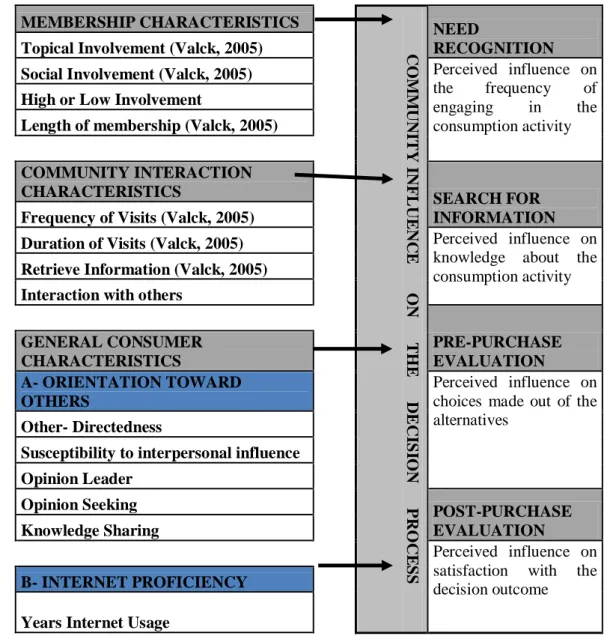
3.2 MODEL AND THE THEORETICAL BACKGROUND ... 27
3.2.1 Membership Characteristics ... 28
3.2.1.1 Topical involvement ... 28
3.2.1.2 Social involvement ... 29
3.2.1.3 High and low involvement ... 29
3.2.1.4 Membership length ... 30
3.2.2 Community Interaction Characteristics ... 31
3.2.2.1 Frequency and duration of visits ... 31
vii
3.2.3 General Consumer Characteristics ... 33
3.2.3.1 Orientation toward others ... 33
3.2.3.1.1 Other directedness ... 33
3.2.3.1.2 Susceptibility to interpersonal influence ... 33
3.2.3.1.3 Opinion Leader ... 34 3.2.3.1.4 Opinion Seeker ... 34 3.2.3.1.5 Knowledge Sharing ... 35 3.2.3.2 Internet Proficiency ... 35 3.3 RESEARCH METHOD ... 37 3.3.1 Regression Models ... 37
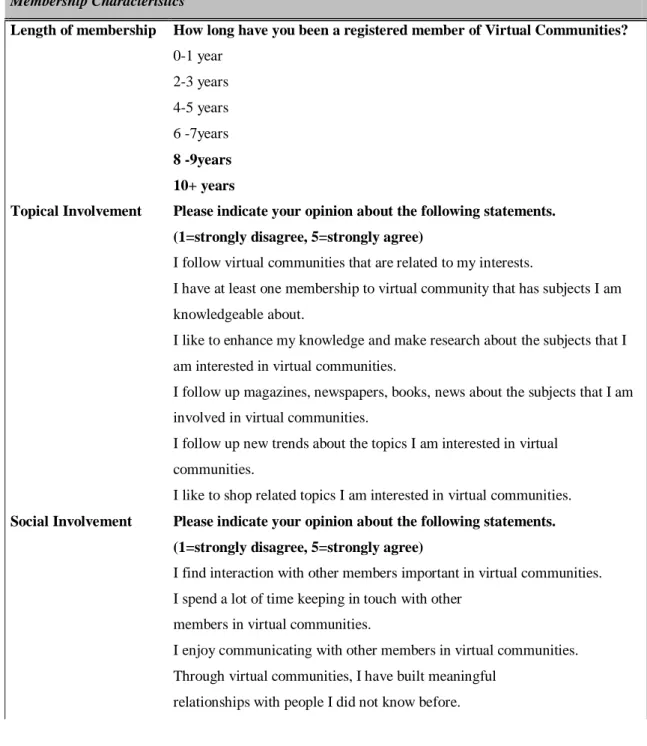
3.4 MEASUREMENT AND SCALING ... 37
4. RESEARCH RESULTS AND ANALYSIS ... 45
4.1 SAMPLE CHARACTERISTICS ... 45
4.2 RESULTS ... 50
5. DISCUSSION, CONCLUSION, LIMITATIONS & FUTURE RESEARCH 79 5.1 CONCLUSION ... 79
5.2 LIMITATIONS AND RECOMMENDATION FOR FUTURE RESEARCH ... 81
5.3 MANAGERIAL IMPLICATIONS ... 82
REFERENCES ... 85
APPENDICES ... 90
viii
LIST OF TABLES
Table 2.1: Categories of instantiations of the self ... 11
Table 2.2: Consumer buying behavior in high and low involvement product ... 19
Table 2.3: Consumer decision process ... 22
Table 3.1: Research model ... 36
Table 3.2: Measurements for membership characteristics ... 38
Table 3.3: Community Interaction Characteristics ... 39
Table 3.4: General consumer characteristics ... 41
Table 3.5: Dependent variables ... 44
Table 4.1: Monthy income distribution of men and women ... 47
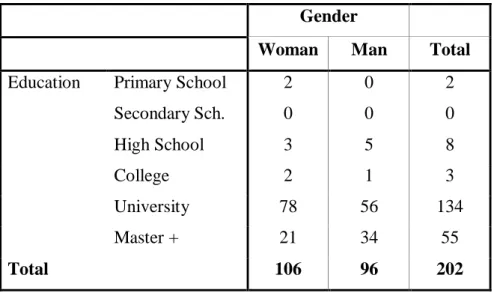
Table 4.2: Level of Education Based On Gender ... 48
Table 4.3: Virtual Community Membership Distribution ... 49
Table 4.4: The list of eliminated questions of survey ... 50
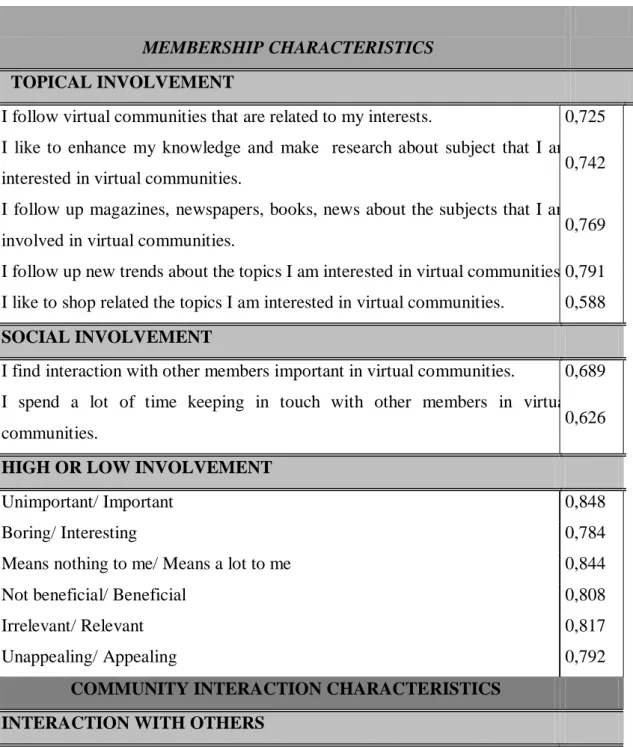
Table 4.5: Factor loadings of independent scales ... 52
Table 4.6: Factor loadings of dependent scales ... 54
Table 4.7: Correlation results ... 56
Table 4.8: Correlated factors ... 57
Table 4.9: Regression analysis results of dependent variable: perceived influence on the frequency of engaging in the consumption activity ... 59
Table 4.10: Regression analysis results of dependent variable: perceived influence on knowledge about the consumption activity ... 60
Table 4.11: Regression analysis results of dependent variable: perceived influence on choices made out of alternatives ... 61
Table 4.12: Regression analysis results of dependent variable: perceived influence on satisfaction with the decision outcome ... 62
Table 4.13: Regression results ... 62
Table 4.14: Regression analysis results of dependent variable: Community effect on consumer decision ... 64
Table 4.15: T test results of frequency of visits and perceived influence on consumption ... 65
Table 4.16: T test results of frequency of visits and perceived influence on knowledge about the consumption activity ... 65
ix
Table 4.17: T test results of frequency of visits and perceived influence on choices made out of alternatives ... 66 Table 4.18: T test results of frequency of visits and perceived influence on satisfaction
with the decision outcome ... 66 Table 4.19:T test results of duration of visits and perceived influence on
consumption ... 67 Table 4.20: T test results of duration of visits and perceived influence on knowledge
about the consumption activity ... 67 Table 4.21: T test results of duration of visits and perceived influence on choices made
out of alternatives ... 68 Table 4.22: T test results of duration of visits and perceived influence on satisfaction
with the decision outcome ... 68 Table 4.23:T test results of years of internet usage and perceived influence on
consumption ... 69 Table 4.24:T test results of years of internet usage and perceived influence on
knowledge about the consumption activity ... 69 Table 4.25: T test results of years of internet usage and perceived influence on choices
made out of alternatives ... 70 Table 4.26: T test results of years of internet usage and perceived influence on
satisfaction with the decision outcome ... 70 Table 4.27:T test results of membership length and perceived influence on
consumption ... 71 Table 4.28:T test results of membership length and perceived influence on knowledge
about the consumption activity ... 71 Table 4.29: T test results of membership length and perceived influence on choices
made out of alternatives ... 72 Table 4.30: T test results of membership length and perceived influence on satisfaction
with the decision outcome ... 72 Table 4.31: Summary of T test results ... 73 Table 4.32: T test result of frequency of visits and community influence on consumer
x
Table 4.33: T test result of duration of visits and community influence on consumer
decision ... 74
Table 4.34:T test result of years of internet usage and community influence on consumer decision ... 74
Table 4.35: T test result of membership length and community influence on consumer decision ... 75
Table 4.36: T test summary of community influence on consumer decision ... 75
Table 4.37: Results of Hypothesis ... 75
Table 4.38: Community influence on the consumer decision process ... 76
Table 5.1: Factors affecting virtual community influence on consumer decision process ... 79
xi
LIST OF FIGURES
Figure 4.1: Gender distribution ... 45
Figure 4.2: Age Distribution Based on Gender ... 45
Figure 4.3: Age distribution of respondents ... 46
Figure 4.4: Level of education... 47
Figure 4.5: Internet usage of sample ... 48
1. INTRODUCTION
Internet has changed the life of people and it will continue to change. It has been developing rapidly and affecting people’s attitudes, behaviors and habits. People are getting used to living with the Internet and it has become the important part of daily life. Most people spend most of their time on Internet. It is almost an indispensable part of our life. People socialize in social networks, search online for gathering information about a subject that they are interested in, watch videos, buy something online both tangible products and services. They live online. Virtual communities are also part of this life. They connect people to each other around a common subject, interest or purpose. People share their knowledge, experience or build relationships with each other. Virtual communities are on of the informal information sources for consumers. Virtual communities have been significantly effective on consumer decisions. Consumer decides what to buy after the research through the internet since credibility of informal sources such as internet, reference groups, friends and family members is higher than commercials, advertisements. Credibility of informal sources is high because consumer perceives that there is no financial gain in these sources. When they perceive it as having no financial gain, trustworthiness of the source gets higher. Virtual communities are like reference groups. People ask other members of virtual communities that they perceive them as expert of the subject, search for other people’s own experience, comments about products and after all these they evaluate conditions and alternatives, and finally decide to buy the product or not. When a product is initially introduced to the market people talk to each other on virtual communities such as forums, facebook and so on. They criticize products, share their knowledge that the y gain from various sources. Besides, internet provides people to gather information from all virtual communities over the world. This shows the WOM effect of virtual communities.
Virtual communities are also important for marketers and companies. It is a new way to reach the customer, to attract their attention to the company or products. Strategies or ways for communication differ for each virtual community type.
2
Relevantly, aim of this project is to understand the relationship between virtual communities and consumer decision process. Also, it is explored how virtual comunities affect consumer decision process and which phase of consumer decision is affected more by virtual communities. In addition to that, the determinants of virtual community influence on consumer decision process are investigated. Virtual community is a rising topic on the internet and has many boht direct and indirect effects on consumer decisions. Consumers are influenced by virtual commnities since it has started to be on of the most important information sources for consumers, however, it is not known very well how virtual communities affect consumer decision,in which stage it affects more in Turkey. Thus, it was necessary to conduct a research about virtual community influence on consumer decision process.
Second chapter of this study defines virtual communities and, most commonly used types of virtual communities. This chapter also sheds light on consumer decision process and some concepts such as reference group effect, involvement theory, word of mouth effect, social identity, social self.
In order to gather data from consumers, a survey was designed and snowball sampling method was used to deliver survey. The survey was spread through the internet and social media. Thirds chapter, explains the research method, methodology, research model, concepts in detail.
After data gathered from consumers, results should be analyzed and in the forth chapter analysis method ,which are regression and T test,and results are explained. Regression is used for the scales that are not nominal, T test was used for the nominal variables. In the last chapter, results of research was discussed and concluded with recommendations for future research, limitations and was ended with managerial implications. The results are aevaluated based on the marketing concepts and some recommendations are made for future researchers, marketing professionals.
3
2. LITERATURE REVIEW OF VIRTUAL COMMUNITIES
The World has changed with the evolution of the Internet. It provides people to get together without boundaries of time and place. In the 1990s, the virtual communities exponentially grew through the rise of the Internet (Flavian & Guinaliu 2006). There are many definitions of virtual community in the literature. It is defined as “a place where a group of people drawn together by an opportunity to share a sense of community with like-minded strangers having common interest, is a large internet-based site offering a range of online services, including access to social environments, community services, municipal information, and e-commerce to its info habitants.” (Nichols et al. 2006). It is also defined as a social community which emerged from the Internet when enough people carry on public discussions long enough and with sufficient human feeling to build personal relationships (Kim et al. 2004). It is also asserted that the virtual communities have relationships between people with similar interests and passion in a wide range of subjects. Relationships are formed by people who want to share their own experiences (Kim et al. 2004). An online virtual community can be defined as a new social entity that differs from traditional communities. It removes distances between people who are located in different geographical areas, besides people can share their own interests whenever they want (Flavian & Guinaliu 2006). There is no need to be in the same place and have physical contact. The virtual community should not be understood as merely a place where people communicate, but rather as a virtual place in which to share experiences and knowledge (Flavian & Guinaliu 2006). Virtual Communities enable their users to satisfy some of their needs such as;
Sharing Resources: Virtual communities enable people to share information on subjects, experience which they may be interested in. They can find solutions to their problems (Flavian & Guinaliu 2006). Social interaction among users is an important feature of social networks and it considerably influences the extent to which interpersonal knowledge sharing occurs. According to Chiu (2006), users interact with each other with expectation of some future rewards such as approval, status and respect. In addition to that, there are several tangible benefits for users that they could have as a
4
result of knowledge sharing in virtual communities such as enhancing reputation, achieving a sense of self-worth, enjoyment in helping others (Chiu et al. 2006).
Establishing Relationships: In virtual communities, members can find and meet with people having similar problems and experiences. It allows users to contact other members, maintain those contacts and share online content and media with those contacts. In other words, people are inclined to develop social relationships with other people. They can meet other people (Flavian & Guinaliu 2006).For example, on Facebook people can meet with new people and contact them, they can share whatever they want on their wall. Their contact can see what they write on their wall, what they think about any subject, what they are interested in, what kind of songs they like and so on. Users can establish relationships as in the offline life.
Living fantasies: Virtual communities provide their members to share fantasy experiences as in the case of multiple online games (Flavian & Guinaliu 2006). On most multiple online games, users create a character and play with this character. Generally, it is a character that has supernatural powers and try to complete missions that is given to them to move to upper levels. During the game, people express themselves with these characters and can meet people around the world, they are able to share same objectives in this fantasy world. Members of community are able to actualize their fantasy needs through supernatural world that community creates for its members. World of Warcraft is really a good example of multiple online games that enable their users to interact with each other.
Trading: With the increase of e-commerce all over the world, there are some virtual communities that allow users to sell-buy things. It enables their users to have economical transactions as in the case of auction web-sites (Flavian & Guinaliu 2006). For example, e-bay users can sell their used or new products online. Mostly, they upload photos of their products and reply questions of potential buyers. Users rate sellers and write comments about them, comments are very useful for other potential buyers to see whether seller is reliable or not. It is a trust network among users. Members of community can earn money through the community.
5 2.1 TYPES OF VIRTUAL COMMUNITIES
Virtual communities include everything from discussion boards to massive multiplayer online role-playing games and virtual realities such as Second Life. There are many types of virtual communities such as;
Communities of Transaction: The main function of communities of transaction is to exchange. In the beginning, it was based on information exchange, but now it is based on transaction such as in the case of E-bay. Communities of transaction are different from other virtual communities in making it easier to buy-sell products/services and dissemination of information about products and services (Spaulding 2009). Participants are encouraged to do transaction. Information that is gathered from other community members to do transaction is used as an input (Uzkurt & Özmen 2006). Trust is the main issue in communities of transaction. It can’t be exist without trust between members. E-Bay and Craigslist are examples of communities of transaction (Spaulding 2009). Gittigidiyor and Sahibinden are another example of transaction communities in Turkey. On Gittigidiyor or Sahibinden, members can sell their second hand products or new products by uploading photos of products and giving information about the product. Other members of the community can buy products from sellers. After the transaction is finished, buyers make comments about sellers in terms of quality of product and service delivery and rate sellers. These comments and ratings are significant for the buyer since it increases the reliability of seller and sales.
Communities of Interest: People have some special interests which they are passionate as an amateur or professional. These can vary from sports to entertainment. So, in communities of interest, members get together for a common theme, purpose or interest (Uzkurt & Özmen 2006). In some cases, people get together for sharing information about products or services. Members who create accounts to get information and never contribute to community may lose their accounts after a while. If a user starts a threaded discussion that is closely related o another discussion they are told to move their discussion to the previous thread. This allows members to answer questions in one place and reduces the complexity to gain the information. (Spaulding 2009). In addition to that, to increase the quality of information in the community, members give rates to
6
comments and can complain about deceitful information or members who use community for their own purposes. Moral responsibility which creates moral commitment among the community members.is fairly important on virtual communities. It encourages communal behaviors and enables stronger group cohesion. (Flavian & Guinaliu 2006). It also increases the quality and reliability of information disseminated through community members. There are moderators to organize these issues in the community. They reduce the negative contributions in the community. This increases the quality and reliability of community (Spaulding 2009). For example, donanimhaber which is a famous technology forum in Turkey, members share their experiences and knowledge, especially about technological products such as laptops, cameras and so on, and also members can ask questions to other members about products that they want to buy. It is not allowed to make deceitful comments about products in order to promote products. If a user is supposed to be promoting some products in order to convince other members to buy, he is banned from the forum in order to increase the reliability of forum. On Quora, members can ask a question and other members can share their knowledge or experience by answering this question. Members can enhance their knowledge or get some advises for free. On Quora, users are invited by existing users in order to increase the quality of the network.
Communities of Relationship: People want to build relationships with others and want to get together with them. This is a way of socializing. It emerges as a result of human nature (Uzkurt & Özmen 2006). Communities of relationship are formed by the objective of connecting people who are in the same situation for social contact and support . Communities of relationship generally focus on real-life relationships such as in the case of LinkedIn.com. However, in the last couple years, with the rise of the MySpace or Facebook, people develop online relationships with other participants who they have never met (Spaulding 2009). Social networks, a type of communities of relations, have been growing rapidly. MySpace was the first social network. The popularity of social networks has increased after Facebook, which was founded in 2004. Furthermore, Twitter, which was launched in 2006, is another type of social network (Silverthorn 2009). In social networks, people can follow their friends’ lives, lives of famous people and share many common applications. The biggest discovery in social
7
networks is ability to load pictures. People can view each other’s photo (Silverthorn 2009). Besides people write everything on their profile, make comments about each other. It is a sort of voyeurism. Social networks enable people to pry into other people’s lives (Silverthorn 2009). Furthermore, people can build intimate relationships through these social networks. In addition to that, especially in twitter, diffusion of information is very fast. It increases dissemination of information (Silverthorn 2009). For instance, fire of Haydarpasa train station in Istanbul was announced firstly in twitter, people saw pictures of fire firstly in twitter. It was faster than the media.
Communities of Fantasy: Communities provide people to get together and discover new entertainment and fantasy worlds. These communities provide their members act as a different personality and having different experiences (Uzkurt & Özmen 2006). Users often omit or falsify personal information. They use different personal identity. Users of fantasy communities expect that they have to find something interesting or entertaining while they are spending their time (Spaulding 2009). For example, on Second Life, users live in a fantasy world by creating their virtual characters. Generally, they act as a different person from their daily life and can meet with other people, talk to them. Another example for community of fantasy is a multiple online game which is Knight Online. On Knight Online, members can create a character that has supernatural powers and fight with other members by creating teams in order to complete some missions and move to an upper level.
2.2 SOCIAL IDENTITY AND SELF-IMAGE
Identity is a definition placed on the self. People’s sense of identity refers to your knowledge of who you are. Identity is always an answer of “Who are you?”. Examples of identity components include being an employee of a certain company, a lawyer, a student, someone’s nephew, a member of the swimming team and so on (Baumeister 1999, p. 248).
Identity plays a key role in virtual communities. Identity is also ambiguous in the virtual world. Many of the basic cues about personality and social role that we are accustomed to in the physical world are absent (Donath 1999, p. 30).
8 2.2.1 Social Identity
Social identity is defined as “the individual’s knowledge that he belongs to certain groups together with some emotional and value significance for him as having the group membership” where a social group is “two or more individuals who share a common social identification of themselves or which is nearly the same thing, perceive themselves to be members of the same social category.” (Abrams & Hogg 1990,, p. 51). Social identity includes how we identify our similarities and differences to other known groups of individuals. Social identity is a continuous interaction between how we identify ourselves and how others identify us. Social identity plays a key role in understanding intergroup relations and relation of an individual to his or her social group. Individuals have multiple social identities in a variety of social groups. These multiple social identities help an individual to adopt various roles and social contexts (Code & Zaparnyniuk 2009, p. 91). The various social contexts and relationships developed with the development of technology as in the case of virtual communities. Nominal identity is defined as “Who you believe you are” and your virtual identity is the experience of being that person. For example, a person can be a shy person in face-to-face meetings (nominal identity), however, when online he or she can present himself as having outgoing personality (virtual identity). Internet plays a considerable role in social identity formation and it allows individuals to explore their values and beliefs within environments that they perceive as safe. The anonymity of online interactions allow users to create multiple virtual identities (Donath 1999, p. 37). It is mentioned that “Social and group identities are generally more powerful than individual identities and users in a community are inclined to go along with the group in which they identify. In the development of a social identity, the new group or collective identity tends to depersonalize the individual as being part of the group. Depersonalization make people adapt to group prototypes and behave according to group norms (Code & Zaparnyniuk 2009, p. 95).
The individual observes the situation and acts according to their perceptions; even if their perceptions are inaccurate. In the physical world, the body provides a convenient definition of identity. The virtual world is different. It is composed of information rather
9
than matter. Information spreads and diffuses among the members of virtual communities (Donath 1999, p. 35).
Reliability of community depends on the quality of information among the community members. You don’t know the identity of members but you may know the accuracy and reliability of the member by regarding the information or knowledge he has shared. Trust in the shared motivations and beliefs of the other participants – in other words, their social identity – is essential to the community (Donath 1999, p. 41).
2.2.2 Self Image
Consumers have a number of images of themselves. These self-images or perception of self are related to personality which affects the buying behavior of consumers. Individual consumers have been considered to have “a single self” and it is supposed that they are interested in products and services that satisfy their singleself. However, researches indicate that it is more precise to think that consumers have multiple self or selves. It means that consumers are more tend to behave quite differently in different situations. For instance, a person is likely to behave differently at school, at night club, at work, with friends, with parents. They have different social roles (Schiffman & Kanuk 1997, p. 136). The self-concept is the individual’s beliefs about himself or herself, including the person’s attributes and who and what the self is. The self-concept includes many things that might not be part of one’s identity. (Baumeister 1999, p. 248).
Consistent with the idea of multiple self-images, each individual has an image of himself or herself as a certain kind of person, with certain traits, habits, possession, relationships and ways of behaving. Individuals develop their self-images through interactions with other people. It inilitially develop with their parents and then other individuals or groups with whom they have relationships over the years. (Schiffman & Kanuk 1997, p. 136).
10
It isgenerally believed that self-images of consumers have an influence on their product selection. Consumers select products in order to preserve or enhance their self-images. They are sensitive that their selection should be congruent with their own self-images and therefore they avoid some products that are not. (Schiffman & Kanuk 1997, p. 136).
There are various different self-images that are identified in the consumer behavior literature. One of them defines four specific kinds of self-image. Actual self-image is how consumers in fact see themselves, ideal self-image is to how consumers would like to see themselves, social self-image is how consumers feel others see them, ideal social self-image is how consumers would like others to see them, and expected self-image is how consumers expect to see themselves at some specified future time. The expected self image is like between the actual self image and ideal self image. It is a kind of future oriented combination of “what is” (actual self image) and what consumers would like “to be” (the ideal self image”. (Schiffman & Kanuk 1997, p. 137).
In different occasions, consumers might select a different self-image to form their attitudes or behavior.For example, with everyday household products, such as detergents, consumers are possibly guided by their actual self images, while for some products that are indicators of social status or socially conspicious products, consumers may be guided by their social-self image. When fantasy products are taken into account, they might be guided by either their ideal self-images or ideal social self-images. (Schiffman & Kanuk 1997, p. 137).
Possessions of consumers can be defined as confirmation or extention of their self-images. It is mentioned that possession can extend the self in a number of ways such as; a) actually by allowing the person to do things that otherwise would be very difficult or impossible to accomplish (problem solving using a Computer), b) symbolically, by making the person feel better or bigger (receiving an employee award for excellence), c) by conferring status or rank (status among collectors of rare Works of art because of the ownership of a particular masterpiece, d) by bestowing feelings of immortality, by leaving valued possessions to young family members (this also has the potential of extending the recipients’ “selves”, e) by endowing with magical powers (a cameo pin
11
inherited from one’s aunt might be perceived as a magic amulet bestowing good luck when it is worn. ) (Schiffman & Kanuk 1997, p. 138).
Consumers sometimes wish to change themselves and want to become a different or improved self (Schiffman & Kanuk 1997, p. 138).
People create an account on the Internet, in a chat room, in a virtual community, on a free email service etc. In every account they create, they create an additional identity. Such identity is generally is the expression of the self. This identity may point to the real or may be away from the real self. It is mentioned that most people generally are inclined to create an identity that differs from their real identity. De’ (2003) mentioned that there are two categories of expression of the self, which are revealing the real and eliding the real, refer to the intention of the creation personas.
Table 2.1: Categories of instantiations of the self
Source: De', R., (2003) Social Resistance and the self in Virtual Communities, Ninth Americas Conference on Information Systems.
2.2.2.1 The contracted self
It is asserted that online self is contracted, or is only a part of the total personality of the real self.
In face-to-face meetings, social information is exchanged which enables trust between people. In online negotiations, the self is guarded and withdrawn (De' 2003).
2.2.2.2 The mutable self
The self within the digital environment is mutable.In digital space, people have multiple avatars, multiple email identities, multiple identities in chat rooms. Most people, prefer
12
to reveal some part of their own personality, somewhat idealized self of themselves. Some users never reveal their real self. They use graphical displays for their self expression (De’ 2003).
2.2.2.3 The reflexive self
The user is conscious of his or her projected image and chooses words and actions that confirm their constructed, reflexive self. This “self-consciousness” shows up in text messages broadcasted to groups, to chat room discussions and to website messages (De’ 2003).
2.2.2.4 The anonymous self
Use of anonymous identities to protest and challenge authority are common on the internet. Anonymity allows people explore dimensions of their selves that is not possible to happen in real situations. It makes people act how they want. For example, many chat room discussions mainly revolve around sexuality and personal politics that enable participants to fantasize about sexuality and politics. It would not be possible otherwise. (De’ 2003).
2.2.2.5 The virulent self
People unleash their vicious form of their self on the Internet. Also, people create virulent forms of themselves as avatars or players in multi-user online games. They act cruel in their play and project a devastating form that is totally opposite to their real self. (De’ 2003).
2.3 VIRTUAL COMMUNITIES AND THE REFERENCE GROUP EFFECT
Generally, people give importance to the opinion of others while making purchase decisions. They talk about their purchase intentions to family members, friends and colleagues and may ask for advice. The prevalent use of spokespeople and service endorsements has an influence on information processing, attitude formation and
13
purchase behavior of individuals (Rao & Childers 1992). Consumers possibly are influenced while making decision since they interact and communicate with other members whom they believe have more information than them. It is possible that products and brands that individuals select can be influenced by their reference group. This is called as reference group effect. The reference group is defined as ”any person or group that serves as a point of comparison (or reference) for an individual in forming either general or specific values, attitudes or behavior.” (Schiffman & Kanuk 1997, p. 323). Reference group is a person or group of people that has effects on individuals behavior or buying decisions (Etzel & Bearden 1982). Reference groups are groups that give consumers a frame of reference in their purchase or consumption decisions (Schiffman & Kanuk 1997, p. 323). Reference groups can be individuals like friends, family members, classmates, local communities, sportsmen, celebrities and so on.
It is mentioned that there are two types of reference groups which are normative referents and comparative referents. Parents, teachers and peers are representative of normative referents who provide the individual with norms, attitudes, and values through direct interaction. Comparative referents, such as sports heroes and entertainment figures, provide standards of achievement to which individuals aspire and therefore, the individual is only able to observe the behavior of the referent and does not directly interact with him or her. The main difference between two types of reference groups is social proximity. Normative referents are socially proximal referents that are in the individual’s immediate social network. Comparative referents are socially distant referents that are in the verge of individual’s social domain. There is a considerable amount of interaction bevtween socially proximal reference groups, normative referents, and individuals, whereas socially distant referents allow less or no direct interaction (Rao & Childers 1992).
There are two dominant influences of reference groups which are informational and normative. Informational social influence refers to the tendency to accept information from others as evidence about reality. Normative social influence is defined as an influence to conform to the perceived expectations of another person, group, or one's self. The operational mechanism of these two influences differs. Message content,
14
source credibility, and trustworthiness are the major determinants of informational social influence, while characteristics of the referent, such as appearance and social status, determine the degree of normative social influence. When making purchase decisions, consumers are inclined to seek other people’s evaluations of different alternatives or gain information from the brands’ reference group members. Referents may provide new information to the solution of a problem or add what the individual already believes. The referent's influence is based on his credibility (Richardson et al. 1999).In general, reference group effect is expected to be higher in some cases such as; a) Relatively high desire for social acceptance; b) Less experience in the situation or with the decision; c) Public conspicuousness of purchase and use; d) Complex products and luxury items (De Valck 2005, p. 38).
Researchers have identified a number of different motives that may emphasize purchase behaviors. There are two kinds of motives which are cognitive versus affective motives. Quality, price, or the functional performance of products are important factors for cognitive motives. Affective motives are related to the need for self expression, social belongingness, or ego gratification. Informational social influence is more dominant than normative social influence in cognitive motivated purchases since there a need to search information related sources to product attributes such as price, quality, and value. Affectively motivated purchases are stimulated by satisfying social belonging, ego gratification, or self expression needs (Richardson et al. 1999).
The main difference between virtual and traditional reference groups is that participating in a virtual community is voluntary and conscious choice; on the other hand membership in traditional, reference groups may be imposed among other things, such as proximity of location. People are free to join the virtual community, it depends on members’ choice. This can make virtual communities more influential reference group than traditional communities (De Valck et al. 2009). People participate and share their knowledge in virtual communities because of social reasons such as affective commitment, and group based self-esteem (De Valck et al. 2009). People have specific reasons to participate within the specific type of virtual communities. So, money is not a reason to participate rather than sharing knowledge and experience in virtual
15
communities are the main issues. This increases the reliability of information in virtual communities because consumers believe that information in virtual community is not an advertisement or aiming to gain money. In addition to that, virtual communities have low entry and exit barriers (De Valck et al. 2009). If a member does not agree with the group norms, they can easily leave and join another virtual community. This provides people having opportunity to tell what they think, because there is no obligation and exit is very easy. Furthermore, in virtual communities there are some rules to establish and maintain an amiable ambiance in the community (De Valck et al. 2009). Community administrators or managers define these rules and are responsible for carrying out these rules. These rules include some standards regarding behavior, language, content, identity and commercial use and so on. (De Valck et al. 2009). Community members can report behaviors against these rules so that community managers’ interference to stress these rules is not necessary. Many virtual community members actively seek information and advice from other members. The most important source characteristic is credibility i.e. the source's expertise and trustworthiness (De Valck et al. 2009). Receivers get advice when they perceive sender to be knowledgeable about a subject and free of personal gain. It is asserted that “online information produced by other consumers is perceived as more credible and relevant, and results in more empathy than marketer-generated information.” (De Valck et al. 2009).
Generally, virtual community members don’t know each other’s offline behavior; they just have information about each other’s sharing and knowledge on the community. It is stated that participants who are exposed to online discussions have more product interest than those that are exposed to corporate web pages. (De Valck 2005, p. 40).
2.4 VIRTUAL COMMUNITIES AND THE WORD OF MOUTH EFFECT
We need to focus on the way how information flows from one member to another in order to understand the real mechanism of interpersonal effects within the online environment.
Word-of-mouth (WOM) is the concept in marketing that is related to information flows between individuals. WOM is defined as “all informal communications directed at other
16
consumers about the ownership, usage or characteristics of particular goods or their sales.” (Burgee & Steffes 2009). It is also defined as “informal transmission of ideas, comments, opinions and information between two or more individuals, neither one of which is a marketer.” (De Valck et al. 2009). Body language, facial expressions, texts, audio-visual or interactive material may be considered as word-of-mouth, it is not only oral expression. It occurs when people talk about product or service characteristics or experiences of people with products or services (De Valck 2005, p. 42). The focus of word of mouth communication is the sharing of information regarding individuals’ experiences with various products and services regardless of the form of WOM.
It is claimed that word of mouth has a more significant impact on consumer choice than personal selling, print advertisements and radio (Burgee & Steffes 2009). The sender, as the initiator of the communication can be either formal or an informal source. A formal source generally represents either for profit oriented company or not-for-profit organization, an informal source can be a parent, friend who gives product information or advice, sharing experience. An informal source is often perceived as more reliable since they gain nothing from the receivers’ subsequent actions. The receivers have greater confidence in such sources (Schiffman & Kanuk 1997, p. 280). WOM is perceived as a relatively credible source of information and is an important source of consumer information. It forms the basis of interpersonal communications and significantly influences product evaluations and purchase decisison (Grewal et al. 2001). It is asserted that “WOM communications often have a strong impact on product judgments because information received in a face-to-face manner is more accessible than infor mation presented in a less vivid manner.” (Kim et al. 1991). A personal information source is more persuasive in product evaluations than a nonpersonal source like advertising (Giese et al., 1996). The effect can be positive or negative. The effect of negative recommendation on consumer decision is higher than positive recommendation effect. Word of mouth recommendations can have a more impact on consumer decision process than advertising or other marketer generated sources. This is most probably because of the higher reliability of source, which is considered as not commercially motivated. The influence of word-of-mouth is strongest
17
with the high risk products, new products and intangible products (De Valck 2005, pp. 42-43).
In word-of-mouth process there is a mutual relationship between receivers and senders. Receivers gain valuable and reliable information about products or services and it helps receivers to make more effective and more efficient buying decisions, so they can decrease the risk of a new buying experience, decreasing cognitive dissonance, which includes doubts after purchase, and increasing the confidence of the product. Senders have some benefits from this relationship such as decreasing cognitive dissonance, increasing confidence in product choice by persuading others to buy it. In addition, advising others may affect feelings of power and prestige, increase their status and cohesion within a group (De Valck 2005, pp. 42-43).
Virtual communities can be considered as word-of-mouth communities. There are several receivers and senders on virtual communities. Individuals share their own experiences or knowledge. The effect of word-of-mouth communication within the virtual communities is related to both the structural and the interactional characteristics of the network. The structural characteristics have factors such as the size of the network, amount of connections between one person and all others, and the number of actual relationships relative to the potential number, whereas the interactional characteristics include tie strength. (De Valck, K., et al., 2009). Virtual communities have large potential; people can have recommendations from other members without any cost. Recommendations can be widespread quickly within and outside the virtual community network. It provides people money and time opportunity. Information about a product or service can be disseminated very quickly within virtual communities. For example, in a mail group when someone tells his/her bad experience, perception and attitude of members toward that product will be affected (Chevallier & Mayzlin 2006). Furthermore, in a forum, which is an example of communities of interest, every member can share their own experience about a product. People read it and decide whether to buy or not to buy this product. There is a famous forum in Turkey, which is www.donanimhaber.com, most people who are interested in technology follow this site to gather information about products they want to buy. Their decision and attitude
18
toward product or purchase intention is shaped by information shared by other users. It is maintained that there is a correlation between book sales and consumer comments. When positive consumer comments increases, book sales also increases. It is also asserted that online consumer comments are related to number of movie-going audience; even these comments are better forecaster of movie revenues than professional critic comments (Chevallier & Mayzlin 2006). This proves that virtual communities have a function as alternative and influential sources of information.
2.5 INVOLVEMENT THEORY
Involvement theory developed from a research called hemispheral lateralization. The basic premise of this theory is that the right and left hemisphere of the brain has specialty in the kinds of information process. The left side of the brain is responsible for cognitive activities such as reading, speaking and attributed information processing. It is mainly concerned with verbal information and cognitively analyzes the information through left brain processing. Unlikely, the right hemisphere is concerned with nonverbal, timeless, pictorial information. The right brain is emotional, metaphoric, impulsive and intuitive; on the other hand, the left brain is rational, active, and realistic (Schiffman & Kanuk 1997, p. 215).
There are some purchase situations that there is no need for extensive information processing and evaluation. Such purchases are considered of minimal personal relevance. Purchases of minimum personal importance are called low involvement purchases, besides complex, search oriented purchases are considered high involvement purchases (Schiffman & Kanuk 1997, p. 216).
It is mentioned that passive learning is thought to occur through repeated exposures to a TV commercial, and information is processed on the right side of the brain. It is a simple information processing and is a low involvement information processing. On the other hand, cognitive (verbal) information is processed on the left side of the brain, it is a complex information processing and is depicted as high involvement information processing (Schiffman & Kanuk 1997, p. 217).
19
It is maintained that there are low and high involved consumers, and also there are low and high involvement purchases. This led us to the notion that a consumer’s level of involvement depends on the degree of personal relevance that the product holds for the consumer. This means that high involvement purchases are those that are very important to the consumers (in terms of perceived risk) and this stimulates extended information search and problem solving. Buying an automobile is an example of high involvement purchase because of high perceived financial risk. Low involvement purchases are purchases that are not very important to consumers, has little relevance and low perceived risk. Therefore, there is a need to limited information search and processing for low involvement purchases (Schiffman & Kanuk 1997, pp. 218-219).
Giese et al. (1996) stated that high involvement consumers strongly hold needs, values and interests, on the contrary, low involvement consumers weakly hold (or nonexistent needs, values and interests. For the low involvement consumers, brands in a product category are perceived as nondifferentiated, there are acceptable substitutes (Giese et al., 1996). As a consequence, involvement plays a significant role in consumer decision process. The need for information search is higher for high involvement consumers, they spend considerable time and effort for buying. For example, there are two consumers. One of them wants to buy a car and other one wants to buy shampoo. A consumer who wants to buy a car searches more on the internet, however, almost nobody searches on the internet but goes to a supermarket, picks a brand which he is familiar with.In general, buying a car is much more difficult and riskier for consumers. Therefore, in order to decrease doubts about the purchase, consumers may ask friends, post a question in a virtual community. As a result of that, the degree of involvement is positively related to the influence of community on consumer decision process.
Table 2.2: Consumer buying behavior in high and low involvement product
Behavior High involvement Low involvement
Time invested Large amount Small amount
Information search Active Little or none
Response to information Critically evaluate
Ignore or accept without evaluation
20
Brand evaluation Clear and distinct Vague and general
Likelihood of
brandloyalty developing Strong Weak
Source: http://www.freepatentsonline.com/article/Journal-International-Business-Economics/243876918.html
2.6 CONSUMER DECISION PROCESS
Consumers often face a large number of alternatives, which are constantly changing due to new technologies and competition in the market. There is a great deal of information from various sources and consumers make decisions based on information or prior experiences on their own (Bettman et al. 1991,, p. 53). Consumers follow decision making process in order to choose an alternative that best satisfies their needs considering some constraints such as budget, time and effort. The process is typically composed of five steps including problem recognition (need recognition), information search (prepurchase search), evaluation of alternatives, purchase and post-post purchase evaluation (Moon 2004).
When consumers face a problem, they recognize their needs. There are different needs or recognition styles for consumers which are actual state types or desired state types. Actual state types refers to consumers who perceive that they have a problem when performance of the product is low. In contrast, desired state types occur for consumers who want to try something new that triggers the decision process (Schiffman & Kanuk 1997, p. 566).
After recognition of the need, information search or prepurchase search begins for the consumers who perceive a need that might be satisfied by the purchase and consumption of a product. Consumers store their experiences in their long term memory and may recall their previous experiences as an information search. Past experiences are such a reference for them. It might provide adequate information. On the other hand, if a consumer hasn’t had a prior experience, he may be involved in an extensive search for adequate information. Generally, consumers start to search their memories before seeking external sources of information based on a given consumption need. Consumer
21
decisions are mainly based on a combination of both sources, internal and external sources. Researches show that there is positive correlation between the external search effort and consumer attitude toward shopping. If the effort increases, attitudes of consumer toward shopping became more positive. People might use personal information sources such as asking friends, co-workers, relatives (Schiffman & Kanuk 1997, p. 568). For instance, a consumer may ask a close friend about which attributes are important to consider for a given product but may also gather complementary information from other information sources such as advertising, store visit, and salespeople in order to determine the pertinent product attributes to consider (Nantel et al. 2003) Internet is another source to get information from a variety of sources very quickly and efficiently.
The Internet provides many opportunities for consumers to access consumption related information more quickly and efficiently. It saves time, effort and monetary cost for information search. Considering the diffusion of information through the internet and members of virtual communities, consumers are overloaded by information (Moon 2004).
After the information search, consumers define their alternatives and evaluate them. While evaluating alternatives, consumers are inclined to use two types of information: a brand list including brands which consumers tend to make their selection (the Evoked Set), the criteria that they are going to use in order to evaluate each brand.
Choosing from a sample of possible brands is one of the human characteristics that enables making decision process simple. Evoked set, within the context of consumer decision, refers to the specific brands a consumer takes into account while making a purchase within a particular product category. Evoked set includes the small number of brands and consumers are familiar with these brands through their experiences and they find them acceptable (Schiffman & Kanuk 1997, p. 570-571).
The output of the consumer decision making model consists of two closely related kinds of postdecision activity which are purchase behavior and post purchase evaluation. The
22
aim of both activities is to increase the customer satisfaction with his purchase (Schiffman & Kanuk 1997, p. 581).
Consumers generally make three types of purchases which are trial purchases, repeat purchases and long-term commitment purchases. If the consumers buy something for the first time, they probably buy a smaller quantity than usual in order to try the product. Consumers attempt to evaluate the product that they are not familiar with through direct use. If consumers are satisfied by the trial more than other brands, they tend to repeat the purchase (Schiffman & Kanuk 1997, p. 581)
As consumers use a product, they evaluate their performance regarding their expectations. There are three possible outcomes of these evaluations: a) Actual performance meets the expectations, a neutral feeling occurs, b) Performance is more than expectations, causing what is known as positive disconfirmation of expectations (it leads to satisfaction), c) Performance is lower than expectations, causing negative disconfirmation of expectations.
Consumers are inclined to analyze their experience based on their expectations when performing postpurchase evaluation. One of the important components of postpurchase evaluation is the reduction of uncertainty or doubt about their selection. As part of the postpurchase evaluation, consumers try to relieve themselves that their selection is a wise one. They make an effort to reduce postpurchase cognitive dissonance. They follow some strategies to reduce postpurchase cognitive dissonance such as; searching for advertisement that support their choice and avoiding advertisements of competitive brands, trying to persuade friends or neighbors to buy the same brand, finding other owners for reassurance (Schiffman & Kanuk 1997, p. 582).
23 Table 2.3: Consumer decision process
Source: Schiffman, G.L., Kanuk, L.L., Consumer Behavior, 1997.
2.7 SUMMARY OF LITERATURE REVIEW
Virtual communities are part of our life and used for are used for different purposes. People share their experience, knowledge on virtual communities with other members and use it as information provider. These type of virtual communities are called as communities of interest. Besides, on communities of relationships, people can build social relationships, meet with people having the same interests and similar problems. In addition, people can make their fantasies real on virtual communities, for example on online games they are able to have supernatural powers. These type of communities are called as communities of fantasy. People also can use virtual communities for their commercial purposes. They can sell and buy on aucition websites which is a communities of transaction.
Identity and self-image has an important role in virtual communities. If people are encourage to express their real identity on virtual communities, the reliability of virtual communities possibly increases. In addition, self image on virtual community affects sharing motivation of people. They can try to act as a different person on virtual communities by sharing information with other and try to be considered as a different person who they like to be.
Virtual communities are a kind of information provider for consumers. It is has a reference group effect on consumer decision process. People make their decisions based
24
on the information they retrieve from virtual communities. There are some members who are considered as an expert on a specific topic on virtual communities. In order to increase the reliability of virtual communities, they have some rules. Community administrators try to have establish standards of virtual communities. There are some reasons of participation and sharing of people on virtual communities such as affective commitment, and group based self-esteem. There is no financial motivation to participate to virtual communities. As a result of that, the trustworthiness of virtual communities increases.
In addition to reference group effect, virtual communities have word-of-mouth effect on consumption decisions. Friends, relatives and people from consumers’ network are considered as more reliable information sources than advertising and other communication tools of companies. Virtual community network is considered as a more reliable information provider than companies, since it is like getting information from your friends and relative. Since, as in the case of your friends, there is no financial gain of people on virtual communities. So, virtual communities are a kind of word-of-mouth communities.
There are some purchases called as high involvement purchases and low involvement purchases. High involvement purchases include more personal relevance than low involvement purchases. Generaally, high involvement purchases are more complex, search oriented purchases and consumers need information more, as a result of that high involvement products trigger consumers to search information about products. Mostly, they are riskier products in terms of perceived risk of consumers. Virtual communities have an important role on consumption of high involvement products, since it provides information to consumers for high involvement products.
Consumer decision process has five stages which are need recognition, search for information, pre-purchase evaluation, purchase and post-purchase evaluation. Consumer decision process starts when consumers recognize their needs, after that they want to find some information about the product. Then, they define their choices and evaluate their options. After the evaluation phase, they decide which product is the best option
25
for them. They buy the product and evaluate the result of their consumption. This is called as post-purchase evaluation. Satisfaction of their consumption occurs in that phase.
Virtual communities have some effects on the consumer decision process. Consumers use virtual communities in different stages of consumer decision process.