Urease Immobilized Piezoelectric Quartz Crystal
for Urea Conversion
Aykut Erdamar1, Fatma Ayhan2, İ.Cengiz Koçum1, Hakan Ayhan2* 1Başkent University, Biomedical Engineering Dept., Ankara, Turkey.
2Mugla University, Department of Chemistry, Mugla, Turkey.
Abstract
In this study, the immobilization of the enzyme urease on the surface of the quartz crystal was reported.The layer growth on silver electrode resonator was monitored with QCM and the catalytic activity of the enzyme layer was studied with UV-Vis spectroscopy at 255 nm by the detection of unconverted urea quantity in pH 7.4 phosphate buffer. Urease immobilization efficiency was tested with two initial urease concentrations, 0.02 and 0.2 mg/ml, respectively. The crystals of various urease immobilized amount was treated with urea solutions of 0.0025-0.02 mg/ml. The best conversion results were obtained for the crystal that treated with 0.02 mg/mL initial urease solution with 65 % conversion for 8.33x10⁻⁵M urea concentrations and less than this value. In case of 0.2 mg/ml urease immobilization,
more than 52 % of urea was converted when exposed to 1.6x10⁻⁴M urea.
Key Words: Piezoelectric quartz crystal (QCM), urease, chemical modification, chemical immobilization.
INTRODUCTION
Urea is a biomolecule which is excreted by kidney
as an end product of protein metabolism. The
normal level of urea in serum is 8–20 mg/dl (1.3 to ~3.5 mM). An increase in urea concentration causes renal failure (acute or chronic), urinary tract
obstruction, dehydration, shock, burns and
gastrointestinal bleeding, whereas a decrease in urea concentration causes hepatic failure, nephrotic
syndrome, cachexia (low-protein and high
carbohydrate diets) [1]. Hemodialysis is an
important clinical procedure for the removal of toxic
biological metabolites in patients with end-stage renal disease. A hemodialyzer is the semipermeable membrane, which allows for selective transport of low molecular weight biological metabolites from blood [2].
Various attempts have been made for urea
hydrolysis by enzyme urease. Nevertheless,
studying of urease immobilization is very important, because immobilized urease can be used in biomedical applications for the removal of urea from blood in artificial kidney, in blood detoxication or in the dialysate regeneration system of artificial kidneys [3-7] in food industry [8] and in analytical applications as urea sensor [9-12].
The adsorption of urease onto inert solids, like flannel cloth [13], ion-exchange resins, like
DEAE-HACETTEPE JOURNAL OF BIOLOGY AND CHEMISTRY Research Article
Hacettepe J. Biol. & Chem., 2008, 36 (2), 173-180
* Correspondence to: Hakan Ayhan
Mugla University, Department of Chemistry, Biochemistry Division, 48170 Mugla, Turkey
Tel: +90252 211 15 06 E-mail: [email protected]
---'-Cellulose [14], or physically entrapped/encapsulated
in solids, such as cross-linked gels like,
polyacrylamide and calcium alginate [15], chitosan [16], reverse micelles [17], microspheres [18] and hollow fibers were investigated.
The recording of the frequency decrease during biological interaction is the principle of the QCM detection [19]. Quartz crystal microbalance (QCM) is a simple, rapid, economical and highly sensitive microgravimetric method. The applications of enzyme urease in piezoelectric quartz crystal biosensors were reported for various purposes. For example, non-mass effects such as viscosity [20, 21], conductivity [22-25] and permittivity [26] were used for analytical applications in the liquid phase. The series of piezoelectric quartz crystal sensor (SPQC) was applied to determine the urease activity in plant seeds with a detection limit of 0.004 U/ml, based on the change in conductivity [23].
In this study, chemical immobilization approach was employed to insolubilize urease enzyme on the QCM surface. The surface activation, functional group modification, and protein immobilization steps were applied in the scope of the research. Surface regeneration was evaluated for enzyme loading with two different initial concentrations. The activity of the immobilized enzyme was tested.
MATERIALS AND METHODS
Chemicals
All chemicals used in this study were obtained from
commercial sources. NaOH (Sigma)
NaH2PO4.2H2O, Na2HPO4.2H2O, Cysteamine
(C2H7NS), and glutaraldehyde (GA) were from
Sigma. Acetic acid (CH3COOH) and methanol
(CH3OH) were from Merck. The jack bean urease
(EC 3.5.1.5) was Sigma type IV with a specific activity of 72 units/mg protein. One unit is defined
as the amount of enzyme that liberates 1.0 μmol
NH3 from urea per minute at pH 7.0 and 25ºC.
Phosphate buffers were from BDH Chemicals, Poole, England. Urea (Analar grade) was obtained from Hopkin & Williams Ltd. General Purpose
Reagent. PZ quartz crystal (AT cut, 10-MHz
resonant frequency silver electrode of an 8.7 x 0.17 mm wafer and which are placed between 4.7 mm silver electrodes) was purchased from MEC Quartz
Limited Honkong & mainland China.All solutions
were prepared by using bidistilled water.
Quartz Crystal Microbalance System
The QCM used in this work was designed and constructed in our laboratory. It has three main parts which are: two crystal oscillators, temperature controlled conditioning chamber and frequency discriminator.
The crystal oscillators are well known collpits oscillators. All components of these oscillators and
especially quartz crystals were placed in
temperature controlled chamber. Commercially available quartz crystals which are AT-cut 10 MHz quartz crystal of an 8.7 x 0.17 mm wafer which is placed between 4.7 mm silver electrodes were used with these oscillators in this study. Microcontroller (PIC 16F877) was used for temperature control of the chamber. PWM pulses were used to drive power transistors and heater. Temperature measurement was achieved by using semiconductor sensor of LM35. The temperature control range of chamber is from room temperature to around 70°C. For the
discrimination of frequencies (Δf) of two oscillators,
a high frequency mixer with dual gate MOSFET
(3N200) and a passive low pass filter were
designed. The details of the designed instrument were given elsewhere [27]. Frequency values were measured by using a frequency counter (Protek-Universal Counter UA 2000, China).
Immobilization Procedures
The urease enzyme was immolized on to surface of quartz crystal with silver electrode (10 MHz) using the following methods which were given below.
Surface Cleaning and Activation of Silver Quartz Crystals
At the first step, the crystal was hold in 0.5 M NaOH
solution, acetone ((CH3)2CO) and methanol
(CH3OH) for 30 minutes, respectively. The surface
activated electrod was dried and frequency change was monitored.
Functional Group Modification via Cysteamine Immobilization
The surface activated silver quartz crystals were
modified by cysteamine (C2H7NS) immobilization.
Cysteamine (18 mM, C2H7NS) stok solution was
prepared by dissolving cysteamine in phosphate buffer (pH:7.0) solution, purged with nitrogen and stored in refrigerator. Treatment process was performed for each electrod by using this solution.
Functional group modification via GA
Cysteamine modified crystals were treated with glutaraldehyde (GA,) which is a bifunctional reagent. Aqueous solution of 2 % v/v glutaraldehyde was prepared using phosphate buffer at pH 8.2 [28] and electrodes were immersed to this solution in the conditions depicted below.
Urease Immobilization
Surface activated, cysteamine and glutaraldehyde modified silver crystal surface was finally treated with urease solution. Urease enzyme solutions were prepared from stock solutions of phosphate buffer
pH 5.5 at a concentration of 0.2 mg/ml. Then
enzyme solutions were prepared from this stock solution before usage. The stock enzyme solution was kept in refrigerator at 4.0°C maximum one mounth when it was not used. Two different concentrations of urease solutions (0.2 and 0.02
mg/ml) which were regarded as excess and trace
amount were tested.
All surface modification and washing processes were achied at room temperature for 30 min under mild stirring conditions of 5 ml solution. The silver quartz crystals were kept in incubator until dryness at 37°C and frequency changes were again measured at 37ºC after each modification step.
Immobilized Enzyme Activity
Urea was dissolved in phosphate buffer solution at
pH 7.4. In order to estimate the activity of
immobilized enzyme, quartz crystal was hold in urea solution for 1 minute at room temperature. The four different urea concentrations (0.0025, 0.005, 0.01, 0.02 mg/ml) were tested where each crystal was used to measure one urea concentration. The urea conversion was determined spectrophotometrically
by measuring the urea reduction in a Shimadzu
UV-Visible Spectrophotometer at 255 nm wavelength. The unconverted urea concentration was calculated from a calibration curve of absorbance versus urea concentration. The difference between initial and final urea concentration gives the converted urea amount by immobilized urease. The immobilization and urea concentration results were the average of three experiments.
RESULTS AND DISCUSSION
The surface of the quartz crystal was first chemically modified with a process of three steps to obtain hydroxyl groups. These interactions were applied to obtain the functional hydroxyl groups on to silver
electrodes of the crystal surface to preparation the cysteamine immobilization. Then the chemical immobilization was carried out with a thiol
compound, cysteamine which is a unithiol
compound to provide amine groups on the QCM surface. Amine groups were altered to aldehyde by the addition of glutaraldehyde before subjected to urease immobilization. The frequency shift of quartz crystal which depends on mass variation was measured at the beginning and after each step of
modification in order to follow the surface
modification results of each step. For this purpose,
initial frequency of each crystal (fo) was measured
under dry condition in the conditioning chamber at constant temperature of 37°C. For temperature stability, frequency values were recorded 5 minutes later after the placement of crystals to measurement chamber.
The frequency change resulted from mass
accumulation on the surface observed after surface cleaning, cysteamine and glutaraldehyde bonding
was given in Figure 1. It was observed that resonant frequency of the crystal decreased about 420 Hz and 290 Hz for cysteamine and GA bounding, respectively.
Cysteamine molecule has two reactive functional
groups which are thiol (SH) and amine (NH2) groups
which can provide surface specificity for spacer arm immobilization. Due to this beneficial property of the cysteamine molecule, it has been immobilized to the surface modified crystal. On the other hand, a bifunctional reagent, glutaraldehyde has also two functional groups. Glutaraldehyde was used as spacer arm for the attachment on to the crystal surface and it was assumed that the reactive amine group of cysteamine interacts with aldehyde to form chemical bonding. Figure 1 depicts the end frequency shifts of the chemical treatment steps before biological molecule immobilization versus modification time end.
Figure 1. Frequency shift values of various immobilization step times. (Each value is the average of three experiments).
Immobilization
Steps
---+-Noıı Modi:fied---1. snıface cleaııiııg
---½-2. cysteamiıı e Iıııınobiliz.atioıı
9998200 ---3. Gntarnldehide Moclificatioıı
9998000 9997800
1
--g,9997600••
::,._1
<.> ~ §..9997400 <U ~ 9997200t
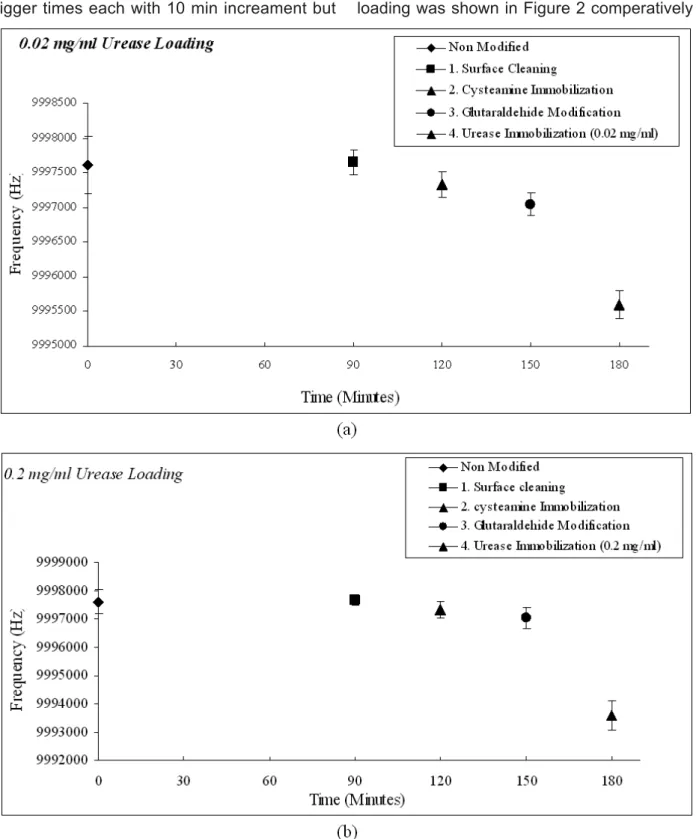
9997000 9996800 o 20 40 60 80 100 120 140 160 Time (Miımtes)The enzyme immobilization step was applied after modification of crystal. In this step, the amine group in the peptide amino acid was coupled with aldehyde group in glutaraldehyde. For the purpose, the crystal was immersed to the enzyme solution with increased time courses at room temperature. The enzyme laoding was reached to a maximum at 30 min immobilization time. The loading was tested for bigger times each with 10 min increament but
only small frequency shifts were observed and urease enzyme was immobilized to the crystal surface with 30 min treatment time throughout the research.
Two different concentrations of urease, 0.02 and 0.2 mg/mL were used to test the immobilization amount and the frequency shift values resulted after urease loading was shown in Figure 2 comperatively with
Figure 2. The reduction of frequency after surface activation, functional group additions and urease immobilization steps for 0.02 (a) and 0.2 (b) mg/mL initial urease concentrations.
0.02 mglnu Ure,ıse LolUüııg ---+--Noıı Modified
---1. Surfu ce Cleaııiııg
---2. Cysteaııiııe lıınııobilizatioıı 9998500
---3. Ghıtarnldelıicle Moclifıcatioıı
9998000 ---4. Urease lııınobiliz.atioıı (0.02 ıııg/ıııl) 9997500 •
•
!
I
Nö
!
;>, 9997000 r..:, ::: (1) ,.., 9996500 O" (1) ~ 9996000 9995500~
9995000 o 30 60 90 120 150 180 Time (1\11:imtes) (a)O. 2 ınglınl Urease Lorı.ding ---+--N on Mo clifıecl
---1. Surfuce cleaııiııg
---2. cysteaııiııe Jıınııo biliz.atioıı
- - -3. Clııtarnlclelıicle Mo clifıcatioıı
---a--4. Urease Jıınııobiliz.atioıı (0.2 ıı:ıg/ııi)
9999000 9998000
•
••
i
'N' 9997000!
ö
~ 9996000 u5
9995000 §. 11) G: 9994000t
9993000 9992000o
30 60 90 120 150 180 Time (1vlinutes) (b)previous steps. The enzyme urease immobilization
process ended with an increased mass
accumulation compared with previous chemical modification steps for both enzyme concentrations. The enzyme loading was also occurred when silver quartz crystal was treated with ten times more concentrated enzyme solution and a significant frequency shift occurred. This result indicates that crystal surface has more unreacted functional groups. Figure 3 shows the frequency shifts of all the surface processes of two experiments when crystal were exposed to 0.02 and 0.2 mg/ml urease solutions, comperatively. The frequency shifts are the average of three experiments. The frequency change of the steps before urease immobilization is the same as Figure 1 but the biological molecule with large molecular weight has significantly reduced frequency which also indicates the mass accumulation of a big molecular weight biomolecule.
Mass accumulation to the crystal surfaces
calculated from Sauerbrey equation after each immobilization step was given in Figure 3. At a concentration of 0.2 mg/ml urease, the crystal frequency approximately decreased by 3000 Hz. corresponding to 5.46 µg urease immobilized. The results are the average of eight experiments. When the crystal was treated with 0.02 mg/ml urease which is ten times less than previous one, the frequency change was about half of the other urease concentration and almost equal standart deviations were observed. When excess amount (0.2 mg/ml) of urease concentration was used immobilization to the crystal surface resulted with only two fold increase in frequency shift.
Immobilized urease activity was analyzed by the immersion of silver crystal to the urea solution in pH 7.4 buffer. Urea concentration was determined spectroscopically at 255 nm in the range of 0-0.02
mg/ml (0-3.33x10⁻⁴M) urea with the regression line
of y = 66.232x + 0.0094, R2 = 0.998 where urea
conversions were given in Fig. 4. Converted urea at low initial urea amounts was high and nearly equal while it was different at high urea concentrations for 0.02 and 0.2 mg/ml urease loading experiment. The conversion of more than 60 % was determined for 0.0025 and 0.005 mg/ml urea concentrations. The substrate conversion was observed to be small for 0.01 and 0.02 mg/ml urea which may come from substrate inhibition at these values.
When 0.2 mg/ml urease loading was applied, urea
conversion decreases slowly with increased
substrate concentration. Silver-plated electrodes were used in some research projects [22, 29]. But silver surfaces of the piezoelectric crystals were modified either with electrochemical plating or
Figure 3. Frequency shift values versus immobilized material amount.
Figure 4. The change of converted urea versus initial urea concentration for 0.2 and 0.02 mg/mL urease treated crystals. 3500 3000 2500 Urease Loading
"
~ "' 2000 :E (1) >-u ı:: 1500 :, er " u:: 1000 500 o o 2 3 4 5 6 Mass (Microgram) 100 1 ı,. 0.02 mg/ml urease • 0.2 mg/ml urease ı:: 80 o ·;;; :;; ı,. ı,. > ı:: 60•
o u•
•
"' Q) 40 :5 ~•
20 ı,. ı,. o o 0.004 0.008 0.012 0.016 0.02 0.024 urea concentration (mg/ml)subjected to other coating process like cryptand, C60-cryptad22. In case when crystal electrodes
were used without gold-coated manner the
observed frequency shifts were high compared to the uncoated electrodes.
CONCLUSION
The quartz crystal which surface modified by urease immobilization was carried out and urea-urease interactions was investigated. The insolubilized enzyme showed a good urea conversion at small urea concentrations. The urea content of blood for the patients which suffer from kidney failure dialysis is a big problem where the process is time consuming and painful to patients. So, a cartridge system containing processed QCM chip(s) may be an alternative kidney failure treatment method by the external circulation of blood.
REFERENCES
[1] C.L. Dueck, J. Neufeld, and T.M.S. Chang,
1986. Hydrodynamics and urea hydrolysis in a microcapsulated urease, fluidised bed reactor,
The Canadian Journal of Chemical
Engineering, 64, 540-546.
[2] Z. Wang, L. Wan, Z. Xu, Surface engineerings
of polyacrylonitrile-based asymmetric memb-ranes towards biomedical applications: An
overview, J. Membrane Sci.304(2007) 8-23.
[3] Y.M. Elcin, Encapsulation of urease enzyme in
xanthan-alginate spheres, Biomaterials 16 (1995), pp. 1157–1161.
[4] C.C. Lin and M.C. Yang, Cholesterol oxidation
using hollow fiber dialyzer immobilized with
cholesterol oxidase: preparation and
properties, Biotechnol. Prog. 19 (2003), pp. 361–364.
[5] C.C. Lin and M.C. Yang, Urea permeation and
hydrolysis through hollow fiber dialyzer
immobilized urease: storage and operation properties, Biomaterials 24 (2003), pp. 1989– 1994.
[6] F. Ayhan, H. Ayhan, E. Pişkin, A. Tanyolaç,
Optimization of urease immobilization onto non-porous HEMA incorporated poly(EGDMA)
microbeads and estimation of kinetic
parameters, Bioresource Technology, 81
(2002) 131-140.
[7] K. Gabrovska, A. Georgieva, T. Godjevargova,
O. Stoilova, N. Manolova, Poly(acrylonitrile) chitosan composite membranes for urease
immobilization, Journal of Biotechnology
Volume 129, Issue 4, 10 May 2007, Pages 674-680
[8] A. Amine, H. Mohammadi, I. Bourais and G.
Palleschi, Enzyme inhibition-based biosensors for food safely and environmental monitoring,
Biosens. Bioelectron. 21 (2006), pp. 1406–
1423.
[9] Z. Wu, L. Guan and R. Yu, Renewable urea
sensor based on a self-assemdled poly-electrolyte layer, Analyst 127 (2002) 391–395. [10] Y.C. Luo and S.J. Do, Urea biosensor based
on PANi (urease)-Nafion/Au composite
electrode, Biosens. Bioelectron. 20 (2004), 15– 23.
[11] F. Kuralay, H. Özyörük and A. Yildiz,
Potentiometric enzyme electrode for urea determination using immobilized urease in poly(vinylferroceinim) film, Sens. Actuat. B:
Chem. 109 (2005), 194–199.
[12] R. Rajesh, V. Bisht, W. Takashima and K. Kanelo, An amperometric urea biosensor based on covalent immobilization of urease onto an electrochemically prepared copolymer poly (N-3-aminopropyl pyrrole-co-pyrrole) film,
[13] N. Das and A.M. Kayastha, Short Communication: Immobilization of urease from pigeonpea (Cajanus cajan L.) on flannel cloth using polyethyleneimine World J. Microbiol. Biotechnol. 14 (1998) 927-929.
[14] K.R.C. Reddy, P.K. Srivastava, P.M. Dey and
A.M. Kayastha, Immobilization of pigeonpea
(Cajanus cajan) urease on DEAE-cellulose strips for urea estimation. Biotechnol. Appl. Biochem. 39 (2004) 323-327.
[15] N. Das, A.M. Kayastha and O.P. Malhotra, Immobilization of urease from pigeonpea
(Cajanus cajan L.) in polyacrylamide gels and
calcium alginate beads, Biotechnol. Appl. Biochem. 1 (1998), 25-29.
[16] A.M. Kayastha and P.K. Srivastava, Pigeonpea
(Cajanus cajan L.) urease immobilized on
glutaraldehyde-activated chitosan beads and its analytical applications, Appl. Biochem. Biotechnol. 96 (2001) 41-53.
[17] N. Das, P. Prabhakar, A.M. Kayastha R.C. Srivastava, Enzyme entrapped inside the reversed micelle in the fabrication of a new urea sensor. Biotechnol. Bioeng. 54 (1997) 329-332.
[18] A.M. Kayastha, P.K. Srivastava, B. Miksa and S. Slomkowski, Unique Activity of Ureases
Immobilized on Poly(Styrene-Co-Acrolein)
Microspheres, J. Bioact. Compat. Polym. 18 (2003) 113-124.
[19] R. L. Bunde, E.J. Jarvi, J.J. Rosentreter, Piezoelectric quartz crystal biosensors. Talanta 46, 1223-1236.
[20] H. Muramatus, E. Tamiya, M. Suzuki, I.
Karube, Viscosity monitoring with a
piezoelectric quartz crystal and its application to determination of endotoxin by gelation of limulus amebocyte lysate, Anal. Chim. Acta, 215 (1988) 91-98.
[21] H. Endo, K. Sode, I. Karube and H.
Muramatus, On-line monitoring of the viscosity in dexztran fermentation using piezoelectric quartz crystal, Biotechnol. Bioeng. 36 (1990) 636-641.
[22] W.Z. Wei, L.H. Nie, S.Z. Yao, Regression analysis of piezoelectric titration data to estimate system parameters Anal. Chim. Acta, 269 (1992) 149-156.
[23] D. Shen, T, Q. Kang, Z. Liu, L. Wang, Oscillation condition for a series piezoelectric sensor. Application to the determination of urease activity in plant seeds, Anal. Chim. Acta. 340 (1997) 55-60.
[24] S. Disawal, J. Qiu, B. B. Elmore, Y. M. Lvov, Two-step sequential reaction catalyzed by layer-by-layer assembled urease and arginase multilayers, Colloid Surface: B 32 (2003) 145-156.
[25] Z. Yang, S. Si, H. Dai, C. Zhang, Piezoelectric urea biosensor based on immobilization of urease onto nanoporous alumina membranes, Biosensors and Bioelectronics 22 (2007) 3283–3287.
[26] W.H. Whu, W.Z. Wei, Z.H. Mo, L.H. Nie and S.Z. Yao, Piezoelectric detection of water with a separated electrode, Anal. Chem. 65 (1993) 2568-2571.
[27] İ.C. Koçum, A. Erdamar, H. Ayhan, Design of
Temperature Controlled Quartz Crystal
Microbalance System for Biotechnological Applications, Instrumentation Science and Technology, March 2008, Submitted.
[28] K.C. Hou, R. Zaniewski, S. Roy, Protein A
immobilized affinity cartridge for
immunoglobulin purification, Biotech. Appl. Biochem., 13 (1991) 257-262.
[29] Y. Liu, C. Wang, K. Hsiung, Comparison of Different Protein Immobilization Methods on Quartz Crystal Microbalance Surface in Flow Injection Immunoassay. Anal. Biochem. 299 (2001) 130-135.