International Journal of
Intelligent Systems and
Applications in Engineering
Advanced Technology and ScienceISSN:2147-67992147-6799 www.atscience.org/IJISAE Original Research Paper
An Application of ANN Trained by ABC Algorithm for Classification of
Wheat Grains
Ahmet Kayabasi
*1Accepted : 01/12/2018 Published: 30/03/2018: 10.1039/b000000x
Abstract:
Artificial Neural Networks (ANNs) have emerged as an important tool for classification problem. This paper presents an application of ANN model trained by artificial bee colony (ABC) optimization algorithm for classification the wheat grains into bread and durum. ABC algorithm is used to optimize the weights and biases of three-layer multilayer perceptron (MLP) based ANN. The classification is carried out through data of wheat grains (#200) acquired using image-processing techniques (IPTs). The data set includes five grain’s geometric parameters: length, width, area, perimeter and fullness. The ANN-ABC model input with the geometric parameters are trained through 170 wheat grain data and their accuracies are tested via 30 data. The ANN-ABC model numerically calculate the outputs with mean absolute error (MAE) of 0.0034 and classify the grains with accuracy of 100% for the testing process. The results of ANN-ABC model are compared with other ANN models trained by 4 different learning algorithms. These results point out that the ANN trained by ABC optimization algorithm can be successfully applied to classification of wheat grains.Keywords: Classification, wheat grains, image processing technique, artificial neural network, artificial bee colony algorithm.
1. Introduction
The quality of bakery products is largely dependent on the wheat used to obtain flour. The amount of protein contained in each wheat specie is different and therefore different wheat species are used for each flour product. For example, durum wheat contains more protein than bread wheat. The bread wheat grains mixing into durum grains lead to a reduction in its protein content. For this reason, classification of wheat grains is important to reduce costs and increase quality. Agricultural products are classified manually and automatically with different techniques. Manual classification has disadvantages in terms of time and cost. In the literature, image processing techniques (IPT) are widely used for the classification of agricultural products. In addition, image processing techniques and artificial intelligence techniques (AITs) are used in combination to increase classification accuracy [1-2]. Neural networks such as artificial neural network (ANN), support vector machine (SVM), adaptive neuro-fuzzy inference system (ANFIS) and decision tree (DT), K-nearest neighbors (KNN), Naive Bayes (NB) and discriminant analysis (DA) are the most utilized with IPT for classifying agricultural products [3-7]. Over a last decade ANN which is widely used artificial intelligence technique model adopts remarkable importance in classification of agricultural grains due to its fast and accurate modelling.
Studies which is classified the agricultural products by various methods are presented in the literature. The wheat grains were classified using a near infrared hyperspectral image analysis technique by (Berman et al; 2007). (Jamuna et al; 2010) determined the efficiencies of cotton seeds by classifying based on the DT and the multilayered perceptron (MLP). In (Guevara-Hernandez et al; 2011), the wheat and barley seeds were classified using DA and KNN. A progressive analysis and meta-multiple class method was used by (Zapotoczny; 2011) to classify wheat
grains. The KNN method based ultraviolet visible spectrophotometry was used for classification of the spice (Anibal et al; 2012). The classification of objects was studied for machine vision implementations with classifier algorithms of the Naive Bayes and KNN by (Prakash et al; 2012). In (Pazoki et al; 2014), the rice grains into five species with respect to the morphological features were classified with ANN and ANFIS models. By (Muñiz-Valencia et al; 2014) were utilized a model which is MLP based ANN for classification of coffee grains according to their mineral content. The classification of green coffee grains into four groups was carried out using ANN by (Oliveira et al; 2016). The wheat grains as durum and bread were classified using computer vision based ANFIS and ANN methods by (Sabanci et al; 2017). In (Aslan et al; 2017), three different wheat species from the UCI library were classified with ANN and extreme learning machine (ELM) techniques.
The combination of ANN models and optimization algorithms based on the swarm intelligence has been used to solve complex learning problems. Swarm intelligence algorithms are used to carry out some complications in the construction of the ANNs. Swarm intelligence algorithms were used to adjust the parameters of neural networks in the literature [20-24]. Artificial bee colony (ABC) algorithm which is one of the swarm intelligence algorithms was proposed by (Karaboga; 2005) and it was inspired by collective behaviours of bees gathering honey. Training neural networks are one of the most interesting application of the ABC algorithm [26]. The ABC algorithm has good performance in the training of neural networks.
In this study, an ANN model combining with an ABC algorithm (ANN-ABC) is used for classification of the wheat grains into bread and durum according to their dimension features with high accuracy. The ABC algorithm has been used to determine the weight and bias values of the neural network model by minimizing the mean square error value of between target and out of the ANN model. Thus, the ABC algorithm in the network training phase provides for avoiding the local minima solutions by performing a high-performance search process in the solution space. 5
_______________________________________________________________________________________________________________________________________________________________ 1 Engineering Faculty, Department of Electrical-Electronics Engineering,
Karamanoglu Mehmetbey University 70100, Karaman, Turkey
This journal is © Advanced Technology & Science IJISAE, 2018, 6(1), 85-91 |86
dimension features of 200 wheat grains are acquired for each grain through IPTs for input ANN-ABC model. The feature data of 170 grains and 30 grains which are uniformly selected from the total number of 200 grains are respectively employed to train and test the accuracy of the model. In the wheat grains classification, ANN is used as modelling technique and ABC employed as learning algorithm. The weights of the network are obtained by using artificial bees to search best training parameters in an iterative manner. The purpose of this study is to improve the classification of wheat grains accuracy by using the convergence and optimization ability of ABC. The ANN-ABC model correctly classifies the wheat grains into durum and bread with 100% for the training process. Moreover, the results of ANN-ABC model are compared with other ANN models trained by different learning algorithm such as Levenberg Marquardt (LM), Bayesian regularization (BR), one step secant (OSS) and scaled conjugate gradient (SCG) [27].
2. Proposed ANN-ABC Model
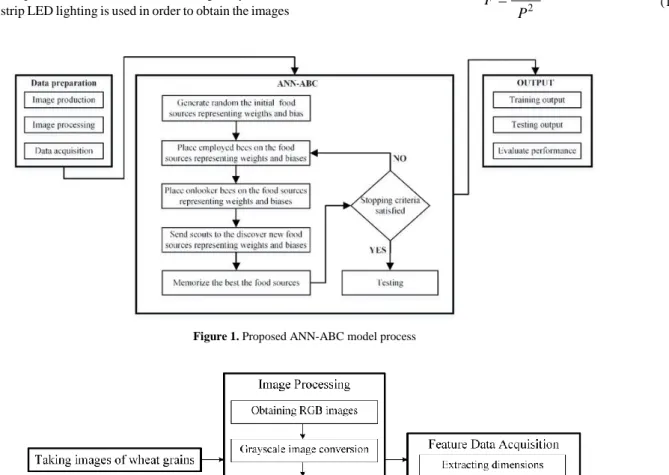
The application of the ABC algorithm is relatively simple [26] and it has the advantage of not requiring a lot of parameters to be tuned [28]. All processes related to proposed ANN-ABC model are illustrated in (Figure.1). The processes in the (Figure.1) will be described in the subsections.
2.1. Image Processing Technique and Data Preparation
In this section, the data set is obtained by applying IPT to the wheat images in order to model the AITs as shown in (Figure.2). A setup including a computer, a camera and a box arranged by camera holder and a strip LED lighting is used in order to obtain the images
as shown in (Figure.3). The camera is a Logitech C920 CCD with the specifications of full HD (1080p), 15 MP, H.264 encoding, Carl Zeiss optics. The photographs are taken by the camera fixed at 35 cm height from the wheat at the bottom of the box which is closed and self-illuminated. The inside of the box is covered with black background.
The images of the wheat grains for bread and durum taken by the camera are illustrated in (Figure.4). As can be seen, the main discrimination between the two grains is that the durum wheat grain is bigger than that of bread wheat. Therefore, dimension features of the wheat grains are considered in this study to model. As given in (Figure.5), the photographs of 100 bread wheat grains and 100 durum wheat grains are taken via the high resolution camera. The wheat used for classification is cultivated in Konya, Turkey.
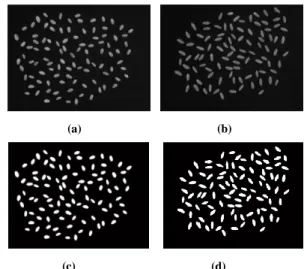
The IPTs are conducted through MATLAB®2014b software to acquire the feature data. Firstly, the RGB level of each pixel in the images are determined. These images are then converted to grayscale format as shown in (Figure.6a & 6b). Secondly, the grayscale images seen from (Figure.6c & 6d) are converted to binary images (black/white) using Otsu's method [29]. Thus the noise of each image is eliminated using morphological process. Thirdly, each grain’s position is fixed and they are tagged according to its position through a segmentation process. Each grain’s dimensions in terms of the length (L), width (W), area (A) and perimeter (P) are extracted from binary images. Feature of fullness (F) related to dimension is reproduced from these parameters by (Equation.1).
(1)
Figure 1. Proposed ANN-ABC model process
Figure 2. Flowchart of extracting dimension features
2
4 A
F
P
Figure 3. The setup for obtaining the images
(a)
(b)
Figure 4. The images of the grains for a) bread wheat, b) durum wheat
(a) (b)
Figure 5. The RGB images of 100 grains for a) bread wheat, b) durum
wheat
(a) (b)
(c) (d)
Figure 6. The images of 100 grains for a) grayscale of bread wheat, b)
grayscale of durum wheat a) binary images of bread wheat, b) binary images of durum wheat (originally given in Figure 5)
2.2. Artificial Neural Network
ANN consists of neurons organized into different layers. These neurons containing non-linear types of functions are mutually connected by synaptic weights [30]. The neuron number of the input layer equals to the number of the input parameters. A function given in (Equation.2) processes in each neuron.
(2)
here, i and j are respectively indexes for neurons of input and hidden layers. Neurons in the input layer act as buffers for distributing the input signals xi to neurons in the hidden layer. Each neuron j in the hidden layer sums up its input signals xi after weighting them with the strengths of the respective connections wji from the input layer and computes its output yj as a function f of the sum and θi is the threshold (or bias) of the node. During training, these strengths weaken or strengthen to bring closer the output to the target of the network. f can be a simple threshold function such as sigmoid, hyperbolic tangent, tangent sigmoid, radial basis, purelin etc. The goal is to minimize the mean square error (MSE) function given by (Equation. 3)
2 1 1 ( ( ))
(
)
n k j j E w t n d
o
(3)where E(w(t)) is the error at the tth iteration; w(t), the weight in the connections at the tth iteration; dj is the desired output node; oj is the target value for the jth output node.
2.3. Artificial Bee Colony Algorithm
The ABC algorithm as named of heuristic technique is a powerful optimization method by (Karaboğa et al; 2007). In ABC algorithm phases, the search process performed for solution of optimization problems mimics the foraging behavior of honey bees.
The detailed implementation of the ABC algorithm is shown in Algorithm 1. At the initial of the ABC algorithm, the bee population (P) having a randomly distributed is generated. The number of solutions (represented food source positions, SN) is equal to the half of the population. Each solution xi (i=1, 2, ..., SN) has a D-dimensional vector named of optimization parameters. Therefore, these vectors having D-dimensional will be optimized solutions by ABC algorithm. The positions representing of possible solutions are improved by employed, onlooker and scout bee phases until reach maximum cycle (MCN, cycle=1, 2, …, MCN).
A modification position from the position of the employed bee is generated by using (Equation.4). If the nectar quality of previous position is lower than new position, the new position is memorized by a bee and then the old position is abandoning. Otherwise, the old position is kept by a bee in the memory.
(4) where k ∈ {1, 2,…….SN} and j ∈ {1, 2,……D} are randomly chosen indexes. k is determined randomly and should be differ from i. Φij us a random generated number between [-1,1]. The search process is completed by all the employed bees and then the information about the food sources found by the employed bees is shared with the onlooker bees. These information covers of the nectar quality and position of the food sources.
A food source is selected by an onlooker bee evaluating the probability value of food sources. This probability pi related to the nectar quality of the food source is calculated by (Equation.5).
(5) 1 fiti pi SN fitn n
(
)
1
n
y
j
f
w x
ji i
i
j
(
)
ij ij ij ij kjv
x
x
x
This journal is © Advanced Technology & Science IJISAE, 2018, 6(1), 85-91 |88
Algorithm 1: Public ABC algorithm [25]
1 Produce the initial positions of bees in the population xi; i = 1, …, SN 2 Evaluate the nectar quality of the initial position point.
3 cycle = 1
4 repeat
5 Generate new positions representing of new solutions vi by the employed bees using (Equation.4) and evaluate the nectar quality of new positions.
6 Apply greedy selection process to solutions found by employed bees. 7 Compute the probability values pi of the solutions xi by using (Eq. 5)
8 Generate the new solutions vi for the onlookers from the solutions xi selected depending on pi values and evaluate the nectar quality of new positions.
9 Apply greedy selection process to solutions found by onlooker bees.
10 Determine the abandoned solution for the scout, if exists, and replace it with a new randomly produce solution
xi by (Equation.6)
11 Memorize the best solution achieved so far 12 cycle = cycle+1
13 until Until cycle = MCN;
fitness value of the solution i and SN is the number of food sources. A modification position from the position of the onlooker bee is generated by using (Equation.4). If the nectar quality of previous position is lower than new position, the new position is memorized by a bee and then the old position is abandoning. Otherwise, the old position is kept by a bee in the memory. If the nectar of a food source is consumed by an employed bee. This employed bee transforms a scout bee and the old food source is abandoned. A position of a new food source is found by scout bee using (Equation.6).
(6)
3. Results of Classification of Wheat Grains
In this study, the ABC optimization algorithm is used in the ANN model as learning algorithm. ABC updates the weight/bias values and minimizes a linear combination of squared errors. It also modifies the linear combination so that at the end of the training the resulting network has good generalization qualities.
3.1. Training Process of ANN-ABC Model
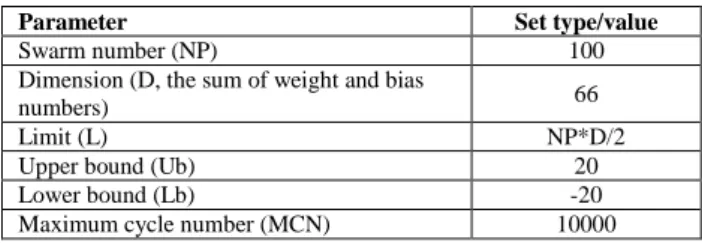
The dimension parameters (L, W, A, P and F) of the wheat grains were given as inputs and their respective classification results of IPT were given as output to the ANN-ABC model. The data set of 170 wheat grains representing the overall problem space is used to train the ANN-ABC model and the remainders 30 wheat grains that are not included in the training process are utilized to test the accuracy of the model. ANN-ABC model based on MLP having one input layer with five neurons, one hidden layer with five neurons and one output layer with one neuron was constructed, as shown in (Figure.6).
Table 1. The parameters used to set the ANN-ABC model
Parameter Set type/value
Swarm number (NP) 100
Dimension (D, the sum of weight and bias
numbers) 66
Limit (L) NP*D/2
Upper bound (Ub) 20
Lower bound (Lb) -20
Maximum cycle number (MCN) 10000
“Log-sigmoid” function is used for input and output layers while “tangent sigmoid” function is utilized for the hidden layer. The parameters of the ANN-ABC model used in this work are listed in
Table 1. The training results are checked according to the following mean absolute error (MAE),
(7)
3.2. Testing Process Results of ANN-ABC Model
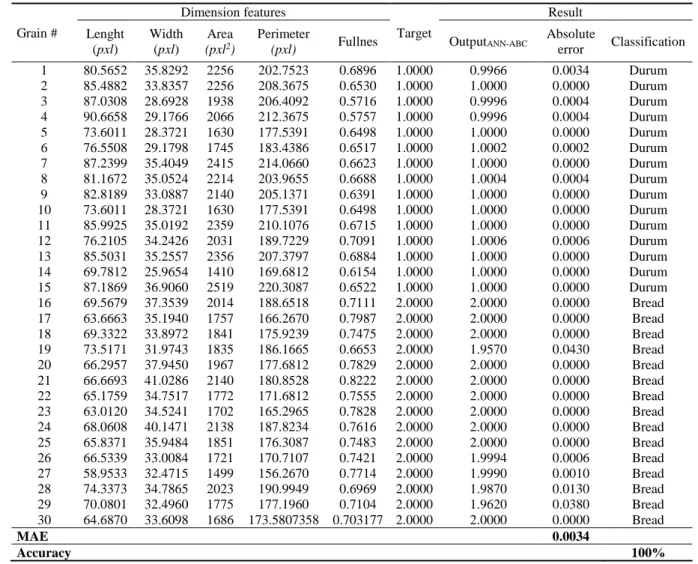
The testing data including 5 dimension features of 30 grains (15 bread wheat grains and 15 durum wheat grains) and their testing results are tabulated in Table 2 to further inspect the data and results. While the number of “2” is assigned to specify bread grains, “1” is appointed to define the durum grains as targets of the ANN-ABC model. The ANN-ABC model proposed in this study accurately classifies 19 grains with 0 (zero) and 11 grains with very small absolute errors. Therefore, it classifies the total grains of 30 with a negligible MAE of 0.0034 and with 100% accuracy. It demonstrates that the proposed IPT based ANN-ABC model can be successfully utilized to classify the wheat grain varieties in an automatic manner.
min
(0,1)(
max min)
j j j j i
x
x
rand
x
x
grains of Number Output Target
MAEFigure 6. ANN-ABC model and problem parameters
Table 2. The testing results of classifying the wheat grains with the ANN-ABC model
Grain # Dimension features Target Result Lenght (pxl) Width (pxl) Area (pxl2) Perimeter
(pxl) Fullnes OutputANN-ABC
Absolute error Classification 1 80.5652 35.8292 2256 202.7523 0.6896 1.0000 0.9966 0.0034 Durum 2 85.4882 33.8357 2256 208.3675 0.6530 1.0000 1.0000 0.0000 Durum 3 87.0308 28.6928 1938 206.4092 0.5716 1.0000 0.9996 0.0004 Durum 4 90.6658 29.1766 2066 212.3675 0.5757 1.0000 0.9996 0.0004 Durum 5 73.6011 28.3721 1630 177.5391 0.6498 1.0000 1.0000 0.0000 Durum 6 76.5508 29.1798 1745 183.4386 0.6517 1.0000 1.0002 0.0002 Durum 7 87.2399 35.4049 2415 214.0660 0.6623 1.0000 1.0000 0.0000 Durum 8 81.1672 35.0524 2214 203.9655 0.6688 1.0000 1.0004 0.0004 Durum 9 82.8189 33.0887 2140 205.1371 0.6391 1.0000 1.0000 0.0000 Durum 10 73.6011 28.3721 1630 177.5391 0.6498 1.0000 1.0000 0.0000 Durum 11 85.9925 35.0192 2359 210.1076 0.6715 1.0000 1.0000 0.0000 Durum 12 76.2105 34.2426 2031 189.7229 0.7091 1.0000 1.0006 0.0006 Durum 13 85.5031 35.2557 2356 207.3797 0.6884 1.0000 1.0000 0.0000 Durum 14 69.7812 25.9654 1410 169.6812 0.6154 1.0000 1.0000 0.0000 Durum 15 87.1869 36.9060 2519 220.3087 0.6522 1.0000 1.0000 0.0000 Durum 16 69.5679 37.3539 2014 188.6518 0.7111 2.0000 2.0000 0.0000 Bread 17 63.6663 35.1940 1757 166.2670 0.7987 2.0000 2.0000 0.0000 Bread 18 69.3322 33.8972 1841 175.9239 0.7475 2.0000 2.0000 0.0000 Bread 19 73.5171 31.9743 1835 186.1665 0.6653 2.0000 1.9570 0.0430 Bread 20 66.2957 37.9450 1967 177.6812 0.7829 2.0000 2.0000 0.0000 Bread 21 66.6693 41.0286 2140 180.8528 0.8222 2.0000 2.0000 0.0000 Bread 22 65.1759 34.7517 1772 171.6812 0.7555 2.0000 2.0000 0.0000 Bread 23 63.0120 34.5241 1702 165.2965 0.7828 2.0000 2.0000 0.0000 Bread 24 68.0608 40.1471 2138 187.8234 0.7616 2.0000 2.0000 0.0000 Bread 25 65.8371 35.9484 1851 176.3087 0.7483 2.0000 2.0000 0.0000 Bread 26 66.5339 33.0084 1721 170.7107 0.7421 2.0000 1.9994 0.0006 Bread 27 58.9533 32.4715 1499 156.2670 0.7714 2.0000 1.9990 0.0010 Bread 28 74.3373 34.7865 2023 190.9949 0.6969 2.0000 1.9870 0.0130 Bread 29 70.0801 32.4960 1775 177.1960 0.7104 2.0000 1.9620 0.0380 Bread 30 64.6870 33.6098 1686 173.5807358 0.703177 2.0000 2.0000 0.0000 Bread MAE 0.0034 Accuracy 100%
This journal is © Advanced Technology & Science IJISAE, 2018, 6(1), 85-91 |90
3.3. Comparison Results
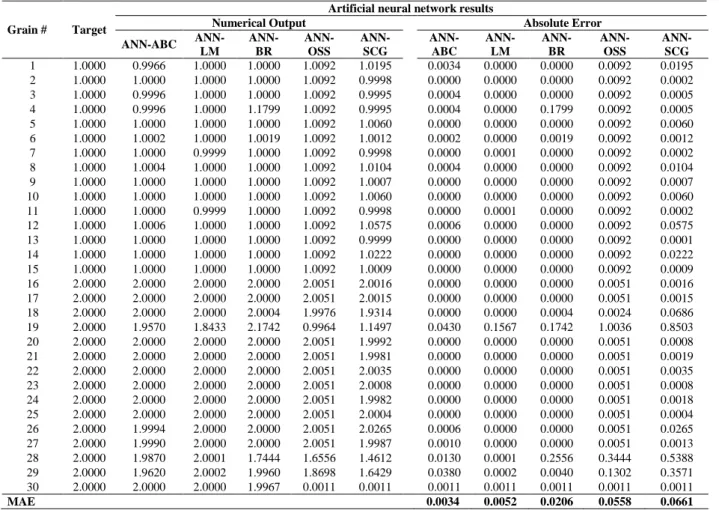
In this study, wheat grains are also classified with the ANN models trained by 4 different learning algorithms to show the success of the ANN-ABC model. LM, BR, OSS and SCG learning algorithms are used for this purpose. The ANN models based MLP which is used LM, BR, OSS and SCG learning algorithms are constructed as in the ANN-ABC model. The activation functions used for the ANN models trained by different learning algorithms are also selected as in the ANN-ABC model. " Log-sigmoid" function is used for the input layer and output layer, and " Tangent sigmoid" activation function is used for the hidden layer. In the ANN-ABC model, the number of network parameters is less than the other ANN models. This shows that the appropriate ANN-ABC structure is more easily
modelled. This shows that the appropriate ANN-ABC structure is modelled more easily than ANN trained by four different learning algorithms. For further comparison, the numerical results of ANN models are also listed in Table 3. It is apparent from Table 3 that, ANN-ABC and ANN-LM models give the remarkable results in comparison with other models. MAE values of the ANN-ABC and ANN-LM models are close to each other and successful. However, among these learning algorithms, ANN-ABC model gives best result for classification of wheat grains into bread and durum.From the testing results presented in Table 4, while the MAE result of the ANN-BC is 0.0034, MAE results of ANN-LM, ANN-BR, ANN-OSS and ANN-SCG models are 0.0052, 0.0206, 0.0558 and 0.0661, respectively. Computational time for the five models is almost the same for testing process.
Table 3. The comparative test results for classification with ANN models
Grain # Target
Artificial neural network results
Numerical Output Absolute Error
ANN-ABC ANN-LM ANN-BR ANN-OSS ANN-SCG ANN-ABC ANN-LM ANN-BR ANN-OSS ANN-SCG 1 1.0000 0.9966 1.0000 1.0000 1.0092 1.0195 0.0034 0.0000 0.0000 0.0092 0.0195 2 1.0000 1.0000 1.0000 1.0000 1.0092 0.9998 0.0000 0.0000 0.0000 0.0092 0.0002 3 1.0000 0.9996 1.0000 1.0000 1.0092 0.9995 0.0004 0.0000 0.0000 0.0092 0.0005 4 1.0000 0.9996 1.0000 1.1799 1.0092 0.9995 0.0004 0.0000 0.1799 0.0092 0.0005 5 1.0000 1.0000 1.0000 1.0000 1.0092 1.0060 0.0000 0.0000 0.0000 0.0092 0.0060 6 1.0000 1.0002 1.0000 1.0019 1.0092 1.0012 0.0002 0.0000 0.0019 0.0092 0.0012 7 1.0000 1.0000 0.9999 1.0000 1.0092 0.9998 0.0000 0.0001 0.0000 0.0092 0.0002 8 1.0000 1.0004 1.0000 1.0000 1.0092 1.0104 0.0004 0.0000 0.0000 0.0092 0.0104 9 1.0000 1.0000 1.0000 1.0000 1.0092 1.0007 0.0000 0.0000 0.0000 0.0092 0.0007 10 1.0000 1.0000 1.0000 1.0000 1.0092 1.0060 0.0000 0.0000 0.0000 0.0092 0.0060 11 1.0000 1.0000 0.9999 1.0000 1.0092 0.9998 0.0000 0.0001 0.0000 0.0092 0.0002 12 1.0000 1.0006 1.0000 1.0000 1.0092 1.0575 0.0006 0.0000 0.0000 0.0092 0.0575 13 1.0000 1.0000 1.0000 1.0000 1.0092 0.9999 0.0000 0.0000 0.0000 0.0092 0.0001 14 1.0000 1.0000 1.0000 1.0000 1.0092 1.0222 0.0000 0.0000 0.0000 0.0092 0.0222 15 1.0000 1.0000 1.0000 1.0000 1.0092 1.0009 0.0000 0.0000 0.0000 0.0092 0.0009 16 2.0000 2.0000 2.0000 2.0000 2.0051 2.0016 0.0000 0.0000 0.0000 0.0051 0.0016 17 2.0000 2.0000 2.0000 2.0000 2.0051 2.0015 0.0000 0.0000 0.0000 0.0051 0.0015 18 2.0000 2.0000 2.0000 2.0004 1.9976 1.9314 0.0000 0.0000 0.0004 0.0024 0.0686 19 2.0000 1.9570 1.8433 2.1742 0.9964 1.1497 0.0430 0.1567 0.1742 1.0036 0.8503 20 2.0000 2.0000 2.0000 2.0000 2.0051 1.9992 0.0000 0.0000 0.0000 0.0051 0.0008 21 2.0000 2.0000 2.0000 2.0000 2.0051 1.9981 0.0000 0.0000 0.0000 0.0051 0.0019 22 2.0000 2.0000 2.0000 2.0000 2.0051 2.0035 0.0000 0.0000 0.0000 0.0051 0.0035 23 2.0000 2.0000 2.0000 2.0000 2.0051 2.0008 0.0000 0.0000 0.0000 0.0051 0.0008 24 2.0000 2.0000 2.0000 2.0000 2.0051 1.9982 0.0000 0.0000 0.0000 0.0051 0.0018 25 2.0000 2.0000 2.0000 2.0000 2.0051 2.0004 0.0000 0.0000 0.0000 0.0051 0.0004 26 2.0000 1.9994 2.0000 2.0000 2.0051 2.0265 0.0006 0.0000 0.0000 0.0051 0.0265 27 2.0000 1.9990 2.0000 2.0000 2.0051 1.9987 0.0010 0.0000 0.0000 0.0051 0.0013 28 2.0000 1.9870 2.0001 1.7444 1.6556 1.4612 0.0130 0.0001 0.2556 0.3444 0.5388 29 2.0000 1.9620 2.0002 1.9960 1.8698 1.6429 0.0380 0.0002 0.0040 0.1302 0.3571 30 2.0000 2.0000 2.0000 1.9967 0.0011 0.0011 0.0011 0.0011 0.0011 0.0011 0.0011 MAE 0.0034 0.0052 0.0206 0.0558 0.0661
4. Conclusion
In this article ANN model trained by ABC optimization algorithm is proposed for accurate classification of the wheat grains into bread and durum. The ANN-ABC model based on the MLP with three layers is designed for this purpose. 5 features of dimensions for 100 bread and 100 durum wheat grains are acquired by using IPTs. The ANN-ABC model is trained by 170 grains and its accuracy is tested through 30 grains of 200 wheat grains data. The ANN-ABC model classifies the wheat grains with the MAE of 0.0034 for the testing process. Moreover, proposed model is
compared with 4 different learning algorithm such as LM, BR, OSS and SCG and it is seen to be more successful. The results achieved in this study show that ANN-ABC model based on IPT can be successfully used to classify the wheat grains according to their dimension features with high accuracy.
References
[1] K. Mollazade, M. Omid and A. Arefi (2012). Comparing data mining classifiers for grading raisins based on visual features. Comput Electron Agr. 84 124–131.
[2] C. Sungur and H. Ozkan (2015). A real time quality control application for animal production by image processing. J Sci Food Agr. 95 2850–2857.
[3] X. Yu, K. Liu, D. Wu and Y. He (2012). Raisin quality classification using least squares support vector machine (LSSVM) based on combined color and texture features. Food Bioprocess Tech. 5 1552–1563.
[4] B.G. Hu, RG. Gosine, LX. Cao and CW. de Silva (1998). Application of a fuzzy classification technique in computer grading of fish products. IEEE T Fuzzy Syst. 6 144–152. [5] Y. Al Ohali (2011). Computer vision based date fruit grading
system: Design and implementation. Journal of King Saud University-Computer and Information Sciences. 23 29–36. [6] R.P. Gálvez, F.J.E. Carpio, E.M. Guadix and A. Guadix
(2016). Artificial neural networks to model the production of blood protein hydrolysates for plant fertilisation. J Sci Food Agr. 96 207–214.
[7] J. Pet'ka, J. Mocak, P. Farkaš, B. Balla and M. Kováč (2001). Classification of Slovak varietal white wines by volatile compounds. J Sci Food Agr. 81 533–1539.
[8] M. Berman, P.M. Connor, L.B. Whitbourn, D.A. Coward B.G. Osborne and M.D. Southan (2007). Classification of sound and stained wheat grains using visible and near infrared hyperspectral image analysis. J Near Infrared Spec 15 351–358.
[9] K.S. Jamuna, S. Karpagavalli, P. Revathi, S. Gokilavani and E. Madhiya (2010). Classification of Seed Cotton Yield Based on the Growth Stages of Cotton Crop Using Machine Learning Techniques. International Conference on Advances in Computer Engineering 20-2, Bangalore, Karnataka, India, 312–315.
[10] F. Guevara-Hernandez and J. Gomez-Gi (2011). A machine vision system for classification of wheat and barley grain kernels. Span J Agric Res. 9 672–680.
[11] P. Zapotoczny (2011). Discrimination of wheat grain varieties using image analysis: morphological features. Eur Food Res Technol. 233 769–779.
[12] C.V. Di Anibal, I. Ruisánchez, M. Fernández, R. Forteza, V. Cerdà and M.P. Callao (2012). Standardization of UV– visible data in a food adulteration classification problem. Food Chem. 134 2326–2331.
[13] J.S. Prakash, K.A. Vignesh, C. Ashok and R. Adithyan (2012). Multi class Support Vector Machines classifier for machine vision application. In Machine Vision and Image Processing (MVIP) 14-15; Taipei, Taiwan, 197–199. [14] A.R. Pazoki, F. Farokhi and Z. Pazoki (2014). Classification
of rice grain varieties using two Artificial Neural Networks (MLP and Neuro-Fuzzy). J Anim and Plant Sci. 24 336–343. [15] R. Muñiz-Valencia, J.M. Jurado, S.G. Ceballos-Magaña, A. Alcázar and J. Hernández-Díaz (2014). Characterization of Mexican coffee according to mineral contents by means of multilayer perceptrons artificial neural networks. Journal of Food Composition and Analysis. 34 7–11.
[16] E.M. De Oliveira, D.S. Leme, B.H.G. Barbosa, M.P. Rodarte and R.G.F.A. Pereira (2016). A computer vision system for coffee beans classification based on computational intelligence techniques. J Food Eng. 171 22–27.
[17] K. Sabanci, A. Kayabasi and A. Toktas (2017). Computer vision-based method for classification of the wheat grains using artificial neural network. Journal of the Science of Food and Agriculture. 97(8) 2588–2593.
[18] K. Sabanci, A. Toktas and A. Kayabasi (2017). Grain classifier using computer vision with using adaptive
neuro-fuzzy inference system. Journal of the Science of Food and Agriculture. 97(12) 3994–4000.
[19] M.F. Aslan, K. Sabanci and A.Durdu (2017). Different Wheat Species Classifier Application of ANN and ELM. Journal of Multidisciplinary Engineering Science and Technology. 4(9) 8194-8198.
[20] J.-R. Zhang, J. Zhang, T.M. Lok and M.R. Lyu (2007). A hybrid particle swarm optimization back-propagation algorithm for feedforward neural network training. Appl. Math. Comput. 185(2) 1026–1037.
[21] H. Shah, R. Ghazali, N.M. Nawi Using an artificial bee colony algorithm for MLP training on earthquake time series data prediction, arXiv preprint, arXiv:1112.4628
[22] E. Valian, S. Mohanna, S. Tavakoli (2011). Improved cuckoo search algorithm for feedforward neural network training. Int. J. Artif. Intell. Appl. 2 (3) 36–43.
[23] S. Yu, K. Wang, Y.-M. Wei (2015). A hybrid self-adaptive particle swarm optimization genetic algorithm-radial basis function model for annual electricity demand prediction. Energy Convers. Manag. 91 176–185.
[24] J. Wu, J. Long and M. Liu (2015). Evolving RBF neural networks for rainfall prediction using hybrid particle swarm optimization and genetic algorithm. Neurocomputing. 148 136–142.
[25] D. Karaboga (2005). An idea based on honey bee swarm for numerical optimization. Techn. Rep. TR06, Erciyes Univ. Press, Erciyes.
[26] D. Karaboga, B. Gorkemli, C. Ozturk and N. Karaboga (2014). A comprehensive survey: artificial bee colony (ABC) algorithm and applications. Artif. Intell. Rev. 42 (1) 21–57.
[27] M. Zandieh, A. Azadeh, B. Hadadi and M. Saberi (2009). Application of neural networks for airline number of passenger estimation in time series state. J. Appl. Sci. 9(6), 1001–1013.
[28] D. Karaboga, B. Akay and C. Ozturk (2007). Artificial bee colony (ABC) optimization algorithm for training feed-forward neural networks. In: Modeling decisions for artificial intelligence. 318{329. Springer (2007)
[29] N. Otsu (1979). A Threshold Selection Method from Gray-Level Histograms. IEEE T Syst Man Cyb. 9 62–66. [30] S.Haykin (1994). Neural networks: A comprehensive
foundation, Macmillan College Publishing Company, New York, A.B.D.