T.C. DOĞUŞ ÜNİVERSİTESİ
INSTITUTE OF SCIENCE AND TECHNOLOGY
DEPARTMENT: ENGINEERING AND TECHNOLOGY MANAGEMENT
KUVEYT TÜRK PAYMENT SYSTEMS TECHNOLOGY ROADMAP
Thesis
Ayşe TURAN 201199015
Thesis Supervisor: Lect. Dr. Burcu KULELİ PAK
Istanbul, July 2014
T.C. DOĞUŞ ÜNİVERSİTESİ
INSTITUTE OF SCIENCE AND TECHNOLOGY
DEPARTMENT: ENGINEERING AND TECHNOLOGY MANAGEMENT
KUVEYT TÜRK PAYMENT SYSTEMS TECHNOLOGY ROADMAP
Thesis
Ayşe TURAN 201199015
Thesis Supervisor: Lect. Dr. Burcu KULELİ PAK
Istanbul, July 2014
ACKNOWLEDGEMENTS
I would like to thank my supervisor Dr. Burcu KULELİ PAK for the invaluable guidance. She provides an endless inspiration to me. I would also like to thank my co-workers for their tolerance. I present my sincere thanks to my friend Safiye Demirsoy for her encouragements.
(Istanbul, July 2014) Ayşe TURAN
ABSTRACT
With the spread of computers and internet, we have witnessed a technologic revolution in financial markets. Payment systems became one of the profitable market in both Turkey and the world thanks to the information technology (IT). The remarkable evolutions have been made on payment systems due to the development of information technology in the world. In Addition, rapid developments in technological products are confronting traditional banks with major challenges. Competition in Turkey payment system market has also increased in these days. Therefore, most banks in turkey aim to increase their profitability and customer numbers by following technology trends and making investments on research and development (R&D). Some of technology trends have been applied to Kuveyt Turk Payment Systems. However, some have not been applied to payment systems in Kuveyt Turk yet. Aim of thesis study is;
• to observe current structure of Kuveyt Turk Payment Systems,
• to find key gaps and opportunities in the current payment environment both Turkey and the world,
• to help capturing these opportunities for future of Kuveyt Turk Payment Systems,
• to help determining potential strategies and tactics to shape the future of the Kuveyt Turk Payment System,
• to develop technology road map by making using of SWOT and QSPM that are used as strategic planning tools.
Keywords: Kuveyt Türk, Payment Systems
ÖZET
Bilgisayar ve internetin yaygınlaşmasıyla mali pazarlarda teknolojik devrimlere tanık oluyoruz. Ödeme sistemleri bilgi teknolojilerindeki gelişmeler sayesinde hem dünyada hem Türkiye’de en önemli kar getiren pazarlardan biri olmuştur. Dünyadaki bilgi teknolojileri gelişimi ödeme sistemlerinde birçok yenilikleri getirmiştir. Buna ek olarak teknoloji ürünlerindeki hızlı gelişmeler geleneksel bankaları büyük değişimler yapmaya zorluyor. Türkiye’ deki ödeme sistemleri pazarındaki rekabet her gecen gün artmaktadır. Bunun beraberinde Türkiye pazarında çoğu bankalar araştırma ve geliştirmeye yatırım yaparak ve teknolojik trendleri takip ederek müşteri sayısını ve karlılığını artırmayı hedeflemektedir. Kuveyt Turk’ te teknolojik trendlerin bir kısmını mevcut bünyesinde uygulamış olup bir kısmını henüz uygulamamıştır. Bu çalışmanın amacı;
• Kuveyt Türk ödeme sistemlerinin mevcut yapısını incelemek,
• Türkiye ve dünyadaki mevcut ödeme sistemlerinin fırsatlarını ve tehditlerini belirlemek,
• Kuveyt Türk ödeme sistemlerinin olası fırsatları yakalamasına yardım etmek, • Kuveyt Türk ödeme sistemlerinin geleceğinin şekillenmesine katkıda
bulunmak için olası strateji ve tatikleri belirlemek,
• Stratejik planlama aracı olarak kullanılan SWOT ve QSPM den faydalanarak teknoloji yol haritasını geliştirmek.
Anahtar Kelimeler: Kuveyt Türk, Ödeme Sistemleri
TABLE OF CONTENTS ACKNOWLEDGEMENTS ... iii ABSTRACT ... iv ÖZET ... v LIST OF FIGURES ... x LIST OF TABLES ... xi
LIST OF ABBREVIATIONS ... xii
1. INTRODUCTION ... 1
1.1 Participants in a Payment System ... 2
1.2 Types of Payment Systems ... 2
1.2.1 Large-value Payment Systems (LVPS) ... 2
1.2.2 Retail Payments ... 3
1.2.3 Retail Payment Instruments ... 3
1.2.3.1.1 Cash payments ... 3
1.2.3.1.2 Non-cash payments ... 4
1.2.3.1.2.1 Payment Cards... 4
1.2.3.1.2.1.1 Credit Cards ... 5
1.2.3.1.2.1.2 Prepaid Cards ... 5
1.2.3.1.2.1.4 Credit, Prepaid and Debit Cards Comparison Chart ... 8
1.2.3.1.2.1.5 E-Cash ... 9
2. PAYMENT SYSTEMS IN TURKEY ... 11
2.1 Introduction ... 11
2.2 General Overview ... 11
2.3 Large-value Payment Systems ... 11
2.3.1 The real-time gross settlement system: TIC-RTGS ... 11
2.3.2 The Takasbank Clearing System (TCS) ... 12
2.4 Retail Payment ... 12
2.4.1 Retail payment systems ... 12 vi
2.4.1.1 Interbank Card Centre (BKM) ... 12
2.4.1.2 Interbank Clearing Houses Centre (BTOM) ... 13
2.4.2 Retail payment instruments ... 13
2.4.2.1 Cash ... 13
2.4.2.2 Payment Cards ... 14
2.4.2.2.1 Credit Cards ... 14
2.4.2.2.2 Debit Cards ... 15
2.4.2.2.3 Prepaid Cards ... 16
3. TECHONOLOGY TRENDS IN PAYMENT SYSTEMS ... 18
3.1 Smart Card ... 18
3.1.1 Features of Smart Card ... 19
3.1.2 Smart card applications in the world ... 19
3.1.3 Smart card applications in Turkey ... 20
3.2 E-Wallet ... 21
3.2.1 E-Wallet security ... 22
3.2.2 Benefits of e-wallet ... 22
3.2.3 E-wallet applications in the world ... 23
3.2.3.1 Microsoft E-wallet ... 23
3.2.3.2 Google Wallet ... 23
3.2.4 E-wallet applications in Turkey ... 24
3.2.4.1 Vodafone Cep Cüzdan ... 24
3.2.4.2 Turkcell Cüzdan ... 24
3.3 NFC (Near Field Communication) ... 25
3.3.1 Benefits of NFC Payment ... 26
3.3.2 NFC applications in the world ... 26
3.3.3 NFC applications in Turkey ... 28
3.3.3.1 Mobile Payment ... 28
3.3.3.2 Transportation Projects (Konya Transportation Project) ... 29 vii
3.4 Biometric Payment System ... 29
3.4.1 Fingerprint scanning ... 30
3.4.2 Other biometric types and applications in the world ... 30
3.4.2.1 Face recognition ... 30
3.4.2.2 Hand geometry and palm print scanning ... 30
3.4.2.3 Iris scanning ... 31
3.4.2.4 Voice recognition ... 31
3.4.3 Biometric applications in Turkey ... 31
4. KUVEYT TURK PAYMENT SYSTEMS ... 33
4.1 Generel Overview ... 33
4.2 Kuveyt Turk Payment System Management ... 33
4.2.1 Credit Cards Data Entry and Inquiry ... 34
4.2.2 Credit Card Operations ... 34
4.2.3 Security and Fraud ... 35
4.2.4 Alternative Delivery Channel (ADC) Operations ... 36
4.2.4.1 ATM Operations ... 36 4.2.4.2 POS Operations ... 36 4.3 Payment instruments ... 37 4.3.1 Cash ... 37 4.3.2 Payment Cards ... 37 4.3.2.1 Credit cards ... 37 4.3.2.2 Debit Cards... 39
4.4 Kuveyt Turk Information Technology ... 40
4.4.1 Payment Systems in Kuveyt Turk Information Technology ... 41
5. TECHNOLOGY ROADMAP LITERATURE REVIEW ... 46
5.1. Technology Road Mapping Processes ... 47
5.1.1. Fast-Start technology road mapping (T-Plan) ... 48
5.1.2. Standard technology road mapping ... 51 viii
5.2. Strategic Planning ... 54
5.2.1. Strategic Planning Tools ... 55
5.2.1.1. SWOT Matrix ... 55
5.2.1.2. The Boston Consulting Group (BCG) Matrix ... 56
5.2.1.3. The Strategic Position and Action Evaluation (SPACE) Matrix .. 57
5.2.1.4. The Quantitative Strategic Planning Matrix (QSPM) ... 59
6. METHODOLOGY ... 62
7. DEVELOPING TECHNOLOGY ROADMAP FOR KUVEYT TURK PAYMENT SYSTEMS ... 64 7.1 SWOT ... 64 7.1.1 Strengths ... 64 7.1.2 Weaknesses ... 65 7.1.3 Opportunities ... 66 7.1.4 Threats ... 68 7.1.5 Strategies ... 68 7.1.5.1 SO (Strengths-Opportunities) Strategies ... 69 7.1.5.2 WO (Weaknesses-Opportunities) Strategies ... 70 7.1.5.3 ST (Strengths-Threats) Strategies ... 70 7.1.5.4 WT (Weaknesses-Threats) Strategies ... 70
7.2 Evaluating and Prioritizing Strategies ... 71
7.3 Prioritizing Technologies on QSPM matrix ... 77
8. CONCLUSION ... 78 REFERENCES ... 80 APPENDIXES ... 89 Appendix 1 ... 89 RESUME ... 99 ix
LIST OF FIGURES
Figure 1-1 Simple Transaction Flow for Credit and Debit ... 5
Figure 1-2 Offline debit card transaction ... 7
Figure 1-3 Online debit card transaction ... 8
Figure 1-4 E-cash process in general ... 10
Figure 3-1 A typical NFC application scenario ... 27
Figure 4-1 R&D Market share of banks ... 40
Figure 4-2 Debit and credit card application process ... 41
Figure 4-3 Credit card payment or cash advance process ... 42
Figure 4-4 Sale transaction process by a Kuveyt Turk credit card. ... 42
Figure 4-5 Sale transaction process by a Kuveyt Turk debit card ... 43
Figure 4-6 Kuveyt Turk credit card process at the end of day. ... 43
Figure 4-7 A New development process for Kuveyt Turk payment systems ... 45
Figure 5-1 Technology roadmap architecture and process for Faraday Partnership 50 Figure 5-2 Inputs, processes and outputs for standard technology roadmapping process ... 51
Figure 5-3 Result of portfolio analysis for LCD ... 52
Figure 5-4 Relationship between technology roadmap and strategic planning ... 54
Figure 5-5 BCG Matrix ... 57
Figure 5-6 Space Matrix ... 58
Figure 5-7 The Quantitative Strategic Planning Matrix ... 60
Figure 7-1 A New development process on card systems in Kuveyt Turk information technology ... 69
LIST OF TABLES
Table 1-1 Credit, Prepaid and Debit Cards Comparison Chart ... 9
Table 2-1 Atm number year by year ... 14
Table 2-2 POS number year by year ... 15
Table 2-3 Credit card number year by year ... 15
Table 2-4 Debit card number year by year ... 16
Table 4-1 Fraud events in Kuveyt Turk ... 36
Table 4-2 ATM number in Kuveyt Turk ... 37
Table 4-3 POS number in Kuveyt Turk ... 38
Table 4-4 Credit Card number in Kuveyt Turk ... 38
Table 4-5 Debit card number in Kuveyt Turk ... 40
Table 5-1 Technology roadmap architecture and process for Brazilian Software Company ... 49
Table 5-2 Random index (RI) values ... 61
Table 7-1 A pairwise comparison matrix for expert 1 judgments considering external key factors ... 72
Table 7-2 AW values of expert 1 judgments considering external key factors ... 73
Table 7-3 AW/W values of expert 1 judgments considering external key factors ... 73
Table 7-4 Group decision for Internal key factors ... 74
Table 7-5 Group decision for external key factors ... 74
Table 7-6 QSPM for Kuveyt Turk Payment System ... 76
LIST OF ABBREVIATIONS
3DES The triple data encryption standard ACH Automated Clearing House
ADC Alternative Delivery Channel AHP Analytical Hierarchy Process
AS Attractiveness Scores
ATM Atomated Teller Machines BCG Boston Consulting Group
BLU Back light unit
BOA Business Oriented Architecture
CBRT Central Bank of the Republic of Turkey CEO Chief Executive Officer
CI Consistency Index
CP Competitive Position
CR Consistency Ratio
EEPROM Electrical Erasable Programmable ROM EFT Electronic Funds Transfer
FP Financial Position
FTP File Transfer Protocol
GSM Global System Mobile
ICC (BKM) Interbank Card Centre system (Bankalararası Kart Merkezi)
ICH (BTOM) Interbank Clearing Houses (Bankalararası Takas Odaları Merkezi) Centre
ICHs Interbank Clearing Houses
IP Industry Position
ISE Istanbul Stock Exchange
ISO / IEC 14443 International Organization for standardization / International Electro technical Commission
IT Information Technology KTPS Kuveyt Turk Payment Systems LCD Liquid Crystal Display
LVPS Large-value Payment Systems MICR Magnetic ink character recognition NFC NFC (Near Field Communication)
P2P Peer To Peer
PC Personal Computer
PIN Personal Identification Number
POS Point Of Sale
QSPM Quantitative Strategic Planning Matrix R&D Research and Development
RAM Random Access Memory
RFID Radio-Frequency Identification
RI Random Index
ROM Read-Only Memory
RTGS Real-Time Gross Settlement System
SIM Subscriber Identity Modules
SP Stability Position
SPACE Strategic Position and Action Evaluation STAS Sum Total Attractiveness Scores
SWOT Strength-Weakness-Opportunities-Threats TAS Total Attractiveness Scores
TCS Takasbank Clearing System
TI Technology intelligence
TICNET Turkish Interbank Clearing Network
TIC-RTGS Turkish Interbank Clearing and real-time gross settlement system
T-Plan Fast-Start technology Road Mapping
TRDP Technology Roadmap Development Process xiii
TRM Technology Road Mapping
TRY Turkish Lira
URL Uniform Resource Locator
1. INTRODUCTION
Payment systems are the mechanisms that enable the smooth transfer of funds between buyers and sellers, and/or between banks. In the modern society, no economic activities are possible without the transfer of money. In this sense, it can be said that payment systems are one of the most significant social infrastructures.
A payment system consists of a set of instruments, banking procedures and, typically, interbank funds transfer systems that ensure the circulation of money. A typical payment system interconnects the banks, central bank, and real-time computer networks. Payment system enables them to exchange payments. Payment systems are a vital part of the economic and financial infrastructure. Their efficient functions allow transactions to be completed safely, securely and on time makes a key contribution to economic performance.
Payment systems show the remarkable changes in the past two decades. In the early years of 20th century, the payments among the banks used to be made by exchanging paper payment instructions, which is called the “paper-based payment system”. However, as the number of payments increased dramatically, it became very difficult to process paper work with paper instructions and manual handling. Therefore, people tried to utilize information technology (IT) with regard to the payment system. This leads developing the payment systems using the computers and networks. That is why most payment systems became electronic within a short period.
Therefore, this paper proceeds following steps. The first step is the review of payment systems literature. The structure and general properties of payment systems in the world are explained. Then, the structure and features of payment systems in Turkey market are discussed. Later, current and future technology trends in payment systems in both turkey and globe are observed. Furthermore, the general structure of Kuveyt Turk Payment systems is assessed. Moreover, SWOT analysis that helps managers or policy makers are developed for Kuveyt Turk payment system. Developing strategy planning and road mapping based on SWOT applications are also significant part of this thesis that are
mainly published in literature and articles. Finally, technology road map is developed by making using of SWOT and QSPM that are used as strategic planning tools.
1.1 Participants in a Payment System
The participants in a payment system are listed as follows;
• Banks: Banks that have a license to take deposits and effect payments intermediates between users and payment systems.
• The settlement agent: It sends/receives amount transfers between Automated Clearing House members. RTGS is a real-time gross settlement system that transfers and settles payments.
• Central bank: The task of central bank is to improve the function of payment systems and to protect the financial system.
• Money market: The money market is an important participant of payment systems.
An efficient market offers a variety of instruments that include cash and non-cash payments. So that, it is vital for the operation of a payment system (Gogoski, 2012).
1.2 Types of Payment Systems
Different types of payment systems are available. These can be categorized into two groups: Large Value and Retail Payment Systems.
1.2.1 Large-value Payment Systems (LVPS)
It is also named ‘‘Wholesale Payment Systems''. These payments are used for large amounts and require urgent or timely settlement. Therefore, payments needs to meet secure, safety and efficiency standards. In general, payments processed through an LVPS have ;
• Payments involve large amounts.
• Payments are involved exchange among payment participants (so-called wholesale payments).
• Payments should be on the time. Transaction should be done as soon as possible (BIS, 2005).
1.2.2 Retail Payments
Retail payments require transactions between two customers, between customers and businesses, or between two businesses. Retail payment systems generally have higher transaction volumes and lower average dollar values than Large-value Payment Systems (LVPS) (FFIEC, 2010).
1.2.3 Retail Payment Instruments
The range of payment instruments available in any particular country necessarily reflects country’s essential factors. These factors are;
• technological developments,
• competition or corporation among institutions issued by payment services, • globalization of payments services,
• the usage cost of payment services,
• the existence of alternative payment services, • country’s economic developments.
Today, the range of non-cash payment instruments has risen in the world. So that, we categorize payment instruments into two groups. These are cash payments and non-cash payments (Tarhan, 2013).
1.2.3.1.1 Cash payments
Cash is the common used method for small payments because it involves no credit and no promises. People can usually purchase goods and services easily as it is widely
accepted. On the other hand, although most people still carry cash for its convenience and flexibility, it is risky as it can cause theft and other problems. In addition, received cash from sellers can be re-used for other transactions (Tarhan, 2013).
1.2.3.1.2 Non-cash payments
1.2.3.1.2.1 Payment Cards
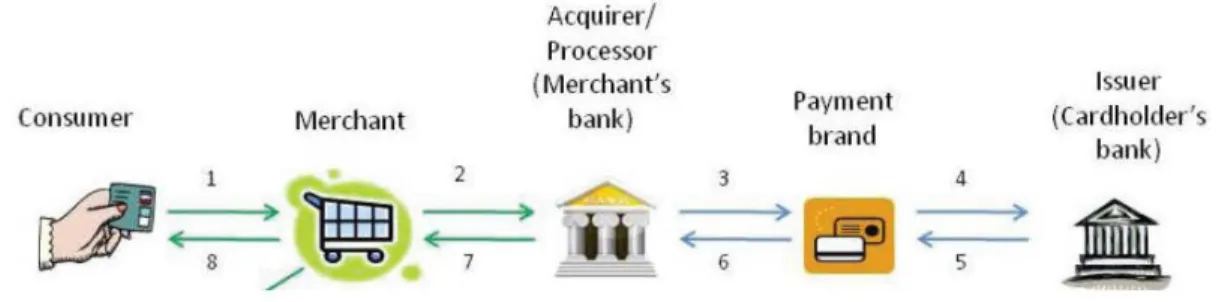
A payment card is typically a plastic card with either a magnetic stripe or a computer chip. It stores the cardholders’ info, card number and expiration date. The most familiar types of payment cards include credit, debit, and prepaid cards. Simple transaction workflow for debit and credit cards are given in Figure 1-1. According to A First Data White Paper payment cards transaction flow follows steps below.
1. When any card for payment is selected by customers, the cardholder data is inserted into the merchant’s point-of-sale (POS) terminal/software or an e-commerce website. 2. The card information data is sent to an acquirer/payment processor for authentication. 3. The acquirer/processor sends the data to the payment brand. Payment brand can be
Visa, MasterCard or American Express that cardholder is issued.
4. The issuing bank/processor checks that the card is not lost or stolen. The account also has the available balance to pay for the transaction.
5. The cardholders’ bank creates an authorization number and sends it to the card brand. 6. The card brand transmits the authorization code to the acquirer/processor.
7. The acquirer/processor resends the authorization code back to the merchant. 8. The merchant completes the sale transaction (A First Data White Paper, 2010).
Figure 1-1 Simple Transaction Flow for Credit and Debit
1.2.3.1.2.1.1 Credit Cards
The concept of a card is rely upon back to the 1920s in the United States. Then, “BankAmericard” was established in 1958. In this way, the modern concept of the credit card involved. It was issued by a third-party bank and used by sellers and merchants. Then, they started to be used by other retailers. Finally, Master Charge was established by a group of banks. Master Charge were separated into MasterCardVisa and MasterCard. They are still separated and commercial companies (A First Data White Paper, 2010).
Credit cards enable a cashless payment. Many cards offers instalments without charging any interest charges nowadays. Therefore, it makes credit cards popular. Their numbers tremendously increase (BIS, 2007).
1.2.3.1.2.1.2 Prepaid Cards
Prepaid cards evolved as an alternative to credit cards and debit cards at the end of the 1990s. Prepaid cards are used to make payment for goods and services where the issuer does not need the costs for opening and managing a payment account. In addition, customers also use the amount that they originally load. It allows withdrawing cash from automated teller machines (ATMs). In addition, some of them enables the person-to-person money transfers (Prior and Santoma, 2008).
The prepaid payment needs of:
• teenagers with online access, disposable income, but no credit card, • consumers who don’t want to use their credit/debit card on the Internet, • users to control their cash flow.
Prepaid cards can be associated with one of the payment brands, such as Visa, Master Card. In this way, it allows their use at any merchants that Visa, Master Card accept payment. On the other hand, they can be used at specific point such as gift cards for a specific retailer. The prepaid cards are used as reloadable cards, transit cards and payroll cards (A Smart Card Alliance Transportation Council White Paper, 2011).
1.2.3.1.2.1.3 Debit Cards
Debit cards have evolved in two forms; PIN-based debit and Signature-based. In Turkey, payment systems only have PIN-based debit feature. So that the customer account is debited immediately.
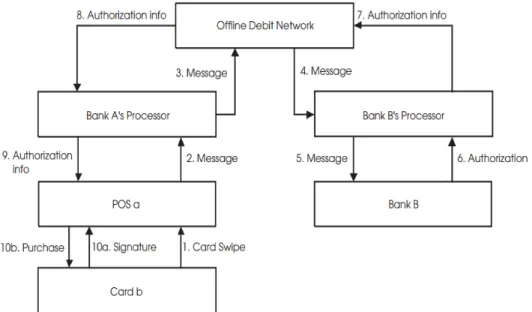
• Signature-based; Signature-based debit transactions are also named “offline debit”. The account of customer is debited approximately 2 days after transaction process. They are like a credit card transaction. The process has two messages. These are authorization, clearing and settlement (A First Data White Paper, 2010).
Offline debit card transaction flow is depicted in Figure 1-2. It follows below rules; 1. A customer uses debit card b of bank B at point of sale (POS) during shopping process. The customer signs the slip instead of using a PIN (Personal Identification Number).
3. Bank A’s processor sends the transaction message to the offline debit network that both Bank A and Bank B are members.
4. The offline debit network sends the transaction message to Bank B’s processor. 5. Bank B’s processor sends the transaction message to Bank B.
6. – 9. Bank B authorizes the transaction. The transaction is reversely resent to in order of Bank B’s processor, the offline debit network, Bank A’s processor, and the terminal, POS a.
10. The costumer signs the slip and the transaction is completed (Fumiko et al., 2003).
Figure 1-2 Offline debit card transaction
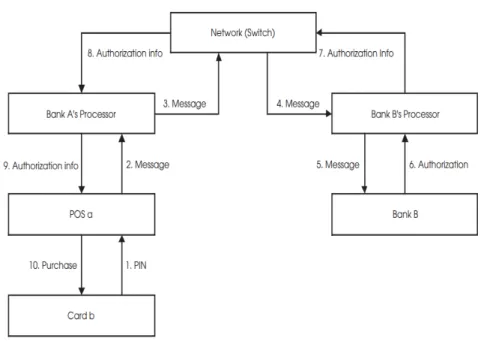
• PIN-based; PIN-based debit are also named “online debit”. It needs the customer to enter a personal identification number (PIN) at the point of sale (POS). Later, the transaction is run like MasterCard, Visa. The account of customer is immediately checked (A First Data White Paper, 2010).
Online debit card transaction flow is also depicted in Figure 1-3. It follows below rules; 1. A costumer uses debit card b (debit card of Bank B), at POS. The costumer needs to enter a PIN instead of signing slip.
2. POS a sends the transaction message to Bank A’s processor (acquiring services) 3. Bank A’s processor sends the transaction message to the online debit network (switch). 4. The online debit network sends the transaction message to Bank B’s processor.
5. Bank B’s processor sends the transaction message to Bank B.
6. – 9. Bank B authorizes the transaction message. It is reversely resent to in order of Bank B’s processor, the network (switch), Bank A’s processor, and the terminal, POS a. 10. The transaction is completed.
(Fumiko et al., 2003)
Figure 1-3 Online debit card transaction
1.2.3.1.2.1.4 Credit, Prepaid and Debit Cards Comparison Chart
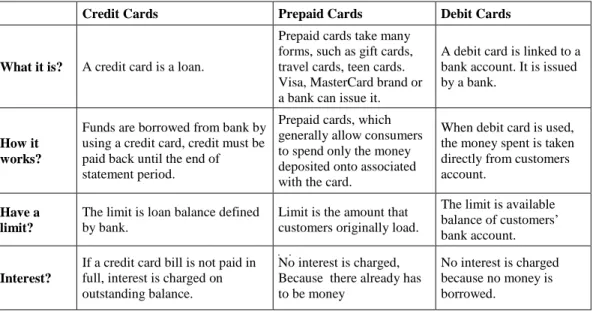
Following Table 1-1 shows similarities and differences of credit cards, prepaid cards and debit cards based on their feature.
Table 1-1 Credit, Prepaid and Debit Cards Comparison Chart
Credit Cards Prepaid Cards Debit Cards
What it is? A credit card is a loan.
Prepaid cards take many forms, such as gift cards, travel cards, teen cards. Visa, MasterCard brand or a bank can issue it.
A debit card is linked to a bank account. It is issued by a bank.
How it works?
Funds are borrowed from bank by using a credit card, credit must be paid back until the end of statement period.
Prepaid cards, which generally allow consumers to spend only the money deposited onto associated with the card.
When debit card is used, the money spent is taken directly from customers account.
Have a limit?
The limit is loan balance defined by bank.
Limit is the amount that customers originally load.
The limit is available balance of customers’ bank account.
Interest?
If a credit card bill is not paid in full, interest is charged on outstanding balance.
No interest is charged, Because there already has to be money
No interest is charged because no money is borrowed.
1.2.3.1.2.1.5 E-Cash
E-cash was developed to allow secure electronic cash to be used on the Internet. It also mediates online trading between buyers and sellers. E-cash is a payment protocol for digital money on the Internet. It is developed by named DigiCash Company in Amsterdam (Srivastava and Mansell, 1998).
E-cash payment can be by means of software or token based. Transactions through internet are normally encrypted.
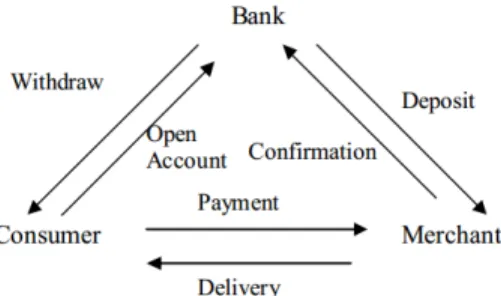
• As, shown in Figure1-4, when Customer wants to purchase goods or services, customers will transfer the E-cash from his/her bank account to his/her online system. Then, e-cash can be sent to the merchant in exchange with the merchants products or services.
• Whenever Merchant receives e-cash payment from customer, merchant will receive confirmation info from the bank. Then, the bank will authenticate the cash transaction.
In that time, customer account will be debited by bank. Later, the merchant will send the products. Amount will be deposited to merchant bank account (Razali, 2002).
2. PAYMENT SYSTEMS IN TURKEY
2.1 Introduction
Central Bank of the Republic of Turkey (CBRT) is responsible for payment systems in Turkey. According to the Central Bank Law, tasks of central banks are “to regulate the volume and circulation of the Turkish lira, to establish payment, securities transfer and settlement systems, to enact regulations to ensure the uninterrupted operation and oversight of the existing or future systems, and to determine the methods and instruments, including the electronic environment for payments.” (BIS, 2007).
2.2 General Overview
In Turkey, the payment systems are: • TCS: the Takasbank Clearing System;
• ICH (BTOM - Bankalararası Takas Odaları Merkezi): is the system of the Interbank Clearing Houses Centre;
• ICC (BKM - Bankalararası Kart Merkezi): is the Interbank Card Centre system; • TIC-RTGS (Turkish Interbank Clearing and real-time gross settlement system): is a
real-time gross settlement system that transfers and settles payments in Turkish Liras (BIS, 2007).
2.3 Large-value Payment Systems
2.3.1 The real-time gross settlement system: TIC-RTGS
“TIC-RTGS is Turkey’s real-time gross settlement system. The system is owned, operated, regulated and overseen by the Central Bank. TIC-RTGS was developed between October 1989 and March 1992 with live operations starting in April 1992. Driven by the changing demands of the banking sector and developments both in the payment systems area and in technology, a project was started in 1997 to develop the second-generation
system, which started live operations in April 2000.” CBRT is Central Bank of the Republic of Turkey (CPSS, 2012).
2.3.2 The Takasbank Clearing System (TCS)
The Takasbank Clearing System (TCS) handles large-value payments. It makes operations for clearance and settlements on the Istanbul Stock Exchange (ISE). TCS includes both cash and securities settlement (BIS, 2007).
2.4 Retail Payment
2.4.1 Retail payment systems
2.4.1.1 Interbank Card Centre (BKM)
The Interbank Card Centre (BKM) was set by 13 major public and private Turkish banks in 1990. The BKM system started operations in 1993. The BKM’s services include online credit card authorization, standalone credit card authorization and ATM and POS services for debit cards. It also offers solutions for card payment issues. In addition, it makes enhancements for rules and standards (BIS, 2007).
BKM’s main fields of activity are;
• to provide the authorization operation between the banks,
• to develop the procedures for the banks in the credit card and debit card sector, • to establish the rules and regulations,
• to make efforts to standardize provision process, • to get in touch with the international organizations,
• to inform and alert the members in these organizations for ongoing bank operations and regulations,
• to provide a transaction in a more secure, simple and fast. (BKM History Page, 2014)
2.4.1.2 Interbank Clearing Houses Centre (BTOM)
According to payment systems in Turkey prepared by the Central Bank of the Republic of Turkey and the Committee on Payment and Settlement Systems of the central banks of the Group of Ten countries ; “The Cheque Law defines the Interbank Clearing Houses Centre (BTOM) as a legal entity and empowers the Central Bank of the Republic of Turkey (CBRT) to supervise and control the cheque clearing process nationwide. The Cheque Law and the CBRT’s by-law on the BTOM govern the establishment and functioning of the interbank clearinghouses (ICHs), which operate as branches of the BTOM. The CBRT issues directives and regulates the functioning of all clearing houses.” (BIS, 2007).
2.4.2 Retail payment instruments
2.4.2.1 Cash
Although people tend to use alternative payment methods in recent years, cash is the dominant retail payment medium in Turkey. People mostly use cash for their everyday payment requirements. However, the use of cash to pay wages, salaries is declining. Most corporate companies pay their personal salaries through the banks. Pensions are paid through state banks including Ziraat, Halkbank and Vakıfbank.
The Central Bank has authority for banknotes with the status of legal tender. Six zeros were removed from the Turkish Lira (TRY) on 1 January 2005. Currency was renamed as the new Turkish lira . The subunit, which is one 100th of a new Turkish lira is called the new kurus. Banknotes has denominations of TRY 5, 10, 20, 50, 100 and 200 (BIS, 2007).
Cash withdrawals are made mainly from bank branches or cash dispensers. Banks encourage the use of ATMs for cash withdrawals and their usage. Table 2-1 shows increase in ATM Number year by year in Turkey.
Table 2-1 Atm number year by year (BKM POS ATM Card Number Page, 2014)
PERIOD ATM NUMBER
2009 December 23.800,00 2010 December 27.649,00 2011 December 32.462,00 2012 December 36.334,00 2013 December 42.011,00 2014 February 42.368,00 2.4.2.2 Payment Cards 2.4.2.2.1 Credit Cards
In 1968, Turkish people were first introduced to DinersClubCards. Diners Club cards were charge cards that required paying the whole balance on last payment date. It was given to only rich people as a prestige, so that the numbers of Diners Club were few. In addition, it could only be used in Turkey. There was a mechanical device called Imprinter. The number of shops that had the Imprinter devices was very few. Provision was taken by telephone. Credit cards that belong to Visa, Master Card branded banks started to enter into the market after 1980. Visa opened an office in Turkey in 1984. It increased the development of Turkish credit card market. In 1990, Interbank Card Center (BKM) was established (Aysan and Yıldız, 2005).
In 1993, first electronic POS terminal was used in that year. Euro Pay/MasterCard opened its first office in Turkey. POS number in Turkey is given in Table 2-2.
Table 2-2 POS number year by year (BKM POS ATM Card Number Page, 2014)
PERIOD POS NUMBER
2009 December 1.738.728,00 2010 December 1.823.530,00 2011 December 1.976.843,00 2012 December 2.134.444,00 2013 December 2.293.695,00 2014 February 2.283.888,00
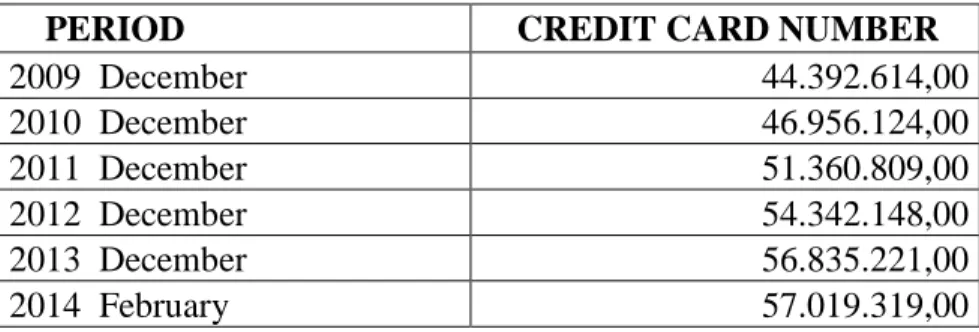
Increase in POS number has also triggered increase in credit card number in Turkey. As Table 2-3 is shown, there is a great increase in credit card number in Turkey according to BKM reports .According to reports that are published by BKM, total credit card number is 57.019.319 on February 2014.
Table 2-3 Credit card number year by year (BKM POS ATM Card Number Page, 2014)
PERIOD CREDIT CARD NUMBER
2009 December 44.392.614,00 2010 December 46.956.124,00 2011 December 51.360.809,00 2012 December 54.342.148,00 2013 December 56.835.221,00 2014 February 57.019.319,00 2.4.2.2.2 Debit Cards
Debit cards are used to withdraw cash by debiting the holder’s account at ATMs if there is sufficient balance. Since 1994, they are also used for retail purchases direct from the cardholders account through POS terminals. Card holders could purchase goods or services such as clothing luxury goods, food, electronics, drugs and sanitary products, furniture and car rentals via POS terminals that accept debit cards.
BKM published an advertising campaign on October 2004 to increase the use of debit cards and to convince cardholder to use debit cards instead of using cash when they do shopping. After the completion of the BKM-managed ATM Sharing Project in 2009, debit card of cardholder issued by any bank could withdraw money from any ATM terminals of other bank in return for being charge commission. Cardholders have also a chance to use any debit card at any ATM points for balance inquiry.
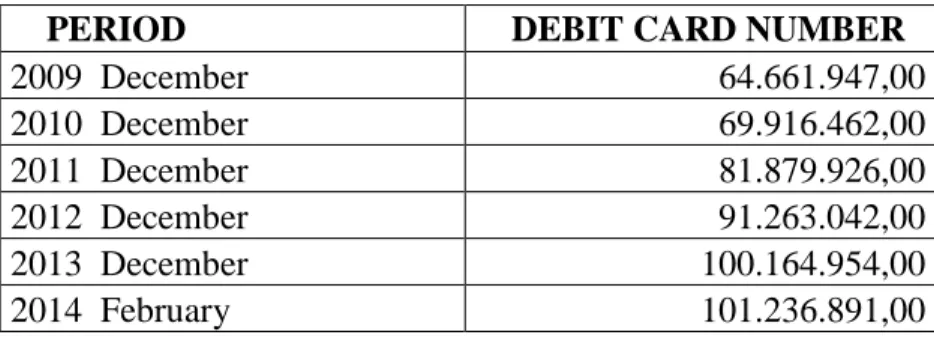
The latest development in debit card services allows consumers to withdraw cash at any selected retail stores via POS terminals. These developments have increased the usage of debit cards. On the February 2014, the total number of debit cards was 101.236.891 million.
Table 2-4 shows that there are about 1.26 debit cards per person if we consider Turkish population is about 80 million.
Table 2-4 Debit card number year by year (BKM POS ATM Card Number Page, 2014)
PERIOD DEBIT CARD NUMBER
2009 December 64.661.947,00 2010 December 69.916.462,00 2011 December 81.879.926,00 2012 December 91.263.042,00 2013 December 100.164.954,00 2014 February 101.236.891,00 2.4.2.2.3 Prepaid Cards
There is no credit check and no bank account required by using prepaid cards. People just load one with funds, and then people can use it for all the things such as shopping, bill payments, or everyday purchases.
The most frequently used prepaid cards areas are; • Some banks issue prepaid card in Turkey;
o Akbank (Akbank Cep-T Page, 2014 ) o Is bank (Is bank MaxiPara Page, 2014)
o Bank Asya (Bank Asya DIT Pratik Master Card Page, 2014)
o Turkish Bank (Turkish Bank Rodpa Club Express Card Page, 2014)
• Disposable phone cards issued by Turkish Telekom for making calls from public telephones.
• Mobile operators issue reloadable cellular phone cards. • Reloadable payment cards used at ticket gates of toll roads.
3. TECHONOLOGY TRENDS IN PAYMENT SYSTEMS
There is a vision of the future where no one needs pockets to hold cards, cash, password and username. In today’s world, everybody has number of cards in his pocket for selling things, traveling and many facilities for his need. So that, people have to pick many cards. The bankcard industry globally is utilizing new technologies to avoid these kinds of problems instead of holding credit, debit, and prepaid cards in the pocket.
3.1 Smart Card
Smart cards are devices that securely store and process data. They are portable and durable. They are also as tiny computers having their own memories and processors. Therefore, the integrated circuit on a bank credit card is a smart card. “Subscriber identity modules (SIM) used inside our cellular phones are smart cards that store subscriber information to use the phones properly. A smart card includes a microprocessor, read-only memory (ROM), random access memory (RAM) and electrical erasable programmable ROM (EEPROM). Operating system of the card is stored in ROM. Similar to the main memories of our desktop PCs, applications run on RAM. Finally, EEPROM stores applications and data while the card is unpowered” (Saritas and Kardas, 2014).
Based on the usage type, smart cards are classified into two groups;
• Contact cards are physically put in a card reader. Card reader is also connected to a main computer.
• Contactless cards are not required put in a card reader. Instead, it communicates with the reader through Radio Frequency (RF) induction technology just by waving contactless cards (A Smart Card Alliance Transportation Council White Paper, 2011).
3.1.1 Features of Smart Card
• They are very portable and durable. So that they are used for many applications, such as identification, authorization, and payment.
• They include memory and a small microprocessor. They run preprogrammed tasks. • It allows the data on the card to be either encrypted or decrypted. The data on the card
encrypts through the triple data encryption standard (3DES).
• The microprocessor of the smart card has own encryption keys and encryption algorithms.
• The amount of memory on the cards changes based on the application. The amount of memory between 2 and 4 kb need to store financial data, personal data, and transaction history (Pelletier et al., 2012).
3.1.2 Smart card applications in the world
The main applications that smart cards are used;
• The telecommunications industry; They are used with prepaid phone cards or they are used with SIM cards inserted in mobile phones.
• The banking industry; They are used with credit and debit cards. For example; Euro pay, MasterCard and Visa cards include smart cards.
• The identification industry; They are used with electronic passports, national ID cards.
• The transportation industry; Contact-less cards are used for public transport. • Loyalty applications; They are used for the accumulation of free miles for each
3.1.3 Smart card applications in Turkey
SoftTech associated with “Türkiye İş Bank” are targeting to take a key role in smart card market in both Europe and Turkey. So that it offers a variety of services by means of product called “Kart Ekspres”. It also has a capability of consultation services to other companies due to experience. Kart Ekspres has developed with multi-layer service oriented architecture and integrated with third party software, Kiosk, ATM, and POS. Well-designed user Interfaces manage communication between layers and components that new features can easily be added to Kart Ekspres. So that it can integrate with other existing, application is easier and by low cost. In other means, Companies can deploy Kart Express applications without giving up other existing systems. Users need to carry smart cards in their pocket to use smart card applications. Users are forced to carry separate card for each application. MIFARE smart card technology, which supports many applications on it, offers important solutions to that problem. SoftTech, takes a step forward MIFARE smart card technology, and includes smart cards that are used with smart card applications with other cards in our lives. For example, smart cards being used at workplace entrance, at the same time, can be used debit card at point of sale or KGS card on high ways. Furthermore, smart card with multi task can be used as student ID card. E-Cash that is charge on Smart cards allows doing shopping securely; (especially e-wallet applications). Kart Express offers quick, secure and easy credit charge on smart cards through Credit Charge Applications. That application enables to match bank accounts with smart cards and transfers Money between bank accounts and smart cards conversely. Demand features are added through card format application. For example, the same card can be used as both e-wallet and storage of personnel information due to card format application (Softtech Smart Card Application Page, 2014).
“The Smart Card Technology, which has been under development since the early 2000s in METU, was put into effect as a project at the start of the 2002 - 2003 academic year when all students and staff were provided with Smart Card identification cards. Within the scope of the project, as planned, the Smart Card was put into use first as the e-wallet for the cafeteria, then as an e-ID application at seven department buildings, two PC rooms,
and two campus gate entry barriers in 2005. With the second stage of the Smart Card application, started at the end of 2006, the e-wallet application of the smart card has been extensively widespread within the campus. Later stages of the project is being devised and shaped according the needs and the requirements of the METU members” (METU Smart Card Application Page, 2014).
Students of Mustafa Kemal University can do variety of transactions through in campus BANK24 JET card (smart card) issued by Halk Bank.
o They can withdraw money, deposit money, inquiry balance and view transactions by means of e-cash feature of BANK24 JET at point of sales that Visa is accepted. Students can make use of all banking services.
o BANK24 JET card can be used as KGS entrance card on the highways.
o It can be used as student identification card, doing shopping at campus restaurant, and identification control before exams. Students can demand student documents like transcripts through BANK24 JET card at student affair office (Mustafa Kemal University Smart Card application Page, 2014).
3.2 E-Wallet
The electronic wallet (E-wallet) is like a today’s wallet. It holds information of the several cards, e-checks, e-cash, username, passwords and PINs in a mobile phone instead of carrying wallet. In addition, the e-wallet enables security features that is not available to traditional wallet. Identification and authorization are needed for every credit card transaction. People protect their e-wallet file with a password. People enter the wallet’s password before they can access the information on any of the cards, e-checks, e-cash, username, passwords and PINs in that wallet. If an e-wallet does not require a password, anyone can access e-wallet that contains important personal information (Upadhayaya, 2012).
Simplicity of transactions is so important during shopping process. In this way, customers and merchants do shopping process by exchanging electronic money. As a result, it facilitates to do shopping from mobile phone. It also enables price comparison-shopping (Taghiloo et al., 2010).
3.2.1 E-Wallet security
E-wallet protects personal information as follows;
• A password is need to be entering before accessing any cards information in e- wallet. • It encrypts the information of cards, e-checks, e-cash, username, passwords in e-
wallet (Upadhayaya, 2012).
3.2.2 Benefits of e-wallet
• It manages account from our mobile phone.
• It is secure because of being encrypted the information.
• It helps to transfer money from E-wallet to E-wallet without sharing personal account information.
• It facilitates payment and transfer process by instead of carrying heavy or banknotes and coins.
• It is easy to use globally because there is no link with the bank account during the payment process.
• It helps to send and receive payments anywhere in the world.
• It saves time and makes it simpler, faster. For example, the user has to queue to buy a ticket, pay, go through a ticket control system. Then they hold on to the ticket for inspection. All these steps are done in one single action with the e-wallet (Sahut, 2008).
3.2.3 E-wallet applications in the world
3.2.3.1 Microsoft E-wallet
One of the most popular example of an E-wallet on the world market is Microsoft Wallet. Microsoft Passport is needed to be installed to obtain Microsoft Wallet. After setting up a Passport, a Microsoft E-wallet can be used for payment transactions. They also eliminate reentering personal information on the forms, resulting in higher speed and efficiency for online shoppers. Microsoft Passport consists of several services including, a single sign-in, and wallet and kids passport services. A single sign-in service allows the customer to use a single name and password at a growing number of participating e-commerce sites. The shopper make fast, easy and secure online purchases with a wallet service. Kid’s passport service helps to protect and control children's online privacy (Microsoft E-Wallet Page, 2014).
3.2.3.2 Google Wallet
“A first meaningful and promising concept available for the public has been developed by Google, called Google Wallet. It was officially presented for the first time in May 2011 and launched in September 2011. Google Wallet is primarily built upon an application for Google’s own operating system Android and is available at the Android market free of charge. Currently however, only a single NFC phone is supported, that is Google’s Nexus S 4G smartphone. In addition, the number of supported credit cards and the number of available payment locations is still limited at present. Google Wallet currently offers two types of payment instruments: owners of a Citi MasterCard credit card can directly link their banking account to Google Wallet. As of 2005, MasterCard has already begun to roll out a proprietary NFC based payment system called Pay Pass. This system originally was designed for credit cards with small built “ (Burkard.Simon, 2012).
3.2.4 E-wallet applications in Turkey
3.2.4.1 Vodafone Cep Cüzdan
Vodafone offers “Vodafone Cep Cüzdan “service. Not only, users can doing shopping by Vodafone Cep Cüzdan, but also they can do financial transactions by downloading application on smart phone from iPhone/Android markets.
Vodafone Cep Cüzdan has following functions ;
• Money Transfer: Users can transfer money to all GSM operators and can receive money from all Vodafone users.
• Charging Lira: Users can charge Lira to All Vodafone prepaid lines.
• My Cards: Users can save in “Vodafone Cep Cüzdan” by taking the photo of physical credit card or debit card. Therefore, that people can do shopping by means of mobile phone.
• Save and Send: Users can transfer balance or receive balance due to cards.
• Transaction History: Users can view all card transactions that are done with debit or credit card (Vodafone Cep Cuzdan Page, 2014).
3.2.4.2 Turkcell Cüzdan
It allows you to charge TL coin, to purchase package, and transfer Money by “Turkcell Cüzdan”. Users can buy products from e-commerce site, do contactless payment and do shopping on the net securely.
Turkcell Cüzdan offers functions below to users;
• Doing shopping on the net securely. Users do not need card information during payment process through Turkcell Cüzdan.
o There is “Pay Turkcell Cüzdan” among payment options. o After GSM Number is entered, then credit card is selected.
o After being approved information that sent on the phone, shopping is completed by being entered password of selected card.
• Users can charge TL coin to any Turkcell number. • Users can transfer money to anyone.
o It is enough to know phone number whom people you will transfer money. • Users can learn personalized discount coupons and bonus cards easily.
• Contactless payment can be done through NFC Technology .to make use of NFC technology.
o User should have either mobile Phone with NFC featured or SimCard with Turkcell SIMPlus 256 K. (SimCard based SimCard )
o SimCard can store credit card information, public transportation card and entrance card of work securely.
• Users can pay their bills through “Turkcell Cuzdan” without going to bill payment shop. Users need to enter credit card /debit card with MasterCard logo of Garanti Bank or GarantiParam to pay their bill by means of credit card (Turkcell Cuzdan Page, 2014).
Some banks such as Akbank, Garanti are cooperating with Turkcell. Therefore, Turkcell Cuzdan users can do shopping by using banks cards (Akbank Turkcell Cuzdan Page, 2014; Garanti Mobil Cuzdan Page, 2014).
3.3 NFC (Near Field Communication)
NFC technology is a wireless communication technology and integrated with mobile phones. It is enough to exchange data a few centimeters apart. NFC payment products are available in the U.S. since 2011. Now they are available in other countries market. An NFC-enabled mobile phone includes a chip. It enables the phone to store a payment application and the account information of customers securely an NFC enabled phone contacts with the account information of customers to the POS terminal via radio frequency, using the ISO/IEC 14443 (International Organization for Standardization/International Electro technical Commission) standard protocol. NFC
enable mobile contactless credit and debit payments can be done at POS readers (A Smart Card Alliance Transportation Council White Paper, 2011).
Mobile Phone can be used as contactless card by means of NFC. It has a shorter range than Bluetooth and Wi-Fi. NFC compatible mobile phone also provides Radio-Frequency Identification (RFID) tags or readers. It provides great opportunities for trend technologies. For example, when an RFID tag is inserted in a poster. The customer with mobile phone can receive information by just zooming on poster (Ondrus and Pigneur, 2007).
3.3.1 Benefits of NFC Payment
• Contactless readers require less maintenance. So that, it provides cost savings to merchants.
• Payment credentials such as personal information, passwords, username are stored securely in the NFC-enabled mobile device.
• It is more secure than current magnetic stripe technology and reduces fraud.
• It reduces the frequency that cards are passed to the clerk to perform a transaction, simplifying the transaction.
• It increases consumer convenience by providing e-wallet in mobile phone instead of need for carrying cash and coins.
• It enables customers to use a single device to support multiple payment options. • It helps to increase electronic payment penetration into traditional cash markets
(A Smart Card Alliance Transportation Council White Paper, 2011).
3.3.2 NFC applications in the world
As, NFC offers cheap, fast acceptance and marketability, it is used in various applications. Some of applications that NFC are used;
Mobile Payment: NFC payment provides fast, secure and simple payment at the Point of
Sale (POS). For example, a customer pays either by cash or with a debit card today at the supermarket checkout. When people pay by cash, the customer needs to carry cash money with him. Then, the proper amount of invoiced money is required to be counted and to be exchanged at the POS. This results in time-consuming activity. When the customer pays with debit card, it is more efficient, however it is a time consuming activity too. Because the appropriate card needs to be picked out of the wallet, it needs to be contacted in the terminal with the correct style. On the other hand, a single action is enough for NFC payment. The payment process is done by just waving the NFC-capable phone over the reader device.
Medical Applications: It is used for health monitoring and recording of health status of
patients by using NFC.
P2P Data Transfer: It can be used for easy money transfer between persons. In addition,
it transmits or receives other forms of data.
Movie, Concert and Hotel Ticketing: It is used for ticketing in public transport systems.
It can be applied ticket reservation, ticket selling and admission control (Burkard Simon, 2012).
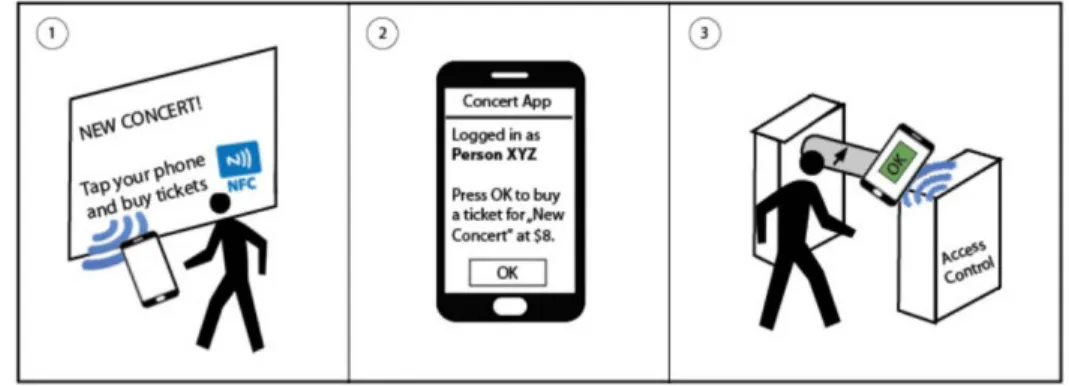
As, Figure 3-1 is shown, a typical NFC application scenario includes following steps. A customer zooms in the upcoming concert poster with his NFC enabled phone (1). A screen is open on his phone displaying details of the concert. As the customer registers with an account and is log in, he can immediately buy a ticket (2). The ticket Information is securely stored on his phone. Finally, the access control gates that provides NFC reader enable the customer to enter concert (3).
Product Information System: Clothes are equipped with a NFC tag. It allows shop
assistants to check availability of products. It also offers the required information about the products immediately to the customer (Burkard Simon, 2012).
3.3.3 NFC applications in Turkey
3.3.3.1 Mobile Payment
BKM has been running on NFC since 2008. It enables the usage of NFC based products to Turkey market. As a result, Turkey market offers NFC based markets. It allows developing the technology needed to NFC solutions.
Turkcell launched its Cep-T Cüzdan NFC mobile wallet service in May 2011. Rival mobile network operator Avea also has a NFC service, launched in December 2010 in conjunction with Garanti Bank, and is working to expand the service.
Some banks, Halkbank, Vakifbank and Garanti allowes NFC credit and debit card payments using BKM technology (Garanti Payment System Page, 2014; HalkBank Investment Page, 2014; Is bank MaxiMobil Page, 2014; BKM NFC Forum Page, 2014).
3.3.3.2 Transportation Projects (Konya Transportation Project)
In Konya, local and foreign credit cards, bankcards and prepaid cards are used for payment in buses and streetcars. It allows paying through NFC compatible mobile phones, contactless cards with smart card feature.
Konya Metropolitan Municipality made coloration with Interbank Card Center to carry out the Transportation Project. Residents of Konya and 2 million domestic tourists and 500,000 foreign tourists can make use of this opportunity by doing payment with NFC compatible mobile phones, contactless cards with smart card feature.
Nine banks in Turkey made collaboration with BKM to be used their card for public transportation in Konya. It is also the same tariff named “Elkart” used as Konya’s local transportation card (BKM Transportation Projects Page, 2014).
3.4 Biometric Payment System
We need to carry many kinds of cards such as, the credit or debit cards for shopping, bus card for traveling, and student card for library and university campus entrance in our lives. Therefore, a person has to take many cards and has to memorize their username, passwords or PIN. The biometric payment system solves this problem. Biometric payment system is simple, reliable, secure and easy to use without remembering any password or PIN (Kumar and Ryu, 2009).
Today, many businesses are using different kind of biometrics, such as fingerprint readers, iris scans and face recognition. Biometrics are also used for user identification and authorization by using several algorithms. So that, biometrics payment system has a great acceptance (Clodfelter, 2010).
3.4.1 Fingerprint scanning
Fingerprint identification collects fingerprint template using a sensing device for authentication. The captured image has data points. It also saved as a biometric algorithm. Algorithm software includes 40 or more data points and store for future authentication. Fingerprint authentication is used for identity verification in Malaysia and Singapore. Citibank set a fingerprint authentication payment service on Wednesday 9th November 2006. It allows making payments for credit card customers by touching of the finger (Kumar and Ryu, 2009).
3.4.2 Other biometric types and applications in the world
3.4.2.1 Face recognition
Face recognition technology analyzes facial features such as eyes, nose, and mouth. Face recognition is used for some passport control systems around the world (Clodfelter, 2010).
3.4.2.2 Hand geometry and palm print scanning
Hand geometry analyzes the size of the whole hand, its palm, and fingers. Hand geometry are used for employee access control, and they are used for bank branches for safe deposit box access (Clodfelter, 2010).
“Italian bank UniCredit has begun market tests of a new biometric payment system that uses palm scanning technology from Fujitsu, reports Finextra.” (Tracey, 2013).
3.4.2.3 Iris scanning
Iris scanning measures the iris features. The iris features can require users to look into a camera to complete the analysis. A digital camera takes an image of the eye. The irises do not change after a person birth. Once the image is stored on a hard drive. It can uses for identification. It is used for identification at airports in several European and Middle Eastern countries (Clodfelter, 2010).
3.4.2.4 Voice recognition
Voice recognition measures the distinct pronunciation of an individual’s voice. This technique is used for telephone services (Clodfelter, 2010).
“Online consumer bank ING Direct Canada is working with IBM to simplify account access across mobile devices and social media channels, using voice recognition. The ING Direct biometric implementation supports its Orange Snapshot initiative that gives mobile consumers a simplified view of all their accounts, as well as bill payment and money transfers. The bank has begun experimenting with voice recognition capabilities on its mobile apps that will allow clients to conduct simple banking transactions by speaking rather than typing. It is also exploring the use of biometrics within mobile apps for purposes such as client login” (Tracey, 2013).
3.4.3 Biometric applications in Turkey
Today, some banks and GSM operators use biometric applications to offer a quick, secure and fast payment to their users.
2011 to further develop biometric finger vein scanner technology to the point where it could be added easily to existing sites. After starting a deployment programme in late 2011, Isbank announced in February 2012 it had successfully deployed around 3,400 Hitachi finger vein scanners in ATMs and branches across Turkey, allowing customers to withdraw cash without a card. Isbank works with MIG International to install the authentication scanners in around 2,400 NCR and Wincor Nixdorf ATMs, allowing customers to withdraw cash without cards and human intervention” (Gold, June 2012).
Some banks such as Garanti, Yapı Kredi launched voice signature system. Therefore, that call center recognizes a calling customer by analyzing customer’s biometric voice. Due to this, speech recognition provides much safer and faster processing by eliminating steps for customer’s identity validation process, such as, place of birth, date of birth, tariff information. Furthermore, speech recognition predicts why customer call bank by using some algorithms. It directs customer to related subjects among complex menus (Garanti News Page, 2014; Yapı Kredi Call Center Page, 2014).
VeriFone has developed first biometric point of sale of Turkey for Is Bank. According to project, cardholder of Is Bank can do a quick, secure and fast payment by scanning their finger on POS that Is bank and VeriFone developed (Is Bank Activity Report Page, 2014).
o People who want to do shopping at biometric People need to go to Is Bank branch to match finger vain map with customer account information.
o Is bank is planning to launch the largest biometric point-of-sale network in the world (Tracey, 2013).
4. KUVEYT TURK PAYMENT SYSTEMS
4.1 Generel Overview
“Kuveyt Turk was established in 1989 in the status of Private Financial Institution for the purpose of operating in accordance with the principles set by the Cabinet Decree No. 831/7506 of 16.12.1983. Operations of Private Financial Institutions were conducted by Cabinet Decrees on the one hand and communiqués of the Central Bank and the Undersecretaries of Treasury on the other hand until such operations were included within the scope of the Banking Law in 1999. In December 1999, Kuveyt Turk became subject to the Banking Law No. 4389, just like other Private Financial Institutions. The title was changed to be Kuveyt Turk Participation Bank Inc. in May 2006” (Kuveyt Turk History Page, 2014).
Kuveyt Turk Quality Policy aims; • to increase service quality,
• to provide continuous education, knowledge and experience of working employees in Kuveyt Turk,
• to develop new products and services through alternative service channels. (Kuveyt Turk Vision Mission Page, 2014)
4.2 Kuveyt Turk Payment System Management
Kuveyt Turk Payment System helps customer to solve customer problems when customer face with any problem about its cards. Furthermore, it operates clearance and accounting reconciliation of credit cards, provides reports and being managed of POS services. • Manager of payment system creates and manages comprehensive
• Manager of payment system assesses personnel performance in payment systems and defines education need of personnel’s who are working with him.
Kuveyt Turk Payment System Management includes four units; • Credit Card Operations
• Credit Cards Data Entry and Inquiry • Security and Fraud
• Alternative Delivery Channel (ADC) Operations
4.2.1 Credit Cards Data Entry and Inquiry
When a customer applies for a credit card at any Kuveyt Turk branch, she/he fills form. Then, the form is sent to Credit Cards Data Entry and Inquiry unit by means of electronic system in payment systems to verify customer information, so that phone number that the customer types on the application form is called. Customer’s workplace is also called to get information about customer. Official documents of customers like passport, identity card and sign samples are observed whether they are fake or not. After being a verified customer, customer data is sent to credit card operations units to being prepared card-printing data.
4.2.2 Credit Card Operations
Card printing data is prepared by credit card operations personnel, and sent to card printing company through FTP channel. Then, Kuveyt Turk operation personnel receives card data through FTP after being executed card data by company and transfer data on kredikart.exe on BankSoft system. On the other hand, printed card on plastic are sent to customer through courier.
Tasks of credit card operation unit are listed below;
• Card printing data is daily viewed by operation personnel from kredikart.exe, • Address of current card customers are refreshed,
• Due cards and cards will be renewed are identified and observed through reports, • Cards will not be renewed are cancelled,
• New credit and debit cards information is sent to Interbank Card Centre (BKM) through FTP,
• Credit and debit cards problems that are received by branch, call center channels are solved.
4.2.3 Security and Fraud
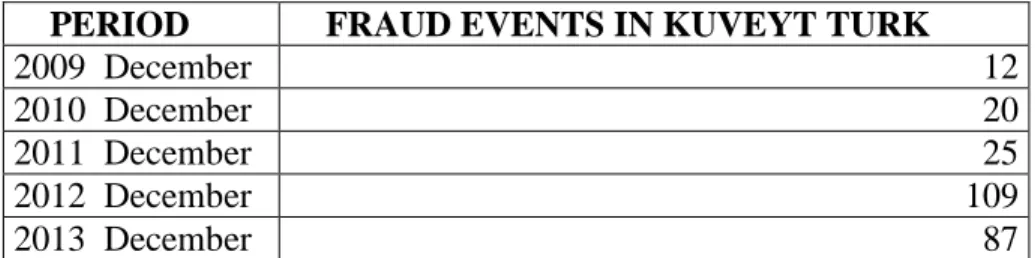
There is a system called “SABAS” that are provided by Credit Record Office (KKB -Kredi Kayıt Bürosu). Security and Fraud Unit personnel are responsible for SABAS system to prevent fraud applications of cards. Therefore, fraud personnel match applications that is received by branch with applications on SABAS. If it matches, personnel can take necessary action, and control SABAS warning messages. Furthermore, as shown in Table 4-1, Kuveyt Turk faces fraud events from time to time.
Tasks of security and fraud unit are also listed below;
• Some suspicious applications are sent to Fraud Unit and they are observed by fraud personnel. So that, fraud personnel have an option whether to approve or reject card. • Debit/credit card transactions are monitored online through Fraud programs. Instant
caution are taken for some transactions with risk. Sometimes customers are called by phone to confirm transactions.
• Some actions are taken against croakers by collaborating with other banks continuously.
Table 4-1 Fraud events in Kuveyt Turk
PERIOD FRAUD EVENTS IN KUVEYT TURK
2009 December 12
2010 December 20
2011 December 25
2012 December 109
2013 December 87
4.2.4 Alternative Delivery Channel (ADC) Operations
4.2.4.1 ATM Operations
ATM Operations unit operates new ATM machine installation. Then, 7/24 ATM services are maintained uninterreptly after being installed. ATM machines are monitored for 24 hours a day. If breakdown is occurred at ATM machine, technical help work are carried out to recover breakdown of ATM machine. Safe reconciliation of ATM is done and controlled daily by ATM operation personnel. Daily monthly debit card usage is also monitored and reported.
4.2.4.2 POS Operations
POS applications that are done by merchants are assessed by operation personnel. If documents provided by merchants are enough, POS operations unit operates new POS machine installation. Furthermore, breakdown and change of POS machines are monitored. Accounting of transactions done through POS machines are followed by POs operations personnel. In addition, POS operations unit identifies merchants who uses its POS in efficiently and works on effıcient POS usage. POS operations unit also prepares reports for VISA, MC and BKM.
4.3 Payment instruments
Used payment instruments in Kuveyt Turk are cash, credit card and debit cards. Kuveyt Turk does not have prepaid cards. Furthermore, although cheque is used as payment instruments, it is operated under banking operations unit instead of payment system unit.
4.3.1 Cash
Cash withdrawals are made mainly from bank branches or ATM/XTM machines in Kuveyt Turk. Kuveyt Turk encourages the use of ATMs for cash withdrawals and their usage is increasing. As Table 4-3 is shown, ATM number in Kuveyt Turk increased in last three year.
Table 4-2 ATM number in Kuveyt Turk
PERIOD ATM NUMBER IN KUVEYT TURK
2009 December 125 2010 December 133 2011 December 149 2012 December 199 2013 December 256 2014 February 335 4.3.2 Payment Cards 4.3.2.1 Credit cards
POS number of Kuveyt Turk is quite low with regard to market. The most reason why merchants do’not want to have Kuveyt Turk POS is that, there are no enough Kuveyt Turk cards in the market. In other way, card numbers are directly proportionate to POS numbers. Decrease in POS numbers triggers decrease in card numbers. Table 4-4 shows total POS numbers of kuveyt turk year by year.
Table 4-3 POS number in Kuveyt Turk
PERIOD TOTAL POS NUMBER IN KUVEYT TURK
2009 December 19.413 2010 December 30.464 2011 December 38.064 2012 December 47.152 2013 December 63.433 2014 February 78.906
As POS number of Kuveyt Turk is not at desired level, card numbers hasn’t increased at desired level too. When, total card numbers of Kuveyt Turk (329.085) that is given in Table 4-5 with total card number of all banks (57.019.319, 00) in the market is compared, Kuveyt Turk fall behind in the market.
Table 4-4 Credit Card number in Kuveyt Turk
PERIOD TOTAL CARD NUMBER IN KUVEYT TURK
2008 December 56.716 2009 December 91.945 2010 December 125.047 2011 December 182.936 2012 December 237.753 2013 December 329.085
There are five types of credit card used for different purposes. These are;
• Business Card: It is given to firm owners. Customers can buy products at large amounts through their business cards.
• İhtiyaç Card: Newlywed couple, people who renovates the house can demand
“ihtiyac kart”. In addition, it focuses on customers who have credit need and can be used for education, health and travel. It requires to be used for 3 month.
• Klasik Card: It can be given to individual customers. It is used at point of sale where visa member.