Effect of Yucca schidigera extract on blood pressure, antioxidant
activity and some blood parameters in the L-name-induced
hypertensive rats
Nuray ÖZTAŞAN1, Aziz BÜLBÜL2,Abdullah ERYAVUZ2, Gülcan AVCI3, İsmail KÜÇÜKKURT3,
A. Fatih FİDAN3
1 Department of Physiology, Faculty of Medicine; 2 Department of Physiology, Faculty of Veterinary Medicine; 3 Department of Biochemistry, Faculty of Veterinary Medicine, Afyon Kocatepe University, Afyonkarahisar, Turkey.
Summary: The present study was aimed at investigating the effects of dietary supplementation of Yucca schidigera extract (YSE) on blood pressure, antioxidant activity and some biochemical parameters in the L-NAME-induced hypertensive rats. The study was performed on eighteen male Sprague-Dawley rats divided into 3 groups with 6 animals per group: 1) Control, fed standard chow ad libitum, 2) N-nitro-L-arginine methyl ester (L-NAME)-treated group, 75 mg/L drinking water, 3) YSE+L-NAME group, YSE (125 mg/kg diet)+L-NAME (75 mg/L drinking water), through study period lasted at 4 weeks. L-NAME-treated rats had significantly (P<0.05) higher the mean arterial blood pressure (MABP) as compared with the rats in the control and YSE+L-NAME groups. L-NAME+YSE-treated rats had lower heart rate (HR) as compared to the L-NAME-treated and control rats and, higher MABP as compared to the control rats. Plasma concentration of NO metabolites (NOx) decreased after treatment with NAME. L-NAME+YSE-treatment increased the plasma malondialdehyde (MDA) and NOx concentration but decreased the antioxidant activity (AA), glucose, total cholesterol and total protein levels as compared to the other groups. The L-NAME-treatment decreased the vitamin A, but increased the beta-carotene and methemoglobin concentrations as compared to the other groups. In conclusion, these results may suggest that YSE ameliorates the increase of MABP in the L-NAME-induced hypertension by enhanced generation of vascular NO.
Key words: Cholesterol, glucose, nitric oxide, vitamin A, yucca schidigera extract
L-NAME ile hipertansiyon oluşturulmuş sıçanlarda diyete Yucca schidigera ekstraktı (YSE) ilavesinin kan basıncı, antioksidan aktivite ve bazı biyokimyasal parametreler üzerine etkisi
Özet: Bu çalışmada, L-NAME ile hipertansiyon oluşturulmuş sıçanlarda diyete Yucca schidigera ekstraktı (YSE) ilavesinin kan basıncı, antioksidan aktivite (AA) ve bazı biyokimyasal parametreler üzerine etkileri araştırıldı. Araştırmada, 18 adet erkek Sprague-Dawley sıçan kullanıldı ve sıçanlar; 1) standart diyetle adlibutum beslenen kontrol grubu, 2) içme sularına günde 75 mg/L
N-nitro-L-arginine methyl ester (L-NAME) uygulanan grup ve 3) içme sularında L-NAME alan grubun diyetine 125 ppm YSE
uygulanan grup olmak üzere her biri 6 sıçandan oluşan üç gruba ayrıldı. Araştırma 4 hafta sonra sonlandırıldı. L-NAME uygulanan sıçanlarda ortalama arteriyel kan basıncı (OAKB) kontrol ve YSE+L-NAME gruplarına göre yüksek çıktı. Kalp atım sayısı ise YSE+L-NAME uygulanan sıçanlarda kontrol ve L-NAME grubuna göre düşük belirlendi. L-NAME uygulaması NO metabolitleri (NOx) ile vitamin A düzeyini azaltırken, β-karoten ve methemoglobin değerlerini artırdı. Sonuç olarak, L-NAME ile hipertansiyon oluşturulmuş sıçanların diyetine YSE ilavesinin NO oluşumunu artırarak ortalama arteriyel kan basıncını düzenleyebileceği düşünülmektedir.
Anahtar sözcükler: Glikoz, Kolesterol, Nitrik oksit, vitamin A, yucca schidigera ekstraktı.
Introduction
Nitric oxide (NO) released by endothelial cells is an important regulator of vascular function. The ability of NO to maintain vascular tone is deficient in hypertensive condition (16). Therefore, long-term blockade of NO synthesis causes systemic arterial hypertension (18). Saponins are widely distributed in many plant species and have complex chemical structures consisting of a variety of triterpenoidal or steroidal aglycons and various
carbohydrate moieties. Although saponins have always been considered as deleterious by scientists, lately, they are accepted as functional components in food because of their physiological properties (28). Experiments demonstrating the physiological, immunological and pharmacological properties of saponins have provoked considerable clinical interest in these substances (6,13).
Yucca schidigera (YS) originates from the lily family of
American southwest and the mountains of northern Chili, known and used for food and medicine by native people for centuries (6). YS has the highest saponin content of any Yucca species and, is the most common commercial source of steroidal saponins (26). Therefore, the condensed juice of this plant finds wide commercial application as food, cosmetic and pharmaceutical additive (6). YS extracts have been used for centuries in folk medicine to treat a wide variety of inflammatory disorders, especially headaches, gonorrea, arthritis and rheumatism (13,20) but in literature there are no data about its physiological characteristics such as antihypertensive and relating blood lipid peroxidation with hypertension in rats fed a diet containing YSE. Therefore, the aim of this study was to investigate whether NO-deficient hypertensive rats could be ameliorated by the administration of YSE. To evaluate the blood pressure change and oxidative stress by YSE in the L-NAME-induced hypertensive rats, we have also studied the effect of dietary supplementation of YSE on blood pressure, antioxidant activity and some biochemical parameters in the L-NAME-induced hypertensive rats.
Materials and Methods
Eighteen rats (Sprague-Dawley strain with a body weight of 220-250 g) fed with a standard laboratory chow and water were used. The study protocol was approved by the Ethical Committee of the Afyon Kocatepe University (B.30.2.AKÜ.0.8Z.00/092). Rats were randomly divided into 3 groups containing six animals per group and placed in separate cages during the study. The groups occured as 1) Control, fed standard chow ad libitum, 2) N-nitro-L-arginine methyl ester (L-NAME)-treated group, 75 mg/L drinking water (25), 3) L-NAME+YSE treatment group, L-NAME, 75 mg/L drinking water and 125 mg/kg supplementation of a commercial source of YSE (De-Odorase® Alltech Inc., USA) powder into diet of the rats (4).
At the end of this study lasted at 4 weeks, the mean arterial blood pressure (MABP) was measured by the tail-cuff method, via the tail cuff method using a model ML 125 rat tail NIBP system / Blood Pressure Amplifier/Pump from U.K. The heart rate (HR) was measured by MLS310 heart rate variability from Power Lab /4st. UK. The blood samples were taken from all rats after the animals were fasted overnight and sacrificed by anesthetizing with a combination of ketamine (80 mg/kg i.p.) and xylasine HCl (10mg/kg i.p.). The plasma was prepared by centrifugation (3000 x g, 10 min, +4 ◦C) to
measure the biochemical parameters.
The malondialdehyde (MDA) as a biomarker for oxidative stress was estimated according to Draper and Hardley (10). Plasma antioxidant activity (AA) was
measured according to Koracevic et al. (21). Nitric oxide was assayed by the colorimetric method of Griess (24) in the plasma. Methemoglobin level was measured spectrophotometrically according to Fairbanks and Klee (12). The plasma vitamin A and β-carotene concentrations were estimated by the method of Suziki and Katoh (32) using a spectrophotometer. Total protein, total cholesterol and triglycerides were measured using commercially available assay kits (TECO Diagnostics, California, USA). Statistical analyses of data from the experiment were analyzed with SPSS (13.0) statistical software. Comparisons between different groups were performed by one-way ANOVA; if ANOVA revealed significant differences, the post-hoc comparisons were performed by Duncan’s multiple range test. Differences between means of p<0.05 were considered significant. The results were expressed as mean ± SE.
Results
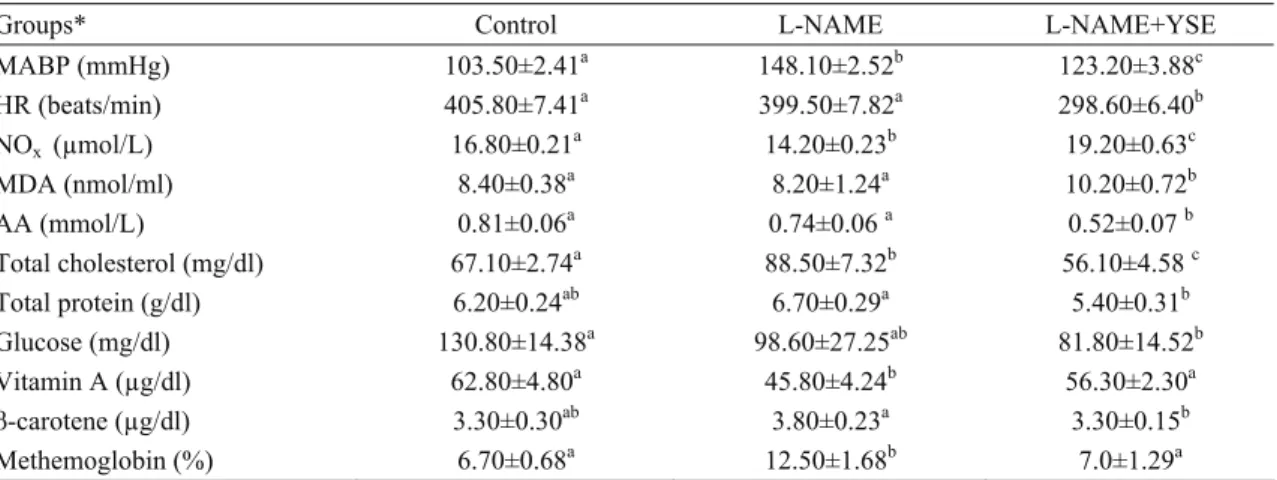
The effects of L-NAME and L-NAME + YSE treatments on the MABP and HR during the 4-week periods of blockade of NO synthesis with L-NAME are shown in Table 1. Oral administration of L-NAME increased the MABP but unchanged the HR (p<0.05) versus control. Oral administration of L-NAME + YSE dropped significantly (p<0.05) the MABP and HR as compared with the control and L-NAME treated groups. Plasma concentration of NO metabolites (NOx) was decreased (p<0.05) by the treatment of L-NAME compared to the control group. The supplementation with YSE for 4 weeks reversed the decreased release of NOx by L-NAME-treatment. However, plasma concentration of NOx in the L-NAME + YSE treated rats was also higher (p<0.05) than in the control rats (Table 1). L-NAME+YSE treatment increased (p<0.05) the plasma MDA, but decreased plasma AA, cholesterol and total protein levels significantly (p<0.05) as compared with the control and L-NAME-treated rats. The treatment of L-NAME increased plasma cholesterol concentration versus the control, but decreased plasma vitamin A concentration as compared with the control and L-NAME + YSE treated rats and they were both statistically significant (p<0.05). The methemoglobin level in blood of the L-NAME + YSE treated rats was lower (p<0.05) than that of rats in the L-NAME treated rats, but similar to that of rats in the control group (Table 1).
Discussion and Conclusion
Pharmacological long-term blockade of NO synthesis by the chronic administration of L-NAME, an inhibitor of nitric oxide synthase (NOS), produces systemic arterial hypertension, vascular structural change, and renal dysfunction (7,18). Because NO
induces vasodilatation and inhibits renal tubular sodium reabsorption, reduced bioavailability of NO leads to peripheral vasoconstriction and sodium retention (34). We also observed in the present study that chronic oral administration of L-NAME into rats increased the blood pressure in association with decreased plasma NOx levels.
The use of plants and plant parts for therapeutic purposes has a long history. Recently, many studies have been performed to find more suitable antihypertensives from natural sources. Among them, extracts of saponin-rich plants have the hypotensive effects due to diuresis (29,35), endothelium-dependent vasorelaxation or direct stimulation of NO release (2,16,17) and inhibition of angiotensin-converting enzyme (9). In this study, the administration of YSE into diet attenuated the increase of MABP in L-NAME+YSE-treated rats. The plasma NOx were also reversed by co-administration of YSE through the this experiment as in accordance with previous studies (16,17). In addition, the decrease of HR in L-NAME+YSE-treated rats observed in this study may be due to the inhibition effect of saponins on catecholamine secretion (22). The saponins from Heniaria glabra (29) or Korea red ginseng (16,17) have an antihypertensive effect on conscious spontaneously hypertensive rats or the L-NAME-induced hypertension via enhancement of NO in the vascular tissues. Accordingly, YSE may also have an antihypertensive effect via stimulation of NO system in the vascular tissues.
Detection of lipid hydroperoxides and conjugated dienes and tribarbituric acid-reactive substances (TBARS) such as MDA, often applies to the study of lipid peroxidation reactions (4,11,19). Thus, the presence of MDA is taken as an indicator of free- radical damage
through membrane lipid peroxidation (3). Hypertension may result in yielding reactive oxygen species (ROS). However, in this study, MDA and AA in the blood of L-NAME-treated rats were not different as compared to control rats. Cracowski et al. (8) found that lipid peroxidation and oxidative stress were not increased in untreated mild- to- moderate hypertension, and suggested that ROS may not be critical in the early stages of hypertension, but could be more important in severe hypertension. On the other hands, the increase of MDA and the decrease of AA in L-NAME+YSE-treated rats is contradictory to the reports of Piacente et al. (27) suggested that the significant activities exhibited by the phenolic fraction and its constituents showed the potential use of YS as a source of antioxidant principles. In the present study, an increased NO production in L-NAME+YSE-treated rats may be responsible for the elevated MDA and decreased AA indicating lipid peroxidation because of being a free radical with vasodilatory properties of NO (31).
The molecular studies are useful to understand biochemical pathways that have been altered during the development of hypertension. The L-NAME-treated rats had higher cholesterol levels in plasma than the other groups in this study. However, plasma cholesterol level in the L-NAME+YSE treated rats was lower than in the L-NAME-treated and control rats. This result is in consistent with report that saponins are known to be hypocholesterolemic because of forming an insoluble complex with cholesterol, which prevents its absorption from the small intestine (15). Similarly, the L-NAME+YSE treated rats had significantly lower plasma glucose and total protein concentrations than the rats of control and L-NAME treated groups, as in agreement
Table 1. Effect of the supplementation of YSE to diet on blood pressure, antioxidant activity and some blood parameters in hypertensive rats (n=6, ±SE).
Tablo 1. Hipertansif sıçanlarda diyete YSE ilavesinin kan basıncı, antioksidan aktivite ve bazı kan parametrelerine etkisi
Groups* Control L-NAME L-NAME+YSE
MABP (mmHg) 103.50±2.41a 148.10±2.52b 123.20±3.88c HR (beats/min) 405.80±7.41a 399.50±7.82a 298.60±6.40b NOx (µmol/L) 16.80±0.21a 14.20±0.23b 19.20±0.63c MDA (nmol/ml) 8.40±0.38a 8.20±1.24a 10.20±0.72b AA (mmol/L) 0.81±0.06a 0.74±0.06 a 0.52±0.07 b Total cholesterol (mg/dl) 67.10±2.74a 88.50±7.32b 56.10±4.58 c Total protein (g/dl) 6.20±0.24ab 6.70±0.29a 5.40±0.31b Glucose (mg/dl) 130.80±14.38a 98.60±27.25ab 81.80±14.52b Vitamin A (µg/dl) 62.80±4.80a 45.80±4.24b 56.30±2.30a β-carotene (µg/dl) 3.30±0.30ab 3.80±0.23a 3.30±0.15b Methemoglobin (%) 6.70±0.68a 12.50±1.68b 7.0±1.29a
Control, fed standard chow ad libitum; L-NAME, treated group, 75 mg/L drinking water; L-NAME+YSE, L-NAME treated 75 mg/L drinking water and 125 YSE mg/kg supplementation of a commercial source of YSE
with previous results in chicks (15). In addition, this result may be due to decreased absorption of amino acids across the small intestine, because saponins reduce protein digestibility probably by the formation of scarcely digestible saponin-protein complexes (29).
Vitamin A plays an important role in many physiological activities through its metabolites, particularly 9-cis and all-trans retinoic acids (atRA) (5). Previous studies have shown that a high intake of vitamin A and β-carotene is associated with a decreased risk for coronary artery disease (1,14,30). In the present study, the treatment of L-NAME decreased the vitamin A level and, increased the β-carotene level in the plasma of the rats. Lansink et al.(23) suggested that endothelial cells are exposed to the highest concentration of circulating atRA, express retinoid receptors, and play a significant role in atRA metabolism compared with other cell types. Achan et al. (1) demonstrated that atRA increases NO synthesis in endothelial cells without increasing eNOS expression and the expression of dimethylarginine dimethylaminohydrolase II (DDAH II), which is the predominant DDAH isoform in endothelial cells. The asymmetric dimethylarginine (ADMA) is an endogenous inhibitor of NOS and metabolized by the enzyme DDAH (34). Therefore, the increase of the enzyme DDAH II in endothelial cells contributes to the increase of NO production (33). Our results may indicate that endothelial cells in the L-NAME treated rats received more vitamin A from circulating to product NO because of the decrease of NO production in the endotelial cells by the treatment of L-NAME known as an inhibitore of eNOS. In the present study, the increase of β-carotene in the L-NAME treated rats may also suggest that the biosynthesized vitamin A from the β-carotene in the liver and peripheral tissues is diminished by the L-NAME treatment because a significant fraction of β-carotene is absorbed from the intestine and is then converted to metabolites (retinoids) in the liver and peripheral tissues (15).
Triterpenoid saponins from Gypsophila and
Quillaja included in the diet appear to interfere with the
absorption of vitamins A and E in chicks. However, feeding a steroid saponin at the same level had no effect on any of these parameters (15). Our results confirmed the results of Jenkins and Atwal (15) and, may also indicate no effect of YSE containing steroidal saponins on the absorption of fat-soluble vitamins from the small intestine.
Alteration of hemoglobin-oxygen supply may be involved in the pathogenesis of hypertension. Zinchuk et al. (36) indicated that the endothelial dysfunction in patients with arterial hypertension leads to significant impairments in blood oxygen transport indices. In the
present study, the treatment of L-NAME increased methemoglobin level, but the treatment of L-NAME +YSE did not effect it in blood of rats as compared with the blood of the control rats.
In conclusion, the inactivation of NO system was reversed by co-administration with YSE in the L-NAME-induced hypertension. YSE attenuated the increase of MABP in the L-NAME-induced hypertension via enhancing NO concentrations.
References
1. Achan V, Tran CT, Arrigoni F, Whitley GS, Leiper JM, Vallance P (2002): All- trans retinoic acid increases
nitric oxide synthesis by endothelial cells: a role for the induction of dimethylearginine dimethlylaminohydrolase.
Circ Res, 90, 764-769.
2. Achike FI, Kwan CY (2003): Nitric oxide, human
diseases and the herbal products that affect the nitric oxide signalling pathway. Clin Exp Pharmacol Physiol, 30,
605-615.
3. Akpolat AZ, Borlu F, Dogan S, Onrat E, Kaya D, Esen A M (2002): Oksidan, antioksidan mekanizmalar ve
hipertansiyon. Hipokrat Kard Derg, 23, 108-112.
4. Aslan R, Dündar Y, Eryavuz A, Bülbül A, Fidan F, Küçükkurt İ (2005): Effects of various quantities of Yucca
shidigera powder (Deodorase) added to diets on performance, some hemotological and biochemical blood parameters and total antioxidant capacity of laying hens.
Revue Med Vet, 156, 350-355.
5. Blomhoff R, Gren MH, Berg T, Norum KR (1990):
Transport and storage of vitamin A. Science, 250,
399-404.
6. Cheeke PP (1998): Saponins: surprising benefits of desert
plants,4-5. In: The Linus Pauling Institute Newsletter, OR
Corvallis (Ed), Oregon State University Press, Oregon. 7. Chen PY, Gladish RD, Sanders PW (1998): Vascular
smooth muscle nitric oxide synthase anomalies in Dahl/Rapp salt-sensitive rats. Hypertension, 31, 918–924.
8. Cracowski JL, Baguet JP, Ormezzano O, Bessard J, Stanke-Labesque F, Bessard G, Mallion JM (2003):
Lipid peroxidation is not increased in patients with untreated mild-to-moderate hypertension. Hypertension,
41, 286-288.
9. Dongmo AB, Kamanyi A, Franck U, Wagner H (2002):
Vasodilating properties of extracts from the leaves of Musanga cecropioides (R Brown). Phytother Res, 16, 6-9.
10. Draper HH, Hardley M (1990): Malondialdehyde
determination as index of lipid peroxidation. Methods
Enzymol, 186, 421-431.
11. Eryavuz A, Dundar Y, Aslan R, Cengiz N (2001):
Investigation of the blood glutathione and malondialdehyde levels in tannery workers. Kocatepe Tıp
Derg, 2, 147-151.
12. Fairbanks VF, Klee GG (1987): Biochemical aspect of
haematology, 803-804. In: Fundamentals of Clinical
Chemistry, NW Tietz (Ed), Saunders, Philadelphia. 13. Francis G, Kerem, Makkar HPS, Becker K (2002): The
biological action of saponins in animal systems: a review.
14. Gaziano JM, Hennekens CH (1993): The role of
beta-carotene in the prevention of cardiovascular disease,
148-155 In: Carotenoids in Human Health, LM Canfield (Ed), New York Academy of Sciences, New York.
15. Jenkins KJ, Atwal AS (1994): Effects of dietary saponins
on fecal bile acids and neutral sterols, and availability of vitamins A and E in the chick. J Nutr Biochem, 5, 134-138.
16. Jeon B H, Kim CS, Kim HS, Park JB, Nam KY, Chang SJ (2000): Effect of korean red ginseng on blood pressure
and nitric oxide production. Acta Pharmacol, 21,
1095-1100.
17. Jeon BH, Kim CS, Park KS, Lee JW, Park JB, Kim KJ, Kim SH, Chang SJ, Nam KY (2000) : Effect of
Korea red ginseng on the blood pressure in conscious hypertensive rats. Gen Pharmacol, 35, 135-141.
18. Kang DG, Sohn EJ, Lee YM, Lee AS, Han JH, Kim TY, Lee HS (2004): Effects of bulbus Fritillaria water
extract on blood pressure and renal functions in the L-NAME induced hypertensive rats. J Ethnopharm, 91,
51-56.
19. Katz D, Mazor D, Dvilansky A, Meyerstein N (1996):
Effect of radiation on red cell membrane and ıntra cellular oxidative defense system. Free Radical Res, 24, 199-204.
20. Kim SW, Park SK, Kang SI, Kang HC, Oh HJ, Bae CY, Bae DH (2003): Hypocholesterolemic property of
Yucca schidigera and Quillaja saponaria extracts in human body. Arch Pharm Res, 26, 1042-1046.
21. Koracevic D, Koracevic G, Djordjevic V, Andrejevic S, Cosic V (2001): Method for the measurement of
antioxidant activity in human fluids. J Clin Pathol, 54,
356-361.
22. Kudo K, Tachikawa E, Kashimoto T, Takahashi E (1998): Properties of ginseng saponin inhibition of
catecholamine secretion in bovine adrenal chromaffin cells. Eur J Pharmacol, 341, 139-144.
23. Lansink M, Bennekum AM, Blaner WS, Kooistr T (1999): Differences in metabolism and isomerization of
all-trans-retinoic acid and 9-cis-retinoic acid between human endothelial cells and hepatocytes. Eur J Biochem,
247, 596–604.
24. Miranda KM, Espey MG, Wink DAA (2001): Rapid,
simple spectrophotometric method for detection of nitrate and nitrite. Nitric Oxide, 5, 62-71
25. Nishiyama A, Fujisawa Y, Fukui T, Rahman M, Kondo N, Ogawa Y, Fanzhu L, Guoxing Z, Kimura S, Abe Y (2001): Role of nitric oxide in regional blood flow in angiotensin II-induced hypertensive rats. Hypertens Res, 24, 421-427.
26. Oleszek W, Sitek M, Stochmal A, Piacente S, Pizza C, Cheeke P (2001): Steroidal saponins of Yucca schidigera
roezl. J Agr Food Chem, 49, 4392–4397.
27. Piacente S, Montoro P, Oleszek W, Pizza C (2004):
Yucca schidigera bark: phenolic constituents and antioxidant activity. J Nat Prod, 67, 882-885.
28. Price KR, Johnson IT, Fenwick GR (1987): The
chemistry and biological significance of saponins in foods and feedingstuffs. Crit Rev Food Sci Nutr, 26, 127-135.
29. Rhiouani H, Settaf A, Lyoussi B, Cherrah Y, Lacaille-Dubois MA, Hassar M (1999): Effects of saponins from
Herniaria glabra on blood pressure and renal function in spontaneously hypertensive rats. Therapie, 54, 735-739.
30. Shaish A, Daugherty A, O'Sullivan F, Schonfeld G, Heinecke JW (1995): Beta carotene inhibits
atherosclerosis in hypercholesterolemic rabbits. J Clin
Invest, 96, 2075–2082.
31. Sidhu GS, Oakenfull DG (1986): A mechanism for the
hypocholesterolaemic activity of saponins. Br J Nutr, 55,
643-649.
32. Suzuki J, Katoh NA (1990): Simple and cheap methods
for measuring serum vitamin-A in cattle using only a spectrophotometer. Nippon Juigaku Zasshi, 52,
1281-1283.
33. Vallance P, Leone A, Calver A, Collier J, Moncada S (1992) : Accumulation of an endogenous inhibitor of nitric
oxide synthesis in chronic renal failure. Lancet, 339, 572–
575.
34. Welch WJ, Tojo A, Wilcox CS (2000): Roles of NO and
oxygen radicals in tubuloglomerular feedback in SHR. Am
J Physiol, 278, 69-776.
35. Zaoui A, Cherrah Y, Lacaille-Dubois MA, Settaf A, Amarouch H, Hassar M (2000): Diuretic and hypotensive
effects of Nigella sativa in the spontaneously hypertensive rat. Therapie, 55, 379-382.
36. Zinchuk VV, Pronko TP, Lis MA (2004): Blood oxygen
transport and endothelial dysfunction in patients with arterial hypertension. Clin Physiol Funct Imaging, 24,
205-211.
Geliş tarihi: 30.07.2007 / Kabul tarihi: 18.01.2008
Address for correspondance
Aziz Bülbül
Afyonkarahisar Kocatepe University, Faculty of Veterinary Medicine, Department of Physiology
ANS Campus 03200 Afyonkarahisar - Turkey e-mail:[email protected]