182
ISSN:1307-9972 e-ISSN:1308-0679
An Uncommon Case in Domestic Rabbit (Oryctolagus Cuniculus):
Mammary Neoplasm
İbrahim KÜÇÜKASLAN
1*, Nihat ÖZYURTLU
1, Özge AL
2#, Özkan ÜNVER
31Department of Obstetrics and Gynecology, Faculty of Veterinary Medicine, Dicle University,21280, Diyarbakır, Turkey
2Department of Surgery, Faculty of Veterinary Medicine, Dicle University, 21280, Diyarbakır, Turkey 3Department of Pathology, Faculty of Veterinary Medicine, Dicle University, 21280, Diyarbakır, Turkey #Current address: Department of Anatomy, Faculty of Medicine, Erciyes University, Kayseri, Turkey
Geliş Tarihi/Received Kabul Tarihi/Accepted Yayın Tarihi/Published
08.11.2017 05.12.2017 25.12.2017
Introduction
Nowadays rabbits are getting popular in the pets kept in the house. Although mammary tumours are often in various animal species and human, it is not a common reason for pet owners to bring their pet
rabbit to the veterinarian. As compared with mammary tumours virus induced cutaneous diseases like Shope Fibroma and papilloma are most common in rabbits (1, 2). These cases are
Olgu Sunumu
Abstract
In this case report, fourteen month aged domestic rabbit housed in faculty was presented to the clinics with solid mass in thoracic mammary gland and abscess in the inguinal one. Unilateral mastectomy was performed after an antibiotic (Enrofloxacin) + anti-inflammatory (Meloxicam) + Tarantula Cubensis extract treatment regimen. Tissue samples were fixed in 10% formaldehyde for routine histopathological processing. Fixed tissue samples were stained with haematoxylin and eosin (H&E) and Mallory’s triple staining to show histopathology and examined under a light microscope. Fibroma was diagnosed after histopathological examination. After 6 months no recurrence was observed.
Keywords: Fibroma, histopathology, mammary gland, rabbit
Evcil Tavşanda (Oryctolagus cuniculus) Nadir Görülen Bir Olgu: Meme Tümörü Öz
Bu vaka sunumunda fakültede barındırılan torakal meme lobunda solid kitle ve inguinal meme lobunda apse şikayeti ile kliniğe getirilen 14 aylık evcil bir tavşanda antibiotik (Enrofloksasin) + anti-enflamatuar (Meloksikam) + Tarantula Cubensis ektraktı tedaviyi takiben tek taraflı mastektomi uygulanmıştır. Elde edilen dokular rutin histopatolojik incelemeler için %10’luk formaldehit solüsyonunda tespit edilmiştir. Tespit edilen dokular histopatolojik inceleme için Hematoksilen-Eozin (H&E) ve Mallory üçlü boyama ile boyanmış ve ışık mikroskop altında incelenmiştir. İnceleme sonucunda fibrom teşhis edilmiştir. Altı ay sonunda herhangi bir nükse rastlanmamıştır.
183
found accidently by the pet owners. It is reportedthat mammary tumours are generally seen together with uterine tumours as multiple tumours (3). Evaluation of an uncommon case mammary tumour in domestic rabbit was considered in this case study.
Case History
In this case; a mammary tumour in a 14 month aged domestic rabbit, treatment of mastitis developed in the same mammary chain (necrotic mammary skin) and surgery after treatment and pathological evaluations are presented. Solid mass in thoracic mammary gland and abscess in the inguinal one were detected in the clinical examination of the rabbit. For the treatment of mastitis Enrofloxacin (5 mg/kg sc, Bayrtil-K®, Bayer, Türkiye), Meloxicam (0.2 mg/kg sc, Maxicam, Sanovel, Türkiye) were applied for 5 days. Also a Tarantula cubensis extract (0.2 ml sc, Theranekron, İnterhas, Türkiye) weekly for 3 weeks to reduce the size of tumour, supporting the treatment and surgical procedure.
Before every administrations size of the tumour was measured and evaluated with ultrasonography (ESAOTE Pie Medical, 100 Falco, 6-8 Mhz Linear transducer). By the time reduction in the size of the tumour and healing of mastitis were observed. At the start of the treatment size of the tumour was 4.1x5.1 cm, in the second week 3.04x3.01 cm and at last week before the surgery 2.63x2.12 cm. (Figure 1, 2). One week after the last Tarantula cubensis extract administration unilateral mastectomy was performed under general anaesthesia (Xylazine, 5 mg/kg, im, Alfazyne, Ege-Vet, Türkiye + Ketamine, 35 mg/kg, im, Ketasol, İnterhas, Türkiye). Tissue samples were fixed in 10% formaldehyde for routine histopathological processing. Fixed tissue samples were stained with haematoxylin and eosin (H&E) and Mallory’s triple staining to show histopathology and examined under a light microscope.
Figure 1: Clinical view of the tumour a: start of the treatment, b: before the surgery Şekil 1: Tümörün klinik görünümü a: tedavi başlangıcı, b: operasyon öncesi
184
Figure 2: Ultrasonographic image of the tumor a: start of the treatment, b: before the surgeryŞekil 2: Tümörün ultrasonografik görüntüsü a: tedavi başlangıcı, b: operasyon öncesi
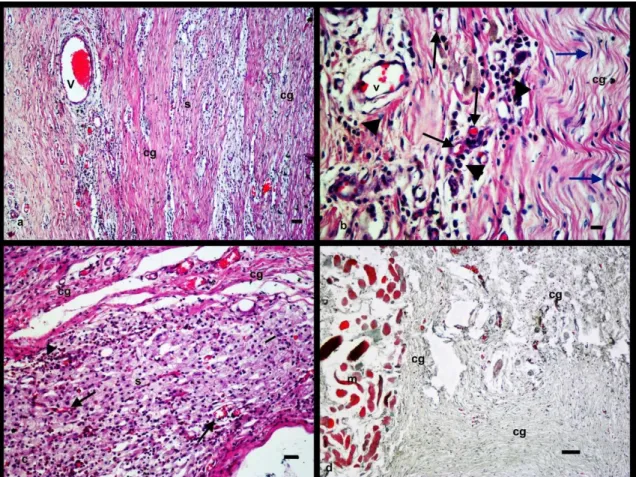
In the microscopic evaluation (x10, x20, x40), structures rich in randomly distributed collagen fibrils with unclear boundaries were observed under intact mammary skin. There were local inflammatory cell infiltrations in these structures. These infiltrations were consisting of polymorph nuclear leukocytes and little amount of plasmocytes. Also neovascular structures were determined. Main vessels were dilated and intima layer was in its normal constitution (Normal structure of the erythrocytes shows there is not an autolysis in the tissue) It was determined spindle shaped fibroblastic cells were in uniform character. Under these microscopic findings mass found in the mammary gland was determined as solid fibroma (Figure 3). After 6 months no recurrence was observed.
Discussion
Although many chemotherapeutics are used for the treatment of mammary tumours, nowadays surgical removal of the tumour is the most preferred treatment protocol (4). Invasive approach should be preferred for the surgery. A homeopathic agent
Tarantula cubensis extract often used for demarcation, reepithelialization, reducing the inflammation in traumatic and necrotic disorders as well as many infectious diseases (5, 6). Also it is used for the treatment of in mammary tumours in dogs (7). It was reported that Tarantula cubensis extract increased the apoptotic mechanism in mammary tumour cells (7, 8). As it was reported by Gültiken and Vural (9) that Tarantula cubensis extract stopped the growth and reduced the size of the tumour similar clinical findings were observed in this study.
It was concluded in this case this effect supported the invasive approach to the surgery of fibroma. Acknowledgements
This case report was represented in 2nd Joint German-Polish Conference on Reproductive Medicine; 46th Annual Conference of Physiology and Pathology of Reproduction; 38th Joint Conference on Veterinary and Human Reproductive Medicine, 27 February -1 March, Gdansk, POLAND.
185
Figure 3: Histopathologic view of the tumour, (a, b, c: H&E, d: Mallory’s triple stainning), a: (Bar=100µm), b: (Bar=25µm), c: (Bar=50µm); s: stroma, cg: collagen fibrils, v: blood vessel, black arrow: neovascular vessels, blue arrow: fibrocyte, arrow head: polymorphonuclear leukocytes and plasmocyte, d: (Bar=100µm), cg: collagen fibrils, m: smooth muscle
Şekil 3: Tümörün histopatolojik görüntüsü, (a, b, c: H&E, d: Mallory’nin üçlü boyaması), a: (Bar=100µm), b: (Bar=25µm), c: (Bar=50µm), d: (Bar=100µm); s: stroma, cg: kollajen fibriller, v: kan damarı, siyah ok: neovasküler damarlar, mavi ok: fibrosit, ok başı: polimorfnükleer lökositler ve plazmosit, m: düz kas.
References
1. Heatley JJ, Smith AN. (2004). Spontaneous neoplasms of lagomorphs. Vet Clin Exot Anim. 7:561–577.
2. Von Bomhard W, Goldschmidt MH, Shofer FS Perl L, Rosenthal KL, Mauldin EA. (2007). Cutaneous neoplasms in pet rabbits: A retrospective study. Vet Pathol. 44: 579-588.
3. Greene H, Strauss J. (1949). Multiple primary tumours in the rabbit. Cancer 2: 673-691.
4. Novosad CA. (2003). Principles of treatment for mammary gland tumours. Clin Tech Small Anim Pract. 18(2):107-109.
5.Anonymous. Access Url:
186
content/uploads/pdf/theranekronD6.pdf. Date ofaccess: 18.11.2017
6. Sardari K, Kakhki EG, Mohri M. (2017). Evaluation of wound contraction and epithelialization after subcutaneous administration of Theranekron® in cows. Comp Clin Path.16: 197-200.
7. Er A, Corum O, Corum D, Hitit M, Donmez HH, Guzeloglu A. (2017). Alcoholic extract of tarantula cubensis induces apoptosis in MCF-7 cell line. Biomed Res. 28(8): 3660-3665.
8. Gultiken N, Guvenc T, Kaya D, Agaoglu AR, Ay SS, Kucukaslan I, et al. (2015). Tarantula cubensis extract changes the degree of apoptosis and mitosis
in canine mammary adenocarcinomas. J Vet Sci. 16 (2): 213-219.
9. Gültiken N, Vural R. 2007. The effect of tarantula cubensis extract applied in pre and postoperative period of canine mammary tumours. JIVS. 2:13-23.
Corresponding Author:
*Assoc. Prof. Dr. İbrahim Küçükaslan
Department of Obstetrics and Gynecology Faculty of Veterinary Medicine, Dicle University, 21280, Diyarbakır, TURKEY, E-mail:[email protected]