The clinical and pathological features
of patients with gastric cancer in
Turkey: A Turkish Oncology Group
Study
BÜLENT YALÇIN1, NURULLAH ZENG‹N2, FAZIL AYDIN3, MAHMUT ‹LHAN4, ABDURRAHMAN IfiIKDO⁄AN5, GÖKHAN DEM‹R6, FARUK AYKAN7, ‹SMA‹L ÇEL‹K8, FAYSAL DANE9, ZEK‹ ÜSTÜNER10, M CEM BÖRÜBAN11, HAKAN BOZCUK12, H fiENOL COfiKUN13, AZ‹Z KARAO⁄LU14, MUSTAFA ALTINBAfi15, DEN‹Z YAMAÇ16, ‹BRAH‹M TEK1, BURÇ‹N BUDAKO⁄LU2, GÜNGÖR UTKAN1, FEYYAZ ÖZDEM‹R3, SERCAN AKSOY8, NUR‹YE ÖZDEM‹R2, HAKAN AKBULUT1, ABDULLAH BÜYÜKÇEL‹K1, F‹KR‹ ‹ÇL‹1
1Ankara University School of Medicine, Department of Medical Oncology, 2Ankara Numune Training and Research Hospital, Department
of Medical Oncology, 3Karadeniz Technical University School of Medicine, Department of Medical Oncology, 4Yüzüncüy›l University
School of Medicine, Department of Medical Oncology, 5Dicle University School of Medicine, Department of Medical Oncology, 6Istanbul
University Cerrahpafla Faculty of Medicine, Department of Medical Oncology, 7Istanbul University Institute of Oncology, Department of
Medical Oncology, 8Hacettepe University School of Medicine, Department of Medical Oncology, 9Marmara University School of Medicine,
Department of Medical Oncology, 10Osmangazi University School of Medicine, Department of Medical Oncology, 11Selçuk University
School of Medicine, Department of Medical Oncology, 12Akdeniz University School of Medicine, Department of Medical Oncology,13Süleyman
Demirel University School of Medicine, Department of Medical Oncology, 14F›rat University School of Medicine, Department of Medical
Oncology, 15Erciyes University School of Medicine, Department of Medical Oncology, 16Gazi University School of Medicine, Department
of Medical Oncology
ABSTRACT
Although the incidence of gastric cancer has declined dramatically in western countries; it is, after the breast cancer in women and lung cancer in men, the second most common cancer in Turkey with a high mortality. Surgery is the mainstay in the management of gastric cancer, and unresectable disease has poor prognosis. The aim of this study was to evaluate the clinicopathological and epidemi-ological features of patients with gastric cancer in Turkey. A questionnaire was used to collect information on clinico-pathological and socioeconomic features of all patients with newly diagnosed gastric cancer in contributing 16 different centers in Turkey in the year 2004. The findings were analyzed by the geographic regions in patients live. Nine-hundred seventy-one patients with newly diagnosed gastric cancer in 2004 were included in the study. Mean age of the
patients was 57±12.9 (mean±SD) years. Male-female ratio was 2/1. The rate of cancer resectability was lower in Eastern Turkey (ET) than Western Turkey (WT) (31.6% vs. 63.4%, p=0.0001). Also, socioeconomic status of the patients was lowest in ET (53.6% vs. 32.3%, p=0.0001). H. pylori gastritis and intestinal metaplasia were more common in ET when compared to WT (75.0% vs. 40.5%; p=0.003, and 68.4% vs. 18.1%; p=0.0001, respectively). Lower resectability rate of disease in ET should be appreciated. Further epide-miological study of gastric cancer is warranted in Turkey. [Turk J Cancer 2006;36(3):108-115].
KEY WORDS:
INTRODUCTION
Gastric cancer is the second most common malignancy worldwide, with a high mortality rate (1). The incidence of gastric cancer is declined in the western countries during the last half of this century. However, in Japan and some Asian countries, it is still the first cause of cancer mortality (2,3).
Surgery is the mainstay of the gastric cancer management (4,5). Early stage gastric cancer has a better prognosis with an overall survival at 5-year exceeding 95% in Japan and 65% in the United States (6). However, if the disease is diagnosed at an advanced stage, the prognosis is very poor in spite of the developments in the chemotherapy regimens (7-9). Unfortunately, the majority of patients with gastric cancer have advanced disease at diagnosis (3,4).
Gastric cancer is the second most common cancer in Turkey after the breast cancer in women and lung cancer in men (10-12). However, there has been no multicentric study which examined the features of patients with gastric cancer in Turkey so far. In this retrospective multicentric study, we evaluated the clinicopathological and socioeco-nomic features of patients with gastric cancer diagnosed in 2004 in Turkey from participating centers.
METHODS Data collection
By using a questionnaire with seventeen questions related to the clinicopathological characteristics of the disease and socioeconomic features of the disease; data was collected retrospectively for all patients with newly diagnosed gastric cancer between January and December 2004 from the contributing 16 different centers from different geographical regions of Turkey.
Questions in the questionnaire were age, gender, resec-tability, places where patients lived, socioeconomic status, smoking, alcohol consumption, presence of anemia, location of tumor, empirical treatment for peptic ulcer before the diagnosis of gastric cancer, presence of intestinal metaplasia and atrophic gastritis, Helicobacter pylori (H. Pylori) infection, and the time from the beginning of symptoms to
Definitions
The location of tumor was defined according to the International Classification of Disease for Oncology, second edition (ICD-O-2): upper tumors (gastric cardia), middle tumors (gastric fundus and overlap cancers), and distal tumors (corpus, antrum and pylorus) (13). Histological types included adenocarcinoma, signet ring cell adenocar-cinoma, undifferentiated carcinoma and other epithelial cancers.
Socioeconomic status of patients was defined as low, medium and high according to patients’ inhabiting in urban or rural area, occupation, and type of health care insurance. Retirement Fund (Emekli Sandigi; ES), Social Insurance Fund (Sosyal Sigortalar Kurumu; SSK), Social Solidarity Fund (Sosyal Dayanisma Fonu) and Bağ-Kur (insurance fund for self employed) are the major public health care providers in Turkey, and the patients are assessed according to these health care providing organizations.
Statistical evaluation
Age and the time from the beginning of symptoms to the diagnosis of cancer were calculated as mean and standard deviation. The clinicopathological characteristics of disease and demographics of patients were compared among six geographical regions: The Marmara Region (MR), The Mediterranean Region (MTR), The Central Anatolia Region (CAR), The Black-Sea Region (BSR), The Eastern-Anatolia Region (EAR), and The Southeastern-Anatolia Region (SAR). Then, the patients were divided in two subgroups as Western Turkey (WT) consisted of MR, MTR and CAR and Eastern Turkey (ET) consisted of BSR, EAR and SAR. Again, the clinopathological features of disease and the demographics of patients were compared between WT and ET. Chi-square, Spearman’s correlation, logistic regression, and one-way ANOVA tests were used for statistical com-parison of the groups.
RESULTS
Questionnaires for 993 patients with gastric cancer diagnosed during 2004, from 16 centers, were evaluated. Twenty two questionnaires were excluded since the data for these patients have been duplicated. Thus, the analysis
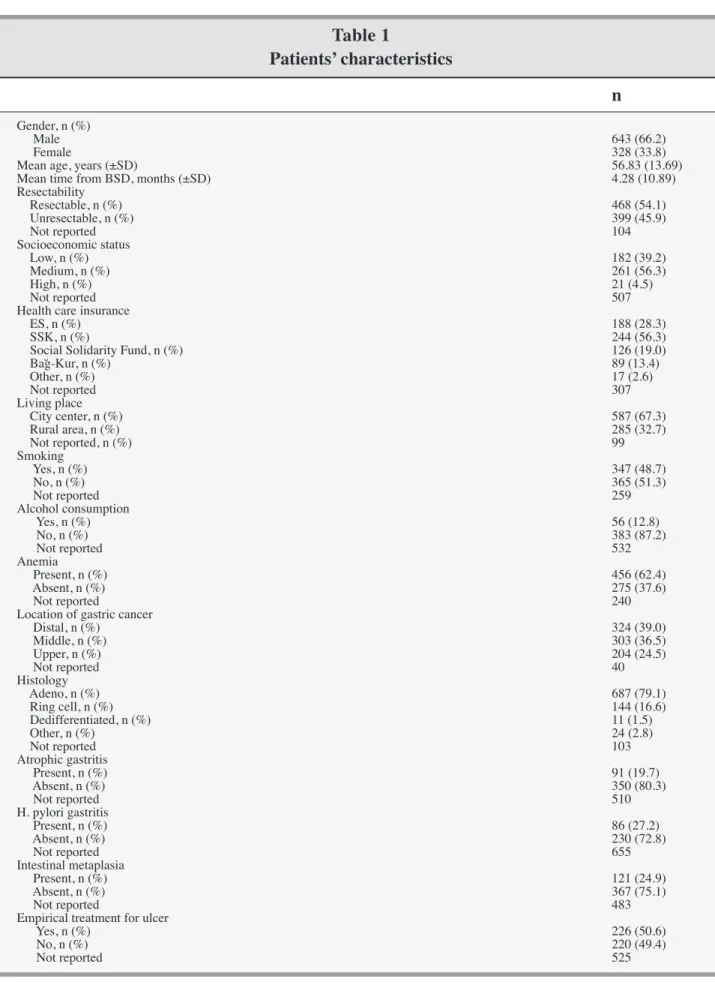
Table 1
Patients’ characteristics
n
Gender, n (%) Male 643 (66.2) Female 328 (33.8)Mean age, years (±SD) 56.83 (13.69)
Mean time from BSD, months (±SD) 4.28 (10.89)
Resectability Resectable, n (%) 468 (54.1) Unresectable, n (%) 399 (45.9) Not reported 104 Socioeconomic status Low, n (%) 182 (39.2) Medium, n (%) 261 (56.3) High, n (%) 21 (4.5) Not reported 507
Health care insurance
ES, n (%) 188 (28.3)
SSK, n (%) 244 (56.3)
Social Solidarity Fund, n (%) 126 (19.0)
Bağ-Kur, n (%) 89 (13.4) Other, n (%) 17 (2.6) Not reported 307 Living place City center, n (%) 587 (67.3) Rural area, n (%) 285 (32.7) Not reported, n (%) 99 Smoking Yes, n (%) 347 (48.7) No, n (%) 365 (51.3) Not reported 259 Alcohol consumption Yes, n (%) 56 (12.8) No, n (%) 383 (87.2) Not reported 532 Anemia Present, n (%) 456 (62.4) Absent, n (%) 275 (37.6) Not reported 240
Location of gastric cancer
Distal, n (%) 324 (39.0) Middle, n (%) 303 (36.5) Upper, n (%) 204 (24.5) Not reported 40 Histology Adeno, n (%) 687 (79.1) Ring cell, n (%) 144 (16.6) Dedifferentiated, n (%) 11 (1.5) Other, n (%) 24 (2.8) Not reported 103 Atrophic gastritis Present, n (%) 91 (19.7) Absent, n (%) 350 (80.3) Not reported 510 H. pylori gastritis Present, n (%) 86 (27.2) Absent, n (%) 230 (72.8) Not reported 655 Intestinal metaplasia Present, n (%) 121 (24.9) Absent, n (%) 367 (75.1) Not reported 483
Empirical treatment for ulcer
Yes, n (%) 226 (50.6)
No, n (%) 220 (49.4)
Not reported 525
SD: Standard deviation; BSD: from beginning of symptoms to cancer diagnosis; ES: Retirement Fund (Emekli Sandığı); SSK: Social Insurance Fund (Sosyal Sigortalar Kurumu); Bağ-Kur: insurance fund for self employed
Patient characteristics
Six hundred forty three of the 971 patients were male, (male-female ratio: 2/1), the mean age was 57±12.99 years, and 67.3% of the patients were living in urban and 32.7% were living in rural areas. About three forth of the patients had low socioeconomic status. Smoking and alcohol con-sumption rates were 48.5% and 13.6%, respectively. Anemia was present in 62.4% of the patients before the diagnosis of the malignancy. Most of the tumors were located in distal and middle stomach (distal 39%, middle 36.5% vs. proximal 24.5%). Three hundred sixteen patients had been evaluated for H. pylori gastritis and 86 (27.2%) were H. pylori positive. Approximately, half of the patients had the history of empirical ulcer treatment. The mean time from the beginning of the symptoms to the diagnosis was 4.28±10.89 months. The resectability rate for the disease was 54.1%. The demographic information for the patients is summarized in table 1.
Evaluation of the patients by geographical regions Approximately half of the patients were from CAR. There was no difference in the rate of smoking history, location of the tumor and presence of intestinal metaplasia among geographical regions. The characteristics of the patients according to geographical regions were summarized in table 2.
The mean age of patients at diagnosis in SAR were smaller than those in other geographic regions (53.85±10.59 years vs. 62.64±13.62 years, p=0.0001). The resectability rate of the patients in EAR group and SAR group (21.8% and 39.2%, respectively) was found to be lower than other groups (p=0.0001). The mean time from the beginning of symptoms to the diagnosis of gastric cancer in MR group and in MTR group, which were longer than in other groups, were 8.56±15.71 months and 8.43±14.19 months, respec-tively (p=0.005).
The SAR group had more patients from the low socio-economic status (p=0.0001). The majority of patients both in EAR group and in SAR group had Social Solidarity Fund as health care provider (p=0.00001). Living in rural area was more common in BSR group and in SAR group than in other groups (p=0.00001), and the alcohol consump-tion was more common among the patients in MR group and MTR group (23.5%), when compared with those in other groups (p=0.0001).
Anemia had been more frequently detected in MR group
was the most common histology in MR group (34.3%), adenocarcinoma was the most common histology in SER group (94.2%) (p=0.001). The rate of atrophic gastritis were higher in MTR group (50%) and in MR group (30.8%) (p=0.003). The frequency of H. pylori infection was the highest in CAR group (12.1%) (p=0.003). The empirical ulcer treatment before the diagnosis of cancer was more commonly employed in EAR group (85.3%) and SAR group (85.2%) when compared with other groups (p=0.0001). The Comparison of Western Turkey with Eastern Turkey
There was no statistically significant difference in gender, age, smoking, anemia, location of the tumor, and frequency of the atrophic gastritis between two groups. The time from beginning of symptoms to the diagnosis was longer in WT group than in ET group (6.98 months vs. 4.24 months, p=0.0001). In addition, the rate of tumor resect-ability was higher in WT group than ET group (63.4% vs. 31.6%, respectively, p=0.0001). The empirical ulcer treat-ment was more commonly employed in ET group than in WT group (52.4% vs. 78.2%, p=0.0001). However, smoking rate was not different in both groups (48.6% vs. 49.2%, p=0.932), and alcohol consumption was more common in WT group (15.5% vs. 6.9%, p=0.043).
Socioeconomic status, health care providers and living area
SSK was the most common health care provider among the patients living in cities (36.8%, p=0.0001). Socioeco-nomic status was lower in ET group when compared with WT group (53.6% vs. 32.3%, p=0.0001). As a health care provider, the Social Solidarity Fund was more common among patients living in rural area, and in ET group than in WT group (45.1% vs. 9.1%, p=0.0001, and 54.4% vs. 24.0%, p=0.00001, respectively).
Location of tumor, histology, atrophic gastritis, intestinal metaplasia and H. pylori infection
Although the incidence of proximal tumors were higher in WT group, the difference was not statistically significant (26.9% vs. 20.9%, p=0.201). Signet ring cell carcinoma were significantly more common in WT group compared with ET group (19.0% vs. 12.6%, p=0.003). There was not significant difference in the rate of atrophic gastritis between two groups (21.7% vs. 13.9%, p=0.070). However, H. pylori infection and intestinal metaplasia were more common in ET group (75% vs. 40.5%, p=0.003, and 68.4% vs. 18.1%,
Table 2
Characteristics of the patients according to six geographical regions
Marmara Mediterranean Central Black-Sea Eastern Southeastern P value
Anatolia Anatolia Anatolia
Gender, n (%)
Male 120 (66.3) 36 (62.1) 276 (68.3) 70 (55.6) 85 (70.8) 56 (68.3) 0.111 Female 61 (33.7) 22 (37.9) 128 (31.7) 56 (44.4) 35 (29.2) 26 (31.7)
Mean age, years 56.83 59.33 56.96 62.64 58.28 53.85
(±SD) (13.69) (14.04) (12.87) (13.62) (11.17) (10.59) 0.0001
Mean time from
BSD, months (±SD) 8.56 8.43 6.15 2.19 5.31 4.28 (15.71) (14.19) (10.31) (1.59) (6.30) (10.89) 0.005 Resectability, % 59.7 76.7 63.6 41.8 21.8 39.2 0.00001 Socioeconomic status, % Low 43.2 20.5 32.5 23.9 42.9 75.3 Medium 46.0 76.9 61.2 76.1 53.6 24.7 High 10.8 2.6 6.3 0 3.5 0 0.0001
Health care insurance, %
ES 41 31.6 31 22.6 14.5 8
SSK 49.3 47.4 36.7 9.7 15.8 40
Social Solidarity Fund 0.7 2.6 14 0 57.9 50.7
Bağ-Kur 2.1 15.8 16.3 67.7 11.8 1.3 Other 6.9 2.6 2 0 0 0 0.00001 Living place, % City center 87.4 57.1 73.6 32 46.7 52.7 Rural area 12.6 42.9 26.4 68 53.3 47.3 0.00001 Smoking, % 51.4 56.7 46.7 56.8 48.5 42.5 0.623 Alcohol consumption, % 23.5 23.5 8.8 13.6 1.9 11.5 0.0001 Anemia, % 70.7 39.5 61.1 56.5 64.5 64.3 0.015 Location of gastric cancer, % Distal 36.3 54.3 36.5 44.0 41.3 41.7 Middle 44.0 29.6 33.5 35.2 35.6 41.7 Upper 19.7 17.1 30.0 20.8 23.1 16.6 0.062 Histology, % Adeno 60.8 75.5 82.9 74.6 94.2 70.9 Ring cell 34.3 15.1 15.5 15.1 3.3 22.8 Undifferentiated 2.9 3.8 0.8 4.0 0 0 Other 2.0 5.6 0.8 6.3 2.5 6.3 0.001 Atrophic gastritis, % 30.8 50 16.2 NR 13.9 14.3 0.003 H. pylori gastritis, % 40.5 75 12.1 NR 69.2 60 0.003 Intestinal metaplasia, % 25.8 25 24.1 NR 20.4 47.8 0.162 Empirical treatment, % 52.4 30 44.1 NR 85.2 85.3 0.0001
SD: Standard deviation; BSD: from beginning of symptoms to cancer diagnosis; ES: Retirement Fund (Emekli Sandığı); SSK: Social Insurance Fund (Sosyal Sigortalar Kurumu); Bağ-Kur: insurance fund for self employed
Table 3
Characteristics of the patients residing in western and eastern Turkey
Western Turkey Eastern Turkey P value
Gender, n (%)
Male 432 (67.2) 211 (64.3)
Female 211 (32.8) 117 (35.7) 0.374
Mean age, years (±SD) 57.14 58.80
(13.21) (12.47) 0.093 Mean BSD, months (±SD) 6.98 4.24 (12.35) (4.84) 0.0001 Resectability, % 63.4 31.6 0.0001 Socioeconomic status, % Low 32.3 53.6 Medium 61.3 45.7 High 6.4 0.7 0.0001
Health care insurance, %
ES 34.0 13.2
SSK 41.3 24.7
Social Solidarity Fund 9.1 45.1
Bağ-Kur 12.0 17.0
Other 3.5 0 0.0001
Smoking, % 48.6 49.2 0.932
Alcohol consumption, % 14.5 6.9 0.043
Anemia, % 62.3 62.7 0.933
Location of gastric cancer, %
Distal 37.5 42.2 Middle 36.3 36.9 Upper 26.2 20.9 0.201 Histology, % Adeno 78.0 81.0 Ring cell 19.0 12.6 Dedifferentiated 1.5 1.5 Other 1.5 4.9 0.003 Atrophic gastritis,% 21.7 13.9 0.070 H. pylori gastritis,% 40.5 75 0.003 Intestinal metaplasia, % 18.1 68.4 0.0001 Empirical treatment, % 52.4 78.2 0.0001
consumption of salted and preserved foods, chronic atrophic gastritis, intestinal metaplasia, pernicious anemia, adenom-atous polyps, family history of gastric cancer, smoking, Menetrier's disease and familial adenomatous polyposis were the reported risk factors in the development of gastric cancer (14-18). In western countries, the decrease in gastric cancer incidence has been largely attributed to the use of refrigeration, and to better control of H. pylori infection in childhood.
Some studies have shown that H. pylori is associated with the development of the important precursor lesions for the development of gastric cancer, including chronic gastritis, atrophic gastritis, and intestinal metaplasia, therefore it is the major risk factor for non-cardia gastric cancers (14,19). Nevertheless, it has been known that the majority of H. pylori-positive individuals never develop gastric cancer. There may be many factors for the explana-tion of this topic, such as the characteristics of colonizing H. pylori strains, the genotype of the host, and exposure to environmental co-factors (e.g. diet). It has been reported that incidence of H. pylori infection in adult population of Turkey exceeds 80% (15).
In this retrospective study, the information about H. pylori infection was reported for only one third of the patients. Sixty percent of the patients were inoperable and only endoscopic biopsies or biopsies from the metastatic regions were obtained and these patients could not be assessed for H pylori infection. However, we found that the frequency of H. pylori infection was higher in ET than in WT (78.2% vs. 52.4%, respectively) for the reported patients.
The location of gastric cancer has changed from distal to more proximal over recent decades. While the incidence of distal gastric cancer has been decreasing in the western countries, the incidence of proximal gastric cancer (cardia and gastro-esophageal junction) has been rapidly rising (20,21). In our study, the frequency of upper gastric cancer was found to be 26.2% and 20.9% in WT and in ET, respectively, but the difference is not significant.
Although our study is retrospective and has some defect in nature, it is informative. Since gastric cancer is one of the important public health problems, it is obvious that there is a need for well-designed, controlled, and multicenter studies to establish the causes and the major risk factors in the development of gastric cancer. Therefore, we have started a prospective, multicenter, case-controlled study supported by TOG in Turkey, in January 2005.
Univariate analysis revealed that the rate of resectability was significantly higher in distally located gastric tumors than the other locations (41.7% in distal tumors, 36.6% in middle tumors and 21.7% in upper tumors, p=0.053). The resectability rate was lower in the patients with atrophic gastritis, intestinal metaplasia, or H. pylori infection (19.8%, p=0.0001, 24.6%, p=0.001, and 27.0%, p=0.0001, respec-tively). The incidence of anemia was higher in distal tumors (62%, p=0.011), and lower in the patients with atrophic gastritis (23.4%, p=0.030). Also, the rate of empirical ulcer treatment was lower among the patients with H. pylori infection (19.1%, p=0.007), atrophic gastritis (26.0%, p=0.010) and intestinal metaplasia (26.1%, p=0.009) when compared with other clinicopathological features.
DISCUSSION
Our findings showed that resectability of distally located gastric tumors and tumors in patients residing in Western part of Turkey, with high socioeconomic status, and without H. pylori infection and atrophic gastritis were higher; whereas sex, age, smoking, alcohol consumption, time from the beginning of the symptoms to the diagnosis of cancer, and empirical ulcer treatment were not associated with cancer resectability. We also found that resectability rate of gastric cancer, which is associated with better prognosis, was lower in Eastern Turkey than in Western Turkey (63.4% vs. 31.6%, p=0.0001). Furthermore, the high frequency of empirical ulcer treatment in ET group was another important finding (78.2% vs. 52.4%). Mainly, low socioeconomic status and Social Solidarity Fund as health care provider may be responsible for the lower resectability rate of gastric cancer in ET, due to insufficient health care. However, in western countries and in Japan, the resectability rate of gastric cancer has been exceeded 70% (1).
Worldwide, the incidence of gastric cancer starts to rise approximately at age 40, and rises progressively with the advancing age. The male-female ratio is 2.1 (1,2). In our study, the mean age (57±12.99 years) and sex ratio (ap-proximately 2/1) of the patients were similar to western countries.
Gastric cancer remains one of the leading causes of cancer death in the world (1). Although the precise etiology is unknown, many risk factors were defined for the devel-opment of gastric cancer. H. pylori infection which is associated with low socioeconomic status, advanced age, male gender, less fruit and vegetable consumption, the high
References
1. Pisani P, Parkin DM, Bray F, et al. Estimates of the worldwide mortality from 25 cancers in 1990. Int J Cancer 1999;83:18-29.
2. Parker SL, Tong T, Bolden S, et al. Cancer statistics, 1997. CA Cancer J Clin 1997;47:5-27.
3. Curtis RE, Kennedy BJ, Myers MH, et al. Evaluation of AJC stomach cancer staging using the SEER population. Semin Oncol 1985;12:21-3.
4. Bonenkamp JJ, Hermans J, Sasako M. Extended lymph node dissection for gastric cancer. N Engl J Med. 1999;340:908-14.
5. Kodama Y, Sugimachi K, Soejima K, et al. Evaluation of extensive lymph node dissection for carcinoma of the stomach. World J Surg 1981;5:241-8.
6. Fukao A, Tsubono Y, Tsuji I, et al. The evaluation of screening for gastric cancer in Miyagi Prefecture, Japan: a population-based case-control study. Int J Cancer 1995;60:45-8. 7. Icli F, Celik I, Aykan F, et al. A randomized phase III trial
of etoposide, epirubicin, and cisplatin versus 5-fluorouracil, epirubicin, and cisplatin in the treatment of patients with advanced gastric carcinoma. Cancer 1998;83:2475-80. 8. Yalcin B, Akbulut H, Buyukcelik A, et al. The effects of
chronomodulated therapy with 5-fluorouracil (5-FU) and folinic acid (FA) on the toxicity and quality of life in patients with advanced gastric cancer. Biol Rhythm Res 2004;35:259-68.
9. Ajani JA, Van Custem E, Moiseyenko FC, et al. Docetaxel (D), cisplatin, 5-fluorouracil compared to cisplatin (C) and 5-fluorouracil (F) for chemotherapy-naive patients with metastatic or locally recurrent, unresectable gastric carcinoma: Interim results of a randomized phase III trial (V 325). Proc Am Soc Clin Oncol 2003;22:999 (abstr).
10. Firat D, Celik I. Cancer Statistics in Turkey and in the World 1993-1995 Turkish Association for the Cancer Research and Control. Ankara, 1998.
11. C a n c e r S t a t i s t i c s i n Tu r k e y ( 1 9 9 9 ) . h t t p : / / www.saglik.gov.tr/sb/default.asp?sayfa=ozelistatistik&id= 115&kelime=&page=
12. Karaoguz H, Icli F. Cancer problem in Turkiye. J Ankara Medical School 1993;15:547-58.
13. Percy C, Van Holten V, Muir C. International classification of diseases for oncology. 2nd ed. Geneva (Switzerland): World Health Organization; 1990.
14. Peek RM, Blaser MJ. Helicobacter pylori and gastrointestinal tract adenocarcinomas. Nat Rev Cancer 2002;2:28-37. 15. Cinar K, Soykan I, Ozden A. The effect of Helicobacter
pylori eradication in patients with functional dyspepsia: Assessment of different diagnostic tests. Turk J Gastroenterol 2004;15:159-63.
16. Kurtz RC, Sherlock P. The diagnosis of gastric cancer. Semin Oncol 1985;12:11-8.
17. Fenoglio-Preiser CM, Noffsinger AE, Belli J, et al. Pathologic and phenotypic features of gastric cancer. Semin Oncol 1996;23:292-306.
18. Talley NJ, Zinsmeister AR, Weaver A, et al. Gastric adeno-carcinoma and Helicobacter pylori infection. J Natl Cancer Inst 1991;83:1734-9.
19. Helicobacter and Cancer Collaborative Group. Gastric cancer and Helicobacter pylori: a combined analysis of twelve case-control studies nested within prospective cohorts. Gut 2001;49:347-53.
20. Blot WJ, Devesa SS, Kneller RW, et al. Rising incidence of adenocarcinoma of the esophagus and gastric cardia. JAMA 1991;265:1287-9.
21. Hansson LE, Sparen P, Nyren O. Increasing incidence of both major histological types of esophageal carcinomas among men in Sweden. Int J Cancer 1993;54:402-7.