©BEYKENT UNIVERSITY
Removal of Ferrous Iron and Manganese From
Water Using Oxidation and Filtration Technique
Neşe TÜFEKÇÎ
(1), Esra Billur BALCIOĞLU
(2), Göksel DEMÎR
(3)and Mehmet BORAT
(4)(1)Îstanbul University, Faculty of Engineering., Department of Environmental Engineering, 34320, Avcılar, Îstanbul-Turkey
(2)Îstanbul University, Faculty of Fisheries, Department of Marine Biology, 34470 Beyazıt, Istanbul-Turkey
ebb_ 100@hotmail. com
(3)Bahçeşehir University, Faculty of Eng., Department of Environmental Engineering, 34538, Beşiktaş, Istanbul- Turkey
goksel. demir@bahcesehir. edu.tr
(4)Fatih University, Faculty of Eng., Department of Environmental Engineering, 34500, Büyükçekmece, Istanbul-Turkey
Received: 22.07.2009, Revised: 05.11.2009, Accepted: 11.11.2009
Abstract:
In oxygen-free aquatic environments, such as groundwaters and hypolimnetic waters of eutrophic lakes, iron and manganese exist predominantly in the ferrous state Fe(II) ions and manganese state Mn(II) ions. Even though iron and manganese removal processes used commonly nowadays were invented in the 19th century, there are still significant gaps in our knowledge. The basic process used for iron and manganese removal is to oxide soluble iron and manganese compounds so that they are converted to insoluble iron and manganese compounds, and these oxidation products are removed by either precipitation and/or filtering. For this reason, in this study the oxidation with air process and slow sand filters were used in decreasing iron and manganese concentrations increasing especially during summer to desired limits. Furthermore both of the processes were compared.
The oxidation of Fe(II) ions or Mn(II) ions by aeration is analyzed in a reaction tank which consists of 2 L flask where pH and temperature is kept constant. The temperature of the reaction solution and the partial pressure of the oxygen are kept at 25°C and 0.25 atm, respectively. Model filter is made of
10 cm internal diameter and 50 cm height plexiglas material. Two reactors with a volume of 4 L are used. The feeding flow of the reactor is 50 ml/min.
The aim of this study was to investigate the mechanisms of Mn(II) ions and Fe(II) ions removals in oxide-coated filters and the oxidation of Mn(II) ions and Fe(II) ions with atmospheric oxygen.
In literature, even though it is stated that autocatalytic effects are highly clear when the initial concentration of Fe(II) ions and Mn(II) ions are over 5mg/L, the same effect has also been observed in low concentration values by this experiment.
Generally the efficiency of Fe (II) ions removal rate with uncoated sand filter is about 85 %, with Fe-Mn coated sand filter it is about 99 %. The removal efficiency rates of Mn(II) ions are approximately 80% and 99% for uncoated filter and Fe-Mn coated sand filter, respectively.
As a result, the oxidation rate in the filter is higher than that of in the aeration pool.
Keywords: Ferrous iron, manganese, oxidation, sand filter, Fe-Mn coated, autocatalytic effect.
Özet:
Yeraltı suları ve ötrofik göllerin hipolimnetik tabakalarındaki sular gibi oksijensiz ortamlarda demir ve mangan çoğunlukla Fe(II) iyonları ve Mn(II) iyonları halinde bulunur. 19. yüzyılda bulunan ve günümüzde de kullanılan demir ve mangan giderim prosesleri yaygın olarak kullanılmasına rağmen, halen bu konuda önemli boşluklar bulunmaktadır. Demir ve mangan
gideriminde en temel proses, çözünebilir demir ve mangan bileşiklerinin okside edilerek çözünmeyen demir ve mangan bileşiklerine dönüştürülmesi ve oluşan oksidasyon ürünlerinin çöktürme ve/ veya filtrasyonla giderilmesidir. Bu nedenle, Bu çalışmada özellikle yaz aylarında artan demir ve mangan konsantrasyonlarının giderimi için hava ile oksidasyon ve yavaş kum filtresi kullanılmıştır. Ayrıca bu iki proses karşılaştırılmıştır.
Havalandırma ile Fe(II) iyonları ve Mn(II) iyonları oksidasyonu pH ve sıcaklığı sabit tutulan 2 L'lik beherde gerçekleştirilmiştir. Reaksiyon çözeltisinin sıcaklığı ve oksijenin kısmi basıncı sırasıyla 25°C ve 0.25 atm'de sabit tutulmuştur. Model filtre 10 cm iç çapa ve 50 cm yüksekliğe sahip pleksiglastan yapılmıştır. 4 L lik iki reaktör kullanılmıştır. Reaktörün besleme hızı 50 ml/dk'dır.
Bu çalışmanın amacı oksit kaplı filtrelerde Mn(II) iyonları ve Fe(II) iyonları giderimini ve atmosferik oksijenle Mn(II) iyonları ve Fe(II) iyonları oksidasyonunu incelemektir. Literatürde, Fe(II) ve Mn(II) iyonlarının başlangıç konsantrasyonlarının 5mg/L' den fazla olduğu durumlardaki otokatalitik etki belirtilmişse de aynı etki bu deneyle düşük konsantrasyonlarda
da gözlenmiştir. Genel olarak Fe(II) iyonlarının giderim verimi kum filtrede %85, Fe(II)- Mn(II) kaplı kum filtrede %99' dur. Mn(II) iyonlarının giderim verimi oranı ise kum filtrede ve Fe- Mn kaplı filtrede sırasıyla ortalama %80 ve %99' dur.
Sonuç olarak, filtredeki oksidasyon hızı tank içindeki oksidasyon hızından daha yüksektir.
Anahtar kelimeler: Demir, mangan, oksidasyon,kum filtre, Fe-Mn kaplı kum filtre, otokatalitik etki
Introduction:
Iron and manganese are two of the most common contaminants found in both surface and groundwater, but predominantly in the latter. Both elements can be present in natural water in concentrations exceeding 10 mg/L, although they are rarely present in concentrations exceeding 1.0 mg/L [1-3]. In natural waters high iron concentrations exist with natural organic materials. It is known that humic materials in the ground waters reduce oxidation and removal of Fe(II) ions [4-5].
The elevated levels of manganese and/or iron in water are considered undesirable on the grounds that when water is exposed to air, Mn(II) ions and Fe(II) ions are oxidized to Mn(IV) ions and Fe(III) ions respectively. These Mn(IV) ions, Fe(III) ions precipitates can stain household utensils and clothes and may impart a metallic, bitter, astringent or medical taste to water.
One of the most common methods for the removal of manganese and/or iron from waters is oxidation of the Mn(II) ions to Mn(IV) ions and Fe(II) ions to the Fe(III) ions form by atmospheric oxygen. Hydrolysis of ferric iron yields ferric hydroxide precipitates which are settled and filtered out from the water. Hydrolysis of Mn(II) ions also takes place in the same way and precipitates as MnO2.
Previous studies have indicated the catalytic effect of MnO2, Fe(OH)3 on the oxygenation of Mn(II) ions, Fe(II) ions. However, the effect becomes noticeable at Fe(III) ions concentrations exceeding 5-10 mg/L. It has been reported that the oxidation rate is linearly increasing with Fe(III) ions concentrations up to 100 mg/L [4,6]. Catalytic effect of the ferric iron was studied at ferric iron concentrations up to 100 mg/L by Tufekci [8], demonstrating the catalytic effect of ferric iron concentrations up to about 600 mg/L, beyond which no significant effect of ferric hydroxide on the ferrous iron oxidation was observed [7-12].
High levels of manganese, ferrous iron can lead to a variety of esthetic problems in drinking water. Techniques for Mn(II) ions, Fe(II) ions, ions
removal include (1) chemical oxidation followed by solid-liquid separation and (2) adsorption or oxidation or both onto manganese, ferrous iron oxide-coated sand filter media [13]. As early as 1946, Edwards and McCall reported that manganese coatings in filters helped to catalyze the removal of Mn(II) ions from drinking water[14].
This study has been conducted to provide a better understanding of the mechanisms of Mn(II) ions and Fe(II) ions removal in oxide-coated filters and the oxidation of Mn(II) ions and Fe(II) ions with atmospheric oxygen.
Material and Methods:
The removal of Fe(II) ions and Mn(II) ions by means of oxidation with the atmospheric oxygen is investigated separately in Batch Reactor and Slow Sand Filters.
The oxidation of Fe(II) ions or Mn(II) ions by aeration is analyzed in a reaction tank which consists of 2 L reactor where pH and temperature is kept constant. The temperature of the reaction solution and the partial pressure of the oxygen are kept at 25°C and 0.25 atm, respectively. The solution is stirred with a IKA-WERK RW 20 type mixer. Air and CO2 are supplied to the reaction tank by means of a diffuser. The reaction medium is prepared by adding Na2CO3 to distilled water such that an alkalinity of 2 X10⁻² - 8 X10⁻² eq/L is obtained. The pH of the solution is controlled by regulating the air and CO2 streams. The pH of the solution was measured by JENWAY model 3040 type of ion analyser with sensitivity of ± 0.001 pH unit. The dissolved oxygen levels were monitored using WTW Oxi 538 oxygen meter.The temperature of the system is kept constant by using a water bath of type WESTON-S-MARE AVON. The experimental setup is schematically shown in Figure 1. The pH is controlled by changing the CO2 stream since a buffer system of HCO3-CO2 is used. In this study, the analysis of Fe (II) ions in samples which contain high concentrations of Fe(III) ions were carried out by spectrophotometric determination of Fe(II) ions with 1.10 phenanthroline [3]. The analysis of the samples which contain relatively low Fe(III) ions concentrations have been done by phenanthroline method which is given in standard methods [15]. The pH of the solution was controlled by adding 0.1 N NaOH and 0.1 N H2SO4 for the oxidation of Mn(II) ions.
The samples taken at pre-decided times as measured from the start of the experiments were immediately filtered and acidified after filtration with 2 ml HNO3. Filtration through 0.45 mm membrane filter is accepted procedure defined in Standard Methods (3010A) for the determination of dissolved manganese [15]. Residual Mn(II) ions concentrations was determined by Atomic Absorption Spectrometer [15]. The detection limit for the AAS
manganese measurement was 0.015 mg/L as Mn. All experiments were conducted at 25°C and 9.5 of pH.
Slow Sand Filter: Model filter is made of 10 cm internal diameter and 50 cm
height Plexiglas material. Two reactors with a volume of 4 L were used. The feeding flow of the reactor is 50 ml/min. Active filter layer is determined as 50 cm and the water level in the filter is 1 cm. By mounting a valve at the filter base, the speed of the water passing through the filter is controlled. Fe-Mn coated and uncoated sand materials were taken from Ikitelli Drinking Water Treatment Plants. Reactor's schematic demonstration is as shown in Figure 2.
Filter was fed with approximately 3 L /hour flowrate and 0,382 m3/m2 surface load per hour. The tank feeding the filter has a volume of 30 L. The Fe(II) ions and Mn(II) ions solution prepared with tap water was sent to the filters through 2 pumps. Samples were taken in every 30 minutes after the start of the filtration. In order not to lose filter, material reactor's base is filled using porous material. All the analyses were made according to Standard Methods
[15].
Results and Analysis:
In this experiment the oxidation of manganese and iron were investigated in contact air-conditioned systems and the removal in slow sand filters. Removal efficiencies in both systems were compared. Experimental study was performed in two phases. In the first phase, the oxidation experiments of Fe(II) ions and Mn(II) ions, and in the second phase the removal of Fe(II) ions and Mn(II) ions in the Slow Sand Filter experiments were carried out.
First phase: Oxidation Experiments of Fe(II) ions and Mn(II) ions
Experiments of Fe(II) ions Oxidation with Oxygen
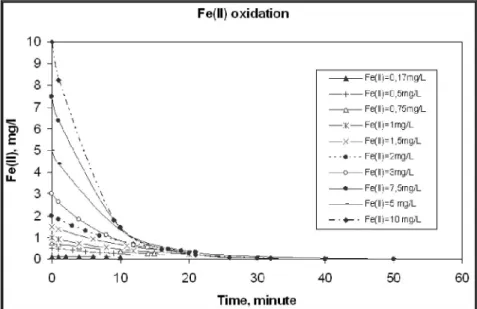
In this phase of the experiment, oxidation of Fe(II) ions with atmospheric oxygen was investigated with experiments which were carried out in the batch reactor. The results of the experiments at pH=6.5 with various initial concentrations are shown in Figure 3 and Table1.
As seen from Figure 3 that the change of different initial concentrations of Fe(II) ions were plotted against time, reaction rate is observed higher when initial concentration values of Fe(II) ions are high (Fe (II)= 5-10 mg/L) and the completion time of oxidation is shorter. However, when initial concentration values of Fe(II) ions are low (0.17 mg/L), reaction rate is slower, whereas retention time is longer. The reason is that the resulting Fe(OH)3 has an autocatalytic effect.
Table 1: Change of Fe(II) ions with time
Time min Concentration (mg/L) 0 0.177 0.5 0.75 1 1.5 2 3 5 7.5 10 1 0.136 0.465 0.697 0.926 1.383 1.830 2.645 4.382 6.358 8.254 9 0.106 0.402 0.359 0.734 0.919 1.077 1.814 1.34 1.439 1.778 16 0.059 0.347 0.309 0.538 0.612 0.445 1.097 0.357 0.276 0.464 21 0.065 0.300 0.267 0.395 0.407 0.313 0.664 0.096 0.053 0.178 26 0.137 0.259 0.248 0.289 0.271 - 0.516 0.026 0.010 0.068 32 0.116 0.209 0.231 0.213 - - 0.401 0.007 0.002 0.022
Figure 3: Change of Fe(II) ions with time (pH:6.5, temperature: 25°C, alkalinity:2x10"2
eq/L, p02=0.21 atm.)
Experiments of Mn (II) ions Oxidation with Oxygen
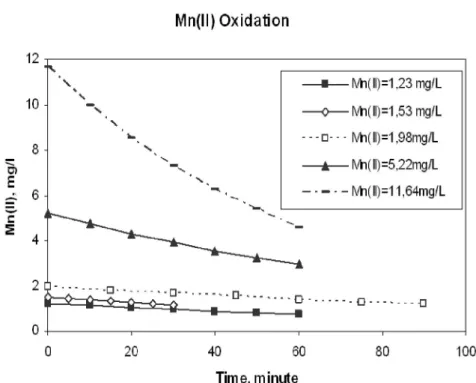
In this phase of the study, the oxidation of Mn(II) ions in the batch reactor was investigated. The results of the experiments which were carried out with different initial concentrations of Mn(II) ions at pH=9.5 are shown in Figure 4 and Table 2.
Table 2: Change of Mn(II) ions with time Time,
min C one entration (mg/L)
0 1.233 1,533 1.982 5,223 11.641 10 1.135 1,395 1.822 4,744 9.969 20 1.044 1.270 - 4.310 8.528 30 0.961 1.156 1.6751 3.916 7.312 40 0.885 - 1.5401 3.557 6.262 50 0.814 - - 3,232 5.363 60 0.749 - 1.416 2.936 4.593
Mn(ll) Oxidation
10 8 01 E 6 "n S 4 2 0 0 20 40 60 80 100 T i m e , m i n u t eFigure 4. Change of Mn (II) with time (pH:9.5, temperature:25 °C, alkalinity: 2x10⁻²
eq/L, pO2=0.21 atm.)
As seen from these curves, when initial concentration values of Mn(II) ions are high(Mn (II) ions = 5-10 mg/L) the reaction rate is higher, and the completion time of oxidation is shorter. The reason is that the resulting MnO2 has an autocatalytic effect.
In literature, even though it is stated that autocatalytic effects are highly clear when the initial concentration of Fe(II) ions and Mn(II) ions are over 5mg/L, the same effect has also been observed in low concentration values by this experiment.
Second Phase: Experiments of Slow Sand Filter
In this phase of the experiment the removal of Fe(II) ions was investigated in Slow Sand Filters which were defined in materials and techniques.
Filtration Experiments of Fe(II) ions
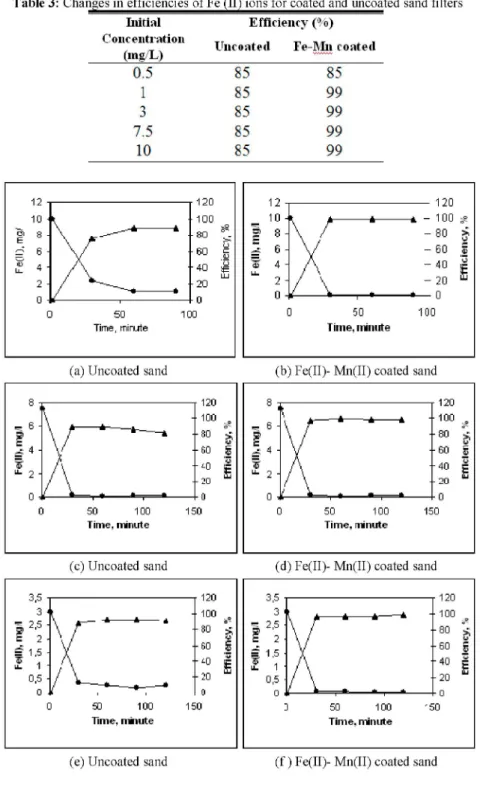
The removal of Fe(II) ions in uncoated sand and Fe(II) ions - Mn(II) ions coated sand were separately studied. The results are shown in the Figure 5 and Table 3. )=1.23 mg/L )=1,53 mg/L 4,98mg/L 5,22mg/L 11,64mg/L - o —
Table 3: Changes in efficiencies of Fe (II) ions for coated and uncoated sand filters
(i) Uncoated sand (j) Fe(II)- Mn(II) coated sand Figure 5. Fe(II) removal with uncoated sand and Fe-Mn coated sand filtration.
(pH:6.8, T:16 °C, V:15 L, Q:50 ml/dk)
In Figures 5 a and 5 b, the initial concentration of Fe (II) ions is 10 mg/L. As the Figures show, while the efficiency of Fe (II) ions removal rate with uncoated sand filter is about 85 % (Figure 5a), with Fe- Mn coated sand filter it is about 99 % (Figure 5 b).
In Figures 5 c and 5 d, the initial concentration of Fe (II) ions is 7.5 mg/L. As the Figures show, while the efficiency of Fe (II) ions removal rate with uncoated sand filter is about 85 %, with Fe-Mn coated sand filter it is about 99%.
In Figures 5 e and 5 f, the initial concentration of Fe(II) ions is 3 mg/L. As the Figures show, while the efficiency of Fe (II) ions removal rate with uncoated sand filter is about 85 %, with Mn coated sand filter it is about 99 %.
In Figures 5 g and 5 h, the initial concentration of Fe (II) ions is 1 mg/L. As the Figures show, while the efficiency of Fe (II) ions removal rate with uncoated sand filter is about 85 %, with Fe-Mn coated sand filter it is about 99%.
In Figures 5 i and 5 j, the initial concentration of Fe(II) ions is 0.5 mg/L. As the Figures show, while the efficiency of Fe(II) ions removal rate with uncoated sand filter is about 85 %, with Fe-Mn coated sand filter it is about 85%.
Generally saying, the Fe (II) ions removal with uncoated sand filtration is relatively lower with Fe-Mn coated sand filtration on the grounds that the effect of the Fe(OH)3, MnO2 flocs' surfaces coverage of sand particles and the catalytic effect of its oxidation.
Filtration Experiments of Mn (II)
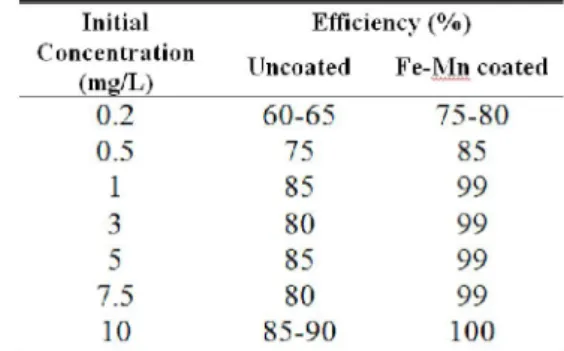
The removal of Mn(II) ions was studied in slow sand filters. In this phase of the study, as defined in the second section, the Mn (II) ions removal with uncoated sand filtration and Fe- Mn coated sand filtration was examined, the results obtained are seen in Figures 6 (a-n) and Table 4.
Table 4: Changes in efficiencies of Mn (II) ions for coated and uncoated sand filters Initial
Concentration (mg/L)
Efficiency (%) Uncoated Fe-Mn coated 0.2 6 0 - 6 5 7 5 - 8 0 0.5 75 85 1 85 99 3 80 99 5 85 99 7.5 80 99 10 8 5 - 9 0 100
(g) Uncoated sand (h) Fe(II)- Mn(II) coated sand
(m) Uncoated sand (n) Fe(II)- Mn(II) coated sand Figure 6. Mn (II) removal in the uncoated sand filter and the Fe-Mn filter.
(pH:6.8,T: 16 °C,V:15 L, Q:50 ml/dk)
As seen in the Figure 6 a and 6 b, initial Mn (II) ions concentration was taken as 10 mg/L. Except the initial concentration, Mn (II) ions removal was done in slow sand filters in almost the same conditions.
In the study, removal efficiency was compared by taking Mn (II) ions first through uncoated sand filter and then through Fe-Mn-coated sand. As seen in the Figures 6 a and 6 b, the removal of Mn (II) ions was achieved
approximately 85-90 % in uncoated sand filter and 100 % in the Fe-Mn coated sand.
In Figures 6 c and 6 d initial Mn (II) ions concentration was 7.5 mg/L. As can be seen from the Figures, efficiency of Mn (II) ions removal in uncoated sand filter was 80 % while it was 99 % in the Fe-Mn coated sand.
In Figures 6 e and 6 f, initial Mn (II) ions concentration was kept at 5mg/L. According to the Figures, Mn (II) ions removal in uncoated sand filter was 85 % while it was 99 % in the Fe-Mn coated sand.
In Figure 6 g and 6 h, 3 mg/L was taken as initial concentration. As seen in Figure, Mn(II) ions removal efficiency was found for uncoated and Fe- Mn coated were 80% and 99 % respectively.
In Figures 6 i and 6 j, initial Mn (II) ions concentration was 1 mg/L. As can be seen from the Figures, Mn (II) ions removal efficiencies were 85 % and 99% in uncoated sand and Fe-Mn coated sand respectively.
In the Figures 6 k and 6 l, 0.5 mg/L was taken initial Mn (II) ions concentration. As seen in the figures, Mn (II) ions removal efficiency in clean sand was nearly 75 % while it was 85 % in the Fe-Mn coated sand.
In Figures 6 m and 6 n, the initial Mn (II) ions concentration was 0.2 mg/L. As seen in the Figures, the removal efficiencies were found 60-65 % for uncoated filters and 75-80% for coated filters.
As generally seen through the Figures, the removal efficiency in clean sand filter was lower than that of in Fe-Mn coated sand filters. The reason for this is the catalytic effects of Fe(OH)3 ,MnO2 flocs covering the surface of the sand particles in the filter on oxidation of Mn (II) ions.
Discussion and Conclusion:
The results of the study examining the filtration and oxidation of Fe (II) ions and Mn (II) ions in batch reactor are as follows:
• At high levels of initial concentration of Fe (II) ions (such as 5-10 mg/L), the reaction rate is higher and the oxidation completion time is shorter. However for the low levels of initial concentration of Fe (II) ions such as 0.17 mg/L it is observed that, the reaction rate is lower and retention time is higher due to the autocatalytic effect of Fe(OH)3 occurring as a result of the reaction.
• In the oxidation of Mn (II) ions, at high levels of initial concentration of Mn (II) ions (such as 5-10 mg/L), the reaction rate is higher and the oxidation completion time is shorter. But, at low levels of initial concentration of Mn (II) ions (such as 1.23 mg/L), the reaction rate is
lower and retention time is higher. The reason for this is the autocatalytic effect of MnO2, occurring as a result of the reaction.
• Fe (II) ions and Mn (II) ions removals in slow sand filters were investigated by using two 4 liter-size reactors. The study was conducted by filling one reactor with clean sand and another with Fe-Mn coated sand. The removal efficiency level in Fe-Mn coated sand is higher than that of clean sand. This is caused because Fe(OH)3 and MnO2 flocs make a film layer by coating sand particles and this film layer causes catalytic effect on oxidation of Fe(II) ions and Mn(II) ions.
Conclusion
As a result of the studies in literature and these experiments, the oxidation rate in the filter is higher than oxidation in the tank. Among the reasons of this case are mechanical filtering, sedimentation, adsorption, chemical oxidation, as well as the catalytic effects of Fe(OH)3 and MnO2 coating sand particles on the oxidation of Fe(II) ions and Mn(II) ions [5, 7, 8].
REFERENCES
[1] ASCE, AWWA Water Treatment, Plant Design, 2nd edn. McGraw-Hill, New York
(1990).
[2] Hamidi A A & Paul G S, Removal of manganese from water using crushed dolomite filtration technique, Water Research, 30 (1996) 489-492.
[3] Tamura H, Goto K & Yotsuyangi T, Spectrophotometric determination of iron(II) with 1.10-phenanthroline in the presence of large of iron(III), Talanta, 21(1974)314-318.
[4] Yasavul E, Tüfekçi N & Demir G, The effect of organic matters on manganese oxidation, Fresenius Environmental Bulletin, 11(2002) 874-879.
[5] Tüfekci N, Demir G, Özgül G & Kınacı C, The effect of organic matters on ferrous oxidation, Fresenius Environmental Bulletin, 12(2003) 771-775.
[6] Tamura H, Goto K & Nagayama M, The effect of ferric hydroxide on the
oxygenation of ferrous ions in neutral solutions, Corrosion Science, 16(1976) 197-207. [7] Robinson, R B, Demirel, T. & Baumann R, Identity and character of iron
precipitates, Journal of the Environmental Engineering Division, ASCE, 107(1981)1211.
[8] Tüfekçi N & Sarıkaya H Z, Catalytic effects of high Fe(III) concentrations on Fe(II) oxidation, Water Science and Technology, 34(1996) 389-396.
[9] Tüfekçi, N & Sarıkaya H Z, Influence of ageing on the catalytic activity of ferric sludge for oxidation of Fe(II), Water Science and Technology, 38(1998) 129-137. [10] Tüfekçi N, Sarıkaya H Z, & Öztürk İ , An experimental study on iron removal with ferric sludge recycling, Water Science and Technology, 42(2000) 393-397.
[11] Tüfekçi N, & Demir G, Catalytic effects of Fe(III) during oxygenation of Fe(II) in continuous flow iron removal systems, Fresenius Environmental Bulletin, 11(2002) 863-867.
[12] Demir G., &Tüfekçi N, Investigation of the catalytic reaction kinetics of Fe(III) on Fe(II) oxidation at various pH values, Fresenius Environmental Bulletin, 11(2002) 868-873.
[13] Knocke, W R, Hoehn, R C & Sinsabaugh R L, Using alternative oxidants to remove dissolved manganese from waters laden with organics, Journal AWWA, 79(1987) 75-79.
[14] Kessick M A & Morgan J J, Mechanism of autoxidation of manganese in aqueous solution, Env. Sci. Tech, 9(1975) 157-159.
[15] APHA- AWWA-WPCF, Standart methods for the examination of water and wastewater, 17th edition, Washington D.C. 1990.