Architectural Sdence Rwiew Volume 43, pp 125 -132 UDC: 725.%6%.1 Keywords: Aging in place; Design model;
Elderly residences; D e r i decision support system.
A Design Decision Support System Model
for
the
Wet Space Renovation
of
Elderly People’s
Residences
Yaprak
Sagdic
* t
and Halime
Demirkan*
This
paper
discusses the problems that need to
be
considered when ekkt-lypeople renovate their
houses,
andparticularly
the wet
~aces,because
they
do
notfirB1 the need and the requirements of the elderly
for aging in place. TherefforeefieM
research was conducted in order to idenofi the variables that are influencing the renovation decisions of Turkish elderly
people. Based upon thefindings,
a
comparison of the
of
the empirital
study
with the proposed solutions
of
&sap
guidehksismmk. Thecollecteddataare usedtodeuelop Design Decisi~SupportSystem
@DS)
modelforthe wetspace
renovation of the residences used
@
Turkish E h l y .
Introduction
Architectural design guides do not always present adequate solutions for the needs of human beings changing with time. The aging process causes many changes in human nature, resulting in environmental inter- actions. Fromanarchitecnualpointofvi~,theenvironmentremainsthe same until human interference causes it to change. From a human point of view, the person using the environment prefers to stay in this same environmentwithsomeimprovementsmade totheunits,whichdoes not serve well, with respect to the changing needs [ 11.
In many design guides [2,3,4,5,6,7], the necessary renovations for people with changing needs are stated with a speaal emphasii given to the needs of people who have extreme mobility impairment like wheel-
chair users. The needs of the aging people are mentioned in a general context or with a few sentences, and many of the recommendations are not specifically useful for all of the people who have minor limitations. As a result, it becomes hard to find useful information for a speafic client, and it takes too much time.
Whiledeterminingtheiuenrial factorson thedecisionsoftheTurkish elderly people related to house renovations, it has been found that two Merent factors were stated in the previous studies [8,9] as income level and psychological profile of eldely people. The first study was belonging to Imamoglu and Imamoglu [8] who accepted retirement as a better * Bdkent Univenity, Faculty of An, Design and Architecture, Department of Interior Architecture and Environmental Design, 06 533, Ankara, Turkey.
’
Corresponding author.index than ageing in their sampling procedure. They found that the income level is more important in housing problems than ageing because the income of a worlung person decreases to a ratio of
a,
when he/she retires. However, Turel [9] mentioned that as a person gets older, hispsychological profile is also changing and, therefore, some elderly people prefer not to change even a tap although they have enough economic power.
Compared to the construction of a building from the inirjal phase, the renovation of a design is not an easy procedure, because the changing needs of human beings due to age require knowledge from many different sources. Knowledge-based systems still promise to be powerful tools in sohing architectural design problems. If low-level design dea- sions canbemade bythecomputer, within agiven timeslice, there should be an improvement in the quality of design in an interactive environment since more time can now be allocated for more complex decisions [lo].
Inthisstudy,asolutionisproposedrhroughaKnowledge-BasedSystem
(DS) model which assists the human designer during the design process of the wet spaces of the residences for the elderly. Here, the authors accept Mitta and Ellis’s [ 111 definition of KBS as “providers of recommen- dations, guidelines, or problem solutions mferred from values assigned to input conditions (236)” There are a variety of possible ways of encodmg
knowledge, Design Decision Suppon System (DDSS) model is a proto- type of a knowledge-based system that can serve a designer during the design process especially in data collection and design critiasm phases.
It is obvious that a DDSS still has many limitations, and it can not replace personal judgements on the change of values with time, but at least it can
Architectural Science Review Volume 43
DYNAMIC
IN
NATURE
help the user on aspects which are not well known to user. Among the many
DDSS
models mentioned by limmerman [ 121, the one proposed in this study aims to help a designer who wants to make renovations in a pre-built wet space to allow for changes intluencing the capability of an older person. Consequently, the model is introduced during the initial state of the design procedure, and is implemented through knowledge acquisition process.The
Model
Design
Procedure
In its m a t general formulation, a design procedure starts with needs and desires, continues with a design process, and ends with a design solution [13]. In this approach, a statement of needs and desires is what usually motivates or initiates a design problem. Initlauy the designer should obtain dormation on what is to be designed and the constraints and requirements of the designed artefact. The designer should then use a broad spectrum of knowledge, which includes codes, rules and habits permrung to the behaviour of people, artefacts and spaces. The solution
is a design description created during the design process.
It is obvious that the needs and desires of a person are influenced by
personal characteristics, including the physical, intellectual and psycho-
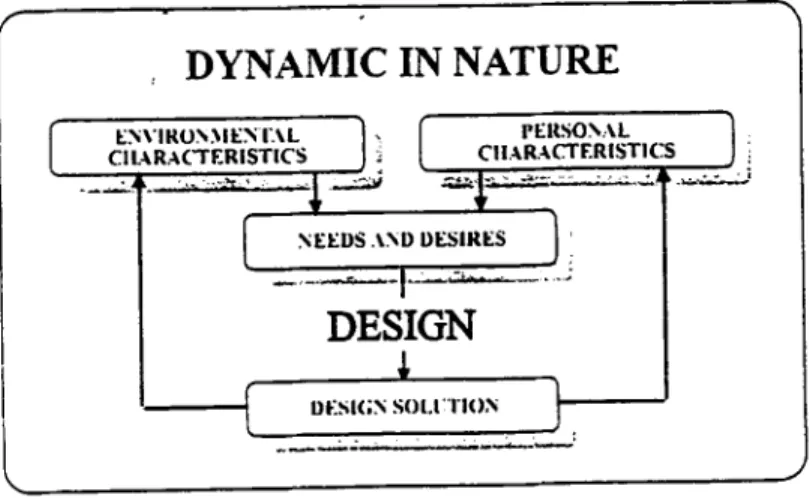
logical aspects, and environmentat hcteristics, including the nature and the built environment [14], as depicted in Figure 1, which is devel- oped from the schema of Bemaras by the authors [ 131.
Adesign solution ofthe type shown in Figure 1 effects the environmen-
tal characteristics, since it becomes a part of the environment in spatial design, and this phenomenon continues in a loop. Like the environmen-
tal characteristics, the personal characteristics are also mfluenced by the designsolutionand bytime.Theeffectoftimeonthephysical, intellectual and psychological characteristics is very dynamic, espwally during two periods of human life: namely, childhood and old age.
Knowlea&e
AcquisitionKnowledge acquisition is an active modeling process. A designer con-
structs a conceptual model of the artefact by absmaing knowledge from
mind. He determines his own priorities on the acquired knowledge and recalls his analogies, memories and forms the presolution model. These conceptual representations are bemg linked both with external forms of knowledge and with the internal representations of the model [ 151.
Accordmg to Shaw and Wcxxiwad [ 161, the process of knowledge base development begm with the inirial selection of the problem, application or domain definition, m o m through iterarion of knowledge acquisition aaivity, knowledge base development, and verification, and end with delivery and a plan for maintaining the KBS in its application environ- ment.
Knowledge acquisition techniques [ 161
focus
on the k c t elicitation of knowledge from a human source in a manner that allows relatively easy representation of this knowledge in a computer environment. Rappaport and Gaines [ 171 define three major knowledge sources: I' knowledgeencoded in releuant naediu, such as book, journals, and videotapes; knowledge available by observing and modeling the rehunt domuin;
and knowledge available from discourse with, and observation of, the
relevant community (51-52)"
After the knowledge acquisition process, one of the m a t important 'bottle-n& [la] of developing a KBS [16,19], is a domain that is
speaf~ed by the system in which everyrhg can be solved and guided.
The Knowledge Base
of
DDSS
Model
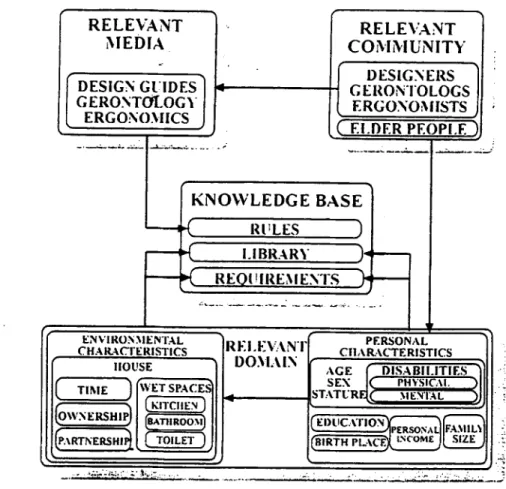
The knowledge environment shown in Figure 2 is an expansion of the knowledge acquisition process explained by Rappapon and Gaines [17] and developed by the authors. The relevant m& are the design guides and books about gerontology and ergonomics, written by the experts in the field of aging and architectural design who are the relevant part of the relevant community. By using the information coming from the relevant media and community, a questionnaire was prepared to define the relevant domain of this study.
Vanables related to the personal characteristics are age, sex, stature (physical height), and disabiity (either by
b
d
or later illness)-mental dsabiity, physical disability and related assisting devices. Cultural vari-ablesarebinhplace,educationlevel. Economicvariabesarethepersonal
DESIGN
Figure 1. Components influencing the needs and desires.
previous experiences and information stored in the memoly. This a b income and family site. The variables related to the environmental suactionisaidedby theuseofinterpretation.Asanexample,indesigning characteristics,on theotherhand,arestatedasyearsspentina house,the a kitchen for the elderly, the designer has images of such spaces in his house ownership, number of people living in the house and existing
Number 3 September 2000
I
C;I.DER PE0PI.E
)
I
I
K N O W L E D G E BASE
I
Figure 2. Tbe relations among tbe relevant media, relevant community and relevant domain in
knowka&acquisition m D D S
situation of the wet spaces
-
kitchens, bathrooms and toilets.Domain
Spcgcation
andCriticism
Pmcm
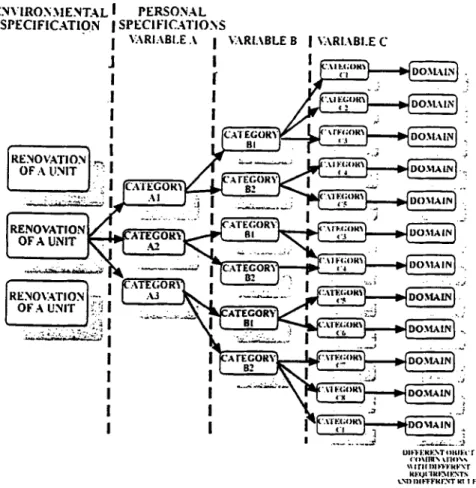
AUtheacquiredlnformationisusedinthedomainspeafication process. T ~ I S defines the requirements related to the domain, the brary of the objects related to the domain and the rules which define the relations between the objects as shown in Figure 3.
The system interacts through a set of choices. The designer, who uses
the system, can define the part of the residence that could be designed for aspeafictypeofdient.Thespeaficarionofdomainisdrawnupafterafew stages. The speafied domain communicateswith a library which contains a set of furniture objects (Figure 2). These objects are the conceptual images of the furniture and other interior elements that are determined by the relevant medu. The objects related to the same unit and the units of the same wet space are clustered accordmg to their qualitative and quantitative properties, and physical and conceptual relations (Figure 4).
Each object in each unit is dassied hierarchically according to its
importance in the space. Awater closet (WC) can be given as an example of hierarchy because it is hierarchically the most important furniture for a toilet space.
AU
the other related furniture like reservoir, toilet paper holder and grab bars, ifnecessary, have secondary importance compared to WC, since they must be placed according to WC.After this W i c a t i o n was defined, a map, which spa- clusters entities and atuibutes within a subdomain and which prompts the expert to add higher-level entities structuring the domain [ 161, is used while stating the physical and conceptual relationship rules of each object.
These o b j e a are used as design tools and they can provide the linguistic standard between the user and the computer. There are two implications to the word 'linguistic'. One is the 'language' which consists of the symbols
used
for communication. The other is the 'communica- tion' which is the information transformation to reach to the same knowledge source. Here, the designer can make use of the abstraction of objects in order to do hisher conceptual design. Metaphorically, it will be just like gatheg the letters of a word and the words of a sentence[ 161.The rules related to the quantitative properties determine the physical dimensions, and the number of objects according to the speafied do- main. In qualitative properties, the required characteristics of an object are specified, e.g., the material suitable for an object. The physical relations among objects determine a suitable place (in the coordinate
system) for an object with respect to the other objects in the same unit. The conceptual relations are the functional relations between the group of objects disregarding the real shapes and exact places of each item.
A function-graph, which shows the primary and secondary functions, without cross intersections, depending on the object, is used to define
Volume 43 Architectural Science Review
J
I
I
II
II
r
Figure 3. Domuin ~ i ~ t i o n p r o c e s r after knowledge acquisition.
:
UNIT-:
QUALITATIVE4-5
.-
- -
9.-L--d-lul-,-,J
Number 3 Seutember ZOO0 the conceptual design of each unit. These graphs are expected to help the
designer to understand the conceptual relationships between two or more objects. These function graphs are used in the criticism part of the model which is an important part of the DDSS.
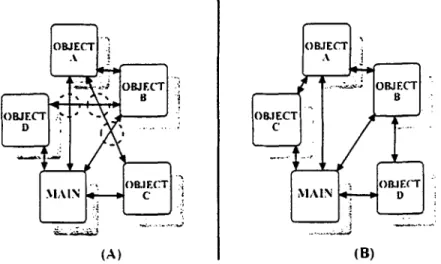
After the objects, related to the speafic domain, space and function, are defined, thedesi~ercreateshisconceptualdesignbyusingthesedolects (Figure 5). Then, the system criticizes the conceptual model and if there is an unacceptable relation among the objects as in Figure 6 (A); the system criticizes the design with respect to the acquired knowledge
duringtheknowledgeacquisitionprocess,andtheruleswhichdetermine
the relationships and properties of each object. DDSS warns the designer on the inresection points, and the designer should correct the places of
the objects to reach to an acceptable solution, as in Figure 6 (B). In spaual clustering the relations of the objects are criticized according to the rules of physical relations. In conceptual relations in a group, the conceptual'relations of the objects are criticized with respect to the rules shown in Figure 4. in a hierarchical clustering criticism, the hierarchical importance of the rules is deduced and the priority is determined
according to the rules, considering any conflicts. If all the criticisms are positive then a conceptual design solution is found.
Method
The personal and environmental characteristics (see Figure 1) are determined through the information cokted in a field research con- ducted among 39 Turkish elderly people, who were chosen by srratified
random sampling method. These data are used in the knowledge acqui- sition process of DDSS model. The samples were visited in their houses and interviewed by the authors. Each panidpant was asked 93 questions and observations were made on the present wet spaces. The questions were related to the personal profile of the participant (9 questions), the disabiity profile of the participant (13 questions) and wet spaces of the house in which the panidpant was living (3 general questions, 30
questionsandobselvationsforkitchen,38questionsandobsenrationsfor
the bathroom-toilet areas). The mean interview duration was 55 minutes
with a srandard deviation of 19 minutes.
KNOWLEDGE
1
ACQUJSTION1
4
RULESCONCEPTU.AL ::
DESIGN SOLL'TION
1
Figure 5. Criticism of the cmeptual design model.
Figure 6 (A) Unacceptable relations and (B) corrected relations among the objects of related domain.
Architectural Science Review Volume 43
Results
Related
to
the
Personal
Profile
The youngald people (60-74-years old) are 66.7 %, the oldald people (7584;yearsald) are 30.8 % and the oldest people (85 and more-years- old) are 2.5 %of the total pamapants of this study. The ratio of men is very low (15.4%) whereas the women are nearly five times more
than
the men (84.6 %). The mean stature is calculated as 167.16~1 (standard devia- tion= 11.75) for men, and 154.84 an (standard deviation= 28.67) for women.Among the participants, there is no illeterate person. Only one of the female participants (2.5%) did not haveaschool diplomaand23.1 %of the participants graduated from a primary school, 15.4 % graduated from a secondary school, 38.5 %graduated from a high or a t&al school and 20.5 % graduated from a university.
All the male participants had a job and 83.33 % are still working after retirement. Although more than half of the female participants (54.5%) had a profession to earn their living only 27.7 % of them had actually worked and 5.12 % of them are sull working.
5.0 % of the participants had no income at all or very low income. 28.2% are in low income level, 33.3 %are in middle income level, 23.1 %
are in upper middle income level and 10.4% are in high income level. The biih-place distribution of the pamapants is as follows: 7.7 %were born
in a village, 20.5 % were bom in a town and 71.8 % were born in meuopolitan areas.
In this study, 87.1 %of the participants have avisual ddility. 38.5 % of the participants are suffering from low level of hearing, and among these people only6.7 % has the impairment due to an illness. According to the self-repow of the paniapants 20.5 % of them do not have any motor system illness.
A small percentage (12.5 %) of the sample do not use any assisting device. Among the users, the assisting devices as eye-glasses a p n s t low vision (82.0 %), audial devices against low hearing (2.5 %) and cane and walker against motor disabiities (10.2 %) could be stated.
r
PERSONAL
1 .
I
CHARACTERISTICSI
’Related to Statistical Analysis
In the begumrig of the field research on the relevant community (elderly people), all of the mentionedvariables were supposed to have an
influence over the dmt domain. The environmental characteristics related to kitchens, bathrooms and toilets evidently determine the library
of appropriate furniture and the requirements of the knowledge acquisi- tion process (seeFigureZ).However,aft~statisti~analysesitwasfound that the decisiins about the movations in one’s house is not independ-
ent of personal characteristics [using Chi-Square Tests
(61,
and there isa sigmiiicant difference among the groups in terms of these vanables (using Two-way Anafysis of Variance by F-tests). Some of the personal characteristics were found to affect the success of the environmental renovation decisions more
than
the others. These relations can be seen in detail in Figure 7 and 8 (see Note).In the kitchen areas (Figure 7), the doorway unit renovation decision, which deals with the e n m c e door to the kitchen and the threshold objects, is mfluenced by the type of assisting device, which is used by the elderly person (F 12.66,
a=
0.025). The floor unit renovation decision, showing the floor finish material, is the unit which is duenced b y t h e g r e a t e s t n u m b e r o f v a r i a b l ~ , i n ~ u ~ g t h e ~ ’ s ~ ( F ,,,=32.11,a=
0.005), b i i place (as Wing born in a big city or in a town or in small village) (F u= 56.97,a=
0.025), education level (F 44= 5.8, a= O.l), andtypeofmotordisabiitiestype(F:,,5=21.73,a=0.005).Thecook-topunit renovationdecision,whichiscompcsedofstove,oven, hoodandamhr on the back wall, is only affected by the assisting devices, used by the elderly people. In other words, assisting device usage is not independent of cook-top renovations in residential kitchens
k2,=
14.995,a=
0.00s).It is worth mentioning that the cabinet unit’s renovation decision, consisting of all the storage units in the kitchen, is not intluenced by any of the vanables, although they were mentioned as the pans of the kitchens mast frequmly renovaied [14,20,21]. The sink unit movation
decision, which is composed of sink, rap, and h, is influenced by the
sex of the people (F ],,= 17.64,
a=
0.005) and by the type of the physical disabiity (F 437, a= 0.1). The success of the spatial arrangement units’ renovation decision, including removal of a balcony door forFigure 7. The infruence of persona^ characteristics over the success of the kitchen unit’s renovation decisions.
Number 3 September 2000
SES !
DIS,\BILITIES FLOOR FIYISH
11
4ST.XTL'RE PHI'SICAI.
\lE\T.\L
II L II t \w
I\
EDUCATIONFigure & 7;be inji'uence ofpersod cbaractetistics over tbe mccess of the barhroom-toilet unit's renovation akisions.
edargmg the space, connecting the kitchen to another mom or moving one of the walls towards the inside or outside of the kitchen area, shows sigdicant difference, if it is done by Merent sexes (F 4.57,
a=
0.001), different personal income groups (F s,5= 6.21, a= 0.05) and
diff~tpeopleusingdifferentassis~gdevices (FC4= 12.42,u=0.025). The work triangle, which is very important for the efficiency of a kitchen,
is only affected by the education level (F 5.8,
u=
0.1). Finally, theelecvical utility system, including the light sources, the switches and outlets, is not
affected
by any kind of personal characteristics.Figure 8 shows the influence of the personal characteristics on the bathroom-toilet units. Although design guides [23] generally mention the importance of bathroom d m opening towards the outside of the bathroom area, none of the variables influenced the doorway renovation decisions. Bathroom-toilet floor finish renovation decision is influenced by the sexof different persons (F 9, u=0.01), and birch places (F == 56.97, u=0.025). The tubhhower unit renovation, which is composed of the t u b o r s h o w e r a r e a , t h e b u c e t , t h e s e a t i n g u n i t s a n d t ~ ~ , ~ influenced by the user's sex (F 21.16, u=0.005), education level (F 44= 6.11, a=O.Ol), personal income (F 4.16, u=O.Ol) and motor
dmbilitytype (F 28.27, u=0.005). The bathroom cabinets' renova- tion decision, consisting of every type of storage unit in the bathroom area, is influenced by the greatest number of variables. People from
dif€erentagegro~ps~~~=4.73,cr=O.l),sexes (FI,,=81,u=0.005),birch places (T u= 236.26, u=0.005), eddcation levels (F 1,4= 6.40, u=0.05),
personal income levels (F 5,s= 8.71, u=0.025) and type of motor
disabilities (F s,5= 11.88, u=O.001) have different effects on the renova-
tion decisions of the bathroom cabinets. The spatial arrangement of the bathroom-toilet areas, which indudes the change of sanitary units and/ or removal of a wall for e n w g the space, are duenced by personal income levels (F 6.21, u=O.OS).The lavatory unit renovation, which includes the lavatory, waterpipes, faucet, faucet control, mirror, medical cabinet, towel barand an outlet, is lnRuenced by people havingdifferenr sexes 6.76, u=0.01), and income groups (F 7.21, u=0.025). The lavatory unit renovation is not independent ofagegroups (fZ=6.842, u=0.05). The water closet unit, including water closet, reservoir, grab
bars and toilet paper holder, is under the influence of same variables as lavatory unit; sex (F 40.11, u=0.005), and income (F I,I= 4.58,
1 ~ 0 . 1 ) . The water closet unit renovation is not independent of age groups aZz=5.39, u=0.1). The
final
item of the bathroom-toilet spacesis electrical utility system which is distinct from the kitchen's elecuical utility system. The design guides [23], mention the importance of emergency call buttons in bathrooms. Therefore, the electrical utility system unit of the bathroom-toilet areas includes the emergency call buttons, and this system is under the influence sex (F 6.25, u=0.01), birth place (F u= 15.83, u=O.l) and assisting device use (F 4.4= 5.66,
a=0.1). Theelecuical utilitysystem renovation is not independent ofage groups (y*=4.73, u=0.1),
Conclusion
In this research, makmg renovations were statistically found to be not independent of age. Although income is an influential factor in making renovations as supported by Imamoglu and Imamoglu [8], people in the middle and upper middle income level are changing more items
than
people with high income levels. The reason behind the stated results can be found in the cultural background, depending on the birch place which definesmanyhabitualactivitiesin personalanddailyliving.Theeconomic independence of the elderly people is also an important issue in decision making, and in the finahtion of the renovations.
The sex variable among the personal characteristics is one of the unexpected domain speafiers of the knowledge acquisition process in the system model. Generally, design guide books are stating the neces-
sary changes in wet spaces without referring to the sex of the users. In rhis
study, the female users' approach in three of the eight kitchen unit renovations (floor finish, cook-top and spatial mgement) are different from that of the male users. Furthermore, in six of the eight bathroom
units' renovations (floor finish, tubhhower area, cabinets, lavatory area, WC and electrical utility), there are significant merences between the two sexes. This is an important issue to rake into consideration when the kitchens were under the control of women until the last decade, but bathroom and toilet usage were common to both sexes. However, their preferences are sigruficandy ddferent in bathroom-toilet areas than in kitchen areas.
Architectural Science Review Volume 43 1. 2. 3. 4. 5. 6. 7. 8. 9.
this. The generation is composed of females who leamed to serve the men, the males who learned to be served by women. Under the influence ofthis culturaltrackground, the kitchenswere thought ofas thecastlesfor women who decide on everydung in the kitchen. The analysis showed that men are deciding on kitchen renovations as much as the women [22]
due to the men's economic power and control of famdy budget.
Note: Further information a b u t the model and statistical analyses can be obtained from the corresponding author.
References
0. Demlrbiek and H. Lkmirkan: Involving the elderly in the design process. Arcbiteaural Science Review. 41: 4,1998, pp. 157-163. A Peloquin: lkarnkr-fie R MDesign. New York: MCCraw Hill. 1994.
L Harber, R Mace and P. Orleans: UFU Retrofit Guide: Accasibilig mod~cationsfor misting buildings. New York: Van Nostrand Remhold. 1993.
R L Mace: The Accm'ble Housing Design
File.
New York: Van Nosuand Reinhold. 1991.J. Dechiari and J. Wender: Time Sayer
standards
for BuiUingT S . NewYork: McGraw Hill. 1990.
B. B. Raschko: H~usinglnteriOrS f o r t b e D h b h f d E h h f y . New
Yo& Van Nostrand Reinhold. 1982.
S. Goldsmith: Designing@ tbe Dkabled. London: RBA Publica- tions. 1976.
E. 0. Imamoglu and V. Imamoglu: Housing and living environments of the Turkish elderly. J o u d of E n v i n m d Psychology, 12, 1995, pp. 3543.
G. T h l : Proposals for the solutions of housing for elderly. Housing
QmfzonofrbeOrh. Ankara,Turkey: ChamberofArchitects, 1995,
pp. 398-406.
11.
D.
k Mim and N. C.EUis:
Development of intelligence design associates: acasestudy.AppliedErgonomics, 24,4,1993, pp. 235-243.12. H. T ~ m ~ s : ~ g n d ~ S u ~ S y ~ ~ i n ~ i t ~
-rure. Dodrecht: Kluwer Academic Publishers, 1993.
13. k B e r n : Problem-oriented and taskaiented models of design in
the common KADS framework. Arri@dlnte@w in Design '94.
14. Y. Sagdic: AFrameumkfbra~@zesignDecisionSlcpportSy~ Model
for tbe Wet Space Renovation of the
Residences Used by
TurkisbEkierly People. Ph.D.
Thesis.
Ankara, Turkey: Bilkent University,1997.
15. H. Demirkan: Integration of reasoning systems inarchitemd mod- elling activities. Automation in conanrcrion. 7,l-2,1998, PP. 229- 236.
16. M. L G. Shaw and J. B. Woodwad Modelling expert knowledge.
17. k
T.
Rappaport and B. R Gaines: h t e p t e d howiedgebse build- ing environments. KnowledgeAquisiriOn.2,1990, pp. 51-71. 18. J. k Rantanen: H y p e m e d ~ in knowledge acquisition and speafica-tion of yuser interface for KBS: An approach and a case study.
19. W. Karbach,M.LinsterandkVoss:Models,methods,~l~andtas~: many labelsane idea7KnowledgeAquisitim. 2,1990, pp. 279-299. 20. H. DemirkanandS. Kutlusoy: Housingconditionsandactivitiesofthe
middle-income Turkish household. lnfemational Joumul of Hous-
ing Scienceandlts Applicutiom, 22,2,1998, pp. 125-136. 21. Y. Sagdic: The influence and requirements of respect to elderly
peopleininteriorarchitecnueasaculturalvalue. C - d w e : BuildingandLifeCongress 95. Bursa: Turkey: Chamberof Architem
Bursa Section., 1995, pp. 291-299.
22. Y. Sagdic and H. Demirkan: Merent aspects of being elderly in
1994, pp. 499-516.
Knowled& AC+itb. 2,1990, pp. 179-206.
K n o ~ M p A c @ i t i ~ ~ ~ 2,1990, pp. 259-278.
10. H. Demirkan, M. Pultar and
B.
Ozguc: A knowledge-based space planning system. Arcbirecturd Science Review, 35,1,1992, pp. 37.residentialwetspaces.IEA,97-13PbTiennialCorrgressofrbeIntenta- tional ErgonomicsAsociation Tampere, Finland: Finnish Institute