T.C.
ISTANBUL AYDIN UNIVERSITY INSTITUTE OF SOCIAL SCIENCES
PREDICTING THE ADOPTION OF WEARABLE HEALTH TRACKING DEVICES: AN APPLICATION OF DIFFUSION OF INNOVATION THEORY
THESIS
Ziya ŞEHBENDEROĞLU
Department of Business Business Administration Program
Thesis Advisor: Assist. Prof. Dr. Farid HUSEYNOV
T.C.
ISTANBUL AYDIN UNIVERSITY INSTITUTE OF SOCIAL SCIENCES
PREDICTING THE ADOPTION OF WEARABLE HEALTH TRACKING DEVICES: AN APPLICATION OF DIFFUSION OF INNOVATION THEORY
THESIS
Ziya ŞEHBENDEROĞLU (Y1612.130101)
Department of Business Business Administration Program
Thesis Advisor: Assist. Prof. Dr. Farid HUSEYNOV
DECLARATION
I hereby declare that all information in this thesis document has been obtained and presented in accordance with academic rules and ethical conduct. I also declare that, as required by these rules and conduct, I have fully cited and referenced all material and results, which are not original to this thesis.
This thesis is dedicated to: My whole family, my beloved parents
& My lovely fiancé Afnan
FOREWORD
First of all, I would like to express my endless gratitude to Allah for being who I am right now and helping me to find patience, strength within myself to complete this thesis.
I would also like to thank my family not only for teaching me to chase my dreams and never give up, but also for encouraging me through my whole life journey. I cannot express how grateful I am for having such a loving parent that always believes in me. Moreover, my sisters Dania and my twin Douaa are my source of inspiration and engine that helps me to improve and move on. Nevertheless, I cannot mention the patience and support that my fiancé showed within this period of my life. Behind of any my success there is a hard work of my beloved Afnan.
I feel very fortunate to have Assist. Prof. Dr. Farid Huseynov as my supervisor and want to express my appreciation for guiding me within whole research process in a patient and effective manner. Assist. Prof. Dr. Farid Huseynov is not only professional in his area, but a person with a great heart that keeps encouraging the students.
I would like to thank my manager Mr. Samer Bairekdar and my colleagues, especially Ammar Alakkad and Ahmet Duman for continuous support and understanding during research period.
Finally, I would like to acknowledge the important contribution of Istanbul Aydin University to my life not only from academic perspective but helping to meet great people that inspire, challenge, support and motivate me.
March, 2019 Ziya ŞEHBENDEROĞLU
TABLE OF CONTENT Page FOREWORD ... v TABLE OF CONTENT ... vi ABBREVIATIONS ... viii LIST OF FIGURES ... ix LIST OF TABLES ... x ÖZET ... xi ABSTRACT ... xii 1. INTRODUCTION ... 1
1.1 Statement of the Problem ... 1
1.2 Purpose of the Study... 2
1.3 Research Questions ... 2
1.4 Originality / Value ... 3
1.5 Thesis Outline ... 3
2. LITERATURE REVIEW ... 4
2.1 Background of Smart devices ... 4
2.1.1 Smart devices definition ... 4
2.1.2 Some of smart devices applications. ... 6
2.1.2.1 Smart home ... 6
2.1.2.2 Radio frequency identification ... 7
1.2.1.2 Wearables ... 9
2.2 Background of IOT ... 12
2.2.1 IOT and health tracking devices ... 12
2.3 Background of Diffusion of Innovation Theory ... 16
1.2.2 Relative advantage ... 18
1.2.1 Compatibility ... 19
1.2.2 Complexity ... 19
2.3.4 Trialability ... 19
1.2.2 Observability ... 20
2.4 Previous Studies on HTD adoption ... 20
3. RESEARCH MODEL DEVELOPMENT AND HYPOTHESES FORMULATION ... 22 3.1 Conceptual Model ... 22 3.2 Relative advantage ... 22 3.3 Compatibility ... 24 3.4 Complexity ... 24 3.5 Trialability ... 25 3.6 Observability ... 26 4. RESEARCH METHODOLOGY ... 28 4.1 Research Design ... 28 4.2 Procedures ... 29 4.3 Study Sample ... 29
4.4 Survey Instruments ... 30
4.5 Statistical Techniques ... 31
5. DATA ANALYSIS ... 32
5.1 Respondent Profile ... 32
5.2 Validity and Reliability Assessment ... 34
5.3 Normality Assessment ... 36
5.4 Confirmatory Factor Analysis (CFA) ... 39
2.2 Hypotheses Testing (SEM) ... 45
6. DISCUSSION AND CONCLUSION ... 49
6.1 Discussion of Findings and Conclusion ... 49
6.2 Implications ... 51
6.3 Limitations and Recommendations for Future Researches ... 53
REFERENCES ... 55
APPENDICES ... 61
ABBREVIATIONS
AGFI : Adjusted Squared Multiple Correlations AmI-S : Ambient intelligent space
AMOS : Analysis of a Moment Structures CFA : Confirmatory Factor Analysis
CFI : Competitive Fitness Index
DOI : Diffusion of Innovation theory ERP : Enterprise Resource planning system GFI : Goodness-of-Fit statistic
HTD : Health Tracking devices
ICT : Information and Communications Technology
IoT : Internet of Things
NFI : Normed Fit Index
PS : Physical space
RMSEA : Room Mean Square Error of Approximation SEM : Structural Equation Modeling
SMC : Squared Multiple Correlations SMC : Squared Multiple Correlations
SRMR : Standardized Root Mean Square Residual
TAM : Technology Acceptance Model
TPB : Planned behavior theory
TRA : The reasoned of action theory
LIST OF FIGURES
Page
Fi e 2.1: RFID Properties ... 9
Fi e 2.2: Positions in different sensors in angel ... 14
Fi e 2.3: Crossing-The-Chasm ... 17
Fi e 2.4: Crossing-The-Chasm ... 17
Fi e 3.1: Research Model. ... 22
Fi e 3.2: Part of IASAM model in SD notation ... 23
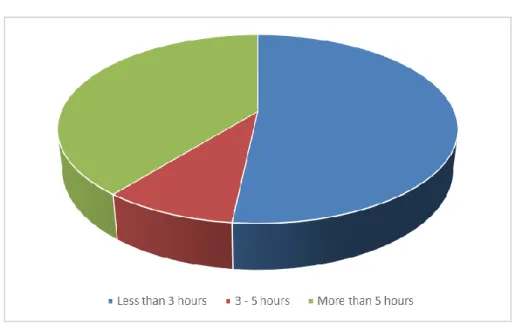
Fi e 5.1: Respondent‘s smart devices usage per day. ... 33
Figure 5.2: Device preferences of respondents. ... 33
Fi e 5.3: Percentage of used operating system by participants. ... 34
Fi e 5.4: Examples of positive and negative skew ... 37
Fi e 5.5: Examples of positive and negative kurtosis ... 37
Fi e 5.6: CFA model. ... 42
Fi e 5.7: Structural Equation Model. ... 45
LIST OF TABLES
Page Ta e 2.1: The benefits and challenges in introducing wearable health technologies.
... 11
Ta e 2.2: Internet of Things in health care. ... 14
Ta e 2.3: The internet of things status and visions of some well-known technology firms. ... 15
Ta e 5.1: Demographic profile of respondents. ... 32
Ta e 5.2: The resume of Validity and Reliability Assessment. ... 36
Ta e 5.3: Rescaled Standardized Kurtosis Index and Skew Index. ... 38
Ta e 5.4: CFA Factor Loadings. ... 40
Ta e 5.5: Standardized Regression Weights. ... 41
Ta e 5.6: Model Fit Analysis for CFA. ... 43
Ta e 5.7: Squared Multiple Correlations ... 47
Ta e 5.8: Regression Weights. ... 48
GİYİLEBİLİR SAĞLIK İZLEME CİHAZLARININ BENİMSENMESİNİN TAHMİN EDİLMESİ YENİLİK YAYILIMI TEORİSİ UYGULAMASI
ÖZET
Bu çalışmada, Türkiye pazarındaki müşterilerin giyilebilir teknolojiyi kullanma ve benimseme konusundaki algılarını analiz etmek amacıyla Everett Rogers‘ın inovasyon yayınım modelini uygulanmıştır. Likert tipi, online tasarlanmış bir anket yoluyla 210 gönüllünün cevapları alınmıştır. Veriler, SPSS sürüm 24 ve AMOS sürüm 23 ile doğrulayıcı faktör analizi (CFA) ve yapısal eşitlik modellemesi (SEM) ile analiz edilmiştir. Temel olarak beş hipotez incelenmiştir. Bağımlı değişken (benimseme) ile diğer dört bağımsız değişken (izafi fayda, uyum, denenebilirlik ve gözlemlenebilirlik) arasında pozitif bir ilişkinin varlığı kabul edilmiştir. Ancak, sadece bir değişkenin (karmaşıklık) benimsemeye olumsuz etkisi olduğu düşünülmektedir. Bu araştırma, giyilebilir sağlık izleme cihazlarının benimsenmesinin seçilen pazarda bir trend haline gelip gelmeyeceğini öngörmeye yönelik bir denemedir. Diğer taraftan, sonuçlar önceki çalışmalarla karşılaştırıldığında şaşırtıcı ve ilginçti. İki hipotezin kabul edildiği ve diğerlerinin reddedildiğini gösteren araştırma, benimseme üzerinde uyum ve karmaşıklığın etkisini göstermiştir. Uyumun benimseme üzerinde olumlu etkisi olduğu onaylanmıştır ve bu da giyilebilir sağlık izleme cihazlarının (HTD) yaşam tarzı, inanç ve değerlerle uyumlu olmasının önemini yansıtmaktadır. Bu arada, benimseme üzerinde karmaşıklığın olumsuz bir etkiye sahip olduğu görüşü de desteklenmiştir. Bir başka deyişle sadelik, Türkiye pazarında giyilebilir cihazların kullanımı hassas ve kritik bir nokta olarak görülmektedir. Reddedilen faktörler ise izafi fayda, denenebilirlik ve gözlemlenebilirlikti. Sonuçların anlaşılması için çalışılan pazarın, örneğin Türkiye pazarının göz önünde bulundurulması ve giyilebilir sağlık izleme cihazlarının hala genç kabul edildiğinin bilinmesi gerçekten çok önemlidir. Bu nedenle, müşteriler bunu denemek bile istemeyebilir. Buna ek olarak faydalar hedef kitle açısından yeterince açık olmayabilir ve bu faydalar bazı nedenlerden dolayı anlaşılamayabilir. Bu nedenle, kullanıcının bu tür cihazları benimsemeyerek elde edeceği avantajların anlatılması çok önemlidir.
Anahtar Kelimeler: Nesnelerin İnterneti, giyilebilir ürünler, teknolojinin
PREDICTING THE ADOPTION OF WEARABLE HEALTH TRACKING DEVICES: AN APPLICATION OF DIFFUSION OF INNOVATION THEORY
ABSTRACT
This study applied Everett Rogers‘ innovation diffusion model to analyze the perceptions of customers in Turkish market toward using and adopting wearable technology. 210 voluntarily responses were collected via Likert type online designed questionnaire. Data were analyzed by SPSS version 24 and AMOS version 23, through confirmatory factor analysis (CFA) and structural equation model (SEM). Basically, five hypotheses were investigated. It is assumed there are positive relationships between the dependent variable (The Adoption) and the other four independent variables (Relative advantage, Compatibility, Trialability and Observability). However, just one of the independent variable (Complexity) considered having a negative relationship with the Adoption. This study is a try to foresee whether the adoption of wearable health tracking devices is going to become a trend in the chosen market. Moreover, the finding was surprising and interesting comparing with previous studies. Where it revealed acceptance for two hypotheses and rejecting the rest, the supported factors were compatibility and complexity‘s impact on adoption. Compatibility was confirmed to have a positive effect over the adoption, which reflects the importance of wearable health tracking devices (HTD) to be compatible with lifestyle, beliefs and values to Turkish market. Meanwhile, complexity was supported by having a negative effect on the adoption. In other words, simplicity is considered by Turkish market as a sensitive and critical point in term of use of wearables. In this study, the rejected factors are Relative advantage, Trialability and Observability. It is really essential for the results , to be understood while considering the market that has been studied, for example, wearable HTD in Turkish market is still considered young. Therefore, customers might not even think of trying it. Add to that, the benefits might not be clear enough to the target customers or they are not able to see and understand those benefits for some reasons, thus, it is very critical to explain the advantages that are the user is going to gain by adopting such devices .
Keywords: Internet of Things, wearables, technology adoption, consumer behavior, health and fitness, Health tracking devices.
1. INTRODUCTION
1.1 Statement of the Problem
In producers or innovators‘ working life there is a goal that every one of them struggle to make it real, making their products or innovations become every day‘s talk. Many companies, individuals or even group of people dream to make enormous profit out of their product, and to increase the profit they need to increase the sales. However, the majority of people won‘t buy the innovation unless it crosses the chasm, which was defined by Roger in DOI theory to be the gap between Early Adoptors and Early Majority (Roger, 2003) . Nowadays, one of the most popular innovations is wearable devices, which is the area of focus for this thesis. Such devices provide users with the ability of monitoring health statue. For instance; tracking of data and communication with a doctor, heart rate monitoring and calories burn count during exercise or physical activity. Moreover, this innovation gives the ability for syncing with the smart phone and other devices, interaction with social media and planning and scheduling of daily routines. Global shipments of wearable devices are forecast to reach 125.3 million units in 2018, up 8.5% from 2017, according to the International Data Corporation (Framingham, Mass., 2018).
However, this technology is still considered young in Turkish market, as the applied questionnaire through this study shows 85.6% of the particpants don‘t use wearable devices. This research is trying to invastigate this problem by applying DOI theory‘s factors (relative advantage, compatibility, complexity, trialability and observability) to understand user adoption of such HTD. The findings would give insights whether the adoption of wearable health tracking devices is going to cross the chasm. With the mentioned questionnaire, the participants‘ responses will be analyzed via SPSS and AMOS, in order to find out what factors influence the adoption process, then, making comments on the findings. The findings of this research are expetcted to help to predict and give
wearable HTD‘s innovators valuable feedback in all means, which would provide a very critical insights in developing marketing straregies.
1.2 Purpose of the Study
Overall, the aim of this research is to apply a theory ―Diffusion of Innovation‖ (Roger, 2003) on the adoption of wearable HTD in Tuekey. Essentially this research is trying to assess whether the five factors of the theory (relative advantage, compatability, complexity, trialability and observability) have any impact on user adoption of wearavle HTD. Analyzing the collected data would give feedback in order to make action to improve the wearable HTD‘s chance spreading over Turkish market.
1.3 Research Questions
In accordance with the purpose of the study following research question was formulated:
What factors influence user adoption of wearable health tracking devices?
Sub-questions:
Is there a positive relationship between Relative Advantage and the Adoption of wearable health tracking devices?
Is there a positive relationship between Compatibility and the Adoption of wearable health tracking devices?
Is there a negative relationship between Complexity and the Adoption of wearable health tracking devices?
Is there a positive relationship between Trialability and the Adoption of wearable health tracking devices?
Is there a positive relationship between Observability and the Adoption of wearable health tracking devices?
1.4 Originality / Value
Although wearables are spreading more widely and their popularity and adoption in markets will reach 189.9 million units in 2022, according to the International Data Corporation (Framingham, Mass., 2018). The number of researches that studying the diffusion of such innovation remain limited. This thesis is an attempt amongst the primary scientific researches which investigate the adoption of wearable HTD in Turkish market.
1.5 Thesis Outline
This thesis consists of six main chapters:
Chapter 1, as Introduction part of the study includes the statement of the problem, objective of the research, formulated research questions and originality of the study.
Chapter 2 reviews available literature dedicated to background of Smart devices and Internet of Things, as well as background of Diffusion of innovation theory in general and its factors. Additionally, literature review has been conducted on background of the adoption of wearable health tracking devices and previous studies made on this regard.
Chapter 3 depicts research model designed for this study and formulated hypotheses based on previous studies.
Chapter 4 describes the methodology of the research with research design, sample size, implemented survey tools and techniques subtopics.
Chapter 5 is dedicated for analyzing the data with a help of statistical techniques. This chapter also reveals the outcomes of the research.
Chapter 6 proposes managerial implications based on research results and discusses research results. Additionally, it provides limitations of the study that can be used for future research.
2. LITERATURE REVIEW
2.1 Background of Smart devices
Nowadays, Smart Devices are used over the world almost every place, every time by everyone. Its role kept increasing in our daily life until no one can even imagine his/her life without it. Its essential role in our daily life cannot been argued. There are many applications for the smart devices, such as mobile smart devices, smart cards, RFID, smart home, wearable devices, etc. These Smart environments consist of devices such as sensors, controller and computers that are embedded in, or operate in. These devices are strongly context -aware of their physical environment in relation to their tasks. Smart devices can have the awareness of specific user activities. For example, gates which acting when individuals moving toward those gates. The action that is taking is happening typically independently without any command or involvement by the walkers. However, the focus nowadays is on finding more complex models of interaction of the smart devices, and aiming to enhance the corporation between the smart devices itself. For instance, an intelligent camera inside a room is able to collaborate with smart lights to adjust them so increase the ability to have a clearer picture or video to be recorded.
In this research, it is going to examine the adoption of health tracking devices, which is one of the wearable family generated as an application of the smart devices. (Poslad, 2013).
2.1.1 Smart devices definition
Smart devices have been an area of focus for many companies and research centers last years. The term -smart device- is used to refer to devices that automatically gather information about users or their environment to assist them in gaining knowledge about themselves and/or taking action. Other terms that have been used to refer to smart devices are personal informatics systems in conference on human factors in computing system, 2010 and quanti fied self in
conference on human factors in computing system, 2014. Smart devices usually supposed to have a variety of functions and objectives as information and communication technology gadgets, e.g., laptop, cell phones, moreover, in order to get the benefits of many common various implementation these devices are used as a platform, no matter this implementation is established distantly by a server or regionally on the equipment. Variety of types are existing as intelligent gadgets and appliances. Which usually have a tendency to be used personally by a particular person with modified setting. In this gadgets type, the control unit and interacting point located in the intelligent equipment. The major features of the gadgets mentioned above are defined in the following: movable, reachable effective applications and non-continuous power charging needed (synchronization, promotion, etc.). Usually devices are destined to be multipurpose as a result of easy reachable and accessible feature, and facilitate the ability to interoperation, multipurpose at work time. Yet, achieving a balance while comparing two desirable but incompatible features is something people tend to refuse, since they do prefer to have advantages from the device as much as possible, so this issue is in a declined level, which is required the system to keep up hardware parts and to provide an additional effective adjustable ability to interoperation work time. Computers usually tend to be considered firstly as multi-functional PC or host computers with server, including kind of demonstration system for showing the data and for sure some tools which used to enter the data such as pointing tools or a mouse and a keyboard. As human beings, they have tendency to deal with gadgets and appliances which include monocular built-in and computing machinery system, for example home devices, as well as dealing with complicated apparatuses which have multiple built-in computing machinery system. Weiser draw attention to a point, where he pointed out a tendency to change from a lot of users per computer, to just one user for each computer, furthermore, heading to number of computers for one user. Devices which rely on computing system technology are heading to achieve effectiveness in size and lighter in weig ht, economical to be produced. Thus, devices can become widespread, made more movable and can appear less irritating. Weiser took into consideration a variety of device sizes in his early work from wearable centimeter-sized devices (tabs), to hand-held decimeter-sized devices (pads) to meter sized (boards) displays.
ICT Pads to give users the ability to reach the phone features and information and communications technology tabs to follow merchandise which are used widely. Another advantageous way for screening to a lot of customers is wall displays, for cooperative operation and showing massive complicated designs such as charts. Another way for screening, horizontally oriented as surface computers or vertically, is board appliances (Poslad, 2013).
2.1.2 Some of smart devices applications.
The applications of smart devices entered our daily routine without even any permission or request, starting with looking at your phone in the morning to know the time, and finishing with moment that you are setting the alarm on your smart phones for the next day. The products of smart devices vary so widely, some of them at home e.g. Smart home, some of them on the transportations e.g. Smart cards, some are used in the marketing e.g. RFID, and others in different places and situations, e.g. wearables and smart watches.
2.1.2.1 Smart home
Sergey Balandin, Sergey Andreev and Yevgeni Koucheryavy identify the term Smart home in their book, Internet of Things, Smart Spaces, and Next Generation Networking, 2013, as a house includes various extremely developed intelligent interrelated appliances. Consequently, the circumference of this type of homes is able to understand, know, analyze, logically thinking and expectation about the action that might be acted by a user and can based on that react appropriately (Ma et al., 2005). All what these appliances and devices are doing is to follow the requirement and wants of a user in order to make life‘s quality much higher. There was an association in Netherlands in 2007 named Smart home association, this association identify the kind of homes as it is the home that is doing services in a home environment by using the technology in order to raise the comfort and quality for whom is living at home (Bierhoff et al., 2007). However, there is a question which wort asking, what can this technology add as an application in an intelligent house? Trying to answer this question, basically, three factors are making this intelligent home environment: Firstly, ambient intelligent space (AmI‐S) which is refer to the computers and sensors that are set up in the environment, so they can interact with the user
actions by automatic smart sensibility. For example: when it is talking about the smart table in the room. This kind of technology will increase the comfort and happiness, in addition, it would help in daily activities such as cleaning or taking care of a baby. Secondly, virtual space (VR‐S) in created from information and communication technology devices, like smart furniture and walls which have a connection with a network. This part is responsible for some kind of activities such as tele-learning and tele shopping…etc. Thirdly, physical space (PS) and which is joint with virtual space (VR‐S), this is in fact the conventional space where people are with their bodies. Of course, the impact of this evolutions in technology will extend to cover the style of life in the future and housing needs, through increasing the comfort, appropriate way to live by offering more technical possibilities. User Centered Framework is d esigning to cover consumers and the new style of life and locative tendency, in order to better understanding what these updating in technology will impact marketing strategies and real state administration.
Previously, there was a dream cold ―Smart house‖, because of the development in the technical fields, nowadays there is a chance to understand that dream better. These homes have reputable ―Possibilities of Sustainability‖; they are described to be able to develop energy maintenance, repose, wellness, safety, space and time usage. A superior realization of the role that can Smart Home represent in real estate scope is offered by knowing all these capabilities. Add to that, what would make Smart house foreseeable and accomplishable is connecting this ―Possibilities of Sustainability‖ to the ―Trends of Sustainability‖ and waiting for the results.
2.1.2.2 Radio frequency identification
In the last few years, researchers and producers has a focus area which is RFI the technology of Radio Frequency Identification (Sarac et al., 2010; Ju et al., 2008). What cause this wave of interest into RFID is the fact that this technology is quicker than barcode technology by ten to twenty times. This technology is system which has the ability to identify automatically objects using radio signal within its domain with no inconsistency (Vlachos, 2014 ; Muller-Seitz et al., 2009; Inlogic, 2013; Enasys, 2014; Roberti, 2013). This technology was clarified by Tajima in 2007 as it is tags consisted system
including a micro size chip and an antena, plus a reader which is electronical device, its responsibility to transfer data between the tag and the database, and a software that acts as a bridge between the operating system or database and applications, which gathering and filtering the information in order to avert invalidity and provide (ERP) the enterprise resource planning system with the filtered data so the system will administer the processes. The radio frequency identification system basically includes tags with control over the fre quency, devices called readers and a system operates tagging operation. This technology is an advanced automatic system which is superior than the scanning system called manual barcode. As Vlachos explained in 2014. Based on many elements, as an example industrialization setting and possible revenue, this technology is vastly changeable in terms of cost and paid price. (Sarac et al., 2010). Moreover, this technology applications develop generally the ability to make profit and the quality of the achieved work through developing the ability to trace and the availability of a product (Gaukler, 2010; Aiello et al., 2015). Since this technology is informing and acting basing on the consumers demands, its accuracy is described to be extremely functional and dynamic method in stock management (order and forecast) (Vlachos, 2014). Add to that the fact that this technology is able to play a critical rule in designing, applying, developing and managing supply chains and producing processes (Ngai et al., 2010; Jimenez et al., 2013), moreover, RFID is able to decrease stock issues and matters due to its developed actual-time informative database availability (Bottani et al., 2010; Kok and Shang, 2014). Major properties of RFID are illustrated in figure 2.1, as it is quick, affordable and efficiently cost tool, that provides for every object an automatic specific code, it has feature such as actual-time detecting and tracing, location details and information, effective operations management, observability, enormous customized production, standardized work, visualized and mentoring operations…etc. In addition to the previously mentioned advantages, RFID can further help in improving, delivery of client‘s ordering delivery, manufacturing control, stock control...etc. (So, 2010; Huang et al., 2010; Qu et al., 2013; Chongwatpol and Sharda, 2013).
Fi e 2.1: RFID Properties
Resource: RFID impacts on barriers affecting lean manufacturing, 2016
2.1.2.3 Wearables
Even though the debut of Hamilton Puslar P1 where digital wristwatches come into sight digital by 1972 primarily, the one that was able to do more than showing the date and time as a first smart watch appeared in 1982 by introducing Sieko‘s Puslar NL C01, which included memory with the ability to be programmed by the user (Charlton, 2013). Throughout the early 1980s Seiko kept going to improve smart watch technology, by introducing a new series which are Data 2000 and RC-1,000 with the ability to offer an exterior keyboard for entering information and transferring by using a cable from laptops and desktops (Marshall, 2013). As the improvement of technology increased, reducing sizes, and the ability to produce a greater number of products with low-priced and quicker performance, smart watches began to be promoted into the new version by integrate a growing amount of intelligent advantages with having higher capacity of computing. In 2000 a tram was created by IBM and Citizen to improve a wristwatch which using Linux as an operating system and
created a trial model of intelligent watch, the WacthPad, with the following features: 32-bit CPU, memory with 16 MB, scanning the fingerprnt ability, and a mic (Chalrton, 2013). By using the radio FM wave to transfer the data, a smart watch with wireless connectivity named SPOT was introduced by Microsoft in 2003. Even though the idea about the future of smart watches which is wireless technology was understood by Microsoft, however, not FM but Bluetooth was the technology that formed the existing smart watch trend (Marchall, 2013). The continuing improvement of phones and devices based on the technology of communication and information has generated a superb medium where users utilize both phones and intelligent watches concurrently. Of course, intelligent watches are not awaited to be used instead of smartphones, but to help in particular for gathering beneficial info from a paired device as satellite equipment via Wi-Fi connection system and supplying more leisure, quicker, functional and practical information reachability, particularly when using a smartphone can be unpractical way of use, and smart watches is processing the information with less exacting and effort. This feature of smart watches differentiates them from other mobile accessories, which make them technologically and psychologically magnificent communication tools that worth deeper research and discussion.
Health tracking wearable
A lot of different kind of information got to be gathered so an individual‘s health situation and lifestyle can be understood and assessed; which needed to be combined in order to have a comprehensive indicator of their well -being. However, in general it is not unpretentious to trace people‘s personal activity data based on factors evaluated in the home from use of devices, except a person lives just by himself, motion in chambers, transfer from couch and seats and closing of windows. Thus, while the IoT assumes that if kitchen devices and other observing devices were connected, that might lead to a wealthy set of data that can be considered to supply related information on household activities, more straight observations are essential on an individual basement. This observation can be done by carried devices by people and or through wearables which are attached to or within their bodies.
Wearables – pros and cons
The wave of attention in wearable technologies in last years might be indicated by to a number of causes, the five described below can be mentioned as bunch of them:
Increasing in users‘ concern in medical technology, particularly with more tendency to precaution lifestyle and aiming for maximal fitness; New concern in adjusted and personal digital healthcare programs which
provided by apps for smartphones and tablet devices;
The accessibility of nearly global wireless connection by Wi-Fi and phones networks;
Contemporary developments in electronics and sensing technologies which become smaller, lighter and power-efficient gadgets; and
Functional and strong wearable, added to movable computing power and software.
Despite these reasons, many obstacles needed to be overcome before users changing existing technologies with wearable devices in term of supporting living technologies. The advantages and the obstacles are compared in Table 2 . It is -1 fortunate that fast procedure is being made in order to meet and overcome the challenges to wholesale adoption (Doughty, K., and Appleby, A. (2016).
Ta e 2.1: The benefits and challenges in introducing wearable health technologies.
The benefits and challenges in introducing wearable health technologies
Benefits challenges Comments
1- Monitoring health status continuously.
2- Improve the ability to manage their devices.
3- Providing direct feedback to users.
4- Provide remote monitoring of lifestyle and medication adherence.
5- Offer standards measurement method to the community. 6- Allows measurement of key parameters in new and direct ways.
1- It requires a lot of resources which can only be available for rich people. 2- Improve the experience of the users so they all can be used these devices. 3- Making them sufficiently robust (and waterproof) to avoid accidental damage.
4- Offering discreet feedback so that information is not accidentally shared. 5- Making sure that users aesthetically pleasing, easy to sync with
smartphones.
6- Having new methods of
measurement accepted by the medical experts.
1- Body heat/motion can provide power. 2- Potential users may have cognition issues. 3- 3D printing allows gor simple cases. 4- Smartphones apps can be customized. 5- Wearables as fashion items offer simplicity.
6- Data needs analysis to improve outcome.
2.2 Background of IOT
The Internet of Things (IoT) is a term which means a connected set of anybody, anything, anywhere, any service, and any network, no matter when. The IoT is an embody in next version of technologies that is able to affect the entire business world and can be considered as the interconnection of unparalleled defenation intelligent objects and devices within today's Internet basement with expanded advantages. Advantages usually contain the developed connection of these appliances, machines or gadgets, framework, and applications that exceed device-to-device situations. Thus, almost in all domains making machine‘s role bigger is something desirable. Variety of resolution for many implementations such as intelligent city, traffic jam, wasting of management, safety issues, economics issues, manufacturing observation, and medical and wellness issues were supplied by the IoT technology. The Internet of Things (IoT) identify intelligent devices as the ultimate building blocks in the improvement of cyber -physical smart. The IoT has a lot of application fields, as well as health care. The IoT revolution is regeneration the up to date health care with encouraging technological, economic, and social fields.
2.2.1 IOT and health tracking devices
The revolutionary IoT has faced a burst of activity and innovation in the healthcare field, thrilling contractors and enterprise capital firms. The term came to light as a collection of newly established business and big companies , which are ready to participate in what might be a huge market, besides providing products and technologies. This sector supplies an inclusive record of innovations for a superior perception of the Internet of Things situation in healthcare domain. A trial model of sensor for wearable was produced by Edisse with actual-time tracing, activity detection and alarms. The normal features of any phone are fundamentally included such as SMS, Global Positioning System, internet connection via phone‘s network, and an acceleration measurement device to reveal abnormal event, for instance; informing the responsible part after recording a falling down action, a baby and his mother (Islam et al,. 2015). Withings has improved a bunch of healthcare gadgets, containing a number of applications for scale measuring, a blood pressure devices and applications, and
a children observer (Islam et al,. 2015). A company from China has produced a device with a virtual storage and computation basement working as a platform for managing medicinal photocopying and information called miPlatf orm, with Three-Dimensional picture on web, visualized and post-processed, and remotely treatment (Islam et al,. 2015). In Chinese medical industry, Neusoft has supplied broad IT solutions and personal healthcare network services , and their services is also available for medical centers, communal health care establishments and health administration. Healthcare services based on the Internet of Things, which was the domain that Neusoft has focused on (Islam et al,. 2015). A fitness smartwatch band is able to issue intelligent announcements in order to inform the users to make the decision whether to act differently or to carry on with their way of acting which called Garmin‘s Vivosmart (Islam et al,. 2015). With plentiful modern sensors, a wearable which is Jawbone‘s UP3 is providing the users with a whole image of their healthy condition , and contains tracing for actions, sleeping situation, training guidance and monitoring for the heart condition (Islam et al,. 2015). As it can be seen in Fig. 1.1, with the ability to observe and compute human‘s pulsation, the degree of both, heat and blood‘s oxygen in the body, a wearable with these features was made by Angel, this wearable provides the smartphone of the user with these pivotal details (Islam et al,. 2015). Researchers have produced an adequately built-in and thin wearable with blood pressure sensor, that has the ability to be utilized to submit continuous observing for an extended run, with causing no annoyance to the user while he is doing his daily activities, the research has been held in Korea (Noh, 2014). A collection of Internet of Things healthcare appliances has been improved containing a Wi-Fi, blood pressure observation, oxygen and blood glucose level observation and more. These appliances have been developed by a laboratory group called iHealth (Islam et al,. 2015).
In health tracing domain, a lot of wrist wearable devices have been produced, such as Misfit, Fitbug Orb, Omate truesmart smartwatch, Samsung smartwatches, Amiigo Activity Tracker, Fitbit wearable and more.
Fi e 2.2: Positions in different sensors in angel
Resource: The IoT for Health Care 2015
In the next two tables the IoT healthcare situation and observation of some well -known technology companies and IoT implementations in healthcare can be seen.
Ta e 2.2: Internet of Things in health care.
Infirmity/ condition Sensors used; operations; IoT roles/connections
Diabetes A non-invasive opto-physiological sensor; the sensor‘s output is connected to the TelosB
mote that converts an analog signal to a digital one; IPV6 and 6LoWPAN protocol architectures enabling wireless sensor devices for all IP-based wireless nodes. Wound analysis for
advanced diabetes patients
A smartphone camera; image decompression and segmentation; the app runs on the software platform in the smartphone's system-on-chip (SoC) to drive the IoT.
Heart rate monitoring Capacitive electrodes fabricated on a printed circuit board; digitized right on top of the electrode and transmitted in digital chain connected to a wireless transmitter; BLE and Wi-Fi connect smart devices through an appropriate gateway.
BP monitoring A wearable BP sensor: oscillometric and automatic inflation and measurement; WBAN
Connect smart devices through an appropriate gateway. Body temperature
monitoring
A wearable body temperature sensor; skin-based temperature measurement WBAN Connect smart devices through an appropriate gateway.
Rehabilitation system A wide range of wearable and smart home sensors: cooperation, coordination, event detection, tracking, reporting, and feedback to the system itself; Interactive
heterogeneous
wireless networks enable sensor devices to have various access points. Medication
management
Delamination materials and a suit of wireless biomedical sensors (touch, humidity, and CO2); the diagnosis and prognosis of vitals recorded by wearable sensors; the global positioning system (GPS), database access, web access & RFIDs, wireless links, and multimedia transmission.
Wheelchair management
WBAN sensors (e.g., accelerometers, and ECG, and pressure); nodes process signals, realize abnormality, communicate with sink nodes wirelessly, and perceive
surroundings:
smart devices and data center layers with heterogeneous connectivity. Oxygen saturation
monitoring
A pulse oximeter wrist by Nonin; intelligent pulse-by-pulse filtering; ubiquitous integrated clinical environments.
Ta e 2.2: (con) Internet of Things in health care Infirmity/ condition Sensors used; operations; IoT roles/connections Eye disorder, skin
infection
Smartphone cameras; visual inspection and/or pattern matching with a standard library of images; the clouds-aided app runs on the software platform in the smartphone‘s SoC to drive the IoT.
Asthma, chronic obstructive pulmonary disease, cystic fibrosis
A built-in microphone audio system in the smartphone; calculates the air flow rate and produces flow-time, volume-time, and floe-volume graphs; the app runs on the software platform in the smartphone‘s SoC to drive the IoT.
Cough detection A built-in microphone audio system in the smartphone; an analysis of recorded spectrograms and the classification of rainforest machine learning; the app runs on the software platform in the smartphone‘s SoC to drive the IoT.
Allergic rhinitis and nose-related symptoms
A built-in microphone audio system in the smartphone; speech recognition and vector machine classification; the app runs on the software platform in the smartphone‘s SoC to drive the IoT.
Melanoma detection A smartphone camera; the matching of suspicious image patterns with library of images of cancerous skin; the app runs software platform in the smartphone‘s SoC to drive the IoT.
Remote surgery Surgical roast systems and augmented reality sensors; roast arms, a master controller, and
a feedback sensory system giving feedback to the user to ensure telepresence; real-time data connectivity and information management system.
Resource: The IOT for health care Resource.
Ta e 2.3: The internet of things status and visions of some well-known technology firms.
Firm Status and vision
CISCO CISCO is ready to provide converged systems based on unrelated networks and can introduce
effective algorithm for handling cumulative traffic loads originating from massively deployed IoT healthcare devices with advanced data analysis. In addition, it can offer clients a new class of intelligent applications to increase efficiency without losing security. CISCO has worked with leading healthcare organizations to develop a medical-grade network architecture. Microsoft Microsoft has forced on using an intelligent system to uncover the potential of IoT-based
healthcare solutions. Intelligent systems provide the backbone of technologies that allow for the capture of health data from devices to ensure required connectivity. Microsoft has business intelligence tools capable of extracting important insights from collected data.
Google Google has opened its code for an open-source physical web standard for the IoT, which can be considered an attempt to arrange an easier approach to communicate with connected medical devices.
Samsung Samsung Electronics, together with University of California, San Francisco, has established a digital health innovation lab to develop new smart health technologies. In addition, Samsung together with IMEC (a leading bio-sensing research institute), has developed the Simband platform, an open reference design for sensor modules. Samsung‘s goal is a ubiquitous and seamless user experience for better health for everyone with no additional complexity. Qualcomm The 2net Platform of Qualcomm Life offers a set of wireless health solutions that can capture
and deliver health device data to integrated portals and databases from almost all wireless medical devices of users. Such data can be stored in a system to integrate security and interoperability Qualcomm is trying to develop intelligent, intuitive, and innovative IoT healthcare solutions.
Intel Intel-powered devices can strengthen information security and improve interactions between doctors and patients. Intel emphasize real-time synchronous communications systems and health data streaming, which can help reduce the cycle time and improve the first-time quality of many existing medical workflow environments. Intel‘s vision is to bring about IoT-based healthcare solutions anytime, anywhere.
Ta e 2.3: (con) The internet of things status and visions of some well-known technology firms.
IBM IBM redefines value and success in health care through the notion of smarter health care. IBM
has helped to develop a set of IoT devices through partnerships of other renowned firms across the world. It focuses on a series of health care solutions such as connected home health, data governance for health care, and health analytics for health care providers.
Apple Apple has publicly claimed the IoT as an ultimate technology. The apple watch can be considered a smart watch, a fitness tracker, or a heart monitor. The Memorial Hermann healthcare system relies completely on Appel‘s solutions to provide efficient and connected healthcare services focusing on secure access, physician gains and better care.
Wind River Systems
Wind River has developed a cloud and business logic model for medical solutions based on the IoT, it designed specialized gateways, data centers, supervisory/ data aggression systems, and device control systems/sensors for this purpose. This model is expected to improve medical services facilitating life-enhancing aid for patience and providers.
Deutsche Telekom
Deutsche Telekom follows the concept of a secure healthcare internet system. It serves as a bridge between associated stakeholders. Researchers on the team focus on developing technologies that can help healthcare services gradually become personal, local, and digital instead of being centrally organized.
GSMA GSMA, an association of mobile operators and related firms, has launched connected living programs to bring the mobile industry and healthcare stakeholders together to deliver sustainable mHealth solutions over an intelligent and secure IoT network
ThingWorx ThingWorx solutions are used by many firms to develop connected healthcare products. ThingWorx enables firms to efficiently enter a connected product space.
Numerex Numerex in one of the top providers of IoT solution and offers stakeholders required support for designing ne mHealth products and converting wired legacy systems into wireless ones. Machine
Research
Machine Research has worked on developing a set of solutions for connected healthcare system based on the IoT. Topics covered by its research team include AAL, remote clinical monitoring, clinical trials, connected medical environments, and telemedicine.
Aeris Aeris is ready to deliver IoT solutions for remote patient monitoring, medical device manufacturers, and healthcare providers.
Eurotech Eurotech design connected medical and healthcare products that can serve as building blocks for large systems.
2.3 Background of Diffusion of Innovation Theory
Diffusion of innovations is a theory that explains how, over time, and why ideas and technological innovations gain momentum and diffuse through a specific population. Based on this theory, there are five factors which influence adoption of innovation: Relative advantage. Compatibility. Complexity. Trialability. Observability.
This study is going to focus on applying these five factors on wearable health tracking devices in Turkish market, investigating the results and answering the
question, is it going to reach the Early Majority level and cro ssing the Chasm? (Geoffrey Moore, 2001(.
Fi e 2.3: Crossing-The-Chasm
|Resource: Geoffrey Moore October 2001
Fi e 2.4: Crossing-The-Chasm
Five adopter categories were established:
Innovators: this category is explained to include people who are willing to try an invention firstly and mostly before anyone else. They are described to be adventurous and concerned in innovations and fresh concepts. This category has the tendency to take venture and usually the new ideas are improved by them.
Early Adaptors: this category includes people who symbolize the leaders of opinion in a community. They like to play a leader role and adopt new chances. They knew deeply the importance of changing and so they adopt new ideas with comfort. plans to address those people contain explaining the way of use and providing information on applications.
Early Majority: usually people in this category is not commanders; however, they accept modern conceptions before the normal individual. They typically need to see evidence that the innovation works before they are willing to adopt it.
Late Majority: these people are skeptical of change and will only adopt an innovation after it has been tried by the majority.
Laggards: these people are bound by tradition and very conservative. They are very skeptical of change and are the hardest group to bring on board.
2.3.1 Relative advantage
Relative Advantage is an observation of the advantages and benefits of adopting a specific innovation, improvement over something already existing. Innovations that have a clear, unambiguous advantage in either effectiveness or cost-effectiveness are more easily adopted and implemented. The potential adopter must first calculate its relative strengths. What is the advantage over the older wearable? What improvements does it hold? What other benefits in terms of ease-of-use, additional software packages, etc. does it present? ―Relative advantage is a sine qua non for adoption‖ (Greenhalgh et al., 2004) Conclusion: If someone finds an advantage in CB, the individual will be more likely to adopt it.
2.3.2 Compatibility
It is also required to be diffused that an innovation has to be compatible with the values, beliefs, past history, and current needs of the adopters. Innovations that are compatible with the intended adopters‘ values, norms, and perceived needs are more readily adopted. How well does it fit into a person‘s needs, usage patterns and/or current value the user has? How consistent it is with the values, experiences, and needs of the potential adopters? Conclusion: If an innovation was more compatible with a person‘s lifestyle and cognitive characteristics, it would be more likely to be assimilated into an individual‘s life.
In the second parameter of the studied theory, the focus is on the subject of integration between the product, which is health tracking device, and the user. 2.3.3 Complexity
Basically, Innovations that are perceived by users as simple to use are more easily adopted. And here, by mentioning complexity, it refers to the level of difficulty that the potential adopters encounter with the innovation. How difficult it is to be understood and used. In order to overcome this barrier, it is considered that complexity can be reduced by practical experience an d demonstration, which leads us to the next factor: Trialability. Conclusion: The more complex or the more difficult the innovation is to understand, the less likely it will be adopted, and its diffusion will occur more slowly.
2.3.4 Trialability
Innovations with which the intended users can experiment are adopted and assimilated more easily, is another characteristic that determines the rate of diffusion. The extent at which the innovation can be tested or experimented with before a commitment to adopt is made. Being able to test the innovation or try it out will facilitate the rate of adoption. Conclusion: If the innovation can be experimented with or taken out for a ―test drive‖ it is more likely to be utilized.
2.3.5 Observability
The extent to which the innovation provides tangible results. Initiatives to make the benefits of an innovation more visible increase the likelihood of their assimilation. The innovation will likely spread through the target population faster if the benefits are visible and tangible. Conclusion: The easier it is to see the advantages of an innovation, the faster it will diffuse throughout society.
2.4 Previous Studies on HTD adoption
A lot of theories have been applied in the previous time to define the elements that have impact over the adoption of innovation in the past. For example, the reasoned of action theory (TRA), planned behavior theory (TPB) by Fishbein and Ajzen in 1975, the model of technology acceptance (TAM) (Chen et al., 2011). Privacy calculus theory (PC) (Dinev and Hart, 2006) and Diffused Innovation Theory (Rogers 1995, 2002, 2004). The articles that studied the adoption in Turkey of HTD particularly have relatively small number, However, if the focus is looking to the wearable scope (even out Turkey), more papers and research that have been done can be found. Moreover, the subject area lies within marketing, health care, information & knowledge management, library studies, communication, e-commerce disciplines and adoption. Reviewed articles about HTD adoption were published within 2009- 2018 time period. Large portion of the studies applied primary data obtained through surveys. For instance, according to a survey was held in 2014 by Nielsen Corporation, 70% of the population in America have some knowledge and idea about wearable devices, especially Smartwatches, which are popular (Nielsen, 2014). By 2020 there is a prediction about the annual shipments of wearable devices to increase 500 million units (Gartner, 2015). Smart watches innovation has been promoted extensively and publicized in ICT manufacture, due to its multi -implementation. Which fulfill wide types pf customers' concern. Where its focus cove rs intercommunication and intelligent features besides bodybuilding, health observation and location detection (McIntyre, 2014).
If the focus goes further more into the health care field, research paper written by Adem Karahoca, Dilek Karahoca and Merve Aksöz in 2018, titled Examining intention to adopt to IoT in healthcare technology products , which
was conducted among Turkish people only, can be found. The main finding of this study is that the factors related to technology acceptance and i mage, significantly affect individuals‘ decision to adopt IoT healthcare products. This information may help product designers to pay attention to all these factors when they design an IoT healthcare product. The main limitations of reviewed articles were related to: sampling that may not represent whole population, sample size, secondary data (commercial companies or producers), HTD adoption having dynamic nature etc.
To review related articles within HTD adoption scope following databases have been used: Emerald insight Researchgate Google Scholar Ieeexplore Wiley Sciencedirect Springer
Following keywords were used while searching the relevant artilces: Health tracking device
IoT
Smart device
Health care technology Technology acceptance Wearable
3. RESEARCH MODEL DEVELOPMENT AND HYPOTHESES FORMULATION
3.1 Conceptual Model
The research model of the study is depicted in Figure 3.1. The model visually describes the framework of variables to be examined: Theory‘s factors and HTD adoption. The relationship within the variables will be tested in order to measure to which extent they impact each other. Theory‘s factors are independent variable, while the adoption is dependent variable.
Fi e 3.1: Research Model. 3.2 Relative advantage
According to E.M. Rogers theory‘s Diffusion of Innovation theory (1962) innovators should continuously focus on the five factors that the theory discussed in order to enhance their products‘ chance to cross the Chasm, as these factors have impacts on user‘s adoption. Such adoption behaviors motivate the other categories‘ intentions to repurchase over the target market, which lead to increase sales level and reduce price sensitivity.
Observability Relative Advantage
Compatibility
Compalexity Health Tracking Devices Adoption
Trialability
E
Diffusion of Innovation Theory (Rogers, 1995, 2002, 2004) seeks to explain how novel ideas, products and practices are adopted by members of a specific social group, so using this theory may aid conceptualization of change processes when new technologies are adopted and diffused through health care organizations. This theory has been used in recent years in a review examining dissemination of innovative treatment approaches to substance dependence more generally (Miler et al., 2006). However, this review did not focus on technology-based treatment approaches, but instead included more traditional human-facilitated treatments. Relative advantage has been defined by Roger as the grade in which an invention is recognized as being superior in term of benefits than the concept it is replacing (Roger, 2003). Yet, those five attributes represent the basement that the researcher relies on in order to make research‘s hypothesis. Relative advantge is the first factor which is the degree to which an innovation is understood as being better than the idea it supersedes (Rogers, 1995). Relative advantage through this theory has the meaning of an innovation to be economic profitability by utilize this invention, being affordable is also a benefit, the advantages of utilizing an invention are immediate (Aizstrauta et al., 2015).
Fi e 3.2: Part of IASAM model in SD notation
Resource: Insight Maker Aizstrauta et al., 2015.
Since the more the user is getting benifits out of using the innovation, the more it is likely to be adopted. Therfore, this attribute has been considered to have a positive relationship with the adoption of an innovation. As a consequence of the above-mentioned discussion following hypothesis has been proposed:
Hypothesis 1: Relative Advantage of using wearable health tracking device has a positive relationship with Adoption with such technology.
3.3 Compatibility
The second element in the DOI is compatibility, which means how much an invention is considered to be compatible with familiar values, beliefs, experiences and needs (Rogers, 1995). Relative advantage and Compatibility were considered similar in several diffusion studies, though they are theoretically different. Rogers explained compatibility as the extent to which an invention is considered to be harmonious with the existing values, experiences, and needs of possible users (Roger, 2003). Compatibility based on this theory, is measuring how much is the innovation compatible with existing values, skills, and work practices of potential adaptors.
In the literature, decrease in some kind of discomfort is an advantage of using a specific technology, as important as using this technology advances the social prestige of the user. The use of technology is positioned as compatible with social/cultural values and belief, as well as compatible with client needs. That is to say, the more comfort and suitable the user feels toward any innovation the more he tends to adopt it in his daily life (Aizstrauta et al., 2015). Another way to define compatibility is explaining it by the degree to which an innovation is perceived as being consistent with existing practices or habits and routines (Vijayasarathy LR. 2002). Accordingly, following hypothesis has been proposed:
Hypothesis 2: Compatibility of using wearable health tracking device has a positive relationship with Adoption with such technology.
3.4 Complexity
Aside from other critical points, the attribute of inventions which participate in the invention acceptance procedure and emphasizing on how complicated the innovation is by Roger. He pointed out that researchers who are studying diffusion should focus on the complex of a product from the point of view of investigation and testing. Which is an essential, and a critical point. Add to that the fact which has been proved by observation, where many recent inventions were unsuccessful and others were successful mainly because of its degree of complication, finding out that not all inventions are equal in term of complexity
(Rogers, 2003). A very sensitive point for the target market is how much the innovation is relatively difficult to understand and use; in other words, as a user, he or she should be considered a used technology as effortless, clear and simple in term of use. Otherwise, the risk of losing the interest and engagement of the protentional customers is regrettably high. Hence, the recovery strategies intended to prevent complication of using a product by customers should include following ideas: simpleness, clarity, understandability and post - service (Aizstrauta et al., 2015). Complexity was identified by Roger as the grade to which an invention is considered as comparatively complicated to be understood and used (Roger, 2003). As Rogers believed, complexity is reverse to the other factors, where it has negative correlation with the average of acceptance. Therefore, complexity is extremely important obstacles to be got over for any innovation in its adoption process. A technological invention may challenge teachers to change their teaching method to merge the technological inventio n into their tools (Parisot, 1995), therefore, there may be various degree of complication. If hardware and software are user-friendly, then they may be accepted to be used successfully for the explanation of course lessons (Martin, 2003). Based on discussion above following hypothesis has been proposed: Hypothesis 3: Complexity of using wearable health tracking device has a negative relationship with Adoption with such technology.
3.5 Trialability
According to Rogers (1995) Trialability is the fourth element that influences the adoption process, this factor focuses mainly on how much important to experiment and test the innovation by a user. Trialability defined as the factor of the invention that make the innovation easier if someone wanted to try it o ut. (Rogers, 2003). The invention might be tried out with an experimental base without unneeded extra work and cost; it may be applied progressively and yet offering a fine positive advantage; there are many mechanisms that enable the users to easily try the technology in order to make his/her mind, such as (free download, Trial versions, prototypes and so on) (Aizstrauta et al., 2015). As long as the user has the chance to try an innovation as he more likely to find out its advantages and get involved in the acquiring process. Based on Rogers
definition, trialability is the extent to which an invention might be tried out on a restricted principle‖ (Roger, 2003). Also, trialability has a positive correlation with the rate of acceptance. To make an innovation adopted faster, make it available to be tried as much as possible. Accordingly, following hypothesis has been formulated:
Hypothesis 4: Trialability of using wearable health tracking device has a positive relationship with Adoption with such technology.
3.6 Observability
Observability means the results and benefits of the innovation`s use can be easily observed and communicated to others, in other words, observability is the degree to which the results of using an invention is identical and can be explained with ease to others. As it was defined by Rogers (Roger, 1995). Another definition for observability is the results and benefits of technology is easily visible by potential users. (Aizstrauta et al., 2015). This is the last characteristic of innovations. Rogers defined observability as ―the degree to which the results of an innovation are visible to others‖ (Roger, 2003). Role modeling (or peer observation) is the key motivational factor in the adoption and diffusion of technology (Parisot, 1997). Similar to Relative Advantage, Compatibility, and Trialability, observability also is positively correlated with the rate of adoption of an innovation. Logical speaking, the more the advantages and outcomes of a product are clear and noticeable to others, the higher are the odds of buying and conduct that product by customers. Taken into consideration discussion above following hypothesis has been formulated:
Hypothesis 5: Observability of using wearable health tracking device has a positive relationship with Adoption with such technology.
In conclusion, Rogers discussed the idea which assumes that inventions providing more relative advantage, compatibility, simplicity, trialability, and observability will be accepted faster than other ones. Rogers does warn, ―having a new idea accepted and spread, even when it has clear benefits, is hard‖ (Roger 2003), that is to say having all these variables with the appropriate relationship with the innovation would lead to speed up the innovation-diffusion process.
Research showed that all these factors have impact on faculty members‘ likelihood of adopting a new technology into their teaching methods (Anderson et al., 1998; Bennett, and Bennett, 2003; Parisot, 1997; Slyke, 1998; Surendra, 2001).