T.R.
ISTANBUL AYDIN UNIVERSITY INSTITUTE OF SOCIAL SCIENCES
A COMPARATIVE ANALYSIS OF THE ROLE OF REGIONAL AND INTERNATIONAL ORGANIZATIONS IN THE RESOLUTION OF NATIONAL CONFLICTS. A CASE STUDY: CENTRAL AFRICAN
REPUBLIC (CAR) FROM 2010 TO PRESENT.
THESIS Jean Claude NDI
Department of Political Science and International Relations Political Science and International Relations Program
Thesis Advisor: Assist. Prof. Dr. Gökhan DUMAN
T.R.
ISTANBUL AYDIN UNIVERSITY INSTITUTE OF SOCIAL SCIENCES
A COMPARATIVE ANALYSIS OF THE ROLE OF REGIONAL AND INTERNATIONAL ORGANIZATIONS IN THE RESOLUTION OF NATIONAL CONFLICTS. A CASE STUDY: CENTRAL AFRICAN
REPUBLIC (CAR) FROM 2010 TO PRESENT.
THESIS Jean Claude NDI
(Y1612.110031)
Department of Political Science and International Relations Political Science and International Relations Program
Thesis Advisor: Assist. Prof. Dr. Gökhan DUMAN
ii
DECLARATION
I hereby declare that all information in this thesis document has been obtained and presented in accordance with academic rules and ethical conduct. I also declare that, as required by these rules and conduct, I have fully cited and referenced all material and results, which are not original of this thesis. (.. /.. /2018)
iii FOREWORD
This thesis is written in completion of Master‟s Program in Political Science and International Relations at Istanbul Aydin University. The research is focused on “A Comparative Analysis of Role of International and Regional Organizations in Resolving Conflicts: Case Central African Republic from 2010 to present”. It tries to analyze the various roles international and regional organizations play in resolving conflicts highlighting how both organizations can work together in maintaining peace in the world. It also included other political actors like sub regional organizations and states who all play key roles in conflict resolution pointing out of the challenges these actors generally face in trying to resolve conflicts. Looking at the world today it is very important for such organizations and actors to work together in preserving human life and prevent conflicts.
If I have learned not to give up despite all the educational and life obstacles, it was because I leaned on a handful of individuals and groups to whom I am deeply indebted. My profound appreciation goes to my supervisor Assist. Prof Gökhan DUMAN whose ideas, criticisms, guidance, encouragement and devotion spurred me, and gave the shape of this study. Despite his tight schedule, he created appropriate time to guide me, read carefully through my manuscript, making necessary corrections and observations, making sure I was on the right tract. I will say he was more of an Elder brother and care taker than just a supervisor.
My sincere gratitude and appreciation goes to my beloved parents, my grandparents, uncles, aunts and most especially my elder brother Mr. Lafon Ernest Ndze and wife Mrs. Mayaah Lafon. My siblings and wonderful friends like; Atabong Therence Njuafac, Mbinka lawrence etc for their relentless encouragement, moral and financial assistance for this exercise. My profound gratitude also goes to the staff of Istanbul Aydin University; ISSA, ERASMUS Office and International Students Office staff. Above all, greatest thanks go to GOD/ALLAH Almighty for protection and guidance throughout the entire course, and His marvelous deeds in my education and life. I wish that this thesis will be useful for researchers in further study on fields related to this topic.
iv TABLE OF CONTENT Page FOREWORD ... iii TABLE OF CONTENT ... iv ABBREVIATIONS ... v LIST OF TABLES ... vi
LIST OF FIGURES ... vii
ABSTRACT ... viii
ÖZET ... ix
1. INTRODUCTION ... 1
2. LITERATURE REVIEW AND SAMPLE CASES ... 4
2.1 The Role of ASEAN in the Cambodia Crisis ... 11
2.2 Aid to the Khmer Rouge ... 22
2.3 Elections to Coalition Formation ... 28
2.4 ASEAN and the South Asian Association for Regional Cooperation (SAARC) 31 2.5 OAS in Haiti ... 44
2.6 The Transition to Democracy ... 54
3. HISTORICAL FRAMEWORK: ... 62
3.1 Historical framework: Stages of the Conflicts in CAR from Independence ... 62
3.2 Reasons for the Escalating Conflicts in CAR ... 69
3.3 Groups that were involved in the Arm conflicts ... 73
4. THE ROLE OF VARIOUS ORGANIZATIONS ... 82
4.1 Efforts at Resolving the Crisis in CAR from 2010 ... 82
4.2 International Responds to the Crisis ... 84
4.3 European Civil Protection and Humanitarian Aid Operations (ECHO) ... 88
4.4 Relations between the Various Groups ... 90
4.5 Observations ... 92
5. CONCLUSION ... 97
REFERENCES ... .101
v ABBREVIATIONS
AFTA : ASEAN Free Trade Area ARF : ASEAN Regional Forum
APEC : Asia Pacific Economic Cooperation A2K : The Alliance of Revival and Rebuilding Anti-Balaka : Anti-Machete
ACP : Association of Central African Farmers ASEAN : Association of Southeast Asian Nations
AU : African Union
CAR : Central African Republic
CGDK : Coalition Government of Democratic Kampuchea CGDK CPT : Communist Party of Thailand
CPP : Cambodian People‟s Party CEP : Provisional Elections Council
CPJP : Convention the Patriote pour la Justice et la Paix CPSK : The Patriotic Convention for Saving the Country CEMAC : Central African Economic and Minatory Community CLMV : Cambodia, Laos, Myanmar and Vietnam
DK : Democratic Kampuchea
ECCAS : Economic Community of Central African States EUFOR RCA : European Forces for Central African Republic
ECHO : European Civil Protection and Humanitarian Aid Operations.
EU : European Union
FDPC : Democratic Front for the Central African People FIDH : International Federation for Human rights (FIDH).
FACA : Central African Armed forces (In French,Force Armees CA) FROCCA : Front for the Return of the Constitutional Order in CAR CSS : Community of Sahel State
HRC : The Commission on Human Rights ICJ : International Court of Justice IDP : Internally Displaced People JIM : Jakarta Informal Meetings
KUFNS : Kampuchea United front for National Salvation KPNLF : Khmer People's National Liberation Front LOC : Cease fire line or Line of Control
MICOPAX : Mission de Consolidation de la Paix en Centrafrique.
MISCA : The African Led International Support to the Central African NATO : North Atlantic Treaty Organization
NGO : Non-Governmental Organizations NTC : National Transitional Council OAS : Organization of American States.
OAS-DEMOC : Organization of American States Democratic Chatter OIC : Organization of Islamic Conference
vi
SAARC : South Asian Association for Regional Cooperation SRP : Sam Rainsy Party
SEANWFZ : Southeast Asia Nuclear Weapons Free
TAC : Treaty of Amity and Cooperation in Southeast Asia UFR : The Union of Republican forces
UFDR : Union de force Democratic pour le Rassemblement UFDR : Union of Democratic Forces for Unity
UN : United Nations
UNBRO : UN Border Relief Organization
UNDP : United Nations Development Program UNICEF : United Nations Children Emergency Fund
UNTAC ` : UN Transitional Authority in Cambodia UNHCR USA : United States of America
USSR : Union of Soviet Socialist Republic WFP : World Food Program
vii LIST OF FIGURES
Page
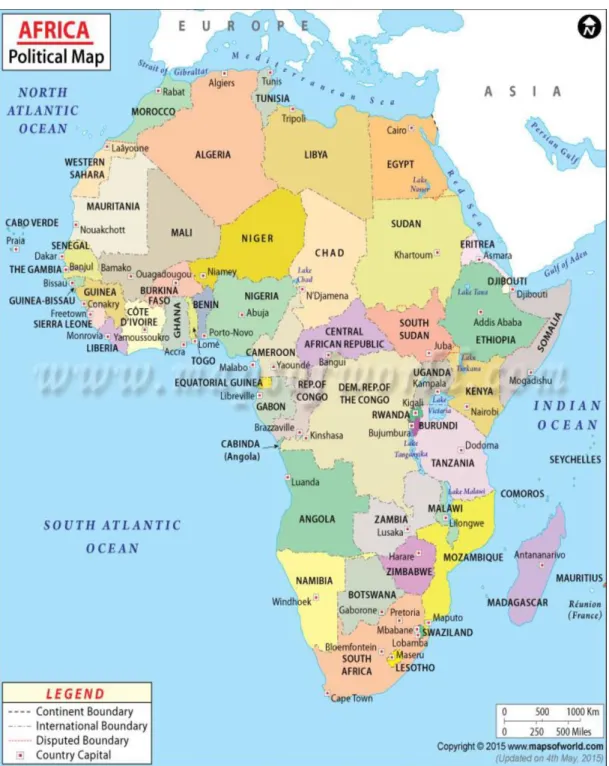
Figure 3.1 : Map of Africa………...………...64
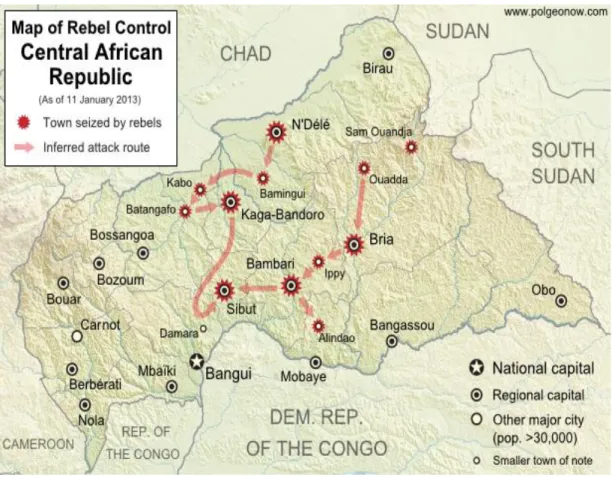
Figure 3.2 : Map of Rebel Control areas CAR (January 2013)”……….…72
Figure 3.3 : Events Involving Muslim and Christian Militias……….73
viii
A COMPARATIVE ANALYSIS OF THE ROLE OF REGIONAL AND INTERNATIONAL ORGANIZATIONS IN THE RESOLUTION OF NATIONAL CONFLICTS. A CASE STUDY: CENTRAL AFRICAN
REPUBLIC (CAR) FROM 2010 TO PRESENT. ABSTRACT
This thesis focused on analyzing the comparative roles of international and regional organizations in resolving national conflicts with focus on Central African Republic (CAR) from 2010 to present. It examines the role of UN and AU Resolving Intrastate conflicts in CAR on the one hand and gives an overview on how both organizations can work together in resolving ethnic conflicts. It equally depicts the major roles of international organizations like UN with it resources and how vital it can be in resolving such conflicts not leaving out it shortcomings. We will also see AU as a regional organization with available potentials and how effective it can contribute to resolving conflicts and some of the challenges it faces with reference to the intrastate conflict in CAR. It should be noted that the researcher shall also pay attention to major key actors like states and how they can assist and cooperate with both international regional and sub regional organization in managing conflicts.
Keywords: International Organizations, Regional Organizations, Sub Regional Organizations, Africa, Powerful States, Central African Republic.
ix
ÇATIŞMALARIN ÇÖZÜMÜNDE ULUSLARARASI VE BÖLGESEL
ÖRGÜTLERİN ROLLERİNİN KARŞILAŞTIRMALI BİR ANALİZİ. VAKA ANALİZİ: 2010'DAN 2017'YE KADAR ORTA AFRİKA CUMHURİYETİ.
ÖZET
Bu tez, Afrika Cumhuriyetinde 2010'dan bugune kadar olan ulusal çatışmaların çözümünde uluslararası ve bölgesel örgütlerin karşılaştırmalı rollerini analiz etmeye odaklanmıştır. Bu çalışma bir yandan Orta Afrika Cumhuriyetinin eyalet içinde ki olan çatışmalarını çözmek için Birleşmiş Milletler ve Afrika Birliğinin oynadığı rolleri inceler ve aynı zamanda bu iki örgütün etnik çatışmaları çözmek için nasıl beraber çalışabileceğine dair genel bir bakış sunar. Aynı şekilde BM gibi uluslararası örgütlerin önemli rollerini ve bu tür çatışmaları çözmek için ne kadar hayati bir öneme sahip olduğunu eksikliklerini göz ardı etmeden eşit bir şekilde ortaya koymaktadır. Ayrıca, Afrika Birliğini mevcut potansiyelleri olan bölgesel bir organizasyon olarak göreceğiz ve Orta Afrika Cumhuriyetindeki eyalet içi çatışmalarına atıfta bulunularak karşılaştığı çatışmaların ve bazı zorlukların çözümüne nasıl katkıda bulunabileceğini göreceğiz. Ayrıca, devletler gibi önemli kilit aktörlerin çatışmaların yönetilmesinde hem uluslararası bölgesel hem de alt bölgesel örgütlere nasıl yardımcı olabileceklerine ve işbirliği yapabileceklerine dikkat edeceğim de not edilmelidir.
Anahtar Kelimeler: Uluslararası Organizasyon Bölgesel Organizasyon,
1 1. INTRODUCTION
From its creation, the United Nations (UN) have as main objective to maintain world peace and security. While the African union (AU) was also created to promote corporation, peace and development of Africa. It is worth noting that the UN and AU have been influential in resolving conflicts elsewhere in Africa like in Sudan and Ivory Coast. This thesis therefore attempts to transfuse into the academic effort the role of UN and AU in resolving conflicts with a paramount subject matter in that it seeks to explain how these two organizations can work together towards resolving the conflict In CAR and why it is difficult at some point for International organizations and regional Organizations to achieve a peaceful deal without each other.
Most academic works on the role played by international and regional organizations have traditionally focused on the separate roles the UN and AU play in conflict resolution. International and regional organizations have all played vital roles in conflicts resolutions but the idea of both organizations working together remains questionable in most studies and academic works. This thesis therefore focuses on analyzing the comparative roles of the UN and AU in resolving national conflict with the focal point being the crisis in the CAR from 2010 to present relating to how both organizations can work together in managing future conflicts in Africa. Also this write-up highlights how the UN can work with other regional organizations in the world in managing conflicts.
The relationship between UN and AU in the 21st century is among the vital aspects in current world politics. Cooperation between these organizations stands out to be strategic and pivotal in resolving conflicts not only in CAR but also in the entire continent of Africa. Looking at the activities of the UN working as a mediator in many conflicts around the world and likewise other regional organizations in the world, AU, therefore, is not an exception and should for these reasons work in
2
collaboration with the UN in resolving national conflicts. The objective of this thesis is to analyze and compare the roles of UN and AU in resolving the conflicts in the CAR from 2010 to present and how both organizations can work together in resolving other Conflicts with respect to their resources and capabilities. The findings of this thesis will also try to show how UN being the main international organization can work with other regional organizations in resolving conflicts in other parts of the world with respect to available resources from both organizations. This thesis is segmented into five chapters. The first chapter introduces the topic with the two major organizations involved in resolving the conflicts in the CAR: that is UN and AU not leaving out other sub-regional organizations like the Economic Community of Central African States (ECCAS) and the Central African Economic and Minatory Community (CEMAC). This component also defines major concepts such as international organizations, regional organizations, and sub-regional organizations giving examples from Africa and the world at large. The second chapter anchor on the literature review recounting what other scholars have written on the roles of International and regional organizations in conflicts resolution.
The third chapter represents historical framework: Stages of the Conflicts in the Central African Republic from Independence to present. This component further indicates the various armed groups that were involved in the crisis from 2010 to present, the reasons they were involved and those that constituted the various groups. Chapter four which is the last but one chapter talks about the efforts that were made at resolving this conflict in CAR or how the international community responded to the crisis Analyzing the various efforts and role played by State Actors, inter-regional, regional and international organizations. This chapter further reveals to the readers the relationship and clash of interest among these actors in the course of resolving the crisis.
Chapter five the last and conclusive chapter points out possible ways in which international and regional organizations can cooperate in resolving national conflicts with respect to their available resources and positions without any clash of interest and thus save the human race from future conflicts.
3
A qualitative method is employed in this thesis and the researcher focuses on content analysis and symmetrically assess past available literature on the topic. Secondary data analysis is used in this thesis, and it is entitled to analyze vividly the roles the UN and AU played in the crisis in the Central African Republic. In this research, articles, conference, presentations, newspapers, official sources, reports, and news announcement at the websites of both UN and AU is used.
This thesis will be structured into five main chapters: The first Chapter will be Introduction of the crisis in CAR outlining the various reasons for the escalating conflicts from 2010 to present as seen above, the second chapter dwells on literature review or what other school of thoughts have written with regards to the various roles of international and regional organizations in resolving conflicts, chapters three will further expatiate on the methodology, Chapter four will point out how the UN and AU have contributed in resolving the crisis in Central African Republic and chapter five which is the last chapter will present various ways through which UN and AU could work together to resolve intrastate conflict in Central African Republic.
Many might be eager to know why delimit the time frame for this thesis from 2010 to present despite the long history of internal conflicts in CAR. The reason is that life in CAR witnessed a drastic change with the creation of the Seleka group, the anti-Balaka, the interventions of AU through it MISCA operation and the coming into play of MINUSCA the UN led multidimensional task force to resolve the crisis in CAR. This period constituted the apex of the conflict in CAR.
4
2. LITERATURE REVIEW AND SAMPLE CASES
Many theories have striven to explain the effective roles of international and regional Organization in resolving national conflicts. Even though literature covers a vast periphery of such theories, this review hub on three main theories that will unfold repeatedly throughout the literature review. These propositions are incorporated into the roles of international and regional organizations and how both can work together in resolving intrastate conflicts.
It should be noted that the UN is the world‟s major inter-governmental organization with it prime objective to enhance international cooperation and encourage international order. Due to too many confrontations in the world today and the profuse of UN activities, it has triggered a lot of scholars to advocate the importance of regional organizations to assist in promoting peace and security in the world. According to Article 52 of the UN charter, its states that interstates disputes could be settled at the regional level before being referred to the UN and this resolutions through the Security Council can be considered only when the regional or sub regional attempts fail to yield dividend (Thi 2002). While the UN charter in resolution 53 states vividly that the Security Council can work and use regional treaties and institutions to foster and promote peace.
Jenny Gustafsson in his book published in 2007 creates a substructure looked at the normative and constructive conceptions through which the UN can act to deter and resolve violence. This findings were segmented in to two viewpoints: The first part was derived from the Joseph Nye‟s analytic framework and gave a lamp light of the research and findings available for the reasons of most ethnic wars. From these findings, three main reasons were developed; society in transition, structural inequality and Poverty. The second section comprised of both normative and constructive methods, with the use of two extreme circles of findings. The normative
5
potion discourses how war deterrence should be and the UN moral position in such a case. The constructive chapter discourse UN available resource and limitations taking into account conflict deterrence and to what extent the UN should assist to address the problems listed in the already seen sector (Poverty, inequality and societal transformation). The conclusion drawn from the analysis is that the UN possesses the know-how, experience and functioning capability to redress such issues, also highlighting the fact that there are some problems concerning the UN as an institution and its member which often makes it cumbersome for the organization to efficiently use the resources it has to deter and resolve deathly ethnic wars (Gustafsson 2007).
He focused on armed intrastate conflicts of ethno-political structure and how such conflicts can be prevented. Intrastate conflicts whatever their character poses a great threat to the global body through it world effect instigated by the media broadcast, huge movement of displace people and the spread of conflicts to nearby countries. In addition, intrastate wars have after the cold war exceeded interstates wars (Peck 1998). These trends therefore explains how important it is to stress on how vital it is to deter and resolve intrastate wars in the scholarly world as well as in the practice of politics: should there be a means of curtailing the spread and occurrence of wars, as imply by the evolution of time, then conflicts prevention and resolution ought to be of priority. This study aimed at highlighting how inter-state and intra-states wars (called national conflicts and international conflicts), since when wars broke out it promote torture, killing, destruction of property, hardship and deaths like the situation with the genocide that took place in Rwanda and the massive killings in former Yugoslavia.
At the end of the WW II, the pioneer members of the UN aimed at promoting the idea of world peace and cooperation at a new and large scale. The understanding of peace is considered a necessary tool for long-lasting security and evolution; considering all as valuable factors to resolve and deter conflict. The states are all looked upon as having first priority to enhance and as promoter of human rights with responsibility to protect first it citizens but when the state fails the international community has as moral obligation to react. This doesn‟t only apply through it commitment carried out with regards to human rights drive, it is often also seen as
6
part of its moral attempt to the problems of particular attributes present day intra-state wars possess. Summarily the international bodies have as top priority to ensure security to the common man when the regime in which they harbor have failed to protect them in time of desperation. Among other issues, the most pertinent point of this moral commitment of nation states is the authority to deter and or stop wars. This is seen as the base of evolutionary rational of human beings and experienced learned from past wars through which hundreds of thousands to millions of lives have been wasted despite the ability of the international institutions or body to deter such incidents (Peck 1998). Given that conflicts prevention and resolution are laudably considered acceptable, it is therefore imperative to acknowledge that which ought to be done to deter national or inter-states wars.
The UN possesses the strength to redress pertinent issues more or less effective looking at the resources got. Gustafsson further in his study argue factually that this organization that is UN and it diverse offices and missions, most particularly the UNDP got the experience, Know-how and functional powers to redress the problems present in within ethnic wars situations. For these reasons the relevance this organization is indicated as a platform to look for means of deterring and resolve ethnic wars through which pertinent questions can be answered through constructive rational. However, the author also points out several difficulties that impede the optimistic views of the UN as a main platform of structural war deterrence looking at them from internal and external views: The internal difficulties are those found inside the organization itself; lack of normative scheme, no decisive authority and there is the absence of corporation and consistency among its various offices. One key obstacle is the contradiction among the states as being elementary actors and their obligation to provide security for its citizens (Boutros 1992).
The external difficulties concern UN‟s member states. Even though they have as moral responsibility to resolve some pertinent points, they sporadically to some very little outstanding act in such directions, as earlier indicated above, the UN seems not to have greater influence over most concerns than it member countries and such member countries in turn to pursue their private political objectives. This puts much blockade to UN‟s functions in attempt to promote a level playground for a transparent international scene. It‟s also decrease some chances of a culture to
7
resolve or prevent or resolve since the eventual obligation for application depends on these countries that makeup the organization. One hopeful developmental advancement is the view that the habit to deter is arising in the UN, both its security council and UNGA are cultivating political will to regularize it (Gustafsson 2007). This school of thought also agree to that these mother institution has the functional powers through it diverse offices, know-how, resources, finance with a vital background to be able to carry it functions at full scale, even though due to the organizations limitations (internal and external difficulties), it thus finds it difficult to perform it duties using their potentials in its entirety.
Another writer by name Thi Hai Yen Nguyen expresses his thoughts that by the time the cold war came to an end, international interactions ceased to capitalize on the by-polar clashes among the super powers (USA and USSR), paving the chance for regional blogs providing them with a direct possibility to take a lead role in war resolution and cooperating with UN as a normative expectation of the global body increases while super powers arbitration in territorial rivalry decreases (Thi 2002). The pertinent scenario he cited in his article included the contributions of the Organization of American States (OAS) as an attempt to resolve the chaos in Haiti and the efforts of the Association of Southeast Asian Nations (ASEAN) during the crisis in Cambodia and North Atlantic Treaty Organization (NATO) in Yugoslavia. In the course of the Cold War, there were some level of conflict proliferation with motivation and contributions from either United States of America (USA) or Union of Soviet Socialist Republic (Soviet Union). These situation projected almost every confrontation to a near war situation between the super powers from the background. Most confrontations at the by-polar era erupted among members of same regional organizations. Such members often feel reluctant to resolve their differences within same regional organizations due to the fact that they are afraid of being deceived by others members. As such, territorial organization functioned at a very low level with limited chances of making only their good offices to disputant.
One could therefore affirm that the UN luxuriate in all alone in crisis resolution arbitration, peace keeping and may be through persuasive armed interventions. When the by-polar era came to a halt, regional organizations got the opportunity to lead in
8
conflict resolution as the polarization confrontation between the two super powers died a natural death. Regional organizations could therefore participate in conflicts management separately with little corporation with the UN as a standardized expectation from global institutions skyrocketed while super powers arbitration influence in territorial crisis greatly dropped.
With a shift from bipolar to multi-polar system, regional organizations had a new role to play beyond providing disputant with simply good offices. ASEAN besides facilitating negotiations was also a third party mediator. The OAS restore democracy and promoted human rights in member states. In Africa, The ECOWAS had as a new responsibility to prevent and resolve regional conflicts. In addition, the AU teamed up with the UN in a joint peace keeping mission in and NATO and Western European union championed the resolution van of the crisis in Yugoslavia with UN permission by 1993 to 1996 (Malone 2008).
As mentioned earlier, I will focus on ASEAN and OAS who after close examination was viewed as functional and efficient during the Haitian and Cambodian crisis. Thanks to geographical nearness in these conflict areas, these organizations were able to act and establish peace, respect for human and people‟s rights and security in their regions. Due to differences in size and capacity and the different qualities with purview of each conflicts, OAS like ASEAN adopted varied means of crisis management and both attained their objectives: Autonomy to the Cambodians through the ballot box and reinstating representative government in Haiti (Gillian 2002).
Comparatively, it can be analyzed with the situations of ASEAN and OAS that regional Organizations could assist in promoting safety and tranquility and peace in the entire globe. If regional organizations have become very productive in managing conflicts, certain conditions are required. Examining the contributions and outcomes of ASEAN and the OAS in managing the crisis in Cambodia and Haiti, it empowers the endorsement for the subsequent parts to be played by regional organizations throughout the world.
Determinants for essential regional organizations engagements, Thi Hai Yen Nguyen outlined some constrains required for regional Organizations in order for them to be
9
efficient and functional their part during crisis management and resolutions: Legitimacy, Enforcement power, Resource allocation and cooperating together with other international organizations and world super states (Thi 2002).
Legitimacy: This point within this context is global acceptance. Deeds with behavior of the mediator arbitrating to manage the crisis should always go along in consonance with the UN constitutions, global regulations, and diplomatic assemblies. Such constitutions permit regional treaties and regional institutions in settling local and ethnic crisis. It is worth noting that these same constitutions together with other global rules and the constitutions of most regional blogs, stops mediation into other states concerns, indicating the negative persuasion through high pressure, including economic punishments is considered unconstitutional apart from self-determination (Tavares 2009).
Such conditions of international recognition could therefore be acceptable if regional blogs have the authorization from the UN Security Council. UN Security Council has the independent mandate to either accept if a current crisis demands arbitration and if intimidating (coercive diplomacy) methods could be vital in preserving safety and peace as stipulated by the UN charter. However, as a result of the lengthy decisions making process, the capacity to vote against (Veto power) of five permanent states with the varying perspective of states of the UN Security Council regarding the part to be played by regional blogs in conflicts resolution has been a problem. Hence it‟s often challenging for regional blogs to get the authorization which is required to mediate in managing national conflicts at it initial level (Ho-Won 2017).
Enforcement Power: Enforcement power in this context is the ability to implement safety strategies in order to efficiently pass on resolutions arrived at to those involve in conflicts. For example, coercive diplomacy method: Ban, restrains and blockade to detach and cripple the parties involved. This point is vital because it is needed throughout the crisis management process trying to convince rivalries to corporate at the start of the conflicts and to enable that both camps come to terms agreeing to take their responsibilities at the end of such crisis or conflicts (Thi 2002).
10
Regrettably it is often complicated and challenging for these regional blogs to have such qualities. UN authorizes regional blogs to implement violent or coercive actions acting with authorized support of territorial treaties due to the points which shows they are acting as tools for the UN Security Council. More so, since regional blogs are regularly headed by superior regional powers, petit states in most cases are afraid agreements of such giant countries in the region can affect their interest. Consequently, most regional blogs resolutions are usually taken through concord or may not be bidding by other countries. Such occurrences vividly compromise regional organizations implementation capacity principally where it tries to manage crisis were a country involved is not a member state (Tavares 2009).
Resources: For Regional organization to be able to intervene and resolve intrastate conflicts, it should be able to finance the safety oppressions by covering a larger part of the total cost. At first, wealth was needed for soft diplomacy and administrative procedures. Where conflicts management is achieved, finance and administrative work is required in order to carryout safety agreements, enable and observe democratic values and recollect weapons from groups fighting. Furthermore, huge sums of money is often needed to assist affected communities, and to take care of such an amount of money required for rebuilding and peace agendas. Such activities demand and absorb valuable hours and material including finances as mentioned above.
Cooperation: Lastly, preconditions required for efficient regional efforts is working together with the UN as a team and other main super countries. Knowledge and revelations at the by-polar era revealed that with the absence of main super states support to regional blogs, the simply play a minor part in crisis management. It is worth noting that many regional blogs are often ready, capable and also moved to partake in resolving conflicts but are hindered by the small nature of their membership within the organization, the exclusion manner in which some members go through and the discrimination they face in analyzing (Thi 2002). UN and the main super powers working together will boast their current ready to be used materials, helps legally recognize their activities and give them more powers and integrity. Experience have also shown that involvement of UN is of advantage since the organization possess the substantial capital and the reputation required in solving
11
conflicts. In this regard therefore, the necessity for regional blogs to closely cooperate in line for super powers and UN to increase their bargaining chip with disputant, gain access to auxiliary capital and provide additional enforcement strength ability and strength (Tavares 2009).
Even though cooperation, enforcement, and legitimacy, are vital while creating an efficient conflicts management though often difficult to these regional blogs procuring complete prerequisite. Referring to the conflicts in Cambodia and Haiti, one can assess the level to which ASEAN and OAS met the above conditions and how this affected Organizations approach, efforts and contributions to the settlement of the two conflicts in question.
2.1 The Role of ASEAN in the Cambodia Crisis.
Born by 1967, ASEAN has as main objectives to enhance economic solidarity and amicable resolution of crisis among its member countries. Notwithstanding its authorization, ASEAN had no crisis management system or application power. However, the coming of ZOPFAN agreement, members officially termed ASEAN the zone for peace, flexibility and noninterference demanding that all members must intervene in other member‟s internal squabbles. When conflicts in Cambodia erupted, ASEAN comprised of just five member states with Indonesia as the largest member and was the world fourth largest most populated country. Other members included Singapore, Philippines, Malaysia, Thailand though it independence came later (Thai 2002.)
The Cambodian conflicts was an intra-state conflicts which comprised of four local fighting groups tussling for administrative power and global realization, The conflict skyrocketed by 1978 during which Vietnamese soldiers with demand of Kampuchea United front for National Salvation (KUFNS) and as a means of retaliation to the confrontations by the Democratic Kampuchea (DK) at the Vietnams south west boundaries instigated a total combat advancement attacking the ruling Khmer Rouge (Le Billo 2002). It took the Vietnamese three weeks to get Phnom Penh to assist in restoring the People‟s Republic of Kampuchea (PRK). Some school of thoughts termed it as a proxy war because China and Vietnam stood for the PRD and the Khmer Rouge over Cambodia. Thus it‟s imperative to know that
12
Cambodia, be it china or Vietnam were not members of the ASEAN during these conflicts. Due to International and local variations of the clashes and targeted killings of the Khmer Rouge which took the lives of up to 1.5 million Kampucheans from 1975 and 1978, it was therefore difficult to resolve the Cambodian conflicts by installing the governing regime . Hence managing the crisis was therefore to put in place a strategy on which individual or group of individuals should govern Cambodia at the end of the war negotiating for a partition of authority in the government in a treaty which can unanimously recognized and mandated to all groups involved with foreign bodies inclusive.
When Vietnamese troops marched into Cambodia, the ASEAN standing committee at the time published some declarations which hinted growth intensifying the already existing crisis in Indochina demanding for respect and acceptance of the UN constitution together with the Bandung Declarations. The ASEAN continuously mount pressure on the Security Council to talk on and analyze the crisis for necessary procedures to be taken and respected. The ASEAN's policy maintains their views on the point which stated the illegal and unlawful interference of Vietnam. Irrespective of the protracted crisis and confrontations which suffices with Cambodia and Vietnam before the Vietnam's interference, ASEAN stood state-fast in its stands on the unlawful Vietnam's troops present in Cambodia.
Among the majority of prosperous strategies the ASEAN's adopted in attempt to manage the crisis was the fact that it made proper application of the UN offices in backing up the point that that Vietnam's troops in Cambodia was unlawful, They stood firm in acknowledging the Democratic Kampuchea government at the UN general assembly. They continuously urged for a complete and prompt removal of all foreign forces in Cambodia pleading for a global meeting with aim at gaining a post conflict resolutions and UN financed election in the country. Looking for means of firmly holding their stands, the Heng Samrin government in 1981 conducted election. The ASEAN refused the holding of any vote affirming the views that it was to force Cambodians agree an international sponsored government. Refusing to go for such an elections, they requested the UN general assembly resolution which will decide a valid and long lasting solution to the conflict with a UN sponsored Elections.
13
The UN by July 1981 sponsored an international conference on the Kampuchea and this conference took place in New York with ASEAN as a key participant. The resolutions arrived at called for a cease fire from both sides, withdrawal of all foreign forces, and putting in place security measures to prevent armed factions from disrupting the elections under the supervision of UN.
ASEAN succeeded in creating a joint government for the Democratic Kampuchea CGDK that united the Khmer Rouge under Khieu Sampha, the United National Front for independent Neutral, Peaceful and Cooperative Cambodia (FUNCINPEC) under Norodom Sihanouk and Khmer People's National Liberation Front (KPNLF) with Son Sann as leader. Reasons for the coalition government was to unite every resistance group beneath one canopy for dialogue to be able to flow, to also legitimize the Khmer Rouge which for many years was left alone by most factions as a results of their inhuman policies. Also this coalition was to give another opportunity for the Heng Samrin government that wish for fetched recognition and acceptance from the international community.
Another initiative that was achieved was the proposition demand for reinstalling safety and a quite society by the Indochina regions whereby every Vietnamese Volunteers should leave and later safeguarding the ultimatum from PRK together with some groups that laid around the Thai and Cambodia boundary witness an end. These volunteers agreed to exit annually.
It was further agreed that elections will take place with foreign observers present with former Khmer Rouge members who are interested in participating to contest. It is worth noting that most of the resolutions proposed during the early stage of the crisis by ASEAN failed because both sides were state fast on their positions and displayed unwillingness to resolve the political crisis.
The main focus of the ASEAN rules were characterized by their die heart need to guarantee the exit of international troops out of Cambodia, before proceeding to the political resolutions of the chaos. Even though, from July 1982 to about May 1983 there was a lot of trials on how to and effectively exit the forces, many doubted if the troops were actually withdrawn because very little or nothing changed in this context.
14
Swift respond from ASEAN and the OAS was the first role they played. Although they never in strict terms addressed Vietnam, ASEAN representative ministers demanded the total exit of every international military present in Cambodia and the dissolving of the Phnom Penh regime in order for Cambodians to be able to exercise their rights to self-determinations through elections. On the other side, OAS ministers denounced the coup few days after it took place, embracing a decree refusing any diplomatic acknowledgement of the governments of General Cedras calling for immediate reinstatement of president Aristed.
ASEAN was adamant in getting long lasting and understandable solutions in Cambodia calling on the withdrawal of all Vietnamese troops, dismantling all armed groups with directions from the UN peace keeping forces to be able organized transparent vote for Cambodians to decide democratically the future regime. OAS on it part strived to reinstall the legally voted president Aristed at same time preventing violators of human rights in Hiati.
ASEAN made much diplomatic efforts by pressurizing the United Nations at the initial level of the conflicts. Between 1979 and 1982, ASEAN involved the crisis of Cambodia in all it yearly program at the UN general assembly. By 1981, ASEAN gained an outstanding buttress for a UN financed global congress on Kampuchea, which demand a stop to violence and requested an understandable and meaningful dialogue for political resolutions (Kierman 2010). Also in formal and informal meetings, ASEAN call for UN and the global society to help resolve the Cambodian crisis. ASEAN efforts towards resolving the conflicts in Cambodia was seen through it pressure to stabilize global interest observant on the crisis for more than 10 years. In addition, ASEAN made everything possible to stop the PRK in gaining membership at the UN and hence from being the legal regime in Cambodia. During the 34th conclave of the UN general assembly, ASEAN representative ministers stood against Indians proposition to abandon the Cambodian chair and the UN empty. In the course of UN conclave 34 until 37 (1979 to 1982), ASEAN successfully stopped India‟s recommendations making sure Cambodia‟s position at the UN remained untouchable (Thi 2002).
15
ASEAN started and aided the peaceful consolidation of the three armed groups in Cambodia and skyrocketed their grip opposing the PRK (Kierman 2010). By April 1981 the regime in Singapore summoned members from the various groups in order to take part in dialogue in attempt to create a coalition government. Consequently, Saddi Savetsilla Thailand‟s foreign minister and the chairperson of the committee arrived in Washington DC in order to demand for assistance. This motion led to the establishment of an alliance government of DK that consolidated the three main combating groups by September 4th 1982 (Gillian 2002).
The formation of coalition government was a lamp light that legitimize the DK‟s seat at the UN indicating to both factions that this crisis can be sought out only by meaningful dialogue and negotiations rather than by the use of force.
Many scholars and diplomats viewed this crisis as being the most complex among all under or less developed states after the world changed from by-polar to multi-polar system because of the presence of Vietnam and China standing with the Khmer Rouge. ASEAN forced Vietnam in order for them their military to exit from Cambodia, galvanized the global institutions and the UN Security Council to disengage the country in Economic, social together with diplomatic aspect. At the end of the 1980‟s, Thailand, Singapore, and Indonesia made everything at their reach to better the corporation with China in order to make at ease their position in Cambodia due to its long standing views on Vietnams presence in Cambodia. It was difficult at this time for china to continuously disregard ASEAN‟s engrossment in resolving the crisis in Cambodia, for this reason they at the end of the day accept to involve the points raised in view of the will be total supremacy of the Khmer Rouge during the pre-conflict resolutions in Cambodia into it antagonizing standpoint (Thi 2002).
It was generally viewed that ASEAN was a prosperous arbitration institution with regards to the crisis. Vietnam made it intensions clear that they cannot meet with the combating coalition ahead of a meeting with the other battling groups, Indonesia made a proposition of two separate meetings, the first one to be just for the four groups fighting, last another one that will involve Vietnam. These near agreement discussions proceeded to the new three Jakarta informal Meetings (JIM): Indonesia
16
25th July 1988, the four factions met in a first ever meeting to talk each other‟s worries and demands (Kierman 2010).The gatherings was therefore regarded as major step that paved the way for the peace negations as Khemer Rouge and PRK kept away their differences.
Also, ASEAN provided good offices to the disputant, at the end of the second JIM of 9 to 21 of February 1989, the PRK made know its own prepositions to the peaceful dialogue and amicable agreement together with all the other groups, The PRK accepted that electoral procedure will be a tool to determine the would be regime in Cambodia against their previous non-negotiable stance.
During the third JIM, ASEAN created peaceful concepts (26TH February to 1st of Match 1990). Ali Alatas Indonesian foreign minister made some vital recommendation programs for the establishment of a national supreme council in Cambodia were every group will have a representative. The conception was an impetus for the four separate groups to thrash out their differences over division of power.
Towards the end of 1980‟s Australia and Japan government together with the UN Security Council championed the move for a peaceful dialogue and reconciliation in Cambodia. 23rd of October 1991, 18 countries together with the four armed groups in Cambodia signed peace accord in Paris that established the UN transitional authority in Cambodia (UNTAC) to follow up the institutionalization of the peace treaties in Cambodia (This 2002). Even though the eventual focus in Cambodian crisis was to a larger extent coordinated by UN Security Council and many other bigger states, ASEAN pilot the awareness plane for the international community to advance the peaceful procedures.
The ASEAN however faced constrains in their effort to facilitate the 1993 elections due to insufficient funds. Where there was a possibility for cease fire infringements and the Khmer Rouge orchestrated a boycott of the electoral plans, The ASEAN called on all groups and political parties in Cambodia to respect the treaties as agreed upon during the peace agreement. The call by ASEAN member countries on to all political parties to stay maintain the ego of national solidarity and reconciliation for
17
the purpose of preserving Cambodians national and territorial sovereignty, inviolability, neutrality, Independence (Gillian 2002).
The ASEAN made much effort than any other body to the successful 1998 elections whereby Hun Sen defeated Norodom Ranariddh who was the first prime minister, In July 1997 the ASEAN authoritative suspended the membership of Cambodia until a transparent elections could take place. Furthermore, Philippine and Thai came together with other Cambodian close partners in order to act as arbitrators for the Hun Sen regime and the main opposing camps to reinstall democratic values for the new regime. Other members of the ASEAN supported Cambodia technically in preparing and to observe the elections.
As the main pilot directing the affairs relating to redressing the conflicts in Cambodia, they gave varying aid to the Cambodian displaced persons. They secured in most cases the expedition of Cambodian refugees to countries were they could get a permanent stay and settlement. When the conflict started, ASEAN called on the UNHCR to manage the current state of affairs urging the global community in putting in place significant assistance to UNHCR (Thi 2002).
The ASEAN‟s main reason aimed at facilitating the continues existence of dictatorial government menaced by foreign destruction with alien duress from the Cold War: the hidden goals were meant to obtain magnitude of unity before the arrival of thrown less government which could bring in the patient Britain and a future probable exit of the USA. Both countries had one adversary who was the Communist hit and run advancement, supported by the USSR, China, and North Vietnam. This group proclaimed the desire for security and development to be able to stand against and deter the USSR the socio-economic circumstances for the much desired political transformation, Although the ASEAN‟s made it vividly clear that it main goals was socio-cultural and economic, the international community was aware of the fact that cooperating economically, socially and culturally will definitely be sluggish. They were joining forces together in order to achieve a common goal which was political and security stability. ASEAN in it capacity made possible, like the Indonesian foreign minister Adam Malik declared openly that, as a result of the political unity or coming together of the five member countries the Sukarno‟s
18
campaign for anti-imperialism came to a standstill point by Suharto‟s new deal regime.
The positioning of the conservative capitalist government through the region granted most of the leaders in the area the opportunity to collaborate in fighting against the pertinent menace of the positions: local revolutions, especially those menace that came from the communist subversions, through that which most ASEAN countries sighed some mutual treaties with them during the late 1970s (Snitwongse 1995). The ASEAN‟s main policy of zero interference, consecrated by the 1967 ASEAN promulgation, the ZOPFAN promulgation of 1971 and the TAC of 1976 simply lay more emphasis, in stern details, norms previously stated in the UN Charter. The fact that these laws previously prevailed in other places demanded the worry some question asking “why ASEAN should wish to epitomize same laws”. The answer to this question could be seen within the timing and how the various declarations impacted the political activities and actions. The ASEAN treaties mostly focused on the frequent clashes among one another‟s role which for a very long time had been common with both international and regional alliances. Henceforth, to guarantee safety and political stability from foreign interference with any magnitude they made efforts to restore and preserve the territorial unfitness (ASEAN, 1967). Their main intensions were to authorize the elite class take into action with much obligation to curtail such violent political atrosicities at a time when nationalistic values where been threaten as a results of its laxity. Both ZOPFAN and TAC came to existence due to the fast declining global institutions and the evolving positions of the communist insurrections. Before the end of 1970, Philippines and Thailand fell before authoritarian regimes because of continues economic failures and the increasing revolutionary menace to embed political and economic establishment. At this time Marxist guerrillas were still functioning within most of these countries, efficiently controlling thousands of people (Alexander 1999).
To refuse the access to the presence of a huge elite arbitration given by civil in Indochina, The ASEAN took an oath to enhance national flexibility guaranteeing safety and calmness from foreign influence to be able to perpetuate core nationalistic values (ASEAN, 1971). Though as a results of the presence of the Nixon Doctrine, the ASEAN therefore decided to push forth and preserve the right to
19
be able to accommodate our own developing actualities in Asia, Claimed Marcos (Silverman 1975). The TAC, evolving during this period of much impetus provided to the regions communists factions by insurgence advancements in Indochina in 1975, laid emphasis for dual respect to the independence, sovereignty, equality, territorial integrity and national values of all countries, the legality of all countries control its territorial rights to life by leaving independently from foreign influence, destruction, or coercive and isolating from themselves from the activities of other (ASEAN 1976).
The ASEAN had positive views in deterring the viral movement of revolution through a means of giving the quite scene to the new communist state of Indochina. In this light of positive aspirations they could implement an independent refusal ordinance. The ASEAN foreign laws of noninterference were home factors inscribed for standard political obligations, proclaimed to deter the strong from attacking the fragile capitalist government from foreign sponsored insurgencies. Some scholars like Justin Rosenberg argued that, foreign institutions have become more involved in the evolution of in domestic political will, something viewed as revolutionary international policy looked upon as a basic international law. To a certain extent it varies among the private situations giving directives inward to a nationalist propaganda of some local political platforms with menace from the international scene (Rosenberg 1994).
Although interventions are looked upon as means construed to alter political eventualities in an out of state political scene, it can thus father be looked at such mediations with the case in Malaysian military assistance against communist insurgencies in Indonesian Borne, a successive indo-Malaysian attempt in defeating the Muslim combatant in the southern Philippines and ASEAN backing of Indonesia as colonization of East Timor.It was believe that actions like this depicting the fact that the ASEAN elites struggled to protect not only the normative laws but rather their own dangerous social aspirations all of which was evident at the current situation. Similarly, an arrangement of that magnitude showed that Thailand financed armed insurgencies in Burma believing they will aid in crushing the communist groups in Thailand preventing the collaboration and unity among the communist parties in Burman (Smith, 1991).
20
When Cambodia was invaded by Vietnam by December 1978 and overthrow Pol Pot, the struggled to install a new regime with the People‟s Republic of Kampuchea (PRK), also pressurizing Khmer Rouge (KR) left over‟s to departs to Thailand border, This raised the aspirations of a continues spread of revelations and overthrowing dominoes. Respective of their exaggerated believes to the laws of no interference, The ASEAN continuously maintained this objective to arbitrate in the crisis in Cambodia.
By 1980,represientative from both rebels and refugee camps: the ASEAN UN actions standing for the Khmer Rouge, the security council regarded Vietnam‟s presence in January and February 1979 but felt discouraged by the Sino-Soviet rivalry. The soviet Union vetoed all propositions regarding the resolving of the cases against Vietnam‟s ally, At same time Beijing troops invaded the northern part of Vietnam to punish Hanoi because he overthrow their friendly government in Cambodia and thus shifting the attention to the UNGA at this point.
The greatest worry at this time was who will be the one to represent the country at the UN since basically it had to do with plenty of bureaucratic procedure observed be the credentials committee, whose yearly reports were seen as rubber stamped not having any objection or debates from the UNGA. The ASEAN made everything political during this time by campaigning successively annually for KR to preserve Cambodia‟s position and the UN. This action was without a pattern and had serious after effects the evenly distribution of power in Cambodia.
While using the expressions of no interference to protect their actions, The ASEAN galvanized most underdeveloped countries at the UNGA to vote in favor Democratic Kampuchea against the PRK qualifications, represented by Leng Sary, Pol Pot‟ deputy: Financing importance yearly resolutions on the crisis management case in Kampuchea; Taking hostage Vietnams backup points during debates on the safety, stability and how to resolve the crisis in southeast Asia to castigate Hanoi.
The ASEAN made it clear that PRK was noise making government put in place by armed insurgencies and allowing such a government to exist is endorsing violent and encouraging the violations of primary international rules and moral political conduct, The Philippines ambassador made his declarations that if the PRK is
21
allowed a position it would be leveling a playground for complicated issues with heavy consequences of event whereby most underdeveloped countries in the world will begin losing their rights of existence and be faced with untold preconditions of live under the schemes of bigger countries and another form of imperialism. The verbal connections between the crisis in Cambodia and the UN constitutional principles and many of its priorities towards smaller countries gave the ambassador of Singapore the legitimacy to openly declare that their stands against Vietnams activities were primarily linked to the principles and the DK obligations to maintain their position at the UN which must be in accordance with the protection of certain basic rights and principles of the UN constitution.
For this reasons it is possible accept such verbal predicaments as symptoms of engagements to the noninterference principles, like many constructivist will often do. Comparatively ASEAN crusade and their actions through their non-interference, therefore brings out the perceptions as being political and not of its value principles. A vivid similarity was the January 1979 Tanzanian intervention in Uganda that marked the end of Idi Amin‟s rule as president. There were a lot of similarities with the factors that encouraged the intervention: There were two wars with great identities in Tanzania and Vietnam were both parties claimed they acted in self-defense mean while it was a simultaneous ethnic revolutions that saw a regime change: and Tanzanian military were stationed in Uganda for many years, as a means of polishing the post war agreements. In 1980, the newly installed government was granted a position at the UN which was endorsed by more than 80 governments with ASEAN raising a trace and criticism (Wheeler 2000).
The occupation of Afghanistan by Soviet Union in same year manufactured and released some counter actions from the ASEAN ministers. Two members spoke at the UN debate while ASEAN stood against Thailand‟s proposal of a joint declaration and reconstruction. Thai Foreign Minister Siddhi accepted it was as results of the interference which did not have any strange impact or consequences on the region as a whole (Van der Kroef, 1980).
The new government was installed with a given position at the UN with very little preservative supports, whereby Singapore a member of the achievement and quality delegation casting their vote for the in significant defense with primary functions nor
22
had ASEAN campaigned against France during it 1978 interference to seize power from the Central African Empire in which the new government was installed without any form of endorsement elections.
The ASEAN‟s crusade therefore was considered political. This also had great impact for the Cambodian plight in times of the crisis. The ASEAN at this moment refused Vietnam and the PRK chance to emerge victorious while they struggled to use the UN organs and its offices in propagating their stand points in the course of the crisis. The ASEAN‟s campaign for complete isolation of the PRK and Vietnam also hindered them from the developmental assistance they got at poor states (e.g. from UNICEF, World Food Program (WFP), the IMF, World Bank, etc), its tighten the strings for the new regime making it difficult for them to attained significant international recognition output legitimacy (Alagappa 1995), irrespective of its local supremacy.
Lastly, the UN membership was the main ASEAN‟s debating stand point, through a process whereby, the Ambassador Koh concluded that, it will be very difficult for them to get any incentives for Vietnam to go into a meaningful political dialogue in favor of the ASEAN stand point in the crisis.
2.2 Aid to the Khmer Rouge.
Looking at the means through which the DK maintained its candidacy at the UN one can say with certainty that it should have been a farfetched dream without the presence and efforts of ASEAN, so the KR‟s army resilience could also have been difficult if Thailand did not supported them. Ieng Sary, who was saved from captivity from Vietnam and was airlifted to safety by Thai forces, In January 1979 the Thai government and it military had laid camps for KR militias on Thai territories, where they were given food water and other basic needs like medical assistance, and later transported back to the boundaries to fight against the Vietnamese. At this time the boundaries were considered safe heavens for displaced persons and refugees, Thai military transported KR soldiers across at safe points away from Vietnamese troops. The military commanders affirmed through condemnation the violation of international norms of non-interference which they looked at as an official law. The KR foot soldiers hidden camps were created on the
23
Thai territories and the island of Khemara Phumin were all protected since they were reserved as safe roads for Chinese weapons.
By early 1980, Thailand was blamed for transporting 500 tons of military materials and weapons to the KR on monthly bases. The US intelligence estimated that Thailand‟s military assisted with closed to $100m cost for weapons yearly to the KR in the course of the crisis by mid 1980s. Thai military bases were regularly used in order to protect and reserve KR bombardments into Cambodia and Thai militias often and regularly place themselves to deter „hot pursuit‟ by Vietnamese forces (BP, 1979; Daily Telegraph, 1979a, 1979b; Guardian, 1979; Kiernan, 2002: 488; Shui, 2002; ST, 1979b, 1979c, 1979a; Van der Kroef, 1990: 235). Without the assistance from Thailand, it would have been very difficult for them to resist as a menace to the PRK. Chinese and Thai government‟s assistance gave the KR the opportunity to reconstruct it military from about 2000 to 40.000 troopers. This delivered uncountable profits the regime in Thailand. One other vital factor was that China stopped it assistances for the communist Party in Thailand (CPT), compelling them to sign a treaty temporarily preventing the access of television channels throughout the Yunnan province and openly pronouncing with strict terms that they will no seat to watch the CPT cripple the Sino-Thai friendly ties (Alexander, 1999). The Chinese assistance to the Bangkok government was estimated to cost close to $283m from 1985-89 alone, with the military also gaining advanced access updated military arms, technology and (Kiernan, 1993).
With all this situations at hand and the confusion that caged the communist menace granted a chance for the military the rights to manage the 1/5 of state budget in 1982, strengthening the capitalist regimes. Providing aid to the KP also opened a vacuum and a buffer area for the containment and holding the growth of revolutions, ensuring that the authorities concern within Cambodian and make them stay in contest, that which legally endorsee ASEAN to proceed in it activities on behalf of DK. As the DK‟s representation within the UN recognized the primary concerns of the crisis was to be removed, there will be no chances for another debates, since they Hanoi annexation should at this point gained the unchangeable truth of their occupation on the land of Kampuchea.
24
The manner in which ASEAN‟s treated of refugees fleeing Cambodia was regarded as another measure to inflict pain on the PRK. At first, the SEAN members looked for ways of excluding refugees with the hope that they were the fifth communist sent to iron the revolution. One senior Thai staff made an estimated which showed that about 10% were Hanoi spies whom according to them were assigned to sabotage the regime, and Bangkok for this reason had no choice that to vehemently repatriated thousands of these refugees into minefields, killing hundreds of them. The regime in Singapore named refugees human bombs, constantly refusing to take some into their country, while Malaysia threatened to deport 65,000 of them and adopt a policy of shot on site (Antolik, 1990).
Nevertheless, the anti-communist irrationality pave the way for new and much unscrupulous programs where the refugees were considered as been a strategic zone for containment along the boundaries and as a root of assistance for the new born resistant as was recognized (Terry, 2002). Thailand therefore had to reject the classification of all those crossing it borders as refugees; refusing them the legal international protection and assuring the global community that the institutions at it border will be the WFP and UNICEF, not the UNHCR due to their powerful protection terms. This granted them the reasons to play on the intelligence of these refugees in three critical methods.
Firstly, to use them as a population primary stand point for the KR and other combating groups, which among them were Khmer People‟s National, Liberation Front (KPNLF, Headed by Son Sann,an ex-Cambodian Prime minister who made public his liberation government) and Moulinaka (A royalist group with Prince Sihanouk, as the head and he was the former president). With heavy support from of Thai Task Force, 80 civilians were held captive in some camps, whereby tens of thousands of refugees were violently momentarily moved away from UNHCR space and facilities.
Accordingly, the UN Border Relief Organization (UNBRO), put in place by WFP during it exit by 1983, made a presentation which stated the combating factions had total control over every refugee camp and about 260.000 civilians by the end of 1987. The ASEAN yearly crusade for UN assistance with which close to 90% of the financial aid was purposely shifted towards the war efforts. Top UN envoys accepted