Introduction
Transmissible de novo mutations in the germ line usually produce null alleles that are recessive. Typically, the null alleles at any essential locus will have a low
frequency of less than 1% due to the selection against its detrimental phenotype. With little inbreeding, the probability of a de novo autosomal mutation is about 1/q times more likely to be in a heterozygote than in a
The Analysis of Partial Dominance of Intragenic Mutations at the
Adh Locus in Drosophila melanogaster at Two
Different Alcohol Concentrations
Vatan TAfiKIN
Department of Biology, Faculty of Art and Sciences, Mu¤la University, Mu¤la - TURKEY E-mail: [email protected]
Received: 18.06.2003
Abstract: The dominance of a de novo mutation determines its effect on the viability of the first and succeeding generations;
therefore, it is a major factor in estimating the risk from mutations to human health. It is well established that large deletions lead to significant dominance, but until the recent development of molecular methods for amplification and sequencing of mutations it was not possible to determine the dominance of specific intragenic changes in DNA. The purpose of this study was to determine the dominance for a series of Adh-null mutations, each with a minimum mutation of a transition at one base pair that produced a single amino acid substitution. This study reports partial dominance of 14 2-CIEMS induced intragenic alcohol dehydrogenase (ADH) null mutations in Drosophila melanogaster previously sequenced. Two different alcohol concentrations, 8% and 10%, were used to determine alcohol tolerance. The percentage survival for 72 h was analyzed with 5 replicates for each mutation treatment level. Results showed a broad spectrum of dominance, from high dominance to apparently no dominance. Different sites of mutation had different effects on dominance. Two mutations, nBR140 and nBR149, were not statistically different from wild-type in all 3 statistical tests: (i) untransformed percentage survival, (ii) arcsine transformation and (iii) Johnson & Kotz transformation. Three mutations, nBR139, nBR150 and nBR164, were significantly different from the control at both alcohol concentrations in all statistical analyses.
Key Words: Alcohol dehydrogenase (ADH), Adh-null mutations, Drosophila melanogaster, partial dominance.
Drosophila melanogaster’in Adh Lokusunda Gen ‹çi Mutasyonlar›n K›smi Bask›nl›¤›n›n ‹ki Farkl› Etanol Konsantrasyonunda Belirlenmesi
Özet: De novo mutasyonlar›n bask›nl›¤› ilk ve sonraki generasyonlarda hayatta kalma oran›n› belirlemektedir. Bu nedenden ötürü,
de novo mutasyonlar›n bask›nl›¤› insan sa¤l›¤›n› etkileyebilecek risklerin tahmininde temel bir faktördür. Büyük delesyonlar›n etkin bir bask›nl›¤a yol açt›¤› bilinmektedir. Fakat son y›llarda y›llarda mutasyonlar›n amplifikasyonu ve baz dizi tayini yöntemleri ile ilgili moleküler metodlar›n geliflimine kadar DNA da spesifik gen içi mutasyonlar›n dominantl›¤›n› saptamak olas› de¤ildi. Bu çal›flman›n amac› herbiri birtek baz de¤iflikli¤i sonucunda bir aminiasitin de¤iflmesi ile sonuçlanan bir seri Adh-null mutasyonu için de¤iflik bask›nl›k derecelerinin belirlenmesidir. Bu çal›flmada daha önce Fosset ve ark. (1) taraf›ndan baz dizi tayini yap›lan 2-CIEMS kullan›larak oluflturulmufl olan gen içi alkol dehidrogenaz (ADH) null mutasyonlar›ndaki k›smi bask›nl›k rapor edilmektedir. Alkol tolerans›n› belirlemek amac› ile %8 ve %10’luk olmak üzere iki farkl› alkol konsantrasyonu kullan›lm›flt›r. Herbir mutasyon için 5 tekrar yap›lm›fl olup bu tekrarlarda 72 saat içindeki % yaflama oranlar› kaydedilmifltir. Sonuçlar yüksek bask›nl›k derecesinden, hiç bask›nl›¤›n olmad›¤› duruma kadar genifl bir spektrumda da¤›l›m göstermifltir. Mutasyonlar›n ge içindeki bulunduklar› bölgeler, bask›nl›¤a de¤iflik flekilde etki etmifltir. Bütün istatiksel analizler, (i) transfome edilmemifl % yaflama oran› (ii) arc-sine transformasyonu ile (iii) Johnson-Kotz transformasyonu ile, sonucunda nBR140 ve nBR149 stoklar›n›n kontrolden istatiksel olarak farkl› bulunmam›flt›r. Di¤er taraftan nBR139, nBR150 ve nBR164 stoklar› her iki alkol konsantrasyonu için 3 istatiksel analiz sonucunda da kontrol grubundan farkl› bulunmufltur.
homozygote. For example, with q less than 1%, the probability of the mutant being homozygous is less than 10-4
. Therefore, the risk assigned to recessive autosomal mutations largely depends on the expression of the mutation in the heterozygote. The effect of a de novo mutation for risk assessment depends on the departure of the heterozygote phenotype from the homozygous dominant normal phenotype. Dominance will be the main determinative for risk assessment and has the greatest effect on the first generation with decreasing effects in successive generations.
Heterozygous effects of chemically induced (ethyl methanosulfate (EMS)) mutations have been studied (1-6). It was reported by Temin (6) that there was a small but statistically significant reduction in the viability of flies that are heterozygous for the EMS treated second chromosome. In addition, the heterozygous effects of X-ray induced mutations have been studied (7-13). The radiation induced lethals had a 4-5% decrease in the viability of heterozygotes (14). The combined results from these experiments demonstrate the importance of the effects of dominance on viability and, more significantly, on fitness.
The Drosophila alcohol dehydrogenase locus (Adh) is a very useful model for mutation studies because it possesses several advantageous properties: (a) naturally occurring mutations and those induced by mutagens can be sequenced because the introns are small, (b) the enzyme is so abundant in a single fly that the Alcohol dehydrogenase (ADH) activity can be easily measured and (c) the electrophoretic variants of ADH are available, and for ADH hybrids between AdhF and AdhS (for fast and slow migration on SDS page) the peptide homodimers for F and S can be distinguished from each other and also from the heterodimer F/S. Therefore, flies with an interesting Adh mutation (s) can be crossed with mutant or wild-type flies to understand the properties of the hybrid molecules (15-18).
The function of the Drosophila ADH enzyme (alcohol: NAD oxidoreductase EC 1.1.1.1) is the detoxification and utilization of environmental alcohols. Regulation of ADH expression in Drosophila was studied in detail (15). This enzyme can reversibly catalyze the conversion of alcohols to their oxidation products such as aldehydes (from primary alcohols) and ketones (from secondary alcohols) (15). Ketones are usually toxic to animals and metabolically inert. Almost 90% of the total ethyl alcohol,
which is the most important alcohol in the environment, in wild-type Drosophila is degraded by ADH (17). There is a positive relationship between ADH activity and ethanol tolerance (19, 20). Flies carrying a null mutant allele at their Adh locus are more sensitive to the toxic effects of ethanol than the normal wild-type flies reviewed by Geer, Heinstra and McKechnie (17).
The active ADH is a dimer of consisting 2 subunits, each with a molecular weight of 27,400, which are transcribed from a single copy of the gene Adh. If both alleles are being transcribed in null/normal heterozygotes, a heterodimer and a homodimer for the mutant allele and a homodimer for the normal allele should be produced, assuming that the mutant allele produces a peptide capable of dimer formation. The catalyzing efficiencies of some of these heterodimers may be lower than that of the control F/S heterodimer and some may be near the lower limit of detectibility (16).
It is well established that large deletions lead to significant dominance (21) but intragenic changes in DNA could not be studied until the recent development of molecular methods for the amplification and sequencing of DNA. It is now possible to determine the dominance of specific intragenic changes in DNA. In this experiment, partial dominance at the Adh locus, when heterozygous with wild-type, of 14 intragenic recessive null mutations was studied. These mutations were induced with 2-chloroethylmethanosulphate (2-CIEMS). These mutants were sequenced and all were due to single base pair GC to AT transition. These intragenic Adh-null mutants were introduced into a wild-type AdhF allele (location 50.1) flanked by black (b) (location 48.5) and purple (pr) (54.5) on the second chromosome. This chromosome was made isogenic and then homozygous b AdhF pr by crossing to stocks that contained inversions to suppress crossing over and both dominant and recessive marker genes. This b Adh pr homozygous chromosome was expanded and constituted the control of the stock from which all male second instar larvae were treated with 2-CIEMS; therefore, all cis acting modifiers and promoters were the same for both treated and control chromosomes. The partial dominance of Adh-null mutations with single base pair substitutions was measured by alcohol tolerance at 2 different alcohol concentrations: 8% and 10%. These values are equal to the environmental stress that can be found on seepage from wineries (22). This high selective stress may enhance the role of Drosophila ADH in alcohol tolerance.
Materials and Methods
(i) Drosophila stocks
Fourteen 2-ClEMS induced Adh-null mutants (Table 1) (named AdhnBR
and induced from AdhF stocks), heterozygous with CyO (In (2LR) O, Cy dplv1AdhnBpr cn), used in this experiment were sequenced by Fossett et al. (1). The CyO, In (2LR) O, has multiple inversions that prevent crossing over, and is marked with a dominant gene, Cy, for curly wings and a recessive lethal dplv1
that prevents this chromosome from being homozygous. All stocks and control (wild-type) were kept at 25 °C on standard corn meal containing agar, corn sugar and brewers yeast media with propionic acid to inhibit mold.
(ii) Genetic crosses
The control and mutagenized second chromosome, b AdhF pr, was outcrossed 3 times to make a nonmutagenized genetic background, except for chromosome 2, which was prevented from crossing over by inversions on the balancing chromosome. Young virgin females, b Adh pr/CyO, In (2LR) O, Cy dplv1
AdhnBR pr cn, were collected from the null mutant Adh stocks and aged to 5-6 days on standard media to confirm virginity by the inability to produce progeny. Later, these virgins were crossed with 5-6 day-old wild-type healthy males from an Oregon R strain that has been maintained in W. Lee’s laboratory for approximately 25 years. In each cross almost 50 healthy females were crossed with approximately 25 males.
The F1 ratio of curly wings to normal flies was not significantly different from 1:1. Curly wing flies were discarded and normal active males, without body damage, were collected. ADH activity was measured only in males because females have a larger variance, probably due to the formation of variable amounts of eggs (20). These normal males were aged at 25 °C on standard media without alcohol and active yeast for 5-6 days, before they were used in alcohol tolerance tests.
(iii) Alcohol tolerance test
The alcohol tolerance test was carried out in 250 ml milk bottles on Drosophila media formula 4-24 (from the Carolina Biological Supply Company) at 2 different alcohol concentrations: 8% and 10%. In the 8% alcohol test 5.05 ml of ethanol (95%) was mixed with 35 ml of distilled water and poured over 40 ml of instant Drosophila media in the bottle. This gave a volume of 60
ml with alcohol uniformly mixed. In the 10% ethanol test, 6.31 ml of ethanol (95%) was mixed with 35 ml of distilled water and poured on the 40 ml of instant Drosophila media for a final volume of 60 ml with 10% alcohol uniformly mixed.
For each stock, at both ethanol concentrations, at least 5 repeats were performed with 250-300 flies tested. Approximately 50 flies were put into each bottle and survival rates were recorded at 24, 48 and 72 h intervals. The alcohol in the media evaporated after approximately 3 days: thereafter, the survival ratios of the flies became stable. For this reason, the percentage survival following 72 h exposure to alcohol or no alcohol for the control was analyzed using SAS version 6.0 software (SAS Institute Inc., Cary, North Carolina, USA). Since the data based on percentages are not normally distributed, it was arcsine square root and Johnson and Kotz (23) transformed prior to analysis. Then, the data were analyzed using one-way ANOVA. When ANOVA indicated significant differences among the survival ratios, Dunnett’s procedure was used to determine whether the survival of a genotype was significantly different from the control.
Results
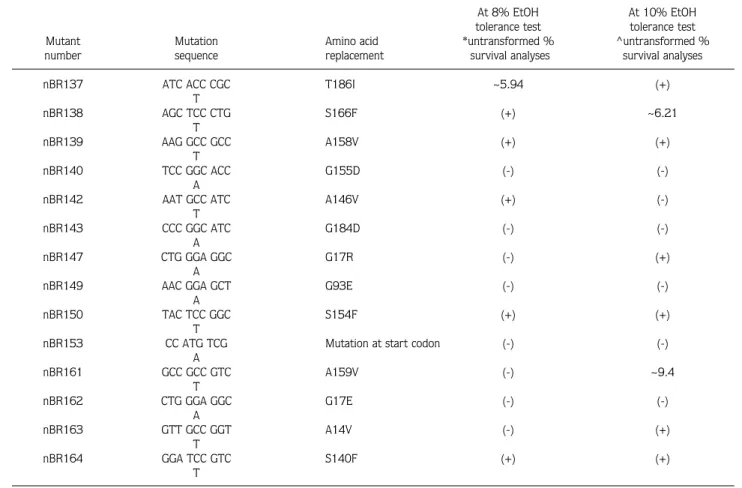
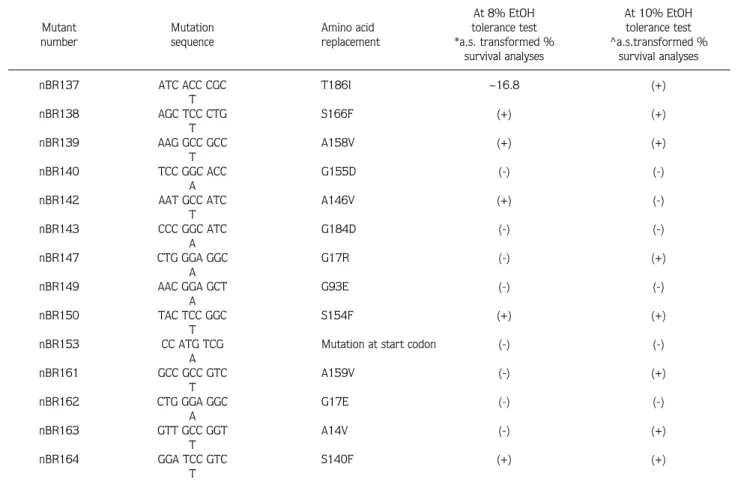
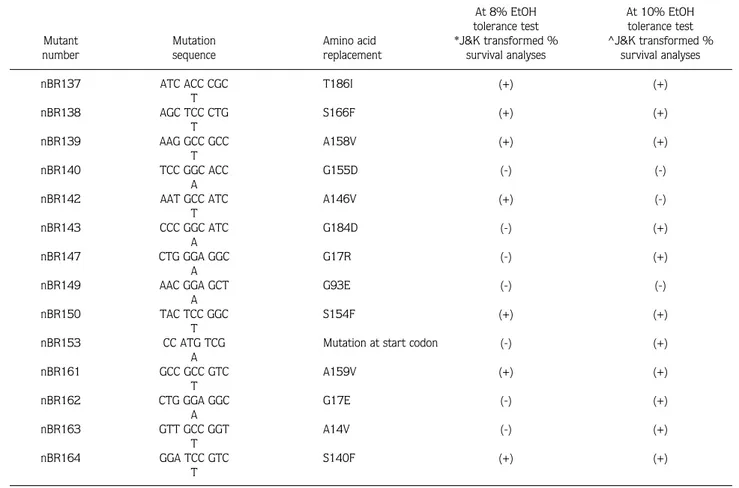
Untransformed percentage survival, arcsine transformed and Johnson & Kotz transformed percentage survival ratios of null/normal heterozygous flies at 8% and 10% alcohol concentrations are presented in Tables 1-3, respectively. With the Johnson and Kotz transformation, 12 of the 14 Adh–null mutations, heterozygous with wild-type chromosomes from stock, Org. R., had a phenotype with significantly lower viability than the wild-type control (AdhF
/AdhF
pr) at either or both ethanol concentration. At both alcohol concentrations and in all statistical analyses, mutations nBR149 and nBR140 were not significantly different from the wild-type control. Mutations nBR139, nBR150 and nBR164 were found to be significantly lower than the control for both alcohol concentrations and all 3 statistical tests. Mutation nBR142 was significantly different from the control in the 8% alcohol tests for all 3 statistical analyses but not in any 10% alcohol tests.
In the 8% alcohol test, the same 5 mutants were significantly different from the control (at probability of type I error = 0.05) in untransformed percentage
survival and arcsine transformation analysis. However, this figure was 7 in Johnson and Kotz transformed data analysis. Mutation nBR138 has a phenotype under the significance level in all 8% survival analyses but not in 10% untransformed percent survival tests. In this analysis it is just above the significance level with a 6.21% probability. Mutation nBR161 was just above the significance level at 9% probability using the 10% untransformed survival analysis. Mutation nBR137 was slightly above the significance level, using the untransformed survival and arcsine transformation analyses, at 5% and 16%, respectively.
In the 10% alcohol tests, 6, 8 and 11 mutants were significantly different from the control, using the untransformed percentage survival, arcsine transformation and Johnson and Kotz transformed
statistical analysis, respectively. When the selective stress was raised to 10% ethanol level, mutants nBR147, nBR163 and nBR137 were significantly lower than the control.
Discussion
Differential survival of 14 different 2-CIEMS induced intragenic Adh-null mutants, single base substitutions with GC to AT, was studied for alcohol tolerance on ethanol supplemented food. Genetic crosses were performed to give a common genetic background for the control and mutagenized chromosomes. The probability of a mutation in the Adh locus following exposure to 2-CIEMS was one per thousand. The probability of an independently induced modifier of the Adh locus with a
Table 1. Data analyses of 14 2-CIEMS induced Adh-null mutants at 2 different ethanol levels with untransformed percentage survival analyses. *Significance level for 8% EtOH test is 54.061. ^ Significance level for 10% EtOH test is 56.781. ~Percentage differences from the significance level in these statistical analyses. (-) indicates that the mutant is not significantly different from the control. (+) indicates that the mutant is significantly different from the control.
Significant difference from the control At 8% EtOH At 10% EtOH tolerance test tolerance test Mutant Mutation Amino acid *untransformed % ^untransformed % number sequence replacement survival analyses survival analyses
nBR137 ATC ACC CGC T186I ~5.94 (+)
T nBR138 AGC TCC CTG S166F (+) ~6.21 T nBR139 AAG GCC GCC A158V (+) (+) T nBR140 TCC GGC ACC G155D (-) (-) A
nBR142 AAT GCC ATC A146V (+) (-)
T
nBR143 CCC GGC ATC G184D (-) (-)
A
nBR147 CTG GGA GGC G17R (-) (+)
A
nBR149 AAC GGA GCT G93E (-) (-)
A
nBR150 TAC TCC GGC S154F (+) (+)
T
nBR153 CC ATG TCG Mutation at start codon (-) (-)
A nBR161 GCC GCC GTC A159V (-) ~9.4 T nBR162 CTG GGA GGC G17E (-) (-) A nBR163 GTT GCC GGT A14V (-) (+) T nBR164 GGA TCC GTC S140F (+) (+) T
similar mutation frequency would depend on the number of genes modifing the Adh locus, and would be considerably less than one per thousand, thereby permitting a comparison between the induced mutation and the control wild-type allele. The differential survival of Adh genotypes on food containing ethanol has been studied previously (20,24-27). Differences in in vitro ADH activities between Adh genotypes have also been reported (16,28-30).
There is a positive correlation between ADH activity and survival on food supplemented with ethanol since flies that have higher ADH activity can detoxify the harmful effect of ethanol faster. Moreover, other biochemical relations may be involved in ADH activity. Glycerol-3-phosphate oxidase (GPO, locus Gpo) and
sn-glycerol-3- phosphate dehydrogenase (GPDH, locus Gpdh) play an important role in alcohol or alcohol product metabolic pathways (17). The function of these minor pathways could be particularly important to the individual when the alcohol concentration is high.
Several experiments have been conducted on null/normal heterodimer formation (16,18,31-35). A mechanism was suggested for the interaction of a recessive null allele and the wild-type monomer in a heterozygote fly; a defect in the folding of a mutant subunit could be corrected by association with a complementing subunit. In this situation, the effect of a mutation should be localized so that a subunit which is correctly folded can restore the active configuration to the mutant subunit (18,31,34,35).
Table 2. Data analyses of 14 2-CIEMS induced Adh-null mutants at 2 different ethanol levels with arcsine (a.s.) transformed percentage survival analyses. *Significance level for 8% EtOH test is 0.523. ^ Significance level for 10% EtOH test is 0.908. ~Percentage differences from the significance level in these statistical analyses. (-) indicates that the mutant is not significantly different from the control. (+) indicates that the mutant is significantly different from the control.
Significant difference from the control At 8% EtOH At 10% EtOH Mutant Mutation Amino acid tolerance test tolerance test number sequence replacement *a.s. transformed % ^a.s.transformed %
survival analyses survival analyses
nBR137 ATC ACC CGC T186I ~16.8 (+)
T nBR138 AGC TCC CTG S166F (+) (+) T nBR139 AAG GCC GCC A158V (+) (+) T nBR140 TCC GGC ACC G155D (-) (-) A
nBR142 AAT GCC ATC A146V (+) (-)
T
nBR143 CCC GGC ATC G184D (-) (-)
A
nBR147 CTG GGA GGC G17R (-) (+)
A
nBR149 AAC GGA GCT G93E (-) (-)
A
nBR150 TAC TCC GGC S154F (+) (+)
T
nBR153 CC ATG TCG Mutation at start codon (-) (-)
A nBR161 GCC GCC GTC A159V (-) (+) T nBR162 CTG GGA GGC G17E (-) (-) A nBR163 GTT GCC GGT A14V (-) (+) T nBR164 GGA TCC GTC S140F (+) (+) T
It was reported by Hollocher and Place (34,35) and Chenevert et al. (18) that in Drosophila EMS induced ADH mutants Gly17 to Arg, Gly93 to Glu, Gly184 to Asp are inactive but form stable homodimers, as well as heterodimers with wild-type ADH, in which the wild-type subunit retains full enzyme activity.
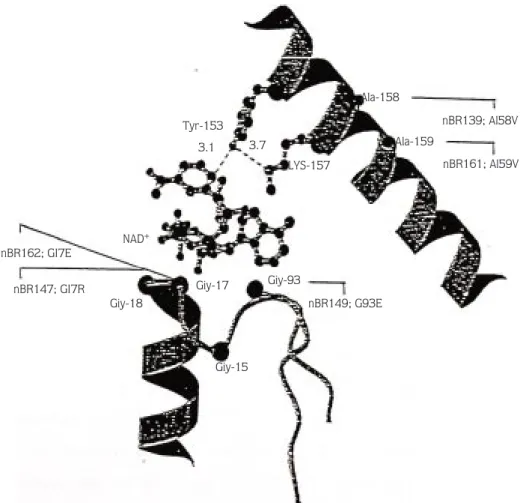
The Gly14 and Gly17 residues are located in the AMP binding domain, a moiety of NAD+ (Figure 1) and this
region consists of an α-β-αstructure. In ADH there is a glycine motif, Gly-Xa2-Gly-Xa-Gly , in this region. However, in most of its homologies this part of the enzymes contains a Gly-Xa3-Gly-Xa-Gly motif. The turn is sharper in ADH and glycine residues provide more flexibility for the enzyme and facilitate the close contact with AMP (18,36,37). It was reported that mutating Gly14 to Val almost inactivates the Drosophila ADH (36).
In our experiment, stock nBR163, which has Gly14 to Val substitution, was significantly different from the control in the 10% alcohol test in all statistical analyses. This was probably because of the additional carbon group in the valine, which may have disrupted this tight turn. Gly-17 was substituted with 2 different amino acid residues, mutations nBR147 residue Gly17 to Arg and mutations nBR162 residue Gly 17 to Glu. Replacement of glycine with arginine gave significantly different results from the control in all 10% alcohol test survival analyses (Tables 1-3). This may be the result of arginine interfering with the flexibility of this region and adding a positively charged side chain to this part of the ADH. These changes may lead to the loss of interaction with the coenzyme NAD+
and the enzyme. When the glycine was replaced with glutamic acid at this site, a less severe effect was
Table 3. Data analyses of 14 2-CIEMS induced Adh-null mutants at 2 different ethanol levels with Johnson and Kotz (J&K) transformed percentage survival analyses. *Significance level for 8% EtOH test is 0.752. ^ Significance level for 10% EtOH test is 0.716. ~Percentage differences from the significance level in these statistical analyses. (-) indicates that the mutant is not significantly different from the control. (+) indicates that the mutant is significantly different from the control.
Significant difference from the control At 8% EtOH At 10% EtOH tolerance test tolerance test Mutant Mutation Amino acid *J&K transformed % ^J&K transformed % number sequence replacement survival analyses survival analyses
nBR137 ATC ACC CGC T186I (+) (+)
T nBR138 AGC TCC CTG S166F (+) (+) T nBR139 AAG GCC GCC A158V (+) (+) T nBR140 TCC GGC ACC G155D (-) (-) A
nBR142 AAT GCC ATC A146V (+) (-)
T
nBR143 CCC GGC ATC G184D (-) (+)
A
nBR147 CTG GGA GGC G17R (-) (+)
A
nBR149 AAC GGA GCT G93E (-) (-)
A
nBR150 TAC TCC GGC S154F (+) (+)
T
nBR153 CC ATG TCG Mutation at start codon (-) (+)
A nBR161 GCC GCC GTC A159V (+) (+) T nBR162 CTG GGA GGC G17E (-) (+) A nBR163 GTT GCC GGT A14V (-) (+) T nBR164 GGA TCC GTC S140F (+) (+) T
observed on the enzyme activity. Stock nBR162 is significant only at 10% Johnson and Kotz analysis.
Glycine 93 is located in a highly conserved hydrophobic β-strand, which is close to the NAD+
binding region (Figure 1). It was reported by Chenevert et al. (18) that the replacement of Gly by a negatively charged Glu at this position probably disrupts the hydrophobic β -strand that binds to NAD+
. It was also stated by Hollocher and Place (34,35) that interallelic complementation of EMS mutant Adhn1
, a mutant of Gly93
to Glu, can form a heterodimer with AdhS that has half the activity of the wild-type heterodimer. In our experiment, Gly93 to Glu substitution, in nBR149, was not significantly different from the control at 2 different ethanol levels and in all statistical analyses.
Spanning positions 139-158 comprise 2 amino acids, Tyr152 and Lys156. Conserved in all short chain dehydrogenases, these are probably in the substrate
interactive domain and have an important functional role in catalysis (36,39). Interactions between NAD+ and
Tyr153, Lys157 and Thr186 are important in stabilizing the conformation that allows the substrate to interact with the nicotinamide group (40,41). In this study, replacement of the amino acids near this region, amino acids 154 and 155, gave significant results. Mutation nBR150 residue 154, Ser to Phe, was significantly different from the control in all statistical analyses with 2 alcohol concentrations. Probably, Phe is a larger amino acid than Ser and this may cause the distruption in the configuration of the active site. However, no effect on enzyme activity was observed on mutation nBR140 with residue 155, Gly to Asp.
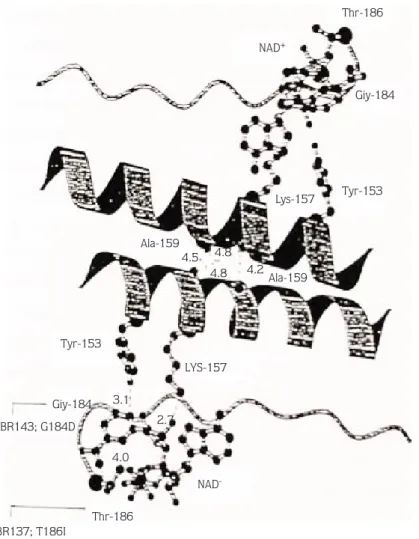
As can be seen in Figure 2, Ala158 and Ala159 are located in the dimer interface and they form a hydrophobic anchor in this region. The 4 Ala residues from the dimer fit into a hydrophobic tetrahedral
Tyr-153 3.1 3.7 LYS-157 Giy-93 Giy-17 nBR149; G93E Ala-158 nBR139; Al58V nBR161; Al59V Ala-159 Giy-18 Giy-15 NAD+ nBR162; GI7E nBR147; GI7R
configuration, and this is important in stabilization of the ADH dimer. In addition, a substitution in Ala159 with a larger amino acid may alter the conformation and displace either the Lys157 and/or Tyr153 at the catalytic site, which leads to loss of enzyme activity (18). It was reported by Hollocher and Place (35) that the EMS mutant of Adhn2
, which has Ala159 to Thr substitution, does not form dimers nor interallelic complementation with either AdhS
and AdhF
that leads to heterodimers. This shows that the Ala159 to Thr mutation affects the stability of functional dimers, leading to loss of enzyme activity. In our experiment, mutations with residue 158, Ala to Val, stock nBR139, and with residue 159, Ala to Val, stock nBR161, showed very important differences from the control in all statistical analyses (Tables 1-3).
The replacement of alanine 158 and alanine 159 with valine residues probably disrupted the configuration and hydrophobicity of this part. Since valine has 1 more carbon atom than alanine, this carbon atom may increase the distance between 2 subunits and reduces the strength of the hydrophobic attraction in this part of the enzyme.
Gly184 is important in the close approach of Thr186 to NAD+ ring (Figure 3) and it is conserved among the
members of this protein superfamily. It was stated by Jiang et al. (16) that residues from 182 to 194 are not critical to the monomer contact and binding. In addition, Hollocher and Place (35) reported that EMS induced Adhn7
, which is Gly184 to Asp mutant forms homodimers which are inactive. Moreover, a cross of this mutant with AdhF and AdhS leads to an active hetrodimer formation. nBR137; T186I Thr-186 NAD -LYS-157 Tyr-153 Giy-184 nBR143; G184D 2.7 4.0 3.1 4.5 4.8 4.8 4.2 Ala-159 Lys-157 Tyr-153 Giy-184 Thr-186 NAD+ Ala-159
Replacement of Gly184 with aspartic acid, in mutation nBR143, was significant only at 10% probability level using the Johnson and Kotz statistical method. The replacement of 186 threonine with isoleucine, in mutant nBR137, almost inhibits the enzyme activity in all statistical tests at 8% and 10% alcohol tolerance levels (Tables 1-3).
In our experiment, we have observed significant differences from the control in the heterozygote with mutations nBR164, residue 140 Ser to Phe, and nBR138, residue 166 Ser to Phe, in all ethanol levels and experimental analyses. More experiments are necessary to clarify the exact functions of these residues.
In this experiment, for each mutation 250-300 flies were used in 5 repeats. With such a large number of flies it was easy to observe the dominance effects of mutations. In heterozygotes, 12 of the 14 mutants showed significant dominance at the 8% or 10% ethanol tests using the Johnson and Kotz transformation.
It was reported by Crow (42) that recessive genes are not completely recessive. If we consider the representative human mutation rate, each individual must carry a large number of recessive genes causing lethality or severe defects. In our experiment, the partial dominance of Adh-null mutations due to single base changes showed a broad spectrum of dominance, from dominance to apparently no dominance, depending on the site of amino acid substitution in the enzyme. The effect can be observed in the first generation with decreasing effects in succeeding generations.
Acknowledgment
This research was carried out at the Department of Zoology and Physiology, Louisiana State University (USA). I would like to thank Dr. William R. Lee, the major advisor for my master’s degree, for his help during this work.
References
1. Fosset NG, Byrne BJ, Tucker AB, et al. Mutation spectrum of 2-chloroethyl methanosulfonate in D. melanogaster premeiotic germ cells. Mutation Research 331: 213-224, 1995.
2. Mukai T, Chiqusa SS, Yoshikawa I. The genetic structure of natural populations of D. melanogaster II overdominance of spontaneous mutant polygenes controlling viability in homozygous genetic background. Genetics 50: 711-715, 1964. 3. Mukai T, Chiqusa SS, Yoshikawa I. Dominance effect of
spontaneous mutant polygenes controlling viability in heterozygous genetic backgrounds. Genetics 52: 493-501, 1965. 4. Mukai T. Viability mutations induced by ethyl methanosulphate in
Drosophila melanogaster. Genetics 65: 335-348, 1970. 5. Ohnishi O. Spontaneus and EMS induced controlling viability in D.
melanogaster I. Recessive lethal mutations. II homozygous effect of polygenic mutations. III. Heterozygous effects of polygenic mutations. Genetics 87: 519-556, 1977.
6. Temin RG. Partial dominance of EMS induced mutations affecting viability in D. melanogaster. Genetics 89: 315-340, 1978. 7. Wallace B. The average effect of radiation induced mutations on
viability in D. melanogaster. Evolution 12: 532-552, 1958. 8. Wallace B. Further data on the overdominance of induced
mutations. Genetics 48: 633-651, 1963.
9. Mukai T, Yoshikawa SS, Sano K. The genetic structure of natural populations of Drosophila melanogaster. IV Heterozygous effect of radiation induced mutations on viability in various genetic backgrounds. Genetics 53: 513-527, 1966.
10. Falk R. Fitness of heterozygotes for irradiated chromosomes in Drosophila. Mutation Research 4: 805-819, 1967.
11. Crow FJ. Minor viability mutation in Drosophila. Genetics 92: 165-172, 1979.
12. Pandey J. Further studies on heterozygous effects of radiation on viability of Drosophila melanogaster. Mutation Research 27: 249-253, 1975.
13. Simmons MJ. Heterozygous effects of irradiated chromosomes on viability in D. melanogaster. Genetics 84: 353-374, 1976. 14. Crow JF, Temin RG. Evidence for the partial dominance of
recessive lethal genes in natural populations of Drosophila. American Nature 98: 21-33, 1964.
15. Sofer W, Martin PF. Analysis of ADH gene expression in Drosophila. Annual Review of Genetics 21: 203-225, 1987. 16. Jiang JC, Lee WR, Chang SH, et al. Mechanism for dominance;
Adh heterodimer formation in heterozygotes between ENU or X-ray induced induced null alleles and normal alleles in D. melanogaster. Environmental Molecular Mutagenesis 20: 260-270, 1992.
17. Geer BW, Heinstra PWH, McKechnie SW. The biological basis of ethanol tolerance in Drosophila. Comperative Biochemistry and Physiolology 105: 203-229, 1993.
18. Chenevert SW, Fossett NG, Chang SH, et al. Amino acids important in enzyme activity and dimer stability for Drosophila alcohol dehydrogenase. Journal of Biochemistry 308: 419-423, 1995.
19. Thompson JN, Kaiser TN. Selection acting upon slow migrating Adh alleles differing in enzyme activity. Heredity 38: 191-195, 1977.
20. Kamping A, Van Dalden. ADH polymorphism in populations of Drosophila melanogaster. II. Relation between activity and adult mortality. Biochemical Genetics 16: 541-551, 1978.
21. Eeken JC, Sobels FH. The effect of multilocus deletions in heterozygotes; a model study using Drosophila. Mutation Research 245: 267-275, 1990.
22. Gibson JB, May TW, Wilks V. Genetic variation at the alcohol dehydrogenase locus in Drosophila melanogaster in relation to environmental variation: ethanol levels in breeding sites and allozyme frequencies. Oecologia 51: 191-198, 1981.
23. Sokal RR, Rohlf JF. Biometry. W.H. Freeman and Company. USA, 1995.
24. Morgan P. Selection acting directly on an enzyme polymorphism. Heredity 34: 124, 1975.
25. Briscoe AD, Robertson A. Dominance at Adh locus in response of adult D. melanogaster to environmental alcohol. Nature 225: 148-149, 1975.
26. Oakeshott JG. Selection at the alcohol dehdyrogenase locus in Drosophila melanogaster imposed environmental ethanol. Genetical Research 26: 265-274, 1976.
27. Van Delden, Boerema WAC, Kamping A. The ADH polymorphism in populations of D. melanogaster.I. selection in different environments. Genetics 90: 161-190, 1978.
28. Gibson JB. Enzyme flexibility in Drosophila melanogaster. Nature 227: 959-960, 1970.
29. Gibson JB, Miklovich R. Modes of variation in alcohol dehydrogenase in D. melanogaster. Experientia 27: 99-100, 1971.
30. Vigue LC, Johnson FM. Isozyme variability in species of genus Drosophila. VI. Frequency property environment relationships of allelic ADH in D. melanogaster. Biochemical Genetics 9: 213-227, 1973.
31. Crick FHC, Orgel LE. The theory of inter-allelic complementation. Journal of Molecular Biology 8: 161-165, 1964.
32. Grell EH, Jacobson KB, Murphy JB. Alternation of genetic material for analysis of alcohol dehydrogenase isozyme of D. melanogaster. Ann. NY Acad. Sci. 151: 441-445, 1968. 33. Schwartz M, Sofer W. ADH negative mutants in Drosophila:
defects at the structural locus? Genetics 83: 125, 1976. 34. Hollocher H, Place AR. Reexamination of ADH structural mutants
in Drosophila using protein blotting. Genetics 116: 253-263, 1987a.
35. Hollocher H, Place AR. Partial correction of structural defects in ADH through interallelic complementation in D. melanogaster. Genetics 116: 265-274, 1987b.
36. Chen Z, Lu L, Shirley M, et al. Site-directed mutagenesis of Gly-14 and two “critical” cysteinyl residues in Drosophila alcohol dehydrogenase. Biochemistry 29: 1112-1118, 1990.
37. Cols N, Marfanny G, Atrian S, et al. Effect of site-directed mutagenesis on conserved positions of Drosophila alcohol dehydrogenase. FEBS 319: 90-94, 1993.
38. Baker EM. Sequence analysis of steroid and prostaglandin metabolizing enzymes: Application to understanding catalysis. Steroids 59: 248-257, 1994.
39. Chen Z, Jiang JC, Lin ZG, et al. Site-specific mutagenesis of Drosophila alcohol dehydrogenase. Evidence for involvement of Tyrosine 152 and Lysine 156 in catalysis. Biochemistry 32: 3342-3346, 1993.
40. Albalat RG, Gonzalez-Duarte R, Atrian S. Protein engineering of Drosophila alcohol deydrogenase. The hydroxyl group of Tyr152 is involved in the active site of the enzyme. FEBS 308: 235-239, 1992.
41. Chen Z. Tsigelny ‹, Lee WR, et al. Adding a positive charge at residue 46 of Drosophila alcohol dehydrogenase increases cofactor specificity for NADP+. FEBS Letters 356: 81-85, 1994.
42. Crow FJ. How much do we know about spontaneus humam mutation rates? Environmental Molecular Mutagenesis 21: 122-129, 1993.