First lactation milk yield, composition, and some
udder measurements of Honamlı goats raised
under extensive conditions*
Ozkan Elmaz1**, Fulya Tascı2, Aykut Asım Akbas1, Mustafa Saatcı3
1 Mehmet Akif Ersoy University, Faculty of Veterinary Medicine, Department of Animal Science,
15030, Istiklal Campus, Burdur, Turkey
2 Mehmet Akif Ersoy University, Faculty of Veterinary Medicine, Department of Food Hygiene
and Technology, 15030, Istiklal Campus, Burdur, Turkey,
3 Muğla Sıtkı Koçman University, Agriculture Faculty,
Department of Animal Science, Fethiye, Turkey
(Accepted September 14, 2018)
The aim of the study was to determine first lactation milk yield, milk freezing point depression, somatic cell counts and some udder measurements of a newly registered goat breed called Honamlı in Turkey. The milk samples were taken from 39 Honamlı goats. Milk yield was recorded with 30-day intervals. It was detected that first lactation milk yield, daily milk yield and lactation length were 107.1 kg, 0.563 kg, and 190.1 days, respectively. The percentages of fat, protein, lactose, total solids, freezing point depression and somatic cell counts /mL of milk were 1.4%, 4.2%, 5.2%, 11.8%, -0.607 °C, 74.8 and 4.5%, 7.3%, 3.8%, 15.9%, -0.587 °C, 1073 at the 30th and 180th lactation day,
respectively. Some udder and teat measurements such as udder length, udder width, udder depth, udder circumference, teat length, teat width, the distance between teats and the distance between the floor and the teat were 10.6 cm, 14.6 cm, 18.8 cm, 46.3 cm, 5.2 cm, 2.2 cm, 15.1 cm, and 35.7 cm, respectively, at the 60th lactation day. Correlation coefficients between contents of total solids (%),
fat (%), and protein (%) were statistically significantly positive at the 30th, 90th, and 150th lactation
days (P<0.001).
This study was the first step to define milk traits and to show preliminary differences of Honamlı goats from the other native goat breeds. Findings related with milk production of this breed may be used for future breeding plans.
*This research is part of a project supported by The Scientific & Technological Research Council of Turkey (TUBITAK), Project No: 112R031.
KEY WORDS: first lactation / Honamlı goat / milk composition / udder measurements
The number of goats reared in Turkey was 6,780,094 in 2002 and 10,416,166 in 2015. According to the data for the year 2015, the amount of goat milk produced in Turkey was 481,174 tons [Ünal et al. 2008]. Most (97%) of goats in Turkey are Turkish Hair goats (Hair goat) reared mainly in areas within and around forests. They also are named black goat because of their black hair colour and their breeding purposes are meat, milk and hair. The remaining 3% consist of the Angora goat (Tiftik goat) with the dual breeding purpose (mohair and meat), the Honamlı goat and dairy breeds such as Malta, Kilis, Saanen, and Damascus.
Honamlı goats are usually reared by Turkish nomads in the forest-maquis areas of the Taurus Mountains in the Mediterranean region. Even though these breeds are reared in similar habitats and for similar breeding purposes (meat, milk and hair), it has been reported that Honamlı goats have higher production performance than Turkish Hair goats (Hair goat) [Elmaz et al. 2012, Elmaz and Saatcı 2017, Saatcı and Elmaz 2017].
The number of studies on lactation milk yield and the length of lactation in Honamlı goats are not sufficient. The previous study revealed that litter size, marketable milk yield and average lactation duration in seven Honamlı flocks reared by local breeders under extensive conditions were 1.35, 89 kg and 210.3 days, respectively [Elmaz et
al. 2012]. Additionally, some researchers [Güler et al. 2007, Erol et al. 2012] have
reported different lactation milk yields and lactation durations for different goat breeds. Goats have a lower level of production, a subsequent and much lower peak yield, as well as a higher persistency during the first lactation period compared to the other lactations. The average milk yield constantly increases from the first lactation period (594.51 kg) until the third lactation period (761.96 kg) [Krajinović et al. 2011]. The average genetic correlations between the first and second lactations, between the second and third lactations, and between the first and third lactations are 0.64, 0.72 and 0.46, respectively [Zumbach et al., 2008].
Goat milk is a valuable food product and an excellent raw material due to its high nutritive value and exquisite taste [Bernecka 2011]. The composition of goat milk is generally reported as 11.6-14.8% for total solids, 3.60-5.63% for fat, 8.68-8.9% for solids-not-fat, 4.08-7.76% for lactose, 2.6-4.1% for protein and -0.540 to -0.573 oC for freezing point [Jandal 1996, Park et al. 2007, Raynal-Ljutovac et al. 2008].
Somatic cell count (SCC) may be used to compare milk quality based on some properties [Zeng et al. 1997, Pridalova et al. 2009, Jimenez-Granado et al. 2014]. Primiparous goats have higher somatic cell counts (840.40 versus 532.30 cells mL-1), but lower milk yields (115.40 versus 193.80 kg) during the evening milking [Orman
et al. 2011].
Udder type is an important trait for both higher milk production and suitability to machine milking in dairy goat breeding. Additionally, attachment of teats to the udder is also important for ease of machine milking. However, the number of studies on udder types of goats as a selection criteria is limited, since machine milking is not common in Turkey [Kor et al. 2004, Aktaş et al. 2012]. Although there is no report
concerning udder measurement value of Honamlı goats, Şimşek et al. [2006] reported udder depth, the length and diameter of right and left teats in Hair goats to be 16.8, 2.4, 2.4, 1.7 and 1.7 cm, respectively.
The aim of this study was to determine primarily the first lactation milk yield, milk composition and some udder measurements in a controlled Honamlı flock reared under extensive conditions in Turkey.
Material and methods
The study was conducted with 39 Honamlı goats kept at the Research and Training Farm of the Faculty of Veterinary Medicine, the Mehmet Akif Ersoy University in Burdur, Turkey. The Honamlı flock was reared under extensive conditions. The goats were allowed to graze and browse for 3-4 hours in the morning and afternoon. They were kept out for minimum 8 hours in a day. The selected goats were fed with 200 g/ day concentrate feed for three weeks before parturition and for the first 5 weeks of lactation (16% crude protein and 2500 kcal metabolisable energy per kg dry matter) in addition to grazing and browsing. This supplement food was given to the animals for about two months under harsh climate conditions to support their endurance. The goats were randomly selected from among two year-old goats in their first lactation. Milk yield, milk composition (total solids, fat, protein and lactose content), freezing point depression and somatic cell counts of Honamlı goats were determined. Lactation was assumed to continue up to the daily milk yield of <0.2 kg/day [ICAR 2012]. The kids were not completely separated from their dams during the recording day. Milk yields were measured using a method called the alternate day system. All the milk measurements were made using this system until the end of lactation. In this system kids were kept away from their dams for 12 hours before milking. During this period the kids were fed by the breeders. In this study, the goats were milked at 07:00 am on the recording day. Then the kids were allowed to suckle their dams until 07:00 am on the next day. The kids were again kept away from their dams until 07:00 pm in the evening when milk yield was recorded. The first test-day of the flock took place 4 to 15 days after kidding.
Lactation period was determined between parturition and the last milking day and additional 15 days were added. Milk yields of each animal during the milking were estimated using the Fleischmann method:
TMYF CMY = MMYD + _______ TMMYF
where:
CMY – control day milk yield (l); MMYD – morning milk yield of doe (l);
TMMYF – total morning milk yield of flock (l).
Milk samples of 50 ml were collected from the morning milk at every 30 days and immediately sent to the laboratory using an icebox. The milk collected by hand milking in the controls was weighed using a precision scale (±2 g). In the study no differences were observed in the udders of the goats in terms of udder size, color and milk characteristics. In addition, the California-mastitis test was applied to the goats to detect the incidence of mastitis. This was associated with the fact that udders were healthy and the goats were not affected by clinical mastitis during the lactation period. While total milk yield was determined using Fleischmann’s method, all milk samples were analyzed using a Bentley Combi 150 at the Mehmet Akif Ersoy University Central Laboratory in order to determine milk components and the somatic cell count. In addition, 8 measurements were taken from the udders of the goats. Udder length (UL), udder width (UW), udder depth (UD), udder circumference (UC), teat length (TL), teat width (TW), the distance between teats (DT) and the distance between the floor and the teat (DFT) of Honamlı goats were recorded. Udder and teat measurements were taken before the evening milking at the 60th lactation day [Ünal et al. 2008].
The general formula for the calculation method for total milk yield is k
TMY = y
1t1 + Σ (yi +yi+1)/2(ti+1 – ti) + yk+1*15 i=2
where:
TMYL – total milk yield;
y1 – amount of milk at the first milking;
t1 – y time between the first measurement and kidding; yi – milk yield at measurement;
ti+1– ti – time
between the measurement at i-th date and the measurement i+1 and 15 = standardisation for the dry period [Ruiz et al. 2000]. Milk yield, lactation period, milk components and udder measurements were defined and presented as descriptive statistics in the tables. Differences between the milk control days were analysed by one-way ANOVA and Paired t-test was employed to describe the alteration between morning and evening milk amounts. Also correlation coefficients of the milk components were calculated. These computations were perfomed via the Minitab package program [Minitab Inc. 2011].
Results and discussion
Table 1 shows the first lactation milk yield, lactation length and daily milk yield of Honamlı goats in this study. First lactation milk yield and lactation length were found to be 107 kg and 190 days, respectively. Considerable changes were observed in milk yield throughout the lactation period (Fig. 1). In a study conducted by Elmaz
et al. [2012] on Honamlı goats, the average marketable milk yield of Honamlı goats
was reported as 89 kg. When comparing lactation milk yield, lactation length and average daily milk yield, it could be stated that Honamlı goats showed similarities with the results of the study [Şimşek et al. 2006] on Hair goats reared under the same conditions as Honamlı goats.
Table 3 shows milk yields of Honamlı goats in the morning and evening milkings. Milk yield of the morning milking was 483 g, 378 g,and 100 g, respectively, at the 30th, 120th and 180th lactation days. Total yields of morning and evening milks were 729, 757, and 215 g, respectively, for the same days. Milk yield, which was higher at the beginning of lactation, decreased towards the end of the lactation. Daily milk yield was the highest at 120th lactation day (757 g/day). According to Table 3, there were significant differences (P<0.05) between morning and evening milks in the recording days. Total milk yield was similar at the 30th and 60th days, but statistically
Table 1. Lactation milk yield of Honamlı goat reared under
extensive conditions
Traits n Mean (SE)
Lactation milk yield (kg) 39 107.1 (.07)
Lactation length (day) 39 190.1 (2.76)
Fig. 1. Changes in milk yield of Honamlı goats during lactation.
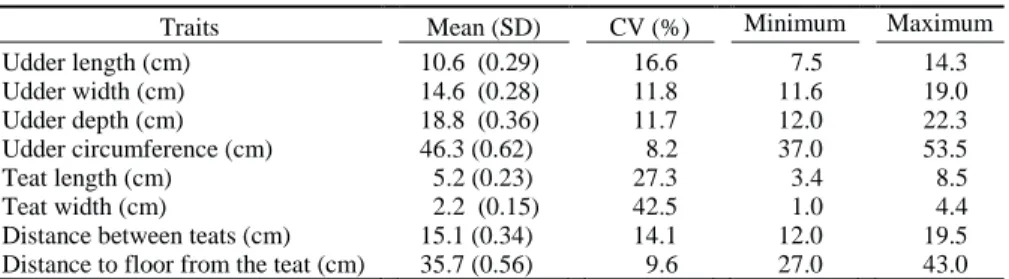
Table 2. Descriptive statistics of udder characteristics in Honamlı goats (n=39)
Traits Mean (SD) CV (%) Minimum Maximum
Udder length (cm) 10.6 (0.29) 16.6 7.5 14.3 Udder width (cm) 14.6 (0.28) 11.8 11.6 19.0 Udder depth (cm) 18.8 (0.36) 11.7 12.0 22.3 Udder circumference (cm) 46.3 (0.62) 8.2 37.0 53.5 Teat length (cm) 5.2 (0.23) 27.3 3.4 8.5 Teat width (cm) 2.2 (0.15) 42.5 1.0 4.4
Distance between teats (cm) 15.1 (0.34) 14.1 12.0 19.5
Distance to floor from the teat (cm) 35.7 (0.56) 9.6 27.0 43.0
...
,
..
,
..
,..
'
.
T a b le 3 . M ea n m il k y ie ld ( g ) o f H o n a m lı g o a ts d ep en d in g o n m il k in g t im e a n d d a y s (n =3 9 ) P er io d 3 0 th d a y 6 0 th d a y 9 0 th d a y 1 2 0 th d a y 1 5 0 th d a y 1 8 0 thd a y P M o rn in g 4 8 3 .3 a ( 3 8 .1 ) 3 2 9 .5 b ( 2 7 .6 ) 3 2 4 .4 b ( 2 1 .9 ) 3 7 8 .2 a ( 2 9 .7 ) 1 8 9 .7 c ( 1 3 .5 ) 1 0 0 .0 c ( 7 .7 ) * E v e n in g 2 4 6 .2 b ( 1 8 .1 ) 4 1 2 .8 a ( 3 6 .1 ) 2 3 9 .7 b ( 1 1 .0 ) 3 7 9 .5 a ( 2 7 .5 ) 1 1 0 .3 c ( 5 .8 ) 1 1 5 .0 c ( 1 2 .9 ) * T o ta l 7 2 9 .5 a ( 5 0 .1 ) 7 4 2 .3 a ( 6 1 .0 ) 5 6 4 .1 b ( 2 9 .3 ) 7 5 7 .7 a ( 5 2 .8 ) 3 0 0 .0 c ( 1 7 .6 ) 2 1 5 .0 c ( 1 6 .3 ) * P * * * n s * * a b… Wi th in r o w m ea n s b ea ri n g d if fe re n t su p er sc ri p ts d if fe r si g n if ic a n tl y a t P < 0 .0 5 . * P <0 .0 5 ; n o n -s ig n if ic a n t (n s) P > 0 .0 5 . T a b le 5 . M il k c o m p o si ti o n a n d s o m a ti c c el l c o u n ts ( S C C ) in d if fe re n t p er io d s (1 2 0 1 8 0 t h d a y s) o f H o n a m lı g o a t (n =3 9 ) P ar a m et er 1 2 0 th d a y 1 5 0 th d a y 1 8 0 th d a y m o rn in g e v e n in g m ea n m o rn in g e v e n in g m ea n m o rn in g e v e n in g m ea n F a t (% ) 3 .2 ( 0 .2 1 ) 2 .8 ( 0 .1 7 ) 3 .0 ( 0 .1 8 ) 1 .9 ( 0 .1 1 ) 2 .8 ( 0 .1 4 ) 2 .4 ( 0 .1 1 ) 4 .6 ( 0 .6 0 ) 4 .4 ( 0 .6 5 ) 4 .5 ( 0 .6 1 ) P ro te in ( % ) 4 .3 ( 0 .0 6 ) 4 .2 ( 0 .0 5 ) 4 .2 ( 0 .0 6 ) 5 .0 ( 0 .1 1 ) 4 .7 ( 0 .1 0 ) 4 .9 ( 0 .1 0 ) 7 .3 ( 0 .4 7 ) 7 .3 ( 0 .4 3 ) 7 .3 ( 0 .4 5 ) L a c to se ( % ) 4 .8 ( 0 .0 3 ) 4 .7 ( 0 .0 2 ) 4 .8 ( 0 .0 3 ) 4 .6 ( 0 .0 8 ) 4 .6 ( 0 .0 2 ) 4 .6 ( 0 .0 4 ) 3 .8 ( 0 .2 5 ) 3 .8 ( 0 .2 8 ) 3 .8 ( 0 .2 7 ) T o ta l so li d s (% ) 1 3 .1 ( 0 .2 1 ) 1 2 .5 ( 0 .1 8 ) 1 2 .8 ( 0 .1 9 ) 1 2 .3 ( 0 .1 8 ) 1 2 .9 ( 0 .1 9 ) 1 2 .6 ( 0 .1 7 ) 1 6 .0 ( 0 .8 2 ) 1 5 .9 ( 0 .8 6 ) 1 5 .9 ( 0 .8 3 ) F re ez in g p o in t (° C ) -0 .6 0 1 ( 0 .0 0 1 ) -0 .5 9 0 ( 0 .0 0 1 ) -0 .5 9 6 ( 0 .0 0 1 ) -0 .5 9 5 ( 0 .0 0 ) -0 .6 0 3 ( 0 .0 0 ) -0 .5 9 9 ( 0 .0 0 ) -0 .5 8 6 ( 0 .0 1 ) -0 .5 8 7 ( 0 .0 2 ) -0 .5 8 7 ( 0 .0 1 ) S o m a ti c c el l c o u n ts (x 1 0 0 0 ) 3 3 1 .0 ( 1 2 6 .0 ) 3 0 8 .7 ( 9 5 .0 ) 3 2 0 .0 ( 1 1 0 .0 ) 6 1 5 .0 ( 1 0 6 .0 ) 5 3 1 .1 ( 8 9 .3 ) 5 7 3 .0 ( 9 4 .2 ) 1 1 9 3 .0 ( 1 3 8 .0 ) 9 5 3 .0 ( 1 5 6 .0 ) 1 0 7 3 .0 ( 1 2 6 .0 ) T a b le 4 . M il k c o m p o si ti o n a n d s o m a ti c c el l c o u n ts ( S C C ) in d if fe re n t p er io d s (3 0 -9 0 t h d a y s) o f H o n a m lı g o a ts ( n =3 9 ) P ar a m et er 3 0 th d a y 6 0 th d a y 9 0 th d a y m o rn in g e v e n in g m ea n m o rn in g e v e n in g m ea n m o rn in g e v e n in g m ea n F a t (% ) 1 .2 ( 0 .0 8 ) 1 .6 ( 0 .0 9 ) 1 .4 ( 0 .0 7 ) 1 .3 ( 0 .1 5 ) 1 .6 ( 0 .1 2 ) 1 .5 ( 0 .1 3 ) 2 .2 ( 0 .1 7 ) 2 .6 ( 0 .3 0 ) 2 .4 ( 0 .1 6 ) P ro te in ( % ) 4 .2 ( 0 .0 5 ) 4 .1 ( 0 .0 5 ) 4 .2 ( 0 .0 5 ) 4 .3 0 .0 5 ) 4 .2 ( 0 .0 5 ) 4 .2 ( 0 .0 4 ) 4 .3 ( 0 .0 6 ) 4 .1 ( 0 .0 5 ) 4 .2 ( 0 .0 5 ) L a c to se ( % ) 5 .3 ( 0 .0 2 ) 5 .2 ( 0 .0 2 ) 5 .2 0 .0 2 ) 5 .0 ( 0 .0 2 ) 5 .0 ( 0 .0 2 ) 5 .0 ( 0 .0 2 ) 4 .9 ( 0 .0 2 ) 4 .8 ( 0 .0 2 ) 4 .9 ( 0 .0 2 ) T o ta l so li d s (% ) 1 1 .6 ( 0 .1 1 ) 1 1 .9 ( 0 .1 2 ) 1 1 .8 ( 0 .1 0 ) 1 1 .3 ( 0 .1 4 ) 1 1 .6 ( 0 .1 4 ) 1 1 .5 ( 0 .1 3 ) 12 .3 ( 0 .2 0 ) 1 2 .3 ( 0 .3 2 ) 1 2 .3 ( 0 .2 5 ) F re ez in g p o in t (° C ) -0 .6 0 6 ( 0 .0 0 1 ) -0 .6 0 8 ( 0 .0 0 1 ) -0 .6 0 7 ( 0 .0 0 1 ) -0 .5 8 9 ( 0 .0 0 1 ) -0 .5 8 7 ( 0 .0 0 2 ) -0 .5 8 8 ( 0 .0 0 2 ) -0 .5 9 9 ( 0 .0 0 1 ) -0 .5 9 4 ( 0 .0 0 2 ) -0 .5 9 7 ( 0 .0 2 ) S o m a ti c c el l c o u n ts (x 1 0 0 0 ) 2 6 .5 ( 1 1 .0 ) 1 2 3 .1 ( 4 5 .4 7 4 .8 ( 2 6 .6 ) 1 1 6 .4 ( 3 4 .4 ) 1 3 4 .0 ( 3 9 .1 ) 1 2 5 .2 ( 3 5 .2 ) 2 6 7 .8 ( 9 6 .8 ) 2 8 0 .6 ( 7 9 .5 ) 2 7 4 .2 ( 8 3 .9 )
significant differences were found in total milk yields of the 90th, 120th, 150th and 180th days (P<0.05). The lactation length and lactation milk yield found in this study for Honamlı goats were higher than those reported by Forik [1995] for Hair goats, but lower than those reported by Keskin et al. [2002] for Damascus (Shami) goat.
Tables 4 and 5 present the milk composition (fat, protein, lactose, total solids, freezing point) and the somatic cell count in different periods of lactation. Daily milk fat contents were determined as 1.4%, 3%, and 4.5% respectively, at the 30th, 120th and 180th days. The fat content in the milk also increased gradually with the progress of lactation. The protein level in the milk was 4.2% at the 120th day, 4.9% at the 150th day and 7.3% at the 180th day. Lactose contents in the morning and evening milks were 5.2%, 4.9%, 4.8% and 3.8% at the 30th, 90th, 120th and 180th days of lactation. The highest total solids, fat and protein contents were recorded during the last month of lactation. In the present study the substantial increase in the total contents of fat and protein towards the end of lactation was affected by the decreasing daily milk yield. Similarly, some researchers reported an increased content of milk total solids towards the end of lactation [Králíčková et al. 2013, El-Tarabany et al. 2016]. Additionally, milk components determined on the different recording days were higher than those reported by Zeng et al. [1997] and Guo et al. [2001] for other goat breeds.
The composition of goat milk shows major differences depending on the breed. Fat is the most variable milk component. Protein and lactose levels are also important for goat milk structure. The specified contents for fat, protein and lactose in this study are comparable to those reported by other researchers [Forik 1995, Zeng et al. 1997, Guo et al. 2001, Keskin et al. 2002]. Additionally, milk content varies depending on milk production.
In this study SCCs were the lowest at the beginning of lactation and reached the highest value at the end of lactation. These results are compatible with the increase in SCC for Turkish Saanen goats during the first lactation period [Orman et al. 2011]. On the other hand, in their study Pridalova et al. [2009] found that average SCCs in goat milk were 1875.103 ml-1 in factory A and 895.103 ml-1 in factory B during lactation.
High SCCs in goat milk seemed natural, particularly in the late stages of lactation [Zeng and Escobar 1995, Gomes et al. 2006]. High SCCs in goat milk may also be associated with a different type of secretion in goats, namely apocrine secretion due to unspecified reasons [Neveu et al. 2002] compared to the merocrine secretion in cows [Pridalova et al. 2009].
In this study monthly average values of freezing points for raw goat milk ranged from -0.587°C to -0.607°C during lactation. These results are comparable to those reported by Janstova et al. [2007], who found that they were the highest in the beginning of lactation (in the spring months) and decreased to minimum values at the end of lactation (in the summer months). In turn, Park et al. [2007] reported that the freezing point of goat milk ranged between -0.540 oC and -0.570 oC, while Strzalkowska et al. [2009] determined the freezing point of goat milk as -0.625 oC, -0.570 oC, and -0.625 oC, respectively, for three lactation durations.
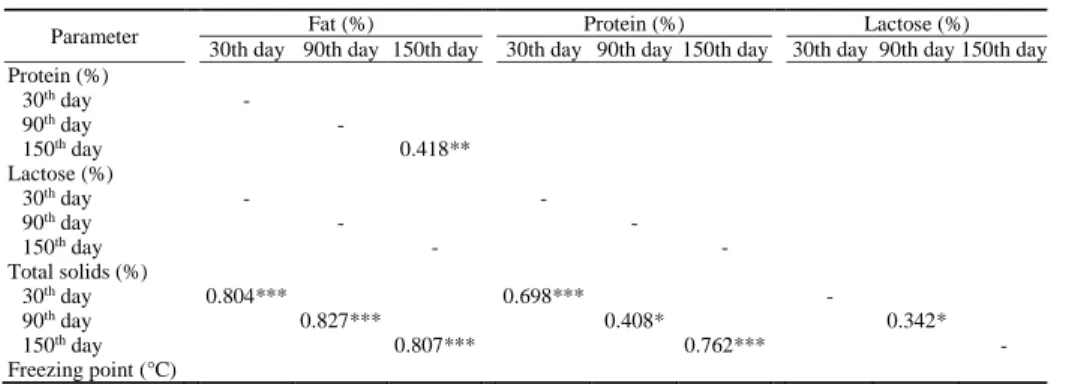
Table 6 shows the correlation coefficients between milk yield traits during the lactation period. Correlation coefficients between total solids (%), fat (%) and protein contents (%) were clearly positive (r = 0.698 to 0.827) and significant (P<0.001) at the 30th, 90th, and 150th lactation days. Correlation coefficients between the freezing point, lactose (%) and dry matter (%) were also positive (r = 0.357 to 0.869) and significant (P<0.05 to P<0.001) at the 30th, 90th, and 150th lactation days. Zeng et
al. [1997] found that there was a negative correlation between milk amount and fat
content for Alpine goats during the lactation period. Similarly, Bagnicka et al. [2015] reported a negative correlation (-0.30) of milk yield and percentage contents of fat and protein. In the same study correlations between fat and protein yields and their contents were detected as moderate. In turn, Analla et al. [1996] found phenotypic correlations between fat and protein content as 0.54, which was relatively higher, but in agreement with the present study. In another study it was reported that the milk fat content showed a significant correlation with dry matter content for Alpin and Saanen goat’s milk during five consecutive lactation periods [Antunac et al. 2001].
Some udder and teat characteristics of Honamlı goats, such as udder length, udder width, udder circumference, teat length and the distance between the floor and teat were 10.6 cm, 14.6 cm, 46.3 cm, 5.2 cm and 35.7 cm, respectively, at the 60th lactation day (Tab. 2).These values were relatively lower than those reported by Akbaş et al.
[2018] for Honamlı goats. Additionally, the values were higher than in the reports by
various other researchers [Atay et al. 2011, Şimşek et al. 2006] for Hair goats, a native goat breed, as well as some reports [Cedden et al. 2002, Erol et al. 2017] for various goat breeds reared in Turkey.
This study is one of the first scientific studies conducted on first lactation milk yield, milk composition and udder structure of Honamlı goats recently registered in Turkey. Milk yield of Honamlı goats was determined to be similar to that of other native goat breeds reared in Turkey. It will be useful for future studies to investigate the effect of various rearing systems and feeding strategies on milk yield and composition (especially milk fat content) in Honamlı goats. Relatively higher reproduction
Table 6. Correlation coefficients among milk composition of Honamlı goats (n = 39)
Parameter Fat (%) Protein (%) Lactose (%)
30th day 90th day 150th day 30th day 90th day 150th day 30th day 90th day 150th day Protein (%) 30th day - 90th day - 150th day 0.418** Lactose (%) 30th day - - 90th day - - 150th day - - Total solids (%) 30th day 0.804*** 0.698*** - 90th day 0.827*** 0.408* 0.342* 150th day 0.807*** 0.762*** - Freezing point (°C)
performance of Honamlı goats reported [Elmaz et al. 2012] makes its milk production more important than in other native breeds; therefore, first lactation data collected from this study could be used to evaluate milking performance of Honamlı goats in the future breeding plans to be applied in that breed.
Acknowledgments. A part of this study was presented as an oral presentation at
the International VETistanbul Group Congress - 2015, St. Petersburg, Russia, April 7-9, 2015.
REFERENCES
1. AKBAŞ A.A, ELMAZ Ö., SAATCI M., SARI M. 2018 – Investigation of Honamlı goat herds in
terms of dairy characters. Project report: Mehmet Akif Ersoy University Scientific Research Projects Commission (Project No: 0350-NAP-16).
2. AKTAŞ Z.M., KAYGISIZ A., BAŞ S. 2012 – The relationships between Turkish Saanen Goats milk
yield traits, some udder measurements and SCC at Kahramanmaraş breeders conditions. KSÜ Doğa Bilimleri Dergisi 15, 7-17 (Turkish with English abstract).
3. ANNALLA M., JIMENEZ-GAMERO I., MUNOZ-SERRANO A., SERRADILLA J.M., FALAGAN
A. 1996 – Estimation of genetic parameters for milk yield and fat and protein contents of milk from Murciano-Granadina goats. Journal of Dairy Science 79, 1895-1898.
4. ANTUNAC N., SAMARZIJA D., HAVRANEK J.L., PAVIC V., MIOC B. 2001 – Effects of stage
and number of lactation on the chemical composition of goat milk. Czech Journal of Animal Science 46, 548-553.
5. ATAY O., GÖKDAL Ö., ÖZUĞUR A.K., EREN V. 2011 – Relationships between udder
measurements and milk yield characteristics of Hair goats in rural conditions. 7th Scientific Animal
Science Congress, 14-16 September, Adana, Turkey.
6. BAGNICKA E., HAMANN H., DISTL O. 2015 – Structure and the non-genetic and genetic effects
on milk traits in Polish dairy goat population. Animal Science Papers and Reports 33, 59-69. 7. BERNECKA H. 2011 – Health-promoting properties of goat milk. Medycyna Weterynaryjna 67,
507-511.
8. CEDDEN F., KOR A., KESKIN S. 2002 – Laktasyonun geç döneminde keçi sütünde somatik hücre
sayımı; yaş, süt verimi ve bazı meme özellikleri ile olan ilişkileri. Yüzüncü Yıl Ünv Ziraat Fak Tarım Bilimleri Dergisi 12, 63-67 (Turkish with English abstract).
9. ELMAZ Ö., SAATCI M., 2017- Turkish Hair Goat, the Main Pillar of Goat Population in Turkey (Pp:
113-130). In: Simões J., Gutiérrez C. (eds). Sustainable Goat Production in Adverse Environments: Volume II. Springer, Cham.
10. ELMAZ O., SAATCI M., DAĞ B., AKTAŞ A.H., ATA A., GÜLAY M.Ş., MAMAK N., GÖK B.
2012 – Some descriptive characteristics of a new goat breed called Honamli in Turkey. Tropical Animal Health and Production 44, 1913–1920.
11. EL-TARABANY M.S., EL-TARABANY A.A., ROUSHDY E.M. 2016 – Impact of lactation stage
on milk composition and blood biochemical and haematological parameters of dairy Baladi goats. Saudi Journal of Biological Sciences (Article in press, https://doi.org/10.1016/j.sjbs.2016.08.003.
12. EROL H., AKÇADAĞ H.İ., ÜNAL N., AKÇAPINAR H. 2012 – Milk yield and its effect on kids
growth in Angora goats. Ankara Üniversitesi Veteriner Fakültesi Dergisi 59, 129-134 (Turkish with English abstract).
13. EROL H., ÖZDEMIR P., ODABAŞ E., ŞENYÜZ H.H., ÜNAL N., BEHREM S. 2017 – Investigation
of various production traits of Angora goat herds kept as gene source both ex situ and in situ conditions. Lalahan Hayvancılık Araştırma Enstitüsü Dergisi 57, 1-12 (Turkish with English abstract).
14. FORIK A. 1995 – Some characteristics related with milk, fiber yield and fertility of Hair goats raised at village conditions. Master’s degree thesis, Institute of Science and Technology, Uludağ University, Bursa, Turkey.
15. GOMES V., LIBERA A.M.M.P.D., PAIVA M., MADUREIRA K.M., ARAÚJO W.P. 2006 – Effect of
the stage of lactation on somatic cell counts in healthy goats (Caprae hircus) breed in Brazil. Small Ruminant Research 64, 30-34.
16. GÜLER Z., KESKIN M., MASATÇIOĞLU M., GÜL S., BIÇER O. 2007 – Effects of breed and
lactation period on some characteristics and free fatty acid composition of raw milk from Damascus goats and German Fawn × Hair goat B1 crossbreds. Turkish Journal of Veterinary and Animal Sciences 31, 347-354.
17. GUO M.R., DIXON P.H., PARK Y.W., GILMORE J.A., KINDSTEDT P.S. 2001 – Seasonal changes
in the chemical composition of commingled goat milk. Journal of Dairy Science 84, E79-E83.
18. ICAR (International Committee for Animal Recording) 2012 – International agreement of recording
practices. Guidelines approved by the general assembly held in Cork, Ireland on June 2012.
19. JANDAL J.M. 1996 – Comparative aspects of goat and sheep milk. Small Ruminant Research 22,
177-185.
20. JANSTOVA B., DRACKOVA M., NAVRATILOVA P,, HADRA L., VORLOVA L. 2007 – Freezing
point of raw and heat-treated goat milk. Czech Journal of Animal Science 52, 394-398.
21. JIMENEZ-GRANADO R., SANCHEZ-RODRIGUEZ M., ARCE C., RODRIGUEZ-ESTEVEZ V.
2014 – Factors affecting somatic cell count in dairy goats: a review. Spanish Journal of Agricultural Research 12, 133-150.
22. KESKIN M., AVŞAR Y.K., BIÇER O., GÜLER M.B. 2002 – A comparative study on the milk yield
and milk composition of two different goat genotypes under the climate of the Eastern Mediterranean. Turkish Journal of Veterinary and Animal Sciences 28, 531-536.
23. KOR A., KESKİN S., KARACA S., ARSLAN S. 2012 – The effect of age and lactation order on
some udder measurements in Akkeçi. Yüzüncü Yıl Ünv Ziraat Fak Tarım Bilimleri Dergisi 14, 105-111 (Turkish with English abstract).
24. KRAJINOVIĆ M., PIHLER I., SIMIN V., JOCIĆ A., NIĆIN S., ŽUJOVIĆ M. 2011 – The influence
of number of lactation on milk yield parameters in German Fawn goats. Biotechnology in Animal Husbandry 27, 1469- 1475.
25. KRALICKOVA Š., KUCHTIK J., FILIPCIK R., LUZOVA T., ŠUSTOVA K. 2013 – Effect of chosen
factors on milk yield, basic composition and somatic cell count of organic milk of Brown
short-haired goats. Acta Universitatis Agriculturae et Silviculturae Mendelianae Brunensis 61, 99-105.
26. Minitab 2011 – Minitab For Windows Version Release 16, Minitab Inc.
27. NEVEU C., RIAUBLANC A., MIRANDA G.J., CHICH F., MARTIN P. 2002 – Is the apocrine milk secretion process observed in the goat species rooted in the perturbation of the intracellular transport mechanism induced by defective alleles at the αs1-Cn locus?. Reproduction Nutrition Development 42, 163–172.
28. ORMAN A., GÜNAY A., BALCI F., KOYUNCU M. 2011 – Monitoring of somatic cell count
variations during lactation in primiparous and multiparous Turkish Saanen goats (Capra hircus). Turkish Journal of Veterinary and Animal Sciences 35, 169-175.
29. PARK Y.W., JUAREZ M., RAMOS M., HAENLEIN G.F.W. 2007 – Physico-chemical characteristics
of goat and sheep milk. Small Ruminant Research 68, 88-113.
30. PRIDALOVA H., JANSTOVA B., CUPAKOVA S., DRACKOVA M., NAVRATILOVA P.,
VORLOVA L. 2009 – Somatic cell count in goat milk. Folia Veterinaria 53, 101-105.
31. RAYNAL-LJUTOVAC K., LAGRIFFOUL G., PACCARD P., GUILLET I., CHILLIARD Y. 2008
32. RUIZ R., OREGUI L.M., HERRERO M. 2000 – Comparison of models for describing the lactation curve of Latxa sheep and an analysis of factors affecting milk yield. Journal of Dairy Science 83, 2709-2719.
33. SAATCI M., ELMAZ Ö. 2017 – Honamlı, Newly Registered Special Goat Breed of Turkey (Pp:
131-146). In: Simões J., Gutiérrez C. (eds) Sustainable Goat Production in Adverse Environments: Volume II. Springer, Cham.
34. ŞIMŞEK Ü., BAYRAKTAR M., GÜRSES M. 2006 – Çiftlik koşullarında Kıl keçilerine ait bazı
verim özelliklerinin araştırılması. Fırat Üniversitesi Sağlık Bilimleri Dergisi 20, 221-227 (Turkish with English abstract).
35. STRZALKOWSKA N., JOZWIK A., BAGNICKA E., KRZYZEWSKI J., HORBANCZUK K.,
PYZEL B., HORBANCZUK J.O. 2009 – Chemical composition, physical traits and fatty acid profile
of goat milk as related to the stage of lactation. Animal Science Papers and Reports 27, 311-320.
36. TURKSTAT (Turkish Statistics Institute) 2016 – The results of animal production statistics.
37. ÜNAL N., AKÇAPINAR H., ATASOY F., YAKAN A., UĞURLU M. 2008 – Bafra koyunlarında bazı meme özellikleri ve kuzularda büyüme ile bu özelliklerin farklı süt kontrol yöntemleriyle tespit edilen süt verimi ve sağım özellikleriyle fenotipik korelasyonları. Ankara Üniversitesi Veteriner Fakültesi Dergisi 55, 117-124 (Turkish with English abstract).
38. ZENG S.S., ESCOBAR E.N. 1995 – Effect of parity and milk production on somatic cell count,
Standard plate count and composition of goat milk. Small Ruminant Research 17, 269-274.
39. ZENG S.S., ESCOBAR E.N., POPHAM T. 1997 – Daily variations in somatic cell count, composition,
and production of Alpine goat milk. Small Ruminant Research 26, 253-260.
40. ZUMBACH B., TSURUTA S., MISZTAL I., PETERS K.J. 2008 – Use of a test day model for dairy
goat milk yield across lactations in Germany. Journal of Animal Breeding and Genetics 125,