ORIGINAL EMPIRICAL RESEARCH
The role of climate: implications for service employee engagement
and customer service performance
Bulent Menguc1,2 &Seigyoung Auh3&Volkan Yeniaras4&Constantine S. Katsikeas2
Received: 27 June 2016 / Accepted: 7 March 2017 / Published online: 18 March 2017 # Academy of Marketing Science 2017
Abstract This research attempts to challenge the resource
–en-gagement and en–en-gagement–performance linkage of the job
de-mands–resources model by testing these links under the mod-erating role of two climates: performance-focused and service failure recovery. Two studies test a model on the boundary conditions of the linkages across four service industries. The results suggest that whether a resource (i.e., self-efficacy and job autonomy) positively or negatively affects engagement de-pends on whether (1) a climate is appraised as a challenge or hindrance demand and (2) a climate is deemed a complemen-tary or compensatory resource. Using multi-respondent data from customer service employees and their supervisors in the health care industry, Study 1 conceptualizes climate as organi-zational climate and finds that performance-focused climate
strengthens (weakens) the positive effect of self-efficacy (job autonomy) on engagement while service failure recovery cli-mate weakens the positive impact of self-efficacy on engage-ment. Study 2 generalizes the findings from Study 1 and pro-vides broad support by testing the model using psychological climate in the financial services, tourism and hospitality, and retailing industries. This study closes with a configuration ap-proach to climate research by discussing when multiple cli-mates can co-exist under different types of resources.
Keywords Job demands–resourcesmodel .Self-efficacy .Job
autonomy . Engagement . Climate . Service failure recovery
There is widespread consensus that the rewards of employee
engagement, defined as Ba positive, fulfilling, work-related
state of mind that is characterized by vigor, dedication, and
absorption^ (Schaufeli et al.2002, p. 465), range from more
customer satisfaction, productivity, profitability, and earnings per share to less turnover, absenteeism, and service failure
(e.g., Gallup 2013a; Harter et al. 2002; Salanova et al.
2005). Recent studies also indicate that highly engaged
em-ployees are more than four times as likely to recommend their company’s products and services as their disengaged
counter-parts (Temkin Group2016). All evidence points to the
strate-gic significance of having engaged employees as a foundation
for customer engagement marketing (Harmeling et al.2016).
Notwithstanding the benefits associated with employee job
engagement,1the current state of engagement looks bleak
both in the United States and globally. According to Gallup
(2016), a modest 32% of the U.S. workforce and a dismal 13%
of employees worldwide are engaged in their work. Even grimmer is that frontline service employees are
1Engagement refers to employee job engagement hereinafter, unless specified
otherwise. Martin Mende served as Area Editor for this article.
* Bulent Menguc [email protected] Seigyoung Auh [email protected] Volkan Yeniaras [email protected] Constantine S. Katsikeas [email protected]
1 Department of Business Administration, Kadir Has University, 34083 Istanbul, Turkey
2
Marketing Division, University of Leeds, Leeds University Business School, Leeds LS2 9JT, UK
3
Thunderbird School of Global Management and Center for Service Leadership, Arizona State University, Glendale, AZ 85306, USA 4 College of Business Administration, Department of Management,
among the least engaged (Gallup 2013a). Considering the consequences of engagement (Harmeling et al.
2016; Kumar and Pansari 2016), the pervasiveness of
such highly disengaged service employees is trouble-some. Therefore, deepening understanding of what firms can do to improve and capitalize on engagement is a strategic priority that merits further research attention.
Many studies on engagement have drawn from the job demands–resources (JD-R) model to explicate how people form engagement. Although the JD-R framework has gar-nered widespread support in marketing literature on sales
(Miao and Evans 2013; Schmitz and Ganesan 2014) and
frontline employees’ customer service, customer orientation,
and performance (Chan and Wan2012; Singh2000; Zablah
et al.2012), we argue that the JD-R model is overly simplistic
and does not adequately capture the nuanced nature of how engagement is formed and affects performance. For example, according to the JD-R model, resources (e.g., supervisor and coworker support, feedback, role clarity) enhance engage-ment, while job demands (e.g., role ambiguity/conflict) hinder
it (Bakker and Demerouti2007; Demerouti et al.2001). This
perspective is fairly narrow, and research has attempted to broaden the basic relationships in the JD-R model. For exam-ple, research has proposed extensions to the framework, such as specifying the differentiated JD-R model, which fur-ther divides job demands into challenges (i.e., demands appraised as supporting personal growth and develop-ment) and hindrances (i.e., demands appraised as imped-ing learnimped-ing, personal development, and growth), with the former positively and the latter negatively affecting
engagement (Crawford et al. 2010).
We develop a model by extending the scope of the differ-entiated JD-R to capture organizational climate as either a resource or a demand and show how the same organizational climate as a resource or a demand can have different moder-ating effects (i.e., positive or negative) on the relationship between personal/job resources and engagement. Given the growing competition in the health care industry, hospitals are increasingly charged with delivering exceptional service performance and effective recovery after service failures
(Taylor and Cronin1994; Vinagre and Neves 2008). This
study examines two types of organizational climates that re-flect this growing trend in the health care context: performance-focused and service failure recovery. A performance-focused climate reflects service employees’ shared perception that outperforming other employees is im-portant and that high-performing employees receive the most attention. Service failure recovery climate entails service em-ployees’ shared perception that restoring service quality and customer satisfaction after a service failure is supported, ex-pected, and rewarded. As we explain subsequently, we main-tain that service failure recovery climate is an organizational resource, while performance-focused climate is an
organizational demand. The core of our argument is that the impact of personal (e.g., self-efficacy) and job (e.g., job au-tonomy) resources on engagement is more complicated than originally believed and is contingent on the type of organiza-tional climate under examination. Furthermore, in contrast with research that relies on a universal positive effect of en-gagement on performance (for an exception, see Kumar and
Pansari2016), we outline boundary conditions of the
engage-ment–customer service performance relationship by examin-ing this link under different organizational climates. To this end, this research takes a more granular approach to the JD-R model in three respects.
First, we argue that the same demand (i.e., performance-focused climate) can either strengthen or weaken the impact of personal (e.g., self-efficacy) and job (e.g., job autonomy) re-sources on engagement depending on the resource it moder-ates. Implicit in the differentiated JD-R model is the notion that whether a demand is considered a challenge or a hin-drance depends on how individuals who possess different types of personal or job resources appraise the demand. In support of this, in their call for further research, Crawford
et al. (2010, p. 844, italics added) argue,BMost important,
perhaps, researchers could examine how demands are appraised as a challenge or a hindrance and how these ap-praisals impact the cognitions, emotions, and coping strategies that ultimately translate to self-perceptions of engagement.^
Consequently, our central thesis is that service employees may appraise the same demand as either a challenge or a hindrance contingent on the types of personal or job resources they possess. For example, self-efficacious employees may appraise a performance-focused climate as a challenge be-cause such a climate enables them to achieve development and growth, while employees who possess job autonomy may consider the same climate a hindrance because such a climate prevents them from experiencing discretion and lati-tude in how to accomplish their jobs. This line of reasoning departs from the dominant view in extant literature, which chiefly centers on the diminished impact of resources under
demands (e.g., Demerouti et al.2001) or the mitigated effect
of demands under resources (e.g., Schmitz and Ganesan
2014). However, by extending the differentiated JD-R model,
we take a more nuanced view by arguing that performance-focused climate as a demand may have a negative or even a positive moderating effect on engagement, depending on the resource with which it interacts.
Second, while the prevailing view in the JD-R literature is that resources lead to more engagement when accompanied by other resources, we show that personal and job resources can have either a positive or a negative effect on engagement depending on whether the moderating organizational resource is complementary or compensatory. For example, we show that service failure recovery climate as an organizational re-source can either positively or negatively moderate personal
and job resources on engagement depending on whether the relationship between such a climate and resources is comple-mentary or compensatory. Again, these predictions extend the literature that mainly focuses on positive interaction effects of
resources on engagement (e.g., Bakker and Demerouti2007).
Third, the boundary conditions of the engagement
–perfor-mance linkage have received sparse attention (for an
exception, see Kumar and Pansari2016), and this study
at-tempts to investigate this relationship under different types of organizational climate, an approach that has not been tested empirically. We add to this important linkage by showing that engagement’s effect on customer service performance needs to be taken into account under the conditioning role of differ-ent organizational climates.
Against this backdrop, this study sheds new light on why some resources encourage engagement while others discour-age it under the same climate. We also show that the boundary conditions that shape the consequences of engagement are still poorly understood; thus, moving from a universal to a contin-gency lens provides a more fine-grained perspective of the engagement–customer service performance link.
Through two studies, we explain how our research broadens the JD-R framework by developing interaction hy-potheses between personal (i.e., self-efficacy) and job (i.e., job autonomy) resources and the performance-focused and ser-vice failure recovery climates on engagement and also be-tween engagement and the two climates on customer service performance. Study 1 tests the hypotheses in the health care industry by conceptualizing climate as organizational climate, while Study 2 tests the same model in the financial services, tourism and hospitality, and retailing industries by conceptu-alizing climate as psychological climate at the individual ser-vice employee level.
Theoretical background and hypotheses
Although prior research has argued that resources and de-mands have a positive and negative influence on engagement, respectively, we provide a more nuanced view of how engage-ment is formed and influences customer service performance.
Table1summarizes the marketing literature on the drivers and
outcomes of employee job engagement.
Differentiated JD-R model
We draw from Crawford et al.’s (2010) differentiated
JD-R framework to develop our conceptual model (see
Fig. 1). According to this perspective, not all demands
negatively affect engagement. While some demands, known as hindrance demands (e.g., role ambiguity), dis-courage engagement, others such as challenge demands (e.g., workload) encourage engagement. Following
Cavanaugh et al. (2000), Crawford et al. (2010), and
Bakker and Demerouti (2007), we define Bhindrance
demand^ as physical, psychological, social, or
organiza-tional aspects of the job that hinder learning, personal growth, and development. Hindrance demands can ob-struct personal goal achievement and ultimately impair service employees’ engagement in their jobs. We define Bchallenge demand^ as physical, psychological, social, or organizational aspects of the job that have the poten-tial to stimulate greater learning, personal development, and goal attainment. Although challenge demands can be stressful, unlike hindrance demands, when overcome and met, they can lead to personal growth and advancement.
Both Crawford et al. (2010) and Bakker and
Sanz-Vergel (2013) clearly classify demands into hindrances
and challenges, with the latter authors asserting that whether an employee classifies a demand as a challenge or a hindrance depends on occupation (e.g., a nurse may view work pressure as a hindrance demand, while a journalist may view the same demand as a challenge demand). However, our objective is to empirically show that the same demand, such as performance-focused cli-mate, can function as a challenge or hindrance demand depending on the resource employees possess. For ex-ample, we subsequently explain why self-efficacy’s ef-fect on engagement is strengthened under
performance-focused climate, while job autonomy’s impact on
en-gagement is mitigated. This prediction of the same de-mand exerting a positive moderating effect (when ap-praised as a challenge demand) on the one hand and a negative moderating effect (when appraised as a hin-drance demand) on the other hand, contingent on the type of resource it interacts with, finds support in the
literature (see Crawford et al. 2010).
We also argue that, in contrast with the dominant perspective that resources have a positive effect on en-gagement or are neutralized by demands, personal and job resources can interact with organizational resources (e.g., service failure recovery climate) to exert positive or negative effects on engagement. We examine self-efficacy and job autonomy as a personal and job re-source, respectively. These two resources appear in
many JD-R models (e.g., Schmitz and Ganesan 2014),
and job autonomy is also a critical element of the job
characteristics model (Hackman and Oldham 1980). The
main difference between the two resources lies in the source of replenishment. Personal resources are self-generated and originate from the employee, while job resources come from the organization or from supervi-sors. We maintain that whether a personal or job re-source exerts a positive or negative impact on engage-ment depends on the nature of the moderating
Ta b le 1 Review of th e m arketing literature on the driv ers and outcomes of employee job eng agement S tudy Sample Lev el o f analys is T heo retical fr amewor k C oncep tual iza tion o f employee engagement Drivers o f employee engagemen t Outcome variables Kum ar and Pa n sar i ( 2016 ) 52 manufacturing and 6 8 servic e fi rms Fir m Str ate gic Fi t S ati sfa cti on, Id enti fic ati on, L oyal ty , C o mmitmen t, and P erformance Not E xamined C ustomer E ngagement Firm Pe rformanc e (I ncr eas e in Reve nue and Net Income) S antos-V ijande et al . ( 2016 ) 246 service firms Firm Service-Dominant Logic F rontline employees ’ ro le in se rvice innovation – New S er vice M ar k et Performance De C ar lo and La m ( 2016 ) Stu dy 1: 357 B2B salespeople Stu d y 2 : 200 sales p eople pro v ided by a m arket re se ar ch fi rm Multilevel R egulatory F oc us C ustomer Retention and Acquisition Promotion F ocus Pr eve n tion Fo cus Profit Mar g in s Y e et al . ( 2012 ) 5 0 S BUs , 85 managers, and 1213 frontline employees from hos pitals Mult ile vel O rg ani za tiona l and Individual Learning Employee ’s converting generated knowledge into articulated k nowledge – Gro up L evel (Knowledge A rti cu la ti on) Unit Level (Kn owledge Updating, Cus tomer Sat isfact ion, Se rvi ce Ef fici enc y an d R evenu e) Miao and E vans ( 2013 ) 223 industrial salespeople Individual-Level JD-R A dapt ive S elling and S elling E ffo rt Job D emands (Sup ervisor ’s O u tcome and A cti vity Control) Job S tre ss (R o le A m bi guity & R ole C onflict) S ale sp er so n P er for m an ce Z abla h et al . ( 2012 ) 323 samples repo rted in 2 91 studies (1979 –201 1) based on data provided b y 99,641 frontline employees Individual-Level Met a-A na lysis JD-R S ati sfa cti on and Or ganizational C o mmitment Cus tomer Orientation Jo b S tr es s (R o le C onf li ct and R o le A mbiguity) Job Per for m an ce Propensity to L eave Ve rb ek e et al . ( 201 1 ) 268 studies published between 1981 and 2008 Individual-Level Met a-ana lysis Not specified Enthus iasm Job Involvement Job D edication W orking Ha rde r C itiz ensh ip Beha viors Not examined S ales performance This stud y 800 frontline service employees in 25 hospitals (S tudy 1) 276 respondents from the financial services , tourism and hospitality , and re tai ling se ctor s (S tudy 2) Mult ile vel Individual-Level JD-R W o rk -r ela ted st ate ch ar ac ter ize d b y v igor , dedication, and abs orption Job A u tonomy and Se lf -E ff icac y Customer Service Performance This literature review is li mited to studies published in Jo urnal of the A cademy of Marketing Science , Journal of Marketing ,a n d Jou rnal of Marke ting R esea rc h b etween 1990 and 2016
organizational resource. If this resource is complemen-tary, a positive effect is likely to occur; if it is compen-satory, a negative effect is likely to occur.
Performance-focused and service failure recovery climate
BOrganizational climate^ refers to the collective and shared value and meanings that employees derive from their work environment through social and group
inter-actions (Schneider and Reichers 1983). That is,
organi-zational climates are the lens through which employees interpret and filter what is important, rewarded, and ex-pected in their work environment (Schneider et al.
1998). We chose performance-focused and service
fail-ure recovery for this study after consulting with hospital administrative staffs about the most important organiza-tional climates emphasized in employees’ daily opera-tions. The first was an explicit focus on performance excellence. The second, which is consistent with the service literature, was the belief that no matter how much emphasis is put on performance excellence, mis-haps are bound to happen, and thus how organizations respond when a service failure occurs is critical. The emphasis on a climate that underscores recovery after a service failure is consistent with research that shows that customers can become more satisfied with and loyal to a firm that handles recovery of service failure prop-erly than had the service failure not happened in the
first place (McCollough and Bharadwaj 1992; Tax and
Brown 1998). To corroborate our selection, we
approached senior management staff at the hospitals and confirmed that these two climates best represented
their hospital’s focus.2
We conceptualize performance-focused climate as an orga-nizational demand and service failure recovery climate as an organizational resource. We argue that performance-focused climate is a demand because the overly heavy focus on high-performance standards reflected in the emphasis on performing better than colleagues and favoring high-performing employees puts significant physiological and
psy-chological pressure on employees (Greenhaus et al.1987).
Such a climate involves a competitive and high-pressure work environment that can steer employees to compete against one another rather than collaborate, potentially building tension and conflict. Therefore, while we assert that performance-focused climate is a demand, employees appraise it as either a challenge or a hindrance depending on the type of resource they possess.
Service failure recovery climate is a resource because we conceptualize this climate as management’s support to em-ployees in terms of providing training, resources, and empow-erment as well as rewarding and recognizing them for restor-ing service quality and customer satisfaction after a service
2Other organizational climates that we identified were safety and innovation.
However, these two climates were emphasized more for physicians and nurses than for service employees, who were the focus of this study.
Organizational Resource
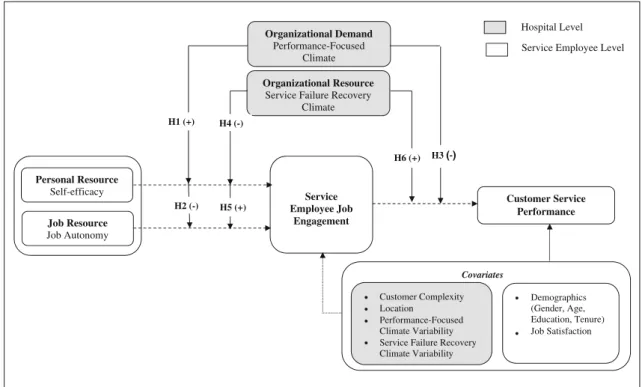
Service Failure Recovery Climate Personal Resource Self-efficacy Job Resource Job Autonomy Service Employee Job Engagement Organizational Demand Performance-Focused Climate Customer Service Performance Hospital Level Service Employee Level
H3 ( ) Demographics (Gender, Age, Education, Tenure) Job Satisfaction H6 (+) Customer Complexity Location Performance-Focused Climate Variability Service Failure Recovery Climate Variability H4 (-) H5 (+) H1 (+) Covariates H2 (-)
Fig. 1 The hypothesized model for service employee job engagement and customer service performance (Study 1). Note: The dotted lines indicate direct effects, which we neither hypothesize nor test as they have already received significant attention in the literature
failure. This definition is in line with the role of functional resources in achieving work goals and stimulating per-sonal growth, learning, and development (Bakker and
Demerouti2007). Based on the above two climates, this
study takes a configuration approach to climate research by showing when multiple climates can co-exist under different types of resources.
Moderating role of performance-focused climate
Self-efficacy–engagement link We do not hypothesize main
effects between resources and engagement or between en-gagement and customer service performance because these links have already received attention in the literature (e.g.,
Christian et al. 2011; Schaufeli and Bakker 2004;
Xanthopoulou et al.2007, 2009). Instead, we focus on the
interactions between the two climates (i.e., performance-focused and service failure recovery) and resources and the same two climates and engagement because less research has investigated the boundary conditions of the resource–engage-ment and engageresource–engage-ment–customer service performance relationships.
We argue that self-efficacious employees will appraise performance-focused climate as a challenge because self-efficacy helps them cope with and meet high-performance expectations. Under a high-performance-focused climate, self-efficacious employees will feel motivated to leverage their knowledge and expertise to raise performance. When working in a performance-focused climate, they will sense the need to feel competent and make an impact, and when these needs are satisfied through self-efficacy, they will feel greater intrinsic motivation, leading to more engagement
(Deci and Ryan1985, 2000). Therefore, we posit that a
performance-focused climate allows self-efficacy to manifest through greater motivation and the fulfillment of realized competency, and thus we predict a stronger positive effect of self-efficacy on engagement:
H1: The positive effect of self-efficacy on engagement is stronger under a high (vs. low) performance-focused climate.
Job autonomy–engagement link Service employees who have autonomy in their jobs tend to be engaged because of the increased control and latitude to make their own decisions
(Deci and Ryan1985,2000), which enhance satisfaction. Job
autonomy offers employees the discretion to be self-governing and independent; they can self-regulate and learn at their own pace for growth and development. However, we assert that these employees will appraise a performance-focused climate as a hindrance, thus mitigating job
autonomy’s effect on engagement, because the demand and
expectation to deliver only high performance thwart the mo-tivation to design, pace, and control their work. A high performance-focused climate dampens the benefits associated with job autonomy because, while job autonomy enables em-ployees to take charge of the process of work, a performance-focused climate puts heightened value on the final outcome, rendering the two incompatible. Under a performance-focused climate, we reason that the taxing and demanding pressure to produce high performance and outperform fellow colleagues will interfere with and thus diminish the intrinsic motivation that employees perceive from job autonomy, attenuating its impact on engagement:
H2: The positive effect of job autonomy on engagement is weaker under a high (vs. low) performance-focused climate.
Engagement–customer service performance link In this
study, we define engagement as a work-related state of mind represented by vigor, dedication, and absorption (Schaufeli
et al.2002). Engaged employees feel more inspired, energetic,
and enthusiastic about their work, and this feeling will be reflected in how they interact with customers (Salanova
et al. 2005). Thus, engagement can lead to higher customer
service performance, defined as an assessment of how well a service employee delivers in-role service performance to cus-tomers, because engaged employees have a more positive out-look of their work and are more dedicated to performing their job responsibilities and duties. Engaged employees approach customers quickly, listen to them carefully, and recognize needs that they may possess but are not able to identify; thus, they are able to explain certain service features and benefits to
overcome customer objections (Liao and Chuang2004).
According to social information processing theory
(Salancik and Pfeffer 1978), employees interpret that their
organizations appreciate hard results but not hard work (or the process) in a high performance-focused climate. Therefore, under a performance-focused climate, we expect the positive impact of engagement on customer service per-formance to be weakened because the sole emphasis on high performance impedes the channeling of engagement to better service customers. That is, a performance-focused climate hinders engaged employees from delivering high customer service performance as it creates a competitive work environ-ment, which dampens engagement’s positive effect on cus-tomer service performance. Consequently, we propose that a performance-focused climate mitigates the effect of engage-ment on customer service performance:
H3: The positive effect of engagement on customer service performance is weaker under a high (vs. low) performance-focused climate.
Moderating role of service failure recovery climate
Self-efficacy–engagement link We state our interaction
argument between self-efficacy and service failure re-covery climate by drawing from the information ceiling
effect literature (Ettema and Kline 1977; Sama et al.
1994). According to the information ceiling effect, new
information is less useful for information-rich than information-poor individuals. When applying this to our research, we propose that high self-efficacious ployees will benefit less than low self-efficacious em-ployees when management provides the resources and training for service failure recovery.
When employees have low self-efficacy3 but sense a
high service failure recovery climate, they can be reassured that, despite lacking competency, management will provide them with the necessary tools and training to effectively recover from service failures. However, when employees are already self-efficacious and have the resources and skills necessary to effectively recover from a service failure, a high service failure recovery climate will not be as helpful and uplifting because the training, resources, or technical support offered un-der a high service failure recovery climate will have limited impact. Consequently, when already equipped with the required skill sets and knowledge to execute a recovery strategy, such efficacious employees do not benefit as much from a service failure recovery climate as those who lack recovery capabilities.
Our reasoning suggests that a high level of service failure recovery climate can compensate for low self-efficacy and a low level of service failure recovery climate can be compen-sated by high self-efficacy. That is, when employees sense that management cares about service failure recovery efforts, they may feel engaged regardless of their level of self-efficacy because they know they will receive support for service failure recovery. In this respect, service failure recovery climate and self-efficacy as resources have a compensatory relationship, and therefore we expect service failure recovery climate to mitigate the effect of self-efficacy on engagement.
H4: The positive effect of self-efficacy on engagement is weaker under a high (vs. low) service failure recovery climate.
Job autonomy–engagement link According to the job characteristics model, job autonomy leads to more
engagement because when employees possess autonomy, they sense more control of their jobs because of in-c r e a s e d f r e e d o m , i n d e p e n d e n in-c e , a n d d i s in-c r e t i o n
(Hackman and Oldham 1980). Meta-analysis shows that
work-enriching characteristics, such as job autonomy, give rise to increased perceptions of psychological
em-powerment (Seibert et al. 2011). When a service failure
occurs under a high service failure recovery climate and employees have job autonomy, they do not need to wait or ask for supervisor approval on how to proceed and what should be done to recover from a failure. Therefore, they will be more engaged, knowing that they are empowered to make an impact on reversing what went wrong. We also submit that employees with job autono-my working under a high service failure recovery climate will feel more intrinsic motivation when they have con-trol and latitude over how they can respond to service failures. In this respect, we argue that service failure recovery climate and job autonomy as resources have a complementary relationship. Therefore, service failure re-covery climate will further enable employees to take ad-vantage of the freedom, flexibility, and discretion that accompany job autonomy, leading to greater engagement.
H5: The positive effect of job autonomy on engagement is stronger under a high (vs. low) service failure recovery climate.
Engagement–customer service performance link Under a
high service failure recovery climate, employees are provided with the necessary resources and training to handle unexpected outcomes effectively so that service quality and customer trust are restored. When em-ployees sense such support from management, they are likely to feel self-determined because their need for competency, discretion, and control is fulfilled (Deci
and Ryan 1985). We reason that a service failure
recov-ery climate instills employees with a greater sense of empowerment and therefore bolsters engaged employees in performing customer service at a higher level. Our reasoning is consistent with recent studies that show that the impact of employee engagement on customer engagement is stronger when employees are empowered
(Kumar and Pansari 2016). We therefore posit that the
impact of engagement on customer service performance will be accentuated under a high service failure recovery climate:
H6: The positive effect of engagement on customer service performance is stronger under a high (vs. low) service failure recovery climate.
3We argue that the ability to effectively implement a service failure recovery
strategy is an important criterion of a self-efficacious service employee. Therefore, we assert that when employees possess self-efficacy, they feel com-petent in addressing customer complaints or service failures as part of their job description.
Study 1 (main study)
Research context
Our research context is a private health care company that
owns 25 hospitals4across Turkey. Turkey is the 17th largest
economy in the world and 7th largest in Europe in terms of purchasing power, and the services sector contributes to 64.2% of gross domestic product (International Monetary
Fund2015). Although tourism, communications, and
finan-cial services still play a predominant role in creating wealth, the engines of growth in the Turkish health care sector have been increasing income, changing demographics, and wide-spread access to health care services (Investment Support and
Promotion Agency of Turkey2014). The private sector leads
the growth in Turkey’s health care sector, with the number of
private hospital beds growing 23.6% between 2002 and 2012
(Investment Support and Promotion Agency of Turkey2014).
The Turkish health care system has undergone reforms since 2003. Private hospitals have become more accessible to local patients, whether they have private health insurance or not. Turkish hospitals/medical centers have also experi-enced a 38% increase in foreign patients seeking treatment between 2008 and 2012 (Investment Support and Promotion
Agency of Turkey2014), and private hospitals assume a
sub-stantial role in making the country an attractive destination for health tourism. This trend increases competition among pri-vate hospitals in particular, and managers are now more con-cerned with sustaining and maintaining high levels of service quality to enhance patient satisfaction, loyalty, and retention
(Taner and Antony2006). Thus, a deeper understanding of the
role of service employee engagement in demonstrating supe-rior customer service performance may benefit managers striving to achieve a competitive advantage.
Sample and data collection procedure
We conducted this study at 25 private hospitals governed by a private health care company, with service employees working in the patient admission unit of each hospital as our target respondents. We distributed 1183 surveys across all 25 hospi-tals with the help of contact personnel assigned by the com-pany. Service employees received the survey along with a return envelope and a letter explaining the purpose of the study. We asked the respondents to fill out consent forms on data confidentiality and anonymity as part of our agreement with the company. After completing the survey during work hours, service employees returned the survey directly to the contact personnel, who then forwarded completed surveys to the company headquarters through an internal mailing system.
We obtained 800 usable surveys from service employees, for a response rate of 67.6%. Seventy-one percent of em-ployees were employed by 15 hospitals located in a metropol-itan city. The number of service employee responses across hospitals ranged from 5 to 96, with a response rate ranging from 12.8% to 100%. Of the service employees, 79.6% were women, 47% were within the age range of 25–31 years, 66.8% were university graduates, and average job tenure was 2.5 years. There was a statistically significant difference across hospitals in terms of service employees’ age (F = 5.013, p < .01) and tenure (F = 6.913, p < .01).
Survey design and measures
Service employees responded to the survey in Turkish. However, because a Turkish version of the scales necessary to measure multi-item constructs was not available, we de-signed the survey in English and translated it into Turkish through the translation/back-translation technique (Brislin
et al.1973). While designing the survey, we implemented all
necessary procedural remedies to minimize the possibility for
response bias (Podsakoff et al.2003). That is, we informed
respondents that there were no right or wrong answers to any of the scale items and that their responses would remain con-fidential. We controlled for priming effects and item-context-induced mood states by ordering different types of constructs (e.g., performance-focused climate, self-efficacy, customer complexity) and their respective scale items randomly so that they would not follow the same order as in the proposed mod-el. Finally, we eliminated common scale properties between independent variables and the dependent variable by
obtaining supervisors’ responses to service employees’
cus-tomer service performance using different anchor labels
(Ostroff et al.2002).
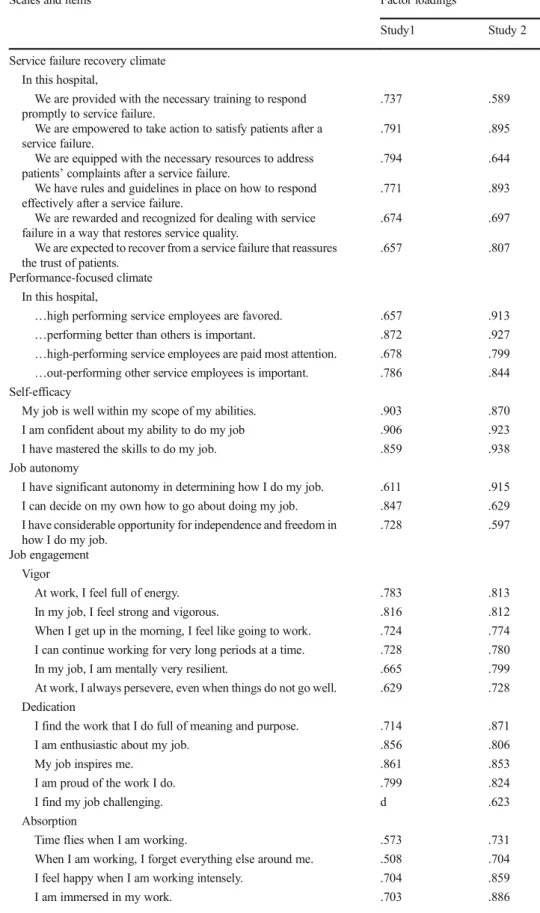
We measured all multi-item constructs except service fail-ure recovery climate with existing scales drawn from the marketing/management literature. We used a five-point Likert format (1 = strongly disagree; 5 = strongly agree) for all measures except for supervisors’ evaluation of service em-ployees’ customer service performance (see the Appendix). Core constructs We measured job autonomy (three items) and self-efficacy (three items) with scales borrowed from
Spreitzer (1995). We measured job engagement in terms of
vigor (six items), dedication (five items), and absorption (six
items) with scales borrowed from Salanova et al. (2005). We
assessed performance-focused climate with the four
highest-loading items of Seifriz et al.’s (1992) performance dimension
of Perceived Motivational Climate scale, which they adapted
from Ames and Archer’s (1988) Achievement Goals
Questionnaire. Drawing from Gonzalez et al. (2005),
we measured service failure recovery climate with a 4A confidentially agreement with the company prevents us from revealing
six-item scale we developed for this study by following
Churchill’s (1979) procedure.
Although the Turkish hospitals are autonomous in their management, they implement a uniform performance evalua-tion system for service employees. Two supervisors evaluate
service employees’ performance twice a year on five criteria
(i.e., accurately anticipating and working to fulfill patients’ needs, interacting professionally with patients, providing high-quality service to patients, attending to patients’ needs and requests, and listening to patients to understand needs and determine how they can be met) on a five-point scale (1 = far below expectations; 5 = very successful). We obtained an average score of the five criteria from supervisors’ evaluations of employees’ customer service performance after the survey was completed. We matched these customer service perfor-mance scores with the survey data from service employees.
Control variables The engagement literature establishes that the level of employee job engagement is influenced by employee-level factors, such as demographics, core self-evaluation (e.g., self-efficacy), leadership, and job satisfac-tion, and group-level factors, such as job design (e.g., auton-omy, task/outcome interdependence) and climate (e.g., Kahn
1990; Rich et al.2010). Therefore, we controlled for service
employee- and hospital-level variables with theoretical and statistical relevance in an attempt to minimize bias for omitted variables and to account for factors that explained significant variance in job engagement and customer service performance
(see Carlson and Wu2012).
At the service employee level, we controlled for gender (0 = male; 1 = female), age (in years), tenure (in years), educa-tion (1 = high school; 2 = college; 3 = graduate degree), and the level of job satisfaction. We performed log transformation for employee age and tenure, as these variables were not normally distributed. We measured job satisfaction with a three-item
scale taken from Fast et al. (2014). At the hospital level, we
controlled for customer (patient) complexity, location (dummy variable; 1 = metropolitan city; 0 = others), and the variability in service employees’ perceptions of performance-focused cli-mate and service failure recovery clicli-mate. We measured cus-tomer (patient) complexity with a five-item scale borrowed
from Chowdhury and Endres (2010). We operationalized the
variability in service employees’ perceptions of climate at each hospital by computing the standard deviation of the average score of each climate measure across service employees.
Measure validation
We ran confirmatory factor analysis (CFA) to assess the
reli-ability and validity of the model’s multi-item constructs.
Initial findings indicated that model fit could be improved by deleting one item with a low factor loading. The CFA with the remaining items (see the Appendix) resulted in good fit to
the data (χ2
= 2030.52, df = 704; GFI = .88; TLI = .92; CFI = .93; RMSEA = .05). In addition to statistically
signifi-cant factor loadings (Anderson and Gerbing1988), the
aver-age variance extracted (AVE) and composite reliability values for all constructs were greater than .50 and .70, respectively
(Bagozzi and Yi1988). The AVE estimates were also greater
than the squared correlation between all pairs of constructs
(Fornell and Larcker1981). These findings indicate the
con-vergent and discriminant validity of the constructs. Table 2
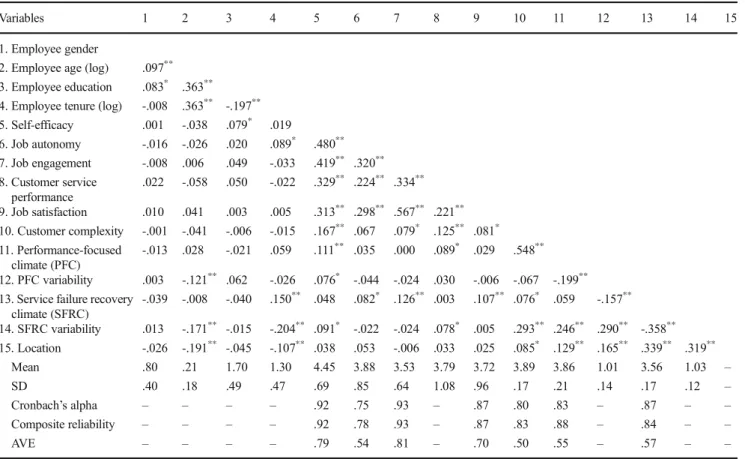
reports descriptive statistics, intercorrelations, and the reliabil-ity and validreliabil-ity measures of the constructs.
We conceptualized job engagement as a higher-order con-struct comprising three first-order dimensions: vigor, dedica-tion, and absorption. The higher-order CFA indicated good fit
to the data (χ2
= 246.09, df = 101; GFI = .96; TLI = .98; CFI = .98; RMSEA = .04). The three first-order dimensions
were highly correlated (rvigor-dedication = .843; r
vigor-absorp-tion = .763; rdedication-absorption = .824), and the importance
weightings of vigor, dedication, and absorption were .884, .953, and .864, respectively. We created the higher-order con-struct of job engagement by multiplying the mean scores of all dimensions with their importance weightings.
Treatment for common method bias Although we relied on multi-respondent data for the second part of the model, using cross-sectional data and the resultant single-respondent effect for the first part of the model could result in common method
bias (Podsakoff et al.2003). Therefore, we re-estimated the
measurement model by including an unmeasured common method factor, which loaded on all items of the focal
con-structs (Podsakoff et al.2003). We found a significant
chi-square difference between the measurement model and the
unmeasured common factor model (Δχ2
= 100.53; df = 40, p < .01). Seventy-two percent of the variance was due to the trait factors (i.e., the constructs), 6% of the variance was accounted for by the method factor, and 22% of the variance resulted from unique sources. Although common method had little systematic influence on service employees’ responses, we controlled for method bias by including the method factor while estimating the hypothesized relationships.
Treatment for social desirability bias Service employees’ responses to the measures of job autonomy, self-efficacy, and job engagement may be influenced by social desirability rather than their genuine beliefs and opinions (Podsakoff et al.
2003). Therefore, we controlled for social desirability5 to
partial out its unique variance on the model’s variables
(e.g., Donavan et al.2004).
5We measured social desirability (Cronbach’s α = .89) with a five-item,
six-point Likert scale (1 = strongly disagree, 6 = strongly agree) taken from Donovan et al. (2004).
Analytic approach
Our model proposes cross-level interactions, such that the two types of climate (performance-focused and service failure recovery) at the hospital level (1) interact with service employee–level resources (i.e., self-efficacy and job autonomy) to influence employee job engage-ment and also (2) interact with job engageengage-ment to in-fluence customer service performance. Nevertheless, analysis of variance results indicated significant
varia-tion across hospitals in self-efficacy (F(24, 775) = 2.292,
p < .01), job autonomy (F(24, 775) = 1.600, p < .05), and
job engagement (F(24, 775) = 8.835, p < .01). In
addi-tion, the ICC1 (interrater correlation coefficient) value suggested that hospital-specific factors (i.e., non-inde-pendence) affected service employees’ job engagement
(ICC1 = .20) (Bliese 2000). Therefore, we performed
latent means technique (Preacher et al. 2010) in Mplus
7.0 (Muthén and Muthén 2012) to estimate the model’s
relationships simultaneously.
We operationalized performance-focused climate, service failure recovery climate, and customer (patient) complexity
at the hospital level by aggregating service employees’
responses on the three measures.6The within-hospital
agree-ment (median rwg) (performance-focused climate = .87;
ser-vice failure recovery climate = .83; customer complexity = .83) and the reliability of hospital-level means (ICC2) (perfor-mance-focused climate = .76; service failure recovery climate = .83; customer complexity = .73) were well
above the threshold value (LeBreton and Senter 2008),
corroborating data aggregation.
Results
Model 1 (main effects) First, we tested the main-effects-only model. We found significant, positive effects of self-efficacy and job autonomy on job engagement and of job engagement on customer service performance. Second, we tested whether job engagement mediated the relationship among self-effica-cy, job autonomy, and customer service performance. We
re-6Previous researchers have treatedBclimate^ variables as a resource or
de-mand, testing it at the individual (Schmitz and Ganesan2014) or group (Dollard and Bakker2010) level. The current study takes into account within-group (i.e., shared) perceptions of performance-focused climate and service failure recovery climate.
Table 2 Descriptive statistics, intercorrelations, and reliability/validity measures (Study 1)
Variables 1 2 3 4 5 6 7 8 9 10 11 12 13 14 15
1. Employee gender
2. Employee age (log) .097** 3. Employee education .083* .363** 4. Employee tenure (log) -.008 .363** -.197**
5. Self-efficacy .001 -.038 .079* .019 6. Job autonomy -.016 -.026 .020 .089* .480** 7. Job engagement -.008 .006 .049 -.033 .419** .320** 8. Customer service performance .022 -.058 .050 -.022 .329** .224** .334** 9. Job satisfaction .010 .041 .003 .005 .313** .298** .567** .221** 10. Customer complexity -.001 -.041 -.006 -.015 .167** .067 .079* .125** .081* 11. Performance-focused climate (PFC) -.013 .028 -.021 .059 .111** .035 .000 .089* .029 .548** 12. PFC variability .003 -.121** .062 -.026 .076* -.044 -.024 .030 -.006 -.067 -.199** 13. Service failure recovery
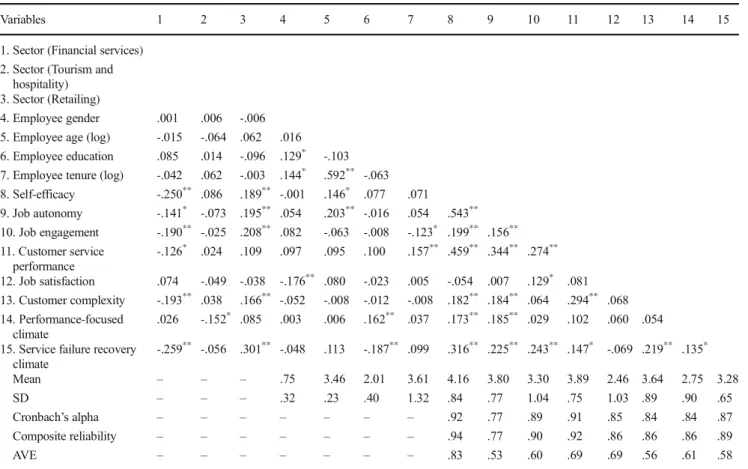
climate (SFRC) -.039 -.008 -.040 .150** .048 .082* .126** .003 .107** .076* .059 -.157** 14. SFRC variability .013 -.171** -.015 -.204** .091* -.022 -.024 .078* .005 .293** .246** .290** -.358** 15. Location -.026 -.191** -.045 -.107** .038 .053 -.006 .033 .025 .085* .129** .165** .339** .319** Mean .80 .21 1.70 1.30 4.45 3.88 3.53 3.79 3.72 3.89 3.86 1.01 3.56 1.03 – SD .40 .18 .49 .47 .69 .85 .64 1.08 .96 .17 .21 .14 .17 .12 – Cronbach’s alpha – – – – .92 .75 .93 – .87 .80 .83 – .87 – – Composite reliability – – – – .92 .78 .93 – .87 .83 .88 – .84 – – AVE – – – – .79 .54 .81 – .70 .50 .55 – .57 – –
Employee age and tenure are log-transformed. Cronbach’s alpha for the aggregated constructs of performance-focused climate, service failure recovery climate, and customer complexity are .89, .87, and .79, respectively
Table 3 Multilevel path analysis results (Study 1)
Paths Model 1 Model 2
From To γ SE γ SE
Main effects
Self-Efficacy Job Engagement .221** .031 .225** .032
Job Autonomy Job Engagement .052* .025 .063* .025
Job Engagement Customer Service Performance .221** .038 .222** .042
Additional path
Self-Efficacy Customer Service Performance .180** .032 .184** .033
Moderators
Performance-Focused (PF) Climate Job Engagement -.187* .110 -.018 .133
Service Failure Recovery (SFR) Climate Job Engagement .569** .143 .527** .174
PF Climate Customer Service Performance .142 .119 .151 .120
SFR Climate Customer Service Performance -.086 .174 -.120 .181
Cross-level interactions
Self-Efficacy x PF Climate Job Engagement .412** .132
Job Autonomy x PF Climate Job Engagement -.409** .127
Job Engagement x PF Climate Customer Service Performance -.297* .144
Self-Efficacy x SFR Climate Job Engagement -.349* .177
Job Autonomy x SFR Climate Job Engagement -.002 .152
Job Engagement x SFR Climate Customer Service Performance .306* .172
Service employee–level covariates
Gender Job Engagement -.012 .044 -.005 .044
Age (log) Job Engagement .012 .107 .002 .107
Education Job Engagement .022 .037 .025 .037
Tenure (log) Job Engagement -.089* .043 -.080 .041
Customer Complexity Job Engagement .212 .155 .271 .163
Job Satisfaction Job Engagement .297** .020 .290** .021
Location Job Engagement -.119* .053 -.088 .059
Gender Customer Service Performance .038 .048 .028 .049
Age (log) Customer Service Performance -.183 .115 -.179 .116
Education Customer Service Performance .022 .040 .022 .041
Tenure (log) Customer Service Performance .016 .047 .006 .047
Customer Complexity Customer Service Performance .269 .152 .279 .147
Job Satisfaction Customer Service Performance .015 .025 .021 .025
Location Customer Service Performance .014 .056 .046 .062
Hospital-level covariates
PF Climate Variability Job Engagement -.058 .176 .152 .197
SFR Climate Variability Job Engagement .270 .218 .322 .221
PF Climate Variability Customer Service Performance .136 .158 .170 .186
SFR Climate Variability Customer Service Performance .103 .228 -.017 .234
Between-level (hospital) effects
Self-Efficacy Job Engagement .101 .177 .147 .195
Job Autonomy Job Engagement .157 .120 .269 .146
Self-Efficacy x PF Climate Job Engagement 2.694** .814
Job Autonomy x PF Climate Job Engagement -1.272 .761
Self-Efficacy x SFR Climate Job Engagement .022 .874
Job Autonomy x SFR Climate Job Engagement -.414 .699
Job Engagement Customer Service Performance -.023 .165 .083 .182
ran the model by adding direct paths from self-efficacy and job autonomy to customer service performance. The model’s fit could only improve (i.e., a significant change in Akaike infor-mation criterion [AIC]) when a direct path from self-efficacy to customer service performance was added to the model (ΔAIC
=28.368). As Table3(Model 1) reports, self-efficacy (γ = .221,
p < .01) and job autonomy (γ = .052, p < .05) are related positively to job engagement, and job engagement is related positively to customer service performance (γ = .221, p < .01). The effect of self-efficacy on customer service
perfor-mance is positive and significant (γ = .180, p < .01).
In line with Zhao et al. (2010), we employed the parametric
bootstrap method (Preacher et al.2010) to test the indirect
effects of self-efficacy and job autonomy on customer service performance. We found a significant indirect effect of self-efficacy (γ = .048, p < .01, 95% confidence interval [CI]
[.030, .075]) and job autonomy (γ = .011, p < .05, CI [.001,
.025]) on customer service performance. Because both the direct and indirect effects of self-efficacy on customer service performance are positive and significant, self-efficacy serves as a complementary mediator. A significant indirect but non-significant direct effect of job autonomy on customer service performance indicates that job engagement serves only as an
indirect mediator (Zhao et al.2010). With these findings, we
ran the hypothesized model by including the cross-level inter-action effects in the main-effects model (e.g., Hofmann and
Gavin1998).
Model 2 (cross-level interactions) H1 posits that the pos-itive effect of self-efficacy on job engagement is strengthened under a high (vs. low)
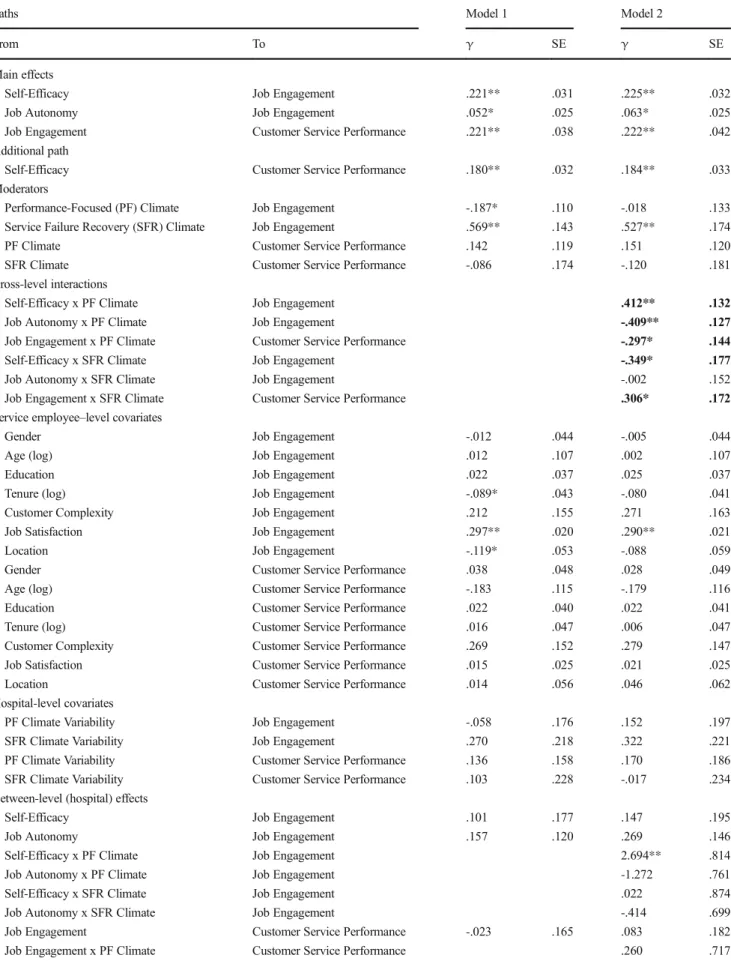
performance-focused climate. Table 3 (Model 2) indicates that the
cross-level interaction effect of self-efficacy and performance-focused climate on engagement is positive Table 3 (continued)
Paths Model 1 Model 2
From To γ SE γ SE
Job Engagement x SFR Climate Customer Service Performance .512 .674
Social desirability effects
Social Desirability Self-Efficacy .063** .021 .063** .021
Social Desirability Self-Efficacy (Hospital Level) .380** .027 -.180** .028
Social Desirability Job Autonomy .123** .026 .123** .026
Social Desirability Job Autonomy (Hospital Level) -.180** .027 .380** .026
Social Desirability Job Engagement -.008 .017 -.003 .016
Social Desirability Job Engagement (Hospital Level) .104** .025 .104** .016
Social Desirability Job Satisfaction .155** .030 .155** .031
Social Desirability Customer Complexity .061* .027 .061* .027
Social Desirability PF Climate -.214** .033 -.214** .034
Social Desirability SFR Climate .129** .028 .129** .028
Common method effects
Common Method Factor Self-Efficacy .095** .027 .095** .027
Common Method Factor Self-Efficacy (Hospital Level) .305** .036 .305** .035
Common Method Factor Job Autonomy .053 .034 .053 .034
Common Method Factor Job Autonomy (Hospital Level) .095** .035 .095** .035
Common Method Factor Job Engagement .081** .021 .081** .022
Common Method Factor Job Engagement (Hospital Level) .256** .033 .256** .032
Common Method Factor Job Satisfaction .096* .038 .096* .038
Common Method Factor Customer Complexity .176** .035 .176** .036
Common Method Factor PF Climate .110* .043 .110* .043
Common Method Factor SFR Climate .153** .036 .153** .035
Pseudo-R2 Job Engagement .36 .40
Pseudo-R2 Customer Service Performance .14 .16
Model 1: main-effects-only model; Model 2: full hypothesized model. Unstandardized coefficients and robust standard errors (SE) are reported. Significant cross-level interaction effects are indicated in bold
(γ = .412, p < .01). Self-efficacy has a more positive effect on engagement at high levels of
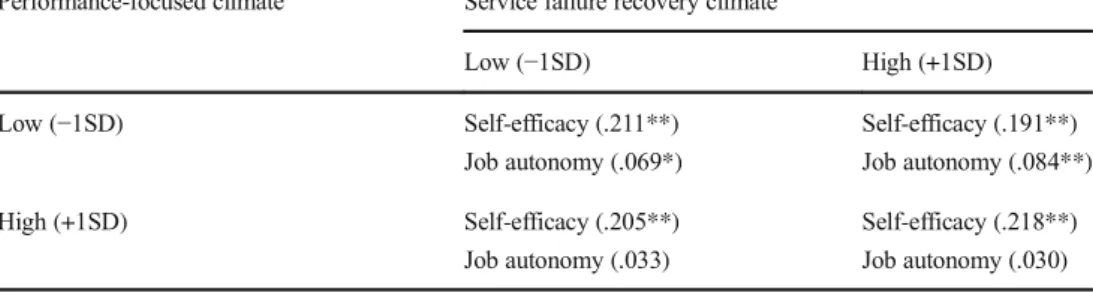
performance-focused climate (γ = .311, p < .01, CI [.204, .391])
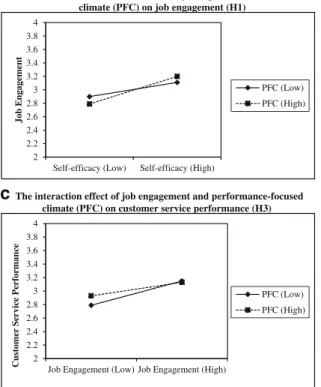
than at low levels (γ = .139, p < .01, CI [.067, 217]), with a significant difference between the two levels (t = 2.963, p < .01). These findings provide support for H1.
H2 posits that the positive effect of job autonomy on en-gagement is weaker under a high (vs. low) performance-focused climate. The interaction effect of job autonomy and performance-focused climate on job engagement is neg-ative (γ = − .409, p < .01). Job autonomy has a posi-tive effect on engagement at low levels of performance-focused climate (γ = .148, p < .01, CI [.078, .227]) but not at high levels (γ = − .023, ns, CI [− .100, .044]). Consequently, H2 is supported.
H3 posits that the positive effect of engagement on custom-er scustom-ervice pcustom-erformance is weakcustom-er undcustom-er a high (vs. low) performance-focused climate. The cross-level interaction ef-fect of engagement and performance-focused climate on cus-tomer service performance is negative (γ = − .297, p < .05). Job engagement has a more positive effect on customer ser-vice performance at low levels of performance-focused climate (γ = .278, p < .01, CI [.177, .372]) than at high
levels (γ = .159, p < .01, CI [.060, .267]), with a
signif-icant difference between the two levels (t = 1.990,
p < .05). Thus, H3 is supported. Fig.2 shows significant
cross-level interaction effects.
H4 posits that the positive effect of self-efficacy on job engagement is weaker under a high (vs. low) service failure recovery climate. The interaction effect of self-efficacy and service failure recovery climate to engagement is nega-tive (γ = − .349, p < .05). Self-efficacy has a more positive effect on engagement at low levels of service failure recovery climate (γ = .285, p < .01, CI [.200, .366]) than at high levels (γ = .164, p < .01, CI [.075, .257]), with a significant difference between the two levels (t = 2.040, p < .05). Thus, H4 is supported.
H5 posits that the positive effect of job autonomy on en-gagement is stronger under a high (vs. low) service failure recovery climate. We find no cross-level interaction effect of job autonomy and service failure recovery climate on engage-ment (γ = − .002, ns). Therefore, H5 is not supported.
H6 posits that the positive effect of engagement on customer service performance is stronger under a high (vs. low) service failure recovery climate. The interac-tion effect of engagement and service failure recovery climate on customer service performance is positive (γ = .306, p < .05). Job engagement has a more posi-tive effect on customer service performance at high levels of service failure recovery climate (γ = .271, p < .01, CI [.165, .374]) than at low levels (γ = .166, p < .01, CI [.070, .271]), with a significant difference between the two levels (t = 2.001, p < .05). These
findings provide support for H6. Fig. 3 shows
signifi-cant cross-level interaction effects.
The interaction effect of self-efficacy and performance-focused climate (PFC) on job engagement (H1)
The interaction effect of job engagement and performance-focused climate (PFC) on customer service performance (H3)
The interaction effect of job autonomy and performance-focused climate (PFC) on job engagement (H2)
2 2.2 2.4 2.6 2.8 3 3.2 3.4 3.6 3.8 4
Self-efficacy (Low) Self-efficacy (High)
Job Engagement PFC (Low) PFC (High) 2 2.2 2.4 2.6 2.8 3 3.2 3.4 3.6 3.8 4
Job Engagement (Low) Job Engagement (High)
Customer Service Performance PFC (Low) PFC (High) 2 2.2 2.4 2.6 2.8 3 3.2 3.4 3.6 3.8 4
Autonomy (Low) Autonomy (High)
Job Engagement
PFC (Low) PFC (High)
a
b
c
Post hoc tests We tested several alternative models to assess the robustness of the proposed model. First, we tested whether the effect of performance-focused climate on job engagement is moderated by the three resources (i.e., self-efficacy, job autonomy, and service failure re-covery climate). Second, we tested whether service fail-u r e r e c o v e r y c l i m a t e m o d e r a t e s t h e e f f e c t o f performance-focused climate on engagement and custom-er scustom-ervice pcustom-erformance. Third, the JD-R model posits that job resources and personal resources are not always
in-dependent (Bakker and Demerouti2014). Therefore,
self-efficacy (i.e., personal resource) and job autonomy (i.e., job resource) may also interact to influence job engage-ment. Finally, customer complexity might be considered either a job-related demand or a resource, such that it interacts with self-efficacy, autonomy, and the two cli-mate variables to influence job engagement and customer service performance. Overall, the results did not support these alternative models, providing empirical evidence for the robustness of the proposed model.
Study 2 (follow-up study)
Purpose and sample
Although most of our hypotheses received support, Study 1 had two limitations, which we attempt to address in Study 2. First, the two organizational climates studied in Study 1 are emergent group-level constructs that repre-sent shared and collective perceptions of employees
within a group (Kozlowski and Klein 2000). That is,
while personal and job resources were at the individual level, climate was at the group level. Although social information processing theory (Salancik and Pfeffer
1978) would predict that employees within the same
group develop a similar view of the importance of per-formance and service failure recovery through social in-teractions, research suggests that climates can also be conceptualized and measured as a psychological climate
at the individual level (Ostroff et al. 2003). A
psycho-logical climate (Jones and James 1979) represents an
individual’s Bcognitive interpretations of the
organiza-tional context or situation … and provide[s] a
represen-tation of the meaning inherent in organizational features,
events, and processes^ (Kozlowski and Doherty 1989, p.
547). Furthermore, appraisals are subjective assessments by individuals, not generalized situational assessments at the organizational level. Therefore, Study 2 tests climates as service employees’ perceptions of rather than shared view on performance emphasis and service failure recov-ery. Specifically, we conceptualize and operationalize both climates as psychological climate at the individual level. Thus, we move from a multi-level model in Study 1 to a single-level model in Study 2 to further test the robustness of our conceptual model.
Second, we tested our model in Study 1 in the health care industry with hospitals. To increase the generaliz-ability of our results to other industries and to provide more confidence that the two climates and resources are not confined to a particular industry, we test our model in Study 2 in the financial services, tourism and hospi-tality, and retailing sectors.
We conducted our survey with 276 participants from Amazon Mechanical Turk. The respondents were mostly men (76%), with an average age of 32.8 years and average work experience of 6.2 years. Eighty-four percent held grad-uate degrees. Forty-three percent were employed in the finan-cial services sector, followed by tourism and hospitality (42%), and retailing (15%).
Study design and analytic approach
In this study, we used the same measures as in Study 1. In addition, we controlled for the effect of demographics (i.e., gender, age, education, and tenure), job satisfaction, customer complexity, and sector on job engagement and customer ser-vice performance.
We assessed the reliability and validity of the measures. The measurement model indicated good fit to the data after
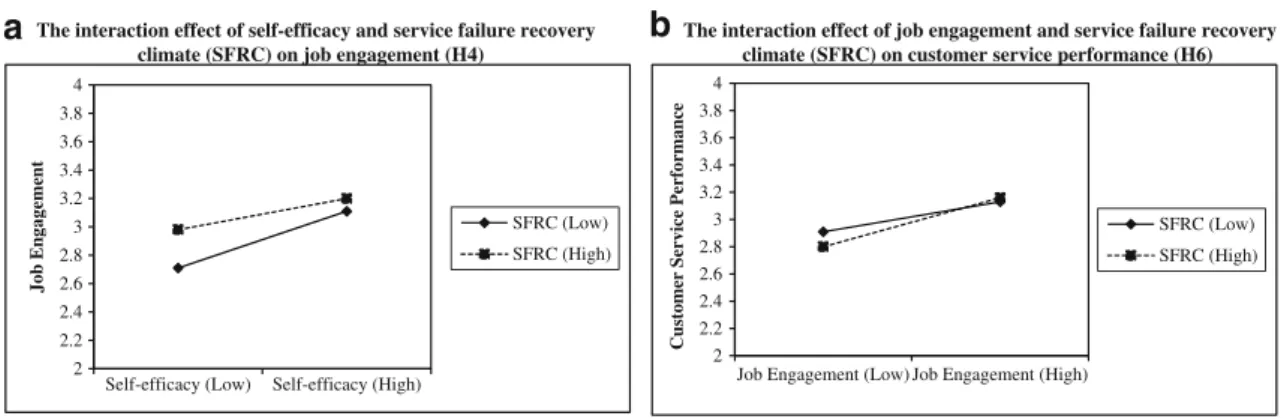
The interaction effect of self-efficacy and service failure recovery climate (SFRC) on job engagement (H4)
The interaction effect of job engagement and service failure recovery climate (SFRC) on customer service performance (H6)
2 2.2 2.4 2.6 2.8 3 3.2 3.4 3.6 3.8 4
Self-efficacy (Low) Self-efficacy (High)
Job Engagement SFRC (Low) SFRC (High) 2 2.2 2.4 2.6 2.8 3 3.2 3.4 3.6 3.8 4
Job Engagement (Low) Job Engagement (High)
Customer Service
Performance
SFRC (Low) SFRC (High)
a
b
deletion of items with low factor loading (χ2
= 2004.54, df-= 953; GFI df-= .90; TLI df-= .93; CFI df-= .94; RMSEA df-= .06). The composite reliability and AVE values were above .70 and .50,
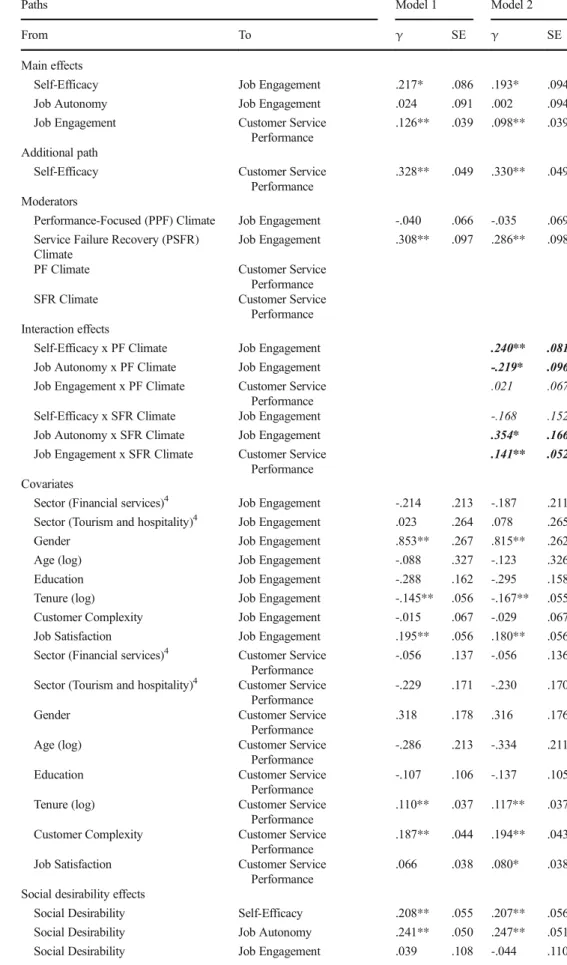
respectively (see Table4). Conventional techniques supported
convergent and discriminant validity of the measures. We operationalized job engagement as a higher-order con-struct by multiplying the mean score of its three dimen-sions with their importance weightings. We also con-trolled for common method bias and self-desirability bias in the same way as in Study 1.
The unit of analysis was an individual service employee. Therefore, we operationalized all constructs at the service em-ployee level. To do so, we took into consideration service employees’ perceptions of the two climate constructs rather
than shared perceptions within a group.7 We employed the
path analysis technique to account for measurement error while estimating the model (for details, see Brown and
Peterson1994). We also incorporated the Monte Carlo
tech-nique (parametric bootstrapping) in our analyses to avoid the problem associated with non-normal distribution of
interac-tion variables (Carson2007).
Results
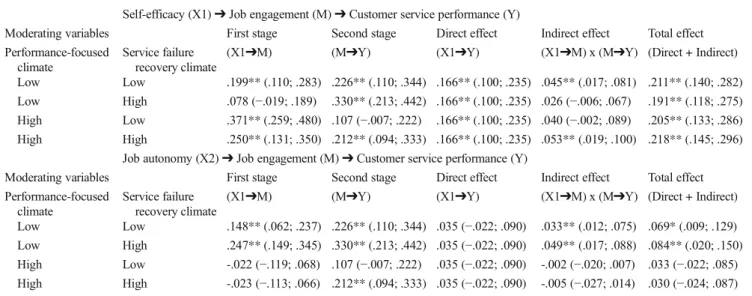
As Table5reports, the interaction effect of self-efficacy and
perceived performance-focused climate on job engagement is positive (b = .240, p < .05), and the interaction effect of job autonomy and performance-focused climate on job
engage-ment is negative (b =− .219, p < .05), in support of H1 and
H2. However, H3 is not supported; the interaction effect of job engagement and perceived performance-focused climate on customer service performance is not significant (b = .021, ns). Furthermore, the interaction effect of job autonomy and perceived service failure recovery climate on job engagement is positive (b = .354, p < .05), while the interaction effect of self-efficacy and service failure recovery climate on job
en-gagement is not significant (b = − .168, ns). These results
provide support for H5 but not H4. Finally, the interaction effect of job engagement and service failure recovery climate on customer service performance is positive and significant 7Considering the central role of individual appraisal of job demands and
resources in JD-R theory, this study takes into account service employees’ own perceptions of performance-focused climate and service failure recovery climate. In other words, we operationalized the two climate variables at the service employee (or individual) level.
Table 4 Descriptive statistics, intercorrelations, and reliability/validity measures (Study 2)
Variables 1 2 3 4 5 6 7 8 9 10 11 12 13 14 15
1. Sector (Financial services) 2. Sector (Tourism and
hospitality) 3. Sector (Retailing)
4. Employee gender .001 .006 -.006
5. Employee age (log) -.015 -.064 .062 .016
6. Employee education .085 .014 -.096 .129* -.103
7. Employee tenure (log) -.042 .062 -.003 .144* .592** -.063
8. Self-efficacy -.250** .086 .189** -.001 .146* .077 .071 9. Job autonomy -.141* -.073 .195** .054 .203** -.016 .054 .543** 10. Job engagement -.190** -.025 .208** .082 -.063 -.008 -.123* .199** .156** 11. Customer service performance -.126* .024 .109 .097 .095 .100 .157** .459** .344** .274** 12. Job satisfaction .074 -.049 -.038 -.176** .080 -.023 .005 -.054 .007 .129* .081 13. Customer complexity -.193** .038 .166** -.052 -.008 -.012 -.008 .182** .184** .064 .294** .068 14. Performance-focused climate .026 -.152* .085 .003 .006 .162** .037 .173** .185** .029 .102 .060 .054 15. Service failure recovery
climate -.259** -.056 .301** -.048 .113 -.187** .099 .316** .225** .243** .147* -.069 .219** .135* Mean – – – .75 3.46 2.01 3.61 4.16 3.80 3.30 3.89 2.46 3.64 2.75 3.28 SD – – – .32 .23 .40 1.32 .84 .77 1.04 .75 1.03 .89 .90 .65 Cronbach’s alpha – – – – – – – .92 .77 .89 .91 .85 .84 .84 .87 Composite reliability – – – – – – – .94 .77 .90 .92 .86 .86 .86 .89 AVE – – – – – – – .83 .53 .60 .69 .69 .56 .61 .58
Employee age and tenure are log-transformed *p < .05; **p < .01 (two-tailed test)
Table 5 Path analysis results
(Study 2) Paths Model 1 Model 2
From To γ SE γ SE
Main effects
Self-Efficacy Job Engagement .217* .086 .193* .094
Job Autonomy Job Engagement .024 .091 .002 .094
Job Engagement Customer Service
Performance
.126** .039 .098** .039
Additional path
Self-Efficacy Customer Service
Performance
.328** .049 .330** .049
Moderators
Performance-Focused (PPF) Climate Job Engagement -.040 .066 -.035 .069
Service Failure Recovery (PSFR) Climate
Job Engagement .308** .097 .286** .098
PF Climate Customer Service
Performance
SFR Climate Customer Service
Performance Interaction effects
Self-Efficacy x PF Climate Job Engagement .240** .081
Job Autonomy x PF Climate Job Engagement -.219* .096
Job Engagement x PF Climate Customer Service Performance
.021 .067
Self-Efficacy x SFR Climate Job Engagement -.168 .152
Job Autonomy x SFR Climate Job Engagement .354* .166
Job Engagement x SFR Climate Customer Service Performance
.141** .052
Covariates
Sector (Financial services)4 Job Engagement -.214 .213 -.187 .211
Sector (Tourism and hospitality)4 Job Engagement .023 .264 .078 .265
Gender Job Engagement .853** .267 .815** .262
Age (log) Job Engagement -.088 .327 -.123 .326
Education Job Engagement -.288 .162 -.295 .158
Tenure (log) Job Engagement -.145** .056 -.167** .055
Customer Complexity Job Engagement -.015 .067 -.029 .067
Job Satisfaction Job Engagement .195** .056 .180** .056
Sector (Financial services)4 Customer Service Performance
-.056 .137 -.056 .136
Sector (Tourism and hospitality)4 Customer Service Performance
-.229 .171 -.230 .170
Gender Customer Service
Performance
.318 .178 .316 .176
Age (log) Customer Service
Performance
-.286 .213 -.334 .211
Education Customer Service
Performance
-.107 .106 -.137 .105
Tenure (log) Customer Service
Performance
.110** .037 .117** .037
Customer Complexity Customer Service
Performance
.187** .044 .194** .043
Job Satisfaction Customer Service
Performance
.066 .038 .080* .038
Social desirability effects
Social Desirability Self-Efficacy .208** .055 .207** .056
Social Desirability Job Autonomy .241** .050 .247** .051
(b = .141, p < .01), in support of H6. These findings yield empirical evidence of the robustness of our model, such that the proposed relationships are largely supported even when we test the model using data collected from other types of service sectors and considering service employees’ own per-ceptions of the two climates.
Discussion
Theoretical contributions
The role of service employees is critical in achieving customer-oriented goals such as customer satisfaction and
ser-vice failure prevention (Albrecht et al.2016; Lim et al.2016),
and ensuring employee engagement can only aid in accomplishing such goals. Despite the importance of engaged employees, however, little progress has been made in the lit-erature beyond examining the antecedents and consequences of engagement. Thus, we proposed and tested a more nuanced model that extends the engagement literature by examining the boundary conditions of when resources lead to engage-ment and, in turn, when engageengage-ment results in customer ser-vice performance.
Despite the theoretical and managerial relevance of the JD-R model to workplace attitudes such as engagement (e.g.,
Zablah et al.2012), studies that have applied this framework
are few and far between. Even scarcer are studies that take a contingency rather than a universal approach to the anteced-ents and consequences of engagement. Apart from Auh et al.
(2016), who examine the antecedents of engagement under
the moderating role of power distance orientation, and
Kumar and Pansari (2016), who show the boundary
condi-tions of the engagement–performance relacondi-tionship, the en-gagement literature has largely adopted a one-size-fits-all ap-proach to the antecedents and consequences of engagement. To address this limitation, this study challenges the resource– engagement and engagement–customer service performance links, both core principles that make up the JD-R framework. We accomplish this by exploring the two linkages within the context of two climates: performance-focused and service fail-ure recovery. Our study reveals distinct findings that contrib-ute to the engagement literature.
Extending the engagement literature: climate as challenge
or hindrance demand Bakker and Sanz-Vergel (2013)
con-clude that whether employees perceive a demand as a chal-lenge or a hindrance depends on the occupation. By contrast, we argue that employees can view the same demand as either Table 5 (continued)
Paths Model 1 Model 2
From To γ SE γ SE
Social Desirability Job Satisfaction -.063 .071 -.071 .072
Social Desirability Customer Complexity .134** .061 .124* .061
Social Desirability PF Climate .045 .061 .034 .062
Social Desirability SFR Climate .195** .042 .175** .042
Social Desirability Customer Service
Performance
.124 .070 .121 .070
Common method effects
Common Method Factor Self-Efficacy -.149** .054 -.149** .054
Common Method Factor Job Autonomy -.077 .049 -.077 .049
Common Method Factor Job Engagement -.251** .067 -.291** .068
Common Method Factor Job Satisfaction -.034 .070 -.034 .070
Common Method Factor Customer Complexity .035 .059 .035 .059
Common Method Factor PF Climate -.113 .060 -.113 .060
Common Method Factor SFR Climate -.072 .042 -.073 .042
Common Method Factor Customer Service
Performance -.043 .045 -.047 .045 R2 Job Engagement .21 .27 R2 Customer Service Performance .34 .37
Model 1: main-effects-only model; Model 2: full hypothesized model. Unstandardized parameter estimates and bootstrapped (1000 samples) standard errors are reported. Significant interaction effects are indicated in bold italic. Omitted sector is retailing