Adherence to vaccination recommendations
after traumatic splenic injury
Ahmet Korkut Belli, M.D.,1 Cem Dönmez, M.D.,1 Önder Özcan, M.D.,1 Özcan Dere, M.D.,1
Selmin Dirgen Çaylak, M.D.,2 Funda Dinç Elibol, M.D.,3 Cenk Yazkan, M.D.,1
Nevin Yılmaz, M.D.,4 Okay Nazlı, M.D.1
1Department of General Surgery, Muğla Sıtkı Koçman University Faculty of Medicine, Muğla-Turkey 2Department of Infectious Disease, Muğla Sıtkı Koçman University Faculty of Medicine, Muğla-Turkey 3Department of Radiology, Muğla Sıtkı Koçman University Faculty of Medicine, Muğla-Turkey 4Department of Gastroenterology, Muğla Sıtkı Koçman University Faculty of Medicine, Muğla-Turkey
ABSTRACT
BACKGROUND: The occurrence of a serious infection called overwhelming post-splenectomy infection (OPSI) increases more than 50 times in patients who have hyposplenia. The aim of this study was to investigate the adherence to vaccination recommendations after traumatic splenic injury.
METHODS: We identified patients who underwent total splenectomy due to abdominal trauma between May 2012 and March 2016. We recorded the clinical, laboratory, and pathological features of the patients. We calculated the vaccination proportions before discharge, after discharge, and final.
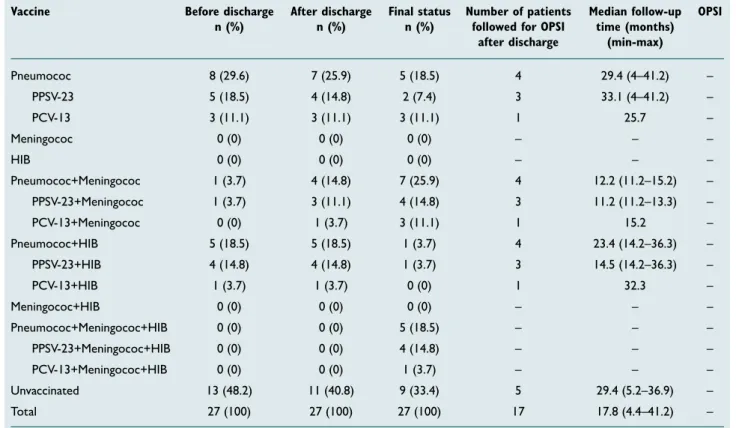
RESULTS: Twenty-seven patients underwent total splenectomy. For the vaccination status before discharge, after discharge, and final, the number of patients who received all the three vaccinations were 0 (0%), 0 (0%), and 8 (18.5%) and those who received none were 13 (48.2%), 11 (40.8%), and 9 (33.4%), respectively. The data of 17 patients were available for developing OPSI. The median follow-up time was 17.8 (4.4–41.2) months, and no OPSI cases were observed.
CONCLUSION: Adherence to vaccination recommendations remains still low. Establishing a vaccination tracking system and follow-ing vaccination recommendations will be helpful to prevent serious infections, such as OPSI, after traumatic splenectomy.
Keywords: Gastroenterology; infection; microbiology; spleen; trauma; vaccination.
post-splenectomy infection (OPSI) increases more than 50 times in patients with hyposplenia.[3,4] Streptococcus
pneu-moniae, Neisseria meningitidis, and Haemophilus influenzae Type b (HIB) are encapsulated bacteria that can potentially cause severe sepsis, meningitis, or pneumonia after splenec-tomy.[5] OPSI is an emergent condition which may develop as
a mild infection and rapidly progress to sepsis with 50%–70% risk of mortality despite treatment.[6] Although the true
inci-dence of OPSI has not been completely identified, Newland et al.[7] reported that the incidence was 0.18%–0.42% per
year, with a lifetime risk of 5% after splenectomy.
INTRODUCTION
The spleen is the most vulnerable organ in blunt abdominal trauma.[1] It has critical functions according to its histological
regions, i.e., the red and white pulp. Using the red pulp, it filters and removes senescent erythrocytes in the circulation and recycles iron for the production of new erythrocytes. Us-ing the white pulp, it functions as a secondary lymphoid organ and generates both humoral and cellular immune responses.[2]
The occurrence of a serious infection called overwhelming
Cite this article as: Belli AK, Dönmez C, Özcan Ö, Dere Ö, Dirgen Çaylak S, Dinç Elibol F, et al. Adherence to vaccination recommendations after traumatic splenic injury. Ulus Travma Acil Cerrahi Derg 2018;24:337-342.
Address for correspondence: Ahmet Korkut Belli, M.D.
Muğla Sıtkı Koçman Üniversitesi Tıp Fakültesi, Genel Cerrahi Anabilim Dalı, Menteşe, 48000 Muğla, Turkey Tel: +90 252 - 211 10 00 E-mail: [email protected]
Ulus Travma Acil Cerrahi Derg 2018;24(4):337-342 DOI: 10.5505/tjtes.2017.84584 Submitted: 20.03.2017 Accepted: 10.11.2017 Online: 21.06.2018 Copyright 2018 Turkish Association of Trauma and Emergency Surgery
To avoid OPSI, vaccination against S. pneumoniae, N. mengitidis, and HIB are recommended in addition to a yearly in-fluenza vaccine. However, the administration of these vac-cines is recommended after the postoperative day 14 to increase the immune response in patients who have under-gone splenectomy due to trauma. Moreover, a booster dose is needed for pneumococcal and meningococcal vaccines af-ter the fifth year of vaccination.[8–11] However, the adherence
to vaccination recommendations and timing of the vaccina-tions vary depending on surgeons’ practice.
To the best of our knowledge, there are few studies which reported the vaccination adherence after splenectomy in the literature. The aim of this study was to investigate the adher-ence to vaccination recommendations after traumatic splenic injury by our surgeons and to analyze the factors that affect the vaccination status.
MATERIALS AND METHODS
Patient Selection
We identified patients who underwent total splenectomy due to abdominal trauma between May 2012 and March 2016 by questioning the surgical code of total splenectomy from the database of our institution. Informed consent was ob-tained from each patient before the surgery. We investigated each patient’s records and recorded patient name, sex, date of surgery, duration of hospital stay, intensive care unit (ICU) transfer status, Glasgow coma scale (GCS), initial and control vital sign, hemograms, number of transfusions, erythrocyte suspension (ES), and fresh frozen plazma (FFP) packs.
We excluded the patients who had nontraumatic splenec-tomy, nonoperative management, or partial splenectomy and who deceased during per- or postoperative period (Fig. 1). We searched for additional organ injuries other than those of the spleen from the patient charts and identified the organ in-jury scale (AIS) scores. Then, we calculated ISS scores for each patient according to the calculator defined by Baker et al.[12]
Patients who had a mean arterial pressure (MAP) of <65 mm Hg in the control vital signs and/or Hct decrease of >20% were defined as hemodynamically unstable. Our radiologist reevaluated the CT images of all the patients according to the American Association for the Surgery of Trauma (AAST) grading system.
Vaccination Status
We investigated both doctors’ directives and nursery notes from the patients’ charts during the hospital stay to identify whether vaccinations for S. pneumoniae, N. meningitidis, and HIB were administered. The ideal categorization of the pa-tients was grouping them into those vaccinated in 14 days and after 14 days of splenectomy. However, we did not have
any vaccination tracking system; hence, we could not find the exact dates of the vaccinations after discharge. If a patient had any of the recommended vaccinations before or after discharge, we considered that patient to be vaccinated to an-alyze the effective factors for vaccination status.
For pneumococcal vaccine, 23 valent pneumococcal polysac-charide vaccine (PPSV-23) and 13 valent pneumococcal con-jugate vaccine (PCV-13) statuses were separately recorded and categorized into 3 groups: before discharge, which was recorded from the patient charts; after discharge, which was determined by calling the patients who had missing vaccina-tions before discharge; and final, which displayed the maxi-mum completion of vaccination by inviting and prescribing the missing vaccines. Furthermore, we categorized all possible combinations of the 3 vaccines and displayed them in Table 1.
Identification of OPSI Development
While we called the patients to determine the missing vacci-nations after discharge, we also asked if they had any severe infection, such as pneumonia, meningitis, or sepsis-related disease, or any condition which required hospitalization. The time period between the interview with the patients and dis-charge date was recorded as the follow-up time.
Statistical Analysis
We compared two categorical data with either the Pearson Figure 1. Study population selection criteria and the time period.
Patients Underwent Total Splenectomy after
Trauma May 2012–March 2016
(n=36) Patients Treated
with NOM or Partial Splenectomy (n=3) Per-operative Deceased Patients (n=6) Remaining patients for the study
(n=27)
Patients who had missing contact information or did not answer phone calls No follow-up data available
(n=10)
Patients remained to determine developing
OPSI (n=17)
Chi-Square or Fischer’s exact test. We used parametric or nonparametric independent samples t tests to compare cat-egorical variables and scale data according to the normality analysis. For the comparison between two scale data, we used the Pearson correlation test. We classified the grades I–III and IV–V as mild and severe grades, respectively, for sta-tistical analysis.
RESULTS
We identified 36 patients with traumatic splenic injury be-tween May 2012 and March 2016. Of these, 2 were treated nonoperatively, 1 underwent partial splenectomy, and 33 un-derwent total splenectomy. Six patients had deceased per- or postoperatively due to injuries other than those of the spleen. Of the remaining 27 patients, 19 (70.4%) were male and 8 (29.6%) were female. The median age was 33 (7–49) years. The median hospital stay duration was 8 (0–31) days. The numbers of patients who had at least one of the recom-mended vaccinations before discharge, after discharge, and fi-nal were 14 (51.8%), 16 (59.3%), and 18 (66.7%), respectively. For the vaccination status before discharge, after discharge and final, the number of patients who received all the three vaccinations were 0 (0%), 0 (0%), and 8 (18.5%) and those who received none were 13 (48.2%), 11 (40.8%), and 9 (33.4%), respectively. Other combinations of the vaccines ad-ministered to the patients are given in Table 1.
For the 14 (51.8%) vaccinated and 13 (48.2%) unvaccinated patients before discharge, the median age was 32 (22–48) and 40 (7–49) years (p>0.05), male/female ratio was 8:5 and 11:3 (p>0.05), number of patients requiring intensive care was 6 (22.2%) and 6 (22.2%) (p>0.05), median hospital stay durations was 8.5 (5–31) and 8 (0–20) days (p>0.05), median ISS score was 19 (4–75) and 25 (4–75; p>0.05), and median GCS score was 15 (3–15) and 15 (3–15; p>0.05), respectively. The data of 17 patients who devel-oped OPSI were available. The median follow-up duration was 17.8 (4.4–41.2) months, and no OPSI cases were ob-served (Table 2).
DISCUSSION
We investigated the adherence to vaccination recommenda-tion after traumatic splenic injury in our institurecommenda-tion and found that patients did not receive all the recommended vaccines after splenectomy due to trauma.
Splenectomy decreases the number of memory B cells and marginal zone monocytes, thereby deteriorating the immune response to capsulated bacteria.[13] Although vaccinations are
recommended at least 14 days before splenectomy for non-traumatic cases, they are recommended after postoperative day 14 for traumatic causes when splenectomy is not fore-seeable.[14]
Table 1. Vaccination statuses of the patients before discharge, after discharge, and final
Vaccine Before discharge After discharge Final status Number of patients Median follow-up OPSI n (%) n (%) n (%) followed for OPSI time (months)
after discharge (min-max)
Pneumococ 8 (29.6) 7 (25.9) 5 (18.5) 4 29.4 (4–41.2) – PPSV-23 5 (18.5) 4 (14.8) 2 (7.4) 3 33.1 (4–41.2) – PCV-13 3 (11.1) 3 (11.1) 3 (11.1) 1 25.7 – Meningococ 0 (0) 0 (0) 0 (0) – – – HIB 0 (0) 0 (0) 0 (0) – – – Pneumococ+Meningococ 1 (3.7) 4 (14.8) 7 (25.9) 4 12.2 (11.2–15.2) – PPSV-23+Meningococ 1 (3.7) 3 (11.1) 4 (14.8) 3 11.2 (11.2–13.3) – PCV-13+Meningococ 0 (0) 1 (3.7) 3 (11.1) 1 15.2 – Pneumococ+HIB 5 (18.5) 5 (18.5) 1 (3.7) 4 23.4 (14.2–36.3) – PPSV-23+HIB 4 (14.8) 4 (14.8) 1 (3.7) 3 14.5 (14.2–36.3) – PCV-13+HIB 1 (3.7) 1 (3.7) 0 (0) 1 32.3 – Meningococ+HIB 0 (0) 0 (0) 0 (0) – – – Pneumococ+Meningococ+HIB 0 (0) 0 (0) 5 (18.5) – – – PPSV-23+Meningococ+HIB 0 (0) 0 (0) 4 (14.8) – – – PCV-13+Meningococ+HIB 0 (0) 0 (0) 1 (3.7) – – – Unvaccinated 13 (48.2) 11 (40.8) 9 (33.4) 5 29.4 (5.2–36.9) – Total 27 (100) 27 (100) 27 (100) 17 17.8 (4.4–41.2) –
HIB: Hemophilus Influenza type b; PPSV-23: 23 valent pneumococcal polysaccaride vaccine; PVC-23: 23 valent pneumococcal polysaccharide vaccine; OPSI: Overwhelming post-splenectomy infection; Min: Minimum; Max: Maximum.
Several studies reported the adherence to vaccination rec-ommendations after splenectomy. Martino et al.[15] reported
in their series that 15.1% of the patients had one of the rec-ommended vaccines, and vaccination proportions against S. pneumoniae, N. meningitides, and HIB were 12.6%, 7.8%, and 6%, respectively. Nived et al.[16] stated that of the 79 patients
who had splenectomy in their series, vaccination proportions against S. pneumoniae, N. meningitides, and HIB were 81%, 22.8%, and 51.9%, respectively.
The first guideline for infection prevention in hyposplenia was determined by the British Committee for Standards in Hema-tology. The following items were the key recommendations for patients with hyposplenia: 1) Patients should have any document which indicates that they have hyposplenia and are in a high-risk infection condition to alert health professionals 2) Education should be given regarding traveling to infection endemic areas, such as those for malaria 3) Patient records should be marked to display the potential risk of infection 4) All patients should receive pneumococcal, meningococ-cal, HIB, and yearly influenza vaccinations. 5) Revaccination times for pneumococcal, meningococcal, and influenza vac-cines should be clearly identified 6) Lifelong prophylactic an-tibiotics, oral penicillin, or macrolides should be advised to patients at high risk of pneumococcal infection. 7) Patients
must carry adequate antibiotics for an emergency infection 8) Patients should be educated to avoid animal bites and tick- or mosquito-borne diseases.[10]
For pneumococcal and meningococcal vaccines, the CDC Advisory Committee on Immunization Practices suggests a repeat dose after the fifth year of splenectomy for both adults and children.[8,9] Kealey et al.[17] assessed the initial
and revaccination proportions in patients who underwent splenectomy due to trauma. They reported that initial vacci-nation proportions were 76%, 75%, and 68% for S. pneumo-niae, N. meningitides, and HIB, respectively, and the revacci-nation proportions were 39% and 15% for S. pneumoniae and N. meningitides, respectively. Therefore, education of health care workers and patients is crucial and establishing a vacci-nation tracking system can improve the completion of the vaccination course. Booster administration of the vaccines was also evaluated by Wang et al.;[3] they reported it to be
76.9% between 2 and <10 years, 82.2% between 10 and <30 years, and 76.7% for ≥30 years after splenectomy. Boam et al.[18] studied the adherence to vaccination recommendations
after splenectomy for all indications and reported that 91.5% of their patients received HIB, meningococcus C, and pneu-mococcus vaccinations peri-operatively, with 84% booster dose administrations for pneumococcus and that 95% of the Table 2. Clinical and pathological features of the vaccinated and unvaccinated patients before discharge
Vaccinated Unvaccinated p Number of patients 14 (51.8%) 13 (48.2%) Age 32 (22–48) 40 (7–49) 0.45 Gender Male 8 (29.6%) 11 (40.7%) 0.29 Female 5 (18.5%) 3 (11.1%) AAST grade I–III 8 (29.6%) 8 (29.6%) 0.56 IV-V 6 (22.2%) 5 (18.5%)
Total erytrocyte suspension 3 (0–10) 3 (0–18) 0.75
Total fresh frozen plazma 2 (0–6) 2 (0–6) 0.96
Duration of surgery (minutes) 105 (50–165) 120 (60–150) 0.59
Injury Severity Score 19 (4–75) 25 (4–75) 0.61
Glasgow Coma Scale 15 (3–15) 15 (3–15) 0.44
Hemodynamic Status
Stable 9 (33.3%) 7 (25.9%) 0.43
Unstable 5 (18.5%) 6 (22.2%)
Intensive care unit status
Required 6 (22.2%) 6 (22.2%) 0.58
Not required 8 (29.6%) 7 (25.9%)
Hospital stay 8.5 (5–31) 8 (0–20) 0.48
Number of consultations 3 (1–7) 3 (1–7) 0.79
patients received annual influenza vaccine. They stated that utilizing electronic health records by general practitioners improved the documentation of health records so that vac-cinations can be better administered. However, we do not have any vaccination tracking system currently to improve the vaccination status of our patients.
We also investigated the effective factors for the vaccina-tion status after traumatic splenic injury before the patients were discharged and found no difference. We observed in our clinical experience that some surgeons prescribed either only pneumococcal or all the vaccines, but the ad-ministration of the vaccines depended on the availability in the pharmacy. For example, HIB vaccine has been available at different time periods in the Turkish Pharmacy because of the import policy. On the other hand, some surgeons referred their patients to infectious disease clinic for the prescription of necessary vaccines, however, the comple-tion of vaccinacomple-tion depended on the proporcomple-tion of patients visiting such a clinic. Furthermore, we observed that many physicians did not recommend yearly influenza vaccine and booster doses for PPSV-23 and meningococcal vaccines in this patient group. Nevertheless, this was out of scope of our study, but further investigations on this topic or the establishment of a vaccination tracking system may be help-ful to improve the completion of the vaccination course in adequate time.
The benefits of this study included creating awareness re-garding missing vaccinations or timing of the vaccination af-ter traumatic splenic injury. Moreover, to the best of our knowledge, there has been no study that reported the ratio of administered vaccines and identified OPSI development according to the combinations of the vaccines, except our study. Furthermore, we limited our study population to only those with traumatic splenic injury, unlike other studies which also included nontraumatic cases. The limitations of our study were as follows: Most patients who had low-grade injury with hemodynamic stability underwent total splenec-tomy instead of nonoperative management; we had relatively less number of patients and designed our study retrospec-tively because traumatic splenectomy is not a frequent pro-cedure; and the follow-up time for developing OPSI was <5 years.
Conclusion
Adherence to vaccination recommendations after traumatic splenic injury remains low in our practice. Establishing a vacci-nation tracking system and following vaccivacci-nation recommen-dations will be helpful to prevent serious infections, such as OPSI, after traumatic splenectomy.
Financial Support: None
Conflict of interest: None declared.
REFERENCES
1. Cirocchi R, Boselli C, Corsi A, Farinella E, Listorti C, Trastulli S, et al. Is non-operative management safe and effective for all splenic blunt trauma? A systematic review. Crit Care 2013;17:R185. [CrossRef ]
2. Fraker DL. Spleen. In: Doherty GM, editor. Current Diagnosis & Treat-ment: Surgery. 13th ed. Columbus, OH: The McGraw-Hill Companies, Inc; 2010.
3. Wang J, Jones P, Cheng AC, Leder K. Adherence to infection prevention measures in a statewide spleen registry. Med J Aust 2014;200:538–40. 4. Hansen K, Singer DB. Asplenic-hyposplenic overwhelming sepsis:
post-splenectomy sepsis revisited. Pediatr Dev Pathol 2001;4:105–21. 5. Sinwar PD. Overwhelming post splenectomy infection syndrome -
re-view study. Int J Surg 2014;12:1314–6. [CrossRef ]
6. Morgan TL, Tomich EB. Overwhelming post-splenectomy infec-tion (OPSI): a case report and review of the literature. J Emerg Med 2012;43:758–63. [CrossRef ]
7. Newland A, Provan D, Myint S. Preventing severe infection after splenec-tomy. BMJ 2005;331:417–8. [CrossRef ]
8. Prevention of pneumococcal disease: recommendations of the Advisory Committee on Immunization Practices (ACIP). MMWR Recomm Rep 1997;46:1–24.
9. Cohn AC, MacNeil JR, Clark TA, Ortega-Sanchez IR, Briere EZ, Meissner HC, et al; Centers for Disease Control and Prevention (CDC). Prevention and control of meningococcal disease: recommendations of the Advisory Committee on Immunization Practices (ACIP). MMWR Recomm Rep 2013;62:1–28.
10. Davies JM, Lewis MP, Wimperis J, Rafi I, Ladhani S, Bolton-Maggs PH; British Committee for Standards in Haematology. Review of guidelines for the prevention and treatment of infection in patients with an absent or dysfunctional spleen: prepared on behalf of the British Committee for Standards in Haematology by a working party of the Haemato-Oncology task force. Br J Haematol 2011;155:308–17. [CrossRef ]
11. Carlino C, Zaratti L, Lucciola G, Franco E. National Vaccine Preven-tion Plan (PNPV) 2012-2014 in the Italian Regions. Ig Sanita Pubbl 2013;69:131–43.
12. Baker SP, O’Neill B, Haddon W Jr, Long WB. The injury severity score: a method for describing patients with multiple injuries and evaluating emergency care. J Trauma 1974;14:187–96. [CrossRef ]
13. Leone G, Pizzigallo E. Bacterial Infections Following Splenectomy for Malignant and Nonmalignant Hematologic Diseases. Mediterr J Hema-tol Infect Dis 2015;7:e2015057. [CrossRef ]
14. Shatz DV, Schinsky MF, Pais LB, Romero-Steiner S, Kirton OC, Car-lone GM. Immune responses of splenectomized trauma patients to the 23-valent pneumococcal polysaccharide vaccine at 1 versus 7 versus 14 days after splenectomy. J Trauma 1998;44:760–5. [CrossRef ]
15. Martino C, Gallone MS, Quarto M, Germinario C, Tafuri S. Immu-nization coverage among splenectomized patients: Results of an ad hoc survey in Puglia Region (South of Italy). Hum Vaccin Immunother 2016;12:1277–9. [CrossRef ]
16. Nived P, Jørgensen CS, Settergren B. Vaccination status and immune re-sponse to 13-valent pneumococcal conjugate vaccine in asplenic individu-als. Vaccine 2015;33:1688–94. [CrossRef ]
17. Kealey GP, Dhungel V, Wideroff MJ, Liao J, Choi K, Skeete DA, et al. Patient education and recall regarding postsplenectomy immunizations. J Surg Res 2015;199:580–5. [CrossRef ]
18. Boam T, Sellars P, Isherwood J, Hollobone C, Pollard C, Lloyd DM, Den-nison AR, Garcea G. Adherence to vaccination guidelines post splenec-tomy: A five year follow up study. J Infect Public Health; 2017;10:803–8.
OLGU SUNUMU
Travmatik dalak yaralanmalarından sonra aşılama rehberlerine uyum
Dr. Ahmet Korkut Belli,1 Dr. Cem Dönmez,1 Dr. Önder Özcan,1 Dr. Özcan Dere,1 Dr. Selmin Dirgen Çaylak,2
Dr. Funda Dinç Elibol,3 Dr. Cenk Yazkan,1 Dr. Nevin Yılmaz,4 Dr. Okay Nazlı1 1Muğla Sıtkı Koçman Üniversitesi Tıp Fakültesi, Genel Cerrahi Anabilim Dalı, Muğla
2Muğla Sıtkı Koçman Üniversitesi Tıp Fakültesi, Enfeksiyon Hastalıkları Anabilim Dalı, Muğla 3Muğla Sıtkı Koçman Üniversitesi Tıp Fakültesi, Radyoloji Anabilim Dalı, Muğla
4Muğla Sıtkı Koçman Üniversitesi Tıp Fakültesi, Gastroenteroloji Anabilim Dalı, Muğla
AMAÇ: Postsplenektomi sepsis hiposplenizm gelişen hastalarda 50 kat artan ciddi bir enfeksiyondur. Bu çalışmanın amacı travmatik dalak yaralan-malarından sonra aşılama rehberlerine ne kadar uyulduğunun tespit edilmesidir.
GEREÇ VE YÖNTEM: Mayıs 2012–Mart 2016 tarihleri arasında karın travması sebebiyle total splenektomi yapılan hastalar çalışmaya dahil edildi. Hastların klinik, labaratuvar ve patoloji verileri kaydedildi. Taburculuk öncesi, sonrası ve de nihai aşılanma oranları ayrı ayrı belirlendi.
BULGULAR: Yirmi yedi hastaya total splenektomi yapılmıştı. Taburculuk öncesi, sonrası ve nihai aşılama oranları sırasıyla şu şekildeydi: Her üç aşının yapılma oranı 0 (%0), 0 (%0) ve 8 (%18.5) idi. Hiç aşılama yapılmama oranları ise 13 (%48.2), 11 (%40.8) ve 9 (%33.4) idi. Postsplenektomi sepsis gelişmesi açısından 17 hastanın verisi mevcuttu. Ortanca takip süresi 17.8 (4.4–41.2) aydı ve hiçbir olguda postsplenektomi sepsis gelişmedi.
TARTIŞMA: Aşılama rehberlerine uyum düşük seyretmektedir. Aşılama takip sistemi kurulması ve aşılama rehberlerine daha fazla uyum sağlanması postsplenektomi sepsis gibi ciddi enfeksiyonları önleyecektir.
Anahtar sözcükler: Aşılama; dalak; enfeksiyon; gastroenteroloji; mikrobiyoloji; travma. Ulus Travma Acil Cerrahi Derg 2018;24(4):337-342 doi: 10.5505/tjtes.2017.84584 ORİJİNAL ÇALIŞMA - ÖZET