213 Ankara Üniversitesi Tıp Fakültesi Mecmuası 2008, 61(4) DAHİLİ BİLİMLER / MEDICAL SCIENCES
Olgu Sunumu / Case Report
Sunct-Like Syndrome In A Patient With Small Cell Lung Cancer
Küçük Hücreli Akciğer Kanserli Hastada SUNCT Benzeri Sendrom
Elif Şen
1, Canan Işıkay Togay
2, Füsun Ülger
4, Barış Poyraz
3, Cenk Akbostancı
2,
Uğur Gönüllü
11Ankara Üniversitesi Tıp Fakültesi, Göğüs Hastalıkları Anabilim Dalı 2Ankara Üniversitesi Tıp Fakültesi, Nöroloji Anabilim Dalı 3Özel TDV 29 Mayıs Hastanesi
4Abant İzzet Baysal Bolu Üniversitesi
Received: 23.06.2008 • Accepted: 08.12.2008
Corresponding author
Uzm. Dr. Elif Şen
Ankara Üniversitesi Tıp Fakültesi, Göğüs Hastalıkları Anabilim Dalı
Phone : +90 (312) 595 65 14 E-mail address : [email protected]
Short-lasting unilateral Neuralgiform headache attacks with conjunctival injection and tearing (SUNCT) is a rare form of primary headache disorder. SUNCT-like syndrome or secondary SUNCT has been also described in the literature. We report the first case of SUNCT syndrome in a patient with a previous diagnosis of small cell lung cancer. Brain magnetic resonance imaging of this pa-tient revealed a lesion located in the right temporal muscle. He had a moderate response to the treatment with carbamazepine. SUNCT-like syndrome diagnosis should be evaluated carefully in patients with previous history of lung cancer. Cranial metastases may be a trigger for this headac-he syndrome, and cranial MRI is needed in investigating secondary SUNCT in theadac-hese patients. Key Words: small cell lung cancer, SUNCT syndrome, magnetic resonance imaging
Kısa süreli tek tarafl ı nöraljiform başağrısı atakları, konjonktival injeksiyon ve gözde sulanma(SUNCT- Short-lasting unilateral Neuralgiform headache attacks with conjunctival injection and tearing) primer başağrılarının nadir bir formudur. SUNCT benzeri sendrom veya sekonder gelişimli SUNCT literatürde tanımlanmıştır. Biz SUNCT sendromlu küçük hücreli akciğer kanseri tanısı olan ilk olgu-yu sunuyoruz. Hastanın kraniyal manyetik görüntülemesinde sağ temporal kas içinde yerleşimli bir lezyon saptandı. Karbamazepin ile tedaviye orta derecede yanıt verdi. SUNCT benzeri sendrom tanısı, akciğer kanseri olan hastalarda dikkatli bir şekilde değerlendirilmelidir. Kraniyal metastazlar bu başağrısı sendromunu tetikleyebilir ve hastalarda sekonder SUNCT araştırılırken kraniyal MRG gereklidir.
Anahtar Kelimeler: küçük hücreli akciğer kanseri, SUNCT sendromu, manyetik rezonans
görün-tüleme
SUNCT syndrome (Short-lasting uni-lateral Neuralgiform headache attacks with Conjunctival Injec-tion and Tearing) is a rare form of strictly unilateral headache with prominent autonomic symptoms (1). This syndrome was first de-scribed in 1978 by Sjaastad et al (2).This syndrome is one of the Trigeminal Autonomic Cephalgias (TACs), this form of short-lasting headache is also among the rarest of headache syndromes (3). The clinical picture consists of brief at-tacks of moderate to severe orbital / periorbital pain accompanied by ipsilateral conjunctival injection, lacrimation, and nasal obstruc-tion or rhinorrhea, the
accom-paniments being rather constant and prominent (4). The charac-ter of the pain is a burning sen-sation, stabbing or electric shock-like, lasting from 5 to 250 sec-onds. Patients may have up to 30 episodes per hour but usually the frequency is 5-6 per hour (4-6). Diagnostic criteria for SUNCT syn-drome was defined in the second edition of the International Clas-sification of Headache Disorders (ICHD-II) (7). SUNCT syndrome is a rare condition that predom-inates slightly in men (8). In the vast majority of patients, etiology and pathogenesis are unknown. A secondary SUNCT or SUNCT-like syndrome has been described in
Ankara Üniversitesi Tıp Fakültesi Mecmuası 2008, 61(4)
214 Sunct-Like Syndrome In A Patient With Small Cell Lung Cancer
some patients with either intra-axial or extra-intra-axial posterior fos-sa lesions, mostly vascular distur-bances / malformations, and pitu-itary abnormalities. It is remark-able that most of the lesions in-volve the posterior fossa or the posterior part of the brain (3, 6, 8, 9).
We present a new case of secondary SUNCT syndrome in a 57 year old male patient with a diagnosis of small-cell lung cancer (SCLC).
Case Report
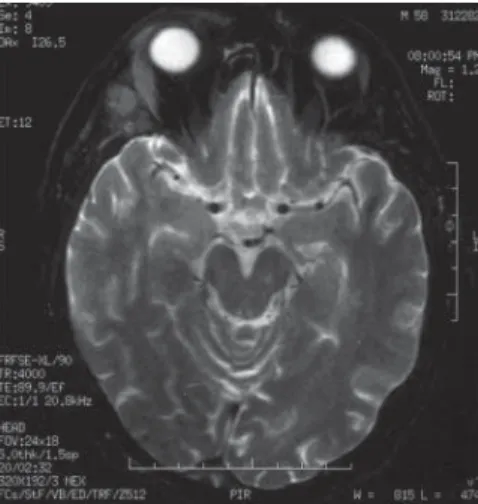
A 57-year-old man with a previous diagnosis of small cell lung can-cer, was admitted because of a new history of headache. He was diagnosed with an extensive dis-ease metastatic to the liver and bones six months ago. His cranial computed tomography (CT) scan was normal at baseline. He had an early relapse after six cycles of cis-platin-etoposide chemotherapy with a progression of the primary thoracic tumor. On admission, he described few recent episodes of severe left sided orbital and tem-poral pain. His pain was strictly unilateral on the left side with a stabbing character. He had an ex-cruciating pain located at the pe-riorbital area with radiation to the fronto-parietal area of the head. This brief paroxysmal pain was accompanied by lacrimation and redness of the ipsilateral eye, and nausea. The usual duration of pain attacks was changing between 60 to 120 seconds. He had 1-2 attack per day. Any well defined trigger-ing movement was described. A cranial CT scan showed any le-sions. Thereafter the patient re-ceived two cycles of topotecan as a second line therapy. He experi-enced a mild improvement for this complaint of unilateral headache
with diclofenac sodium, but his pain had worsened over the sec-ond line therapy period, and he readmitted with this complaint of headache. He was a 70 pack-years ex-smoker who had quit smoking one year earlier, and he had a his-tory of type 2 diabetes mellitus, controlled with insulin. He had no previous history of migraine or headache, but his mother and his brother had a history of migraine. His neurological and ophthalmo-logic examinations were normal. A cranial magnetic resonance im-aging (MRI) (Figure-1) revealed an increased intensity in the re-gion of the right temporal mus-cle. A SUNCT-like syndrome was diagnosed, and he was started on carbamazepine 400 mg daily from which there was a moderate ben-efit, and then the carbamazepine dose was increased to 800 mg dai-ly, nevertheless he had no further improvement. He died due to the progression of his malignancy with hepatic encephalopathy one month after his readmission.
Discussion
SUNCT syndrome is a rare form of trigeminal autonomic cephalgias, that predominates slightly in men, with a mean age of onset around 50 years. It is characterized by strictly unilateral attacks centered on the orbital or periorbital regions, forehead, and temple. Most attacks are moderate to severe in intensity and burning, stabbing or electrical in character. The usual duration ranges from 5 to 240 seconds, although the reported range of duration is 2 seconds to 20 minutes. Ipsilateral conjunctival injection and lacrimation are present in most, but not all patients (8).The new diagnostic criteria according to the ICHD-II for SUNCT is given
in table-1 (7), and they have been met for the diagnosis of the reported patient.
The TACs are characterized by short-lasting headaches with autonom-ic features, since the differential diagnosis includes mainly these trigeminal-autonomic cephalgias. Short-lasting attacks of unilateral pain are much briefer than those seen in any other TAC and very of-ten accompanied by prominent lacrimation and redness of the ipsilateral eye (7). Most cases of SUNCT syndrome described in the medical literature are primary, but several cases of secondary SUNCT or SUNCT like syndrome have been reported, and they are rath-er related to postrath-erior fossa and pituitary abnormalities. Causes of symptomatic SUNCT syndrome have included posterior fossa le-sions (such as cerebellopontine angle AVMs, brainstem cavern-ous angiomas, posterior fossa le-sions in an HIV/AIDS patient, se-vere basilar impression causing pontomedullary compression in a patient with osteogenesis imper-fecta, craniosynostosis resulting in a foreshortened posterior fos-sa, pontocerebellar astrocytoma, cerebellopontine angle and
fron-Figure 1. Cranial magnetic resonance
imaging (MRI) showed an increased intensity in the region of the right temporal muscle marked with a thicken arrow.
Journal of Ankara University Faculty of Medicine 2008, 61(4)
215
Elif Şen, Canan Işıkay Togay, Füsun Ülger, Barış Poyraz, Cenk Akbostancı, Uğur Gönüllü4
tal lobe meningiomas, anomolous vertebrobasilar vascular develop-ment, brainstem and upper cer-vical lesions secondary to Devic’s syndrome and multiple sclerosis, pituitary tumors (such as a non-functioning pituitary adenoma, prolactinomas, acromegaly) and miscellaneous causes such as a cavernous sinus leiomyosarco-ma, orbital cyst, intraorbital met-astatic bronchial carcinoid, and an HIV patient with no opportu-nistic infections and normal brain imaging. A case of a patient with SUNCT syndrome who also was HIV-positive, and had no oppor-tunistic infections with a normal brain imaging has been reported. Even the authors raised the possi-bility of a causal relationship be-tween the two conditions, an al-ternative explanation is a coinci-dental occurrence of the two con-ditions (8, 11). This case is also addressed to a similar possibili-ty, since we report a patient with SUNCT syndrome who also had a
diagnosis of SCLC. Furthermore, brain MRI showed an increased intensity in the region of the right temporal muscle which may be a triggering factor in this patient with extensive disease. The occur-rence of SUNCT syndrome in this case of SCLC may also be coinci-dental, even though our patient’s very severe headache fulfilling the SUNCT diagnostic criteria start-ed after the diagnosis of SCLC, it may be argued that a contralateral temporal muscle lesion should be precautiously considered a pos-sible trigger. However, SCLC is a disease which can have relatively frequent occurence of paraneo-plastic syndromes, and if this spe-cial headache entity could be con-sidered as one of them, this may be another possible explanation for this headache syndrome pres-ence in that patient.
SUNCT is differentiated by its pre-dominance of autonomic symp-toms from trigeminal neuralgias
which is often responsive to anti-epileptics such as carbamazepine. SUNCT syndrome, unlike chronic or episodic paroxysmal hemicra-nias, is generally considered re-fractory to the treatment or dif-ficult to treat, although recent open clinical trials suggest that lamotrigine, gabapentin, topira-mate, and intravenous lidocaine have produced beneficial thera-peutic responses(1,8-10). Our pa-tient had a mild to moderate re-sponse to the treatment with a non-steroidal anti-inflammatory drug and carbamazepine.
In summary, we reported the first case of SUNCT syndrome with a diagnosis of SCLC in the litera-ture. SUNCT-like syndrome diag-nosis should be evaluated careful-ly in patients with previous histo-ry of lung cancer. Cranial metasta-ses may be a trigger for this head-ache syndrome, and cranial MRI is needed in investigating secondary SUNCT patients.
Table 1. Diagnostic criteria for SUNCT (Short-lasting unilateral Neuralgiform headache attacks with Conjunctival Injection and Tearing)
REFERENCES
1. Sjaastad O, Saunte C, Salvesen R, Fredriksen TA, Seim A. Shortlasting unilateral neuralgiform headache at-tacks with conjunctival injection, tea-ring, sweating, and rhinorrhea. Cep-halalgia 1989; 9:147-56.
2. Sjaastad O, Russell D, Hørven I, Bu-naes U. Multiple neuralgiform unila-teral headache attacks associated with conjunctival infection and appearing in clusters. A nosological problem.
Proceedings of the Scandinavian Mig-raine Society. 1978:31.
3. Goadsby PJ, Lipton RB. A review of paroxysmal hemicranias, SUNCT syndrome and other short-lasting headaches with autonomic feature, including new cases. Brain 1997; 120:193-209.
4. Pareja JA, Sjaastad O. SUNCT Syndro-me. A clinical review. Headache 1997; 37: 195-202.
5. Sesso RM. SUNCT syndrome or trige-minal neuralgia with lacrimation and conjunctival injection? Cephalalgia 2001; 21: 151-153.
6. Trucco M, Mainardi F, Maggioni F, Ba-dino R, Zanchin G. Chronic paroxy-smal hemicrania, hemicrania continua and SUNCT syndrome in association with other pathologies: a review. Cep-halalgia 2004; 24: 173-184.
7. Headache Classification Subcommit-tee of The International Headache
A. At least 20 attacks fulfilling criteria B-D
B. Attacks of unilateral orbital, supraorbital or temporal stabbing or pulsating pain lasting 5-240 seconds C. Pain is accompanied by ipsilateral conjunctival injection and lacrimation
D. Attacks occur with a frequency from 3 to 200 per day E. Not attributed to another disorder ¹
¹ History and physical and neurological examinations do not suggest any of the disorders listed in groups 5-12, or history and/or physical and/or neurological examinations do suggest such disorder but it is ruled out by appropriate investigations, or such disorder is present but attacks do not occur for the first time in close tem-poral relation to the disorder
Ankara Üniversitesi Tıp Fakültesi Mecmuası 2008, 61(4)
216 Sunct-Like Syndrome In A Patient With Small Cell Lung Cancer
Society. the International Classifi-cation of Headache Disorders, 2nd ed (ICHD-II). Cephalalgia 2004; 24 (Suppl 1).
8. Matharu MS, Cohen AS, Boes CJ, Go-adsby PJ. Short-lasting Unilateral Ne-uralgiform Headache with Conjuncti-val Injection and Tearing Syndrome: A Review. Current Pain and Headache Reports 2003, 7:308-318.
9. Pareja JA, Caminero AB, Sjaastad O. SUNCT Syndrome: diagnosis and treatment. CNS Drugs 2002; 16: 373-83.
10. Matharu MS, Cohen AS, Goadsby PJ. SUNCT syndrome responsive to intravenous lidocaine. Cephalalgia 2004; 24: 985-992.
11. Bare LM, Forcelini CM. Onset of short-lasting, unilateral,
neuralgi-form headache with conjunctival injection and tearing (SUNCT) after acquired human immunodeficiency virus (HIV): more than a coinciden-ce? Cephalalgia 2001; 21:518.