109
Conflict Risk and its Implications on Economy and Financial System
Umit Hacioglu, PhD
a, Hasan Dincer,PhD
b, Ismail Erkan Celik,PhD
ca Beykent University, Department of Capital Markets and Portfolio Management, Beylikduzu Campus, Istanbul, 34500, Turkey
b Beykent University, Department of Capital Markets and Portfolio Management, Beylikduzu Campus, Istanbul, 34500, Turkey
c Beykent University, Department of Banking and Finance, Ayazaga Campus, Istanbul, 34500, Turkey
Abstract
Considering the impacts of the conflict on the economic parameters in terms of macroeconomics, the following factors might affect the profitability of the company: foreign capital outflows, decrease in exports, increase in the interest rates, disruption of the investment climate, increase in the exchange rates, increase in the costs of import entry etc. Due to the expectable decrease in profit shares as to the investors, the contraction in the risk appetite will cause volatility in the prices of equity securities markets based on the impacts of the conflict, and the equity securities will depreciate. In this study, the main contributions on conflict risk and related econometric models have been discussed.
Keywords: Conflict, Risk Analysis, Economic Modelling, Financial System
© 2013 Published by SSBFNET
1. Introduction
Positioned at the center of financial system, risk is a fundamental component requiring management. “As financial
markets entail a certain level of risk, creating markets capable of risk pricing and consolidation is the primary function of the financial markets” (Uludag & Ercan, 1999: 114; Campbell & Kracaw, 1993: 52-59; Bolgun & Akcay,
2003: 37-43). Explaining the concept in a general framework, Kenneth E. Boulding states that the conflict comes out between the economic organizations in economy, between the states in politics, and distinct cultures in anthropology while it occurs between different branches of an organization, in that anywhere people are present (Boulding, 1963: 1). Bernard Mayer defined the conflict as “a disagreement arising out of cognitive, emotional and behavioral
distinctions” (Mayer, 2000: 1).
Above-mentioned disagreements, in turn, emerge as uprisings, armed clashes, or war. Individual as well as international disagreements between agents may arise. Conflicts are divided into two as internal or external conflicts; and they concern the utilization and distribution of the resources of a country.
Within the framework of struggle against the problem of poverty, the World Bank conducts activities under
Conflict Prevention and Restructuring Post-Conflict. According to the statistics of the World Bank, 80% of the
poorest 20 countries of the World have been experiencing the heavy-armed or internal conflicts in the last 15 years.
a Corresponding author. +90 212 444 1997 (5307)
110
During the peace in the post conflict period, only 44% of the growth has been achieved during the initial five years. Considering the correlation between conflict and economic stability, one needs to scrutinize the relation between conflict and economics.
Dougherty and Pfaltzgraff describe conflict as “the conscious opposition of a community, which can be
characterized in terms of cultural, religous, ethnic, socio-economics, politics etc. against one or more than specific communities because of the conflicting interests” (Dougherty & Pfaltzgraff, 1990: 187).
As is evident from the definition there various aspects of the conflicts. Ethnic, political, cultural, strategic or economic reasons come into prominence among the features of a conflict.
The studies focusing on the concept of conflict in the literature show that the relief in the diplomatic conflict between the parties, the prevention of clash of arms and correspondingly the decrease in the volatility of the conflict risk can solely be achieved through economic growth, increase in employment rates and fiscal discipline (Collier, Hoeffler & Soderbom, 2007: 7-12). However, the studies conducted to contextualize the nature of the recent international or regional conflicts focus mostly on the ethnic, socio-cultural, religious and political aspects of the
conflict while giving the financial dimension secondary significance.
2. History of Conflict
The aspects of the conflict risk affecting the economic development should be closely examined. On an international scale, the constraint on the energy prices due to the conflict will have an adverse impact on the energy export-dependent economies. Corresponding to the deepening conflict risk, the credit rating agencies will lower the credit ratings of the country. Thus, the costs of the resources will be increased by the local banks and the private establishments. The efficiency of the credit devices will be mitigated thorough the country.
As well as the risks it brings along, the conflict is an evidence which might disrupt the economic infrastructure of the macro system as well as the portfolio investments. In such an environment of conflict, only the superpowers which are economically powerful and the leaders of the world politics as well as holding the invaluable mine and energy markets will turn out to be profitable. Entering the Second World War in a dominant position thanks to its gold reserves, the USA constructed the economic infrastructure of the world through Bretton Woods system* and became the sovereign power in politics especially following the dissolution of the Soviet Bloc. Following the recent wars in Afghanistan and Iraq, the USA reinforced its authority on the world's energy resources.
Methods such as economic sanctions, military interventions as well as humanitarian intervention have been adopted as in the case of the dissolution of Yugoslavia, yet they have neither have terminated the conflicts conclusively, nor sustained a long lasting stability.
Today the conflict risk still exists in the region. At the root of the risk conflict in the region, there is the instability in the economic cooperation and the financial deepness in the markets of the involved parties which are also neighbors of each other. In such a financial environment, the intended level couldn't be reached in the foreign capital investments and the co-investments. The experts support the idea that following the dissolution of the Federation in particular the persistent political instability is the primary hindrance in the economic development.
*
Thanks to Bretton Woods system, US dollar had become the reserve currency and the response tool in the market. Nevertheless this monetary system collapsed in 1973 Crisis and a transition to the system of unencumbered currency took place.
111
In the beginning of the 1990's, entering the World politics as a novel state Bosnia Herzegovina is constituted of Bosnian - Croatian Federation and Serb Republic. In a political structure consisting of two houses and more than one hundred ministries the troika system takes place alternately. The traces of this disparity in the political system can also be observed in the economic life of the country.
The troika system cannot ensure equality or justice in the public expenditures or distribution income and sources. The state owned enterprises cannot be promoted as a transparent or righteous process. Thus the ethnic discrimination experienced in employment leads to social differentiation. Due to this unfavorable environment and the political conflict, the desired foreign capital investments cannot be reached and the shallow financial markets remain to be stagnant. The risk of conflict prevails in the region because there exists a deep autonomous finance and no mutual economic cooperation has been achieved yet.
3. Measuring Conflict Risk and ıts Econometric Analysis
In the recent past, many developing countries have experienced severe social, cultural, political and economic conflicts. These conflicts have taken place as riots and protests evolving into the wars. Millions of people passed away, and the economic and social development level of the country has been inflicted profoundly.
While conflict risk affects the movement of the capital, qualified labor force perishes or is manipulated as military resource. Consequently, emerging labor costs dissuade foreign capital.
Many conflicts ending up as wars result in millions of death, and the internal disorders and riots increase the risk rates in terms of capital investments. Therefore, an issue of trust arises between economic actors and the center of sources. For instance, when military and police power is wielded to intervene in the conflict, there occurs a drastic monetary outflow; besides, supplying qualified labor force for the unproductive police power is costly (Justino, 2004:
1-15).
In such an environment of conflict, the economic actors will orient the capital and portfolio investments to foreign countries and more secure regions due to the prevalent risks.
According to Justino, “the conflicts not only deteriorate the sanity of the citizens, but also decrease the income
level of the country, and annihilate the favorable conditions for investment leading the gap between the rich and poor to expand” (Justino, 2004: 1-25). The risk of conflict affects the balances in macro- and micro-economics adversely.
Regarding the reports of the World Bank, the countries where the conflict risk is on the decline, the economic development gains a momentum. There is a correlation between the decrease of conflict risk and increase in the employment and economic development.
According to the risk analysis model of Collier, Hoeffler and Soderbom, the studies assert that the conflict risk in underdeveloped countries is quite higher compared to developed countries. “When the economic development fosters
and collaterally the income level is increased, the conflict risk decreases” (Collier, Hoeffler & Soderbom, 2007: 17).
Collier, Hoeffler and Soderbom underline the priorities of the post-conflict economic policies of the country. According to Collier, Hoeffler and Soderbom, “a long-lasting security must be ensured between the conflicting parties
and different policies must be formulated to alleviate the unemployment and the social differentiation following the conflict” (Collier, Hoeffler & Soderbom, 2007: 13).
In the analysis of Collier, Hoeffler and Soderbom, it is stated that “Taking military precautions against the conflict
risk is an intensifying factor. In the post-conflict environments an increase in the military expenditures affects the overall system in an adverse way. There is a negative correlation between the conflict risk and expenditure” (Collier,
112
The most fundamental benefit of risk analysis for the financial decision making processes is the measurement of the potential impacts on the running profitability of making investments in the conflict-sensitive regions. Thereby, for the businesses having invested in these regions the impacts of the changes in the estimated growth rates on the yields of equity securities might be predicted and governed accordingly. The investors make decisions and the portfolio managers develop rational investment strategies corresponding to the analysis (Campbell, Polk & Vuolteenaho, 2009; Cresson, 2009; Aktan, Mabrouk, Ozturk & Rhaiem, 2009).
In the conflict-sensitive countries like Kosovo and Bosnia, the businesses having invested in these countries have to consider the risk of recurrence of the conflict (Bray, 2005: 44). However, in the conflict-sensitive countries the restructuring activities cannot be relied upon fully for the regeneration of the economic infrastructure due to the uncertainty. According to Starr, “The preconception as to the recurrence of the conflict risk prevents the business
world from investing in the needed projects necessary for the economic growth” (Starr, 2004: 4-7).
To measure the conflict risk and to analyze its impacts on the balances of macroeconomics is vital. Thereby, the investment profitability may be calculated and from this uncertainty even different opportunities might be taken advantage of.
In Starr and Collier models, it is shown that there is a relation between the decrease of conflict risk and economic growth, increase in the employment rates and maintenance of fiscal discipline. Moreover, the achieved fiscal discipline and sustainable economic growth following the conflict minimize the risk.
In the empirical study conducted by Starr there is also a correlation between the conflict risk, hyper-inflation and economic stagnancy. After the conflict, a decrease in the conflict risk for the economics shows a correspondence with the efficient fiscal discipline. It is shown that the countries where no efficient fiscal discipline can be applied are more susceptible to the conflict risk in comparison with the countries applying one. Starr remarks that “in the economies
where an efficient fiscal discipline is achieved the control of the rapid growth rate and the inflation fosters the interaction between the movements of foreign trade and capital” (Starr, 2004: 18-22).
Post-conflict economies require an econometric model in order to conceptualize the alleviating impacts of economic growth and fiscal discipline on the conflict risk.
4. Post-Conflict Risk Analysis and Econometric Model of Paul Collier
In the risk analysis model of Collier, Hoeffler and Soderbom, the factors affecting the conflict risk are examined and it is shown that the impacts of economy affect the conflict risk fundamentally. According to Collier, Hoeffler and Söderbom, two significant difficulties awaiting the post-conflict communities are economic recovery and achieving a decrease in the probability of recurrence of conflict risk. Economic growth lowers the conflict risk as to Collier and et.al. Furthermore, the increasing expenditures of international organizations such as the UN in this region reduces the conflict risk by 40% (Collier, Hoeffler & Soderbom, 2007: 1-40). Collier considers 6 phases of the post-conflict period for the econometric analysis:
(i) Ongoing conflict risk in post-conflict environment
(ii) Deficiency of international peace power in post-conflict environment (iii) Unachieved level of democracy in post-conflict environment
(iv) Persistent anxieties of the sovereignty due to the instable government reforms in post-conflict environment
113
(v) Alleviation of the distress thanks to the assurance of the state authority through the reelections in post-conflict environment
(vi) Withdrawal of the international western powers, established democracy and relief of tension in post-conflict environment.
4.1. The Reasons of Conflict Regarding to Collier's Model
Collier tries to limit the reasons of the conflict before analyzing the conflict risk. Collier states the reasons of conflict on the ground of the flexibility of the following factors (Collier, Hoeffler & Soderbom, 2007: 8):
(i) Geographical conditions
(ii) Dependency on the foreign security factors (iii) Low income level
(iv) Stagnancy in the economic growth (v) Exporting of the most natural sources.
In the model of Collier, the high level of risk in the post-conflict period is associated with the flexibility of the factors.
4.2. Factors of the Model
The recurrence of the conflict risk in post-conflict period is explained in the following model of Collier's (Collier, Hoeffler & Soderbom, 2007: 10):
)
(
)
exp(
)
;
,
(
x
t
x
h
t
h
t
t
B ,t
; peaceful atmosphere in post-conflict periodt
x
; in t calendar time the vector of off-system, exogenous variables
; unknown parametersB
h
; risk basis0
;X
tjan increase in the explanatory parameters causes a danger of war and a contraction of the peace period.
< 0;X
tja decrease in the explanatory parameters averts the danger of war and contributes to the prolongation of the peace time.For the risk basis in the model of Collier,
h
(t
)
Ba quite flexible exponential model is adopted.
In Collier's model, the beginning point is decided by the division of the time axis into W ranges, W
c
c
c
c
1,
2,
3,...,
and thus a consistent risk basis might be predicted in each range:
4.3. Application of the Model
W w W W Bt
d
t
h
2)
(
exp
)
(
114
t
d
W=the variable risk is equal to 1 if
c
W1<t
c
W (c
0
0
,c
W
and for the reverse it is 0)
It signifies the interceptor and
1,
2,...
.,
Wrisk basis parameters.Decimal system is applied to the model. In the sample, an environment in which 68 conflicts have been experienced is considered, and 31 of these have been evolved into a war. The calculated mean risk is approximately 46%. After the implementation of the model, the probability of failure of the fighting countries is 40% in the first 10 years following the conflict.
4.4. Measurement of the probability of keeping peace in the first 10 years following the conflict
In the Collier’s Model, the probability of keeping peace in the first 10 years following the conflict is measured as such (Collier, Hoeffler & Soderbom, 2007: 12): t = for 10 years;
10 0)
(.;
exp
)
10
(
udu
u
h
S
,In the first two years the risk is too high as well as the risk rate at the beginning condition immediately after the conflict. During the time the risk reduces gradually. In the model, the significance of the economic performance is highlighted, and it might be inferred that the post-conflict economies show a rapid growth with respect to the others (Collier, Hoeffler & Soderbom, 2007: 1-18).
Regarding the Starr's model this dramatic growth is associated with the effective management of the financial policies. Collier and Hoeffler determine the conflict risk of the stagnant economies to be 42.1% in 10 years. For instance, if the economy grows by 10% annually, a decrease of 26.9% in the conflict risk is expected for the next 10 years (Collier & Hoeffler, 2004).
4.5. Interpretation of Collier's Model
Regarding Collier’s model, unemployment, economic stagnancy and decrease in the safety expenditures of the international actors increase the conflict risk. For instance, even though it has been 14 years since the war, in Bosnia the unemployment rate is more than 40%, and the economic investments have not reached a certain level yet. In addition to these, the retreat of EU police power and decrease in the number of NATO soldiers in the region also signal for the conflict risk in the region. Such a conflict risk impedes the economic growth and the integration of the country to EU. As stated earlier, Collier and Hoeffler state that in the stagnant economy the conflict risk decreases by 42.1%. If the growth rate is 10% annually, in the next 10 years the conflict risk reduces to 26.9%.
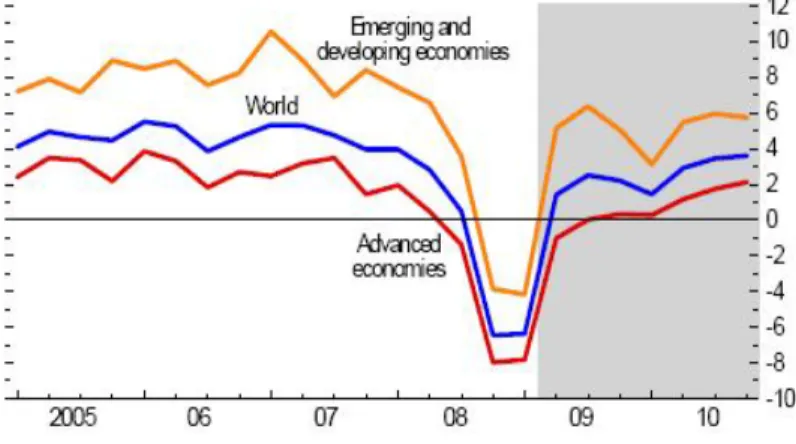
Starting in the last quarter of 2008 and continuing to deepen until the second half of 2009, the global financial crisis affect the growing rate in the next 4-5 adversely as can be seen in the graphic 1. Thus, it results with an increase in the conflict risk. Table 3 shows the annual growth predictions.
115 Graphic 1: Global Growth Rate and 2009-2010 IMF prediction Source: IMF
The IMF prediction for Bosnia's growth rate is -3% for 2009. It is assumed that the predicted yields and values of the equity securities of the businesses having invested in these regions will depreciate according to the discount model (Brealey, Myers & Marcus, 2007: 122-138; Hacioglu & Dincer, 2009; Tevfik, 2005). Due to the global crisis Bosnia has become more susceptible to the external crisis. Especially when the stability of the European centered banks on which the financial system of the country is depended for recovery, the situation proves to be risky for the small economy (IMF, 2008: 199).
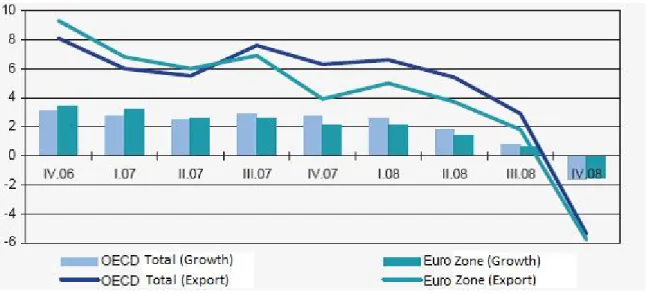
Graphic 2: Annual Growth Rate of the Developed Countries Source: TCMB Inflation Report 2009
In Graphic 2 and 3, the values indicate that a crisis emerging out in the developed countries affect the developing countries fundamentally too. This impact and co-movement is discussed in the fourth chapter.
116 Graphic 3: Annual Growth Rate of the Developing Countries Source: TCMB Inflation Report 2009
117 Table 3: Annual Growth Predictions
2009 2010
previous prediction new prediction previous prediction new prediction IMF World -1,4 -1,1 2,5 3,1 Developed Countries -3,8 -3,4 0,6 1,3 USA -2,6 -2,7 0,8 1,5 Euro Zone -4,8 -4,2 -0,3 0,3 Developing Countries 1,5 1,7 4,7 5,1 OECD All OECD -4,1 -3,7 0,7 - USA -2,8 -2,8 0,9 - Euro Zone -4,8 -3,9 0,0 - Consensus Economics World -2,3 -2,3 2,6 2,7 USA -2,6 -2,5 2,4 2,6 Euro Zone -3,9 -3,9 1,0 1,1
Source: TCMB Inflation Report 2009
The opportunity cost of the investments which are decided not to be made in the risky region might be too high to affect the predictable profitability of the company. Therefore, the risk of post-conflict environment should be analyzed carefully. If the conflict is managed competently, the growth rate might be considered to increase. The businesses which cannot analyze the uncertainty fully and thus don't invest in the region will have to cover more costs compared to the others. Accordingly, the business having invested in the region will show a growth rate corresponding to the local economy thanks to a sound analysis, and their profitability rates might be predicted to increase as well as the dividend of profit per share. Also, the investment of the international companies in the region averts the risk.
4.6. Criticism of the Study of Collier and his Colleagues
The model developed by Collier and et.al. has aroused some severe criticisms because of the employed scientific methodology. The fact that the data poll utilized in the empirical studies is not open to other academicians is particularly at the center of these critics. How only Collier and his colleagues were able to reach the secret data of the World Bank is unknown. The studies which are conducted by Collier, who works in the World Bank, with the banks'
118
sponsorship are assumed to be manipulative. In this issue, Benedikt Korf comments that the scientific methodology of Collier belongs to the ‘cargo culture’ and it is questionable whether the data he utilized had been gathered with a universally accepted scientific method (Korf, 2006).
Another essential criticism made as to the analysis of conflict risk suggested by Collier and et.al. is that in the study the policies advised for the minimization of the risk is based on economics and four fundamental factors solely. These factors are as such: foreign economic support, management methods of financial sources, international military intervention and establishing democratic parties (Suhrke, Villanger & Woodward, 2005).
In the study of Collier and Hoeffler examining the optimum aid policies to the post-conflict countries a relation between aid and growth is found as well as economic growth and sustainability of peace. However, Collier and Hoeffler are also criticized for not being able to establish an efficient and satisfying relation of causality (Suhrke, Villanger & Woodward, 2005). In the model adopted for risk analysis, the consistency and validity of the codification which is included in the data set of Collier and Hoeffler is questionable (Korf, 2006).
In Collier's study while the relation between economic growth in the post-conflict period and decrease of conflict risk is evaluated, the fact that the impact of aid and growth on poverty has not been analyzed is criticized. A relation is defined between economic growth and risk, but Collier and his colleagues give the priority to the macroeconomic policies rather than social policies (Suhrke, Villanger & Woodward, 2005).
Concerning the studies of Collier and Hoeffler, the comments Laurie Nathan made is about the employed statistical methods and data. How Collier and Hoeffler define each variant is questioned. For instance, while the macroeconomic indicators and income level are measurable and definable, why the unjust treatment is not considered to be measurable variable in the study is examined. The result of the empirical study conducted by Collier is believed to be speculative because of the reliability and validity of the data (Nathan, 2005: 1-29).
The most questionable feature of the study is that it is not explained by Collier how they obtained the secret data of the World Bank and why the data remains to be confidential for the other researchers. In spite of all these criticisms, the study performed by Collier and his team is accepted to be the most successful research about the minimization of the risk in the post-conflict regions in the literature and keeps its currency.
5. Econometric Model of Martha Starr
Econometric model of Starr is focused on the analysis of the impacts of conflict duration and the financial applications applied following it on the inflation and growth (Starr, 2004: 1-24).
When the impact of fiscal discipline and economic growth is considered, in the post-conflict societies it is seen possible to reduce the risk and eliminate the uncertainty. Consequently, there is a need for efficient financial policies. When the countries conflicting during the war are considered, high inflation and budget deficiency are observed in especially the states composing Balkans and former Yugoslavia such as Bosnia, Serbia, Montenegro, Croatia, Slovenia and Macedonia. In the econometric model of Martha A. Starr the states are analyzed in terms of their application of the mentioned fiscal discipline in the conflict period and after the conflict (Starr, 2004: 18).
5.1. Factors of the Model
Regarding the Econometric Model of Starr, the inflation and growth rate in i country is assessed in t time (Starr, 2004: 18-19). it it RE it UNRE t i it
it
pX
V
CONFLICT
V
POST
V
POST
119
it
x
; the change in the consumer price index and its impact on the GDP between the years t-1 and t,
1
it
X
; deferred value of the variable for consistency, i
; stagnancy impact on the country, t
; time-specific impact it
CONFLICT
If i country is in conflict for t time, the variable equals to 1 (otherwise its value is 0),
it UNRE
POST
If i country has been relieved from the conflict for t time and has not been following a specific fiscal discipline reform, the variable equals to 1.
it RE
POST
If i country has been relieved from the conflict for t time and has been following a specific fiscal discipline, the variable is equal to 1.
Coefficient
V
1; the difference in the inflation and growth changes between the conflicting countries andnon-conflicting ones,
Coefficient
V
2veV
3 the inflation and growth difference between the post-conflict countries, the application of thefiscal discipline reform
(
V
2V
1)
; shows the changes in the inflation and growth rates of the countries switching over to the post-conflictenvironment without a plausible fiscal discipline.
)
(
V
3V
1; shows the changes in the inflation and growth rates of the countries switching over to the post-conflict environment through a plausible fiscal discipline.
)
(
V
3V
2; shows the changes in the inflation and growth rates of the countries which cannot switch over to the post-conflict environment through a plausible fiscal discipline.
5.2. Application of the Model
In the econometric model of Starr, the inflation and growth ratios between 1993 and 2003 are evaluated. Collier’s risk analysis is based on the first 10 year after the conflict. In Starr’s model, Bosnia, Croatia and Georgia which apply plausible financial reforms are examined as well as Moldova, Serbia and Tajikistan which don't apply any.
6. Results of the Econometric Models
According to the result of Starr's econometric analysis, a correlation was found between the conflict and hyper-inflation. Moreover, the countries which cannot adopt any efficient fiscal discipline experience hyper-inflation with respect to the other countries. Based on the econometric analysis of Starr five major statements are defined as such (Starr, 2004: 18-22):
120
(i) In the post-conflict economies, an efficient fiscal discipline brings about the peace.
(ii) Whether the local government plays with the financial symbols or creates expectations after the conflict doesn't bring along the growth.
(iii) Rather than a fiscal discipline program parallel to the conflict a discipline program should be followed. (iv) In the conflict environment, the fiscal discipline, national safety and federal state regime advances parallel to each other.
(v) When the small states emerging after the conflict switch to euro and adopt an international currency, it will create more favorable environment for the businesses.
Collier's Model proves that the conflict affects the inflation and the growth rate. In the conflict environment efficient fiscal discipline cannot be applied. If the macroeconomics balance is disrupted, the affects will continue after the conflict. The countries applying fiscal discipline after the conflict gain great momentum compared to the countries which don't apply.
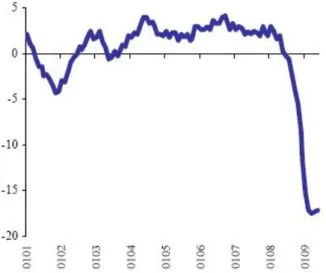
The fact that international trade covers post-conflict countries helps the local markets to integrate more quickly. Thereby, it will assist to increase the values of the equity securities while creating growth opportunities parallel to the foreign developments for the businesses. The primary requirement for this growth and the integration of the country with the World is the application of the efficient fiscal discipline following the conflict. Graphic 4 shows the decreases according to the regions' growth of trading volume. Graphic 5 and 6 illustrate the decrease in industrial growth.
Graphic 4: Growth rate of Trade Volume Source: TCMB financial stability report of 2009
Efficient fiscal discipline controls the inflation, fosters the integration with the World, and creates favorable investment atmosphere. Thus increase in the employment rates decreases the conflict risk. Decreasing conflict risk reduces the uncertainties for the businesses and foreign investors. Continuously growing rate has a positive impact on the business profitability, productivity of the equity securities, and recovery in the welfare as well as increase in the employment rates. Thereby, it reduces the conflict risk.
121 Graphic 5 Developed Countries' Industrial Production Index
Source: TCMB Financial Stability Report, IMF World Economic Outlook 2009
According to this model, taking into account' the alleviating effect of efficient fiscal policies and growth rate for the conflict, especially the bankruptcy of Lehman Brothers combined with the deepening of global crisis in the last quarter of 2008 have adverse impacts on real and financial areas in 2009. We should consider that this economic crisis will increase conflict risk in post-conflict economies.
Graphic 6: Developing Countries Production Index
Source: TCMB Financial Stability Report, IMF World Economic Outlook 2009 7. Conclusion
One of the most primary risks which affect the financial system is the risk of conflict. Due to the risk of conflict, volatility may occur in parallel with the unpredictable fluctuations in the interest rates and the emerging uncertainties in the financial markets. The stability of macroeconomics may be disrupted and the economic stagnancy may deepen
122
as per the scale and size of the conflict correspondingly. Therefore, the impacts of the risk of conflict on the financial system should be thoroughly defined and analyzed.
In Collier’s model of risk analysis, the factors affecting the conflict risk have been considered for the recurrence of probable conflict risk in the post-conflict environments. It is shown that the economic impacts such as inequality in the distribution of natural sources, unemployment and slow economic growth affect the conflict risk fundamentally. In the post-conflict environment the conflict risk is observed to prevail and the recurrence risk of the conflict is high in the first 10 years. This ongoing risk stems from the unachieved democracy, instable reforms and the anxieties of the authority. Thus, the ambiguity will be potent in the conflict region.
The businesses have to invest in the region by considering this risk. When the most effective factors to affect this risk are considered to be mostly economic or political, in the first 10 years it is essential for the international organizations to undertake the guarantorship. Moreover, economic fiscal reforms have to be managed successfully. These are the factors to determine the investment decisions. The businesses measuring the risk to invest in the region will be more advantageous than the others.
In the model of Collier, Hoeffler and Soderbom, the analysis of the risk in the post-conflict environment, and the economic improvements to reduce the unemployment will provide advantage for the international investors to manage the conflict risk in the region.
As a result, the countries applying efficient fiscal discipline struggle with high inflation rates and this impedes the economic stability. Additionally, a decrease in the employment and growth rates increases the conflict risk. The favorable investment atmosphere is disrupted. Post-conflict economies belong to the regions which should be refrained for foreign investments. On the other hand, the success of the economies which apply post-conflict fiscal discipline creates a favorable investment atmosphere for foreign investors. However, if an internationally valid unit of currency is adopted, this will foster the international investments and enable the conflicting countries to integrate easily.
References
Aktan, B., Mabrouk, A. B., Ozturk, M. & Rhaiem, N. (2009). Wavelet-Based Systematic Risk Estimation An Application on Istanbul Stock Exchange, International Research Journal of Finance and Economics, 23. Bolgun, K. E. & Akçay, M. B. (2003). Risk Yönetimi. İstanbul: Scala Yayıncılık.
Boulding, K. E. (1963). Conflict and Defence: A General Theory. Michigan: Harper Torchbooks
Bray, J. (2005). International Companies and Post Conflict Reconstruction, Social Development Papers, 22: 44. Brealey, R., Myers, S. & Marcus, A. (2007). İşletme Finansının Temelleri. (Trans.) U. Bozkurt et.al. Istanbul: Literatür Yayınları.
Campbell, J., Polk, C. & Vuolteenaho, T. (2009). Growth or Glomour? Fundamentals and Systemic Risks in Stock Returns, The Review of Financial Studies.
Campbell, T. & Kracaw, W. A. (1993). Financial Risk Management. USA: HalperCC Publishers.
Collier, P. & Hoeffler, A. (2004). Aid, Policy and Growth in Post-Conflict Societies, European Economic Review, 48(5): 1125-1140.
123
Collier, P. & Hoeffler, A. (2004). Greed and Grievance in Civil War, Oxford Economic Papers, 56.
Collier, P., Hoeffler, A. & Rohner, D. (2006). Beyond Greed and Grievance: Feasibility and Civil War, Center for the
Study of African Economics, Working Paper.
Collier, P., Hoeffler, A. & Soderbom, H. (2007). Post-Conflict Risks, Center for the Study of American Economics, Oxford OKI 3UQ, UK: 7-12.
Cresson, J. (2009). Systemic Risk Measures of Homogenous Investments: Evidence from S&P 500 Index Mutual Funds Employing Daily Returns, Journal of Business & Economic Studies, 15(1), 48-69.
Dougherty, J. E. & Pfaltzgraff, R. L. (1990). Contending Theories of International Relations: A Comprehensive
Survey. 3. Edition. New York: HarperRow Publishers Inc.
Goertz, G. & Regan, P. M. (1997). Conflict Management in Enduring Rivalries, International Interactions: Empirical
and Theoretical Research in International Relations, 22(4): 321-340.
Hacioglu, U. & Dincer, H. (2009). Finansa Giriş. İstanbul: Beta Yayınları. IMF (2008). IMF Survey Magazine, 37(12).
Ivgen, H. (2003). Şirket Değerleme. İstanbul: Finnet.
Justino, P. (2004). Redistribution, Inequality and Political Conflict, PRUS Working Paper, No:18: 1-15
Korf, B. (2006). Cargo Cult Science, Armchair Empiricism and The Idea of Violent Conflict, Third World Quarterly, 27(3): 459-476.
Mayer, B. S. (2000). The Dynamics of Conflict Resolution: A practioner’s Guide, California: Jossey-Bass Inc. Nathan, L. (2005). The Frightful Inadequacy of most of the statistics: A Critique of Collier and Hoeffler on Causes of Civil War, Discussion Paper N.11, Crisis States Research Centre.
Starr, M. (2004). Monetary Policy in Post-Conflict Countries: Restoring Credibility, Working Paper Series, American University, Washington, No.7: 1-7.
Suhrke, A., Villanger, E. & Woodward, S. L. (2005). Economic Aid to Post-conflict Countries: a Methodological Critique of Collier and Hoeffl)er, Conflict, Security & Development, 5(3): 329-361.
TCMB (2009). Financial Stability Report, IMF World Economic Outlook 2009. TCMB (2009). Inflation Report 2009.
Tevfik, A. (2005). Hisse Senedi Değerlemesi. İstanbul: Literatür Yayınları.