Menstrual cycle variability of CA 72-4 in healthy women
☆
Asl
ı Yarcı Gursoy
a,⁎
, Mine Kiseli
a, Sedat Ozdemir
b, Rabia
Şeker
c, Gamze Sinem Caglar
aa
Ufuk University Faculty of Medicine, Obstetrics and Gynecology Department, Ankara, Turkey
b
Ufuk University Faculty of Medicine, Biochemistry Department, Ankara, Turkey
cBeypazarı State Hospital, Biochemistry Department, Ankara, Turkey
a b s t r a c t
a r t i c l e i n f o
Article history: Received 23 July 2014
Received in revised form 22 September 2014 Accepted 24 September 2014
Available online 2 October 2014 Keywords:
CA 72-4 Menstrual cycle Variability
Objectives: CA 72-4 is not approved as a tumor marker but has been used as an adjunct marker in gynecolog-ical practice. The study aims to evaluate the menstrual cycle variability of CA 72-4 in a population of healthy women.
Design and methods: Forty apparently healthy regularly menstruating subjects were included in the cross-sectional study designed in the University Obstetrics and Gynecology outpatient clinic. Venous blood samples from each participant were collected twice:first at the follicular phase (2nd–5th days of the menstrual cycle) for FSH, estradiol, CA 125, CA 72-4 and the other at the luteal phase (21st-24th days of the menstrual cycle) for progesterone, CA 125 and CA 72-4 levels.
Results: CA 72-4 values were similar in follicular and luteal phase of the menstrual cycle in apparently healthy regularly menstruating subjects (1.15 U/mL (0.2–5.4) vs 1.15 U/mL (0.56–6.3); p = 0.326 respectively). Ovulatory or smoking status did not have an effect on CA 72-4 values (pN 0.05).
Conclusion: Thisfirst clinical study about the menstrual cycle variability of CA 72-4 revealed that the men-strual cycle does not have a significant impact on CA 72-4 values and that it can be measured at any time during the menstrual period.
© 2014 The Canadian Society of Clinical Chemists. Published by Elsevier Inc. All rights reserved.
Introduction
Interest in early detection of cancer as an approach to reducing mor-tality has grown with the discovery of serum tumor markers. Intensive research is ongoing to identify additional serum tumor markers and a cost-effective screening strategy for malignancies. However, the prob-lem of false-positive screening tests become critically important in dis-eases with low prevalence such as ovarian cancer. The odds of screening for ovarian cancer with CA 125 resulting in four surgeries to detect one case of cancer and the risk of a severe complication while undergoing surgery for a false positive screening were 6%[1]besides psychological morbidity and substantialfinancial cost.
Menstrual cycle variations and the prevalence of benign gynecolog-ical conditions in premenopausal women might result in a substantially higher likelihood of false-positive tests of tumor markers. The menstrual cycle is characterized by different levels of interacting hormones. Changing levels of gonadotropins resulting withfluctuations in estrogen and progesterone levels, might have many unpredictable effects on dif-ferent organ systems and molecular pathways. Accompanying changes
in peritonealfluid, retrograde menstruation[2]and unknown possible
complex mechanisms[3]among different hormones are the possible
explanations for variability in tumor marker levels throughout the men-strual cycle. Previously, CA 15-3[3], CA 125[4]and a novel marker Human Epididymis Protein 4 (HE 4)[5]have been reported to be altered during different phases of the menstrual cycle. To our knowledge, no clinical trial has ever focused on menstrual cycle variability of CA 72-4. Eventually, this study aims to provide evidence about menstrual cycle variability of CA 72-4 in a population of healthy women.
Materials and methods
The study was performed in a University Hospital, Obstetrics and Gynecology outpatient clinic between March 2013 and June 2014. Forty apparently healthy hospital staff members were eligible for the study. The routine gynecological examination and pelvic ultraso-nography of all participants were normal. The local ethical committee approved the study and informed consent was taken from all partici-pants. Exclusion criteria were presence of any chronic disease related to gastrointestinal system, any hormonal contraceptive use, adnexal mass (endometrioma, etc.), irregular menstruation and pregnancy. Venous blood samples from each participant were collected twice: one at the follicular phase (2nd–5th days of the menstrual cycle) for FSH, estradiol, CA 125, CA 72-4 and the other at the luteal phase (21st–24th days of the menstrual cycle) for progesterone, CA 125 and
Clinical Biochemistry 48 (2015) 70–72
☆ Conflict of interest and source of funding: none.
⁎ Corresponding author at: Ufuk University Faculty of Medicine, Department of Obstetrics and Gynecology, Mevlana Bulvarı (Konya Yolu) No:86-88, 06520 Balgat/ Ankara, Turkey. Fax: +90 312 2847786.
E-mail address:[email protected](A. Yarcı Gursoy).
http://dx.doi.org/10.1016/j.clinbiochem.2014.09.020
0009-9120/© 2014 The Canadian Society of Clinical Chemists. Published by Elsevier Inc. All rights reserved.
Contents lists available atScienceDirect
Clinical Biochemistry
CA 72-4 levels. Ovulation was defined as luteal phase (21st–24th days of the menstrual cycle) progesterone level≥3 ng/mL[6].
CA 72-4 levels were studied by electrochemiluminescence immuno-assay (ECLIA) method in the Cobas-e 601 instrument (Roche Diagnos-tics Cobas® 6000 analyzer series). Reference values were between 0 and 6.9 U/mL and coefficients for intraassay and interassay variability were 1.4 and 2.2 respectively. CA 125, FSH, estradiol and progesterone levels were measured by Abbott i2000. Principle of CA 125 method was chemiluminescent microparticle immunoassay (CMIA) technology withflexible assay protocols, referred to as Chemiflex. The Architect i2000 analyzer (Abbott Diagnostics, Abbott Park, IL, USA) uses CMIA for the other parameters too. Intraassay and interassay coefficients of variation for CA 125 were 3.2 and 3.9 respectively.İntraassay and interassay coefficients of variation values for FSH, estradiol and proges-terone were 2.7 and 3.2; 1.7 and 2.3; 2.2 and 2.6, respectively.
Statistical analysis was performed using SPSS for Windows Version 21.0 (SPSS Inc., Chicago, IL, USA). Data were shown as mean ± standard deviation (SD) or median (minimum–maximum) where applicable. The differences between groups were compared by Student's t test. Other-wise, Wilcoxon test was used for comparison of values which do not meet parametric test criteria. Independent variables were compared by Mann Whitney U test. Correlation between numeric variables was re-ported by Spearman correlation coefficient. A p value less than 0.05 was considered statistically significant.
Results
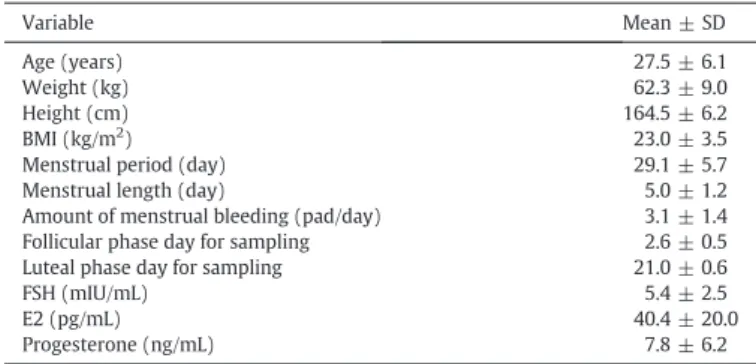
The mean age of the patients was 27.5 ± 6.1 years and the mean BMI was 23.0 ± 3.5 kg/m2. The menstrual cycle characteristics of the pa-tients' mean FSH, E2 levels in follicular phase and progesterone in luteal phase, and days of sampling are summarized inTable 1. No significant difference was found for CA 72-4 values when compared for follicular and luteal phase levels [1.15 U/mL (0.2–5.4) vs 1.15 U/mL (0.56–6.3) re-spectively; p = 0.326] (Fig. 1). The levels of CA 125 were higher in fol-licular than luteal phase of the cycle [17.4 U/mL (7–59) vs 14.6 U/mL (4.7–30.6) respectively; p b 0.001]. Seventy percent (n = 28) of the cy-cles were ovulatory. The levels of CA 72-4 did not differ also between ovulatory and anovulatory cycles [1.1 U/mL (0.8–3.7) vs 1.2 U/mL (0.2–5.4) in follicular phase respectively, p = 0.988 and 1.2 U/mL (0.6–6.3) vs 1.3 (0.7–4.7) in luteal phase, p = 0.694]. Twenty five per-cent (n = 10) of the subjects were smokers and CA 72-4 levels were similar when compared for smokers and non-smokers [1.25 U/mL (0.6–6.3) vs 1.25 U/mL (0.80–5.40), p = 0.48 in follicular phase and 1.10 U/mL (0.56–4.7) vs 1.09 U/mL (0.20–2.5), p = 0.84 in luteal phase, respectively]. There was not a significant correlation between age and CA 72-4 levels (pN 0.05). CA 72-4 values were correlated
Table 1
Demographic variables of the study population.
Variable Mean ± SD
Age (years) 27.5 ± 6.1
Weight (kg) 62.3 ± 9.0
Height (cm) 164.5 ± 6.2
BMI (kg/m2) 23.0 ± 3.5
Menstrual period (day) 29.1 ± 5.7
Menstrual length (day) 5.0 ± 1.2
Amount of menstrual bleeding (pad/day) 3.1 ± 1.4 Follicular phase day for sampling 2.6 ± 0.5 Luteal phase day for sampling 21.0 ± 0.6
FSH (mIU/mL) 5.4 ± 2.5
E2 (pg/mL) 40.4 ± 20.0
Progesterone (ng/mL) 7.8 ± 6.2
FSH: follicle stimulating hormone; E2: estradiol; BMI: body mass index.
Fig. 1. CA 72-4 values of the subjects.
71 A. Yarcı Gursoy et al. / Clinical Biochemistry 48 (2015) 70–72
with neither follicular phase FSH and E2 levels nor luteal phase proges-terone levels (pN 0.05).
Discussion
This is thefirst study in the literature evaluating the variability of CA 72-4 during the menstrual cycle. According to our results, the intra-cycle variability in serum CA 72-4 levels are low enough to per-mit random timing of CA 72-4 measurement during the menstrual cycle.
CA 72-4 is mucin like high molecular weight tumor associated anti-gen (TAG-72). This antianti-gen was characterized by using two murine monoclonal antibodies, the CC-49 and the B 72-3, both recognizing tumor associated glycoprotein TAG-72 in human serum[7]. Although, CA 72-4 has not been approved as a tumor marker by the Food and Drug Administration (FDA)[8]it is widely used in clinical practice. The potential clinical usefulness of CA 72-4 is mostly in combination with CEA and CA 19-9 in gastrointestinal cancers or with CA 125 for ovarian cancer. When CA 72-4 is used in accordance with other tumor markers, an increase in the sensitivity can be achieved without substan-tial changes in the overall specificity, improving the possibility of mon-itoring these patients[9].
Among gynecological malignancies, elevated levels of CA 72-4 were detected in ovarian mucinous cystadenocarcinoma[10], epithelial ovarian cancer[11], borderline ovarian tumors[12]and endometrium cancer[13]. Screening with serum tumor markers lacks sufficient spec-ificity for an average-risk population for ovarian cancer. For ovarian cancer, CA 125 in combination with CA72-4 and HE 4 ameliorate ef fica-cy for both diagnostic and follow up purposes[11]. If this data is sup-ported by further research, CA 72-4 mayfind wider clinical use.
Tumor markers are used in clinical practice not only for screening purposes but also to predict prognosis and recurrence of different ma-lignancies. Therefore, any factor influencing the baseline levels of a tumor marker gains significance. Up to now, some benign inflammatory conditions such as pancreatitis, cirrhosis or pulmonary diseases[14], endometriosis[15]and benign ovarian tumors have been shown to re-sult in increased CA 72-4 levels. However, the menstrual cycle variabil-ity of CA 72-4 has not been determined yet. According to the results of the current study, neither the phase of the menstrual cycle nor smoking status has an effect on CA 72-4 levels.
The previously reported cut off values for CA 72-4 measured with different laboratory techniques vary. The difference in the reported cut-off values might be due to laboratory techniques or the purpose for which CA 72-4 was intended to evaluate. The repeated evaluation of the same samples with different kits revealed quite different results for CA 72-4 compared to other cancer antigens, even in kits offered by the same manufacturers[16]. In a study in which CA 72-4 values were measured by solid-phase two-site immunoradiometric ELSA-CA72-4® assay in ovarian cancer patients, the reported cut-off value was 3 U/mL[11]; while Gadducci accepted a cut off value of 3.8 U/mL for the same patient group[17]. In the current study CA 72-4 values were studied with electrochemiluminescence immunoassay method and the cut-off value was accepted as 6.9 U/mL as reported in the kit leaflet.
Considering the narrow reference range, any small difference in cut off values might result in a greater impact reversing a‘negative’ result to‘positive’ ending up with different statistical outcomes. However, there is no consensus on the exact cut off value for the technique used and one for each malignancy in which CA 72-4 values are important. Conclusion
CA 72-4, although not a certified marker, has value to some extent, especially when combined with other markers, in the current gyneco-logical practice. Thisfirst clinical study about the menstrual cycle variability of CA 72-4 revealed that the menstrual cycle does not have a significant impact on CA 72-4 values and it can be measured at any time during the menstrual period.
References
[1] Reade CJ, Riva JJ, Busse JW, Goldsmith CH, Elit L. Risks and benefits of screening asymptomatic women for ovarian cancer: a systematic review and meta-analysis. Gynecol Oncol Sep 2013;130(3):674–81.http://dx.doi.org/10.1016/j.ygyno.2013. 06.029.
[2]Bon GG, Kenemans P, Dekker JJ, Hompes PG, Verstraeten RA, van Kamp GJ, et al. Fluctuations in CA 125 and CA 15-3 serum concentrations during spontaneous ovulatory cycles. Hum Reprod 1999;14(2):566–70.
[3]Erbağci AB, Yilmaz N, Kutlar I. Menstrual cycle dependent variability for serum tumour markers CEA, AFP, CA 19-9, CA 125 and CA 15-3 in healthy women. Dis Markers 1999;15(4):259–67.
[4]Kafali H, Artunc H, Erdem M. Evaluation of factors that may be responsible for cyclic change of CA125 levels during menstrual cycle. Arch Gynecol Obstet 2007;275(3): 175–7.
[5]Anastasi E, Granato T, Marchei G, Viggiani V, Colaprisca B, Comploj S, et al. Ovarian tumour marker HE4 is differently expressed during the phases of the menstrual cycle in healthy young women. Tumour Biol 2010;31(5):411–5.
[6]Clinical Gynecologic Endocrinology and Infertility. 8th ed. Wolters Kluwer/2011 Lippincott Willams and Wilkins; 2011.
[7]Colcher D, Horan Hand P, Teramoto YA, Wunderlich D, Schlom J. Use of monoclonal antibodies to define the diversity of mammary tumour viral gene products in virions and mammary tumours of the genus Mus. Cancer Res 1981;41(4):1451–9.
[8]Wu AHB. Tietz clinical guide to laboratory tests. 4th ed. USA: Elsevier; 2006 208–10.
[9]Guadagni F, Roselli M, Cosimelli M, Ferroni P, Spila A, Cavaliere F, et al. CA 72-4 serum marker—a new tool in the management of carcinoma patients. Cancer Invest 1995;13(2):227–38.
[10]Negishi Y, Iwabuchi H, Sakunaga H, Sakamoto M, Okabe K, Sato H, et al. Serum and tissue measurements of CA 72-4 in ovarian cancer patients. Gynecol Oncol 1993;48: 148–54.
[11]Granato T, Midulla C, Longo F, Colaprisca B, Frati L, Anastasi E. Role of HE4, CA72.4, and CA125 in monitoring ovarian cancer. Tumour Biol 2012;33(5):1335–9.
[12] Lenhard MS, Nehring S, Nagel D, Mayr D, Kirschenhofer A, Hertlein L, et al. Predictive value of CA 125 and CA 72-4 in ovarian borderline tumours. Clin Chem Lab Med 2009;47(5):537–42.http://dx.doi.org/10.1515/CCLM.2009.134.
[13]Hareyama H, Sakuragi N, Makinoda S, Fujimoto S. Serum and tissue measurements of CA72-4 in patients with endometrial carcinoma. J Clin Pathol 1996;49:967–70.
[14]Mizumoto Y, Kyo S, Takakura M, Nakamura M, Inoue M. CA72-4 (TAG72). Nihon Rinsho 2010;7:717–9.
[15]Imai A, Horibe S, Takagi A, Takagi H, Tamaya T. Drastic elevation of serum CA125, CA72-4 and CA19-9 levels during menses in a patient with probable endometriosis. Eur J Obstet Gynecol Reprod Biol 1998;78(1):79–81.
[16]Reinauer H, Wood WG. External quality assessment of tumour marker analysis: state of the art and consequences for estimating diagnostic sensitivity and specific-ity. Ger Med Sci 2005;3 [30, Doc02].
[17]Gadducci A, Cosio S, Carpi A, Nicolini A, Genazzani AR. Serum tumour markers in the management of ovarian, endometrial and cervical cancer. Biomed Pharmacother 2004;58(1):24–38.