FOREIGN DEMAND FUELS ECONOMİC GROWTH
Zümrüt İmamoğlu* ve Barış Soybilgen
†Executive Summary
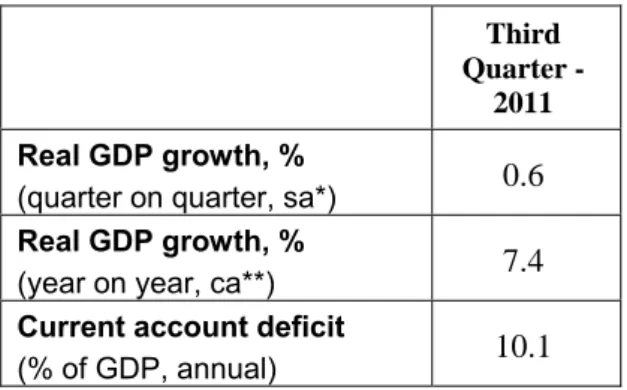
After the September data release, all third quarter economic indicators are finalized. The most profound economic development in the third quarter was the increase in exports while imports continued to fall. We believe that in the third quarter GDP growth was mostly driven by the increase in net exports. The large decline in imports of investment goods show that investment demand decreased in the third quarter. Furthermore, most of our consumption indicators are either stagnant or declining for the third quarter. Betam’s quarter on quarter forecast for third quarter is 0.6 percent and corresponding year on year growth forecast is 7.4 percent.
Growth rates of both the trade deficit and current account deficit slowed down in third quarter compared to the last quarter. However, the current account deficit to GDP ratio is still above sustainable levels. Betam’s current account forecast for the end of third quarter is 10.1 percent of GDP.
* Dr. Zümrüt İmamoğlu, Betam, Research Associate. [email protected]
†
Table 1. Betam’s quarterly and annual growth rate forecasts
Source: Betam *sa: seasonally and calendar day adjusted **ca: calendar day adjusted
Foreign demand drives GDP growth
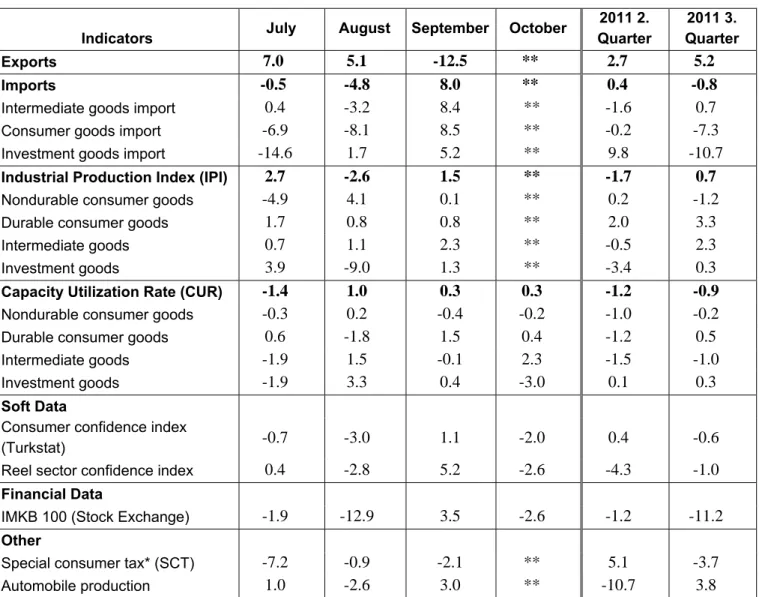
In the third quarter, industrial production index (IPI) increased by 0.7 percent, and exports increased by 5.2 percent. Interestingly resurgence of foreign demand didn’t push IPI into higher levels. We can interpret this as weak domestic demand in the third quarter. Our interpretation is further fortified by consumption indicators which were mainly stagnant or on a downward trend in the third quarter.
First signs of economic indicators for fourth quarter showed that both consumer and reel sector consumer confidence is deteriorating and financial market expectations are also negative. If we also include base effect in our analysis, it’s clear that
Third Quarter -
2011 Real GDP growth, %
(quarter on quarter, sa*) 0.6
Real GDP growth, %
(year on year, ca**) 7.4
Current account deficit
(% of GDP, annual) 10.1
Economic Outlook and Forecasts:
November 2011
growth rate of GDP in Turkey will decline sharply in the fourth quarter.
Due to high volatility in financial markets, monetary policy is now conducted on a daily basis. Phrases about “expansionary policy” has been removed from announcements of Turkish Central Bank’s (CBRT) monetary policy committee documents so we believe that CBRT will not pursue policies that will fuel domestic demand in the short run. Turkish fiscal policy seems tight. However, this tightness is not achieved by austerity measures but is mainly caused by the increase in government income. In the third quarter we believe that the contribution of government spending to GDP was positive.
Consumption increase in September & fall in October
In September, nearly all consumption indicators increased. Production of durable and nondurable consumer goods increased by 0.1 and 0.8 percent, respectively. Imports of consumer goods also increased by 8.5 percent. However, decline of consumer indicators in July and August curbed their quarterly growth. In third quarter, consumer goods imports decreased by 7.3 percent and consumer confidence fell by 0.6 percent. On the other hand, automobile production increased by 3.8 percent. In October, the government increased special consumer tax of many consumer goods and it directly affected the consumer confidence. Consumer confidence index decreased by 2 percent in October and we can expect that this fall will continue in upcoming months.
Investment declined in the 3rd quarter
Investment was on a downward trend since the beginning of third quarter. In July, investment goods imports decreased by 14.6 percent and in August investment goods production decreased by 9.0 percent. Overall, investment goods imports declined by 10.7 percent in the third quarter. In September investment indicators seem to recover a little. Real sector confidence index, imports and production of investment goods increased by 5.3, 1.3 and 5.2 percent, respectively. IPI and intermediate goods imports also increased by 1.5 and 8.0 percent respectively. However, quarterly levels of investment indicators were below second quarter. In the third quarter, we forecast that private investment declined and made a negative contribution to GDP.
Increase in exports halted in September
Figure 2 shows monthly changes of seasonally adjusted import and export volume indices. In September, exports decreased by 6.9 percent and imports increased by 8.0 percent. Despite the large decline in exports and increase in imports in September, exports increased by 5.2 percent in the third quarter from the previous quarter and imports fell by 0.8 percent. Therefore in the third quarter, we expect that contribution of net exports to quarterly GDP growth will be most important factor in the GDP growth.
Current account deficit might exceed 10 percent
In third quarter, fluctuations in trade affected current account deficit as well. In August, current account deficit declined due to high tourism income and in September, the large decline of exports and the increase of imports caused current account deficit to rise. In the third quarter, rate of increase in the current account deficit fell. Figure 4 shows the rate of increase in the current account deficit in percentage points. During the previous three quarters, current account deficit has increased by 1.4 percentage points in each quarter and in the third quarter the current account deficit increased by only 0.9 percent point. We don’t
know whether the deceleration in the current account deficit is permanent and lead to a reduction in the current account deficit eventually. However, economic slowdown and depreciation of TL enhanced these expectations. Moreover, in the fourth quarter, due to the base effect the current account deficit will decrease further. However, none of these will prevent the current account deficit to reach unsustainable levels by the end of 2011. We expect the current account deficit to be be 10.1 percent of GDP at the end of third quarter.
Table 2. Monthly and quarterly changes of Betam’s selected indicators (real and sa)
Indicators July August September October
2011 2. Quarter 2011 3. Quarter Exports 7.0 5.1 -12.5 ** 2.7 5.2 Imports -0.5 -4.8 8.0 ** 0.4 -0.8
Intermediate goods import 0.4 -3.2 8.4 ** -1.6 0.7
Consumer goods import -6.9 -8.1 8.5 ** -0.2 -7.3
Investment goods import -14.6 1.7 5.2 ** 9.8 -10.7
Industrial Production Index (IPI) 2.7 -2.6 1.5 ** -1.7 0.7
Nondurable consumer goods -4.9 4.1 0.1 ** 0.2 -1.2
Durable consumer goods 1.7 0.8 0.8 ** 2.0 3.3
Intermediate goods 0.7 1.1 2.3 ** -0.5 2.3
Investment goods 3.9 -9.0 1.3 ** -3.4 0.3
Capacity Utilization Rate (CUR) -1.4 1.0 0.3 0.3 -1.2 -0.9
Nondurable consumer goods -0.3 0.2 -0.4 -0.2 -1.0 -0.2
Durable consumer goods 0.6 -1.8 1.5 0.4 -1.2 0.5
Intermediate goods -1.9 1.5 -0.1 2.3 -1.5 -1.0
Investment goods -1.9 3.3 0.4 -3.0 0.1 0.3
Soft Data
Consumer confidence index
(Turkstat) -0.7 -3.0 1.1 -2.0 0.4 -0.6
Reel sector confidence index 0.4 -2.8 5.2 -2.6 -4.3 -1.0
Financial Data
IMKB 100 (Stock Exchange) -1.9 -12.9 3.5 -2.6 -1.2 -11.2
Other
Special consumer tax* (SCT) -7.2 -0.9 -2.1 ** 5.1 -3.7
Automobile production 1.0 -2.6 3.0 ** -10.7 3.8
Source: TurkStat. TCMB. Treasury. IMKB. Betam. All series are real (or inflation adjusted) wherever necessary and seasonally adjusted.
*This tax is collected on sales of goods such as gas. fuel oils. alcohol. tobacco products and automobiles. **Data not yet released
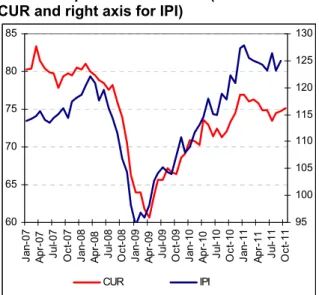
Figure 1: Capacity utilization rate and industrial production index (sa. left axis for CUR and right axis for IPI)
60 65 70 75 80 85 Ja n-07 A pr-0 7 Ju l-0 7 Oct -0 7 Ja n-08 A pr-0 8 Ju l-0 8 Oct -0 8 Ja n-09 A pr-0 9 Ju l-0 9 Oct -0 9 Ja n-10 A pr-1 0 Ju l-1 0 Oct -1 0 Ja n-11 A pr-1 1 Ju l-1 1 Oct -1 1 95 100 105 110 115 120 125 130 CUR IPI
Source : TurkStat. Betam
Figure 2: Volume indices of exports and imports (sa) 120.00 130.00 140.00 150.00 160.00 170.00 180.00 190.00 200.00 210.00 Jan-07 May -07 S ep-07 Jan-08 May -08 S ep-08 Jan-09 May -09 S ep-09 Jan-10 May -10 S ep-10 Jan-11 May -11 S ep-11 Export Import
Source : TurkStat. Betam
Figure 3: Ratio of current account deficit to Figure 4: Ratio of current account deficit to
GDP (yearly) GDP’ growth rate (QoQ, percentage point)
Source: TCMB. TurkStat. Betam * Betam’s forecasts -1.5 -1.0 -0.5 0.0 0.5 1.0 1.5 2.0 200 8( 1) 200 8( 3) 200 9( 1) 200 9( 3) 201 0( 1) 201 0( 3) 201 1( 1) 201 1( 3) 0.0 2.0 4.0 6.0 8.0 10.0 12.0 2008 (1 ) 2008 (3 ) 2009 (1 ) 2009 (3 ) 2010 (1 ) 2010 (3 ) 2011 (1 ) 2011 (3 )
Source: TurkStat. Betam September 2011 -20.00% -15.00% -10.00% -5.00% 0.00% 5.00% F ood pr oduc ts and bev erages T abac co produc ts T ex til e goods C lot hi ng goods F urs leat her and pr oduc ts Wood and co rk produc ts P aper and paper pr oduc ts C ok ing c oal , ref ine d pet . C hem ic al s P las tic and r ubber pro duc ts O ther non-m et allic m in er al p ro d. M et al indus tr y M et al produc ts (not m ac h. ) M ac hi nery and e qui pm ent E lec tr ic al m ac hi nary R adi o, t el ev is ion and c om m . M ot or v ehi cl es and t rai le rs F urni tur e and ot her pr oduc ts August 2011 -10.00% -5.00% 0.00% 5.00% 10.00% 15.00% 20.00% 25.00% 30.00% 35.00% 40.00% F ood produc ts and bev erages T abac co produc ts T ex til e goods C lot hi ng goods F urs leat her and produc ts Wood and c or k produc ts P aper and paper produc ts C ok ing c oal , r ef ined pet . C hem ic al s P las tic
and rubber produc
ts O ther non-m et al lic m iner al prod. M et al indus tr y M et al pr oduc ts ( not m ac h. ) M ac hi nery an d equi pm ent E lec tr ic al m ac hi nary R adi o, t el ev is ion and c om m . M ot or v ehi cl es and t rai le rs F ur ni ture and ot her produc ts