ISSN-L: 2501 - 1111 Available on-line at: www.oapub.org/edu
Copyright © The Author(s). All Rights Reserved.
doi: 10.5281/zenodo.937254 Volume 3 │ Issue 9 │ 2017
EQUITY IN MIDDLE SCHOOL STUDENTS’ FRACTIONAL
KNOWLEDGE: DOES SCHOOL TYPE MATTER IN TURKEY?
Utkun Aydıni , Zelha Tunç-Pekkan, Rukiye Didem Taylan, Bengi Birgili, Mustafa Özcan MEF University, Turkey
Abstract:
This study examined school type differences in fifth-grade students’ fractional knowledge with data from a university-school partnership. Students (n = 203) from a public school and a private school willing to collaborate in University within School Project participated. Results revealed that there were significant school type differences in fractional knowledge favoring private school students. Since school type differences have important impacts on the quality and equity of mathematical outcomes, we need to strongly consider the implications of these school type-related differences and pay attention particularly to the structure of schooling in public schools and the student performance in private schools.
Keywords: public schools, private schools, school type differences, middle school
students, university-school partnership
1. Introduction
‚An adequate and fair distribution of resources, programs, and teachers won’t, by itself, guarantee that disadvantaged students will learn well.‛
(Oakes, 1995, p. 86) This quota was our driving source of conducting the present research while we – as members of the Faculty/School/College of Education- worked in a disadvantaged public middle school as mathematics teachers. During one academic year, we
developed the University within School Project as a way to increase fifth-grade students’ mathematics achievement in general, and fractional knowledge, in particular. Supported by the İstanbul Provincial Directorate of National Education, the University within School partnership was a collaborative effort of the MEF University and, Beşiktaş and Sarıyer school districts to develop an overlapping network of partnering, experiencing, and mentoring relationships across Grade 5 and Grade 8 levels. This practice was the first of its kind in the Turkish context where there are not long-term opportunities of collaboration between K-12 public and private schools, and universities (Özcan, 2013). These efforts to connect theory and practice further drew our attention to the inequities associated with a range of resource issues (i.e., instructional materials, technology, school staff etc.) between public and private schools in Turkey.
A considerable body of research has been developed to explain reasons for student success in schools focusing on the school effectiveness (Amjad & MacLeod, 2014; Bassani, 2006; Liou, Marsh, & Antrop-González, 2017; Tremblay, Ross, & Berhelot, 2001; Wilms, 1996). In a related vein, researchers have been interested in answering the controversial question of whether private schools are more effective than public schools in enhancing student achievement in general (e.g., Cain & Goldberger, 1983; Coleman, Hoffer, & Kilgore, 1982; Lubienski, Lubienski, & Crane, 2008; Murnane, Newstead, & Olsen, 1985), and mathematics achievement, in particular (e.g., Entwistle & Alexander, 1992; Philips, 1997). This line of scholarly work put forth the role of school processes and climate in shaping achievement in different types of schools. For instance, many schools in the U.S. were considered to be in trouble because of underfunding, academic failure, and lack of community support (National Commission on Excellence in Education, 1983). One possible reason for this might be the fact that educational institutions were working well for a select few of students (i.e., attending to private schools located in districts with middle to high social economic status [SES]), fair for many (i.e., attending to public schools located in districts with middle SES), and not at all for most (i.e., attending to public schools located in districts with low SES). This also holds for mathematics in particular because students worldwide (Mathematical Sciences Education Board, 1989), as well as in Turkey (National Report, 2017), are routinely sorted by success or failure in mathematics achievement (Ronau, 1993). In other words, socio-economically advantaged students and schools tend to outscore their disadvantaged peers (Organisation for Economic Co-operation and Development [OECD], 2013) and that economics, income inequality, and SES become important factors in predicting differences in mathematics achievement (Jurdak, Renuka, de Freitas, Gates, & Kollosche, 2016).
While there is a strong theoretical impetus, views on the superiority of private schools is also based, in part, on past studies involving both international (e.g., Third International Mathematics and Science Study [TIMSS], Programme for International Student Assessment [PISA]) and/or national (i.e., High School and Beyond [HSB], National Assessment of Educational Progress [NAEP]) large-scale assessments. These highly respected studies showed that private school students outperform public school students in mathematics, science, and reading (OECD, 2009), in part due to the fact that private schools were more effective than public schools at boosting student achievement, even after individual socioeconomic variables were adequately were controlled for (e.g., Coleman & Hoffer, 1987). That is, after controlling for student and home background factors there appears to be little to no statistically significant school type differences in standardized test scores (OECD, 2013). Indeed, Turkey had the largest variance internationally between schools in student performance: The overall achievement gap between the lower and higher achievers was large (OECD, 2007), and that this discrepancy was attributable to the between-school variation while controlling for family background and demographic characteristics (Alacacı & Erbaş, 2010). More specifically, Günçer and Köse (1993) investigated the effects of family, SES, and school variables in explaining Turkish high school students’ performance in university entrance examination. They reported that family background and SES explained 40% (i.e., a large portion) of the variance of student performance while school quality explained only 2% (i.e., a small portion) of the variance. In this accordance, in a large-scale study, Berberoğlu and Kalender (2005) used data from PISA 2003 and University Entrance Examination 1999-2002 and investigated student performance across school types and geographical regions. They indicated that differences related to geographical regions in student performance were relatively small whereas the achievement gap was large between different school types. The particular challenge to these conclusions came from Alacacı and Erbaş’s (2010) multilevel study that sought to explain variance in students’ mathematics performances in PISA 2006 while controlling for family background and demographic characteristics. Researchers’ findings unpacked the inequality among Turkish schools indicating that 55% of the variance was attributable to between-schools (e.g., selectivity in admissions, geographical region) and the remaining 45% to within-schools (e.g., individual student characteristics). These results supported the findings of previous studies (e.g., Koçberber & Kazancık, 2010; Sarıer, 2010), which revealed [National] region was below the average of Turkey in the educational opportunities (e.g., educational investments). More specifically, findings from both national high school/university entrance examinations and international assessments showed that Turkish students from South Eastern Anatolia Region
performed below the country average scores in measures of mathematics literacy, scientific literacy, reading literacy and problem solving (Berberoğlu & Kalender, 2005; Sarıer, 2010) and that west regions (e.g., Marmara) were above the average of country in the educational opportunities as well as educational investments (Koçberber & Kazancık, 2010).
Obviously, the study of school type disparity in performances based on student assessments has assumed an increasing importance (Lubienski & Lubienski, 2006; Mahuteau & Mavromaras, 2014). This can be grounded on the fact that these attempts have many implications for equity in mathematics education where equity is defined as ‚being unable to predict mathematics achievement and participation based solely upon student characteristics such as race, class, ethnicity, sex, beliefs, and proficiency of language” (Gutiérrez, 2002, p. 9). In the literature, particular attention is given to equity in mathematics education (see Journal for Research in Mathematics Education for the March 2013 special issue), which seems to have a relevant influence on the student achievement outcomes, treatment of students, and students’ access to educational resources (National Council of Teachers of Mathematics [NCTM], 2008). From this perspective, important features of equity include equity in students’ mathematics achievement outcomes that can be established by closing the achievement gap among various groups (Lubienski, 2008; Yetkiner Özel, Özel, & Thompson, 2013).
The majority of studies have investigated equity in terms of differences in academic achievement (e.g., Gee, 2015; Gong, Ding, & Tsang, 2014; Grant & Sleeter, 1986; Halai, 2011; Han, 2016) or mathematics performance (Hanna, 1996; Githua & Mwangi, 2003; Masland, 1994; Pangei, 2014) associated with gender. Equity research employing school type differences in mathematical learning outcomes (e.g., fractional knowledge) that in a sense mirror the discrapencies between public and private schools remain surprisingly sparse (see Bishop & Forgasz, 2007; Leder, 1992; Secada, 1995). Questions remain regarding general mathematics performance amongst students in different types of schools (i.e., private and public) and it is unclear whether the extent of particular fractional knowledge possessed by middle school students vary by the type of school that they attend.
Clearly, achieving equity in the schools is very difficult for particularly in Turkish mathematics classrooms. For instance, although the mathematics curriculum itself does not vary, there are differences in the way mathematics is implemented. In Turkey, owing to the greater resources of private schools in financial and physical terms, mathematics education in private schools is much more effective, which is evidenced by a number of studies (e.g., Cinoglu, 2006). Similarly, international studies documented that private schools affected better mathematical outcomes than did public
schools (Coleman, Kilgore, & Hoffer, 1981; Coleman & Hoffer, 1997; Jimenez, Lockheed, & Paqueo, 1991). However, more recent studies showed that mathematics achievement in public schools was slightly higher than that in private schools (Braun, Jenkins, & Gregg, 2006; Driessen, Agirdag, & Merry, 2016; Lubienski & Lubienski, 2006). Although most research strongly suggests that there are school type differences in mathematics achievement, there has been little progress in explaining these differences with respect to skills acquired through association with a particular content such as fractional knowledge. Few studies (Hallett, Nunes, & Bryant, 2010; Hallett, Nunes, Bryant, & Thorpe, 2012) attempted to explain grade level differences in conceptual and procedural knowledge while learning fractions. Researchers indicated that the existence of such differences could result from students’ school experiences which reflect differences across teaching practices, and in turn, knowledge of fractions.
The purpose of the present study was to explore school type differences in students’ fractional knowledge by using data from a university-school partnership, University within School. The main research question was ‚Is there a significant difference between the mean scores of fifth-grade students attending public and private schools in fractional knowledge?‛
This study is important because it documents the student outcomes in fractional knowledge that are possible and lead to improved mathematical practice for all students. Mathematics teachers and mathematics teacher educators can use our small piece of finding to support the development of fractional knowledge among public school students that undergirds partnership approaches that been documented to be as effective in improving student learning outcomes (e.g., Aydın, Tunç-Pekkan, Taylan, Birgili, & Özcan, in press).
2. Methodology
The present study was conducted within a university-school partnership during 2014-2015 academic year. The University within School Partnership (Özcan, 2013), involved collaborative efforts of the MEF University and two school districts – Beşiktaş and Sarıyer – to develop an overlapping network of partnering, experiencing, and mentoring relationships across middle grade levels (Grades 5-8) (see Aydın, Tunç-Pekkan, Taylan, Birgili, & Özcan, 2016; Taylan, Tunç-Tunç-Pekkan, Aydın, Birgili, & Özcan (2016); and Tunç-Pekkan, Taylan, Birgili, Aydın, & Özcan (2016)16) for details of that partnership).
2.1. Participants
The fifth-grade students who participated in the study were from two school districts in İstanbul, Turkey. All Grade 5 classes (n = 10) available at the time of the study were selected from one public (n = 5; School A) and one private (n = 5; School B) school. The public school students contained 108 students (57 females and 51 males) and the private school students contained 95 students (43 females and 52 males). Schools were nonrandomly selected based on the criteria that the school administrations were willing to participate in the partnership.
In Turkey, 4 + 4 + 4 Education System has been implemented since 2012-2013 academic year. Along the 12 years of schooling, students attend to primary (Grades 1-4), middle (Grades 5-8), and high (Grades 9-12) school. There are no requirements (i.e., national exams) for the transition from primary to middle school.
Within the transition from primary to middle school, students make a school choice between public and private schools. Public schools accept students with regard to their place of residence. Because of such educational policies, parents of students in public schools cannot choose or exert influence over which schools their children attend. Private schools provide an alternative for parents who 1) are dissatisfied with the conditions of public schools, 2) can afford the tuition charged, and 3) receive financial aid. Some private schools are selective in their admissions, while others are not. Various foundation schools accept students according to the results of standardized exams conducted by their measurement and evaluation departments. To be accepted to public schools students are required neither to take level determination exams nor to pay tuition.
It is also noteworthy that the same educational curriculum (Ministry of National Education [MoNE], 2013) is implemented for each subject (e.g., Mathematics) in both public (n= 15858) and private (n= 1111) schools. However, there are some differences concerning the school policies and classroom practices. For instance, in public schools classroom size is large and students are exposed to the traditional method of instruction. This teacher-centered instruction stressed drill-and-practice on the board and review of the topic. In contrast, the methods of instruction implemented in small size classrooms in private schools allow for making sense of information, questioning, thoughtful investigating, and/or individual development of understanding.
2.2. Instrument
The Fractions Test (FT) was developed by the researchers to measure students’ fractional knowledge (Aydın et al., in press). The test was constructed in light of the Fraction Scheme Theory (Steffe & Olive, 2010) as well as the objectives of fractions unit
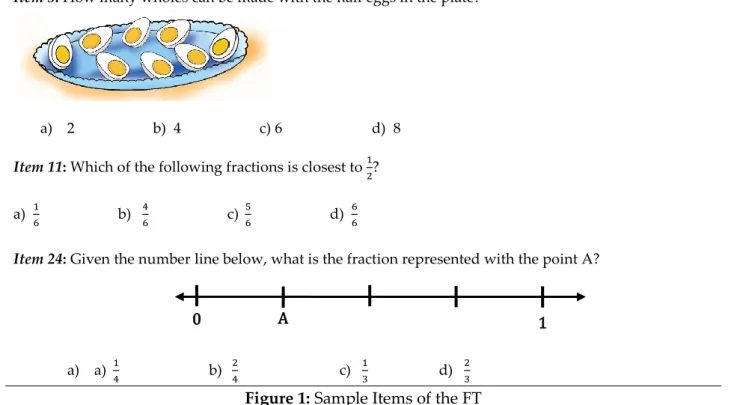
in the middle school mathematics program (MoNE, 2013). The FT contained 32 multiple-choice items (see Fig. 1 for sample items). The KR-20 reliability coefficient was .80. Each item was scored either 0 (incorrect) or 1 (correct). The possible scores on the FT ranged from 0 to 32. The total testing time was 40min.
2.3. Data sources and analysis
The data sources for the study included the scores for the FT. We chose the independent samples t-test for data analysis, using school type as the grouping variable. Independent samples t-test is a robust statistical technique for comparing the mean scores of two different groups of subjects or two different conditions (Pallant, 2001). Besides, it is appropriate for testing continuous data and dealing with small sample sizes (Frankel & Wallen, 2003). Four steps were taken in investigating the overarching research question of whether there was a significant difference in the mean fractional knowledge scores for public school students and private school students. In a preliminary analysis step (Step 1), the information about the groups (public and private school students) was checked. In Step 2, assumptions were checked based on the results of the Levene’s Test for Equality of Variances. In Step 3, school type differences were assessed based on the results of the t-test for Equality of Means. Finally, in Step 4, effect size (eta squared, ) was calculated to provide an indication of the magnitude of the differences between public and private school students. Statistical analyses were performed with IBM SPSS 21.0 (SPSS, 2012).
Item 3: How many wholes can be made with the half eggs in the plate?
a) 2 b) 4 c) 6 d) 8
Item 11: Which of the following fractions is closest to ?
a) b) c) d)
Item 24: Given the number line below, what is the fraction represented with the point A?
a) a) b) c) d)
Figure 1: Sample Items of the FT
1 A
3. Results
Table 1 reports the results of the group statistics including the mean and standard deviations of FT scores for the public and private school students (Step 1). Results revealed that private school students (M= 25.02, SD= 5.26) outperformed public school students (M= 15.73, SD= 6.21) in fractional knowledge. More specifically, the mean score of students in the private school was 9.2 points above the mean score of students in the public school. This implied that private school students were more able to build a relationship between the halves and the whole (see Item 3 in Fig. 1), compare fractions using the half as a benchmark (see Item 11 in Fig. 1), and/or identify fractions represented by a point on the number line (see Item 24 in Fig. 1).
Table 1: Means and Standard Deviations of the Scores for the
Public School and Private School Students
Table 2 summarizes the results of the Independent Samples t-test including Levene’s Test for Equality of Variances and t-test for Equality of Means. Before analyzing the Independent Samples t-test for public and private school students, a preliminary assumptions check was done to investigate whether the variation of FT scores for both groups is the same (Step 2). Results of the Levene’s Test yielded a significance value of .06 (p> .05) indicating that the variances of FT scores were the same across the two groups and that the assumption was not violated. Accordingly, equal variances were assumed leading us to investigate the differences between public and private schools (Step 3).
Results of the t-test for Equality of Means showed that there was a significant difference in the mean FT scores of the public school and private school students, t(201)= 11.41, p= .00 (two-tailed), with private school students receiving higher scores than public school students.
Group Public School (N = 108) Private School (N = 95)
M SD M SD
Fractional Knowledge 15.73 6.21 25.02 5.26
Table 2: Independent Samples t-Test Levene’s Test for
Equality of Variances t-Test for Equality of Means F p t df p Mean Difference Fractional knowledge 3.33 .069 11. 41 201 .00* 9.29
Note. Total scores = 32.
*p < .05.
To check the magnitude of the mean difference (Step 4), eta squared was calculated (Cohen, 1988). Results revealed that the magnitude of the differences in the mean FT scores (M= 9.2) was very large ( = .39). This implied that 39% of the variance in fifth-grade students’ fractional knowledge can be explained by school type differences.
4. Discussion
All findings of this work lead to the conclusion that, in the beginning of the middle school, an achievement gap in fractional knowledge exists: Fifth grade students enrolled in private school were more able to, for instance, locate fractions on the number line, identify equivalent fractions, and solve fraction word problems.
With respect to differences by content domain, several studies illustrated that mathematics shows the most relevant differences in favor of private schools (e.g., Coleman & Hoffer, 1997). The current analysis of Turkish data supported these findings, which are particularly important in relation to the fact that private schools have more resources to implement different instructional methods (e.g., computer assisted learning) and perspectives (e.g., better discipline). Because the use of fruitful approaches relates to academic achievement, we certainly could expect that private school students would do better in mathematics than public school students.
Additionally, parents who send their students to private schools have sufficient financial affordance and value their children’s schooling highly. The resulting enthusiasm should bring about higher scores for private than for public school students. To reduce the disparity between schools, educational policy makers can improve mathematics curriculum that provides every student with the opportunity to acquire core mathematical skills within appropriate time regardless of school type. Future researchers could conduct longitudinal studies to understand the reasons that led to the disparity between different types of schools. For instance, Masino and Niño-Zarazúa (2016) identified the first driver of change that improves the quality of student
learning as the provision of additional material and human resources (i.e., supply-side elements of education). We agree that the mere provision physical and human resources is ineffective at improving education quality. Instructional designers could develop mathematics programs that prompt family (e.g., establish regular, meaningful communication between home and school) and community (e.g., organize fairs) involvement. Additionally, universities and schools should work together to upgrade students’ academic achievement in general and mathematics achievement in particular. Furthermore, when university-school partnerships actively involve family and engage community resources they are able to respond more effectively to the needs of students. Based on our experiences during the implementation of University within School Project, we believe that such partnerships would result in sharing and maximizing resources and that they would help students in adapting well to school, attending school more regularly, having better social skills, having better relationships with their parents. Besides, university-school partnerships might link community activities to the classroom and improve students’ school-related behaviors (e.g., reduce suspension rates).
We are aware of the fact that conducting univariate hypothesis tests - independent samples t-test (i.e., a simple form of analyzing data (Pallant, 2011) to compare groups) - is not enough for explaining differences among students associated with personal (e.g., gender) or institutional (e.g., school type) variables. As mentioned in previous sections, however, throughout the implementation of the University within School Project we conducted various quantitative (e.g., Aydın et al., 2016) and qualitative (e.g., Taylan et al., 2016; Tunç-Pekkan et al., 2016) studies and observed that public school students were able to show improvement when they were given the opportunity to be taught in more effective ways (e.g., Aydın et al., in press). These observations honestly reflected that we went after our curiosity: Does school type really matter? From an educational perspective, we sought to investigate whether two schools – one public and one private –, which were our volunteers during the first two years of the project differed in terms of students’ fractional knowledge. From a methodological perspective, on the other hand, we took this critical first step for our future research agenda as it opened a window of opportunity for understanding school type differences in middle school students’ fractional knowledge.
As Turkey moves forward in its efforts to reform education generally, mathematics education particularly (Aydagül, 2006; Education Reform Initiative [ERG], 2012), and equity in education/mathematics education (ERG, 2009, 2014) as well, the University within School Project described above is a critical example of how academicians are breaking the longstanding barriers of access to schools with particular
emphasis on the school type differences that the present findings brought on the scene. To conclude, from a Turkish perspective, if equity in education, particularly equity in mathematics education (ERG, 2009, 2014), continues to be viewed as appropriate and necessary for all students, movement toward a curriculum that is inclusive is possible (ERG, 2016).
Acknowledgements
An earlier version of this article was presented at the European Conference on Educational Research (ECER), 22-25 August 2017, in Copenhagen, Denmark.
References
1. Alacacı, C., & Erbaş, A. K. (2010). Unpacking the inequality among Turkish schools: Findings from PISA 2006. International Journal of Educational Development, 30(2), 182-192.
2. Amjad, R., & MacLeod, G. (2014). Academic effectiveness of private, public and private–public partnership schools in Pakistan. International Journal of Educational Development, 37, 22-31.
3. Aydagül, B. (2006). Education: An Overarching ‘Acquis’ for Turkey. Turkish Policy Quarterly, 5(1), 93-103.
4. Aydın, U., Tunç-Pekkan, Z., Taylan, R. D., Birgili, B., & Özcan, M. (in press). Impacts of a university-school partnership on middle school students' fractional knowledge. The Journal of Educational Research.
5. Aydın, U., Birgili, B., Tunç-Pekkan, Z., Taylan, R. D., & Özcan, M. (2016). Improving fifth grade students’ fractional knowledge through university-school partnership. Presentation at the American Educational Research Association Meeting. April 8-12, Washington, DC, USA.
6. Bassani, C. (2006). A test of social capital theory outside of the American context: family and school social capital and youth’s math scores in Canada, Japan and the United States. International Journal of Educational Research, 45(6), 380–403. 7. Berberoglu, G., & Kalender, I. (2005). Investigation of student achievement across
years, school types and regions: the SSE and PISA analyses. Educational Sciences and Practice, 4(7), 21–35.
8. Bishop, A., & Forgasz, H. (2007). Issues in access and equity in mathematics education. In F. Lester (Ed.), Second handbook of research on mathematics teaching and learning. Charlotte: Information Age Publishing.
9. Braun, H., Jenkins, F., & Grigg, W. (2006). Comparing private schools and public schools using hierarchical linear modeling (NCES 2006-461). U.S. Department of Education, National Center for Education Statistics, Institute of Education Sciences. Washington, DC: U.S. Government Printing Office.
10. Cain, G. G., & Goldberger, A. S. (1983). Public and private schools revisited. Sociology of Education, 56(4), 208-218.
11. Cinoglu, M. (2006). Private education as a policy tool in Turkey. International Education Turkey, 7(5), 676-687.Cohen, J. (1988) Statistical power analysis for the behavioral sciences (2nd ed.) Hillsdale, NJ: Erlbaum.
12. Coleman, J. S., & Hoffer, T. (1987). Public and private high schools: The impact of communities. New York: Basic.
13. Coleman, J., Kilgore, S., & Hoffer, T. (1981). Public and private high schools. Washington, D.C.: National Center for Educational Statistics.
14. Driessen, G., Agirdag, O., & Merry, M. S. (2016). The gross and net effects of primary school denomination on pupil performance. Educational Review, 68(4), 1-15.
15. Education Reform Initiative *Eğitim Reformu Girişimi ERG+. (2017). Eğitim İzleme Raporu 2015-2016 [Education monitoring report 2015-2016]. Retrieved July 18, 2017, from http://www.egitimreformugirisimi.org/egitim-izleme-raporu-2015-16/.
16. Education Reform Initiative *ERG+. (2016). Türkiye’de kapsayıcı eğitimi yaygınlaştırmak için politika önerileri *Policy recommendations to promote
education in Turkey]. Retrieved July 18, 2017, from
http://www.egitimreformugirisimi.org/kapsayici-egitimin-durumu-ve-oneriler-2/.
17. Education Reform Initiative *ERG+. (2014). Türkiye eğitim sisteminde eşitlik ve akademik başarı. *Equity and academic achievement in Turkish education system]. http://www.egitimreformugirisimi.org/turkiye-egitim-sisteminde-esitlik-ve-akademik-basari/.
18. Education Reform Initiative [ERG]. (2012). Türkiye PISA 2012 Analizi: Genel Bulgular ve eğilimler. *Turkey PISA 2012 Analysis: General findings and trends+. http://www.egitimreformugirisimi.org/turkiye-pisa-2012-analizi-genel-bulgular-ve-egilimler/.
19. Education Reform Initiative *ERG+. (2009). Türkiye’de öğrenci başarısında eşitsizliğin belirleyicileri. *Determinants of inequality in student achievement]. http://www.egitimreformugirisimi.org/yayin/turkiyede-ogrenci-basarisinda-esitsizligin-belirleyicileri/.
20. Entwisle, D. R., & Alexander, K. L. (1992). Summer setback: Race, poverty, school composition, and mathematics achievement in the first two years of school. American Sociological Review, 72-84.
21. Frankel, J. R., & Wallen, N. E. (2003). How to design and evaluate research in education (5th ed.). New York: Mcgraw- Hill.
22. Gee, K. A. (2015). Achieving gender equality in learning outcomes: Evidence from a non-formal education program in Bangladesh. International Journal of Educational Development, 40, 207-216.
23. Githua, B. N., & Mwangi, J. G. (2003). Students’ mathematics self-concept and motivation to learn mathematics: relationship and gender differences among Kenya’s secondary-school students in Nairobi and Rift Valley provinces. International Journal of Educational Development, 23(5), 487-499.
24. Gong, X., Ding, Y., & Tsang, M. C. (2014). Gender differences of academic performance in compulsory education in rural Southwestern China. International Journal of Educational Development, 39, 193-204.
25. Grant, C. A., & Sleeter, C. E. (1986). Race, class, and gender in education research: An argument for integrative analysis. Review of Educational Research, 56(2), 195-211.
26. Gutiérrez, R. (2002). Enabling the practice of mathematics teachers in context: Toward a new equity research agenda. Mathematical Thinking and Learning, 4(2&3), 145-187.
27. Günçer, B., & Köse, M. R. (1993). Effects of family and school on Turkish students’ academic performance. Education and Society, 11(1), 51-63.
28. Halai, A. (2011). Equality or equity: Gender awareness issues in secondary schools in Pakistan. International Journal of Educational Development, 31(1), 44-49. 29. Hallett, D., Nunes, T., & Bryant, P. (2010). Individual differences in conceptual
and procedural knowledge when learning fractions. Journal of Educational Psychology, 102(2), 395–406.
30. Hallett, D., Nunes, T., Bryant, P., & Thorpe, C. M. (2012). Individual differences in conceptual and procedural fraction understanding: The role of abilities and school experience. Journal of Experimental Child Psychology, 113(4), 469-486.
31. Han, S. W. (2016). National education systems and gender gaps in STEM occupational expectations. International Journal of Educational Development, 49, 175-187.
32. Hanna, G. (Ed.) (1996) Towards gender equity in mathematics education: An ICMI study. Dordrecht: Kluwer Academic Publishers.
33. Jimenez, E., Lockheed, M.E., & Paqueo, V. (1991). The relative efficiency of private and public schools in developing countries. The World Bank Research Observer, 6(2), 205-218.
34. Jurdak, M., Vithal, R., de Freitas, E., Gates, P., & Kollosche, D. (2016). Economic factors behind mathematics education. In G. Kaiser (Ed.), Social and political dimensions of mathematics education (pp. 23-29). Springer.
35. Koçberber, G., & Kazancık, L. (2010). A novel approach towards the examination of educational opportunities at primary schools. Hacettepe University Journal of Education, 38, 165–176.
36. Leder, G. C. (1992). Mathematics and gender: Changing perspectives. In D. A. Grouws (Ed.), Handbook of research on mathematics teaching and learning (pp. 597– 622). New York: Macmillan.
37. Liou, D. D., Marsh, T. E., & Antrop-González, R. (2017). Urban sanctuary schools for diverse populations: Examining curricular expectations and school effectiveness for student learning. Equity & Excellence in Education, 50(1), 68-83. 38. Lubienski, S. T. (2008). On ‚gap gazing‛ in mathematics education: The need for
gaps analyses. Journal for Research in Mathematics Education, 39(4), 350-356.
39. Lubienski, S.T., Lubienski, C., & Crane, C. C. (2008). Achievement differences and school type: The role of school climate, teacher certification and instruction. American Journal of Education, 115 (1), 97-138.
40. Lubienski, S. T., & Lubienski, C. (2006). School sector and academic achievement: A multilevel analysis of NAEP mathematics data. American Educational Research Journal, 43(4), 651-698.
41. Mahuteau, S., & Mavromaras, K. G. (2014). Student scores in public and private schools: Evidence from PISA 2009. IZA Discussion Paper No. 8471. Retrieved from SSRN: http://ssrn.com/abstract=2505333
42. Masino, S., & Niño-Zarazúa, M. (2016). What works to improve the quality of student learning in developing countries?. International Journal of Educational Development, 48, 53-65.
43. Masland, S. W. (1994). Gender equity in classrooms: The teacher factor. Equity & Excellence in Education, 27(3), 19-27.
44. Mathematical Sciences Education Board [MSEB]. (1989). Even/body counts: A report to the nation on the future of mathematics education. Washington, DC: Mathematical Sciences Education Board, National Research Council.
45. Ministry of National Education (MoNE) (2013). Ortaokul Matematik Dersi Öğretim Programı (5, 6, 7 ve 8. Sınıflar) *Middle School Mathematics Program
(Grades 5, 6, 7 and 8)]. Retrieved from http://ttkb. meb.gov.tr/www/ogretim-programlari/icerik/72.
46. Murnane, R. J., Newstead, S., & Olsen, R. J. (1985). Comparing public and private schools: The puzzling role of selectivity bias. Journal of Business & Economic Statistics, 3(1), 23-35.
47. National Commission on Excellence in Education. (1983). A nation at risk. Washington, DC: Government Printing Office.
48. National Council of Teachers of Mathematics [NCTM]. (2008). Equity in
mathematics education. Retrieved from
http://www.nctm.org/about/content.aspx?id=13490
49. Oakes, J. (1995). Opportunity to learn: Can standards-based reform be equity-based reform. In I. M. Carl (Ed.), Seventy-five years of progress: Prospects for school mathematics (pp. 78-98). Reston, VA: NCTM.
50. OECD. (2007). PISA 2006: Science competencies for tomorrow’s world (Vol. 1: Analysis & Vol. 2: Data). Paris: OECD Publishing.
51. OECD. (2009). PISA 2006 technical report. Paris: OECD Publishing.
52. OECD. (2013). PISA 2012 results: What makes schools successful? Resources, policies and practices (Vol. IV). Paris: OECD Publishing.
53. Özcan, M. (2013). Okulda Üniversite: Türkiye’de öğretmen eğitimini yeniden yapılandırmak için bir model önerisi. *University within School: A new model to re-structure teacher education in Turkey+. Ankara: TÜSİAD Yayınları *TÜSİAD Publications].
54. Pallant, J. (2001). SPSS survival manual. Buckingham, UK: Open University Press. 55. Pangeni, K. P. (2014). Factors determining educational quality: Student
mathematics achievement in Nepal. International Journal of Educational Development, 34, 30-41.
56. Phillips, M. (1997). What makes schools effective? A comparison of the relationships of communitarian climate and academic climate to mathematics achievement and attendance during middle school. American Educational Research Journal, 34(4), 633-662.
57. Ronau, R. N. (1993). Excellence and equity in mathematics: Not a Zero-Sum relationship. Equity & Excellence in Education, 26(3), 48-50.
58. Sarıer, Y. (2010). An evaluation of equal opportunities in education in the light of high school entrance exams (OKS-SBS) and PISA results. Ahi Evran University Journal of Education, 11(3), 107-129.
59. Secada, W. G. (1995). Social and critical dimensions for equity in mathematics education. In W. G. Secada, E. Fennema, & L. B. Adajian (Eds.), New directions for
equity in mathematics education (pp. 146–164). Cambridge, England: Cambridge University Press.
60. SPSS (2012). IBM SPSS Statistics for Windows, Version 21. Boston, Mass: International Business Machines Corporation.
61. Steffe, L. P., & Olive, J. (2010). Children's fractional knowledge. New York: Springer. 62. Taylan, R. D., Tunç-Pekkan, Z., Aydın, U., Birgili, B., & Özcan, M. (2016). Influence of a number line based model of instruction on 5th grade students’ use of mathematical language during clinical interviews. National Council of Teachers of Mathematics, Research Conference, April 11-13, San Fransisco, USA. 63. Tremblay, S., Ross, N., & Berhelot, J. M. (2001). Factors affecting grade 3 student
performance in Ontario: a multi-level analysis. Education Quarterly Review, 7(4), 25–36.
64. Tunç-Pekkan, Z., Taylan, R. D., Birgili, B., Aydın, U., & Özcan, M. (2016). Academicians as teachers: Nurturing teacher experience. 13th International Congress on Mathematics Education (ICME). July 24-31, Hamburg, Germany. 65. Willms, J. D. (1996). Indicators of mathematics achievement in Canadian
elementary schools. In: HRDC (Eds.), Growing up in Canada: National longitudinal study of children and youth. Human Resources Development Canada and Statistics Canada, Ottawa, Ontario, pp. 69–82.
66. Yetkiner O zel, Z. E., O zel, S., & Thompson, B. (2013). SES-related mathematics achievement gap in Turkey compared to European Union countries. Education and Science, 38(170), 179–193.
Creative Commons licensing terms
Author(s) will retain the copyright of their published articles agreeing that a Creative Commons Attribution 4.0 International License (CC BY 4.0) terms will be applied to their work. Under the terms of this license, no permission is required from the author(s) or publisher for members of the community to copy, distribute, transmit or adapt the article content, providing a proper, prominent and unambiguous attribution to the authors in a manner that makes clear that the materials are being reused under permission of a Creative Commons License. Views, opinions and conclusions expressed in this research article are views, opinions and conclusions of the author(s). Open Access Publishing Group and European Journal of Education Studies shall not be responsible or answerable for any loss, damage or liability caused in relation to/arising out of conflicts of interest, copyright violations and inappropriate or inaccurate use of any kind content related or integrated into the research work. All the published works are meeting the Open Access Publishing requirements and can be freely accessed, shared, modified, distributed and used in educational, commercial and non-commercial purposes under a Creative Commons Attribution 4.0 International License (CC BY 4.0).