1 Dumlupınar University Faculty of Medicine, Department of Internal Medicine, Kütahya, Turkey 2 Kadirli State Hospital, Central Laboratory of Medical Biochemistry, Osmaniye, Turkey
Yazışma Adresi /Correspondence: Fatih Şahpaz,
Dumlupınar University Faculty of Medicine, Department of Internal Medicine, Kütahya, Turkey Email: [email protected] ORIGINAL ARTICLE / ÖZGÜN ARAŞTIRMA
Assessment of mean platelet volume in type 2 diabetics receiving insulin or oral
antidiabetic agents
İnsülin veya oral anti diyabetik ilaç alan tip 2 diyabetli hastalarda ortalama trombosit
hacminin değerlendirilmesi
Fatih Şahpaz1 Kemal Türker Ulutaş2
ÖZET
Amaç: Artmış Ortalama Trombosit Hacmi (OTH), Diabe-tes Mellitus (DM) hastalarında yaygın vasküler kompli-kasyonlarla yakından ilişkilidir. Bu çalışma OTH ile insulin tedavisi alan veya oral hipoglisemik tedavi alan hastaları kıyaslamayı amaçlamaktadır.
Yöntemler: Çalışmaya randomize olarak seçilen 300 hasta 100 kişilik üç gruba ayrıldı: oral hipoglisemik tedavi alan grup-1, insulin tedavisi alan DM grup-2 ve non-DM sağlıklı grup-3. Tüm hastalardan açlık kan şekeri, HbA1c ve OTH ve biyokimya değerleri retrospektif olarak değer-lendirildi.
Bulgular: Çalışma sonucu OTH değerlerinin Tip 2 DM olan hastalarda artmış olduğu göstermiştir ve oral antidi-yabetik tedavi alan hastalarda, insulin tedavisi alan has-talara göre daha yüksek olarak saptanmıştır. OTH değeri grup 1’de (oral hipoglisemik tedavi alan) 10.07±0.7fl, grup 2’de (İnsülin tedavisi alan) 9.01±0.6fl ve kontrol grubunda 8.15±0.8fl olarak tespit edildi.
Sonuç: Çalışma sonucu DM hastası olgularda vasküler hastalık olasılığını tahmin etmek için OTH basit ve dü-şük maliyetli-etkin bir tanı aracı olarak kullanılabileceğini düşündürmektedir. Tip 2 diyabet doğrulanmış olgularda insulin tedavisinin erken başlanması sadece kan şekeri düzeyini kontrol etmede yardımcı olmaz; aynı zamanda OTH seviyesini düşük tutarak yaklaşan vasküler olayların olma olasılığını önlemeye yardımcı olabilir.
Anahtar kelimeler: Ortalama trombosit hacmi, tip 2 di-abetes mellitus, insülin tedavisi, oral hipoglisemik ilaçlar ABSTRACT
Objective: Increased mean platelet volume (MPV) is a known risk factor for various acute vascular complica-tions, which is commonly associated with patients with diabetes mellitus (DM). This study was aimed to investi-gate the association of MPV, Type 2 DM and to know the difference of MPV in patients on oral hypoglycemic drugs and insulin therapy.
Methods: A total of 300 patients were selected and al-located to three subgroups with 100, as DM Group on insulin therapy, DM Group on oral hypoglycemic therapy and non-DM Group (Negative control Group). Investiga-tions like fasting blood glucose, HbA1c and MPV were performed. The results of patient values were evaluated retrospectively.
Results: Results of the study showed that patients with type 2 DM have increased in the MPV. Oral antidiabetic treatment in patients MPV, was found to be higher com-pared to patients treated with insulin. The mean MPV in Group 1 (on oral hypoglycemic treatment) was 10.07±0.7 fl, in Group 2 (on Insulin therapy) 9.01±0.6 fl and in the controls Group 8.15±0.8 fl.
Conclusion: The outcome of study has shown that val-ues of MPV are increased in patients with, Type 2 DM and are significantly higher in those patients on oral hy-poglycemic therapy than patients on insulin therapy. MPV is a simple and cost-effective tool which can be explored for predicting the possibility of vascular events in patients suffering from diabetes mellitus. Early initiation of insulin treatment in confirmed cases of Type 2 diabetics not only helps in controlling blood glucose level but also helps in keeping MPV low and thereby preventing possibility of im-pending vascular events.
Key words: Mean platelet volume, type 2 diabetes mel-litus, insulin therapy, oral hypoglycemic drugs
INTRODUCTION
Diabetes mellitus (DM) is a health problem in the world [1,2]. According to estimates of the World Health Organization, there were 382 million people suffering from diabetes worldwide in 2014. The in-creased platelet activity is emphasized to play a role in the development of vascular complications of DM [3]. Diabetic patients have an increased risk of developing micro and macro vascular disease, and platelets may be involved as a causative agent with respect to altered platelet morphology and function [4,5]. The large platelets contain more dense gran-ules, are more potent than the smaller ones, and are hence more thrombogenic. Both the size and num-ber of granules in platelets in circulation are under independent hormonal control and do not change during the life span of the platelet [6,7].
Increase in Mean Platelet Volume (MPV) has been documented in patients with DM, metabolic syndrome and stroke [8]. MPV, a determinant of platelet function, is a newly emerging risk factor for atherothrombosis. Many studies have shown that increased MPV is one of the risk factors for cere-bral ischemia, myocardial infarction and transient ischemic attacks [9,10]. Platelet volume, a marker of the platelet activation and function, is measured as MPV by hematology analyzers. Cardiovascular complications are associated with MPV and HBA1c in patients with type 2 DM [11]. Altered platelet function and morphology have been reported in pa-tients with DM, and MPV was found to be higher in diabetic patients [12,13]. This study was aimed to investigate the association of MPV, DM and to know the difference of MPV in patients on oral hy-poglycemic drugs and insulin therapy.
METHODS
This is a retrospective study conducted over a pe-riod of one year (from January 2013 to January 2014). The study was done on diabetic patients. Di-agnosis of DM was established using the American Diabetes Association 2003 criteria of fasting blood glucose (FBG) of ≥ 126 mg/dL on two occasions. There was no significant difference among the sub-groups for demographic characteristics of study participants, including age, body mass index (BMI) and diabetes duration. A total of 300 subjects were
selected randomly and allocated to three Groups of 100 patients each, referred to as DM Group on oral hypoglycemic therapy (Group 1) DM Group on insulin therapy (Group 2), non-DM Group (Group 3-healthy control Group). All of the patients were using oral hypoglycemic therapy of sulfonylureas and metformin. All of the patients were treated with insulin is treated with insulin aspart + insulin aspart protamine.
Inclusion criteria
Confirmed cases of Type 2 DM, who are on oral hypoglycemic treatment since at least 6 months. Confirmed cases of Type 2 DM, who are on insulin therapy since at least 6 months.
Exclusion criteria
• Cases of Type 1 DM.
• Patients with abnormal platelet counts (thrombo-cytopenia/thrombocytosis).
Female patients below 12 gm%, male patients with hemoglobin below 13 gm% and were excluded from the study because nutritional anemia can be a cause for reactive thrombocytosis and hence, in-creased MPV. Nondiabetic subjects with diabetics and coronary artery disease on antiplatelet drugs such as clopidogrel and acetylsalicylic acid were also excluded. Subjects with any diagnosed malig-nancy were also excluded. Subjects having acute post streptococcal glomerulonephritis and idiopath-ic thrombocytopenidiopath-ic purpura, cardiac disease such as cyanotic congenital heart diseases and myocar-dial infarction were excluded [14]. Investigations like FBG, HbA1c, platelet count and MPV were performed.
MPV was analyzed by an automatic blood counter (Abbott Cell Dyn 3200 Hematology Ana-lyzer, Diamond Diagnostics, MA, USA). Venous blood samples were collected in hemogram tubes with dipotassium EDTA and biochemistry tubes, and tested within 1 hour of collection to minimize variations due to sample aging. Samples were main-tained at room temperature. HbA1c was measured by automated ion-exchange high performance liq-uid chromatography (Bio-Rad Variant II, Hercules, CA), serum glucose by hexokinase enzymatic
Statistical Analysis
Mean and Standard Deviations (SD) were calcu-lated for age and MPV for all the three homoge-nous Groups separately. Kolmogorov-Smirnov test groups homogeneity of views, the groups were ho-mogeneous. Difference between the means of age, MPV and the gender between the three Groups and within three Groups were calculated by ANOVA (analysis of variance) using Tukey’s HSD (Hon-estly Significant Difference) test. P-value and Con-fidence intervals were also calculated. p<0.05 was considered as statistically significant. Correlation analysis was specifically evaluated in MPV. Statisti-cal analysis was done by using SPSS 16 (SPSS Inc., Chicago, IL, USA).
RESULTS
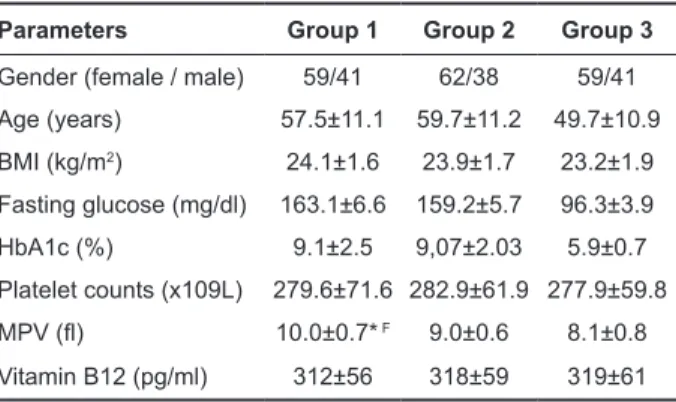
The study included 120 (40%) males and 180 (60%) females. Group 1 included 41 (41%) males and 59 (59%) females. Group 2 included 38 (38%) males and 62 (62%) females. Group 3 included 41 (41%) males and 59 (59%) females. The mean age of the diabetic population on oral therapy was 57.5±11.1 years, patients on insulin therapy was 59.7±11.2 years, whereas that of nondiabetic control Group was 49.7±10.9 years. The mean duration of diabetes was 6.5±6.24 years.
Table 1. Clinical and laboratory parameters in study groups
Parameters Group 1 Group 2 Group 3
Gender (female / male) 59/41 62/38 59/41
Age (years) 57.5±11.1 59.7±11.2 49.7±10.9 BMI (kg/m2) 24.1±1.6 23.9±1.7 23.2±1.9 Fasting glucose (mg/dl) 163.1±6.6 159.2±5.7 96.3±3.9 HbA1c (%) 9.1±2.5 9,07±2.03 5.9±0.7 Platelet counts (x109L) 279.6±71.6 282.9±61.9 277.9±59.8 MPV (fl) 10.0±0.7* F 9.0±0.6 8.1±0.8 Vitamin B12 (pg/ml) 312±56 318±59 319±61
For MPV: F P <0.05 versus control group, *P <0.05 versus
group 2
Abbreviations: BMI: body mass index; MPV: mean plate-let volume
Comparison of MPV values for the 3 Groups showed statistically significant intergroup differ-ence (p<0.05). The mean BMI in the diabetic group 1
was 24.1±1.6 kg/m2, diabetic Group 2 was 23.9±1.7
kg/m2, Group 3 was 23.2±1.9 kg/m2 (p=0.321). The
mean HbA1c level in the diabetic Group 1 was 9.13±2.53 %, diabetic Group 2 was 9.07±2.03%, as compared to 5.95±0.723 % of the nondiabetic group3 (p<0.001). The mean FBG in the diabetic group 1 was 163.17±6.6 mg/dL, diabetic Group 2 was 159.21±5.7 mg/dL, and in non-diabetic Group 3 was 96.32±3.9 mg/dL. Vitamin B12 level in the diabetic group 1 was 312±56 pg/ml, diabetic Group 2 was 318±59 pg/ml, as compared to 319±61 pg/ml of the nondiabetic group 3.
DISCUSSION
In our study, the diabetic group had higher MPV than the nondiabetic subjects. In our study, MPV was higher in diabetics with oral hypoglycemic treatment than in diabetics with insulin therapy. There was also a significant association between in-sulin therapy and MPV. This study showed that in DM, MPV is increased and it is indicative of wors-ening glycemic control. Insulin by achieving good glycemic control and thereby keeping MPV low is playing some role in preventing vascular complica-tions.
DM is a complex syndrome characterized by chronic hyperglycemia responsible for complica-tions affecting the peripheral nerves, kidneys, eyes, macro and micro vascular systems. Diabetes affects more than 300 million patients in the world with morbidity and mortality worldwide. It was detected that prevalence of diabetes in Turkish population was reached to 13.7% according to TURDEP II study [15].
The prevalence of diabetic micro and macro vascular complications is higher in people with poor glycemic control, longer duration of DM. A large proportion of patients with Type 2 DM suffer from preventable vascular complications. There is a need to develop risk factor modification interventions to reduce the impact of long-term complications [16]. Study by Kodiatte et al., showed that in DM, their MPV is increased and platelets become more reac-tive. The increased platelet size may be one factor in the increased risk of atherosclerosis associated with diabetes mellitus and associated vascular compli-cations. Hence, MPV could be a useful prognostic
biomarker of cardio-vascular complications in dia-betes [17].
MPV is an indicator of the average size and activity of platelets. Larger platelets are young-er, more agreeable and reactive. So, they con-tain denser granules, secrete more serotonin and β-thromboglobulin, and produce more thromboxane A2 than smaller platelets [14, 18, 19]. All these can produce a pro-coagulant effect and cause thrombot-ic vascular complthrombot-ications. This suggests a relation-ship between the platelet function especially MPV and diabetic vascular complications thus indicating changes in MPV reflect the state of thrombogen-esis [14, 20]. There might be small bleeds due to the rupture of atherothrombotic plaques leading to increased platelet recruitment, hyper reactivity, and bone marrow stimulation. High MPV is emerging as a new risk factor for the vascular complications of DM of which atherothrombosis plays a major role [21]. Thus, DM has been considered as a “pro-thrombotic state” with increased platelet reactivity [22]. Diabetic patients are known to have higher incidence of myocardial infarction and stroke [23]. Another important finding in our study was presence of significantly higher MPV in patients with DM as compared to non-diabetic subjects. Therefore, it may be concluded that glycemic control improves platelet activity and function and may prevent or de-lay possible diabetic vascular complications. In pre-vious studies, it was shown that MPV increased in diabetic populations [24, 23]. Study by Vernekar et al., showed that in DM values of MPV are increased in patients with uncontrolled Type 2 DM, and are significantly higher in diabetic patients treated with oral hypoglycemic therapy than in those patients on insulin therapy [25, 26]. In our study, the diabetic group had higher MPV than the nondiabetic sub-jects. In our study, MPV was significantly higher in diabetics with oral hypoglycemic treatment than in diabetics with insulin therapy. There was also a significant association between insulin therapy and MPV. Vernekar and our results showed that early initiation of insulin treatment in confirmed cases of Type 2 diabetics not only may help in controlling blood glucose level but also may help in keeping MPV low and thereby preventing possibility of im-pending acute vascular events.
This study showed that in DM, MPV is in-creased and it is indicative of worsening glycemic control. The increased platelet size may be one of the factors in the increased risk of atherosclerosis associated with DM and associated micro and macro vascular complications. We found that it increased the MPV increased HbA1c value. We propose that MPV could be used as a simple and cost-effective test to monitor the progression of DM and thereby in preventing vascular injuring primary health care. Early initiation of insulin treatment in confirmed cases of Type 2 diabetics not only helps in control-ling blood glucose level but also helps in keeping MPV low and thereby preventing possibility of im-pending vascular events.
In conclusion, increased platelet size may be one factor in the increased risk of atherosclerosis as-sociated with diabetes mellitus and asas-sociated vas-cular complications. Hence, MPV would be a useful prognostic marker of cardio-vascular complications in diabetes. Early initiation of insulin treatment in confirmed cases of Type 2 diabetics not only helps in controlling blood glucose level but also helps in keeping MPV low and thereby preventing possibil-ity of impending vascular events.
REFERENCES
1. Mahsud MAJ, Khan A, Hussain J. Hematological changes in tobacco using type 2 diabetic patients. Gomal J Med Sci 2010;8:8-11.
2. King H, Aubert RE, Herman WH. Global burden of diabetes, 1995-2025: prevalence, numerical estimates, and projec-tions. Diabetes Care1998;21:1414-1431.
3. Demirtunc R, Duman D, Basar M, et al. The relationship between glycemic control and platelet activity in type 2 diabetes mellitus. J Diabetes Complications 2009;23:89-94. 4. Hekimsoy Z, Payzinb B, Ornek T, et al. Mean platelet vol-ume in Type 2 diabetic patients. J Diabetes Complications 2004;18:173-176.
5. Zuberi BF, Akhtar N, Afsar S. Comparison of mean platelet volume in patients with diabetes mellitus, impaired fast-ing glucose and non-diabetic subjects. Sfast-ingapore Med J 2008;49:114-116.
6. Chamberlain KG, Tong M, Chiu E, et al. The relationship of human platelet density to platelet age: platelet popula-tion labeling bymonoamine oxidase inhibipopula-tion. Blood 1989; 73:1218-1225.
7. Martin J. The relationship between megakaryocyte ploidy and platelet volume. Blood Cells 1989;15:108-121.
8. Tavil Y, Sen N, Yazici HU, et al. Mean platelet volume in patients with metabolic syndrome and its relationship with coronary artery disease. Thromb Res 2007;120:245-250. 9. Khandekar MM, Khurana AS, Deshmukh SD, et al.
Plate-let volume indices in patients with coronary artery disease and acute myocardial infarction: an Indian scenario. J Clin Pathol 2006;59:146-149.
10. O’Malley T, Langhorne P, Elton RA, et al. Platelet size in stroke patients. Stroke 1995;26:995-999.
11. Bock G, Dalla Man C, Campioni M, et al. Pathogenesis of pre-diabetes: mechanisms of fasting and postprandial hy-perglycemia in people with impaired fasting glucose and/or impaired glucose tolerance. Diabetes 2006;55:3536-3549. 12. Papanas N, Symeonidis G, Maltezos E, et al. Mean platelet
volume in patients with type 2 diabetes mellitus. Platelets 2004; 15:475-478.
13. Hekimsoy Z, Payzin B, Ornek T, et al. Mean platelet vol-ume in Type 2 diabetic patients. J Diabetes Complications 2004; 18:173-176.
14. Kim KY, Kim KE, Kim KH. Mean platelet volume in the normal state and in various clinical disorders. Yonsei Med J 1986;27:219-226.
15. Satman I, Yilmaz T, Sengul A, et al. The TURDEP Group. Population-based study of diabetes and risk characteristics in Turkey: results of the Turkish diabetes epidemiology study (TURDEP). Diabetes Care 2002;25:1551-1556. 16. Khuwaja AK, Rafique G, White F, et al. Macrovascular
complications and their associated factors among persons with Type 2 diabetes in Karachi, Pakistan-a multi-center study. J Pak Med Assoc. 2004;54:60-66.
17. Kodiatte TA, Manikyam UK, Rao SB, et al. Mean Plate-let Volume in Type 2 Diabetes Mellitus, J Lab Physicians 2012;4:5-9.
18. Colwell JA, Nesto RW. The platelet in diabetes-focus on pre-vention of ischemic events. Diabetes Care 2003;26:2181-2188.
19. Chang HA, Hwang HS, Park HK, et al. The role of mean platelet volume as a predicting factor of asymptomatic cor-onary artery disease. Korean J Fam Med 2010;31:600-606. 20. Bae SH, Lee J, Roh KH, et al. J. Platelet activation in pa-tients with diabetic retinopathy. Korean J Ophthalmol 2003;17:140-144.
21. Zuberi BF, Akhtar N, Afsar S. Comparison of mean platelet volume in patients with diabetes mellitus, impaired fast-ing glucose and non-diabetic subjects. Sfast-ingapore Med J 2008;49:114-116.
22. Jindal S, Gupta S, Gupta R, at al. Platelet indices in diabetes mellitus: indicators of diabetic microvascular complica-tions. Hematology 2011;16:86-89.
23. Arauz-Pacheco C, Parrott MA, Raskin P. The treatment of hypertension in adult patients with diabetes. Diabetes Care 2002;25:134-147.
24. Jabeen F, Fawwad A, Rizvi HA, et al. Role of platelet indi-ces, glycemic control and hs-CRP in pathogenesis of vas-cular complications in type-2 diabetic patients. Pak J Med Sci 2013;29:152-156.
25. Vernekar PV, Vaidya KA. Comparison of mean platelet vol-ume in type 2 diabetics on insulin therapy and on oral hy-poglycaemic agents. J Clin Diagn Res 2013;12:2839-2840. 26. Yenigün EC, Okyay GU, Pirpir A, et al. Increased mean
platelet volume in type 2 diabetes mellitus. Dicle Tıp Der-gisi 2014;41:17-22.