THE REPUBLIC OF TURKEY
BAHCESEHIR UNIVERSITY
THE EFFECT OF HEDONIC SHOPPING
VALUES AND PRICE IN DIFFERENT AGE,
GENDER AND INCOME GROUPS FOR MOBILE
PHONE
Master Thesis
AHMET KOÇAK
THE REPUBLIC OF TURKEY
BAHCESEHIR UNIVERSITY
GRADUATE SCHOOL OF SOCIAL SCIENCES
MA in MARKETING
THE EFFECT OF HEDONIC SHOPPING
VALUES AND PRICE IN DIFFERENT AGE,
GENDER AND INCOME GROUPS FOR MOBILE
PHONE
Master Thesis
AHMET KOÇAK
Thesis Supervisor : PROF.DR. SELİME SEZGİN
THE REPUBLIC OF TURKEY BAHCESEHIR UNIVERSITY
GRADUATE SCHOOL OF SOCIAL SCIENCES MA in MARKETING
Name of theThesis: The Effect Of Hedonic Shopping Values And Price Between Different Age,Gender And Income Groups For Mobile Phone Name/Last name of the Student : Ahmet Koçak
Date of the Defense of Thesis: 02.01.2013
Thethesis has been approved by the Graduate School of ____________.
Yrd.Doç.Dr.BurakKÜNTAY Director of the Graduate School of SocialSciences
I certify that this thesis meets all the requirements as a thesis for the degree of MA in Marketing.
Dr.Selcuk Tuzcuoglu
This is to certify that we have read this thesis and we find it fully adequate in scope, quality and content, as a thesis for the degree of MA in Marketing.
Examining Comittee Members Signature
Thesis Supervisor
Prof. Dr. Selime Sezgin --- Member
Yrd.Doç.Dr. Caner Giray --- Member
ACKNOWLEDEGMENT
I come to the end of my master degree program that I started in 2009. During my study, I would like to thank my advisor Bilgi University, Prof. Dr. Selime Sezgin, from whom I learned every aspects of marketing deeply, of whom I am proud of being my consultant,
I would like to thank also Bahcesehir University, Yrd.Doc.Dr. Gulberk Gultekin Salman, and Yrd.Doc.Dr. Caner Giray for their comments, orientation, advices. I would like to thank also Yıldız Technical University, Assoc. Prof. Dr. Gülhayat Gölbaşı, who helped me for all my statistical analysis,
I would like to thank also my dear friend Hatice Akbaş, who helped me for all the statistical comments,
And I would like to thank my wife, Merve Koçak, who motivated me to study within the master program, and who supported me to write my thesis every time.
ABSTRACT
THE EFFECT OF HEDONIC SHOPPING VALUES AND PRICE ON DIFFERENT AGE, GENDER, INCOME GROUPS FOR MOBILE PHONE
PRODUCT
Ahmet Koçak MA in Marketing
Thesis Supervisor : Prof.Dr.Selime Sezgin
January, 2013, 44 pages
In today’s marketing, consumer understanding became extremely important. Consumption attains a different dimension because of developing areas of technology, communication and informatics. The marketeers try to recognize consumer behaviour and they try to make products and marketing programs according to consumer’s needs so they can make consumers more satisfied. For successful marketing plan, the targeting audience should be examined and analysed. Consumers not only do shopping to satisfy their needs but they also try to enjoy the shopping act. In this context hedonic consumption concept looms large. However consumers make their shoppings under the hedonic feelings, their decisions are also affected by the price.
The purpose of this study is to determine the effect of price and hedonic shopping value in terms of different gender, age and income groups for mobile phone product. In the end of the research, while there is no significant difference in gender groups, there is significant difference in age groups.
Keywords : Consumption, Hedonic Consumption, Consumer Behaviour, Hedonic
ÖZET
HEDONIK TÜKETİM DEĞERLERİ VE FİYATIN CEP TELEFONU ÜRÜNÜNDE FARKLI YAŞ, CİNSİYET VE GELİR GRUPLARINDA ETKİSİ
Ahmet Koçak MA in Marketing
Tez Danışmanı : Prof.Dr.Selime Sezgin
Ocak, 2013, 44 sayfa
Günümüz pazarlamasında, tüketiciyi anlama çok önemli hale geldi. Teknoloji, iletişim ve bilişimin gelişmesiyle tüketim farklı boyutlar kazandı. Pazarlamacılar tüketici davranışlarını tanımaya çalışırlarken, aynı zamanda tüketicileri daha fazla tatmin edebilmek için onların ihtiyaçlarına uygun pazarlama programları ve ürünler geliştirmeye çalışmaktalar. Başarılı bir pazarlama planı için hedef kitle iyi analiz edilmeli ve incelenmeli. Tüketiciler sadece ihtiyaçları için değil, aynı zamanda keyif almak içinde alış veriş yaparlar. Bu aşamada, hedonik tüketim kavramı olduğundan daha da büyük bir hal alıyor. Tüketiciler hedonik duyguları altında alışveriş yapsalarda kararlarını fiyattan etkileniyor.
Bu çalışmanın amacı cep telefonu ürününde farklı yaş ve cinsiyet gruplarında hedonik tüketim değerleri ile fiyatın etkisini ölçmektir. Çalışma sonunda cinsiyet grupları arasında önemli bir fark çıkmasada, farklı yaş gruplarında önemli farklar ortaya çıkmıştır.
Anahtar Kelimeler : Tüketim, Hedonik Tüketim, Tüketici Davranışı, Hedonik
TABLE OF CONTENTS
1. INTRODUCTION...…...………...………….………1
2. LITERATURE REVIEW…...…..………...…………..2
2-1 CONSUMER BEHAVIOR.………...………2
2-1-1 What is Consumer Behavior………2
2-1-2 TheFactorsEffects Consumer Behavior.………….3
2-1-3 Types of Consumer BuyingDecisions…..…………4
2-1-3-1 Extensive Problem Solving………..4
2-1-3-2 Limited Problem Solving………....4
2-1-3-3 Routinized Problem Solving………...5
2-1-4 Consumer Purchase Decision Process.………….…...5
2-2 HEDONISM………....………7
2-2-1Hedonism And Hedonic Consumption……….…...7
2-2-2TheStructure Of HedonismAnd Its Features……….8
2-2-3 What is Consumption………11
2-2-4 Hedonism , Product Symbolism and Shopping Motivation...12
2-2-5 Multisensory Aspect Of Hedonic Consumption...15
2-2-6 Ubiquity Of Hedonic Consumption..………...17
2-2-6-1Mental Constructs………..17
2-2-6-2 Product Classes……….…………..…18
2-2-6-3 Product Usage……….18
2-2-6-4 Individual Differences………18
2-2-7 Gender Differences In Hedonic Consumption……18
2-2-8 HedonismAnd Cultural Influence……….20
2-2-9 The Relationship Between Price And Hedonic Shopping Value…...………....20
2-3 CONCLUSION………....……..………….……….….21
3. RESEARCH METHODOLOGY………...…..…...22
3-1 AIM OF THE RESEARCH………...………...22
3-2 RESEARCH MODEL………22
3-3 SURVEY DATA COLLECTION …………..…………...………22
3-4 DEMOGRAPHIC CHARACTERISTIC OF THE SAMPLE...23
4-1 FACTOR ANALYSIS……….……….………..24
4-2RELIABILITY RESULTS OF THE RESEARCH FINDINGS.27 5. DISCUSSION, IMPLICATIONS AND SUGGESTIONS FOR FUTURE RESEARCH……….34
5.1 DISCUSSION………...34
5.2 IMPLICATIONS………...35
5.3 LIMITATIONS………...36
5.4 SUGGESTIONS FOR FUTURE RESEARCH ………...36
5.5 REVISED RESEARCH MODEL……….37
6. CONCLUSION……….…....………...…..…...38
FIGURE LIST
Figure2.1 : General Consumer Behavioral Model………...3
Figure 2.2 : The Series Of Consumer Problem Solving………...4
Figure2.3 : Consumer Decision Process Model...5
Figure2.4 : Logical Flow Model Of Consumer Buying Behavior...10
Figure2.5 :Enviromental Inputs And Hedonic Consumption ………...11
Figure2.6 :Consumption Event...11
Figure2.7 : Products With Different Weightings...14
Figure2.8 : Hierarchy Of Consumer Emotions...16
Figure 3.1 : Research Model………22
Figure 4.1 : KMO and Barlett’s Test .………...…………26
Figure 4.2 : Total Variance Explained………...26
Figure 4.3 : Rotated Component Matrix……….………...27
Figure 4.4 : Research Reliability.……….……27
Figure 4.5 : Reliability For Price Sensitivity….………....28
Figure 4.6 : Reliability For Price Mavenism………...……...28
Figure 4.7 : Reliability For Value Consciousness……....…………...29
Figure 4.8 : Reliability For Price Consciousness………...29
Figure 4.9 : Mann-Whitney Test-Gender Group.………....30
Figure 4.10 : Mann-Whitney Test-Marital Status Group…………...31
Figure 4.11 : Age Groups ZScores……….………...32
Figure 4.12 : Income Groups ZScores………..…………...33
1. INTRODUCTION
What do consumers get from a shopping experience? Some people may be satisfiedonly if they purchase what they had planned; however, others enjoy emotions such as fun and excitement as well as the actual purchase. Babin, Darden, and Griffin (1994) suggested that value is provided by the complete shopping experience, not simply by product acquisition, and they posited two dimensions of shopping values; hedonic and utilitarian. Hedonic shopping value can be defined as shopping’s potential entertainment and emotional worth, whereas utilitarian value reflects shopping with a work mentality. (Babin et al. 1994).
Price is the most important cue consumers use in their decision making. One of the research on price cues regards price as a unidimensional cue (Alsamdan 1996; Chang&Wildt 1996). It is important to consider whether consumers’ price perceptions can arouse hedonic shopping value. So in this study it was studied whether hedonic consumption behavior is changing between different age, gender and income groups for mobile phone under price cues/dimensions such as price consciousness, price mavenism, value consciousness and price sensitivity. For example, people may experience excitement when they pay a high price for mobile phone.
After determining 4 dimensions, all questions were prapared for hedonic consumption. And the survey was given to 315 people mainly in Istanbul/Turkey. And it was tested in May of 2012.
2. LITERATURE REVIEW
2.1
CONSUMER BEHAVIOR
2.1.1 What is Consumer Behavior
Consumer behavior is one of the basic issues for marketing. The aim of marketing is tosatisfy the needs and demands of consumers. To be able to do this the first thing need to be done is to analyze consumer behavior. Without understanding the consumer behavior or knowing the consumer it is impossible to determine needs and demands and also the variables that motivates them. Therefore marketing helps how consumers choose, buy and use products and services.
Marketeers should always analyze the needs, choice and the shopping behaviors of the target consumers and in accordance with that knowledge they should make strategic decisions. For long term period success of the marketing strategies it is very important to understand exactly the behavior of consumers.
Consuming is a process that all of us do in our daily life. We buy products and consume them. We also consume things that we have. Consuming is not just about product, we can consume services also. For example, regarding one course that we get in the university, we get information from the professor while he/she is teaching something; in other words we consume this service. We buy products according to our needs, preferences and buying power. What, how, where, when we buy,how much quantity we buy could be definition of our behavior as a consumer. Actually consumer behavior is defined as process of decision-making and physical activity involved in acquiring, evaluating, using and disposing of goods and services.¹This definition brings out that it is not just the buying of goods and services that get attention in consumer behavior but, the process starts much before the goods have been got or bought.
Consumer behavior depends on perception of consumer, self-concept, social and cultural 1background and consumers` age and family cycle, consumers` attitudes, personality, motivation, values, beliefs, social class and many other factors that are both external and internal. Consumer behavior is complex, multidimensional,and dynamic process, and all marketing decisions are based on assumptions about consumer behavior. Marketing process or marketing strategies starts with the needs
of the customer and ends with their satisfaction. Therefor marketeers should and try to understand the needs of different consumers and having understood their different behaviors which require an in-depth study of their internal and external environment, they formulate their plans for marketing. In fact marketers try to know each consumer and his/her needs and behaviors, so they can use strategies to be successful. Because as we know all of the consumers are different from each other and each of them act based on their intent of buying. Buying process starts first in the mind of the consumer, which leads to the finding of alternatives between products that can be acquired with their relative advantages and disadvantages. To be able to understand the consumer deeply, extensive consumer research studies are being conducted. These researches try to find out:
a. Thoughts of the consumers thinks of the companies’ products and those of its competitors?
b. How can the product be improved in their opinion? c. How the customers use the product?
d. The customers attitude towards the product and its advertising. e. The role of the customer in his family
2.1.2 The Factors Effecting Consumer Behavior
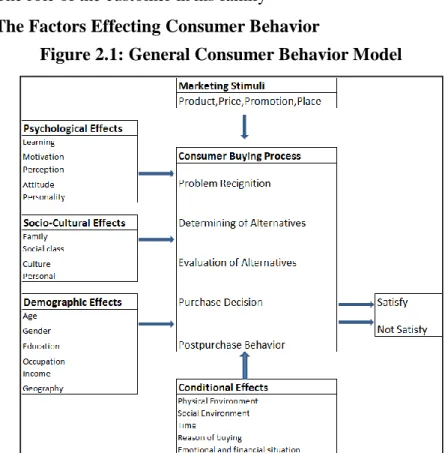
Figure 2.1: General Consumer Behavior Model
Source: Yavuz Odabaşı ve Gülfidan Barış,2002,Tüketici Davranışı, İstanbulKapital Medya A.Ş.,2.Baskı,s.50
Consumer behavior is process of decision-making and physical activity involved in acquiring, evaluating, using and disposing of goods and services as shown in Figure 2.1. Analyzing this process and activities we can learn the facts that effect the consumer behavior. So we can understand and evaluate the consumers easily. The main factors that effect the consumer buying behavior are cultural, social, personal, psychological.2A simple model of consumer behaviour, is presented in Figure 2.1. In this model, several aspects related to stimuli and consumer decision process are integrated.
2.1.3 Types of Consumer Buying Decisions
The process of consumer decision making can be different in every situtation and time. There are different levels in consumer decision making as shown in Figure 2.2. While the quickness of the decision made, and the information to be neededwere considered, the consumer makes decisions using the alternatives such asextensive, limited, and routinized decision making.
2.1.3.1 Extensive Problem Solving
This is valid when the product is new and the information is limited. It is the situation facing of the consumer when the product is important, expensive, rarely bought or never bought before. An example can be given, if the consumer buys the mobile phone the first time. In that case the consumer need more information and time. The consumer doesn’t know any brand, thinks more, spends more time, tries to get as much information as he can. He evaluates all alternatives one by one carefully. (Solomon&Michael R. 1996)
2http://www.newagepublishers.com/samplechapter/000160.pdf)
Figure 2.2: The Series Of Consumer Problem Solving
2.1.3.2 Limited Problem Solving
This is where the customer has had some experience of buying a particular type of product or service before. There is less risk attached and less information is required. The purchaser try to put minimal effort for making the decision as to which is the best and most efficient way to satisfy their need and want, but they feel as if their purchase ethics is an over exhausting process.3
2.1.3.3 Routinized Problem Solving
This type of behaviour is most ordinary where the purchaser has a lot of experience on how to address the need or want, and has known subsequent knowledge on the product itself. The consumer can buy different brand just for changing and make use of discounts. He doesn’t consider his motives and different brand choices. Therefore he doesn’t have problem to make decisions. For example choosing gas station, stationary etc. This type of purchasing is used when the interest is less, without thinking, without searching, and without spending time. (Solomon&Michael R. 1996)
2.1.4 Consumer Purchase Decision Process
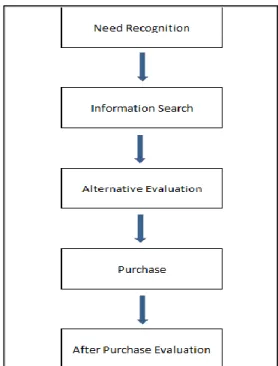
Consumer behaviour is defined as the process of decision-making and physical activity involved in getting, evaluating, consuming and disposing of goods and services as shown in Figure 2.3.
3http://www.helium.com/items/2021306-behaviour-problem-solving-business-marketing-strategy
Figure 2.3: Consumer Decision Process Model
Consumer behaviour is dynamic, multidimensional and complex process, and all marketing decisions shoulb be made on assumptions about consumer behaviour. Marketing strategy is the game plan which the firms must stick to, to be able to outrun the competitor or the plans to achieve the planned and desired objective.In formulating the marketing strategy, for selling the product effectively, cost-benefit analysis must be undertaken.4
There can be many benefits of a product and the benefits or needs change from person to person, for example, for owning a motor bike one can be looking for ease of comfort, transportation, pleasure, status, and feeling of ownership. The cost is the amount of money paid for the bike, the cost of gasoline,parking, maintenance, risk of injury in case of an accident, pollution and frustration such as traffic jams. The customer value is formed with the difference between this total cost and benefit. The idea is to provide excellent customer value and this requires the formulation of a marketing strategy. The entire process consists of market analysis, which leads to target market selection, and then to the formulation of strategy by juggling the 4P, so that a total product (a set of entire characteristics) can be offered. The total product creates an image in the mind of the consumer, with that consumer undergoes a decision process that leads to the result in terms of satisfaction or dissatisfaction, which reflects on the sales and image of the product or brand.5
The process of decision-making is composed of a series of steps which the consumerundergoes. First, the decision is made to solve a problem of any type. This may be the problem of creating a cool atmosphere in the home.For this, information search is carried out. This leads to the assesment of alternatives and a cost analysis is made to decide which product and brand image will be suitable, and can take care of the problem adequately and suitably.Then the purchase is made and the product is used. The continual use of the product leads to the satisfaction or dissatisfaction.If satisfaction occurs then consumer buy the product again otherwise the product or brand is rejected. 6
4http://tr.scribd.com/doc/86758643/Consumer-Behaviour 5http://www.newagepublishers.com/samplechapter/000160.pdf 6http://www.newagepublishers.com/samplechapter/000160.pdf
2.2 HEDONISM
2.2.1Hedonism And Hedonic Consumption
‘Hedonism’ derives from the Greek word ‘hedone’, meaning pleasure.7
The central thesis of hedonism isthat the natural objective of human life is to attain pleasure, considered as the highest good, and to avoid pain. There have been many different views of pleasure some involving a hierarchy of different pleasures. In British philosophy, the hedonistic current is linked to utilitarianism. Utilitarianism was described by Bentham as "the greatest happiness principle".(Bentham J. 1789) That is, the moral worth of an action is determined only by its resulting outcome. Because it is widely believed that, if something is good, you have reason to bring about as much of it as possible.
In general it can be mentioned that there are 2 types of hedonism. Psychological and philosophical. According to philosophical approach to reach the satisfaction at the highest level is the goal of everybody. A person works for this. In psychological approach hedonism can be explained by motivation. The human being works to reach the things that he/she enjoys or is satisfied with. He/she tends to act for his/her pleasure and works for it.
Theories of hedonism can be divided into two different types. Psychological hedonists claim that all agents act for the sake of their individual greater pleasure. Normative hedonists hold that all agents have reason to maximize pleasure, either their own or that of all sentient creatures.(Hills A.)
Psychological egoism is the case that people always act selfishly, to foster their own self-interest or happiness. Psychological hedonism is the claim that people always act to acquire their own pleasure and avoid pain. Psychological hedonism is called also “pleasure principle.” 8
Hedonism can be conjoined with psychological egoism - the theory that humans are motivated only by their self interest - to make psychological hedonism: a purely descriptive claim which states that agents naturally seek pleasure. Hedonism can also be combined with ethical egoism - the claim that individuals should seek their own good - to make ethical hedonism the claim that we should act so as to produce our own pleasure.
7http://en.wikipedia.org/wiki/Hedone
However, hedonism is not necessarily related to egoism. The utilitarianism of John Stuart Mill is sometimes classified as a type of hedonism, as it judges the morality of actions by their consequent contributions to the greater good and happiness of all. This is altruistic hedonism. Whereas some hedonistic doctrines propose doing whatever makes an individual happiest (over the long run), Mill promotes actions which make everyone happy.9
The degree of hedonism can differ in terms of person, society, and circumstances. But the main issue is accepted as to get the pleasure or the satisfaction to top level. In stead of patient and adjourned satisfaction, quick and immediate satisfaction are dominant. (Y.Odabaşı 2006)
One of the things that we should bear in mind is that the hedonic consumption is related with wants and not should. It is also related with desire not with willpower. On the other hand it is in touch with heart and not mind (Shiv, B. Fedorikhin, A. And Nowlis,S. 2005). Imagine a person who is thinking about whether to study for an upcoming exam or go to a party. She may want to go to the party but feel that she should work towards her exam instead. This person is faced with a classic heart versus mind conflict. Although working for the exam has long-term benefits, it has little immediate appeal. On the other hand, going to the party is immediately attractive but may compromise future academic success. I think we can also consider it as a decision between ego and superego.
2.2.2 The Structure Of Hedonism And Its Features
The hedonistic modern consumption structure is based on the beginning of romantic consumption in 18th century in West European, especially in England. The disciplines search for the consumption and the consumer and the researches in this area posits that modern consumer does not show just mental and economic consumption behavior. The consumer, consumes under the influence of motives and feelings. (Y.Odabaşı 2006)
Hoolbrook investigated the effects of romantism and sentimentality through purchasing behavior. He mentioned that the model below is not enough for romantism.
Romantism ==== Hedonism ==== Demand of Consumer === Purchasing Behavior He explained this model below;
Romantism === Experience === Emotional Reaction === Pleasure
According to this for consumption experience romantism is looked for, and for emotional reaction the experience should be realized, and pleasure occurs.
In general the goods can be divided into two groups; luxury goods and necessarry goods. In a less technical sense, to imply that luxuries are consumed primarily for hedonic pleasure while necessities are required to meet more utilitarian goals (Dubois, Laurent, and Czellar 2004). The word luxury is derived from Latin luxus, meaning excess. Luxuries are therefore objects of desire that provide a condition of abundance, pleasure, ease and comfort. Necessities, on the other hand, are objects that relieve an unpleasant state of discomfort (Berry, C. 1994). Psychologists have discussed the extent, to which luxuries are less important than necessities in terms of a hierarchy of needs (Maslow). This is consistent with how economists define luxuries as goods whose income elasticity of demand is positive, while necessities are goods whose income elasticity of demand is negative (Deaton A.,Muellbauer J.1980)
Hedonic goods are multisensory and provide for experiential consumption, fun, pleasure, and excitement.Corresponding necessities and getting pleasure are not the same. Flowers, designer clothes, music, sports cars, luxury watches, and chocolate fall in this category. Utilitarian goods, on the other hand, are primarily instrumental and their purchase is motivated by functional product aspects. Examples are microwaves, detergents, minivans, home security systems, or personal computers (Dhar Ravi and Wertenbroch Klaus 2000). Both utilitarian and hedonic consumption are discretionary and the difference between the two is a matter of degree or perception. That is, in comparison to utilitarian consumption, hedonic consumption may be perceived as relatively more discretionary (Okada,E.M. 2005). Different products can be high or low in both hedonic and utilitarian attributes at the same time. In fact, most evaluations in our consumption profile are based on the degree, to which various alternatives satisfy utilitarian and hedonic goals (Batra,R.,&Ahtola,O. 1990). A person evaluating a pair of sneakers may care for both functional features (e.g., durability) as well as hedonic features (e.g., design). Usage and consumption motives are central in determining whether an item is
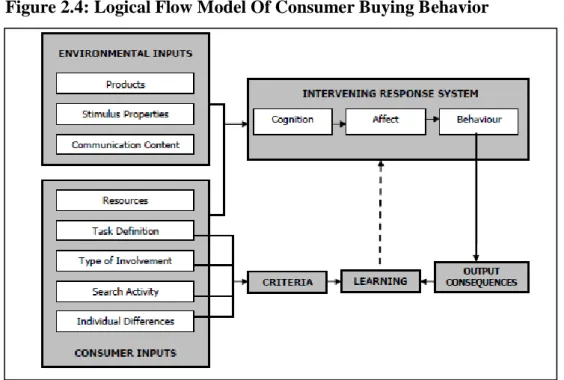
perceived as primarily hedonic or utilitarian (e.g., Pham 1998). For example, purchasing a cell phone to access help in times of trouble makes a cell phone a utilitarian product. Buying the same phone to chat with friends makes it hedonic. Holbrook and Hirschman (1982b)investigate hedonic consumption using ‘logical flow’ model of consumer behaviour.(Figure 2.4) According to this framework, Environmental and Consumer Inputs are processed by an Intervening Response System. This system, consequently, produces Output Consequences which, after assessing against Criteria, lead to Learning feedback ‘loop’. These criteria are influenced by individual differences, search activity, type of involvement and task definition.
In Figure 2.5, According to the environmental inputs; hedonic consumption is strictly connected with ‘subjectivity’, that is the same product can have different meaning for two different consumers. The author considers this aspect of hedonic consumption as one of the highest importance, because it is strongly related with other facets of hedonic consumption, e.g. stimulus properties – subjectivity of taste, smell or feeling.In consumer input, in case of lack of resources, other inputs have no meaning, e.g. if a consumer does not have enough money for buying a dress, or time for shopping, he/she will probably resign from the purchase, at least in the short term.
Figure 2.4: Logical Flow Model Of Consumer Buying Behavior
Products Stimulus Properties Communication Content
Environmental Inputs
Research focused on exploring ‘the symbolic meanings of
more subjective characteristics’ (e.g.joyfulness,
friendliness) products often researched: leisure activities, entertainment
Recognizes the importance of numerous stimulus: consumers can SEE, HEAR, TASTE,
FEEL,SMELL moreover, in many consumption events, these ‘sensory channels’ function simultaneously (e.g. watching a theatre spectacle)
Research focused on the structure and style of
message content
Resources Task Definition Types of Involvement Search
Activity Individual Differences
Consumer Inputs Time (‘subjective time resources’)
Hedonic response; -Primary process, -The pleasure principle
Orientation reaction involving arousal -Focus on the type of
involvement Exploratory behaviour (complex) .-Differences in personality area: sensation-seeking, creativity,religion, etc. -Recognition of the importance of ethnic differences
Cognition Affect Behaviour
Intervening Response System
More subconscious processes ‘pictorial imagery’,fantasies
and daydreams
Recognizes importance of all kinds of emotions both positive
(e.g. love) and negative (e.g.jealousy)
Usage: - Consumption experience (embraces purchase decisions and
many other events) -Activities
Criteria Output Consequencies Learning
Output Consequences, Criteria and Learning
Play mentality Enjoyment, pleasure, fun
Stream of associations’ that occurred during
consumption, e.g. imagery, emotions, etc. [Satisfaction is only one important element of an
experience
2.2.3What is Consumption ;
Addis and Holbrook (2001) perceive the ‘consumption event’ as an ‘interaction’ between a product and a consumer. They argue that the product has objective features, for example colour or shape, while the consumer is equipped with a sensitive personality which can produce diverse types of subjective responses, for example various feelings, beliefs etc. This consumption event is presented in Figure 2.6below.
Figure 2.5: Enviromental Inputs And Hedonic Consumption
Source: Holbrook and Hirschman 1982a
Source: Addis and Holbrook, 2001
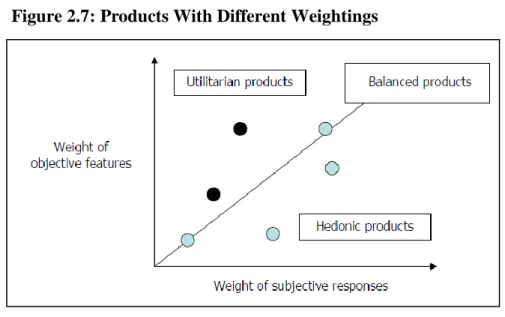
In some consumption experiences the objective characteristics of the product may ‘weighmore heavily than the consumer’s subjective response’ (Addis and Holbrook 2001). This is the case when consumers are more interested in product’s functional features, e.g. whitening qualities of a toothpaste. Such products and the customer value delivered by them are termed as ‘utilitarian’. In some consumption situations, however, consumers’ subjective responses, e.g. emotions, ‘weigh’ more than the objective features of the product.
2.2.4 Hedonism , Product Symbolism And Shopping Motivation
The experiential perspective of consumption is ‘phenomenological in spirit and regards consumption as a primarily subjective state of consciousness’ (Holbrook and Hirschman 1982a). All products have a certain degree of hedonism. This is because all products have some degree of symbolic meaning and arouse at least some degree of hedonic motivations among individuals (Holbrook and Hirschman 1982a,b)
If products are varying in the extent of inherent symbolism, then one can expect that the hedonic value would vary across product categories. This is supported by research examining the extent of hedonism in different products (Batra,R.,&Ahtola,O.1990)
Hedonic value across products seems to vary depending on the intrinsic and extrinsic attributes of the product (Addis and Holbrook 2001). Utilitarian value is associated with tasks that are easily completed. Thus any product associated with simple routine task completion like purchase of coffee or detergents is likely to be less in hedonic value as compared to a product with higher degree information processing and involvement such as cellular phones where the outlay is much larger and bargain seeking behaviour may impact product purchase (Holbrook and Hirschman 1982a).
Consumers are increasingly seeking value not only from the product but from the shopping process itself (Teller,C., Reutterer,T.&Schedlitz,P. 2008).Specially by establishing big and beautiful shopping malls and also because most of the population of the world are younger people that are interested in all kind of entertainments, nowadays shopping has become fun for people.
Regarding the things that motive people to hedonic shopping, as (Babin,B.J.&Attaway,J.S.2000)contend the store atmosphere, such as layout, lighting and use of colors can have a significant influence over the consumers shopping behavior and can help develop long lasting relationship with the consumer. Peck and Childers (2006)have analysed the effect of touch on impulse buying and contend that it has a positive effect on it. Jones and his friends (Jones, Reynolds, Arnold 2006)have shown in their study that hedonic value had a greater influence over the satisfaction of consumers in terms of loyalty and re-patronage intentions. Perhaps this is the reason that even long after the introduction of internet shopping, that is fast, efficient and cheaper, shopping malls still account for the majority of shopping done by consumers (Arnold, Reynolds 2003). Furthermore discount retailers whose business model is to offer lower prices with minimum regard to hedonic aspects have also started to focus on them due to their perceived significance (Carpente, Moore 2009) especially in the case of lower income consumers who have been shown to value hedonic aspect more than the utilitarian one (Allard, Babin, Chebat2009).
Shopping motivation can be defined as the “drivers of behavior that bring consumers to the marketplace to satisfy their internal needs”. (Jin,Kim 2003) According to Westbrook and Black (1985)shopping behavior evolves from three fundamental reasons; to acquire a product, to acquire both a desired product and provide satisfaction with non-product related needs, and to primarily attain goals not related to product acquisition. Hausman (2000)in her study on various motivations of consumers in buying impulsively, found that in addition to the primary motive of satisfying hedonic aspirations there were some other needs that consumers tried to fulfill via the process of shopping. The need to interact and socialize with people figured prominently in her findings. Along with all these motivations I think there are many other things that make people to be hedonistic. For example, if someone needs some product and he/she goes to buy it, he /she will be affected by stores decorations, color, music, and he/she wants to visit there even he/she doesn’t want to buy anything from that store.
Generally, shopping motivations have been categorized into two aspects ; utilitarian and hedonic. (Hausman2000)Utilitarian shopping motivations are task oriented, rational, and cognitive with the intensions or desires to purchase a product efficiently and rationally highlighted(Kang and Park-Poaps2010). Hedonism, on the
other hand, is concerned with the fun and play of shopping arising from the experience itself. Typical dimensions of hedonism are “increased arousal, high involvement, perceived freedom, fantasy fulfillment, and escapism. Babin (Babin,Darden,Griffin 1994)as well as festivity (Arnold and Reynolds 2003), treat and self-indulgence (Miller1998)Arnold and Reynolds stress that “hedonic shopping motives are similar to the task orientation of utilitarian shopping motives. So where as an utilitarian shopper would try and get a good quality product at the least possible price, hedonic shopper is more likely to purchase that product from a store that has a pleasent atmosphere and offers other avenues of entertainment. (Babbin and Attaway 2000)Ultimately, for some products the ‘weightings’ of their objective features and subjective responses can be very similar or even the same and this type of products are labelled as ‘balanced’. These three types of products with different ‘weightings’ are shown inFigure 2.7.
The utilitarian consumption is associated with the traditional view of consumption which is based on decision-making process (information processing) and refers to notions like functionality, constancy, rationality and analysis. The hedonic consumption is connected with the experiential view of consumption and the following concepts: interaction, variability, rationality and emotions, and uncertainty (Addis and Holbrook2001)
Arnold and Reynolds(2003) have recognized six dimensions to the hedonic shopping values, which comprise of adventure, gratification, role, value, social and idea shopping.
Figure 2.7: Products With Different Weightings
Adventure shopping refers to shopping for excitement, adventure, and stimulation. It also refers to experiencing a different environment that stimulates the senses. Social shopping emphasizes the social benefits of shopping with friends and family. Gratification shopping refers to shopping as a means to create a positive feeling, that is, to feel better or give a special treat to oneself. Idea shopping refers to shopping to gather information about new trends, fashions, and products. Role shopping reflects the enjoyment felt when shopping for others and finding the perfect gift. Value shopping refers to the joy of hunting for bargains, finding discounts, and seeking sales. As such, consumers enjoy shopping for various reasons.
2.2.5 Multisensory Aspect Of Hedonic Consumption
According to Holbrook and Hirschman (1982b)the term ‘multisensory’ mean ‘the receipt ofexperience in multiple sensory modalities including tastes, sounds (music in stores!) scents, tactile impressions and visual images (aesthetics, lighting, colours, merchandising)’.
Consumers ‘not only respond to multisensory impressions from external stimuli by encoding these sensory inputs but also rea
ct by generating multisensory images within themselves. For example, smelling a perfume may cause the consumer not only to perceive and encode its scent but also to generate internal imagery containing sights, sounds and tactile sensations, all of which are also "experienced". They also stated that the same stimulus can result in slightly different multisensory images indifferent consumers (the importance of subjectivity).
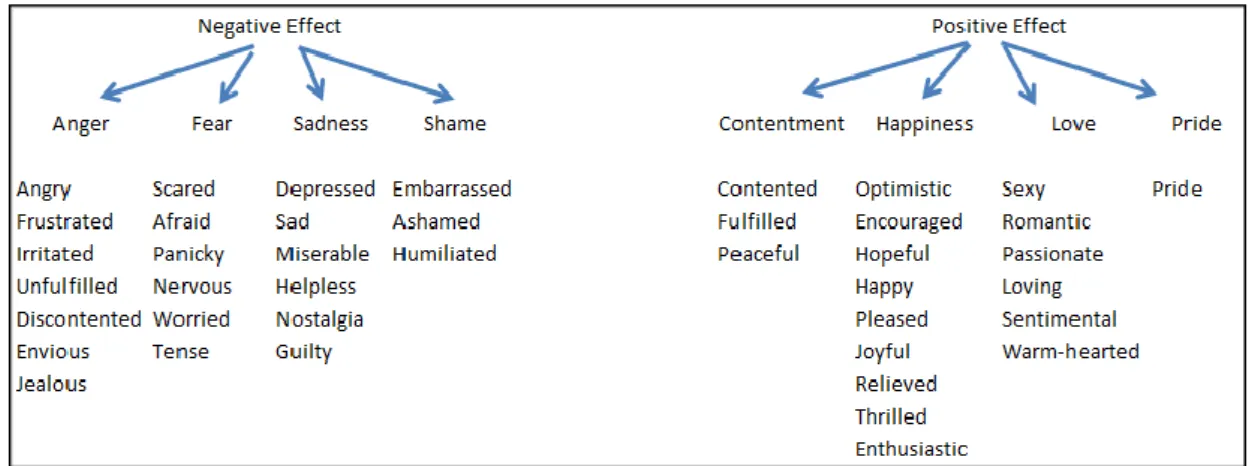
Measuring emotions seems to be a difficult and challenging task. There are developed fewframeworks ‘for positioning consumption experiences in an emotion space and for developing experience-specific emotional profiles, e.g. three-dimensional Mehrabian-Russell framework (1974) (The PAD – pleasure, arousal, dominance), eight-dimensional Plutchik scheme (1980) (fear, anger, joy, sadness, disgust, acceptance, expectancy and surprise) (Havlena and Holbrook 1986) and Consumption Emotion Set (CES) by Laros and Steenkamp (2003) based on Richins’ Consumption Emotion Descriptors model (Richins 1997). CES is a ‘hierarchical consumer emotions model’ and its intermediate level consists of four
negative and four positive basic emotions. This framework (Figure 2.8) seems to provide more information aboutconsumer emotions than the two previous ones.
Holbrook and Gardner (1998)conducted interesting research concerning ‘the roles ofmotivation and emotions in determining the duration of consumption – that is, the length of time that consumers devote to consumption experiences’. They examined two types of motivation: ‘Task-Oriented Extrinsic Motivation’ and ‘Enjoyment-Oriented Intrinsic Motivation’and their influence on pleasure and arousal in consumption experience. The first type of consumption ‘serves as the means to an end’, that is focused on solving a problem, while the latter is ‘an end in itself’ and is ‘aimed at hedonic response – that is, consumption geared toward obtaining pleasure’ They found that ‘a positive effect of pleasure on consumption duration would appear for those in the intrinsically motivated enjoyment condition but would disappear for those in the extrinsically motivated task condition which seems to be reasonable. As they suggest, consumers intrinsically oriented are interested in ‘maximizing the duration of enjoyable consumption experience’.
The pioneers in hedonic consumption, Holbrook and Hirschman (1982a), argue that hedonic consumption is strictly connected with multisensory images, fantasies and emotions which occur during consumption of the product. Holbrook and Hirschman (1982b) propose a framework which reveals the ubiquity of hedonicconsumption. They examine following aspects of hedonic consumption: mental constructs,product classes, product usage and individual differences. Holbrook and Hirschman’s framework is focused particularly on mental constructs because, as the
Figure 2.8: Hierarchy Of Consumer Emotions
Source: Laros and Steenkamp, 2001
author of the study believes, the ubiquity of hedonic mental constructs plays the most important role in the total (hedonic) consumption behaviour.
2.2.6 Ubiquity Of Hedonic Consumption
Holbrook and Hirschman (1982a), argue that hedonic consumption is strictly connected with multisensory images, fantasies and emotions which occur during consumption of the product. In other words, this is a unique kind of consumption which engage many human senses like sight, smell, taste, hear etc., and the final result of this is a creation of a multisensory image. Their view consumption as ‘experiential’ (‘experiential view of consumption’).Holbrook and Hirschman (1982b) propose a framework which reveals the ubiquity of hedonic consumption. They examine following aspects of hedonic consumption: mental constructs, product classes, product usage and individual differences. They believe, the ubiquity of hedonic mental constructs plays the most important role in the total (hedonic) consumption behaviour.
2.2.6.1 Mental Constructs
Holbrook and Hirschman notice that there are several consequences of the unique ‘hedonic mental constructs’. First of all, it seems that in some situations ‘emotional desires dominate utilitarian motives in the choice of products’. It is particularly relevant to strong emotions like love, hate or jealousy, which can sometimes ‘override consumers' economic decision rules based on deductive reasoning’.The another implication of this is connected with subjectivity. Holbrook and Hirschman notice that some products, e.g. aesthetic objects (e.g. paintings), are chosenmainly due to subjective perceptions of the consumers. Moreover, they argue that hedonicconsumption is connected with ‘imaginative constructions of reality’ and acts of such consumption ‘are based not on what consumers know to be real but rather on what they desire reality to be’. It was also examined that, sometimes, consumers’ ‘internal construction of reality’ not ‘match’ with the external, ‘objectively verifiable world’, e.g. perception of self as ‘Marlboro type’ man vs. ‘Shrek type’ man.
2.2.6.2 Product Classes
Holbrook and Hirschman(1982b) propose that product classes such as aesthetic objectsseem to be highly emotionally involving. Moreover, they argue that consumers make decisions about purchasing such products based on rather ‘symbolic elements of the products’ than their tangible aspects.
2.2.6.3 Product Usage
Holbrook and Hirschman (1982b)argue that ‘the hedonic perspective includes thepsychological experiences that accompany product usage. Thus, hedonic responses may be viewed as the essence of the usage experience’ They argue that the interaction between product and consumer is dynamic.
2.2.6.4 Individual Differences
There are significant differences between individuals concerning hedonic consumption. They include differences in the following areas: ethnic background, social class and gender related. According to Holbrook and Hirschman (1982b), differences in such area cause that products’ perception can ‘vary greatly in the emotions and fantasies they inspire in a consumer’. Holbrook and Hirschman (1982b) suggest that the source of subcultural differences lies in various systems of socialization that educate ‘their members into a certain world view and enforcing adherence to a set of customs’. They add that the outcome differences are connected with ‘the amount of fantasy and emotionality encouraged/permitted in theirmembers’.
2.2.7 Gender Differences In Hedonic Consumption
There are significant differences between individuals concerning hedonic consumption. They include differences in the following areas: ethnic background, social class and gender related. According to Holbrook and Hirschman (1982b), differences in such area cause that products’ perception can ‘vary greatly in the emotions and fantasies they inspire in a consumer’. For instance, it was found that Chinese, English, Greek and Jewish differ greatly ‘in their emotional motives for pursuing consumption activities, their tendencies toward fantasy and altered states
of consciousness, and their projection into consumption experiences’. It is obvious for all of us that women are more eager for shopping than men. When we go shopping, we see that most of the buyers are women especially in shopping malls. It depends on product range. For example, in buying electronic instruments men are more eager to do such purchases. But we can’t be sure that these kinds of products considered as a hedonic consumption. So regarding hedonic consumption we can say that females are more hedonistic than males. Women stress emotional and psychological involvement in the buying process, whereas, men emphasize efficiency and convenience in obtaining buying outcomes (Dittmar,Long,Meek 2004).Women tend to enjoy shopping (Alreck,Settle 2002); shopping is undoubtedly as a fantastic journey for them. Dittmar and Drury (2002)pointed out that shopping seems to play a psychologically and emotionally encompassing role for women than for men, whereas, men focus on the outcome to get the actual goods with the least effort. In other words, the added value attached to shopping process may play a much more prominent role for female consumers, while male consumers’ primary concerns are to get the product only, shopping process may function as nothing meaningful for men. We can relate this to adventure shopping motivation and say that females will report higher mean scores on adventure than males.
Chyan and Chia (2006)discover that females are dominated over perfectionism and novel-fashion consciousness than males, suggesting that females are more fashion oriented. Keeping up with the latest trends, fashions and innovations is a kind of hedonic shopping motive. So females are more interested in hedonic consumption. When we consider value motivation of hedonic shopping, we see that everyone try to buy goods in lower prices. Arnold and Reynolds (2003)depicted that getting a bargain makes consumers feel like winning the challenge, and the bargaining process is viewed as a kind of hedonic value (Babin,Darden,Griffin 1994). In this case we can say that value is equally important for male and female when they are shopping.
Considering all above mentioned things we can say that males are prefer to be utilitarian consumer. They want to buy goods when they need. They try to save cost and time and in shopping process they are less social than females. On the contrary, females care about fashion, adventure and sociality in their shopping. They prefer to be hedonism. As Arnold and Reynolds (2003)indicated: “younger females stress
hedonic values more than younger males and have stronger hedonic shopping motivations”. Arnold and Reynolds (2003)noted that females are more hedonic-oriented than males when they go to retail stores for shopping.
2.2.8Hedonism And Cultural Influence
Dworkin, 1984 explored into the individual differences in hedonic capacity which he defined as ‘an individuals ability to experience pleasurable affect’ Consumption has been linked to ‘symbolic meanings, values and lifestyles - all of which are likely to be specific to local cultures’ (Shaw and Clarke 1998). Several studies have examined and recognized the strong impact of values in shaping consumer motivations and product choices (Carman 1978; McCracken 1986, Yau 1988). Several motives of shopping are socially and culturally anchored (Tauber 1972; Siu et al. 2001) including ethnic identifications (Eun-Ju, Fairhurst and Dillard 2002) and acculturation effects (Ownbey and Horridge 1997). Products associated with health seem to have a mix of utilitarian and hedonic values which may be impacted by the cultural influences (Ximing and Collins 2002).
2.2.9 The Relationship Between Price And Hedonic Shopping Value
It is assumed that paying a high price, or having the ability to pay a high price, could be a source of ostentation or pleasure, which gives shoppers a sense of hedonic feeling. In contrast, paying a low price has been considered solely as an economic benefit or a utilitarian value. Mano and Elliott (1997) posited that shoppers experience both utilitarian and hedonic responses through price savings. Price savings can elicit utilitarian responses because savings lead to economic utility. Price savings can also cause hedonic responses because the bargain may be a source of pride, excitement, increased sensory involvement, accomplishment. (Babin et.al. 1994; Holbrook, Chestnut, Greenleaf 1984; Schindler 1989) and feelings about being a smart shopper. (Schindler 1989). Jones, Trcocchia, and Mothersbaugh (1997) also explored consumers’ three noneconomic motivations for price haggling: achievement, affiliation, and dominance. Tauber (1972) also posited that the pleasure of bargaining is a shopping motive.
It is important to understand underlying dimensions of price. High price can be both a positive and negative cue according to Lichtenstein (1993). Some consumers
regard high price as an indicator of quality or prestige. The higher the price, the greater the likelihood of purchase. In this case, high price can be a positive cue in their decision making. In contrast, consumers who view price as something they have to give up for products are more likely to seek lower prices. In this case, high price can be a negative cue inversely related to purchase.
Price-sensitive consumers were traditionally viewed as rational and logical problem solvers emphasizing utilitarian shopping value (Tauber 1972; Schindler 1989). However, researchers have begun to view them as those who seek hedonic value from bargain hunting. For instance, Jin and Kim (2003) found that hedonic and recreational shoppers exhibited high price sensitivity by hunting bargains and using coupons. Other researchers (Babin et al 1994; Arnold & Reynolds 2003) also noted a positive relationship between bargain perception andhedonic shopping value. Babin et al (1994) expected that the consumers' bargain perceptions to influence shopping value. They discussed that price discounts create transaction utility or smart shopper feelings, which may increase hedonic value. In addition, price discounts could create utilitarian value by facilitating an efficient end to the product-acquisition task. Consistent with this reasoning, they found that consumer bargain perceptions relate significantly to both hedonic value and utilitarian value. However, Lee et al (2009) found that there is a negative relationship between price sensitivity and hedonic shopping value. In addition, there was no relationship between price sensitivity and utilitarian value.
2.3 CONCLUSION
Consumer behavior is very important issue for marketing and can be defined as the decision-making process. And it is a dynamic, multidimensional,complex process, and all marketing decisions are made on assumptions about consumer behaviour. Different products can be high or low in hedonic attributes at the same time. And the same product can have different meaning for two different consumers. Consumers need to satisfy with thier shopping. So long as marketeers who understand their consumers accurately, they will be more successful and they have loyal customers.
3. RESEARCH METHODOLOGY
3.1 AIM OF THE RESEARCH
Hedonic behaviour can change from person to person. Consumers are increasingly seeking value from the product. In our contemporary world informatic technology have developed so much. Mobile phone sector has also developed amazingly. There are many types of products, many type of brands in mobile phone sector. Of course, while the market developes, the prices of the products also increase and may vary. Consumers can buy mobile phone under the mood of hedonism.So in this study it was studied whether hedonic consumption behavior is changing between different age, gender and income groups for mobile phone under price cues/dimensions such as price consciousness, price mavenism, value consciousness and price sensitivity.
3.2 RESEARCH MODEL
As shown in Figure 3.1 the research model was formed under price circumstances and measured whether hedonic shopping motivations were effected by different age, income and gender groups.
3.3 SURVEY DATA COLLECTION
Consumer behaviour researchers are interested in understanding how consumers process price cues because price is one of the most useful cues in consumer
Figure 3.1 : Research Model
decision making and therefore price can be unscrupulously used by marketers. In this study the price was consciousness tested in different age, gender and income groups in mobile phone with hedonic shopping value. So this study it can be suggested how price perception affects hedonic shopping value in different age, gender and income groups. The questions were asked for mobile phones, because this type of product is appropriate choice to act as an example for every aspects of price dimensions and hedonic shopping value.
3.4 DEMOGRAPHIC CHARACTERISTIC OF THE SAMPLE
The sample (n=315) consisted of 57,8 percentage (182) males, and 42,2 percentage (133) females, most of whom were aged 30 to 39 (42,2 percentage) and 21 to 29 (35,6 percentage).
73 percentage of the respondents have university degree, and 16 percentage of the respondents have master degree.
While 41,5 percentage of the respondents’s monthly income was under 2.000 TL, 27,3 percentage was between 2001-4000 TL, 16,5 percentage was between 4001-6000 TL.
Questionnaire included measure of hedonic shopping value, with price sensitivity, value consciousness, price consciousness, price mavenism. The questionnaire consists of 20 questions of which 7 is related with demographic characteristics. Hedonic shopping value includes five items measured by 5-point Likert-type scale. Respondents were asked to indicate their level of agreement (1=Strongly Disagree and 5=Strongly Agree). Representative items for each construct are the following. Price sensitivity ; The higher the price of a product, the better feeling I have.
Price Mavenism ; My friends think of me as good source of price information. When consumers view price as cash that they have to give up for a product, they are likely to keep up to date on market place prices. (Feick&Price 1987). A price maven, a term adapted from Feick and Price’s term market maven, is an individual who is a source of price information for many kinds of products and places to shop. (Feick&Price 1987)
Value Consciousness ; When shopping I compare the prices of different brands to be sure I get the best value for the money. Value, is a primary factor influencing purchase intention (Chang&Wildt 1994) Value-conscious consumers use shopping lists, compare unit prices, watch checkout scanner, and check prices on small items.
(Mano&Elliot 1997). Consumers can easily compare the price (and thus, value) of alternatives of durables.
Price Consciousness ; Whatever I buy, I shop around to get the best prices. When consumers think of price as a resource they must sacrifice in purchasing, they tend to be price conscious and actively search for the lowest available price.
4. RESULTS OF THE RESEARCH
4.1
FACTOR ANALYSIS
The questions were prepared in 4 basic dimensions by subjects. Every groups were related to price.
Paying a high price, or having the ability to pay a high price, could be a source of pleasure, which gives shoppers a sense of hedonic feeling. In this perspective price sensitivity dimension was formed. Price mavinism is focused only on people who search for pricing information. In this perspective price mavenism dimension was formed. Value, is a primary factor influencing purchase intention.Value-conscious consumers use shopping lists, compare unit prices. In this perspective value consciousness dimension was formed. When consumers think of price as a resource they must sacrifice in purchasing, they search for the lowest available price.In this perspective price consciousness dimension was formed. The questions for all dimensions were shown below;
Price Sensitivity Questions :
Buying a high priced brand of mobile phone makes me feel good about myself I enjoy the prestige of buying a high priced brand of mobile phone.
I have purchased the most expensive brand of a mobile phone because I knew other people would notice
Buying a high-priced brand of mobile phone makes me feel good about myself. Value Consciousness Questions :
When shopping I compare the prices of different brands of mobile phones to be sure I get the best value for the money.
When purchasing a mobile phones, I always try to maximize the quality I get for money I spend.
I check the prices even for inexpensive mobile phone. Price Consciousness Questions ;
I usually purchase the cheapest mobile phone.
Low price is an important consideration in my purchases of mobile phone. No matter what I buy any brand of mobile phone, I shop around to get the
lowest price.
Price Mavenisim Questions :
For many types of mobile phones, I would be better able than most people to tell someone where to shop to get the best price.
I have brands of mobile phone that I favour.
People ask me for information about prices for different types of mobile phone.
Factor analysis examines whether there is an order between responses to variables of participants. The result of KMO test (Figure 4.1) is 78,1 percentage. Since 0,78>0,5, it can be said that data set is suitable for factor analysis. According to Kalaycı (2008), if the KMO value is bigger or equal to 0,90, then it is excellent, if it is between 0,80-0,90, then it is very good, if it is between 0,70-0,80, then it is good, if it is between 0,60-0,70, then it is medium, if it is 0,50-0,6, then it is poor, and if it is under 0,50 then it is not acceptable.
In Barlett’s test it is meaningful when sig. value is 0,000. That is, there is high correlation between variables. In other words, the data set that was set up for hedonic consumption, is suitable for factor analysis.
Component
Initial Eigenvalues Extraction Sums of Squared Loadings Rotation Sums of Squared Loadings(a) Total % of
Variance Cum.% Total % of
Variance Cum.% Total Buying a high priced brand of mobile phone makes me
feel good about myself 3.852 29.630 29.630 3.852 29.630 29.630 3.313 I enjoy the prestige of buying a high priced brand of
mobile phone 2.402 18.474 48.103 2.402 18.474 48.103 2.649 I have purchased the most expensive brand of a mobile
phone because I knew other people would notice 1.393 10.716 58.819 1.393 10.716 58.819 2.333 Buying a high-priced brand of mobile phone makes me
feel good about myself 1.345 10.345 69.164 1.345 10.345 69.164 2.221 I have brands of mobile phone that I favour .629 4.842 74.005 People ask me for information about prices for different
types of mobile phone. .596 4.585 78.590
For many types of mobile phones, I would be better able than most people to tell someone where to shop to get the best price
.547 4.205 82.795
When shopping I compare the prices of different brands of mobile phones to be sure I get the best value for the Money
.506 3.891 86.686
When purchasing a mobile phones, I always try to
maximize the quality I get for money I spend .458 3.520 90.206 I check the prices even for inexpensive mobile phone .368 2.833 93.039 I usually purchase the cheapest mobile phone. .347 2.669 95.707 Low price is an important consideration in my
purchases of mobile phone .314 2.415 98.122
No matter what I buy any brand of mobile phone, I
shop around to get the lowest price. .244 1.878 100.000
There are different methods to determine the numbers of factors. In this research the sum of factors that are bigger than 1 explains 69 percentage of total variance (Figure 4.2). While the first component, getting the score of 29,63 percentage explains a major part of total variance. The second component explains 18,47 percentage. In total this scale explains 69,16 percentage of the total variance.
Kaiser-Meyer-Olkin Measure of Sampling Adequacy. .781 Bartlett's Test of Sphericity Approx. Chi-Square 1489.09 6 df 78 Sig. .000
Figure 4.1 : KMO and Barlett’s Test
Figure 4.2 : Total Variance Explained
Extraction Method: Principal Component Analysis.
When components are correlated, sums of squared loadings cannot be added to obtain a total variance.
Component
1 2 3 4
Buying a high priced brand of mobile phone makes me feel good about myself. .867 .176 -.059 .068 I enjoy the prestige of buying a high priced brand of mobile phone. .861 .099 -.049 .123 I have purchased the most expensive brand of a mobile phone because I knew
other people would notice. .739 .191 -.048 -.031
Buying a high-priced brand of mobile phone makes me feel good about myself. .712 .188 -.285 .003 I have brands of mobile phone that I favour. .148 .862 -.028 .116 People ask me for information about prices for different types of mobile phone. .144 .814 -.022 .198 For many types of mobile phones, I would be better able than most people to tell
someone where to shop to get the best price. .283 .749 -.088 .012 When shopping I compare the prices of different brands of mobile phones to be
sure I get the best value for the money. -.115 -.033 .858 .050 When purchasing a mobile phones, I always try to maximize the quality I get for
money I spend. .057 -.129 .789 .225
I check the prices even for inexpensive mobile phone. -.310 .031 .729 -.063 I usually purchase the cheapest mobile phone. -.019 .119 .059 .833 Low price is an important consideration in my purchases of mobile phone. .146 .065 -.057 .815 No matter what I buy any brand of mobile phone, I shop around to get the lowest
price. -.002 .110 .196 .733 Cronbach`s Alpha Article Number Price Sensitivity .844 4 Price Mavenism .795 3 Price Consciousness .735 3 Value Consciousness .734 3
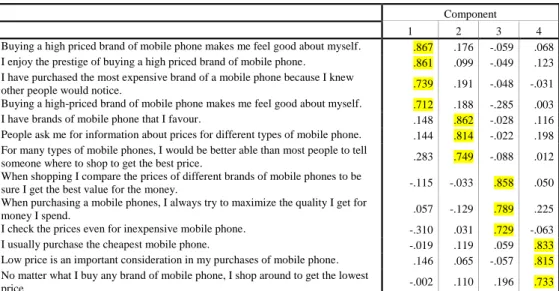
The questions were perceived in 4 basic dimensions by subjects. These dimensions are important because they are the starting points of the research. The matters that we are facing in the factor analysis are clustered under related headings. As shown in Figure 4.3, the first 4 questions are related with price sensitivity, the triad groups are price mavenism, value consciousness, price consciousness respectively. Since they were clustered, it can be said that these matters are character determining.
4.2RELIABILITY RESULTS OF THE RESEARCH FINDINGS
The aim of the reliability analysis is to measure coincidental. If the answers that are given to the survey show random dispersion, then it can be said that the result of the survey is reliable. The reliability analysis is used for to test reliability, coincidentality and consistency of sample chosen.The reliability was examinedFigure 4.4 : Research Reliability Figure 4.3 : Rotated Component Matrix
Extraction Method: Principal Component Analysis. Rotation Method: Varimax with Kaiser Normalization.
Cronbach's
Alpha N of Items
.844 4
Price Sensitivity Questions
Scale Mean if Item Deleted Scale Variance if Item Deleted Corrected Item-Total Correlation Cronbach's Alpha if Item Deleted Buying a high priced brand of mobile phone
makes me feel good about myself 11.09 7.145 .773 .760
I enjoy the prestige of buying a high priced
brand of mobile phone 11.09 7.257 .735 .778
I have purchased the most expensive brand of a mobile phone because I knew other people would notice
10.83 8.317 .617 .829
Buying a high-priced brand of mobile phone
makes me feel good about myself 10.91 8.251 .601 .835
N % Cases Valid 315 100.0 Excluded(a) 0 .0 Total 315 100.0 N % Cases Valid 315 100.0 Excluded(a) 0 .0 Total 315 100.0 Cronbach's Alpha N of Items .795 3
Price Mavenism Questions
Scale Mean if Item Deleted Scale Variance if Item Deleted Corrected Item-Total Correlation Cronbach's Alpha if Item Deleted
I have brands of mobile phone that I favour. 6.91 4.428 .579 .781
People ask me for information about prices for
different types of mobile phone. 7.00 4.057 .691 .664
For many types of mobile phones, I would be better able than most people to tell someone where to shop to get the best price.
7.14 4.121 .646 .712
using Cronbach’s alpha technique. As shown in Figure 4.4; for price sensitivity since cronbach alpha is 84,4 percentage, for price mavenism since cronbach alpha is 79,5 percentage, for price consciousness since cronbach alpha is 73,5 percentage, and for value consciousness since cronbach alpha is 73,4 percentage the research can be said that it is reliable.
For every dimension the reliability was analyzed. For price sensitivity 4 questions were asked. The questions were also shown on Figure 4.5. According to the cronbach`s alpha values for price sensitivity it can be said that each question is reliable.
Figure 4.5 : Reliability For Price Sensitivity
Figure 4.6 : Reliability For Price Mavenism
N % Cases Valid 315 100.0 Excluded(a) 0 .0 Total 315 100.0 Cronbach's Alpha N of Items .734 3 Value Consciousness Questions Scale Mean if Item Deleted Scale Variance if Item Deleted Corrected Item-Total Correlation Cronbach's Alpha if Item Deleted When shopping I compare the prices of different
brands of mobile phones to be sure I get the best value for the money.
4.75 3.825 .613 .581
When purchasing a mobile phones, I always try to
maximize the quality I get for money I spend. 5.06 4.105 .560 .646
I check the prices even for inexpensive mobile
phone. 4.71 4.182 .503 .713 N % Cases Valid 315 100.0 Excluded(a) 0 .0 Total 315 100.0 Cronbach's Alpha N of Items .735 3
Price Consciousness Questions
Scale Mean if Item Deleted Scale Variance if Item Deleted Corrected Item-Total Correlation Cronbach's Alpha if Item Deleted I usually purchase the cheapest mobile phone 4.82 3.467 .496 .726 Low price is an important consideration in my
purchases of mobile phone 5.09 3.474 .538 .673
No matter what I buy any brand of mobile
phone, I shop around to get the lowest price 5.02 3.315 .650 .543 For price mavenism 3 questions were asked. The questions were also shown on Figure 4.6. According to the cronbach`s alpha values for price mavenism, it can be said that each question is reliable.
For value consciousness 3 questions were asked. The questions were also shown on Figure 4.7. According to the cronbach`s alpha values for value consciousness it can be said that each question is reliable.
For price consciousness 3 questions were asked. The questions were also shown on Figure 4.8. According to the cronbach`s alpha values for price consciousness it can be said that each question is reliable.
Figure 4.8 : Reliability For Price Consciousness Figure 4.7 : Reliability For Value Consciousness