Improvement of popliteal angle with
semitendinosus or gastrocnemius tenotomies
in children with cerebral palsy
Correspondence: Ali Şeker, MD. İstanbul Medipol Üniversitesi Medipol Mega Hastanesi,
Ortopedi ve Travmatoloji Kliniği, TEM Avrupa Otoyolu Göztepe Çıkışı No: 1, 34214 Bağcılar, Istanbul, Turkey. Tel: +90 212 – 460 71 57 e-mail: [email protected]
Submitted: February 27, 2014 Accepted: August 18, 2014 ©2015 Turkish Association of Orthopaedics and Traumatology
Available online at www.aott.org.tr doi: 10.3944/AOTT.2015.14.0078 QR (Quick Response) Code
doi: 10.3944/AOTT.2015.14.0078
İlker Abdullah SARIKAYA1, Muharrem İNAN2, Ali ŞEKER3 1Department of Orthopedics and Traumatology, Muş State Hospital, Muş, Turkey;
2Department of Orthopedics and Traumatology, Cerrahpaşa Faculty of Medicine, Istanbul University, Istanbul, Turkey; 3Department of Orthopedics and Traumatology, Medipol Mega Hospital, Istanbul Medipol University, Istanbul, Turkey
Flexion deformity related to spasticity of the hamstring muscles is the most common knee deformity in cerebral palsy (CP).[1] Surgical lengthening of the hamstrings is
the treatment of choice to improve knee function.[2-4]
Lengthening procedures address the semimembrano-sus, semitendinosemimembrano-sus, and biceps femoris muscles. Several surgical methods consisting of Z-plasty, fasciotomy and
tenotomy have been described in the literature.[5,6]
De-spite successful postoperative functional results, recur-vation of up to 10° has been observed as a complication.
[7] Recurrence of knee flexion deformity is another
com-mon complication of this procedure, with rates of up to 40% as reported in the literature.[8,9] It is presumed that
the effect of each hamstring muscle on knee flexion is Objective: The aim of this study was to determine the efficacy of semitendinosus and gastrocnemius
tenotomies on popliteal angle presenting knee flexion spasticity in children with cerebral palsy (CP). Methods: The study included 44 patients (25 males, 19 females; mean age: 8.1 years, range: 4 to 14 years) with spastic CP who underwent surgery for knee flexion spasticity. A total of 78 semitendinosus tenotomies and 28 associated gastrocnemius tenotomies were performed. Popliteal angle was mea-sured under general anesthesia before and after surgery. Patients were divided into groups according to age (younger and older than 7 years), severity of deformity and type of CP.
Results: Mean popliteal angles decreased by 14.3º (30.1%) following semitendinosus tenotomy and by 6.1º (12%) following gastrocnemius tenotomy (p=0.0001). The change in popliteal angle was not statistically significant according to age, severity of flexion spasticity, and type of CP palsy. There was a significant difference following gastrocnemius tenotomy between groups with a popliteal angle of greater or lesser than 50º (p=0.0001).
Conclusion: Semitendinosus and gastrocnemius tenotomies improved popliteal angle by 30.1% and 12%, respectively. Age, preoperative popliteal angle or anatomical disease classification did not a sig-nificantly affect popliteal angle.
important in order to avoid recurvation of the knee or recurrence of deformity.
It is also crucial to describe the effects of gastrocne-mius tenotomy on knee motion in patients with spastic CP. The gastrocnemius muscle plays an important role in both knee flexion and ankle plantarflexion.[10-12] Its
re-lease in addition to that of the hamstring muscles may increase recurvation of the knee. Therefore, determina-tion of the quantitative effect of semitendinosus and gas-trocnemius tenotomies on popliteal angle improvement may affect surgical planning.
The aim of this study was to evaluate the effect of semitendinosus and gastrocnemius tenotomies on the popliteal angle in spastic CP and determine the factors that affect the results of these surgical procedures. The estimation of the amount of improvement in knee ex-tension after such procedures will help in preoperative planning.
Patients and Methods
The study included a total of 44 patients (25 males, 19 females; mean age: 8.1 years, range: 4 to 14 years) with spastic CP who underwent surgery for knee flexion spas-ticity between August 2012 and March 2013. A total of 78 operations of 44 patients were performed. Bilateral surgery was performed in 34 patients and unilateral sur-gery in 10. A total of 78 semitendinosus tenotomies and 28 associated gastrocnemius tenotomies were performed.
Patients were operated by a single surgeon for knee flexion contracture and equinus deformity. Inclusion
cri-teria were children with a diagnosis of spastic CP and a planned hamstring tenotomy and/or gastrocnemius tenotomy. Subjects were not included if they had any previously undergone open hamstring lengthening pro-cedure or gastrocnemius tenotomy or if they had hip or fixed knee flexion contracture. Surgical indications for hamstring tenotomy were a popliteal angle greater than 30° under general anesthesia and knee flexion greater than 20° in the stance phase of gait. Surgical indica-tions for gastrocnemius tenotomy was equinus gait and gastrocnemius spasticity that did not allow the ankle to dorsiflex to neutral while the knee was extended as de-scribed by Silfverskiöld.[13]
Patients were divided into two groups according to age at the time of the surgery. Group 1 included 22 patients younger than 7 years and Group 2, 22 patients 7 years old or older. Ten patients were hemiplegic and 34 diplegic. Patients were divided into groups based on preoperative popliteal angles: less than 50° (Group A; 42 procedures) and greater than 50° (Group B; 36 procedures).
For semitendinosus tenotomy, the patient was placed in the supine position on the operating table under general anesthesia. The limb was prepared and draped free. The semitendinosus tendon was palpated on the medial side of the popliteal area, with the hip flexed at 90° and the knee in maximum extension. A percutane-ous transection of the semitendinosus tendon was then performed. The popliteal angle was checked after semi-tendinosus tenotomy and semimembranosus or gracilis tenotomy was performed if more extension was needed.
Gastrocnemius tenotomy was performed according
Fig. 1. (a) Measurement of the preoperative popliteal angle. (b) Measurement of the postoperative popliteal angle. (c) Measurement of the
pop-liteal angle using a goniometer. [Color figures can be viewed in the online issue, which is available at www.aott.org.tr]
to Strayer.[14] The patient was positioned supine on the
operating table under general anesthesia. The limb was prepared and draped free. The incision was made at the posterior medial border of the calf. The fascia overlying the gastrocnemius was identified and the tendon of the gastrocnemius resected transversely.
Popliteal angle was measured under general anesthe-sia before (Fig. 1a) and after tenotomy. In cases requiring both semitendinosus and gastrocnemius tenotomy, surgi-cal release was begun with the gastrocnemius tenotomy and popliteal angle was measured before and after the gastrocnemius tenotomy. The second popliteal angle mea-surement was the preoperative value of the semitendino-sus tenotomy. While the patients were in the supine posi-tion and the contralateral limb was extended (Fig. 1b),[1,15]
the ipsilateral hip and knee were flexed to 90° and the knee maximally passively extended to the point of mild resistance. The ankle dorsiflexed to neutral while the pop-liteal angle was measured after gastrocnemius tenotomy. A goniometer was used for the measurements (Fig. 1c).
Correlation with age, severity of the deformity and anatomical CP classification were statistically evaluated. SPSS 15 (SPSS Inc., Chicago, IL, USA) software was used for statistical analysis. The Mann-Whitney U test was used in order to compare the differences between means of two groups. The Friedman and Wilcoxon tests were used for repeated measures and the Pearson test for correlation analysis. P values less than 0.05 were ac-cepted as statistically significant.
Results
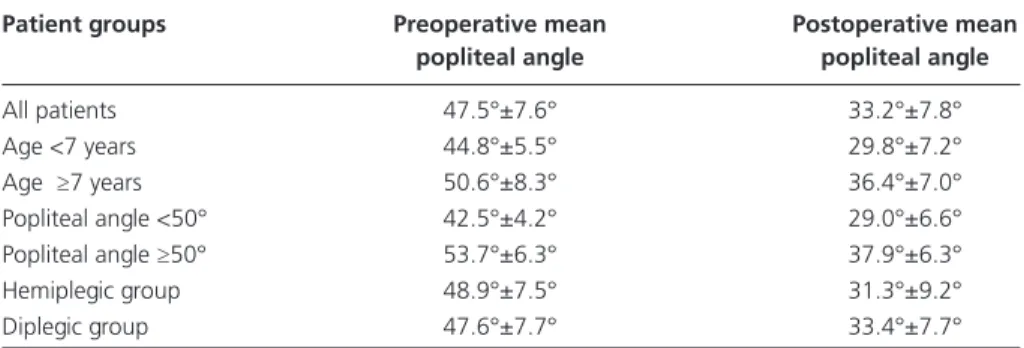
Mean popliteal angles were 47.5°±7.6° (range: 32 to 68°) and 33.2°±7.8° (range: 15° to 50°) before and after semi-tendinosus tenotomies, respectively (Table 1). The mean improvement of the popliteal angle was 30.1%±10.5 (range: 23.6% to 55.7%) and it was statistically significant (p=0.0001). The mean popliteal angles were 50.9°±9.0° (range: 33° to 69°) and 44.8°±6.7° (range: 32° to 58°) before and after gastrocnemius tenotomies, respectively.
The mean decrease of 12%±5.7 (range: 2.2% to 25%) was statistically significant (p=0.0001).
When the results of semitendinosus tenotomies were evaluated according to age, preoperative and post-operative mean popliteal angles were 44.8°±5.5° and 29.8°±7.2° in Group 1, respectively. The improvement of the popliteal angle was 33.5% in Group 1 and it was statistically significant (p=0.0001). In Group 2, preop-erative and postoppreop-erative mean popliteal angles were 50.6°±8.3° and 36.4°±7.0, respectively. Popliteal angles improved by 28.1% in Group 2 after semitendinosus te-notomy and this difference was statistically significant (p=0.0001). The difference between popliteal angle im-provements in Group 1 and Group 2 was not statisti-cally significant (p=0.055).
For gastrocnemius tenotomies, preoperative and postoperative mean popliteal angles were 47.2°±7.7° and 42.2°±4.8°, respectively, in Group 1. Popliteal angle significantly improved by 10.6% (p=0.001). In Group 2, preoperative and postoperative mean popliteal angles were 54.6°±9° and 47.4°±7.4, respectively. The mean improvement of the popliteal angle was 13.2% in Group 2 and this difference was also statistically significant (p=0.001). The difference between popliteal angle im-provements in Groups 1 and 2 was not statistically sig-nificant (p=0.069).
According to severity of the spasticity in the semi-tendinosus tenotomies, preoperative and postoperative average popliteal angle was 42.5°±4.2° and 29.0°±6.6°, respectively, in Group A and 53.7°±6.3° and 37.9°±6.3°, respectively, in Group B. Mean popliteal angles signifi-cantly improved by 31.8% in Group A and 29.4% in Group B (p=0.0001). The difference between popliteal angle improvements in Groups A and B was not statisti-cally significant (p=0.242).
For patients undergoing gastrocnemius tenotomies, preoperative and postoperative average popliteal angle was 43.5°±4.9° and 39.6°±4.6°, respectively, in Group A and 57.3°±6.2° and 49.3°±4.6°, respectively, in Group Table 1. The mean values for preoperative and postoperative popliteal angles are shown.
Patient groups Preoperative mean Postoperative mean
popliteal angle popliteal angle
All patients 47.5°±7.6° 33.2°±7.8° Age <7 years 44.8°±5.5° 29.8°±7.2° Age ≥7 years 50.6°±8.3° 36.4°±7.0° Popliteal angle <50° 42.5°±4.2° 29.0°±6.6° Popliteal angle ≥50° 53.7°±6.3° 37.9°±6.3° Hemiplegic group 48.9°±7.5° 31.3°±9.2° Diplegic group 47.6°±7.7° 33.4°±7.7°
B. The improvements of the mean popliteal angles were 9% in Group A and 14% in Group B and these were sta-tistically significant (p=0.001). The difference between popliteal angle improvements in Group A and Group B was statistically significant (p=0.022).
Average popliteal angles were 48.9°±7.5° before and 31.3°±9.2° after semitendinosus tenotomy in the hemi-plegic group and 47.6°±7.7° and 33.4°±7.7°, respec-tively, in the diplegic group. Popliteal angles improved by 36% in the hemiplegic group and 29.8% in the diplegic group. The improvement in popliteal angles was statis-tically significant in both the diplegic (p=0.0001) and hemiplegic (p=0.008) groups. The difference between popliteal angle improvements in the hemiplegic and di-plegic groups was not statistically significant (p=0.104). In patients who underwent gastrocnemius tenoto-mies, average preoperative and postoperative popliteal angles were 50.1°±6.1° and 43.5°±2.9°, respectively in the hemiplegic group and 51.0°±9.7° and 45.1°±7.4° in the diplegic group. Angles improved by 13.2% in the hemiplegic and 11.6% in the diplegic group and these improvements were statistically significant in both groups (p=0.0001 and p=0.026, respectively). The dif-ference between the improvement in popliteal angle be-tween groups was not statistically significant (p=0.573). Discussion
Knee flexion deformity is a common problem in chil-dren with CP. Surgical lengthening of the hamstrings is a treatment option for knee flexion deformity in spas-tic CP.[1,3,4,6] Optional surgical procedures consist of
Z-plasty, fasciotomy and tenotomy of the semimem-branosus, semitendinosus, and biceps femoris muscles. Nonetheless, the improvement in knee extension after each of these procedures is unclear. To our knowledge, no studies in the literature have reported on the correc-tive effect of semitendinosus and gastrocnemius tenoto-mies on popliteal angle. However, such studies would be able to play an important role in the treatment strat-egy of knee flexion deformity in CP. We determined an improvement of 30.1% in the popliteal angle with semitendinosus tenotomy. In addition, shortening of the gastrocnemius-soleus muscle-tendon unit induces abnormal motion in the knee joint[12,16,17] and
gastrocne-mius tenotomy improves extension of the knee joint.[12]
This improvement was determined as an 12% decrease in the popliteal angle. Our findings also suggested that age, preoperative popliteal angle or anatomical disease classification did not have statistically significant effects on these popliteal angle improvements.
Various operative procedures have been determined
to eliminate the spasticity of the hamstring muscles. [13,18-21] Baumann et al. achieved significant improvement in
knee extension after hamstring tenotomy.[22] According
to DeLuca et al., semitendinosus tenotomy, as a part of hamstring tenotomy procedure, provides significantly better gait performance.[2] However, recurrence rates
of up to a 40% have been reported in the literature as a common complication.[7,8,23] Sharps et al. determined
that the correction achieved through distal hamstring tenotomy was not maintained in up to 50% of patients.
[15] We believe that inadequate lengthening of the
ham-strings could cause recurrence of deformity.
Knee recurvation has been observed as another un-favorable effect of hamstring lengthening.[4,20]
Drum-mond et al. reported a recurvation rate of up to 30% af-ter hamstring tenotomy.[24] Dhawlikar et al. reported 8%
recurvation after hamstring tenotomy and emphasized that there is no accurate way to predict postoperative recurvation.[23] Those undesirable effects and difficulties
indicate that the amount of surgical correction plays an important role in the treatment. However, there is no objective guide to show how much correction can be achieved through tenotomy of each hamstring tendon. We examined popliteal angle improvement, which can be achieved with semitendinosus tenotomy, because per-cutaneous determination of the semitendinosus tendon has a higher reliability than that of other parts of the hamstrings. Our study determined that a mean popli-teal angle improvement of 14.3° (30.1%) can be achieved with semitendinosus tenotomy.
Ankle equinus, one of the most common deformities in spastic CP, is commonly treated with gastrocnemius tenotomy.[25] The gastrocnemius muscle is a secondary
flexor of the knee joint.[10,11,17] Previously, while it has
been shown that tenotomy of the gastrocnemius muscle improves extension of the knee joint,[12] no quantitative
data about the effects of this procedure has been present-ed in the literature. Furthermore, gastrocnemius tenoto-my can cause overcorrection of knee flexion deformity if it is performed together with hamstring tenotomy. We determined that a mean popliteal angle improvement of 6.1° (12%) can be achieved with gastrocnemius tenot-omy. We believed that this result may help surgeons to avoid overcorrection of knee flexion deformity in cases in which semitendinosus tenotomy was planned in addi-tion to gastrocnemius tenotomy.
Phelps reported that only 15% of operative proce-dures in patients younger than 14 years of age were suc-cessful.[26] However, many other authors concur that age
does not significantly affect operative outcome of ham-string tenotomy.[7,15,23] Our analysis also showed that the
effect of age on the amount of popliteal angle correction was not statistically significant. Mean popliteal angle improved by a mean of 33.5% in patients younger than the age of seven and by 28.1% in those seven years old or older following semitendinosus tenotomy. The angle improved by 10.6% and 13.2% in patients younger and older than the age of seven, respectively, following gas-trocnemius tenotomy.
There was no statistically significant relationship between the severity of flexion deformity and the mag-nitude of popliteal angle correction. However, Damron et al. performed 117 hamstring tenotomies (proximal, distal or combined) with a follow-up of 3.4 years and re-ported that the severity of preoperative flexion deformi-ty was related with improvement in postoperative range of motion.[7] We had similar results in this study and
found that the popliteal angle improvement was more for semitendinosus tenotomy when preoperatively pop-liteal angle was greater than 50°. However, this improve-ment percentage was statistically insignificant. Further-more, the popliteal angle improvement was statistically significant for gastrocnemius tenotomy in patients with a preoperative popliteal angle greater than 50°.
Popliteal angle measurement is widely used for clini-cal assessment of hamstring spasticity and has good intraobserver reliability.[27,28] The anterior pelvic tilt is
counterbalanced by hamstring contraction, which is ex-pressed by an increased popliteal angle. Although there are some concerns regarding proper popliteal angle mea-surement technic, all meamea-surements were performed by a single experienced author before and after tenotomies using the same method to decrease some bias. Therefore, the effect of anterior pelvic tilt remained constant, in-creasing the objectivity.
The relatively small number of patients with gastroc-nemius release may be considered a limitation of this study. Further studies with a larger group of patients are necessary for greater reliability. In addition, long-term results, complications and loss of improvement in extension were not included in this study. However, the purpose of this study was to evaluate intra-postoperative improvement after the procedure in order to assist in preoperative planning.
In conclusion, both semitendinosus and gastrocne-mius tenotomy appeared to improve popliteal angle in patients with CP. We believe that this data can help sur-geons in the preoperative planning for the treatment of knee flexion deformity in CP. In this manner, overcorrec-tion or recurrence can be avoided.
Conflics of Interest: No conflicts declared.
References
1. Horstmann HM, Bleck EE. Orthopaedic Management in Cerebral Palsy. 2nd ed. London: Mac Keith Press; 2007. p. 303-43.
2. DeLuca PA, Ounpuu S, Davis RB, Walsh JH. Effect of hamstring and psoas lengthening on pelvic tilt in patients with spastic diplegic cerebral palsy. J Pediatr Orthop 1998;18:712-8. CrossRef
3. Gage JR. Gait analysis. An essential tool in the treatment of cerebral palsy. Clin Orthop Relat Res 1993;288:126-34. 4. Kay RM, Rethlefsen SA, Skaggs D, Leet A. Outcome
of medial versus combined medial and lateral hamstring lengthening surgery in cerebral palsy. J Pediatr Orthop 2002;22:169-72. CrossRef
5. Csongradi J, Bleck E, Ford WF. Gait electromyography in normal and spastic children, with special reference to quadriceps femoris and hamstring muscles. Dev Med Child Neurol 1979;21:738-48. CrossRef
6. Sullivan RC, Gehringer KM, Harris GF. A computer-assisted survey of results of medial hamstring surgery in children with cerebral palsy. Orthop Trans 1984;8:109. 7. Damron T, Breed AL, Roecker E. Hamstring tenotomies
in cerebral palsy: long-term retrospective analysis. J Pedi-atr Orthop 1991;11:514-9. CrossRef
8. Campos da Paz A Jr, Nomura AN, Braga LW, Burnett SM. Speculations on cerebral palsy. In proceedings of the British Orthopaedic Association. J Bone Joint Surg Br 1984;66:283.
9. Atar D, Zilberberg L, Votemberg M, Norsy M, Galil A. Effect of distal hamstring release on cerebral palsy pa-tients. Bull Hosp Jt Dis 1993;53:34-6.
10. Daniel DM, Stone M. Instrumented Measurement of Knee Motion. In: Daniel DM, Akeson WH, O’Connor JJ, editors. Knee Ligaments: Structure, Function, Injury and Repair. New York:Raven Press; 1990. p. 421-6.
11. Li L, Landin D, Grodesky J, Myers J. The function of gastrocnemius as a knee flexor at selected knee and ankle angles. J Electromyogr Kinesiol 2002;12:385-90. CrossRef
12. Baddar A, Granata K, Damiano DL, Carmines DV, Blan-co JS, Abel MF. Ankle and knee Blan-coupling in patients with spastic diplegia: effects of gastrocnemius-soleus lengthen-ing. J Bone Joint Surg Am 2002;84:736-44.
13. Silfverskiöld N. Reduction of the uncrossed two-joints muscles of the leg to one-joint muscles in spastic condi-tions. Acta Chir Scan 1924;56:315-30.
14. Strayer Lm Jr. Recession Of The Gastrocnemius; An Op-eration To Relieve Spastic Contracture Of The Calf Mus-cles. J Bone Joint Surg Am 1950;32:671-6.
15. Sharps CH, Clancy M, Steel HH. A long-term retrospec-tive study of proximal hamstring release for hamstring con-tracture in cerebral palsy. J Pediatr Orthop 1984;4:443-7. 16. van der Linden ML, Aitchison AM, Hazlewood ME,
Hillman SJ, Robb JE. Effects of surgical lengthening of the hamstrings without a concomitant distal rectus femoris transfer in ambulant patients with cerebral palsy. J Pediatr Orthop 2003;23:308-13. CrossRef
17. Ettema GJ. Gastrocnemius muscle length in relation to knee and ankle joint angles: verification of a geometric model and some applications. Anat Rec 1997;247:1-8. 18. Ray RL, Ehrlich MG. Lateral hamstring transfer and gait
improvement in the cerebral palsy patient. J Bone Joint Surg Am 1979;61:719-23.
19. Sutherland DH, Schottstaedt ER, Larsen LJ, Ashley RK, Callander JN, James PM. Clinical and electromyographic study of seven spastic children with internal rotation gait. J Bone Joint Surg Am 1969;51:1070-82.
20. Gordon AB, Baird GO, McMulkin ML, Caskey PM, Fer-guson RL. Gait analysis outcomes of percutaneous medial hamstring tenotomies in children with cerebral palsy. J Pe-diatr Orthop 2008;28:324-9. CrossRef
21. Evans EB. The status of surgery of the lower extremities in cerebral palsy. Clin Orthop Relat Res 1966;47:127-39. 22. Baumann JU, Ruetsch H, Schürmann K. Distal hamstring
lengthening in cerebral palsy. An evaluation by gait analy-sis. Int Orthop 1980;3:305-9. CrossRef
23. Dhawlikar SH, Root L, Mann RL. Distal lengthening of the hamstrings in patients who have cerebral palsy. Long-term retrospective analysis. J Bone Joint Surg Am 1992;74:1385-91.
24. Drummond DS, Rogala E, Templeton J, Cruess R. Proxi-mal hamstring release for knee flexion and crouched pos-ture in cerebral palsy. J Bone Joint Surg Am 1974;56:1598-602.
25. Grant AD, Feldman R, Lehman WB. Equinus deformity in cerebral palsy: a retrospective analysis of treatment and function in 39 cases. J Pediatr Orthop 1985;5:678-81. 26. Phelps Wm. Long-term results of orthopaedic surgery in
cerebral palsy. J Bone Joint Surg Am 1957;39:53-9. 27. Ten Berge SR, Halbertsma JP, Maathuis PG, Verheij
NP, Dijkstra PU, Maathuis KG. Reliability of popliteal angle measurement: a study in cerebral palsy patients and healthy controls. J Pediatr Orthop 2007;27:648-52. CrossRef
28. Katz K, Rosenthal A, Yosipovitch Z. Normal ranges of pop-liteal angle in children. J Pediatr Orthop 1992;12:229-31.