ρ ε
///08
■686
ІЭЭ9
THE EFFECT OF THE PROCESS APPROACH ON STUDENTS’ PERCEPTIONS OF THEIR STRENGTHS AND WEAKNESSES IN COMPOSITION
A THESIS PRESENTED BY NESLİHAN GÜNDOĞDU
TO THE INSTITUTE OF ECONOMICS AND SOCIAL SCIENCES IN PARTIAL FULFILLMENT OF THE REQUIREMENTS
FOR THE DEGREE OF MASTER OF ARTS IN TEACHING ENGLISH AS A FOREIGN LANGUAGE
BiLKENT UNIVERSITY JULY 1999
UtO%
'ОгШ
Title
Author
Thesis Chairperson
Committee Members
ABSTRACT
The Effect of the Process Approach on Students’ Perceptions of their Strengths and Weaknesses in Composition.
: Neslihan Giindogdu : David Palfreyman
Bilkent University, MA TEFL Program Dr. William E. Snyder
Dr. Patricia N. Sullivan Michele Rajotte
Bilkent University, MA TEFL Program
This study intended to determine if the process approach to teaching writing changes students’ perceptions of their strengths and weaknesses, and to investigate students’ attitudes towards peer review and the writing of multiple drafts.
A relationship study was conducted at Çukurova University over eight weeks. Two classes at the pre-intermediate level were chosen. One of the groups (Group A) received the traditional approach to writing, while the other group (Group B) was taught using the process approach to writing throughout the treatment. There were 19 students in group A. Group B had 22 students.
Data collection tools included surveys with five-point Likert scale questions and open-ended questions and informal interviews. At the beginning and at the end of the study, students in both groups were asked to respond to surveys about their perceptions of their strengths and weaknesses in writing. The surveys contained same items for both groups. Towards the end of the study. Group B was observed during a peer review session. After the observation, during a break, informal interviews were held with the students. At the end of the study, another survey
determining students’ attitudes toward peer review was given out to the students in Group B.
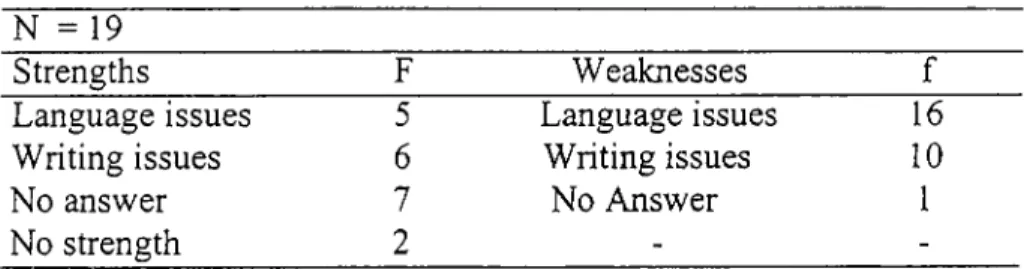
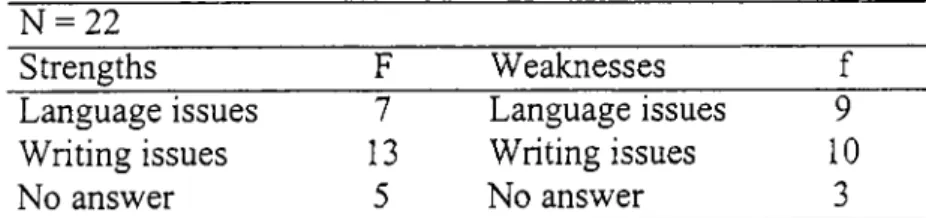
Maim-Whitney Test and Wilcoxon Signed Ranks Test were used to compare pre-treatment and post-treatment survey answers across and within groups. Written responses to the open-ended questions examining students’ strengths and weaknesses in composition were analyzed by categorizing them into language issues and writing issues.
The results of the statistical analysis were interesting. Mann-Whitney Test revealed that groups are not homogenous at the outset. Wilcoxon Signed Rank Test indicated that there is no significance difference across the questionnaire items before and after the treatment for Group A, while there are significant differences in two items of Group B’s results.
Students’ responses to the open-ended question about their strengths and weaknesses revealed that Group A focused on their weaknesses while Group B became more uncertain about their strengths over the course of the study.
Group B’s responses to the survey about their attitudes towards peer review and the writing of multiple drafts showed that they agreed with the usefulness of writing multiple drafts, but felt uncertain about the value of peer review.
Students responses to the open-ended questions about the gains from peer review and the writing of multiple drafts indicated that students felt they benefited in language issues in peer review sessions, but that writing multiple drafts helped them improve more in terms of writing issues.
BİLKENT UNIVERSITY
INSTITUTE OF ECONOMICS AND SOCIAL SCIENCES MA THESIS EXAMINATION RESULT FORM
JULY 31, 1999
The examining committee appointed by the Institute of Economics and Social Sciences for the thesis examination of the MA TEFL student
NESLİHAN GÜNDOĞDU has read the thesis of the student.
The committee has decided that the thesis of the student is satisfactory.
Thesis Title: The Effect of the Process Approach on Students’ Perceptions of their Strengths and Weaknesses in Composition.
Thesis Advisor: Dr. William Snyder
Bilkent University, MA TEFL Program Committee Members: David Palffeyman
Bilkent University, MA TEFL Program Dr. Patricia Sullivan
Bilkent University, MA TEFL Program Michele Rajotte
We. certify that we have read this thesis and that in our combined opinion it is fully adequate, in scope and in quality, as a thesis for the degree of Master of Arts.
Dr .William E. Snyder (Advisor) David Palfreytnan (Committee Member) Dr. Patricia N. Sullivan (Committee Member) -r--- ^ 7 -Michele Rajotte (Committee Member)
Approved for the
Ali Karaosmanoglu Director
VI
VII
ACKNOWLEDGMENTS
I would like to thank my advisor Dr. William Snyder for his support and patience and optimism during the writing of the thesis. I would like to thank other staff members, namely Dr. Patricia Sullivan, Michelle Rajotte, Dr. Necmi Akşit and David Palfreyman. A special thanks goes to Dr. Theodore Rodgers for helping us out in the teaching of SLA and Methodology when a lecturer was needed urgently in the first term. It was a nice opportunity to get to know him and benefit from his experience in teaching.
I wish to express my gratitude to Prof Özden Ekmekçi for giving me the invaluable chance to feel the enjoyable side of being a student again.
I would like to express my deepest appreciation to my dormmate and colleague Melek Türkmen, who helped me cope with the intensity of the program with her optimism, excellent sense of humor, thoughtfulness and kindness. The lifelong friendship we have built shall continue at home and away.
I am grateful to my MA TEFL friends for their cooperation, friendship and moral support through out this program.
My special thanks go to Hülya Yumru who inspired me to carry out this research study.
I am also most grateful to my colleagues Rezzan Altunbaş and Bedriye Tırak, who participated in the study.
My heartfelt thanks go to my parents and my sisters. Emine, Hatice, Fatoş and my brother Mehmet for their moral support and encouragement.
vin
TABLE OF CONTENTS
LIST OF TABLES... x
CHAPTER 1 INTRODUCTION... 1
Background of the Study... 5
Statement of the Study... 7
Purpose of the Study... 8
Significance of the Study... 8
Research Questions... 8
CHAPTER 2 LITERATURE REVIEW... 9
Introduction... 9
An Overview of the Traditional Approach to Writing Instruction... 9
An Overview of the Process Approach to Teaching Writing... 10
Studies Done on the Process Approach... 15
Peer Review... 17
Attitudes Towards Writing... 23
CHAPTER 3 METHODOLOGY... 29
Introduction... 29
Participants... 30
Materials... 30
Research Design and Procedure... 32
Data Collection... 35
Data Analysis... ... 35
CHAPTER 4 DATA ANALYSIS... 37
Overview of the Study... 37
Data Analysis Procedure... 37
The Results of the Study... 38
Statistical Analysis of the Pre-treatment and Post-treatment Survey... 38
Qualitative Analysis... 40
Analysis of the Peer Review and Multiple Drafts Survey... 45
CHAPTER 5 CONCLUSIONS... 49
Overview of the Study... 49
General Results and Discussion... 50
Limitations... 53
F urther Research... 54
REFERENCES... 55
APPENDICES... 59
Appendix A; Pre-and Post Survey on Students’ Strengths and Weaknesses... 59
IX
English Version of Pre-and Post Survey on
Students Strengths and Weaknesses... 60 Appendix B:
Survey on Students’ Attitudes Towards
Peer Review and Writing Multiple Drafts... 61 English Version of the Survey on Students’
Attitude Towards Peer Review and Writing
Multiple Drafts... 63 Appendix C:
Peer Review Checklists... 65 Focus Questions Before / While They
Are Writing... 65 Self-Check... 66 (To the Author) Linguistic Features... 67 (To the Editor) First Draft (
(Expression/Organization of Ideas)... 68 (To the Editor) (Language Mechanic)... 69
LIST OF TABLES
TABLE p a g e
1 Wilcoxon Signed Rank Test Results for Item 3... 39 2 Wilcoxon Signed Rank Test Results for Item 10... 40 3 Frequencies of Reported Strengths and Weaknesses
in the Pre-Treatment Survey of Group A
... 41 4 Frequencies of Reported Strengths and Weaknesses
in the Post-Treatment Survey of Group A ... 41 5 Frequencies of Reported Strengths and Weaknesses
in the Pre-Treatment Survey of Group B ... 42 6 Frequencies of Reported Strengths and Weaknesses
in the Post-Treatment Survey of Group B ... 43 7 Frequencies of Strengths and Weaknesses Reported by Students... 44 8 Rankings for the Survey Determining Students’ Attitudes
Towards Peer Review and Writing of Multiple Drafts... 46 9 Student Gains from Peer Reviews and Writing
CHAPTER I; INTRODUCTION
Increasing literacy requirements in education and in the workplace have raised awareness as to how important writing is in order to communicate ideas in modem society. Having good writing skills in one’s native language in order to deal with daily writing needs is essential (Williams, 1996). For students, having good writing skills in their academic studies and in their future career will help determine their level of success in society.
Having good writing skills to convey our ideas is important in learning a second language, too. In Raimes’ (1983) words “when we leam a second language, we learn to communicate with other people, to understand them, to talk to them, read what they have written and write to them’’ (p. 3). In order to communicate, in other words, “one should not only be competent in speaking, but also be able to
communicate through writing” (Toros, 1991, p. 1).
Being aware of having good writing skills raises the question of how one gains good composing skills. Grabe and Kaplan (1998) define writing as “a
technology, a set of skills which must be practiced and learned through experience” (p. 6). That is to say, people are not bom with good writing skills. To leam and to develop writing skills, students need to be aware of different aspects of writing such as audience awareness, awareness of language and rhetoric, and awareness of language uses. This process can be assisted; in order to be aware of these skills students need to notice them through careful instmction (van Tier, 1996). He argues that “to leam something new, one must first notice it. This noticing is awareness of existence obtained and enhanced by paying attention to it” (p. 11). This can be applied in composition; once students have noticed what they need to do while
writing, they use their mind and logic by paying attention and noticing aspects of good writing skills during the writing process. This noticing and paying attention starts in the process and students discover that their ideas are generated, not transcribed. That is to say, students do not borrow other people’s ideas, but create their own (Susser, 1994). What students need is to become aware of their potential language and resources. This brings their “hidden power” into light (van Lier, 1996). In order to help students become better writers, studies have been carried out and different approaches to teaching writing have been developed.
The process.approach is .one such^approach to teaching writing. It is an approach to writing as a cyclical and ongoing process which “stresses generating ideas, writing drafts, producing feedback and revising in an attempt to produce meaningful written products” (Şaşkın, 1992, p. 17). While composing, students go through the stages of planning, drafting, revising and editing, each of which has equal importance in the non-linear process. During the process, students write drafts which are initial writings, and which are rewritten until the thoughts fully take shape. (Murray, 1980). Teachers encourage students to write multiple drafts of assignments with a focus on content. Students deal with the correction of mechanical errors,
> /
such as spelling and punctuation, in the final stages of editing. Students are also encouraged to practice peer review, which involves sharing their writing with peers to give feedback on each other’s writing (Leki, 1991).
The process approach to teaching writing started as a reaction to the traditional approach in LI writing. Teachers were dissatisfied with the traditional approach as the “emphasis was on correct usage, correct grammar and correct spelling” (Grabe and Kaplan, 1998, p.30). LI writing teachers also thought that
students’ slow progress in their writing abilities was due to the writing instruction they received. “It discouraged creative thinking and writing ’’ (Silva, 1994, p. 15).
The traditional approach is a “straightforward plan, outline and write sequence” (Taylor, 1984, p.3). In this approach, teachers spend their class time having students do spelling drills, vocabulary exercises and then a reading text chosen as a good writing sample is discussed with the students. Having discussed the text, students are assigned to write a similar essay at home to please the teacher. While checking the students’ work the teacher focuses on the form rather than the meaning (Williams, 1996).
The traditional approach to writing instruction is used in ESL/ EFL classes, too. “For many teachers, writing was seen as grammar instruction with the emphasis on product and correct form over the expression of ideas” (Susser, 1994, p. 36; see also Chastain). When students wrote a composition, the purpose of the activity was to catch grammar, spelling and punctuation errors. Grammar exercises served as writing activity. For example, students did transformation activities by changing one tense to another or all singular nouns to plural, or masculine pronouns to feminine ones (Leki, 1991).
Writing was the last skill to be taught because in the traditional approach the philosophy is that “students are not ready to produce a work themselves; they are ready to manipulate forms” (Leki, 1991, p. 170). Therefore writing was served as a side dish and was used as a supplementary activity for grammar exercises. This was also due to dominant methods aimed at acquiring language in schools. For instance, one of the methodological practices of audiolingualism is that “language skills are learned more effectively if the items to be learned in the target language are
presented in spoken form before they are seen in written form (Richards & Rodgers, 1996, p. 51).
Concerns about the traditional approach led teachers of writing to native speakers of English to “new theories of writing instruction based on more successful teaching practices” (Grabe & Kaplan, 1998, p. 31), such as the process approach. Researchers examining LI writing from four different perspectives discovered that writing does not mean correcting students’ grammar and spelling mistakes or doing guided writing (Taylor, 1984). They also showed that writing was a highly complex process that writers go toough, not in a linear process, but instead cyclically and in varying patterns (Grabe & Kaplan, 1998).
They also discovered differences in the writing processes of productive and non-productive writers. For example, non-productive writers focus on the mechanics of writing and do less planning, forgetful of organization and their audience. They do not do revising beyond the word level. In contrast, skilled writers understand the “recursive nature of the writing process” (Pennington & So, 1993, p. 42). Skilled writers are capable of controlling the whole writing process. They “know when to plan, when to review, and when to revise” (Pennington & So, 1993, p. 42). They also take their audience into consideration.
In the writing pedagogy of the process approach, intervention is an important component. From a cognitive perspective, writing is a complex, problem-solving process. Teachers help students solve their problems through activities such as brainstorming, free writing, journal writing, small group activities, teacher-student conferences, peer reviews, revising and editing the final drafts. Intervention is not Just the teachers’ responsibility. Peer review and related procedures encourage
intervention by classmates; “the goal is for students to internalize this intervention as they write and revise” (Susser, 1994, p. 36).
Peer review groups were used in LI English composition classrooms before L2 classrooms. Later, because of the influence of LI composition theorists, many ESL composition teachers started applying it in their classes (Stanley, 1992). Stanley reviews many empirical studies carried out to justify the adoption of peer review sessions in L2 classes. She reports that the findings of native and non-native English composition classroom studies reveal that students benefit from peer
evaluation in terms of helping them reduce their writing anxiety, improve their sense of audience, and increase fluency while writing.
Background of the Study
I was one of the students who had difficulty in writing compositions during my educational life. Both in my LI and L2 writing classes as a student, the
traditional approach to teaching writing was used by my writing teachers. The result was that my writing skills suffered and I felt discouraged from writing. Now, based on my understanding of the process approach, I realize that if I had had a chance to go back to my work, receive feedback both from my teachers and my peers and revise what I had composed, I would have gained awareness of good writing skills and become a more successful writer. Unfortunately, students today face the same problems I did. I believe this is in part a consequence of the traditional approach still being employed in both LI and L2 writing classes. One underlying problem is that students are not aware of the purpose of writing in their life and for their future career. They are also not aware of writing skills that will help them discover their ideas and their strengths and weaknesses in composing.
In the 1990s, unlike past decades, English language teaching has become very important in Turkey and language teachers follow the current trends in ELT to
support their teaching with better techniques and strategies for their students’ development (Tarhan, 1998). The process approach to teaching writing has drawn the attention of writing teachers and has been employed in some schools. The Preparatory School of English (YADİM) at Çukurova University is one of the
institutions whose objectives include teaching writing instruction through the process approach, but it is not utilized effectively.
Writing skills at YADIM are taught with other skills integratively until students reach the pre-intermediate level of English proficiency. Then all four skills are taught separately by different skills teachers. Students receive three hours of writing instruction a week. There are four levels, each of which lasts eight weeks, in an academic year, so students start receiving writing instruction as a separate skill at level three and continue to study writing skills separately at level four, too. When students receive writing instruction in levels one and two, they are learning to write at the paragraph level. Both students, because of their previous studies, and their teachers focus on the form of their work. This is mainly due to students receiving extensive grammar instruction with less attention on developing other skills. This leads students to get in the habit of putting emphasis on mechanical accuracy in writing. In levels three and four, students learn to write different rhetorical styles, such as narration, description, cause and effect, comparison and contrast, letter writing, summary writing and report writing. Students are taught how to write a particular rhetorical style by using the correct transitions: for instance, learning to use “whereas”, “while”, or “in contrast” for contrasting ideas. Then students read a
sample essay in that rhetorical style. Finally, students write about an assigned topic and their work is checked by the writing teacher, correcting their grammar,
vocabulary, spelling and punctuation. This linear sequence is repeated whenever students start learning a new writing style. Grades are not assigned at this point, but an overall grade is assigned by the teacher at the end of the level according to students’ performance and interest in the lesson.
Statement of the Problem
The impetus for this research study originates from the way writing is taught in writing classes at YADİM (Preparatory School of English, Çukurova University) and the way I was taught writing in both LI and L2 writing classes. Since I started teaching, I have observed that the traditional approach to teaching writing is
employed by writing teachers at Çukurova University. That is to say, students write single-drafts which are corrected by the teacher with a focus on mechanical
correctness and accuracy of syntax. In contrast to this, the goal of our institution is to start teaching writing skills from paragraph to composition level by making use of the skills required, such as planning , drafting, revising and editing. Students are also expected to improve their skills in exploring and organizing ideas and writing a coherent essay and to gain awareness of good writing skills. Students would experience these processes in process approach. Therefore there is a mismatch between the goals of the institution and the approach employed in writing classes. In other words, writing teachers use the traditional approach to teaching writing rather than a process approach to teaching writing despite the goals of the institution. As a result students do not develop new perceptions of themselves as writers and of their writing ability that the use of the process approach might bring.
Purpose of the Study
The purpose of the study is to investigate whether the process approach changes students’ perceptions of their strengths and weaknesses in composing. It also aims to find out what students’ attitudes are toward peer review and the writing and revising of multiple drafts.
Significance of the Study
Through this study, ELT writing teachers will receive valuable information on students’ perceptions of their strengths and weaknesses in composition and their attitudes towards peer review and writing multiple drafts. They will understand the process approach to teaching writing and its effects on students better. The results of this study might lead to some innovations in planning the writing syllabus to match the objectives of my institution. The findings of this study will also be useful to field researchers who are planning to do further research on the process approach to teaching writing.
Research Questions
1) Does the use of the process approach change students’ perceptions of their strengths and weaknesses in composing ?
2) What are students’ attitudes towards peer review and the writing of multiple drafts?
REVIEW OF LITERATURE Introduction
“Over the last decades an important shift has taken place within writing pedagogy, from the more traditional testing-oriented view to a process-oriented position” (Bjdrk & Raisanen, 1996, p. 1). EFL/ESL writing teachers have started to focus on meaning rather than on form in their approach to writing instruction. Since then, many research studies have been carried out to investigate the new process oriented approach in order to help meet students’ needs and to raise awareness among ELT/ESL teachers.
This study attempts to understand whether the use of the process approach raises students’ awareness of their strengths and weaknesses in composing. It also aims to investigate the students’ attitudes towards peer review and the writing of multiple drafts.
This chapter reviews the literature on the traditional approach to teaching writing, the process approach to teaching writing, peer review, and students’ and teachers’ attitudes toward writing.
An Overview of the Traditional Approach to Writing Instruction The traditional approach is a “linear process with a strict plan and write sequence” (Toros, 1991, p. 29). In this approach, students are assigned a topic to write about and then the teacher reads through the finished papers, marking
punctuation, spelling and grammar as the focus is on the product. After handing the papers back, the teacher comments on the errors for a few minutes, telling students what their composition should look like (Williams, 1996). As Raimes (1983) points out, “topics are assigned by the teacher since the interest is in how sentences are
10
written rather than in what ideas are expressed” (p. 199). Therefore, in a writing activity students try to avoid grammar, spelling, and punctuation errors (Raimes, 1991, Leki, 1991). This causes anxiety among students and they “ write cautiously and conservatively in their second language” (Leki, 1991, p. 171). Fear of making mistakes prevents students from writing sentences up to their language proficiency in L2. Instead they write simple sentences as they know that they have the control over them. Another feature of the approach is that, as Hedgcock and Lefkowitz (1993) state “the teacher generally serves as the sole audience for the text produced by L2 writers” (p. 288). In other words, the teacher is the only person who reads and checks the students’ papers.
Assessment consists of the assignment of a score or grade on a single draft. (Lefkowitz, 1996). As Bjork and Raisanen (1996) state “writing has been used as a testing tool, either to test the students’ mastering of language as a code (grammatical correctness) or to test the students’ knowledge of a certain subject” (p. 1).
An Overview of the Process Approach to Teaching Writing
The process approach is a non-linear cycle of writing activities including rehearsing (pre-writing), drafting (a reflection of the writers thinking) and revising. “Students learn to invent, select, organize and express their material recursively. They see how decisions about purpose and audience influence decisions about what will be said and how it will be said. They see that reading and writing are linked, and that writing is essentially a thinking process” (Lannon, 1995, p. 3).
In this approach “the focus of attention has shifted from the finished product to the whole process of writing” (Qiyi, 1993, p. 30). Leki (1991) says “ the emphasis in the process approach is less on the product and more on the wandering path that
11
students use to get to the product” (p. 174). She explains that until students produce a proper text, students experience the cycles, writing several drafts by referring back and forth to the initial drafts when necessary.
The process approach is also the process of interaction and communication between peers and teachers. While composing, students make use of the comments of their friends and teachers on their work. Furthermore, students communicate their ideas by forming a triangle, including writer, reader and text. When students are learning to write they discover their ideas by integrating skills and task with the help of the writing instruction that they receive. Going through an interactive process helps students become “self-sufficient in self-learning, self-correction and self editing” (Singh & Sarker, 1994 p. 18).
In Keh’s (1990) words “ a process approach to writing sees writing as a process of several steps; beginning first with generating ideas (via various sources/methods), writing to discover what one wants to say, revising, getting feedback from various readers (between revisions), and writing again” (p. 10). During the composing process, they try to write “what they think they want to say” (Leki, 1991, p. 171) and get feedback from their peers and teachers. In the end, if the student’s work is found satisfactory by teachers and peers, a final version of the produced text is rewritten.
The process approach emphasizes the different writing styles in which students are writing because the process helps them become aware that there are many different kinds of writing and many different reasons for writing. Thus, students are trained to write for different purposes through instruction using this approach (Leki, 1991).
12
The content of student writing is important. Students write about what they are interested in and know about. Students pay attention to what they really want to communicate and what they really want a reader to know. Writing on subjects that students are familiar with and interested in helps students “commit themselves intellectually to express something meaningful. It helps students experiment with ideas” (Leki, 1991, p.l71). Judy (1980) says that “students of all ages have a various range of experience that can serve as the starting point for writing: hopes, fears, wishes and ambitions, past events in their lives even fantasies” (p. 39). Students come to realize that whatever they write has grown out of their experience (Toros, 1993).
Students take the audience and the purpose into consideration while writing in the process approach. In Lannon’s (1995) words “they need to decide who their audience is and how to connect with it. They need to decide what goal they want their writing to achieve and how to make sure the writing achieves that goal. They need to decide what to say and how to say it” (1995, p. 4). These are the same problems that most writers in most real life situations face as there is not one recipe for writing well. While trying to make these decisions, students go through the cycles of the process until their thinking takes shape. Lannon (1995) proposes a model of the process approach that divides the writing process into three cycles: rehearsing, drafting, and revising. The cycles are recursive, and writers can go back and forth to any of the stages to make changes in their writing. Writing progresses and improves over these stages.
Rehearsing is often the first stage of the writing process. As most writers spend a good amount of their time planning before they write, writing teachers ask
13
students to think about the message they want to convey. Students need to think about the content of their composition and become aware of their purpose. That is to say, students should know why they are writing. They should also take their
audience into consideration since “the choice of content, organization and language depends on these factors” (Singh & Sarker 1993, p.l8). Students are made aware of the fact that they need to present their ideas in their composition through “three kinds of competencies: 1) subject competency (knowing what to communicate across the reader), 2) organizational competency (being capable of organizing ideas
effectively), 3) linguistic competency (being able to have the control over the linguistic issues such as grammar, vocabulary, spelling and punctuation)” (Singh & Sarker, 1995, p. 18). Students should be able to show how to communicate by using linguistic knowledge and organization strategies. Becoming aware of planning competencies help students monitor the organization and development of their ideas. This stage helps writers to find out what they have to say.
Drafting is the “central stage of the process” (Murray, 1980, p. 5). Based on the planning in rehearsing, students set out to give shape to the skeletal structure, so a draft is an early version of,a composition. Murray (1980) defines drafting as “the tentative nature of our written experiments in meaning” (p. 6). Students write several drafts in this stage. Writing drafts helps students gain certain skills. First, while experiencing this cycle, students develop fluency and confidence, because they start writing coherent pieces as they learn to express their thoughts and ideas “since the purpose of writing is to convey concrete information” (Singh & Sarker, 1994, p. 18). Second, writing drafts encourages them to try out the ways of presenting their ideas. Third, they learn to take the needs of their audience and the purpose of their writing
14
into account (Toros, 1993). As Williams points out (1996), “writers need to have a sophisticated understanding of audience in order to be successful” (p. 17). Students need to be aware of their audience’s knowledge, background, language abilities, needs, and expectations (Williams, 1996).
Revising is not recopying or correcting errors. During the revising stage, writers reconsider their thoughts to determine whether they were successful in sending a message to their readers (Toros, 1993). In this stage the students need an outsider’s comments on their work. Peer review takes place in this cycle. Students give feedback on each other’s work with the help of the guidelines, such as
questionnaires, which enable students to be aware of both form and meaning. Peer responses send the writer back to the previous stages of writing. Checking a peer’s work with the help of guidelines helps students become critically aware of their own performance as they organize their peer’s writing (Singh & Sarker, 1994). All students have freedom to accept or reject a suggestion and comment on whether it is relevant or not. According to Singh and Sarker (1994), “students reformulate ideas and structure, correct grammatical, lexical, syntactical and organizational lapses, incorporate new ideas or make chaiiges wherever necessary m order to improve overall writing” (p. 21).
Leki (1991) states that “writing is the natural outlet for the students’ reflections on their speaking, listening, and reading experiences in their second language” (p. 171). In other words, students reflect their knowledge of a second language through writing. When students write freely without the fear of making grammatical mistakes and try to write their ideas, they “develop confidence and sense of power over the language” (Leki, 1991, p. 171). In the other skills, unlike
15
writing, one has to reach an advanced level to have sense of power over the other skills. Writing gives students time to think and organize their ideas and go over them until the writer feels that it reflects their thoughts (Leki, 1991).
Studies Done on the Process Approach
In this section the empirical studies carried out on use of the process approach in comparison with the traditional approach in order to investigate different aspects of it are reported.
Toros (1993) conducted a study to find out if the process approach to writing instruction helped intermediate level EFL learners to improve their written work, particularly, with respect to cohesive characteristics of their texts, more than the traditional approach. The researcher carried out an experimental study. Twenty-five students participated in the study: eight students in the experimental group, 17 students in the control group. Four types of external conjunctive cohesive devices (additive, adversive, casual, temporal) were chosen as a means of measuring students’ improvement from the pre-to post-test.
The result of the study indicated that EFL students benefited from a more structured traditional approach than a process approach to writing instruction. The correlation between the holistic measurement and the counting of external
conjunctive cohesive devices used by the students in their work was low. The imbalance between the groups made the results less reliable. Students’ motivation was found to be a significant factor in the success of one approach or the other. These results suggest that motivation may help students succeed in writing, regardless of method.
16
Pennington, Brock and Yue (1996) did a study on students’ reaction to the process approach. Eight volunteer native-Cantonese-speaking English teachers took part in the study and used the process approach in their Hong Kong secondary school classrooms. The data analysis was based on students’ responses to questionnaires administered at the beginning and at the end of the project. The questionnaires were about use of English, attitudes towards English and English writing and a lesson evaluation. In addition to this, lessons were evaluated at the end of each of three units of process writing. Each unit consisted of four or more lessons. The students’ reactions were assessed as positive, negative, or mixed outcomes, and the results were interpreted in terms of a number of possible cause and effect relationships involving the students themselves and their teachers. The attitudes, behaviors, and inherent characteristics of the teachers and students involved were examined as variables. The nature of the adoption of the process writing approach made by individual teachers was examined as a variable.
The results showed that for two groups in academically-achieving-all girl classes, the experience was judged as positive; for two in lower-achieving mixed gender classes as negative and for the four other classes as mixed positive and negative.
These results seem to be a consequence of teachers’ attitudes as determined at the beginning of the project. For instance, there is evidence that in the two classes where the students had the most positive reaction the teacher made a fuller adoption of the process approach than in the two classes where the students had the most negative reaction.
17
Peer Review
“Peer Review has become an increasingly common form of response to students’ writing in both first and second language composition classes”
(Mangelsdorf & Schlumberger, 1992, p. 235). However, 20 years ago, the person who most commonly responded to students’ writing in composition classes was the teacher. As Nelson and Carson (1998) point out “process-oriented classrooms challenge the traditional practice of teaching writing according to reductionist and mechanistic models. Instead they attempt to create an environment in which students are acknowledged as writers and encouraged to take risks” (p. 114). In peer reviews, being as part of the process approach, students help each other discover what they want to communicate to the reader.
Many of the research studies carried out so far have been concerned with the beneficial effects of peer reviews (Mendonca & Johnson, 1994; Villamil & Guerrero, 1998; Stanley, 1992; Mangelsdorf & Schlumberger, 1992). In peer reviews students help each other improve their writing in the early stages of draft development
(Nelson & Carson, 1998). Working in pairs or groups, students read and respond to each other‘s drafts. However, among practitioners, there are still doubts about whether students have enough capacity to help each other in solving linguistic problems in their texts despite the solid theoretical and empirical support for the practice (Villamil & Guerrero, 1998). Attitudes towards peer review are dealt with as a sub question of some studies.
Mangelsdorf and Schlumberger (1992) acknowledge that “peer reviews can give students an authentic audience, provide opportunity for the negotiation and elaboration of meaning and help students practice speaking and listening along with
18
reading and writing” (p. 235). In other words, students do not write for their teachers but for an authentic audience to communicate their ideas. While students comment each other’s work, they discuss their purpose in conveying their ideas. During the review process students learn to practice politeness strategies both in oral and written modes.
Mangelsdorf and Schlumberger (1992) conducted a research study
concerning how advanced ESL students actually respond to each other during review sessions and what these responses suggest about their assumptions concerning peer reviews and composition. Sixty freshmen ESL composition students participated in the study by responding in writing to an essay written the previous semester by another ESL student. Mangelsdorf and Schlumberger then examined the stances the students took toward the text and the writer as they made suggestions for revision. In their analysis, they defined three stances in the students’ reviews: an interpretive stance (students impose their own ideas about the topic onto the text), a prescriptive stance (students expected the texts to follow a prescribed form) and collaborative stance (students tried to see the text through author’s eyes). The reviews were categorized according to the dominant stance the writers took toward the student text. The results of the study showed that a majority of the students took a prescriptive stance, suggesting that they believe that correct form was more important than the communication of meaning.
Unlike the students’ prescriptive or interpretive category, students in the collaborative category wrote reviews, focusing on the important aspects of the rhetorical situation: purpose, audience, message, context and forum. Collaborating in reading the text helps students become aware of the fact that the purpose of
19
expository writing is to influence the reader. Careful planning with collaborative stance can improve teacher-student and student-student interaction. They also point out that “in many ways peer review sessions are a microcosm of the composition classroom” (p. 249) because students’ feedback on each other’s task is the reflection of the teacher’s teaching style. They justify their view by stating that students will be able to express themselves in a particular context if the teacher creates a
collaborative classroom setting. Then peer reviewers will be more likely to
collaborate with each other. They insist that “establishing collaborative peer review sessions within collaborative classroom settings is one way of ensuring that students become actively involved in making meaning, not just receiving meaning” (p. 249).
Stanley (1992) conducted a study to examine the types of peer group
interaction that can occur in the ESL writing classroom and to consider whether more elaborate preparation results in more fruitful conversations about writing. Two freshmen writing classes participated in the study. One of the classes was offered extensive coaching for peer evaluation (seven hours during the first week of a 15- week semester). Students were trained on familiarizing themselves with the genre of the student essay and introduced to the task of making effective responses to each other. Unlike the first group, the second group was given preparation for peer evaluation in a less intensive way. The students in this group were provided with the demonstration of a peer evaluation session and with worksheets and checklists to guide the session. Recorded peer-group conversation was analyzed for the
effectiveness of the coaching. Drafts were analyzed to find out whether students did revision in response to peer evaluators’ advice.
20
The findings indicated that coached group had improved interaction and produced more conversation about their drafts than the groups who had not received coaching. Coached groups gave feedback on each other’s more than the uncoached students by giving specific guidelines for revision. While giving feedback, students used specific response types such as pointing, advising and collaborating. In
addition, the writers in the coached groups were more assertive in receiving advice from their evaluators or responding to them through restatements or comprehension checks. The researcher suggests that “quality and quantity of the responses produced by the coached groups in the sludy suggest that peer evaluation groups were worth the effort with these students” (p. 229). However, teachers-should bear in mind that promotion of such quality peer interaction takes time. Students need to adapt
themselves to the “microculture of the peer evaluation group” (p. 230). They need to learn how to act while interacting in a peer evaluation group. They need to learn to develop different styles of discussing a classmate’s writing without offending them. Development of such awareness takes time.
Mendonca and Johnson (1994) carried out a study to describe the negotiations that occur during ESL students’ peer reviews and the way these negotiations shape students’ revision activities. Twelve advanced ESL learners enrolled in a writing class participated in peer reviews. During peer reviews, students asked questions, made explanations, gave suggestions, restated their peer’s comments and corrected grammar mistakes. Peer review sessions were audio-taped and transcribed.
Transcripts of the peer review and the students’ first and revised drafts were analyzed. Post interviews were used to find out whether the students had found the
21
activity useful, how they had used their peer’s comments, and if they had used sources other than the peer reviews to revise their drafts.
The findings of the study revealed that reviewers made negotiations during the peer review sessions. Students used peer feedback to revise their essays selectively, deciding whether the comments would fit in their revision. Peers from the same field of study could offer each other more ideas. However, peers from different fields of study were better at noticing unrelated ideas in their drafts.
All students in the study reported that they found peer review activity
beneficial because students could see the points that were clear or needed revision in their work with the comments of the other peer. Peer reviews allowed students to compare their work with their peers and to learn some new ideas and new formats. It gave students a chance to see if other people could understand their paper.
Based on the findings, researchers claim that peer reviews force L2 writers to think rather than simply receiving information from their teachers. In addition, peer feedback allowed students to show what they knew about writing and to use that information in their revisions. Students’ questions helped students develop audience awareness.
Nelson & Carson (1998) explored Chinese- and Spanish-speaking students’ perception of their interaction in peer response group in an ESL composition class. They conducted a micro-ethnographic study of three peer response groups in an advanced composition class. Data was collected through video taping for six consecutive weeks, having students watch the video after each session and answer the researchers’ question about the groups’ interaction while being audio-taped. The
9 ?
transcripts from the interviews were examined recursively by the researchers, and patterns were noted.
The analysis indicated that students perceived correction as finding the peer’s mistakes; therefore the focus of the group interaction was on product rather than the process, and drafts were seen in terms of problems to be found and in need of correction. However, focusing on mistakes was not very effective, especially as students did correction on the word or sentence level. It did not help them to say what they wanted to say in their compositions.
Villamil and Guerrero (1998) attempted to assess the impact of peer revision on L2 writing in two rhetorical modes, narration and persuasion. The researchers focused particularly on two questions: how revisions are incorporated in final versions of texts and how the trouble sources were revised according to different aspects of language (content, organization, vocabulary, grammar and mechanics). Fourteen Spanish-speaking ESL students participated in the study. Data was
collected through audio-taped interaction during peer review sessions. Based on the first drafts and final drafts, students incorporated their peers’ suggestions in 74 percent of the revisions. Writers made further revisions and self-revisions depending on the previous peer collaboration. When revising in the narrative mode, students focused on both grammar and content. In the persuasive mode, the focus was on grammar. Organization was the aspect least revised, while grammar was the most revised. Most final drafts increased in length, but the increase in narrative mode was higher than the persuasive mode. The researchers claim, based on the results of the study, that “peer assistance can help intermediate learners realize their potential for effective revision, to the extent their linguistic abilities permit (p. 508).
23
Attitudes Towards Writing
There are different factors affecting students’ attitudes towards writing. These issues may include students’ apprehension of writing, students not perceiving writing as one of the major skills, teachers’ attitudes towards writing and teachers’ feedback on students’ writing.
First, there is a common belief among most students that writing takes talent (Williams, 1996). This may be true to some extent, but it cannot be generalized. This belief is in fact due to the “students’ poor attitudes, which stem from their fears, lack of self confidence and inflexibility” (Davis, 1987, p. 4). Davis states that student writers with high apprehension have communication and test anxiety, low expectations and rigid rules for dealing with tasks. He also adds that there is a
correlation between the students’ writing apprehension and the quality and fluency of their written products. Students with lower apprehension write more, producing more words, sentences and paragraphs, whereas the overall quality of the writing of the high apprehension students is low. In addition to this, high apprehension students do less planning, little editing and revising while low apprehension students take their time to make a plan before starting to write. The poorer writing performance of high apprehension students is unsurprising as evidence shows that writing can be improved through practice and the use of a process approach which involves several drafts (Williams, 1996). Students’ cognitive processes change over writing several drafts and this process helps students develop better strategies for writing (Blanton, 1995). For instance, students learn to do brainstorming, make an outline, write several drafts and do editing. In this way, they learn to overcome their poor writing attitudes which are caused by apprehension of writing (Davis, 1987).
24
Secondly, students do not value writing as much as other subjects in their education (Williams, 1998). They usually think that they will not make use of writing after graduating from school. However Richardson (1992) points out that writing is related to learning and knowing. She also adds that while students work on a subject to learn, they go through a process to make meaning out of it. During the process students are engaged in certain thinking skills, such as decision making, problem solving and critical thinking, as well as writing skills. She states that writing should be utilized as a means of learning something and students and teachers should regard writing as an effective teaching tool. In short, Richardson (1992) claims that students’ writing will not improve unless they perceive writing as an essential subject and learn to value writing and practice it with a sense of
discipline to learn something.
Concerning teachers’ attitudes towards writing, Davis (1987) stated that “the sources of students’ attitudinal obstacles can be traced back to teachers’ actions” (p. 5). He also adds that “the personal attitudes of a writing instructor are often much more important than the pedagogical orientation” (p. 7). In other words, student writers’ performance and attitudes change because of how teachers teach and believe, not because of which teaching and composition theories they practice or support.
Davies (1987) investigated which teacher attitudes seem to affect students’ performance more than others. To explore the correlation between student and teacher attitudes, he looked at the courses and instructors in one small art college. He recorded changes in student writers’ attitudes over the semester and collected instructor’s attitudes about teaching composition. He then compared teachers’
25
opinions to the changes in students’ attitudes within each writing course. A total of 121 students, 23 from basic writing and 98 from composition, took both entrance and exit attitude surveys. Scores from all seven sections revealed that there was
improvement as the semester progressed. The researcher found out that students’ attitudes are reflected in their written products and in the writing process. There existed some clear relationship between the attitudes of a particular teacher towards writing and the adjustment of students to the class. In addition, the six faculty members responded to a questionnaire. In three of four areas measured, the teachers’ attitudes about the importance of English, task definition and linguistic maturity, statistically significant correlations exist between teachers and their students’ improvement attitudes about writing. In the fourth area, the teacher’s views about the importance of self- expression, there was no correlation. These findings suggest that certain attitudes such as concern with individual writers’ development, an understanding of the flexibility of language and a desire to de-emphasize grades, rules and rigid formats, facilitate better attitudes.
Richardson (1992) conducted a study, to examine the attitudes of future teachers towards writing/thinking of themselves as writers, and the role of their writing in their future classrooms. She carried out the study on 23 pre-service education students (three males, twenty females) at Mississippi State University Meridian Campus. Students were asked to respond to a 70-item instrument on a 5- point Likert Scale to determine their attitudes before and after attending a course on writing and thinking. The results indicated that future teachers who had an
26
much more prepared to incorporate writing into their own classrooms without prejudicial attitudes and behaviors.
Finally, giving effective feedback is important for any teacher of writing because “their feedback methods and styles send very strong and sometimes undesirable messages to their student writers” (Hedgcock & Lefkowitz, 1996, p. 289). In many ESL classrooms teachers are regarded as the only audience by students, and the authority in responding to their texts and measuring their progress as writers. Therefore students need to understand what their instructor means when giving feedback.
Hedgcock and Lefkowitz (1996) investigated college foreign language (FL) and ESL writers’ perceptions of instructor feedback on their writing assignments. They carried out two investigations. Study A included 316 students. 192 learners of French, Spanish, or German enrolled in second and third year language courses at state universities and 124 ESL students enrolled in non-native sections of freshmen composition at a major state university. The students responded to a questionnaire which elicited their awareness of the functions of expert input in their writing development. The findings of the study indicated that while FL students view writing as just a means of practicing the language, for many ESL students writing in English is most important for expressing ideas and being evaluated in academic settings.
Study B examined the actual processes of L2 writers during their attempts to understand instructor feedback. The participants of study B were the same as those in study A. Based on the results of the study A, an interview schedule was
27
value form-focused feedback and expected to improve their writing and learn more when their teachers highlighted their grammatical errors. Students’ attitudes are affected by their various preferences and teachers should give feedback according to their students’ needs.
Hyland (1998) examined the effects of written teacher feedback on the revision process and writing products of ESL learners. A case study was conducted. Six students, 3 from an undergraduate class and 3 from a graduate class, participated. Multiple data collection tools were used, including questionnaires and interviews, teacher think-aloud protocols, collection of written data and classroom observation. The data showed that use of teacher written feedback varies due to individual differences in needs and students’ approaches to writing. As the researcher stated, “individual students may have very different perceptions of what constitutes useful feedback (p. 279). Students’ different backgrounds also affect their perceptions of the feedback. This suggests that there needs to be more teacher-student conferences on feedback to prevent miscommunication. Teachers and students should talk together about their aims and expectations with regard to feedback.
Ferris (1995) carried out research to find out whether teacher response to student compositions is most effective when its given on preliminary rather than final drafts of students essays. 155 students in two levels of a university ESL composition program responded to a survey previously used in single-draft settings. The result of the survey showed that students pay more attention to teacher feedback provided on preliminary drafts of their essays. Students use different strategies to respond to their teachers’ comments. Receiving encouraging comments motivates students to
28
problems in understanding their teachers’ comments. Therefore, it is suggested that teachers should be more specific while giving feedback to their students.
29
CHAPTER III: METHODOLOGY Introduction
The basic goal of this study is to determine if the process approach to teaching writing changes students’ perceptions of their strengths and weaknesses more than the traditional approach. It also attempts to find out the students’ attitudes towards peer review and the writing of multiple drafts.
In the traditional approach to teaching writing, students are given a topic and asked to write a single draft. Then the teacher comments on the draft, correcting mechanical errors which are related to form, that is, correct usage, grammar and spelling. In short, the product is emphasized rather than the process and therefore, writing teachers have responded only to the final product of students’ writing. According to Chastain (1990), foreign language teachers have traditionally assigned compositions at the end of grammar-based chapters as a means of testing their students’ grammar knowledge. Under this system, he adds, students often fail to become good writers.
As Şaşkın (1992) points out, a number of previous studies suggest that comments on final drafts are ineffective in terms of improving students’ writing performance. Consequently, researchers and teachers turned their attention from product to process. The process approach to writing instruction emphasizes the importance of the improving the written product through effort and revising ,and helping students improve their writing and become good writers.
Peer review in which students give feedback on each other’s drafts under the guidance of the teacher is sometimes advocated as a part of the process (Leki, 1991).
30
Peer reviews help students learn to write for an audience, not just for a teacher. During peer review sessions students practice four skills in the target language, while making comments on each other’s papers. They learn how to give feedback without offending their peers. Although previous studies have supported the insights that students would gain from peer review, there are still doubts about whether students are capable enough to give feed back on each other’s papers (Stanley, 1992).
Participants
Two EFL writing teachers participated in this study. The teacher who is used to giving traditional writing instruction volunteered to lead Group A. She has ten years’ experience in teaching English. The teacher who was familiar with and in favor of applying the process approach volunteered to lead Group B. She has also worked as an English teacher for ten years.
Forty-one students participated in the study, 19 in Group A and 22 in Group B class. All of these students were between 17 and 20 years old, native speakers of Turkish, and in their first year in the YADIM program.
Materials
The materials of this study were surveys given to the students and the
teachers at the beginning and at the end of the study. At the beginning of the study, a survey for determining perceptions of students’ weaknesses and strengths in
composition was given to students in both Group A and Group B. At the end of the study, the same survey was given to the subjects in Group A and Group B again to see whether there had been any changes over time. Surveys given out to students were translated into Turkish so that they could fully express themselves. (English
31
versions of the surveys are included in the appendices for the convenience of the reader. See Appendix A and for the copies of these surveys).
The surveys consisted of 12 statements on five-point Likert scale and one open-ended question. The statements on the five-point Likert scale covered both language and writing issues. Language issues concerned choosing the right word while writing a composition, having enough range of vocabulary to express ideas, using correct grammar while writing a composition, trying to write complex
sentences and using punctuation marks correctly. Writing issues involved organizing thoughts without difficulty, writing the introduction, the body and the conclusion of a composition well, and thinking about the reader while writing a composition. The open-ended question asked for the respondents’ opinions as to students’ strengths and weaknesses in composition.
Another survey determining students’ attitudes toward peer review and the writing of the multiple drafts was given to students in Group B at the end of the study. The surveys included 12 statements on a five-point Likert scale and two open- ended questions. This survey was administered to students in Turkish, too. (Again, an English translation is provided for the convenience of readers. See Appendix B for a copy of the survey).
The twelve statements on a five-point Likert scale concerned students’
perceptions of peer review and the writing of multiple drafts. Eight of the statements involved attitudes toward writing of the multiple drafts and the remaining four statements were about peer review.
For the peer review sessions, students were provided with checklists dealing with content, organization and linguistic features of student’s compositions. Before
32
the research study started, the researcher chose the checklists for the peer review sessions. There were five checklists used during the study, concerned with purpose, audience, content and the linguistic features of the text. Three checklists were designed for the author to check his/her work on his/her own and two for the peer (editor) to check his/her peer’s work. Four of the checklists were given to the researcher by Hülya Toros, a colleague from the researcher’s institution. Two of these checklists, “Focus Questions before/While Writing’’ and “(To The Author) Linguistic Features,’’ were designed by Toros herself. The other two, “Self Check’’ and “(To The Editor) Expression/Organization of Ideas,” were adapted by Toros The remaining checklist, “To Editor (Language Mechanics),” was adapted by the
researcher from Cramer (1985). The checklist items were copied as a set for each student to keep and bring to the class and use during the peer review sessions. (See Appendix C for copies of the checklists).
The students in both groups followed the same course book while receiving writing instruction. They were also provided with supplementary materials from time to time. They were given to students either as self-study tools or a class activity when the class was ahead of the schedule.
Research Design and Procedure
The researcher carried out a relationship study at Çukurova University School of English (YADIM) in two EFL intermediate level classes for 8 weeks, the length of classes at the institute. In Group A, the traditional approach to writing was employed and in Group B, the process approach was used. The teachers who conducted the study were volunteers. The teacher of the Group A was familiar with the traditional approach and the teacher in Group B had used the process approach in her classes
before. She believes that students improve their writing skills by learning to focus on the process of writing.
The level of the students in YADIM is determined through a placement test given at the beginning of the year. The reason for selecting intermediate level students is that based on my experience teaching writing at intermediate level, students at this level of proficiency can express their own ideas and feelings and communicate effectively with sufficient vocabulary and grammatical knowledge in their writing.
At the beginning of the study, two conferences were held, one with the teacher of Group A and another with the teacher of Group B to ensure that the teachers and I agreed on the essential points of the approaches to writing instruction. During the conferences held with the teachers of Group A and Group B, steps of the two approaches to writing instruction were reviewed. That is to say, the teacher employing the traditional approach in her class would give students a topic to write in a single draft. Then the teacher would check their papers, mainly focusing on form. On the other hand the teacher employing the process approach in her class agreed to teach writing through a non-linear sequence including rehearsing, drafting, and revising. As well as teacher feedback, students would receive peer feedback during peer review sessions.
The surveys determining students’ perception of their strengths and weaknesses in composition and students’ attitudes towards peer review and the writing of multiple drafts were designed after doing extensive reading on writing and peer review.
34
The initial survey was administered to students in both groups by their teachers during the first class of the level. While students were responding to the surveys, the teachers answered the same questions on their survey according their perception of their students’ strengths and weaknesses. Later the students’ surveys were collected by the teachers and mailed with the teachers’ surveys to the
researcher.
On the last day of the study, which was also the last day of the level, the same surveys given out at the beginning of the study were administered again to students in both groups by their teachers. The surveys again were completed during class. The writing teachers also responded to the same questions again. Students in Group B were also asked to respond to another survey determining their attitudes towards peer review and the writing of multiple drafts. Surveys were collected by the teacher and delivered to the researcher.
Peer review sessions were held in Group B four times at irregular intervals over the course of the study. Time constraints did not allow the teacher to hold peer review sessions more than four times throughout the study. Before the peer sessions, the writing teacher made a demonstration of how peers should give each other feedback, examining a writing paper by going through the items in the checklists on the overhead projector.
During the sixth week of the study. Group B was observed during a peer review session upon the request of the teacher. She wanted the researcher to have some ideas about how peer review sessions were held in class and observe students’ interaction with each other. After the session, the researcher held informal
35
researchers asked students what they thought of peer review, whether they made use of their peer’s feedback and whether they enjoyed it. No notes were taken during the interview, but comments were recorded immediately afterwards.
Data Collection
Primary data was collected at the beginning and at the end of the class using survey questionnaires to students and teachers. The questionnaires contained twelve Likert scale items and one-open ended question. The reasons for giving out
questionnaires at the beginning and at the end of the study is to see if there were changes in students’ perceptions of their weaknesses and strengths.
The students in Group B were asked to responded to another survey
examining their attitudes towards peer review and the writing of multiple drafts at the end of the study.
In addition to these primary data sources. Group B was observed by the researcher upon the request of its teacher so that researcher could develop a sense of how peer review sessions in the process group worked. The researcher held informal interviews with the students, asking them whether they find peer reviews useful, whether they take their peers’ ideas into consideration while writing the multiple drafts and whether they find it useful. Students’ comments were not recorded at the time of the speaking, but immediately after the interviews, they were recorded.
Data Analysis
Data were analyzed according to the results drawn from the five-point Lickert scale and open-ended questions on the surveys given to students. (The surveys completed by the teachers were analyzed, but clear interpretation of the data was impossible, so they are excluded from further discussion.) The results of the surveys
36
given out to students both in Group A and Group B were compared within
themselves and across groups as pre-treatment and post-treatment surveys. Mann- Whitney Test was used to compare across groups and Wilcoxon Signed Ranks Test was used for comparison of the student surveys within groups. Students’ answers to the open-ended questions in both groups were categorized as either language issues or writing issues. The statements in the peer review and multiple drafts survey were on a five-point Likert scale. Weighted means and standard deviations were
calculated and then means were rank ordered from lowest to the highest value to find out students’ attitudes towards peer review and writing of multiple drafts. Notes from the interviews were used to support other findings.