Do Global Threats Lead to Awareness or Alienation? The Case of Avian
Influenza in Turkey
Küresel Tehditler Farkındalığa mı Yabancılaşmaya mı Yol Açıyor?: Türkiye Örneğinde
Kuş Gribi
Nilay ÇABUK KAYA
1, Aytül KASAPOĞLU
1, Yonca ODABAŞ
1 1Ankara University, Department of Sociology
[email protected], [email protected], [email protected]
Abstract: This paper aims to find out the respondents’ levels of alienation and predictors for each component of alienation soon after the bird flu cases reported in Turkey (2005/2006). A typology of alienation developed by Seeman (1959) which included “powerlessness”, “meaninglessness”, “normlessness”, “social isolation” and “cultural strangeness” was assumed more operational and used in this study. Results showed that levels of alienation were not very high and education was the most important predictor as an independent variable. As the levels of education increase, the levels of alienation subsequently decrease and findings were in line with former research carried out in Turkey.
Key words: Avian influenza, alienation, threats, Turkey
Özet: Türkiye’de (2005/2006) ilk kuş gribi vak’alarının görülmesinin hemen ardından yapılan bu araştırmanın amacı, çalışmaya katılanların yabancılaşma düzeyleri ile bunlar üzerinde etkili olan faktörlern açıklayıcılık düzeylerini ortaya koymaktır. Bu çalışmada Seeman (1959) tarafından geliştirilen yabancılaşma ölçeği ve “güçsüzlük”, “anlamsızlık”,”kuralsızlık”, “sosyal dışlama” ve “kültürel yabancılaşma” bileşenlerini içeren yabancılaşma tipolojisi daha işlevsel olduğu varsayılarak kullanılmıştır. Sonuçlar yabancılaşma düzeyinin çok yüksek olmadığını ve bağımsız değişken olarak eğitimin en önemli değişken olduğunu ortya koymaktadır. Bulgular eğitim düzeyi artıkça yabancılaşma düzeyinin azaldığını göstermekte olup daha önce Türkiye’de yapılan araştırmalarla aynı yöndedir.
Anahtar kelimeler: Kuş gribi, yabancılaşma, tehditler, Türkiye 1. Introduction
There are different types of global threats such as global warming, desertification; drought, earthquake, tsunami, AIDS and recently global outbreak of avian influenza (popularly known as bird flu) have become a serious risk in the world. Furthermore United Nations Food and Agriculture Organization (FAO, 2006) pointed out that the region covering Caucasus and Balkans is at high risk for deadly H5N1 virus. It is also reported that the number of countries that bird flu observed is increased from 41 to 64 in one year and the number of death reached to 141 cases (http://www.who.int/csr/disease/avian_influenza/country/).
The important question is whether these threats resulted in an extended awareness and preparation for the future risks or lead people to be more alienated. There is always a high probability that as the risks increase the fears increase as well and eventually this might result in a “culture of fear”. As discussed by Furedi (1997), in the current era of risk society, due to a hidden growth of culture of fear, people are so frightened that they even avoid shaking hands not to be infected. He argues that “fear has become an ever expanding part of life in the twenty first century” and “the great danger in our culture is the tendency to fear achievements representing a more constructive side of humanity.” He also focuses on popular panics like genetically modified (GM) foods, genetic research and health dangers of mobile phones.
In this context, Volkan (2005) notes that “when a traumatized group cannot reverse its feeling of helplessness, it cannot assert itself and can not effectively go through the work of mourning.” Erikson (1994) also makes the distinction between “individual” and “collective trauma” in such a way that the latter “works its way slowly and even insidiously into the awareness of those who suffer from it and does not have the quality of suddenness normally associated with trauma”.
There are also discussions about the distinction between “natural” and “manufactured” disasters where the latter is considered as the typical one for the future of modern society (Giddens,
1998). In this context, nuclear disasters like Chernobyl and the destruction of ozone layer can be considered as human-made or manufactured disasters rather than natural, mainly because of the effects of the “consumption cultures” of modern societies.
For the bird flu, it would not be wrong to argue that although the birds represent natural side of the phenomena, there are also risks derived from human attitudes and behavior; thus the bird flu has a “hybrid” character (Latour, 2000) derived from the interaction of nature and culture.
In order to understand the case of avian influenza one should know about viruses. Viruses are simple parasitic microorganisms that consist of proteins. Humans are mostly infected with H1, H2, and H3 subtypes of influenza A type viruses. Besides, only type A influenza causes pandemics and can infect birds, pigs and horses. Type A viruses have an ability to mutate in two ways: “antigenic drift” with small changes and “antigenic shift” with major changes where victims have little or no resistance. Therefore, if antigenic shift produces a virus that is transmissible to people a pandemic can spread out (Perdue and Swayne, 2005).
Influenza A viruses have resulted in several pandemics in human history and the deadliest one was Spanish influenza that occurred in 1918-1919 killing around 50 million people (Carver et al., 2006). Unfortunately, there is a risk of the first global influenza pandemic for the twenty-first century and health authorities warn that it might happen any time and could kill between five to 150 million people. Cases of deadly H5N1 strain of bird flue virus have now been confirmed and unfortunately, three people died in Turkey. People are informed about the risks and dangers of the birds with which they come to contact. Although owners of big companies used various means to convince the public that exposure to a transmissible disease risk is minimal, government of Turkey was keen to apply necessary preventive measures including the destruction of millions of birds and prohibition of open field production of poultry. Recent declarations about the preparation of health infrastructure of Turkey for the future hazards of bird flu disaster had been made by Turkish officials and the acceleration of mitigation plans and activities are all promising.
The concept of alienation is useful in making sense of many environmental and health problems. In this context, alienation refers to the objective separation of people from the decisions taken by themselves and related others. The lack of any real decision-making control over the structure and processes tend to alienate people. Authoritarian, hierarchic and antidemocratic conditions have negative impacts on psychological and physical health and social wellbeing of people and their conceptualization requires a “critical power conflict perspective” rather than a “liberal conservative market approach” as discussed by Feagin and Feagin (1997). It is also known that many ecological and feminist perspectives share Marxist principles that have resulted in many ‘social movements’ fighting with ethnic, gender and class based discriminations originating from different inequalities in liberal or market based societies.
It should also be noticed that the concept of alienation is operational in understanding work related problems, such as health and diseases, in modern capitalism. Although it first appeared in Hegel’s writings, the concept of alienation was developed by Karl Marx (1818-1883) in order to explain human nature and work under capitalism. According to Marx, workers are alienated due to lack of control over major means of production, distribution and exchange in the capitalist system. While Marx uses the concept in a broader sense with regard to the relations of human beings with each other and with products they create; many other social scientists focus on subjective dimensions of alienation, such as loneliness, helplessness, and dissatisfaction (Feagin and Feagin, 1997). The latter can also be conceptualized as “pre-political thought” (Hobsbawm, 1976) since many people are not conscious enough to see the deep roots of social problems to act for radical changes.
In this study, a typology of alienation developed by Seeman (1959) based on the assumptions of “Critical Power Conflict Perspective”, which includes concepts of “powerlessness”, “meaninglessness”, “normlessness”, “social and cultural strangeness” is considered to be appropriate and used. It should also be noted that the term “normlessness” refer to “anomy” and both were considered as sub-components of alienation.
Although the original research was more comprehensive and detailed (Kasapoğlu et al, 2009), this paper primarily aims to understand the level of alienation of the respondents. The impacts of demographic factors on sub-components of alienation are also investigated.
2. Method
The data were collected in February 2006 right after the health authorities in the world have warned that humanity could face the first global influenza pandemic (global outbreak of flue) and virus had been confirmed in Turkey. Convenience sampling which is a non probability method, is used in this empirical research, This study was carried out in 21 provinces within the six regions of Turkey (Central Anatolia, Mediterranean, Thrace, Aegean, Eastern and Southeastern Anatolia). The questionnaires were administered to participants from different socioeconomic statuses in 21 provinces (Ankara, Istanbul, Bursa, Kocaeli, Yalova, Eskişehir, Adana, Antalya, Mersin, Gaziantep, Bingöl, Kars, Erzurum, Sivas, Şanlı Urfa. Elazığ, Hakkari, Hatay, Batman, and Şırnak). Data were collected by face to face interviews using a questionnaire.
The sample was consisted of 488 people of whom 56.6% (247) was female and 45.7% (223) was male. The average schooling for the sample was 10.31 years (std :4.11) and the mean age was 33.28 (std:11.8).
The response rate of the participants was 97.6 % and 488 completed the survey. Participants voluntarily responded to the questionnaires in line with the instructions provided. Researchers informed participants about the objectives of the study and assured them that their answers would remain confidential.
Statistical Package Program for Social Sciences (SPSS) was used for the statistical analysis and findings were discussed in terms of parametric (regression) and non-parametric (Chi-square) statistical test results.
3. Measures
The study was carried out in two stages: A pilot study and the main survey. The pilot study helped to revise the measurement devices used in the study.
Alienation scale that was developed by Middleton (1975) had been used in several studies in Turkey (Ecevit and Kasapoğlu, 2002; Kasapoğlu, 1999) and it was thought that there was not any validity and reliability problems in using the Turkish version of the scale. Five statements in the scale represent components of alienation. For example, powerlessness is a person’s feeling that he/she can do nothing to solve his/her problems. Meaninglessness is a perception of a person that he/she is not able to understand what is going on due to the complexity of the situation. Normlessness is a feeling of not being able to obey rules properly. Social isolation is a feeling of loneliness and finally cultural strangeness is the situation of not reading newspapers/magazines or not watching TV.
In order to measure respondents’ level of alienation, five statements were used: “What do you think about the avian Influenza and its spreading in Turkey? Please mark your level of agreement for the following statements:
Statements 1. Powerlessness
“There is not much I can do personally to solve the problem”
2. Meaninglessness
“I do not understand what is going on” 3. Normlessness
“I can’t prevent myself from engaging in unhealthy practices” 4. Social Isolation
“I feel alone and unprotected against this disease” 5.Cultural Strangeness
“I do not watch much TV or read magazine
Respondents gave their answers on a three-point Likert scale and each “completely agree” answer was scored as three points; “moderately agree” scored as two points; “not agree” scored as one point.
In order to determine prevention measures at the national level the following statements were used: Statements
(1) Strict prohibitions rather than warnings should be introduced (i.e. prohibitions of personal poultry growing, marketing and transportation);
(2) A quarantine should be implemented;
(3) Government should pay more attention to public health measures than those of the economy, (4) Scientific studies and research should be increased;
(5) We should benefit from global experiences (6) People should get better education;
(7) The quantity of specialized personnel should be increased
(8) In short run, common interests of the country should be taken into consideration, rather than those of the specific sectors (i.e. modern big-scaled poultry producers),
(9) Effective communication should be provided among related state organizations such as the
ministries of Environment, Health and Agriculture;
(10) The economic wealth of the society should be improved (11) Health as a human right should be guaranteed by the State; (12) International assistance should be asked (i.e. WHO);
(13) Responsible government officers who did not fulfill their duties should be fired or punished; (14) The loses of sufferers’ should be compensated;
(15) Domestic poultry production should be prohibited;
(16)Migration from rural areas to more urbanized places should be encouraged;
(17) More effective prevention measures should be provided for less developed regions of the country; (18) Please specify others.
Respondents were asked to answer the question “According to you which of the above solutions is the most effective? And told to specify by writing the number of the solution”.
Questions on demographic characteristics of participants such as gender, socio-economic status (SES), educational level and region were all designed as forced-choice questions.
4. Results
The level of alienation experienced by the respondents analyzed in the initial part of the study and presented in Table 1. Percentage of completely agree answers were the highest on meaninglessness (31.9%). The findings also indicated that ratings of powerlessness, normlessness, loneliness and cultural strangeness were quite lower than the those of meaninglessness. In other words, percentages of alienation components can be ordered from highest to lowest as follows: meaningless, powerlessness, loneliness, cultural strangeness and normlessness.
Table 1. Distribution of answers by alienation items (N=488)
Items Completely Agree Moderately agree Not agree TTotal
Powerlessness 27.3 27.7 45.0 1100
Meaninglessness 31.9 22.2 46.0 1100
Normlessness 10.7 17.8 71.5 1100
Loneliness 10.7 10.1 79.2 1100
Cultural strangeness 12.9 18.2 68.9 1100
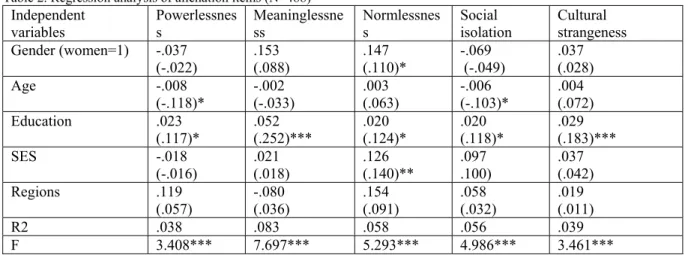
The effects of the independent variables such as gender, age, education, socio-economic status (SES) and region on the components of alienation have been analyzed and results of regression
analysis are presented in Table 2. According to the findings, powerlessness was effected most by age and education while meaningless was effected only by education. Findings revealed that gender, education and SES have had significant impacts on normlessness. It is observed that age and education affected the social isolation/loneliness and finally education was the only independent variable that has significant impact on cultural strangeness. Although R Square results were quite low, the results of Anova (F test) were highly significant for all alienation items. It should also be noted that education was the most important predictor of all components of alienation except social isolation.
Table 2. Regression analysis of alienation items (N=488) Independent
variables Powerlessness Meaninglessness Normlessness Social isolation Cultural strangeness
Gender (women=1) -.037 (-.022) .153 (.088) .147 (.110)* -.069 (-.049) .037 (.028) Age -.008 (-.118)* -.002 (-.033) .003 (.063) -.006 (-.103)* .004 (.072) Education .023 (.117)* .052 (.252)*** .020 (.124)* .020 (.118)* .029 (.183)*** SES -.018 (-.016) .021 (.018) .126 (.140)** .097 .100) .037 (.042) Regions .119 (.057) -.080 (.036) .154 (.091) .058 (.032) .019 (.011) R2 .038 .083 .058 .056 .039 F 3.408*** 7.697*** 5.293*** 4.986*** 3.461***
Unstandardized coefficients B are presented with standardized coefficients Beta in parentheses P<.05* :p<.01**; p<.000***(two tailed test)
5. Discussion
In recent years, the influence and salience of sociologists in disaster policy and administrative matters have increased substantially. The basic themes of sociology such as alienation and critical power conflict perspective are considered useful when analyzing attitudes and behavior in disaster studies. This study can also be considered as a good example for the combination of psychological and sociological concepts and research tools for future disaster studies.
When the results of the bird flu study are compared with those of the earthquake study, important differences were observed: for all alienation components, completely agree answers were higher in the earthquake study than the bird flue one. For example, in the earthquake study, percentages of completely agree answers for the feelings of meaninglessness, powerlessness cultural strangeness and loneliness were 47.8%, 43.1%, 25.3% and 30.7% respectively (Ecevit and Kasapoğlu, 2002). It would not be wrong to argue that 1999 Earthquake have made enormous negative impact in terms of both property and human losses. The levels of alienation in all items were thus higher than bird flue study except normlessness (8.5%). For normlessness, it might not be wrong to interpret that survivors of the earthquake could have found various reason to legitimize their norm breaking behavior and therefore did not report their behaviors as normlessness.
According to the regression analysis results given in Table 2, age and education have significant impact on powerlessness. There are also findings indicating that as the age levels increase, the sense of powerlessness also increases (Chi-square=21.352 df= 6 p<. 002). The findings also showed that while respondents with lower levels of education experienced higher levels of powerlessness (32.0%); university graduates’ experience of such feelings were considerably lower (22.7%) (Chi-square=34.724 df=16 p<.004 ). Findings of this study were in line with the 1999 East Marmara Earthquake survivors’ results (Ecevit and Kasapoğlu, 2002). A common and expected result was that younger people with high levels education had stronger perceptions of themselves.
When the component of meaninglessness is taken into consideration, the regression analysis indicated that education is influential and as the levels of education increase, the feeling of
meaninglessness drops: while 48.0 % of illiterate people expressed having experienced a sense of completely meaninglessness , this proportion drops to 14.0 % for the university graduates (Chi-square=.62.585 df=16 p<.000). Parallel to the 1999 Earthquake data (Ecevit and Kasapoglu, 2002) revealing that those with higher levels of education are better able to assess the events taking place within their surroundings and hence, experience lower levels of meaninglessness.
According to the findings specific to gender, education and SES have had a significant impacts on normlessness. It should also be noted that expression of similar behavior that were not in accordance with the existing norms was higher in men (14.8%) and lower in women (6.1 %). There are apparently significant difference in the non-parametric significance analysis (Chi-square=10.341 df=2 p<.006). Findings indicate that women have adhered to existing norms more in comparison to men. More important, however, is the fact that the percentage of individuals who have indicated that they did not abide by the existing social rules were lower among 1999 Earthquake survivors (8.5%) than the respondents of the bird flu study (10.7%). In fact that the earthquake survivors claimed that they were relatively more adhered to existing social norms, in spite of extreme conditions brought about by the earthquake disaster (Ecevit and Kasapoğlu, , 2002). It could also be interpreted that the norms and rules avoiding in bird flu disease were not similar to those in avoiding earthquake disaster. It might be considered that the respondents of the bird flu study thus are expressing their actual behaviors more freely . On the other hand, as the level of education increase, however, experiencing normlessness drops (Chi-square=57.079 df=16 p<.000). Normlessness was seen to be higher for the illiterates (16.0%) and lower for university graduates (9.1%). When SES as the third variable is taken into consideration, normlessness was reported to be lower for the high SES (4.7%) and higher for the low SES (16.5%) groups. Therefore it would not be wrong to interpret that respondents who are from high SES groups with higher levels education respect their health more than those who have lower levels of education with lower SES (Chi-square=29.998 df= 6 p<.000). Furthermore, there were findings indicating that as people suffer large income shocks, there emerges the possibility of a violent and anomic attitude. For example, Miguel et al. (2004) reported that in poor areas of Tanzania after an extreme rainfall, which resulted in large income drops, crime rates were increased. It is also evident that current and past economic crises increase the possibility of civil conflict and normlessness in African countries (Dreze and Khera, 2000; Miguel et al., 2004).
In the regression analysis with regard to social isolation, it was observed that age and education variables have had significant impact. Social isolation is reported to be lower for the youngest (6.7%) and higher among the oldest (15.6%) age groups. (Chi-square= 20.138 df=6 p<.003). The findings also revealed that as the level of education increases, feeling of isolation drops. For example, while the percentage of highly agree answers for isolation among the low educated individuals was 56%, this decreases to 11.8 % for university graduates (Chi-square=81.986 df =16 p<.000) Findings regarding education and social isolation relationship were in line with the former earthquake study carried by Ecevit and Kasapoğlu (2002).
As it is observed from Table 2, the independent variable that has a strong effect on cultural alienation was education. The group with the lowest level of education had the highest ratio (24%) of those who indicated that they did not read newspapers and/or magazines and did not watch television. This proportion drops to 4% for university graduates (Chi-square=81.986 df=16 p<.000). The findings were in accordance with the earthquake survivors’ data (Ecevit and Kasapoğlu, 2002) and are considered to be consistent and in the expected direction.
6. Conclusion
As a consequence of this recent bird flu findings and also the former research carried out in Turkey with earthquake survivors showed that education was the most important predictor as an independent variable and the over all alienation level was not very high. As the level of education increase, level of alienation decreases. All efforts thus should be directed to increase the level of education in Turkey. Furthermore education has the potential to create awareness, it would not be
wrong to conclude that awareness and education are the different faces of the same coin and in order to make people more aware of and prepared for future disasters comprehensive measures of increasing the levels of education should be taken.
One implication of these findings is that the levels of alienation generally and the meaninglessness specifically have not found to be very high, it would not be wrong to conclude that disasters like bird flu resulted in more awareness than alienation among Turkish people.
This is also very promising for the future mitigation and recovery activities and the following suggestions have been ranked as first three to decrease the negative impacts of bird flu by the respondents.
a) People should get better education (11.9%)
b) Governments should pay more attention to public health measures than those of economic considerations (10.7%)
c) Scientific studies in general and social research specifically should be increased (10.2%) References
Carver, D., Krushinskie, E.A., Slemons,R., Swayne, D. 2006. Avian Influenza :Human Pandemic Concern.Cast Commentary:www.cast-science.org/cast/pub/QTA2006
Coser, L.A.1977. Masters of Social Tought. New York : Harcourt Brace Jovanovich.
Dreze, J., Khera, R. 2000. Crime, gender, and society in India: Insights from homicide data. Population and Development Review, 26:335-352.
Ecevit, M. and Kasapoglu, A. 2002. Demographic and psychosocial features and their effects on the survivors of the 1999 earthquake in Turkey. Social Behavior and Personality, 30:195-202. FAO 2006. Avian Influenza Control and Eradication. www.fao.org/AG/AGAInfo/Subjects/en/
health/disease-cards/special_avian.html
Feagin, J. R., Feagin, C. B. 1997. Social Problems :A Critical Power-Conflict Perspective.New Jersey: Prentice Hall.
Fredu, F. 1997. Culture of Fear. London:Continuum.
Giddens, A. 1998. “Risk Society: The Context of British Politics” In Politics of Risk Society (Ed. J. Franklin), Cambridge :Polity Press.
Hobsbawm, E. J. 1959. Primitive Rebels. New York : Norton.
Kasapoğlu, A. 1999 Social Relations of Personal in Health Organizations. In. Sociology of Health (ed. M.Ecevit).Ankara : Rem.
Kasapoğlu, A., Odabas, Y., Kaya, N. (2009) The case of Avaian Influenza in Turkey, European Societies, 11:4, 495-510.
Latour, B. 2000 When Things Strike Back, British Journal of Sociology, 51,107-123.
Miguel, E., Satyanath, S., Sergenti, E. 2004. Economic shocks and civil conflict :An instrumental variable approach. Journal of Political Economy, 112: 725-753.
Middleton, A. 1975 Alienation (ed. J.Robinson and P.R. Shaver) In Measures of Social Psychological Attitudes. Michigan : University of Michigan.
Perdue, M.L., Swayne, D.E. 2005. Public Health Risk from Avian Influenza Viruses. Avian Diseases, 2005, 49,317-327.
Seeman, M. 1959. On the meaning of alienation. American Sociological Review, 24.
Volkan, V. 2005. From Tsunami to Ethnic Cleansing: Massive Trauma and Societal Responses. Paper presented in the World Congress of Health Challenges of the Third Millennium, Istanbul:Yeditepe University.