Searches for isospin-violating transitions χ
c0,2→ π
0η
cM. Ablikim1, M. N. Achasov8,a, X. C. Ai1, O. Albayrak4, M. Albrecht3, D. J. Ambrose43, A. Amoroso47A,47C, F. F. An1, Q. An44, J. Z. Bai1, R. Baldini Ferroli19A, Y. Ban30, D. W. Bennett18, J. V. Bennett4, M. Bertani19A, D. Bettoni20A, J. M. Bian42, F. Bianchi47A,47C, E. Boger22,h, O. Bondarenko24, I. Boyko22, R. A. Briere4, H. Cai49, X. Cai1, O. Cakir39A,b,
A. Calcaterra19A, G. F. Cao1, S. A. Cetin39B, J. F. Chang1, G. Chelkov22,c, G. Chen1, H. S. Chen1, H. Y. Chen2, J. C. Chen1, M. L. Chen1, S. J. Chen28, X. Chen1, X. R. Chen25, Y. B. Chen1, H. P. Cheng16, X. K. Chu30, G. Cibinetto20A,
D. Cronin-Hennessy42, H. L. Dai1, J. P. Dai33, A. Dbeyssi13, D. Dedovich22, Z. Y. Deng1, A. Denig21, I. Denysenko22, M. Destefanis47A,47C, F. De Mori47A,47C, Y. Ding26, C. Dong29, J. Dong1, L. Y. Dong1, M. Y. Dong1, S. X. Du51, P. F. Duan1, J. Z. Fan38, J. Fang1, S. S. Fang1, X. Fang44, Y. Fang1, L. Fava47B,47C, F. Feldbauer21, G. Felici19A, C. Q. Feng44, E. Fioravanti20A, M. Fritsch13,21, C. D. Fu1, Q. Gao1, Y. Gao38, Z. Gao44, I. Garzia20A, C. Geng44, K. Goetzen9, W. X. Gong1, W. Gradl21, M. Greco47A,47C, M. H. Gu1, Y. T. Gu11, Y. H. Guan1, A. Q. Guo1, L. B. Guo27, Y. Guo1, Y. P. Guo21, Z. Haddadi24, A. Hafner21, S. Han49, Y. L. Han1, X. Q. Hao14, F. A. Harris41, K. L. He1, Z. Y. He29,
T. Held3, Y. K. Heng1, Z. L. Hou1, C. Hu27, H. M. Hu1, J. F. Hu47A, T. Hu1, Y. Hu1, G. M. Huang5, G. S. Huang44, H. P. Huang49, J. S. Huang14, X. T. Huang32, Y. Huang28, T. Hussain46, Q. Ji1, Q. P. Ji29, X. B. Ji1, X. L. Ji1, L. L. Jiang1, L. W. Jiang49, X. S. Jiang1, J. B. Jiao32, Z. Jiao16, D. P. Jin1, S. Jin1, T. Johansson48, A. Julin42, N. Kalantar-Nayestanaki24, X. L. Kang1, X. S. Kang29, M. Kavatsyuk24, B. C. Ke4, R. Kliemt13, B. Kloss21, O. B. Kolcu39B,d, B. Kopf3, M. Kornicer41,
W. Kuehn23, A. Kupsc48, W. Lai1, J. S. Lange23, M. Lara18, P. Larin13, C. H. Li1, Cheng Li44, D. M. Li51, F. Li1, G. Li1, H. B. Li1, J. C. Li1, Jin Li31, K. Li12, K. Li32, P. R. Li40, T. Li32, W. D. Li1, W. G. Li1, X. L. Li32, X. M. Li11, X. N. Li1, X. Q. Li29, Z. B. Li37, H. Liang44, Y. F. Liang35, Y. T. Liang23, G. R. Liao10, D. X. Lin13, B. J. Liu1, C. X. Liu1, F. H. Liu34, Fang Liu1, Feng Liu5, H. B. Liu11, H. H. Liu15, H. H. Liu1, H. M. Liu1, J. Liu1, J. P. Liu49, J. Y. Liu1, K. Liu38, K. Y. Liu26, L. D. Liu30, P. L. Liu1, Q. Liu40, S. B. Liu44, X. Liu25, X. X. Liu40, Y. B. Liu29, Z. A. Liu1, Zhiqiang Liu1, Zhiqing Liu21,
H. Loehner24, X. C. Lou1,e, H. J. Lu16, J. G. Lu1, R. Q. Lu17, Y. Lu1, Y. P. Lu1, C. L. Luo27, M. X. Luo50, T. Luo41, X. L. Luo1, M. Lv1, X. R. Lyu40, F. C. Ma26, H. L. Ma1, L. L. Ma32, Q. M. Ma1, S. Ma1, T. Ma1, X. N. Ma29, X. Y. Ma1,
F. E. Maas13, M. Maggiora47A,47C, Q. A. Malik46, Y. J. Mao30, Z. P. Mao1, S. Marcello47A,47C, J. G. Messchendorp24, J. Min1, T. J. Min1, R. E. Mitchell18, X. H. Mo1, Y. J. Mo5, C. Morales Morales13, K. Moriya18, N. Yu. Muchnoi8,a, H. Muramatsu42, Y. Nefedov22, F. Nerling13, I. B. Nikolaev8,a, Z. Ning1, S. Nisar7, S. L. Niu1, X. Y. Niu1, S. L. Olsen31, Q. Ouyang1, S. Pacetti19B, P. Patteri19A, M. Pelizaeus3, H. P. Peng44, K. Peters9, J. L. Ping27, R. G. Ping1, R. Poling42,
Y. N. Pu17, M. Qi28, S. Qian1, C. F. Qiao40, L. Q. Qin32, N. Qin49, X. S. Qin1, Y. Qin30, Z. H. Qin1, J. F. Qiu1, K. H. Rashid46, C. F. Redmer21, H. L. Ren17, M. Ripka21, G. Rong1, X. D. Ruan11, V. Santoro20A, A. Sarantsev22,f, M. Savri´e20B, K. Schoenning48, S. Schumann21, W. Shan30, M. Shao44, C. P. Shen2, P. X. Shen29, X. Y. Shen1, H. Y. Sheng1,
M. R. Shepherd18, W. M. Song1, X. Y. Song1, S. Sosio47A,47C, S. Spataro47A,47C, G. X. Sun1, J. F. Sun14, S. S. Sun1, Y. J. Sun44, Y. Z. Sun1, Z. J. Sun1, Z. T. Sun18, C. J. Tang35, X. Tang1, I. Tapan39C, E. H. Thorndike43, M. Tiemens24,
D. Toth42, M. Ullrich23, I. Uman39B, G. S. Varner41, B. Wang29, B. L. Wang40, D. Wang30, D. Y. Wang30, K. Wang1, L. L. Wang1, L. S. Wang1, M. Wang32, P. Wang1, P. L. Wang1, Q. J. Wang1, S. G. Wang30, W. Wang1, X. F. Wang38, Y. D. Wang19A, Y. F. Wang1, Y. Q. Wang21, Z. Wang1, Z. G. Wang1, Z. H. Wang44, Z. Y. Wang1, T. Weber21, D. H. Wei10,
J. B. Wei30, P. Weidenkaff21, S. P. Wen1, U. Wiedner3, M. Wolke48, L. H. Wu1, Z. Wu1, L. G. Xia38, Y. Xia17, D. Xiao1, Z. J. Xiao27, Y. G. Xie1, Q. L. Xiu1, G. F. Xu1, L. Xu1, Q. J. Xu12, Q. N. Xu40, X. P. Xu36, L. Yan44, W. B. Yan44,
W. C. Yan44, Y. H. Yan17, H. X. Yang1, L. Yang49, Y. Yang5, Y. X. Yang10, H. Ye1, M. Ye1, M. H. Ye6, J. H. Yin1, B. X. Yu1, C. X. Yu29, H. W. Yu30, J. S. Yu25, C. Z. Yuan1, W. L. Yuan28, Y. Yuan1, A. Yuncu39B,g, A. A. Zafar46, A. Zallo19A, Y. Zeng17, B. X. Zhang1, B. Y. Zhang1, C. Zhang28, C. C. Zhang1, D. H. Zhang1, H. H. Zhang37, H. Y. Zhang1,
J. J. Zhang1, J. L. Zhang1, J. Q. Zhang1, J. W. Zhang1, J. Y. Zhang1, J. Z. Zhang1, K. Zhang1, L. Zhang1, S. H. Zhang1, X. Y. Zhang32, Y. Zhang1, Y. H. Zhang1, Y. T. Zhang44, Z. H. Zhang5, Z. P. Zhang44, Z. Y. Zhang49, G. Zhao1, J. W. Zhao1,
J. Y. Zhao1, J. Z. Zhao1, Lei Zhao44, Ling Zhao1, M. G. Zhao29, Q. Zhao1, Q. W. Zhao1, S. J. Zhao51, T. C. Zhao1, Y. B. Zhao1, Z. G. Zhao44, A. Zhemchugov22,h, B. Zheng45, J. P. Zheng1, W. J. Zheng32, Y. H. Zheng40, B. Zhong27, L. Zhou1, Li Zhou29, X. Zhou49, X. K. Zhou44, X. R. Zhou44, X. Y. Zhou1, K. Zhu1, K. J. Zhu1, S. Zhu1, X. L. Zhu38,
Y. C. Zhu44, Y. S. Zhu1, Z. A. Zhu1, J. Zhuang1, B. S. Zou1, J. H. Zou1 (BESIII Collaboration)
1
Institute of High Energy Physics, Beijing 100049, People’s Republic of China 2
Beihang University, Beijing 100191, People’s Republic of China 3 Bochum Ruhr-University, D-44780 Bochum, Germany 4 Carnegie Mellon University, Pittsburgh, Pennsylvania 15213, USA 5
Central China Normal University, Wuhan 430079, People’s Republic of China
6 China Center of Advanced Science and Technology, Beijing 100190, People’s Republic of China
7 COMSATS Institute of Information Technology, Lahore, Defence Road, Off Raiwind Road, 54000 Lahore, Pakistan 8
G.I. Budker Institute of Nuclear Physics SB RAS (BINP), Novosibirsk 630090, Russia 9
GSI Helmholtzcentre for Heavy Ion Research GmbH, D-64291 Darmstadt, Germany 10Guangxi Normal University, Guilin 541004, People’s Republic of China
11
GuangXi University, Nanning 530004, People’s Republic of China 12
Hangzhou Normal University, Hangzhou 310036, People’s Republic of China 13 Helmholtz Institute Mainz, Johann-Joachim-Becher-Weg 45, D-55099 Mainz, Germany
14
Henan Normal University, Xinxiang 453007, People’s Republic of China
15
Henan University of Science and Technology, Luoyang 471003, People’s Republic of China 16Huangshan College, Huangshan 245000, People’s Republic of China
17Hunan University, Changsha 410082, People’s Republic of China 18
Indiana University, Bloomington, Indiana 47405, USA
19(A)INFN Laboratori Nazionali di Frascati, I-00044, Frascati, Italy; (B)INFN and University of Perugia, I-06100, Perugia, Italy
20
(A)INFN Sezione di Ferrara, I-44122, Ferrara, Italy; (B)University of Ferrara, I-44122, Ferrara, Italy 21
Johannes Gutenberg University of Mainz, Johann-Joachim-Becher-Weg 45, D-55099 Mainz, Germany 22Joint Institute for Nuclear Research, 141980 Dubna, Moscow region, Russia
23
Justus Liebig University Giessen, II. Physikalisches Institut, Heinrich-Buff-Ring 16, D-35392 Giessen, Germany 24
KVI-CART, University of Groningen, NL-9747 AA Groningen, The Netherlands 25Lanzhou University, Lanzhou 730000, People’s Republic of China 26
Liaoning University, Shenyang 110036, People’s Republic of China 27
Nanjing Normal University, Nanjing 210023, People’s Republic of China 28 Nanjing University, Nanjing 210093, People’s Republic of China
29
Nankai University, Tianjin 300071, People’s Republic of China 30
Peking University, Beijing 100871, People’s Republic of China 31Seoul National University, Seoul, 151-747 Korea 32Shandong University, Jinan 250100, People’s Republic of China 33
Shanghai Jiao Tong University, Shanghai 200240, People’s Republic of China 34
Shanxi University, Taiyuan 030006, People’s Republic of China 35 Sichuan University, Chengdu 610064, People’s Republic of China
36
Soochow University, Suzhou 215006, People’s Republic of China 37
Sun Yat-Sen University, Guangzhou 510275, People’s Republic of China 38Tsinghua University, Beijing 100084, People’s Republic of China 39
(A)Istanbul Aydin University, 34295 Sefakoy, Istanbul, Turkey; (B)Dogus University, 34722 Istanbul, Turkey; (C)Uludag University, 16059 Bursa, Turkey
40University of Chinese Academy of Sciences, Beijing 100049, People’s Republic of China 41
University of Hawaii, Honolulu, Hawaii 96822, USA 42
University of Minnesota, Minneapolis, Minnesota 55455, USA 43University of Rochester, Rochester, New York 14627, USA
44 University of Science and Technology of China, Hefei 230026, People’s Republic of China 45
University of South China, Hengyang 421001, People’s Republic of China 46
University of the Punjab, Lahore-54590, Pakistan
47 (A)University of Turin, I-10125, Turin, Italy; (B)University of Eastern Piedmont, I-15121, Alessandria, Italy; (C)INFN, I-10125, Turin, Italy
48
Uppsala University, Box 516, SE-75120 Uppsala, Sweden 49Wuhan University, Wuhan 430072, People’s Republic of China 50
Zhejiang University, Hangzhou 310027, People’s Republic of China 51
Zhengzhou University, Zhengzhou 450001, People’s Republic of China a
Also at the Novosibirsk State University, Novosibirsk, 630090, Russia b
Also at Ankara University, 06100 Tandogan, Ankara, Turkey
cAlso at the Moscow Institute of Physics and Technology, Moscow 141700, Russia and at the Functional Electronics Laboratory, Tomsk State University, Tomsk, 634050, Russia
d
Currently at Istanbul Arel University, 34295 Istanbul, Turkey e Also at University of Texas at Dallas, Richardson, Texas 75083, USA
f
Also at the PNPI, Gatchina 188300, Russia g
Also at Bogazici University, 34342 Istanbul, Turkey
hAlso at the Moscow Institute of Physics and Technology, Moscow 141700, Russia
(BESIII Collaboration)
(Dated: July 2, 2015)
We present the first upper-limit measurement of the branching fractions of the isospin-violating transitions χc0,2→ π0ηc. The measurements are performed using 106 × 106 ψ(3686) events accumu-lated with the BESIII detector at the BEPCII e+e−collider at a center-of-mass energy corresponding to the ψ(3686) mass. We obtained upper limits on the branching fractions at a 90% confidence level of B(χc0→ π0ηc) < 1.6 × 10⁻³ and B(χc2→ π0ηc) < 3.2 × 10⁻³.
PACS numbers: 13.25.Gv, 13.20.Gd.
I. INTRODUCTION
Isospin is known to be a good symmetry in the hadronic decays of charmonium states. The decay
gen-eral found to be very small. For example, the branch-ing fraction (B) of the measured isospin-violatbranch-ing tran-sition ψ(3686) → π0J/ψ was found to be only (1.26 ±
0.02(stat.) ± 0.03(syst.)) × 10−3 [1], whereas for other hadronic transitions such as ψ(3686) → π+π−J/ψ, the
branching fraction is (34.45 ± 0.30) × 10−2 [2] and thus significantly stronger.
Although isospin breaking is found to be very small for the conventional charmonium states, the mysteri-ous X(3872) resonance above the D ¯D threshold decays strongly via the transition X(3872) → π+π−J/ψ, where the invariant-mass spectrum of the π+π− pair shows a
clear ρ signature [3–6] and, hence, is compatible with an isospin-violating decay. A possible interpretation is that the X(3872) is a molecular state composed of a bound D∗0- ¯D0 meson pair ([7–10]). Such an explanation is par-ticularly popular, since the mass of the X(3872) is close to the sum of the ¯D0 and D∗0 masses, pointing to a
state that could be weakly bound by the exchange of a color-neutral meson, similar to the deuteron. More-over, in such a scenario, the strong isospin-breaking de-cay rate of the X(3872) might be explained by the large mass gap between the D∗0 − ¯D0 and the D∗+ − D−
(D+ − D∗−) thresholds [11]. A better understanding
of the isospin-breaking mechanism in a complementary and well-established charmonium system below the open-charm threshold could be crucial to shed light on the nature of the X(3872).
On the quark level, the isospin-symmetry is broken due to the electromagnetic interaction and due to differ-ences in the up- and down-quark masses (mu and md).
It is, therefore, believed that isospin-breaking decays can be used to access the up- and down-quark mass differ-ences once the electromagnetic effect is either well un-derstood or found to be negligible. An example observ-able that has been proposed to obtain the quark mass ratio, mu/md, is a measurement of the ratio between the
branching fractions of the transitions ψ(3686) → π0J/ψ
and ψ(3686) → ηJ/ψ. Based on a leading-order QCD multipole expansion [12] and the BESIII measurement of this ratio [1], the up-down quark mass ratio is ex-tracted to be mu/md = 0.407 ± 0.006. This result is
smaller than the result, mu/md = 0.56, obtained using
the Goldstone boson masses from a leading-order chiral-perturbation theory [13]. It is important to understand such a large discrepancy between the values of mu/md
obtained on the basis of different theoretical conjectures. The most promising developments in this field are based upon an effective-field theoretical approach. A nonrelativistic effective-field theoretical (NREFT) study by the J¨ulich and IHEP groups suggests that inter-mediate (virtual) charmed-meson loops are the domi-nant source for the isospin breaking in the transition ψ(3686) → π0J/ψ [14, 15]. According to the proposed
theory, the contribution of charmed-meson loops to the amplitude of the process is enhanced by a factor of (υ/c)−1 ∼ 2, where υ is the heavy-meson velocity in the loops. Detailed studies of different isospin-violating
tran-sitions in charmonium below the D ¯D threshold and the effect of virtual charmed-meson loops on the widths of the transitions are described in Ref. [16].
The NREFT calculations described above are based on a first estimate, exploiting diagrams involving the lowest-lying pseudoscalar and vector charmed mesons following heavy-quark symmetry and chiral symmetry. Although these theoretical calculations give qualitative insights in the isospin-breaking mechanisms in charmonium decays, the authors in Ref. [16] state that only with a further developed effective-field theory that includes Goldstone bosons, charmonia, and charmed mesons as the degrees of freedom, it would be possible in the future to ex-tract the light-quark masses from quarkonia decays. Cur-rently, for such a theory, quantitative predictions of in-dividual branching fractions of isospin-forbidden decays of charmonium are difficult, because information on the coupling constants fψD ¯D between different charmonium states and D ¯D-mesons is limited. The theory requires constraints from experimental data, in particular from measurements of decay rates of other isospin-violating transitions in charmonium [16].
In this paper, we present an experimental study of the isospin-suppressed transition of the charmonium P-wave states χc0,2 to the ground state ηc via the emission of
the π0. The χc0,2states are obtained via electromagnetic
transitions, ψ(3686) → γχc0,2, whereby the ψ(3686)
reso-nance is directly populated via the e+e−annihilation
pro-cess. The transition χc1→ π0ηc is not considered in this
analysis since it violates conservation of parity and angu-lar momentum. According to Ref. [16], the dimensionless suppression factor for the loops in χc0→ π0ηcis 0.2. This
factor is smaller than in the process ψ(3686) → π0J/ψ,
however, through the interference with the tree-level am-plitude, meson loops may give a significant contribution and cannot be neglected.
II. THE BESIII EXPERIMENT AND DATA SET
The analysis is based on the ψ(3686) data sample ac-cumulated by the BESIII detector in 2009. The total number of ψ(3686) events is (106.41 ± 0.86) × 106 [17], corresponding to an integrated luminosity of 156.4 pb−1. In addition, 42.6 pb−1 data collected at a center-of-mass energy of 3.65 GeV, are used to estimate the background from nonresonant processes.
The BEijing Spectrometer III (BESIII), described in detail in Ref. [18], is a detector for τ -charm studies run-ning at the Beijing Electron-Positron Collider (BEPCII). BEPCII is a double-ring e+e− collider with a designed peak luminosity of 1033 cm−2s−1 at a beam current of
0.93 A. The cylindrical core of the BESIII detector con-sists of a main drift chamber (MDC), a plastic scintil-lator time-of-flight system (TOF), and an electromag-netic calorimeter (EMC), which are enclosed in a super-conducting solenoidal magnet providing a 1 T magnetic field. The solenoid is supported by an octagonal
flux-return yoke with resistive-plate chambers forming a muon counter system. The MDC is a small-cell, helium-based (40% He, 60% C3H8) subdetector consisting of 43 layers
and providing an average single-hit resolution of 135 µm, and a charged-particle momentum resolution of 0.5% at 1 GeV/c. The EMC subdetector consists of 6240 CsI(Tl) crystals in a cylindrical structure (barrel) and two end caps. For 1 GeV photons, the energy resolution is 2.5% (5%) and the position resolution is 6 mm (9 mm) for the barrel (end caps). The TOF system consists of 5 cm thick scintillators, with 176 detectors of 2.4 m length in two layers in the barrel and 96 fan-shaped detectors in the end caps. The barrel (end cap) time resolution of 80 ps (110 ps) provides 2σ K/π separation for momenta up to 1 GeV.
To optimize the event selection, to estimate back-ground contributions, and to evaluate the detection ef-ficiencies, Monte Carlo (MC) simulated samples are obtained exploiting a realistic model of the detec-tor. For this, the GEANT4-based simulation software BOOST [19] is used which includes the geometry and material description of the BESIII spectrometer, and the detector response. A MC sample based on 106 M in-clusive ψ(3686) decays is used to study the background. This inclusive sample is generated with KKMC [20] plus EvtGen [21, 22] and the known branching ratios are taken from the Particle Data Group (PDG) [2], while the un-known ratios are generated according to the Lundcharm model [23]. The decay modes χc0,2 → π0ηc are not
present in the inclusive MC simulation. Signal MC sam-ples are generated to determine the detection efficiency and to model the signal shape. In the MC simulations for the processes presented here, the ψ(3686) → γχcJ decay
is assumed to be a pure E1 transition, and the polar an-gle, θ, follows a distribution of the form 1 + α cos2θ, with
α = 1 and 1/13 for J = 0 and 2, respectively [24, 25]. The χc0,2 → π0ηc and ηc → KS0K±π∓ decays are
as-sumed to be pure phase-space decays.
III. DATA ANALYSIS
For the identification and selection of ψ(3686) → γχc0,2→ γπ0ηc events, where π0→ γγ, ηc→ KS0K±π∓,
the K0
S is reconstructed in its decay mode to π+π−,
re-sulting in the final state 3γ3πK, where K and π are charged.
A. Event selection
Charged tracks are reconstructed from the MDC hits. For each charged-particle track, its polar angle must satisfy | cos θ| < 0.93. A good charged-particle track (excluding those coming from a K0
S) is required to be
within 1 cm of the e+e− annihilation interaction point (IP), transverse to the beam line and within 10 cm of the IP along the beam axis. Charged-particle
identi-fication (PID) is based on combining the energy loss, dE/dx, in the MDC and TOF information to construct PID chi-squared values χ2
P ID(i), that are calculated for
each charged-particle track for each particle hypothesis i (pion, kaon).
Photons are reconstructed from isolated showers in the EMC. The showers in the angular range between the bar-rel (| cos θ| < 0.8) and end caps (0.86 < | cos θ| < 0.92) are poorly reconstructed and excluded from the analysis. Good photon candidates must have a minimum energy of 25 (50) MeV in the barrel (end cap) regions. EMC timing requirements are used to further suppress noise and energy depositions unrelated to the event.
Events with four charged-particle tracks with a net charge of zero and at least three good photon candidates are retained for further analysis.
KS0 candidates are reconstructed from secondary ver-tex fits to all the charged-track pairs in an event (with a pion-mass assumption). Candidates with an invari-ant mass within 10 MeV/c2 of the K0
S nominal mass
are considered and the combination with the smallest chi-squared of the vertex fit is chosen. The event is kept for further analysis if the secondary vertex is at least 0.5 cm away from the IP. The reconstructed four-momenta of the π+ and π−, corresponding to the K0 S
decay, are used as input for the subsequent kinematic fit. To suppress the KS0KS0 background, the remaining charged-particle tracks are required to not form a good K0
S candidate. The π0candidates are reconstructed from
pairs of photons with the invariant mass Mγγin the range
0.11 < Mγγ/(GeV/c2) < 0.16, with the Mγγ resolution
of about 5 MeV/c2.
The 3γ3πK candidates are then subjected to a four-constraint (4C) kinematic fit, with the four-constraints provided by four-momentum conservation. The dis-crimination of charge-conjugate channels (K0
SK+π− or
K0 SK−π
+) and the selection of the best photon candidate
of the ψ(3686) → γχc0,2transition among multiple
candi-dates are achieved by taking the event with the minimum χ2 = χ2
4C+ χ2P ID(K) + χ2P ID(π), where χ24C is the
chi-squared of the 4C kinematic fit. The π0is reconstructed
from the two-photon combination with an invariant mass closest to that of a neutral pion. Events with χ24C < 50 and with an invariant mass of the reconstructed ηc,
MK0
SK±π∓, in the range 2.70 < MK0SK±π∓/(GeV/c
2) <
3.30 are accepted for further analysis. The maximum value of χ2
4C is determined by optimizing the
statisti-cal significance S/√S + B in the ηc signal region, where
S (B) is the number of signal (background) events ob-tained from the signal (inclusive) MC samples. For the estimate of S, the branching fractions of χc0,2→ π0ηcare
assumed to be 10−3in analogy with the isospin-violating process ψ(3686) → π0J/ψ [1]. The signal region is
de-fined as 2.90 < MK0
SK±π∓/(GeV/c
2) < 3.05. The χ c0
and χc2 signal regions are defined for transition-photon
candidates with energies in the γπ0KS0K±π∓ center-of-mass system, Eγ, in the ranges of 0.24 < Eγ/(GeV) <
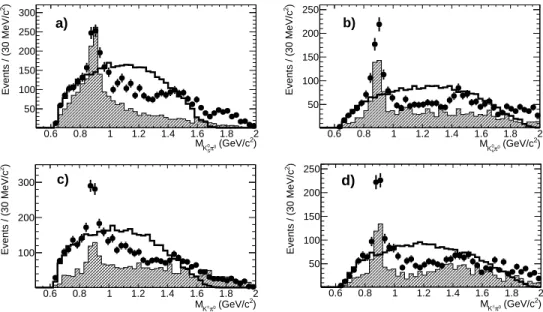
) 2 (GeV/c 0 π S 0 K M 0.6 0.8 1 1.2 1.4 1.6 1.8 2 ) 2 Events / (30 MeV/c 50 100 150 200 250 300 a) ) 2 (GeV/c 0 π s 0 K M 0.6 0.8 1 1.2 1.4 1.6 1.8 2 ) 2 Events / (30 MeV/c 50 100 150 200 250 b) ) 2 (GeV/c 0 π ± K M 0.6 0.8 1 1.2 1.4 1.6 1.8 2 ) 2 Events / (30 MeV/c 100 200 300 c) ) 2 (GeV/c 0 π ± K M 0.6 0.8 1 1.2 1.4 1.6 1.8 2 ) 2 Events / (30 MeV/c 50 100 150 200 250 d)
FIG. 1. Invariant-mass distributions of KS0π 0
candidates (a and b) and K±π0 candidates (c and d) for χc0 (a and c) and χc2 (b and d) mass regions, respectively. Dots represent data, filled histograms represent inclusive MC results, open histograms show results of signal MC simulations based on a phase-space distribution (arbitrarily scaled).
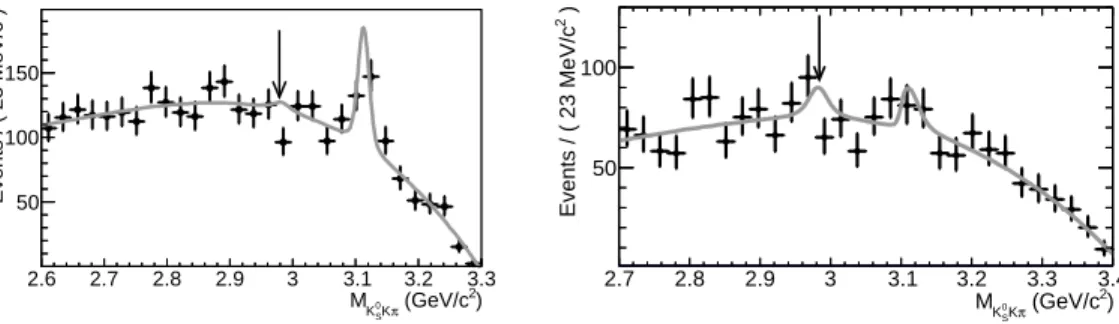
) 2 (GeV/c ± π ± K S 0 K M 2.7 2.8 2.9 3 3.1 3.2 3.3 ) 2 Events / (10 MeV/c 20 40 60 80 100 ) 2 (GeV/c ± π ± K S 0 K M 2.7 2.8 2.9 3 3.1 3.2 3.3 ) 2 Events / (10 MeV/c 10 20 30 40 50
FIG. 2. Invariant-mass distributions of K0 SK
±
π∓. Left: χc0→ π0ηc, right: χc2→ π0ηc; ηc→ KS0K ±
π∓. Dots represent data, filled histograms represent the inclusive (light) and arbitrarily scaled signal (dark) MC results. The peak around 3.12 GeV/c2 is due to the ψ(3686) → π0π0J/ψ background channel.
FIG. 1 shows the invariant-mass distributions of K0 Sπ0
candidates [(a) and (b)] and K±π0 candidates [(c) and
(d)] with π0K0 SK
±π∓ masses within the χ
c0 [(a) and
(c)] and the χc2 [(b) and (d)] mass regions. The most
prominent peak (with the highest intensity and narrow-est width) stems from decays involving a K∗(892). Those are evidently background processes, because the chan-nel of interest, χc0,2 → π0ηc with ηc → KS0K±π∓,
cannot involve K∗(892)0(±) → K0(±)π0 decays, since
the latter does not involve a π0. The regions 0.84 <
MK0(±)
S π0
/(GeV/c2) < 0.95 are excluded in the further analysis to suppress the background from K∗(892)0 and K∗(892)± decays. This condition is optimized to obtain the best statistical significance of the signal.
FIG. 2 shows the invariant-mass distributions of K0
SKπ for candidate events with K 0
SK±π∓masses
corre-sponding to χc0,2→ π0ηc transitions. The data show no
visible peak in the ηc signal region. In the present
anal-ysis, upper limits at the 90% confidence level (C.L.) for
the transitions χc0,2 → π0ηc are determined. Inclusive
MC results do not reproduce the number of events found in the data, but reproduce the shape of the invariant-mass distributions of K0
SKπ quite well. The
discrepan-cies between data and inclusive MC are primarily due to inaccuracies of branching fractions in the generator and due to mismatches in their corresponding decay dynam-ics. We note, however, that the inclusive MC data have solely been used to identify background sources and to optimize selection criteria. The selection criteria were op-timized by assuming a branching fraction of 10−3for the χcJ → π0ηc channels in combination with background
taken from the inclusive MC sample. We varied the signal-to-background ratio by a factor of 2, adjusted our selection criteria accordingly, and found a negligible ef-fect on the precision of our final result.
Efficiencies are calculated using the signal MC simula-tion samples and are found to be 5.8% and 8.6% for the χc0 and χc2 channels, respectively.
B. Background studies
Background events from ψ(3686) decays are studied with the inclusive MC sample. These studies showed that the channel ψ(3686) → π0π0J/ψ, J/ψ → KS0K±π∓ results in a peak around 3.12 GeV/c2 in the K0
SKπ
invariant-mass spectrum as can be observed from Fig. 2. In this type of transition, one of the photons originating from π0decays may escape, which causes a smaller total
energy for the event. The kinematic fit increases the en-ergy of the charged-particle tracks, which results in a shift in the invariant mass from 3.10 GeV/c2 to 3.12 GeV/c2.
This decay channel is taken into account in the final fit to the invariant-mass spectrum of K0
SKπ as described
below.
The major background contribution stems from the channels ψ(3686) → γχcJ, χcJ → π0KS0K±π∓. These
channels have final states that are kinematically iden-tical to the signal of interest and, therefore, cannot be removed easily. Partly, this type of background has been suppressed by vetoing K∗(892)0 signals via a cut on the KS0,±π0 mass since the background decay, χ
c0,2 →
π0K0
SK±π∓, contains intermediate K∗(892) resonances,
as discussed earlier. We note that the remaining contri-bution of this type does not result in a peaking back-ground in the signal region.
The background contribution from e+e− → f ¯f
pro-cesses, where f = e, µ, d, u, s, is studied using the con-tinuum data taken at √s = 3.65 GeV, and it is found to be negligible. Using the exclusive MC simulations and taking the corresponding branching fractions from the PDG [2], the contribution of χcJ → π0KS0K±π∓
and ψ(3686) → π0π0J/ψ channels in the region 2.70 <
MK0
SKπ/(GeV/c
2) < 3.30 is found to be 2260±340 and
1668±260 events for the χc0 and χc2 selection criteria,
respectively, where the errors are mainly due to the un-certainties in the branching fractions. The total num-ber of data events in the same region is 2477±50 and 1527±39, respectively. These are compatible within the uncertainties. No significant peaks are observed in the signal region.
C. Upper limits for the number of signal events
To extract the number of ηc events, an unbinned
max-imum likelihood fit is applied to the candidate events with K0
SK±π∓invariant-mass distributions in the region
2.70 < MK0
SKπ/(GeV/c
2) < 3.30. The η
c signal is
de-scribed by a Voigtian function, which is a Breit-Wigner function convoluted with the detector resolution. Param-eters of the Breit-Wigner function are taken from the PDG [2], and the detector resolution is obtained from a fit to the signal MC set. These parameters are fixed while fitting the data. From the background studies, no peaking background is expected in the signal region. The smooth background is described by a third-order Cheby-shev polynomial. A Voigtian function and a Landau
plus Gaussian function are used to describe the structure around 3.12 GeV/c2 for the χ
c0 and χc2 mass regions,
respectively. The line-shape parameters of the structure around 3.12 GeV/c2 (for both Voigtian and Landau +
Gaussian functions) are fixed to the values obtained from the exclusive MC sample. The MC sample was obtained by simulating the channel ψ(3686) → π0π0J/ψ with the exclusive decay J/ψ → K0
SKπ. The total fit results are
shown in FIG. 3. Using the maximum likelihood method, the upper limits on the number of signal events, NU L, at
the 90% C.L. are found to be 14.1 and 35.9 events for the χc0 and χc2 mass regions, respectively.
IV. SYSTEMATIC UNCERTAINTIES
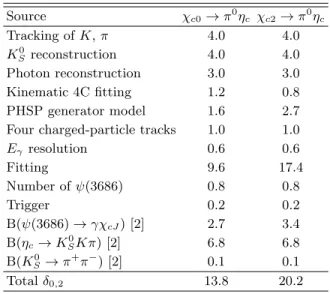
Table I summarizes all the systematic uncertainties that are considered in the analysis. Below we discuss in more detail the individual sources and the procedure that is used to estimate the errors.
The tracking efficiency for kaons as a function of trans-verse momentum has been studied using the process J/ψ → K0
SK±π∓, KS0 → π+π− and the tracking
effi-ciency for pions (not originating from K0
S) as a function
of transverse momentum has been studied using the pro-cess ψ(3686) → π+π−J/ψ. The difference in efficiencies
between data and MC simulations is 2% for each K or π track. This value is taken as the uncertainty in the tracking efficiency. The systematic uncertainty due to the K0
S reconstruction is 4.0%, as reported in Ref. [26].
The uncertainty in the photon reconstruction is taken as 1% per photon as reported in Ref. [27]. In this analysis, there are in total three photons in the final state, which yields a total systematic uncertainty due to the photon reconstruction of 3%.
Some differences are observed for the χ2
4C
distribu-tions between data and MC simuladistribu-tions. These differ-ences are mainly due to inconsistencies in the charged-track parameters between data and MC simulations. We apply correction factors for various K (π) track param-eters that are obtained from the control data samples J/ψ → φπ+π−, φ → K+K−. The correction factors
are used for smearing the MC simulation output, so that the pull distributions properly describe those of the ex-perimental data. Differences between the detection effi-ciencies obtained using MC simulations with and without these corrections are taken as an estimate for the corre-sponding systematic uncertainties. The uncertainties are 1.2% and 0.8% for the χc0 and χc2 selection conditions,
respectively.
A phase-space (PHSP) model used for MC genera-tion of ηc → KS0K±π∓ events does not include
possi-ble intermediate resonances between the final-state par-ticles, for example, K2∗(1430)0,±. These resonances
are observed in the test sample ψ(3686) → γηc, ηc →
KS0K±π∓. To account for K∗ resonances, additional MC samples of ψ(3686) → γχc0,2, χc0,2 → π0ηc, ηc →
re-) 2 (GeV/c π K S 0 K M 2.6 2.7 2.8 2.9 3 3.1 3.2 3.3 ) 2 Events / ( 23 MeV/c 50 100 150 ) 2 (GeV/c π K S 0 K M 2.7 2.8 2.9 3 3.1 3.2 3.3 3.4 ) 2 Events / ( 23 MeV/c 50 100
FIG. 3. Fit to the invariant-mass distributions of KS0K±π∓. Left: χc0 → π0ηc, right: χc2 → π0ηc; ηc → KS0K±π∓. Dots represent data, lines represent the fit. Arrows indicate the peaks of interest.
construction efficiencies are calculated. The difference between efficiencies obtained with two different genera-tor models is taken as a systematic uncertainty. For the χc0 → π0ηc and χc2 → π0ηc decays, the corresponding
systematic uncertainties are 1.6% and 2.7%, respectively. The selection of exactly four charged-particle tracks before the vertex cuts can introduce an additional sys-tematic uncertainty in the efficiency determination due to the presence of fake tracks from misreconstruction. This uncertainty is estimated using a sample of ψ(3686) → π+π−J/ψ, J/ψ → γη
c, ηc → KS0K±π∓ decays, where
events with at least six charged-particle tracks are ac-cepted. The fraction of events with more than six tracks compared to the number of events with exactly six charged-particle tracks are obtained for the data and for a corresponding signal MC sample, and the difference in the fractions is found to be 1%. This we take as the systematic uncertainty due to the preselection of exactly four charged-particle tracks.
To estimate the systematic uncertainties due to the resolution of the transition photon, a smearing of the energy resolution by 1.5 MeV and a shift of 0.5 MeV are introduced on the MC data. The smearing gives a minimum χ2 when comparing data and MC line shapes, where the dominant contribution to the data originates from the processes ψ(3686) → γχcJ, χcJ → π0KS0K±π∓.
The corresponding detection efficiencies of the channels of interest with the standard selection criteria have been calculated. The largest difference between the efficiencies with and without smearing for the χc0,2is 0.6%, which we
quote as the systematic uncertainty due to the transition-photon resolution.
The systematic uncertainty due to fitting consists of four parts: uncertainties due to the fitting range, the J/ψ-related background shape, the χc0,2 → π0KS0Kπ
background shape, and the signal shape. The upper lim-its for the 2.70 < MK0
SKπ/(GeV/c
2) < 3.30 fitting range
with a third-order Chebyshev function and fixed J/ψ pa-rameters are taken as the nominal upper limit, NU L. By varying the fitting ranges (2.60 < MK0
SKπ/(GeV/c 2) < 3.30 and 2.70 < MK0 SKπ/(GeV/c 2) < 3.40 for the χ c0
and χc2 mass regions, respectively), we obtained a set
of upper limits from which we take the maximum
dif-ference as a systematic uncertainty. The uncertainty is found to be 5.8% and 15.0% for the χc0and χc2 mass
re-gions, respectively. By changing the parameters for the J/ψ background from fixed to free, but using the nominal fitting range and the nominal order of Chebyshev poly-nomial, the result of the fitting procedure is obtained, and the relative difference with the nominal upper limit is taken as as a systematic error due to the line shape uncertainty of the J/ψ-related background. This error is found to be 7.3% and 6.8% for the χc0 and χc2
se-lection conditions, respectively. By varying the order of the Chebyshev polynomial from the third to second, we obtained a set of upper limits from which we take the relative difference as systematic uncertainty due to the χc0,2 → π0KS0Kπ background line shape. The
uncer-tainty is found to be 0.1% and 5.0% for the χc0 and χc2
selection conditions, respectively. By changing the mean of the Voigtian within 1 MeV/c2 and the width within
1 MeV, thereby taking conservatively into account the uncertainty in the published mass and width of the ηc[2],
sets of upper limits are obtained from which we take the maximum difference with the nominal upper limit as sys-tematic uncertainty due to the signal line shape. This uncertainty is found to be 2.3% and 2.5% for the χc0
and χc2 selection conditions, respectively. The various
systematic uncertainties on the fitting range and the line shape for the signal and background are highly corre-lated due to double counting of possible uncertainty con-tributions. The total systematic uncertainty on fitting is estimated by adding the individual systematic uncer-tainties in quadrature. The total fitting uncertainty is 9.6% and 17.4% for the χc0 and χc2selection conditions,
respectively.
The systematic uncertainty of the number of ψ(3686) events is estimated to be 0.8% as reported in [17]. The uncertainty originating from the trigger efficiency is esti-mated to be 0.15% [28].
All the uncertainties on the branching fractions of the decaying particles of the channels of interest are obtained from the PDG [2] and are taken into account in the sys-tematic errors of our measurements. The corresponding values can be found in Tab. I.
to-tal systematic uncertainties δ0,2 are obtained by adding
the individual uncertainties in quadrature.
TABLE I. Summary of all considered systematic uncertainties (%). All uncertainties quoted are estimated to be symmetric.
Source χc0→ π0ηc χc2→ π0ηc Tracking of K, π 4.0 4.0 KS0 reconstruction 4.0 4.0 Photon reconstruction 3.0 3.0 Kinematic 4C fitting 1.2 0.8 PHSP generator model 1.6 2.7
Four charged-particle tracks 1.0 1.0
Eγ resolution 0.6 0.6 Fitting 9.6 17.4 Number of ψ(3686) 0.8 0.8 Trigger 0.2 0.2 B(ψ(3686) → γχcJ) [2] 2.7 3.4 B(ηc→ KS0Kπ) [2] 6.8 6.8 B(KS0 → π + π−) [2] 0.1 0.1 Total δ0,2 13.8 20.2
V. RESULTS AND DISCUSSION
The upper limits on the branching fractions of the χcJ → π0ηc (J = 0, 2) transitions are calculated using:
B(χcJ → π0ηc) < NU L J NψεJB(ψ(3686) → γχcJ)Bint(1 − δJ) , where NU L
J are the upper limits on the number of
sig-nal events, δJ is the total systematic uncertainty for the
channel with J = 0, 2, εJ is the detection efficiency,
Bint = B(ηc → KS0K±π∓) · B(KS0 → π+π−) · B(π0 →
γγ) = (1.7 ± 0.3) · 10−2 [2], and Nψ is the number of
ψ(3686) events [17]. Table II summarizes the final re-sults of the analysis.
TABLE II. Summary of the final results for the χcJ (J = 0,2) decays. χc0→ π0ηc χc2→ π0ηc NJU L 14.1 35.9 εJ 5.8% 8.6% δJ 13.8% 20.2% B(χcJ → π0ηc)(10−3) < 1.6 < 3.2
In this paper, we presented an analysis with the aim to search for the hadronic isospin-violating transitions χc0,2 → π0ηc using 106 × 106 ψ(3686) events collected
by BESIII through ηc → KS0K±π∓ decays. No
statis-tically significant signal is observed and upper limits on the branching fractions for the processes χc0,2 → π0ηc
have been obtained. The results are B(χc0 → π0ηc) <
1.6 × 10⁻³ and B(χ
c2 → π0ηc) < 3.2 × 10⁻³. These
are the first upper limits that have been reported so far. These limits might help to constrain nonrelativistic field theories and provide insight in the role of charmed-meson loops to the various transitions in charmonium and charmonium-like states. Further developments in these theories will be necessary to clarify this aspect.
The obtained upper limit on B(χc0 → π0ηc) does
not contradict the theoretical estimate reported by Voloshin [29] of order (few)×10−4. In this estimate, the branching fraction has been derived from a leading-order QCD expansion and related to the partial width of the decay ψ(3686) → hcπ0under the assumption that
the overlap integrals for the 2S→1P and 1P→1S tran-sitions are of similar value. In addition, Voloshin [29] predicts that the branching fractions of the hadronic de-cays χc0 → π0ηc and χc1 → π+π−ηc are approximately
equal. A comparison of our result with that of an upper limit measurement of B(χc1→ π+π−ηc < 3.2 × 10⁻³) by
BESIII [30] does not contradict such a prediction. We note, however, that an earlier theoretical estimate in the framework of a QCD multipole expansion [31] reported a branching fraction for χc1 → ππηc of (2.22±1.24)%,
which contradicts the earlier BESIII measurement [30] and, under the assumption made by Voloshin [29], our result as well.
The near-future PANDA experiment [32] at the FAIR facility has the potential to find evidence or provide tighter constraints for the isospin-forbidden transitions discussed in this paper by directly populating the χc0,2
states using an intense antiproton beam on a proton tar-get.
VI. ACKNOWLEDGMENTS
The BESIII collaboration thanks the staff of BEPCII and the IHEP computing center for their strong sup-port. This work is supported in part by National Key Basic Research Program of China under Con-tract No. 2015CB856700; National Natural Science Foundation of China (NSFC) under Contracts Nos. 11125525, 11235011, 11322544, 11335008, 11425524; the Chinese Academy of Sciences (CAS) Large-Scale Scien-tific Facility Program; Joint Large-Scale ScienScien-tific Facil-ity Funds of the NSFC and CAS under Contracts Nos. 11179007, U1232201, U1332201; CAS under Contracts Nos. KJCX2-YW-N29, KJCX2-YW-N45; 100 Talents Program of CAS; INPAC and Shanghai Key Labora-tory for Particle Physics and Cosmology; German Re-search Foundation DFG under Contract No. Collab-orative Research Center CRC-1044; Istituto Nazionale di Fisica Nucleare, Italy; Ministry of Development of Turkey under Contract No. DPT2006K-120470; Russian
Foundation for Basic Research under Contract No. 14-07-91152; U. S. Department of Energy under Contracts Nos. FG02-04ER41291, FG02-05ER41374, DE-FG02-94ER40823, DESC0010118; U.S. National Sci-ence Foundation; University of Groningen (RuG) and
the Helmholtzzentrum fuer Schwerionenforschung GmbH (GSI), Darmstadt; WCU Program of National Research Foundation of Korea under Contract No. R32-2008-000-10155-0
[1] M. Ablikim et al. (BESIII Collaboration), Phys. Rev. D 86, 092008 (2012).
[2] K. A. Olive et al. (Particle Data Group), Chin. Phys. C 38, 090001 (2014).
[3] S.-K. Choi et al. (Belle Collaboration), Phys. Rev. Lett. 91, 262001 (2003).
[4] S.-K. Choi et al. (Belle Collaboration), Phys. Rev. D 84, 052004 (2004).
[5] A. Abulencia et al. (CDF Collaboration), Phys. Rev. Lett. 96, 102002 (2006).
[6] S. Chatrchyan et al. (CMS Collaboration), JHEP 04, 154 (2013).
[7] F. E. Close and P. R. Page, Phys. Lett. B 578, 119 (2004). [8] N. A. T¨ornqvist, Phys. Lett. B 590, 209 (2004). [9] M. Voloshin, Phys. Lett. B 579, 316 (2004). [10] E. S. Swanson, Phys. Lett. B 598, 197 (2004). [11] N. Li and S.-L. Zhu, Phys. Rev. D 86, 074022 (2012). [12] M. A. Shifman and B. L. Ioffe, Phys. Lett. B 95, 99
(1980).
[13] S. Weinberg, Trans. New York Acad. Sci. 38, 185 (1977). [14] F.-K. Guo, C. Hanhart, and U.-G. Meißner, Phys. Rev.
Lett. 103, 082003 (2009).
[15] F.-K. Guo, C. Hanhart, and U.-G. Meißner, Phys. Rev. Lett. 104, 109901(E) (2010).
[16] F.-K. Guo, C. Hanhart, G. Li, U.-G. Meißner, and Q. Zhao, Phys. Rev. D 82, 034025 (2010).
[17] M. Ablikim et al. (BESIII Collaboration), Chin. Phys. C 37 (2013).
[18] M. Ablikim et al. (BESIII Collaboration), Nuclear In-struments and Methods in Physics Research A 614, 345 (2010).
[19] Z. Y. Deng et al., Chin. Phys. C 30 (2006).
[20] S. Jadach, B. F. L. Ward, and Z. Was, Computer Physics Communications 130, 260 (2000).
[21] D. J. Lange, Nucl. Instrum. Meth. A 462, 152 (2001). [22] R.-G. Ping, Chin. Phys. C 32, 599 (2008).
[23] J. C. Chen, G. S. Huang, X. R. Qi, D. H. Zhang, and Y. S. Zhu, Phys. Rev. D 62, 034003 (2000).
[24] G. Karl, S. Meshkov, and J. L. Rosner, Phys. Rev. D 13, 1203 (1976).
[25] P. K. Kabir and A. J. G. Hey, Phys. Rev. D 13, 3161 (1976).
[26] M. Ablikim et al. (BESIII Collaboration), Phys. Rev. D 87, 052005 (2013).
[27] M. Ablikim et al. (BESIII Collaboration), Phys. Rev. D 83, 112005 (2011).
[28] N. Berger et al. (BESIII Collaboration), Chin. Phys. C 34, 1779 (2010).
[29] M. B. Voloshin, Phys. Rev. D 86, 074033 (2012). [30] M. Ablikim et al. (BESIII Collaboration), Phys. Rev. D
87, 012002 (2013).
[31] Q. Lu and Y.-P. Kuang, Phys. Rev. D 75, 054019 (2007). [32] W. Erni et al. (PANDA Collaboration), arXiv:0903.3905