A Comparative Analysis of Ratio and Proportion
Problems inTurkish and the U.S. Middle School
Mathematics Textbooks
*Lütfi İNCİKABI
1, Hartono TJOE
2ÖZ
This study aimed to examine cross-national similarities and differences between problems involving Proportion and Ratio in Turkish mathematics textbooks and those in the U.S. mathematics textbooks. In particular, content analysis methodology was used to analyze these textbook problems at the 6th and 7th grade level in terms of their mathematics features, contextual features, and performance requirements. Compared with the U.S. textbooks, Turkish textbooks contained: 1) more pure mathematics problems but fewer real-life-application problems, 2) more Ratios and Proportions problems in the cognitive domains of applying and reasoning but fewer in the cognitive domain of knowing, and 3) more emphasis on explanations and solution processes in their problems but no problems involving the use of technology. In general, the U.S. textbooks included fewer multiple step problems and were dominated with problems of low mathematical and cognitive requirements.
Keywords: Mathematics textbooks, ratio and proportion, Turkey, United States.
Türkiye’deki ve Amerika Birleşik Devletleri’ ndeki
Orta Okul Matematik Ders Kitaplarında Bulunan
Oran ve Orantı Problemlerinin Karşılaştırılmalı
Analizi
ABSTRACTBu çalışma, Türkiye’ de ve Amerika’ da bulunan matematik ders kitaplarındaki oran ve orantı konusunu içeren problemlerin benzerlikler ve farklılıklar bakımından analiz etmeyi amaçlamaktadır. 6. ve 7. sınıf ders kitaplarındaki bu problemler, matematiksel özellikleri, içeriksel özellikleri ve performans özellikleri bakımından içerik analizine tabii tutulmuştur. Birleşik Devletler’ deki kitaplarla kıyaslandığında, Türkiye’ deki ders kitapları 1) daha çok sadece matematiksel terimler kullanan problemler içermekte ama daha az gerçek hayat uygulalmaları içeren poblemlere yer vermekte, 2) daha çok uygulama ve muhakeme gerketiren problemler içermekte ama daha az bilme bilişsel alanı vurgulanmakta ve 3) açıklamalar ve çözüm süreçleri daha çok vurgulanmakata ama teknoloj kullanımını gerektiren hiçbir problem kullanmamaktadır.Genel olarak, Birleşik Devletler’ deki ders kitaplarının daha az çok adımlı problemler içerdiği ve daha düşük matematiksel ve bilişsel yeterlikler gerektiren problemlerle donatıldığı görülmüştür. Anahtar kelimeler: matematik ders kitapları, oran ve orantı, Türkiye, Birleşik Devletler.
* 36th Conference of International Group for the Psychology of Mathematics Education (PME)" de bildiri olarak sunulmuştur.
1 Yrd. Doç. Dr., Kastamonu Üniversitesi, e-posta: [email protected] 2
INTRODUCTION
Cross-system studies in mathematics have attracted considerable interest from research in mathematics education. According to Postlethwaite (1988), cross-system comparative studies in education are aimed to: 1) identify occurrences in different countries that potentially contribute to the improvements in their education systems and outcomes, 2) describe and interpret reasons for presence of similarities and differences between education systems, 3) assess relative effects of variables latent to educational results, and 4) demonstrate general principles concerning educational effects.
Many researchers have conducted cross-system studies to compare U.S. students’ mathematics achievements with those from other countries such as Turkey, Japan and Korea (Cai, 1995; Robitaille & Garden, 1989; Incikabi & Ozgelen, 2012). Because curricula play an important role as the fundamental structure of students’ learning experiences (Schmidt et al., 1997b), these cross-system studies necessitate a clear understanding of the relationship between curricula and students’ performance across education systems.
Previous studies have focused on examining cross-national similarities and differences, specifically, with respect to content coverage presented in curricular materials or in classroom teaching, as well as its potential impacts on students’ mathematics achievements (Fuson et al., 1988; Westbury, 1992). However, content topic coverage is not the only factor affecting certain characteristics of students’ mathematics achievements. Indeed, curricular materials also embody specific content requirements for students’ mathematics learning and teachers’ mathematics instruction, as well as expectations to develop students’ mathematical proficiency (Schmidt et al., 1997a). Thus, cross-system similarities and differences of mathematics curricula, which go beyond content coverage, remain to be explored.
Efforts to compare instructional approaches through examining features of textbook content presentation and organization are evident in traditional and cross-system studies. Project 2061 of American Association for the Advancement of Science (AAAS) examined several U.S. middle school mathematics textbook presentation features in terms of their qualities of providing instructional guidance. Moreover, Mayer and colleagues (1995) explored cross-system similarities and differences in the teaching of problem solving between U.S. and Japanese mathematics textbooks. Their findings revealed that Japanese mathematics textbooks emphasized the teaching of problem solving process as reflected in their heavy use of worked-out examples and multiple representations, whereas U.S. textbooks emphasized drill and practice as reflected in their heavy requirements on textbook problems. In another study of mathematics textbooks in Turkey, Incikabi (2011) emphasized that geometry contents in mathematics textbooks were generally compatible with
the conents of the level determination examination (SBS) and the recently structured curricula.
In addition, textbook problems have been analyzed in relation to the expectations to develop students’ mathematical proficiency (Li, 2000). Stigler and colleagues (1986) examined cross-system similarities and differences of arithmetic word problems presented in several American and Soviet elementary textbooks. They found that compared with Soviet textbooks, American textbooks contained fewer types of word problems, more single-step problems, more repetitive problems, and lower mathematical and cognitive requirements.
Moreover, an analysis of textbook problems can provide information on curricular expectations of developing students’ mathematical competence that may not be evident through textbook content analysis. Carter, Li, and Ferrucci (1997) analyzed content presentation in common lesson units of integer addition and subtraction in several middle school textbooks from China and the United States. The results showed cross-national similarities in some of their pedagogical features but not in their expectations for developing students’ mathematics competence.
A few existing studies have shown that textbooks can be analyzed to understand their potential impact (Mayer, Sims, & Tajika, 1995; Schmid et al., 1997a). The instructional approaches embedded in textbooks can be explored to uncover how textbooks differ in teaching mathematics and mathematical problem solving. Mayer, Sims, and Tajika (1995) have exemplified that cross-system differences of content presentations in textbooks have close relationship to teachers’ classroom instruction. Moreover, because textbooks organize their instructional content into different textbook units such as lesson units, textbook units can be examined to show the variations in textbook organization. Indeed, it will be of interest to analyze textbooks’ inclusion and use of several content presentation features.
Research on textbooks problems has analyzed their characteristics of specific curriculum expectations to develop students’ mathematical competence (Li, 2000; Stigler et al., 1986). The current study aims to analyze the characteristics of mathematical contents related to ratio and proportion in Turkish and U.S. textbooks. Although curriculum content has been a focused topic in previous cross-national curriculum studies (McKnight et al., 1987; Schmidt et al., 1997a), curriculum content analysis has often carried out for a broad survey of content topic coverage. Rather than attempting to include an overall survey of content coverage in the whole mathematics textbooks for sixth and seventh grades, this study focused on a common content area for an in-depth content analysis of textbooks.
Findings from international assessments, such as TIMSS 1999 and TIMSS 2007, revealed poor mathematics performance of Turkish students (Olkun & Aydoğdu,
2003). According to TIMSS results, Turkish 8th graders ranked 31st out of 38 countries in 1999 (Mullis et al., 2000) and 30th out of 49 countries in 2007 (Mullis et al., 2008). In particular, Turkish 8th graders scored below average on the content domain Numbers, unlike their American peers who scored above average (Mullis et al., 2008). This test result was in spite of the fact that the content domain Numbers was taught during approximately similar grade level (i.e., 8th grade) in both countries (Mullis et al., 2008). More specifically, the topic of Ratios and Proportions was the only topic included throughout the same grade levels in both countries (Mullis et al., 2008).
Although there are some studies addressing how the Turkish reform curriculum teaches mathematics, no emphasis was given on how mathematics problems are presented in textbooks. The purpose of this study is to illuminate the cross-national similarities and differences between problems involving Ratios and Proportions in Turkish reform textbooks and those in the U.S. textbooks. To this end, this study seeks to answer the following research question: What types of Ratios and Proportions problems are presented in Turkish reform textbooks as compared with those in the U.S. textbooks?
METHODOLOGY
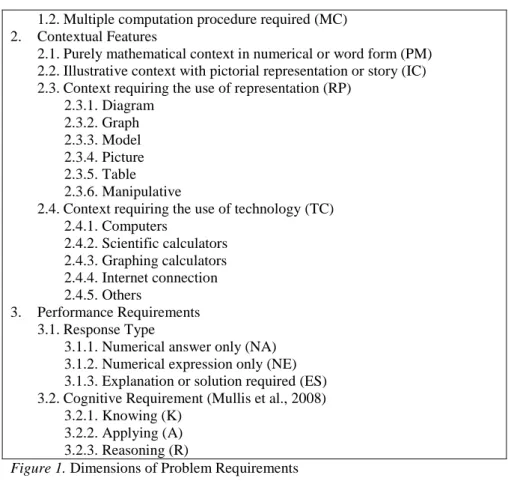
This study included two most commonly used textbook series from Turkish textbook series and the U.S. textbook series at the 6th and 7th grade levels (See Appendix A for the list of textbooks). The topic of Ratio and Proportion was covered in the Turkish 6th and 7th grade curricula, whereas the U.S. included it in the 6th, 7th, and 8th grade curricula. Both Turkish and the U.S. textbook series were commonly used in Turkish and the U.S. public school system respectively. The textbooks were investigated in the language in which they were written. Descriptive in nature, this study employed content analysis methodology that “can be used in any context in which the researcher desires a means of systematizing and (often) quantifying information that is not previously organized to the researcher’s purpose” (Fraenkel & Wallen, 2000). Content analysis was conducted to address the proposed research question. In particular, this study analyzed the contents of 6th and 7th grade mathematics textbooks. Problem analysis was conducted to investigate textbook problems on the topic of Ratios and Proportions. In particular, this study examined mathematics problems or problem components with no accompanying solutions. Previous studies identified three important dimensions for analyzing mathematics problems: mathematics feature, contextual feature, and performance requirement (Li, 1998; Stigler et al., 1986; Tabachneck, Koedinger, & Nathan, 1995). Grounded in previous studies, the analysis in the current study also took into account the use of technology (Akkoyunlu, 2002; Schware & Jaramillo, 1998) (see Figure 1). 1. Mathematical Features
1.2. Multiple computation procedure required (MC) 2. Contextual Features
2.1. Purely mathematical context in numerical or word form (PM) 2.2. Illustrative context with pictorial representation or story (IC) 2.3. Context requiring the use of representation (RP)
2.3.1. Diagram 2.3.2. Graph 2.3.3. Model 2.3.4. Picture 2.3.5. Table 2.3.6. Manipulative
2.4. Context requiring the use of technology (TC) 2.4.1. Computers 2.4.2. Scientific calculators 2.4.3. Graphing calculators 2.4.4. Internet connection 2.4.5. Others 3. Performance Requirements 3.1. Response Type
3.1.1. Numerical answer only (NA) 3.1.2. Numerical expression only (NE) 3.1.3. Explanation or solution required (ES) 3.2. Cognitive Requirement (Mullis et al., 2008)
3.2.1. Knowing (K) 3.2.2. Applying (A) 3.2.3. Reasoning (R)
Figure 1. Dimensions of Problem Requirements
During the coding of the cognitive requirements, the cognitive domains stated in TIMSS 2007 (Mullis et al., 2008) were utizilized (Table1). The coding themes (or behaviours as it was stated in the framework) tahat were defined for each cognitive domain were applied to determine the domain for a textbook problem. Table 1. Coding Themes for Cognitive Domains
Cognitive Domains
Coding Themes
Knowing Recall, Recognize, Compute, Retrieve, Measure, Classify / Order
Applying Select, Represent, Model, Implement, Solve routine problems
Reasonning Analyze, Generalize, Synthesize / Integrate, Justify, Solve non-routine problems
Source: Mullis, I. V. S., Martin, M. O. & Foy, P. (with Olson, J. F., Preuschoff, C., Erberber, E., Arora, A. & Galia, J.).(2008). TIMSS 2007 International Mathematics Report: Findings from IEA’s Trends in International Mathematics
and Science Study at the Fourth and Eighth Grades. Chestnut Hill, MA: TIMSS & PIRLS International Study Center, Boston College.
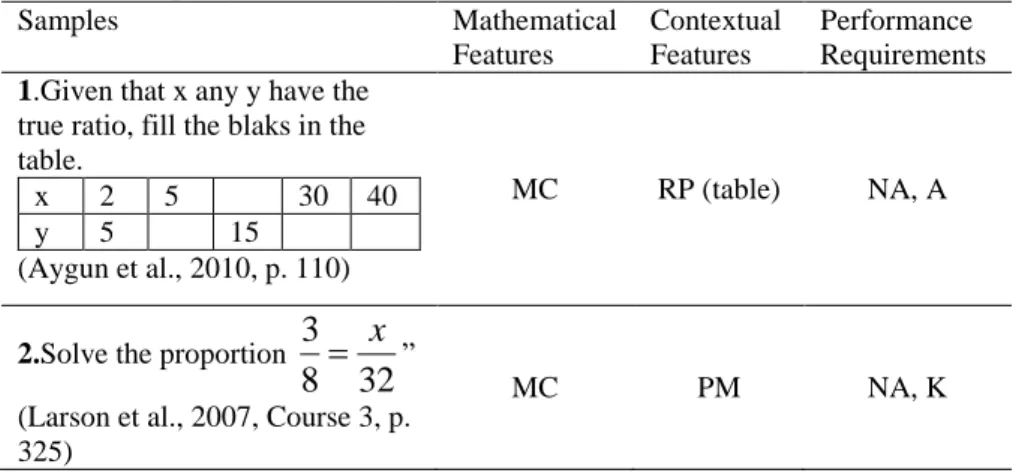
Each problem in all textbooks was coded in terms of the three dimensions stated above. In order to avoid the researchers’ subjectivity, a second independent rater who is literate in both English and Turkish languages coded problems in textbooks. The coder agreement rate found as .98 according to Miles and Huberman’s (1994) formula. Each item for which the coders do not agree was discussed until agreement was reached on how the item would be coded. Table 2 illustrates coding (based on the rubric in Figure 1) of two typical Ratios and Proportions problems one from the U.S. textbook and the other from the Turkish Textbook.
Table 2. Samples for Codings of The Problems
Samples Mathematical Features Contextual Features Performance Requirements
1.Given that x any y have the
true ratio, fill the blaks in the table.
x 2 5 30 40
y 5 15
(Aygun et al., 2010, p. 110)
MC RP (table) NA, A
2.Solve the proportion
32
8
3
x
” (Larson et al., 2007, Course 3, p. 325)MC PM NA, K
The first problem was coded as having multiple computation procedure (MC) in a context requiring the use of table representation (RP). The problem also requires numerical answer only (NA) with the cognitive domain of applying (A) since it requires the implementation of true ratio in a routine problem setting (i.e., MC, RP, NA, A). On the other hand, the second problem was coded as having multiple computation procedure (MC) in a purely mathematical context in numerical form (PM) requiring numerical answer only (NA) with the cognitive domain of knowing (K) since it requires a simple computation of uknown (x) (i.e., MC, PM, NA, K).
RESULTS
Table 3 presents the summary of the findings including the distribution of the Ratios and Proportions problems in Turkish and the U.S. textbooks in terms of their mathematical feature, contextual feature, use of technology, and performance requirement. The findings in the current study revealed that Turkish textbooks were dominated by the Ratios and Proportions problems requiring multiple computation procedures, whereas the U.S. textbooks favored single
computation problems with a closer distribution. Multiple computation procedure accounted for 91% of Turkish Ratios and Proportions problems, but only 43% of the U.S. problems. On the other hand, single computation procedure accounted for 57% of the U.S. Ratios and Proportions problems, but only 9% of the Turkish problems.
Table 3. Summary of Findings
Turkish U.S. Mathematical Features SC 9% 57% MC 91% 43% Contextual Features PM 83% 66% IC 17% 34% RP Diagram 0.6% 0.7% Graph 1.7% 2.8% Model 8.9% 0.5% Picture 5% 0.7% Table 6.7% 0.4% Manipulative 5.6% 0% TC Computers 0% 0.4% Scientific calculators 0% 1.2% Graphing calculators 0% 0.7% Internet connection 0% 2.6% Others 0% 2% Performance Requirements Response Type NA 67% 83% NE 1% 3% ES 32% 14% Cognitive Requirement K 45% 61% A 37% 27% B 19% 12%
Majority of Turkish Ratios and Proportions problems (83%) were written in purely mathematical context in numerical or word form, whereas only 17% of them were written in illustrative context with pictorial representation or story. A relatively similar pattern was also found in the U.S. Ratios and Proportions problems with 66% purely mathematical context problems in numerical or word form and 34% illustrative context problems with pictorial representation or story. Nevertheless, the U.S. textbooks evidently included more illustrative problems than Turkish textbooks.
In addition, contrary to one of the main principals of the reformed Turkish mathematical program that emphasizes the integration of use of technology into students’ learning experience (MEB, 2005), Turkish textbooks included no Ratios and Proportions problems requiring use of technology. On the other hand, the use of technology was evident in the U.S. textbooks. Despite its moderately insignificant percentage when compared with purely mathematical and
illustrative contexts, context that required the use of technology represented approximately five percent of their Ratios and Proportions problems. In particular, most of this particular context was comprised of the Internet connection and scientific calculators.
Compared with the U.S. textbooks, Turkish textbooks covered about six times as many as Ratios and Proportions problems in which the use of representation was required. Among the representation types employed in Turkish textbooks were model (8.9%), table (6.7%), manipulative (5.6%), picture (5%), graph (1.7%), and diagram (0.6%); on the other hand, for the Ratios and Proportions problems of U.S. textbooks, diagram had the same percentage coverage as of the Turkish Textbooks whereas the percentage coverage of graph in U.S. textbooks was higher than in the textbooks from Turkey. However, the other representation types covered less than 1% (0% for manipulative) of all proportion and ratio problems placed in the U.S. textbooks.
Table 2 also presents performance requirements of the Ratios and Proportions problems in the selected textbooks from Turkey and the U.S. Problems from the U.S. textbooks mostly required numerical answer, sometimes an answer as explanation or solution, and rarely as numerical expression. Although the classification of the answers for problems from Turkish textbooks also followed same order as those from the U.S. textbooks, it deemphasized numerical answer in favor of explanation or solution in terms of their percentage coverage.
As far as the distribution of the cognitive domains defined in TIMSS 2007 mathematics framework was concerned, textbooks from both countries included more problem placed in knowing domain, followed by applying and reasoning domains. However, Turkish textbooks presented closer percentage distribution than the U.S. textbooks. Turkish textbooks also included more Ratios and Proportions problems in the cognitive domains of applying and reasoning but less in knowing. The percentage distribution of the cognitive domains for the proportion and ratio problems in the Turkish textbooks was more in line with the target percentages of the TIMSS 2007 Mathematics Assessment devoted to cognitive domains at fourth and eighth grades (Mullis et al., p. 14, 2008).
CONCLUSIONS and DISCUSSIONS
This study examined the types of proportion and ratio problems in Turkish and the United States textbooks. Analyses of these problems further provided a substantial basis for understanding students’ performance. The results of this study demonstrated the value of comparing problems in that students were expected to complete rather than to compare content presentation (Carter et al., 1997). Specifically, results indicated that the U.S. textbooks included fewer pure mathematics problems but more real-life-application problems (including illustrations and story) for students’ practice. All textbooks are dominated with the problems that do not require explanation or problem solution process.
Turkish textbooks indeed consistently put more emphasis on explanations and solution processes in problems than the U.S. textbooks. Cross-system studies in mathematics have revealed that students coming from a system with traditional mathematical problems outperformed their U.S. counterparts in solving pure mathematical problems (Beaton et al., 1996) but not in solving complex problems that pertained to high requirements in cognition and communication, instead of advanced requirements in mathematics (Cai, 1995). Hence, the parallel differences between textbooks problems and students’ performance suggested that students’ experiences in solving problems influence their problem-solving performance.
In addition, contrary to one of the main principals of the reformed Turkish mathematical program that emphasizes the integration of use of technology into students’ learning experience (MEB, 2005), Turkish textbooks included no proportion and ratio problems requiring use of technology. On the other hand, the use of technology, mostly based on uses of the Internet, played an important role in the U.S. textbooks.
Compared with the U.S. textbooks, Turkish textbooks highly emphasized use of representations in their proportion and ratio problems. Among the highly regarded representation types employed in Turkish textbooks were model, table, manipulative, picture, and graph; on the other hand, graph was the most preferred representation type in the U.S. textbooks. Having more representatıon types is an advantage for Turkish Mathematics textbooks since research presents the benefits of providing learners with more than one representation (Cox & Brna, 1995; Mayer & Sims, 1994; Tabachneck, Koedinger, & Nathan, 1994). According to Ainsworth (2006), multiple representations allow the students to combine representations containing complementary information and limits the complexity of every single representation. Multiple representations is also beneficiary in avoiding misinterpretations by constraining the interpretation of single representations. Moreover, connecting multiple representations is useful for gaining a deeper and meaningful learning.
Problems from the U.S. textbooks mostly required numerical answer, sometimes an answer as explanation or solution, and rarely as numerical expression. Although the classification of the answers for problems from Turkish textbooks also followed same order as those from the U.S. textbooks, it deemphasized numerical answer in favor of explanation or solution in terms of their percentage coverage.
As far as the distribution of the cognitive domains defined in TIMSS 2007 mathematics framework was concerned, textbooks from both countries included more problem placed in the content domain of knowing, followed by applying and reasoning. However, Turkish textbooks presented closer percentage distribution than the U.S. textbooks. Turkish textbooks also included more proportion and ratio problems in the cognitive domains of applying and
reasoning but less in knowing. The percentage distribution of the cognitive domains for the proportion and ratio problems in the Turkish textbooks was in line with the target percentages of the TIMSS 2007 Mathematics Assessment devoted to cognitive domains at fourth and eighth grades (Mullis et al., p. 14, 2008) while differences exist in the distribution of items with respect to cognitive categories between SBS and TIMSS (Incikabi, 2012).
In general, the U.S. textbooks included less multiple step problems and were dominated with problems of low mathematical and cognitive requirements. Therefore, the U.S. textbooks embodied different expectations for developing students’ competence when compared to Turkish textbooks. An important type of higher order thinking in mathematics involves beliefs that students form about the nature of mathematics (Schoenfeld, 1985). American students’ proportion and ratio problem solving experiences mostly had to do with single-step problems, which may cause fail to consider appropriate strategies for multiple-step problem situations (Kulm, 1990). Although the study was limited to the comparison of textbook problems, it indicated the importance and feasibility of analyzing textbook problems for examining the expectations of developing students’ mathematics competence in cross-national studies.
The results of this study suggested that neglecting the analysis of textbook problems in curriculum studies may overlook an important aspect of students’ experiences in learning school mathematics. Because textbook-content analysis and problem analysis provide different lenses for studying textbooks and their potential effects on students’ mathematics achievement, combining the two types of analyses holds more promise for revealing such effects than conducting either type alone (Li, 2000).
In fact, reforms in mathematics education call for increasing attentions to students’ mathematical communication, reasoning, problem solving, and use of technology, but not as much to the practice of traditional mathematics skills. Thus, it is a current trend for textbooks to adopt problem for this particular purpose. What is needed in the textbooks may be the problems that are similar to the ones examined and contain high requirement in mathematics and (especially for Turkish side) more integration of the use of technology. Further efforts are needed both to provide students with mathematically challenging problems and to find ways to facilitate students’ development of mathematics competence.
REFERENCES
Ainsworth, S. (2006). DeFT: A conceptual framework for considering learning with multiple representations. Learning and Instruction, 16, 183-198.
Akkoyunlu, B. (2002). Educational technology in Turkey: Past, present and future. Educational Media International, 39, 165-174.
Beaton, A., Mullis, I., Martin, M., Gonzalez, E., Kelly, D., & Smith, T. (1996). Mathematics achievement in the middle school years: IEA’s Third International
Mathematics and Science Study (TIMSS). Chestnut Hill, MA: TIMSS International Study Center, Boston College.
Cai, J. (1995). A cognitive analysis of U.S and Chinese students’ mathematical performance on tasks involving computation, simple problem solving, and complex problem solving. Reston, VA: National Council of Teachers of Mathematics.
Carter, J., Li, Y., & Ferrucci, B. (1997). A comparison of how textbooks present integer addition and subtraction in China and the United States. Mathematics Educator, 2, 197-209.
Cox, R., & Brna, P. (1995). Supporting the use of external representations in problem solving: The need for flexible learning environments. Journal of Artificial Intelligence in Education, 6(2/3), 239-302.
Fraenkel J. R. & Wallen N. E. (2000). How to design and evaluate research in education (4th ed.). New York: McGraw-Hill.
Fuson, K., Stigler, J., & Bartsch, K. (1988). Brief report: Grade placement of addition and subtraction topics in Japan, Mainland China, the Soviet Union, Taiwan, and the United States. Journal for Research in Mathematics Education, 19, 449-456. Incikabi, L. (2011). The coherence of the curriculum, textbooks and placement
examinations in geometry education: How reform in Turkey brings balance to the classroom, Education as Change, 15(2), 239-255.
Incikabi, L. (2012). After the reform in Turkey: A content analysis of SBS and TIMSS assessment in terms of mathematics content, cognitive domains, and item types, Education as Change, 16(2), 301-312.
İncikabi, L., Ozgelen, S., & Tjoe, H. (2012). A comparative analysis of numbers and biology content domains between Turkey and the USA. International Journal of Environment & Science Education, 7(4), 523-536.
Li, Y. (2000). A comparison of problems that follow selected content presentations in American and Chinese mathematics textbooks. Journal for Research in Mathematics Education, 31, 234-241.
Mayer, R. E., & Sims, V. K. (1994). For whom is a picture worth 1000 words e Extensions of a dual-coding theory of multimedia learning. Journal of Educational Psychology, 86(3), 389-401.
Mayer, R. E., Sims, V., & Tajika, H. (1995). A comparison of how textbooks teach mathematical problem solving in Japan and the United States. American Educational Research Journal, 32, 443-460.
McKnight, C. C., Crosswhite, F. J., Dossey, J. A., Kifer, E., Swafford, J. O., Travers, K. J., & Cooney, T. J. (1987). The underachieving curriculum: Assessing U. S. school mathematics from an international perspective. Champaign, IL: Stipes. Miles, M. B., & Huberman, A. M. (1994). Qualitative data analysis: An expanded
sourcebook (2nd ed.). Thousand Oaks, CA: Sage.
Mullis, I. V. S., Martin, M. O., Gonzalez, E. J., Gregory, K. D., Garden, R. A., O’Connor, K. M., Chrostowski, S. J., & Smith, T. A. (2000). TIMSS 1999 International Mathematics Report: Findings from IEA’s Repeat of the Third International Mathematics and Science Study at the Eighth Grade. Chestnut Hill, MA: Boston College.
Mullis, I. V. S., Martin, M. O. & Foy, P. (with Olson, J. F., Preuschoff, C., Erberber, E., Arora, A. & Galia, J.). (2008). TIMSS 2007 International Mathematics Report: Findings from IEA’s Trends in International Mathematics and Science Study at the Fourth and Eighth Grades. Chestnut Hill, MA: Boston College.
Olkun, S., & Aydoğdu, T. (2003). Üçüncü Uluslararası Matematik ve Fen Araştırması (TIMSS) nedir? neyi sorgular? örnek geometri soruları ve etkinlikler.
İlköğretim-Online, 2, 28-35. Retrieved April 16, 2006 from http://www.ilkogretim-online.org.tr
Postlethwaite, T. N. (1988). Preface. In T. N. Postlethwaite (Ed.), The encyclopedia of comparative education and national systems of education (pp. xvii-xxvi). Oxford: Pergamon.
Robitaille, D. F., & Garden, R. A. (Eds.) (1989). The IEA study of mathematics II: Contexts and outcomes of school mathematics. Oxford: Pergamon.
Schmidt, W. H., McKnight, C. C., & Raizen, S. A. (1997a). A splintered vision: An investigation of U. S. science and mathematics education. Dordrecht, Netherlands: Kluwer.
Schmidt, W. H., McKnight, C. C., Valverde, G. A., Houang, R. T., & Wiley, D. E. (1997b). Many visions, many aims: A cross-national investigation of curricular intentions in school mathematics (Vol. 1). Dordrecht, Netherlands: Kluwer. Schware, R. & Jaramillo, A. (1998). Technology in education: The Turkish experiment.
Information Technology for Development, 8, 29-33.
Stigler, J. W., Fuson, K. C., Ham, M., & Kim, M. S. (1986). An analysis of addition and subtraction word problems in American and Soviet elementary mathematics textbooks. Cognition and Instruction, 3, 153-171.
Tabachneck, H. J. M., Koedinger, K. R., & Nathan, M. J. (1994). Towards a theoretical account of strategy use and sense making in mathematical problem solving. Paper presented at the 16 annual conference of the Cognitive Science Society, Atlanta, GA.
Tabachneck, H. J. M., Koedinger, K. R., & Nathan, M. J. (1995). A cognitive analysis of the task demands of early algebra. In Proceedings of the Seventeenth Annual Conference of the Cognitive Science Society. Hillsade, NJ: Erlbaum.
Westbury, I. (1992). Comparing American and Japanese achievement: Is the United States really an underachiever? Educational Researcher, 21, 18-24.
GENİŞLETİLMİŞ ÖZET
Son zamanlarda, eğitim sistemlerinin karşılaştırıldığı çalışmalara matematik eğitimi alanında daha sık rastlanmaktadır. Postlethwaite’e (1988) gore, sistemler arası karşılaştırmaların yapıldığı çalışmalar, 1) değişik ülkerde meydana gelen ve onların eğitim sistemlerinnin gelişmesine katkıda bulunan olayları ve bu olayların sonuçlarını tanımlamayı, 2) eğitim sistemlerinde var olan benzerliklerin ve farklılıkların nedenlerini açıklamayı ve yorumlamayı, 3) eğitimsel sistemlerle alakalı değişkenlerin muhtemel etkilerine ulaşmayı ve 4) eğitimsel etkilerle ilgili genel prensipleri gösterrmeyi amaçlamaktadır.
Geleneksel ve karşılaştırmalı çalışmalarda, ders kitaplarının içeriksel sunum özelliklerinin ve organizasyonunun incelendiği bir yaklaşım göze çarpmaktadır. Amerikan Bilimsel İlerleme Birliği’nin yaptığı Proje 2061’ de, bir çok Amerikan ders kitabının sunum özellikleri, öğretimsel rehberlik sağlama yeterlikleri bakımından incelenmiştir. Başka bir çalışmada, Mayer ve meslekdaşları (1995), Amerika’ da ve Japonya’da kullanılan matematik ders kitaplarının problem çözme konusunun öğretimi bakımından gösterdikleri farklılıkları ve benzerlikleri araştırmışlardır. Çalışmanın sonuçları, Japonya’da kullanılan matematik ders kitaplarının problem çözme sürecinde bol miktarda alıştırmalara ve çoklu gösterimlere yer verdiğini ama Amerika’da kullanılan ders kitaplarının genellikle pratik yapmaya önem verdiğini göstermektedir.
Bu çalışma, Türkiye’ de ve Amerika’ da bulunan matematik ders kitaplarındaki oran ve orantı konusunu içeren problemlerin benzerlikler ve farklılıklar bakımından analiz etmeyi amaçlamaktadır. Bu amaç doğrultusunda, bu çalışma “Türkiye’ deki ve Amerika’daki ders kitaplarında ne çeşit oran ve orantı problemleri bulunmaktadır?” sorusuna ceavp aramaktadır.
Betimleyici doğaya sahip olmakla birlikte, bu çalışmada içerik analizi yöntemi kullanılmıştır. Özellikle 6. ve 7. sınıf ders kitaplarının içerikleri incelenmiştir.Önceki çalışmalar matematik problemlerinin incelenmesinde üç boyuta değinmişlerdir: Matematiksel özellik, içerik özelliği ve performans gerekleri (Li, 1998; Stigler et al., 1986; Tabachneck, Koedinger, & Nathan, 1995). Yine önceki çalışmalardan (Akkoyunlu, 2002; Schware & Jaramillo, 1998) esinlenerek, “teknoloji kullanımı” içerik özelliği boyutuna eklenmiştir. Ders kitaplarındaki bütün problemler beilrtilen boyutlara göre kodlanmıştır. Kodlamanın nesnelliğini arttırmak için İngilizce ve Türkçe bilgisine sahip ikimci bir kodlayıcı kullanılmıştır. Kodlayıcılar arasındaki uyum oranın Miles ve Huberman’ ın (1994) formülüne göre .98 olarak hesaplanmıştır.
Matematiksel özellik boyutunda, çalışmanın sonuçları Türkiye’ de kullanılan ders kitaplarının genellikle çoklu işlem gerektiren oran ve orantı problemleri içerdiğini ama Amerika’ da kullanılan kitapların yoğunlukla tek işlem gerektiren problemler içerdiğini göstermektedir.
İçeriksel özellikler boyutuna bakıldığında, Türkiye’ de kullanılan ders kitaplarındaki problemlerin çoğunluğu (%83) sadece matematiksel terimler kullanılarak yazılmıştır ve resimsel veya hikayesel gösterim içeren problemler (%17) azınlıktadır. Benzer bir eğilim Amerika’ da kullanılan ders kitaplarında da olmasına rağmen görsel ve hikayesel içerikler (%34) daha fazladır. Türkiye’ deki ders kitaplarında teknoloji kullanımı gerektiren oran-orantı problemine rastlanmamıştır. Diğer taraftan yüzdelik oranı diğer içerik özelliklerinden az olmasına rağmen Amerika’ daki ders kitaplarındaki problemlerde teknoloji kullanımı belirlenmiştir. İçerik özellikleri bakımından, Türkiye’deki kitaplar Amerika’daki kitaplara kıyasla altı kat daha fazla sayıda problemde gösterimler içermiştir.
Performans gerekleri boyutunda, Amerika’ da kullanılan kitaplardaki oran ve orantı problemlerinde Türkiye’ deki kitaplardaki problemlere kıyasla daha çok sayısal bir cevap istenmekte ve açıklamalar ve çözüm süreçleri daha az vurgulanmaktadır. Bilişsel alanların vurgulanması bakımından, Türkiye’ de kullanılan ders kitaplarındaki oran ve orantı problemlerinde uygulama ve muhakeme alanına Amerika’ da kullanılan ders kitaplarına kıyasla daha çok vurgu yapılmıştır. Diğer taraftan, Amerika’ daki kitaplardaki oran-orantı pğroblemlerinde bilme bilişsel alanı Türkiye’deki kitaplara kıyasla daha çok içerilmiştir.
Bu çalımanın sonuçları, müfredat çalışmalarında ders kitaplarındaki problemlerin incelenmesinin ihmal edilmesinin öğrencilerin matematik öğrenmelerindeki önemli bir öğenin gözden kaçırılabileceğini önermektedir. Çünkü, ders kitaplarının içerik analizi ve problemlerin analizi ders kitaplarının araştırılmasında ve ders kitaplarının öğrenci başarılarına etkisinin belirlenmesinde değişik açılar sağlar (Li, 2000).
Matematik eğitimi alındaki reform hareketleri geleneksel matematiksel öğretimleri yerine öğrenciler arasında matematiksel iletişime, muhakemeye, problem çözmeye ve teknoloji kullanımına işaret etmektedir. Bu doğrultuda, ders kitaplarınında bu tür kazanımlar sağlayacak problemleri içermesi yönünde eğilim vardır.
APPENDICES Appendix A
List of textbooks used in the study
Turkish textbooks:
Aktas, S., Atalay, A., Aygun, S. C., Aynur, N., Bilge, O., Celik, M., Cuha, S. S., Karaman, U., Ocal, I., Oncu, F., Ozcelik, U., Ulubay, M., & Unsal, N. (2010). Ilköğretim Matematik 6 (Mathematics 6). Ankara: Milli Egitim Yayinlari.
Aygun, S. C., Aynur, N., Cuha, S. S., Karaman, U., Ozcelik, U., Ulubay, M., , & Unsal N. (2010). Ilköğretim Matematik 7 (Mathematics 7). Ankara: Milli Egitim Yayinlari. U.S. textbooks:
Larson, R., Boswell, L., Kanold, T., & Stiff, L. (2007). McDougal Littell Middle School Math Course 1: Student’s Edition. Evanston, IL: McDougal Littell.
Larson, R., Boswell, L., Kanold, T., & Stiff, L. (2007). McDougal Littell Middle School Math Course 2: Student’s Edition. Evanston, IL: McDougal Littell.
Larson, R., Boswell, L., Kanold, T., & Stiff, L. (2007). McDougal Littell Middle School Math Course 3: Student’s Edition. Evanston, IL: McDougal Littell.