Review
Creative thought in teaching Turkish language
Talat Aytan*, Nail Güney and Mesut Gün
Turkish Teaching Department, Ahmet Keleşoğlu Faculty of Education, Selçuk University, Konya, Turkey.
Accepted 13 April, 2011
Primary Turkish lesson curriculum aims to educate individuals who can use Turkish and the abilities of speaking, writing, listening and reading efficiently; who can express feelings, ideas and dreams; who are sensitive to national values and who has the consciousness of language and the top level conscious abilities such as classification, investigating and critical thinking, and the ones who can take responsibilites and work creatively with a group or individually. Especially, the abilitiy of creating is the field to be studied thorougly and developed. Creative thinking can be described as any imaginary product involving original thoughts beyond the straight-line thinking platform. Student-based education and carefully planned lessons have great importance on discovering creativity. The activities enabling the students to be active, to express his or her thoughts easily and democratic atmosphere are effective to discover the creative sides of the students. A teacher of Turkish language should help to form and develop creative thoughts by organizing activities suitable for the students’social and linguistic levels which are based on the use of the students’ creative sides in the fields of listening, watching, reading, speaking, writing and learning grammar, apart from the ones given in the Turkish activity books. In this study, two examples of activites for each field of listening, speaking, reading, writing and grammar are going to be organised in the level of secondary Turkish lesson for 7th classes with the aim of developing creative thinking. The aim of this study is to form alternative activities that can help to discover the students’creative sides, to help the teachers in practising and to emphasize the importance of creative thinking.
Key words: Teaching of Turkish language, creative thinking, Turkish lesson curriculum, examples for activities.
INTRODUCTION
This century is called as atom, knowledge, information technologies and communication age. To give priority to individuality is the main approach in this century. This approach is also seen in the field of education. Different from the past curriculums, the new primary and secondary curriculums are based on multiple intelligence, individuality and personal differences. The approach based on strict rules and give importance to memorizing which gives its place to creative thinking. The meaning of “creativity” in Western languages is “Kreativitaet, creativity”. The Latin word “creare” means “to breed, to create, to form”.
Creativity is being critical and making new propositions. It is forming a relationship between the objects and ideas that have not been related before. Creativity is being new, original and different from the usual and known, seeing the problem, finding out new solutions by
*Corresponding author. E-mail: [email protected].
using different methods. Creativity is the action of changing the world and ourselves. Artistic creation is the different expression of subjective inner life during changing process. It is to realize the reproduction with one’s experiences, sensitivity and perception attitude; to find and discover new relations in dialectical meeting of subjective with objective. Creativity is to reach the solution in different ways in the action formed with dreams, imagination, sense of humour and intellectual, attention, judgement, and argumentation. Creative people benefit from their past, intellectual accumulation, experiences, perceptions and imagination in the process of creativity. They evaluate their environment in this context and produce creative works and products freely by intuition and research as far as their transferring ability allows, and they can give different propositions. For this reason current events and theories are tackled again but with a different point of view. Both the way and the result are original. At the end of this sensitivity process there is innovation. According to Torrance (1968), “creativity is perceiving spaces, disturbances, deficient elements,
perceiving spaces, disturbances, deficient elements, thinking about these or hypothesizing, testing these hypo-theses, comparing the results and probably changing these hypotheses and testing them again.” In creativity in which there is invention and innovation, all abilities of mind, thinking process, imagination and emotions have connection with each other. So creativity has a role in improving abilities of mind. Creativity is complementary of intelligence and it is the top step. Intelligence can be described as collecting information, learning and abilities of using these and adapting different situations. It expands the content of these abilities by making connections and relations between information. There is a process of looking for a creation including concept, feeling and imagination searching and finding out. The connotation of this process with sensation and feelings that stem from perception constitutes a beginning for an efficient metaphor process.” And Conrad called this
“creativity” (Torrance, 1972;
(http://www.universitetoplum.org/text.php3?id=47). According to the researches, left hemisphere of the brain is the center for creative thinking. If we are to explain the learning process of right and left brain briefly; left hemisphere is defined by features mentioned mostly with Mathematics, such as analitical, logical, systematic, numerical and rational. Right brain is defined by features that are mentioned mostly with art, such as instinctive, holistic, visual, sensory and spatial. Left-brain dominant people learn by phonetic and analitical methods, whereas right-brain dominant people learn by visual methods (Goldstein and Hogarth, 1997). For many people left cortex is interested in logic, words, lists, numbers, linearity, analysis, etc. Left cortex deals with these activities while right cortex waits ready to help in stand by or “alpha wave” position. Right cortex deals with rhythm, imagination, colours, spatial awareness, Gestalt (whole Picture) and dimension (Buzan, 2008: 28).
The future of the humanity depends on creative individuals and a particular education for their creativity. All original and superior works that societies have are the works created by people with creative thinking. For every society, the most important educational problem is the early determination of the children who have creative features and forming and developing creative thinking of an individual. Because the people with the characteristics of creativity are the most important potential for the development of both the society they belong to and the whole humanity. The magic and secret power which brings developed countries that are advanced in all fields today to this stage is to provide an educational environ-ment which is suitable for individuals with creative thinking, and according to their abilities and levels. Their creative powers should be turned into products which serve the welfare of their society and other societies. As the aim of education and teaching activities is to ensure changes in students’ behavior in the desired direction, this is a means that students are the focus of these activities.
So it is important to find out to what extent the students’ behaviors change in the direction of target aims and the main factors that affect students’ success. When generally looked at the education process, it is seen that individuals who seem to be more successful mentally are supported more, and rewarded but their creativity is ignored. In this contex, teachers have the most important function in fulfilling education activities and they should support individuals’ creativity and they should help to develop their creativity power to upper limit with their behaviors. For this reason, societies need individuals whose creativity power is in upper level besides the individuals who are mentally in upper level in order to develop (Erdoğdu, 2006: 17).
There are abilities that are accepted to contribute to creative thinking. These are the abilities measured with tools developed by Torrance (1962) and they are known as explanation, fluency, flexibility and originality (Aslan, 1994; Bekci and Erdoğan, 2007; Bonk and Smith, 1998: 261 - 293; Çetingöz, 2002; Emir and Bahar, 2003: 91- 110; Emir et al., 2006; Özden, 2003: 179):
Explanation: It constitutes a ground for creativity.
Individual’s explanations and expansion about the related subject, event and case are important abilities that determine individual’s creativity. Not using these abilities effectively and not ensuring different expansions causes abilities to be confined.
Fluency: Producing many acceptable ideas, solution or
alternatives in a certain period. It shows the number of unusual usages and innovations expressed or done. For individual to produce many ideas, solution or alternatives about the subject, event or situation is an important indicator of creative thinking.
Flexibility: It is the diversity in produced ideas, solution
or alternatives and bringing versatile perspective to the subject, event and situations. It is the number of categories about the unusual usage and the number of approaches used in innovations. Creativity requires diversity in thinking and looking at the events from different perspectives.
Originality: Originality is a feature that requires mental
energy, and it shows up in rare and unusual reactions. They are the ideas different from the known and simple. It expresses the unusual change and the number of usage. The emerging idea should be new and rare. In other words, answers should be different from the usual. Unusually, creative thinking individuals naturally have got different features from an average thinking person. Creative thinkers are more flexible than other individuals and they adapt to new situations more easily. They are more careful. They see what is important for others and care about these. They are more compatible and sensitive about the environment and other people. They
have self-confidence and they are confident.
It is observed in the researches about creativity that almost all children have creative thinking in different levels. Creative abilities are observed more easily in younger children, however they disappear because these creative abilities are not reinforced or they are blocked with some comments such as “ do the right, do not’ be silly” or “how did you do that like this?” (Fyle,1985: 30).
Creatve thinking has had an important role in the developement of societies. Invensions and discoveries which have improved societies have emerged as the product of creative thinking and creative problem solving. So, what is important for creativity? Creativity contains thinking in different cases in such a way that is flexible, fluent, original and different from the usual. Life is full of creative thinking events (Gibson and Chandler, 1988).
It is the subject of the discussion whether education of creativity is acceptable for creativity in real life, but, besides there are many evidences about improving creativity at school. Versatile thinking ability has a central importance in creativity in real life. It is observed that this versatile thinking ability can be improved by many educational programmes. (Gage and Berliner, 1988).
In creative thinking, classroom atmosphere is another element as important as educational programmes. Classroom atmosphere has a big effect on improvement of students’ creativities. These are some advices for preparing an atmosphere that supports creativity in a project oriented class:
1. Make various materials and equipments available. 2. Reduce the negative results of taking risk.
3. Expose students to many different creative products. 4. Make resources about many different subjects available in order for students to find things they are interested in and things that will activate their imagination.
5. Allow flexibility about time and classroom order. 5. Encourage the students to cooperate in projects. 6. During the project work, make sure that students have a quiet period, because noise may hinder creativity. 7. Make connections between the students and the creative people in society.
8. Think creatively yourself and share your products, process and happiness resulting from your success. Be a model.
In any step of education, success depends on student’s motivation. Researches show that extrinsic motivation gives harm to creativity whereas intrinsic motivation improves it (Amabile, 1983).
State of the problem
Which activities can be done in learning fields; listening, speaking, reading, writing and grammar in order to improve creativity in primary education Turkish lesson?
FINDINGS AND COMMENTS
There have been important developments about language teaching in our country in recent years. Improving language and mental abilities has been taken as the basic purpose of Turkish Lesson Curriculum. In the curriculum, teaching Turkish is stated not only as improving language abilities such as listening, speaking, reading, writing, visual reading and visual presentation but also as improving mental abilities such as thinking, understanding, sorting, classifying, questioning, relating, criticizing, analyzing-synthesizing, and evaluating. In this process, students are expected to improve their abilities such as using Turkish correctly, beautifully and effec-tively, communicating, problem-solving, decision-making, maintaining lifelong learning (Güneş, 2010):
1. Using Turkish correctly, beautifully and effectively. 2. Critical thinking. 3. Creative thinking. 4. Communicating. 5. Problem-solving. 6. Searching. 7. Decision-making.
8. Using information technologies. 9. Entrepreneurship (MEB, 2005: 5)
One of the most important elements for Turkish lessons to be effective and useful is the education of improving creative thinking.
As aforementioned, creative thinking is considered as one of the main skills in Turkish Teaching Curriculum, 2005.
Listening
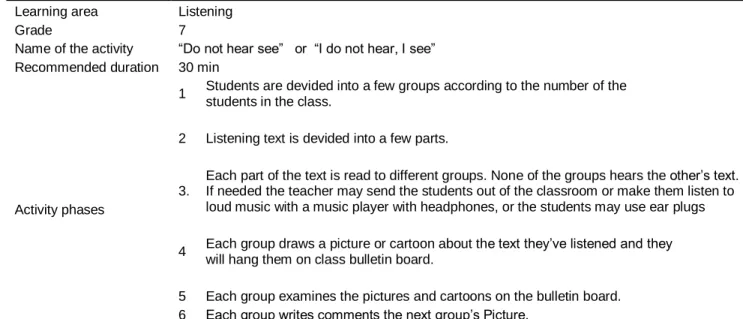
Listening has been described differently by different people. According to Johnson(1951:58), “ Listening is the ability of understanding and responding effectively in oral communication process”; Wolf et al., (1983) “ An active process that includes hearing, understanding, combining the understood information and responding if needed”; Jalongo(1995: 13), “ To use mental filter for most of the heard in order to focus on message, it is more than hearing”; Ergin and Birol(2000: 115), “A psychological process that begins with being aware of sounds and talk images and paying attention to them, continues with recognizing and remembering certain auditory signs, and ends with signification” (Doğan, 2008: 263) There are 5 targets and 31 gains for listening training in Primary education Turkish Lesson Curriculum, 2005 (Tables 1 and 2).
Speaking
Communication is a case needed by people most and a natural result of individual’s being a social presence
Table 1. Listening activity.
Learning area Listening
Grade 7
Name of the activity “Do not hear see” or “I do not hear, I see” Recommended duration 30 min
Activity phases
1 Students are devided into a few groups according to the number of the students in the class.
2 Listening text is devided into a few parts.
3.
Each part of the text is read to different groups. None of the groups hears the other’s text. If needed the teacher may send the students out of the classroom or make them listen to loud music with a music player with headphones, or the students may use ear plugs
4 Each group draws a picture or cartoon about the text they’ve listened and they will hang them on class bulletin board.
5 Each group examines the pictures and cartoons on the bulletin board. 6 Each group writes comments the next group’s Picture.
Table 2. Listening activity.
Learning area Listening
Grade 7
Name of the activity Ten years later Recommended duration 30 min
Activity phases
1 Students are divided into a few groups according to the number of the students in the classroom
2 A motion sentence is given to the students, such as “The child run to his room with tears in his eyes
3 Each group writes a scenario about this child’s situation 4 Each group reads their scenario one by one
5 Each group improves the previous group’s scenario and performs the fiction of ten years later as a drama
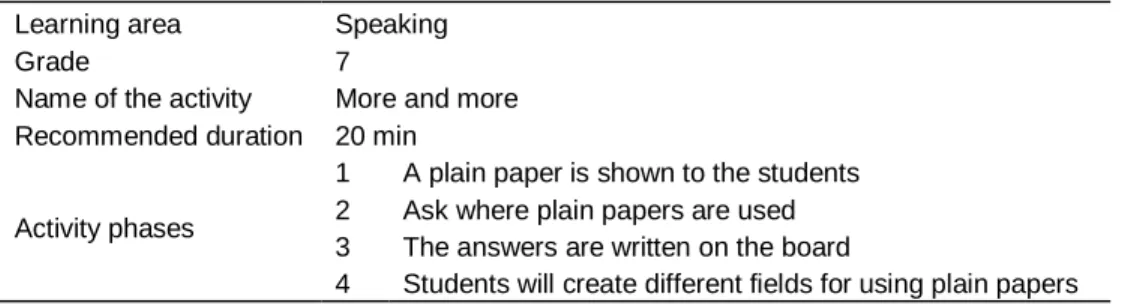
(Erdem and Deniz, 2008: 75). It is the natural understanding of people, transferring feelings and thoughts, and expressing themselves. Speaking is the most important means of the communication, at transferring level. Speaking is transferring thoughts, feelings and information to the other side by using the language consisting of sounds (Demirel, 1999; 40). Speaking field has an important place in education and teaching process. In Primary education Turkish Lesson Curriculum 2005, there are 5 targets and 42 gains in education of speaking (Table 3).
Three or four alternatives are thought for the fields where a paperclip is used with linear logic whereas this number can be increased up to 24 with creative thinking (Buzan, 2003: 47) Table 4.
Reading
The signs and symbols percieved by the help of voice organs and eyes are interpretted, evaluated and sensed by brain. This process is called “reading”. It is aimed in the curriculum with reading to learning field that students can read the written text they confront in daily life correctly, fluently and using the most suitable methods. It is also aimed that they can evaluate what they read, interpret with a critical point of view and acquire reading habit (MEB, 2005: 6) Tables 5 and 6.
Writing
Table 3. Spaeaking activity
Learning area Speaking
Grade 7
Name of the activity More and more Recommended duration 20 min
Activity phases
1 A plain paper is shown to the students 2 Ask where plain papers are used 3 The answers are written on the board
4 Students will create different fields for using plain papers
Table 4. Spaeaking activity
Learning area Speaking
Grade 7
Name of the activity Let us prepare a library Recommended duration 30 min
Activity phases
1 Make the students think about how to prepare a library in their classroom with the least effort and expense
2 Divide the students into groups of five for library creating campaign
3 A group leader explains the solutions that the groups have formed only by talking 4 The leader explains to the class his/her group’s proposals with their reasons
5 The proposals of the groups are critisized with their successful or unsuccessful sides by the class. The most successful proposal about creating a library is decided
Table 5. Reading activity
Learning area Reading
Grade 7
Name of the activity Complete the story Recommended duration 30 min
Activity phases
1 Teacher lets students read an incomplete text, a story or a tale 2 Teacher wants them to think about the end of that story or tale
3 After thinking period, the teacher asks how the students complete the story or tale 4 Teacher wants a volunteer student to complete the story or tale pretending to read 5 While the student is telling the story or tale, a group of students are dramatizing at the
same time.
imaginations and desires in a written form (Aytan, 2010: 66). In Turkish Teaching Curriculum, by improving writing skills, it is aimed that students express their feelings, ideas, imaginations, plans and impressions by taking adventage of language opportunities, and in accordance with the rules of the language. It is also aimed that students acquire writing habits to express oneself and for those who have writing ability improve their writing skills (MEB, 2005: 7). In accordance with these targets, students are oriented to express their feelings, thoughts, dreams and impression in written form. In Primary
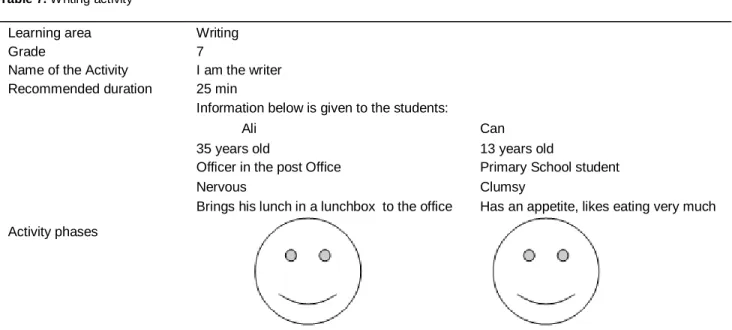
education Turkish lesson curriculum, there are 6 tagets and 42 gains (Table 7).
In the study of literary texts, different methods can be used in accordance with the goals set.
1. Writing the rest of the text and completing.
2. Writing a new ending for the text (shortening or extending).
3. Changing the point of view.
4. Changing the setting, time or characters.
Table 6. Reading activity
Learning area Reading
Grade 7
Name of the activity See the news from someone else’s point of view Recommended duration 30 min
Activity phases
1 A title of media news about traffic accident is read to the class 2 It is asked to the students what may have happened about this news
3 Students are asked to evaluate the accident as the driver who has had the accident 4 Students are asked to evaluate the news as the injured person’s parents. The whole
news is read and evaluated comparing with the activities
Table 7. Writing activity
Learning area Writing
Grade 7
Name of the Activity I am the writer Recommended duration 25 min
Activity phases
Information below is given to the students:
Ali Can
35 years old 13 years old
Officer in the post Office Primary School student
Nervous Clumsy
Brings his lunch in a lunchbox to the office Has an appetite, likes eating very much
Use these information and write a story in which Ali and Can are main characters.
original text or changing the plot by adhering the characters. 6. Improving the characters in the plot of literary text.7. Changing the speech format (dialogue, interior monologue, periphrasis,etc.)
8. Writing various texts about a known motive, character or story.
9. Writing parody or variations.
10. Transformation from a literary type to an other type (changing a text to an other text with a different form.) 11. Constructing a new text by connotation chain of the title, concept or motif in the text (İpşiroğlu, 2006: 40)
Grammar
“Grammar is a field of linguistics that examines the rules of that language’s sounds, word types and their struc-tures, sentence order and their task in the sentence, the rules about inflection, declension and conjugation.” (Göğüş, 1978: 337). Grammar is not an independent set
of rules separated from other learning areas, but it is the supporter, complementary and part of other learning areas. This feature has been stressed im Primary education Turkish Lesson Curriculum 2005 (MEB, 2005: 7). There are 2 targets and 16 gains for sixth grade; 5 targets and 20 gains for seventh grade, 3 targets and 17 gains for eighth grade about grammar in Primary edu-cation Turkish Lesson Curriculum (Tables 8, 9 and 10).
CONCLUSION AND PROPOSALS
Creative thinking is based on critical point of view, and finding unusual, new and original solutions. It is possible to use creative thinking in all learning areas of teaching Turkish such as listening, reading, speaking, writing and grammar. Creative thinking can not be ignored at the point of raising students who can think, critisize, question, analyze, synthesize and make evaluation. So it is really important to create and apply activities allowing students’
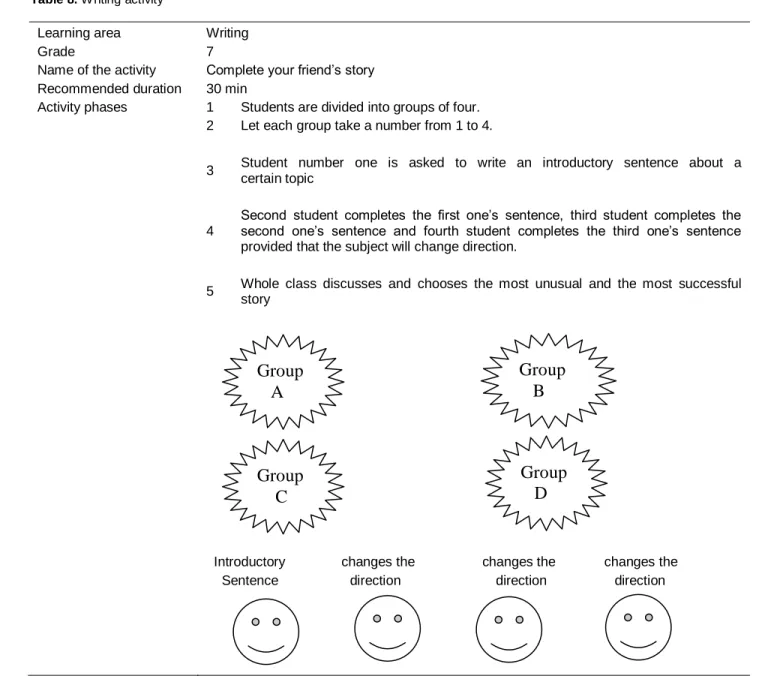
Table 8. Writing activity
Learning area Writing
Grade 7
Name of the activity Complete your friend’s story Recommended duration 30 min
Activity phases 1 Students are divided into groups of four. 2 Let each group take a number from 1 to 4.
3 Student number one is asked to write an introductory sentence about a certain topic
4
Second student completes the first one’s sentence, third student completes the second one’s sentence and fourth student completes the third one’s sentence provided that the subject will change direction.
5 Whole class discusses and chooses the most unusual and the most successful story
Introductory changes the changes the changes the Sentence direction direction direction
Table 9. Grammar activity
Learning area Grammar
Grade 7
Name of the activity The picture of the time Recommended duration 30 min
Activity phases
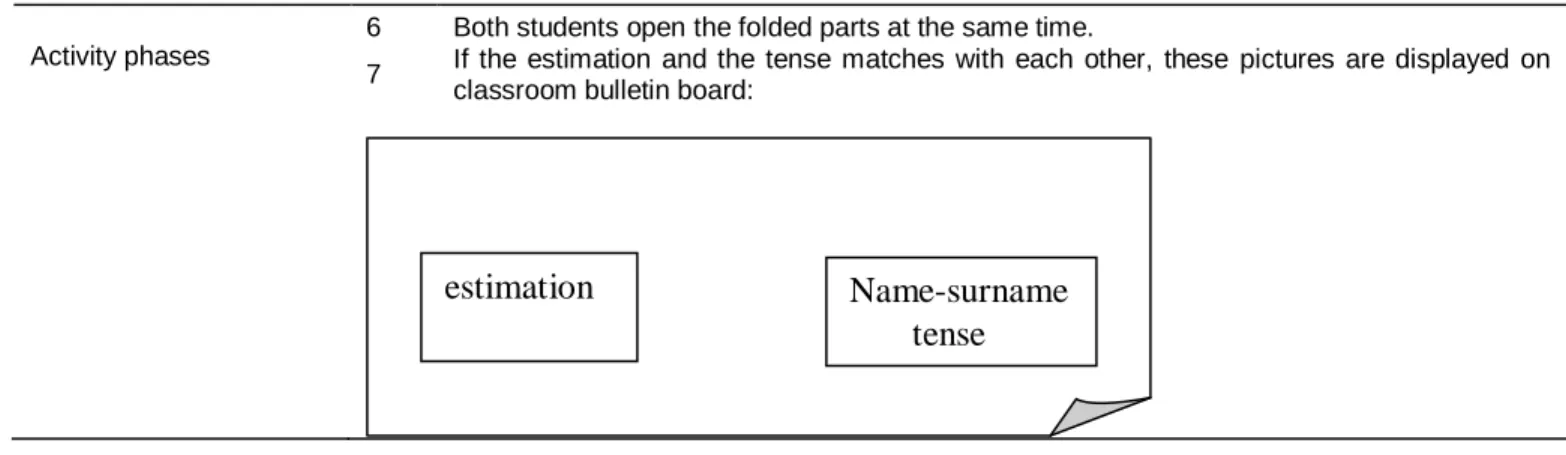
1 Students are told to choose a tense whichever they wish (past, present, future or simple present tense) and to express this tense with pictures
2 The student who has drawn the picture writes his/ her name and the tense he/she has tried to express, on the lower right corner of the page and folds it gently.
3 Then each student changes his/her Picture with deskmate’s picture. 4 Each student tries to guess the tense by interpreting the picture. 5 Then they write their estimation on the lower left corner of the page.
Group
A
Group
B
Group
C
Group
D
Table 9. Contd.
Activity phases
6 Both students open the folded parts at the same time.
7 If the estimation and the tense matches with each other, these pictures are displayed on classroom bulletin board:
Table 10. Grammar activity
Learning area Grammar
Grade 7
Name of the Activity Let’s define our mission. Recommended duration 40 min
Activity phases
1 Blank papers or A4 papers are given to the students. 2 They draw lines that devides the paper into four equal parts.
3 Students are asked to express an action with pictures in detail (First he stood up slowly, he went towards the television with slow steps, etc.)
4 They are asked to tell about a routin action in detail in four parts (If needed there can be more parts)
5 With the help of the pictures they are asked to form a story.
6 After they write their stories, they find the words that describe the verb in various aspects such as case, time, amount and preposition.
7 Students find the picture and the word that explains it. The type of the word is told to the students (Adverb)
1 2 3 4
Turning the pictures into a text as a story.
Finding out the words which describes verbs in various aspects (time, case, preposition, question, amount). Expressing adverbs
estimation
Name-surname
tense
creative thinking. The revised Primary curriculum attracts attention because of its describing creative thinking as one of the main skills.
In this study, two sample activities has been prepared for seventh grade for each learning field; listening, reading, speaking, writing and grammar. First Turkish language teachers and then all educators have a very important duty about preparing Turkish lesson materials in accordance with creative thinking.
REFERENCES
Amabile TM (1983). The Social Psychology Of Creativity, Springer-Verlag Incorporated, New York.
Aslan E (1994). A Research On The Problem Areas For Which Teenagers With The Ability Of Creative Thinking Need Help Of A Counselor. An Unpublished Master Essay, Marmara University, İstanbul.
Aytan T (2010) The New Composition Techniques For Improving Writing Skills In Primary and Secondary Education, J. Milli Eğitim, Ankara.
Bekci B, Erdoğan T (2007). A research On The Relationship Between Candidate Teachers’ Problem –Solving Abilities and Their Creative Thinking Levels, 16th National Education Sciences Congress, Gaziosmanpaşa University, Tokat, Turkey.
Bonk JC, Smith GS (1998). Alternative Instructional Stratejies For Creative and Critical Thinking In Accounting Curriculum, J. Account. Educ., 16: 2.
Buzan T (2008). Use Your Mind, Alfa Pres, İstanbul. Buzan T (2003). The Power Of Mind, Epsilon Pres, İstanbul.
Çağlar D (2008). Creative Children and Improving Creativity. J. Modern Educ., 1: 9.
Çetingöz D (2002). The Research On The Improvement Of Creative Thinking Skills Of Pre-school Teachers Training Department Students, Master Essay, Dokuz Eylül University, İzmir.
Demirel Ö (1999). Turkish Lesson Teaching In Primary Schools, Milli Eğitim Press, İstanbul.
Denizli FL (2008). Grammar With Games, Erdem Pres, İstanbul. Doğan Y (2008). The Effectiveness Of Activity Based Studies For
Seventh Grade Students In Primary Schools To Improve Their Listening Skills, J. Türk Eğitim Bilimleri, 6(2).
Emir S, Bahar M (2003). The Opinions Of Teachers and Students About Creativity, J. Abant İzzet Baysal Universitesi Sosyal Bilimler, 1: 1. Emir S, Erdoğan T, Kuyumcu A (2006). The Relationship Between The
Creative Thinking Level and Sociocultural Features Of Turkish Teachers Training Department Students, 15th National Education Sciences Congress, Muğla University, Muğla.
Erdem İ, Deniz K (2008). A Field Research About Increasing Productivity At Nice Speaking Courses, J. Mustafa Kemal Univ. Inst. Soc. Sci., 5: 10.
Erdoğdu YM (2006). The Relationship Between Creativity and Teacher Behaviours With Academic Success, J. Elect. Soc. Sci., 5: 1. Fyle B (1985). Encouraging Creative Thinking In Children. Teacher
Educ. Q., 12: 1.
Gibson JT, Chandler LA (1988). Educational Psychology: Mastering Principles and Applications, Allyn and Bacon, inc., Boston.
Gage NL, Berliner DC (1988). Educational Psychology, Houghton Mifflin Company, Boston.
Goldstein WM, Hoghart RM (1997). Judgement and Decision Research: Some Historical Context, Cambridge University Press, Cambridge. Göğüş B (1978). Turkish and Writting Education In Our Secondary
Schools, Ankara.
Güneş F (2010) http://www.memurlar.net/haber/158512/
MEB (2006) Primary Turkish Lesson Curriculum (6th,7th and 8th grades), State Books Directorate, Ankara, Turkey.
Oral G (2003). We Are Writing Again, Pegema Press, Ankara. Özden Y (2003). Learning and Teaching, Pegama Press, Ankara. San İ (1985). Art and Education, Ankara.
Torrance EP (1972) Torrance Tests Of Creativity Thinking, Directions Manual and Scoring Guide, Figural Test Booklet A.
Yiğit EÖ, Erdoğan T (2008). The Effect Of Story-telling Technique Applied in Social Studies Lesson On Creative Thinking Levels Of 6th Grade Students in Primary School, J. Ç.Ü Inst. Soc. Scie., 17(3). (http://www.universitetoplum.org/text.php3?id=47).www.sabanciuniv. edu.tr/do/eng/TurkishSym2008/.../GulayseKocak.pdf.