http://ziraatdergi.gop.edu.tr/ Araştırma Makalesi/Research Article
E-ISSN: 2147-8848 (2018) 35 (2), 164-171 doi:10.13002/jafag4443
Physicochemical Properties and Wet-Milling Qualities of Dent Corn
(Zea mays indentata L.) Hybrids Grown in Tokat and Samsun Locations of Turkey
Rüveyda EROL MERCAN
1Abdulvahit SAYASLAN
2*Mehmet Ali SAKİN
3Sabri GÖKMEN
41Ministry of Food, Agriculture and Livestock, Rize Food Control Laboratory, Rize
(orcid.org/0000-0001-6479-4792)
2Karamanoğlu Mehmetbey University, Faculty of Engineering, Department of Food Engineering, Karaman
(orcid.org/0000-0001-7161-1552)
3Gaziosmanpaşa University, Faculty of Agriculture, Department of Field Crops, Tokat
(orcid.org/0000-0002-9774-2478)
4Selçuk University, Faculty of Agriculture, Department of Field Crops, Konya
(orcid.org/0000-0002-4933-2298)
*e-mail: [email protected]
Alındığı tarih (Received): 20.03.2018 Kabul tarihi (Accepted): 23.05.2018
Online Baskı tarihi (Printed Online): 15.08.2018 Yazılı baskı tarihi (Printed): 29.08.2018
Abstract: The aim of this research was to investigate physicochemical properties and wet-milling qualities of
commonly grown dent corn (Zea mays indentata L.) hybrids (Isıdora, Helen, Shemal, Tietar and P32W86) grown in Tokat and Samsun locations of Turkey. Grain yields were much higher in Tokat (average 1577 kg da-1) than in
Samsun (average 1232 kg da-1). Corn hybrids varied significantly by genotype in such physical properties as
thousand-kernel weight, hectoliter weight, hardness and density, and mean values were respectively 372.8-379.3 g, 77.6-77.7 kg, 18.8-19.7 sec and 1.30-1.29 g cm-3. Chemical compositions of corns differed by hybrid and to some
extent by growing location and year. All hybrids, especially Helen, Shemal and P32W86, exhibited wet-milling results (yields: starch 64.2-64.6%, gluten 13.0-14.1%, fiber 10.1-10.5%, germ 6.8-7.1% and steep-water solids 4.7-4.9%) that were comparable to industrial wet-processing. Significant correlations were determined among physical, chemical and wet-milling properties of corn hybrids. Considering higher grain yields but similar wet-milling qualities, Tokat appears to be better suited than Samsun for starch-oriented dent corn production.
Keywords: Dent corn; Zea mays indentata; wet-milling quality, starch yield, recovery
Tokat ve Samsun Lokasyonlarında Yetiştirilen Atdişi Mısır (Zea mays indentata L.)
Hibritlerinin Fizikokimyasal Özellikleri ve Yaş Öğütme Kaliteleri
Bu çalışmanın amacı, yaygın üretimi yapılan atdişi mısır (Zea mays indentata L.) hibritlerinin (Isıdora, Helen, Shemal, Tietar ve P32W86) Tokat ve Samsun lokasyonlarında yetiştirilerek fizikokimyasal özellikleri ve yaş öğütme kalitelerinin belirlenmesidir. Hibritlerin tane verimleri Tokat’da (ort. 1577 kg da-1) Samsun’dan (ort. 1232 kg da-1)
daha yüksek bulunmuştur. Hibritler bin tane ağırlığı, hektolitre ağırlığı, sertlik ve yoğunluk gibi fiziksel özellikler bakımından genotipe göre önemli farklılıklar göstermiş; ortalama değerler sırasıyla 372.8-379.3 g, 77.6-77.7 kg, 18.8-19.7 sn ve 1.30-1.29 g cm-3 arasında değişmiştir. Atdişi mısırların kimyasal bileşimleri hibride ve kısmen de
lokasyon ve yıla göre değişmiştir. Tüm hibritler, özellikle Helen, Shemal ve P32W86, ticari yaş öğütme prosesi ile benzer yaş öğütme özellikleri (verimler: nişasta %64.2-64.6, gluten %13.0-14.1, lif %10.1-10.5, embriyo %6.8-7.1 ve ıslatma suyuna geçen kuru madde %4.7-4.9) sergilemiştir. Atdişi mısır hibritlerinin fiziksel, kimyasal ve yaş öğütme özellikleri arasında önemli korelasyonlar tespit edilmiştir. Hibritlerin tane verimlerinin yüksek ancak yaş öğütme kalitelerinin benzer olması dikkate alındığında, Tokat lokasyonunun Samsun’a göre nişasta amaçlı atdişi mısır üretimine daha uygun olduğu söylenebilir.
Anahtar Kelimeler: Atdişi mısır; Zea mays indentata; yaş öğütme kalitesi, nişasta verimi, randıman
1. Introduction
Among the cereals, corn or maize (Zea mays L.) is an important industrial crop with over one billion tons of annual production in the world and about six millions tons in Turkey. Corn production has also been steadily increasing in Turkey for the last decades (FAO, 2016). Dent, flint, sweet and popcorn are mainly produced types of corn, of which dent corn (Zea mays indentata L.) accounts for more than one-fifth of total production (Eckhoff, 2004). Apart from being feed raw material, dent corn is the source for more than three-fourth of global starch production (Sayaslan, 2004).
There is rather limited literature on wet-milling properties of corn hybrids grown in Turkey (Sayaslan et al., 2016). Genotype, environmental conditions and postharvest treatments influence wet-processing traits of dent corn (Eckhoff, 2004). Compared to other corn types, dent corn is more suitable to wet-processing since it is usually of higher starch, lower protein and softer endosperm, all of which give rise to elevated starch yield and recovery in wet-milling (Fox et al., 1992; Hellevang and Wilcke, 1996; Eckhoff, 2004).
Kernel hardness, size and density are among the vital physical parameters in corn wet-milling. Softer corn hybrids are preferred in wet-milling due to their ease of processing (Eckhoff, 2004). Kernel size, expressed habitually by thousand-kernel weight, is also considered an important factor in corn wet-milling quality as the larger kernels have higher ratio of endosperm leading to higher starch yield (Fox et al., 1992). Kernel density, measured as either true density or hectoliter weight, is yet another parameter related to wet-milling quality (Paulsen et al., 2003).
Although there are contradictory results
concerning the effects of kernel density on wet-milling quality (Fox et al., 1992; Yang et al., 2000; Eckhoff, 2004), Paulsen et al. (2003) reported that corn hectoliter weight was negatively correlated with starch yield. The above-mentioned physical properties of dent corn hybrids were reported to explain only about half of the differences in wet-milling quality of corn hybrids (Jackson, 1996), indicating that there are still unresolved differences in wet-processing quality of corns with comparable physicochemical properties (Zehr et al., 1995). In this respect, Eckhoff (2004) reported that starch yields varied from 50 to 72% in a six-year study with hundreds of commercial corn hybrids.
Postharvest treatments of corn can affect its wet-milling quality (Hellevang and Wilcke, 1996;
Singh et al., 1998a; 1998b; Eckhoff, 2004). When artificial drying of corn kernels is practiced, prolonged exposure to high temperatures (>55°C) reportedly caused a strengthening effect on starch-protein interactions in the endosperm, which in turn reduced its wet-milling quality (Mistry et al., 2003; Eckhoff, 2004). Kernel breakage or internals cracks caused by inappropriate drying, harvest or transportation were found to increase steep-water solids, leading to deteriorated wet-milling quality (Wang and Eckhoff, 2000; Mbuvi and Eckhoff, 2002). Contrary to common assumption, Eckhoff (2004) and Jennings et al. (2002) concluded that there was no wet-milling quality difference between newly harvested and stored corn, provided that the storage was carried out properly.
The objective of this research was to study physicochemical properties and wet-milling qualities of five commonly grown dent corn hybrids in Tokat and Samsun locations of Turkey. To this end, physical, chemical and wet-milling quality parameters were determined.
2. Methodology
2.1. Plant materials, locations and field trials
Five genetically dissimilar dent corn hybrids (Table 1) with extensive cultivation were planted as main crop in the Agricultural Research Fields of the Ministry of Agriculture in Tokat and Samsun provinces. The hybrids were grown in triplicate for two years (2008 and 2009 growth seasons) by the randomized complete block design. Each plot was 39.2 m2 (7.0 m x 5.6 m) with eight rows. Nitrogen
and phosphorus fertilizations, based respectively on 20 kg da-1 and 7 kg da-1, were applied depending
on soil analyses of the locations. Conventional agricultural practices were applied as described by Kırtok (1998).
Tokat is located in the transitional zone of Central Anatolia and Central Black Sea regions with an altitude of 608 m, while Samsun in the Central Black Sea region with an altitude of 40 m. During the growth seasons, both locations had their typical climate conditions. Average temperatures from April to October were 18.9 and 18.7 °C and total rainfalls were 246 and 392 mm in Tokat and Samsun, respectively (MGM, 2009). Trial fields in
characteristics with pH of 7.79 and 8.09, and organic matter of 0.91 and 1.69%, respectively.
2.2. Measurement of physical properties Thousand-kernel and hectoliter weights of corn hybrids were determined by the method of Elgün et al. (2002). Density and hardness of hybrids were respectively assessed by means of gas pycnometer (AccuPyc II 1340, Micromeritics, USA) and Stenvert hardness mill (Micro hammer mill, Glen Mills, USA) as specified by Zehr et al. (1995).
2.3. Determination of chemical compositions Moisture, protein, fat, ash and starch contents of ground corn hybrids were determined by the American Association of Cereal Chemists International (AACCI) standard methods of 44-15, 46-30, 30-25, 08-01 and 76-13, respectively (AACCI, 2000).
2.4. Assessment of wet-milling characteristics
Laboratory-scale method of Vignaux et al. (2006) as described in detail by Sayaslan et al. (2016) was used in wet-milling quality assessment of corn kernels. In brief, the procedure was sequentially consisted of (a) steeping of 100 g of corn sample in 300 ml of water containing 0.2% sodium metabisulfite and 0.5% lactic acid at 50°C for 48 hours and collecting “steep-water solids” by decantation, (b) coarse grinding of steeped kernels in Waring blander with blunted blades and separation of “germ fraction” by sieving, (c) fine grinding of degermed mixture in heavy duty Waring blender with sharp blades and collection of “fiber fraction” by sieving, (d) separation and purification of “starch fraction” by starch-table, and finally (e) recovery of “gluten fraction” by decantation. Yields and recoveries of five fractions were calculated by Sayaslan et al. (2016).
2.5. Statistical analysis
The data collected from dent corn hybrids grown in two locations for two years with three replications by the randomized complete block design were subjected to analysis of variance (ANOVA) and Duncan’s multiple comparison test
using SPSS statistical software (2010 release, 19th
version, Armonk, NY, USA). 3. Results and Discussion
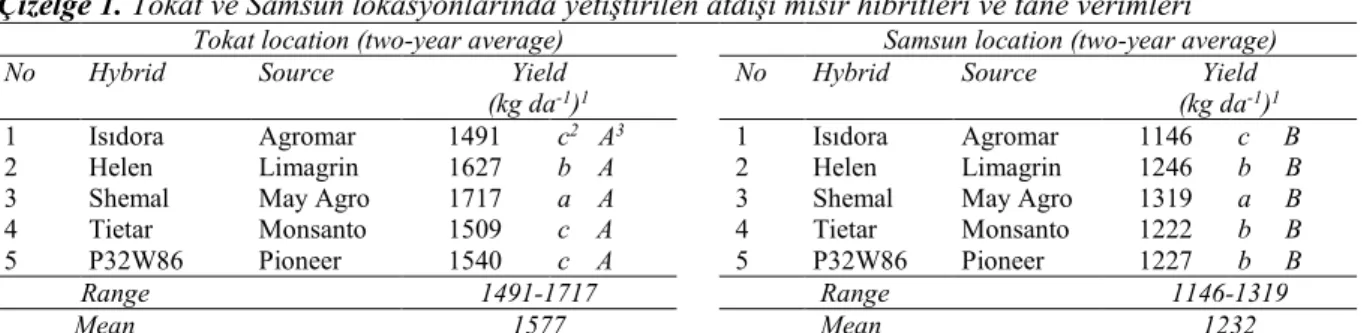
3.1. Grain yields of dent corn hybrids Grain yields of corns varied significantly by hybrid, location and year (Tables 1 and 2). Corn hybrids yielded much more in Tokat location (1491-1717 kg da-1; average 1577 kg da-1) than in
Samsun location (1146-1319 kg da-1; average 1232
kg da-1). Shemal and Helen hybrids had the highest
grain yields in both locations. Other researchers (Sezer and GüTablümser, 1999; Vartanlı and Emeklier, 2007; Sayaslan et al., 2016) also showed that grain yield customarily varied by hybrid and growing environment.
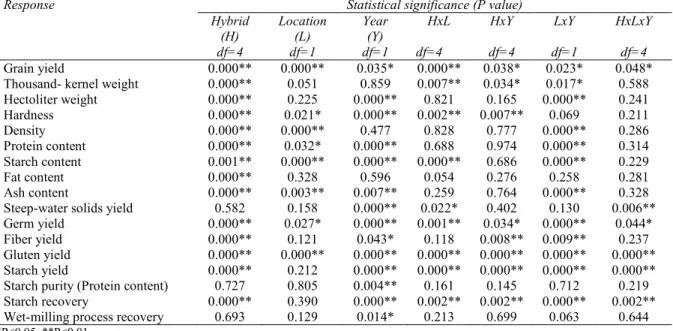
3.2. Physical properties of dent corn hybrids All physical properties of dent corns, which are critical in corn wet-milling quality, differed significantly by hybrid (Table 2). However, growth location influenced only hardness and density, and growing year affected only hectoliter weight and hardness. As seen in Table 3, thousand-kernel weights of hybrids ranged from 364.5 to 389.7 g in Tokat and from 362.3 to 419.1 g in Samsun. It is generally assumed that the higher the thousand-kernel weight, the higher the endosperm to thousand-kernel ratio, resulting in higher starch yield in wet-milling (Fox et al., 1992).
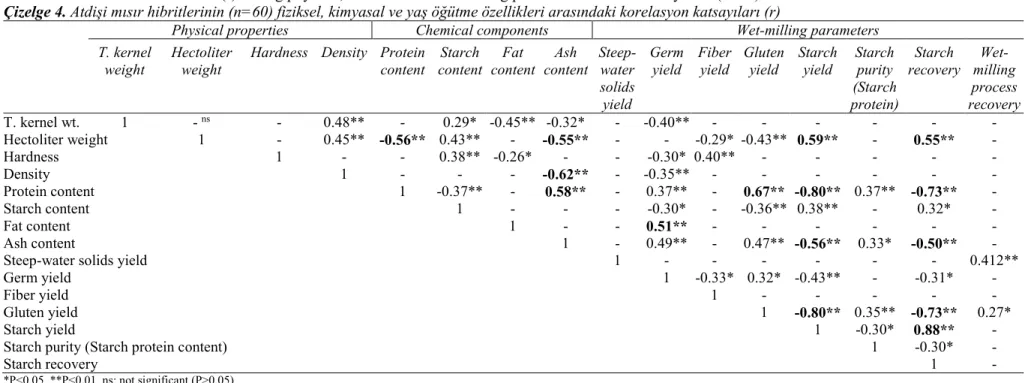
In this study, however, almost no significant correlation was established between thousand-kernel weight and wet-milling parameters (Table 4), probably because of the limited number of hybrids in the study. In terms of hectoliter weight (Table 3), Isıdora hybrid had the lowest hectoliter weights (74.2 and 73.9 kg), whereas other four hybdrids had statistically similar hectoliter weights (77.3 to 79.7 kg) in both locations. Providing information on cleanness, hardness and plumbness of corn hybrids (Paulsen et al., 2003), hectoliter weight was determined to have positive correlations with kernel density and hardness (Hellevang and Wilcke, 1996). In this study, hectoliter weight was also found to have positive correlations with density, starch content, wet-milling starch yield and recovery, and negative 166
correlations with protein content, ash content and wet-milling gluten yield (Table 4). In fact, there are conflicting findings on the relationship of hectoliter weight with wet-milling quality of corn (Fox et al., 1992; Yang et al., 2000; Paulsen et al., 2003; Eckhoff, 2004). As shown in Table 3, hybrid P32W86 gave the lowest hardness values (16.5 and 15.9 sec), while other hybrids had higher but somewhat comparable hardness values, ranging from 17.8 to 23.1 sec. Furthermore, densities of hybrids were quite close to one another, varying
from 1.28 to 1.31 g cm-3. Except for hectoliter weight, corn physical properties showed rather limited correlations with corn wet-milling parameters (Table 4). Nevertheless, others (Fox et al., 1992; Hellevang and Wilcke, 1996; Eckhoff, 2004; Sayaslan et al., 2016) reported that kernel hardness and density correlated positively with protein content and thus reduced wet-milling quality.
Table 1. Dent corn hybrids grown in Tokat and Samsun with their grain yields
Çizelge 1. Tokat ve Samsun lokasyonlarında yetiştirilen atdişi mısır hibritleri ve tane verimleri Tokat location (two-year average) Samsun location (two-year average)
No Hybrid Source Yield
(kg da-1)1
No Hybrid Source Yield
(kg da-1)1 1 Isıdora Agromar 1491 c2 A3 1 Isıdora Agromar 1146 c B
2 Helen Limagrin 1627 b A 2 Helen Limagrin 1246 b B
3 Shemal May Agro 1717 a A 3 Shemal May Agro 1319 a B
4 Tietar Monsanto 1509 c A 4 Tietar Monsanto 1222 b B
5 P32W86 Pioneer 1540 c A 5 P32W86 Pioneer 1227 b B
Range 1491-1717 Range 1146-1319
Mean 1577 Mean 1232
114% moisture basis. 2Different small letters in the same column indicate significant difference (P<0.01). 3Different capital letters in the
same line indicate significant difference (P<0.05).
3.3. Chemical compositions of dent corn hybrids
Protein, starch, fat and ash contents of corns varied significantly by hybrid and to a lesser extent by growing location and year (Table 2). As listed in Table 5, protein contents ranged from 6.9 to 8.7%, starch contents from 71.2 to 75.8%, fat contents from 3.4-5.1% and ash contents from 1.09 to 1.31%. These values are in agreement with the previous findings (Eckhoff, 2004; Sayaslan et al., 2016). In wet-milling, corn hybrids with lower protein but higher starch contents are favored (Eckhoff, 2004; Sayaslan et al., 2016). In this respect, Tietar, Helen and Shemal were low-protein and high-starch hybrids.
Table 4 summarizes the correlations between chemical compositions and wet-milling parameters of corn hybrids. Protein contents of hybrids positively correlated with ash contents or gluten yields, and negatively correlated with starch yields or recoveries, all of which confirm the findings of Sayaslan et al. (2016) that hybrids with lower protein contents performed better in wet-milling. Similarly, ash contents of hybrids showed a parallel trend of correlations to protein contents.
On the other hand, starch contents of hybrids had fairly weak negative correlations with germ or gluten yields, and weak but positive correlations with starch yields or recoveries. These correlations are in agreement with the previous findings of Fox et al. (1992), Zehr et al. (1995), Arora et al. (2008) and Sayaslan et al. (2016).
3.4. Wet-milling properties of dent corn hybrids
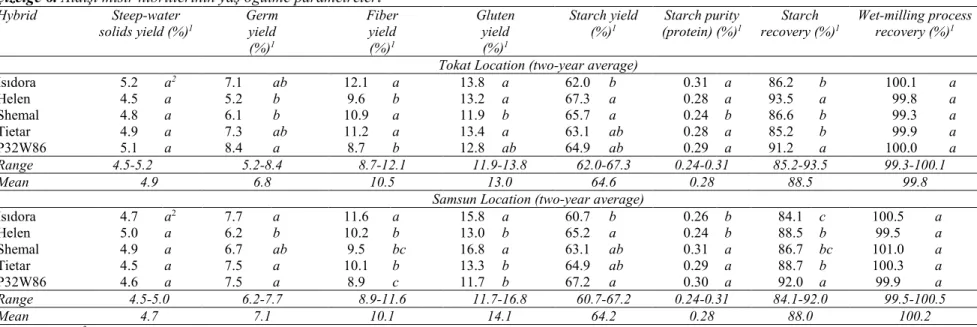
Hybrid and growing year had significant effects on most wet-milling quality parameters, yet growth location had rather limited influence (Table 2). Wet-milling data of hybrids are listed in Table 6. Steep-water solids of hybrids grown in both locations were comparable (averages of 4.9 and 4.7% by locations) with no statistical difference by hybrid. In terms of germ (averages of 6.8 and 7.1%), total fiber (averages of 10.5 and 10.1%) and gluten yields (averages of 13.0 and 14.1%), significant differences were observed among the hybrids. Helen and Shemal hybrids gave the lowest yields of steep-water solids, germ, fiber and gluten, implying their superior wet-milling qualities. With respect to starch yield, recovery and purity, which
are central to wet-milling quality, corn hybrids showed differences by hybrid. Starch yields in wet-milling ranged from 62.0 to 67.3% in Tokat and from 60.7 to 67.2% in Samsun. Though statistically different, purities of starches were fairly close (0.24 to 0.31%) and within the industrially accepted upper limit of 0.30% (Sayaslan, 2004). Starch recoveries, an indication of wet-milling ability of a given hybrid, ranged from 85.2 to 93.5% in Tokat and from 84.1 to 92.0% in Samsun. Helen, P32W86 and Shemal hybrids produced the highest starch recoveries in both locations. Sayaslan et al. (2016) also determined that Helen and P32W86 hybrids had higher wet-milling quality scores among 15 dent corn hybrids grown
in Adana. The wet-milling results of this study (starch 64.2-64.6%, gluten 13.0-14.1%, fiber 10.1-10.5%, germ 6.8-7.1% and steep-water solids 4.7-4.9%) were quite in agreement with the industrial wet-milling data provided by Eckhoff (2004). Given the fact that corn hybrids are expected to give higher starch yields, recoveries and purities with lower yields of steep-water solids, fiber and gluten in wet-milling, all hybrids in this study were of good wet-milling qualities, especially Helen, Shemal and P32W86 hybrids. However, grain yields of hybrids were much higher in Tokat than in Samsun, implying that dent corn production for wet-milling is more appropriate in Tokat.
Table 2. Variance analysis results for five dent corn hybrids grown in Tokat and Samsun for two years with three replications
Çizelge 2. Tokat ve Samsun lokasyonlarında iki yıl süreyle üç tekerrürlü olarak yetiştirilen atdişi mısır hibritlerine ait varyans analiz sonuçları
Response Statistical significance (P value)
Hybrid (H) df=4 Location (L) df=1 Year (Y) df=1 HxL df=4 HxY df=4 LxY df=1 HxLxY df=4 Grain yield 0.000** 0.000** 0.035* 0.000** 0.038* 0.023* 0.048*
Thousand- kernel weight 0.000** 0.051 0.859 0.007** 0.034* 0.017* 0.588 Hectoliter weight 0.000** 0.225 0.000** 0.821 0.165 0.000** 0.241 Hardness 0.000** 0.021* 0.000** 0.002** 0.007** 0.069 0.211 Density 0.000** 0.000** 0.477 0.828 0.777 0.000** 0.286 Protein content 0.000** 0.032* 0.000** 0.688 0.974 0.000** 0.314 Starch content 0.001** 0.000** 0.000** 0.000** 0.686 0.000** 0.229 Fat content 0.000** 0.328 0.596 0.054 0.276 0.258 0.281 Ash content 0.000** 0.003** 0.007** 0.259 0.764 0.000** 0.328
Steep-water solids yield 0.582 0.158 0.000** 0.022* 0.402 0.130 0.006**
Germ yield 0.000** 0.027* 0.000** 0.001** 0.034* 0.000** 0.044*
Fiber yield 0.000** 0.121 0.043* 0.118 0.008** 0.009** 0.237
Gluten yield 0.000** 0.000** 0.000** 0.000** 0.000** 0.000** 0.000** Starch yield 0.000** 0.212 0.000** 0.000** 0.000** 0.000** 0.000** Starch purity (Protein content) 0.727 0.805 0.004** 0.161 0.145 0.712 0.219 Starch recovery 0.000** 0.390 0.000** 0.002** 0.002** 0.000** 0.002** Wet-milling process recovery 0.693 0.129 0.014* 0.213 0.699 0.063 0.644
*P<0.05. **P<0.01.
Table 3. Thousand-kernel weights, hectoliter weights, hardnesses and densities of dent corn hybrids Çizelge 3. Atdişi mısır hibritlerinin bin-tane ağırlıkları, hektolitre ağırlıkları, sertlikleri ve yoğunlukları
Tokat location (two-year average) Samsun location (two-year average)
Hybrid Thousand-kernel weight (g)1 Hectoliter weight (kg) Hardness (sec) Density (g cm-3) Hybrid Thousand-kernel weight (g)1 Hectoliter weight (kg) Hardness (sec) Density (g cm-3) Isıdora 366.7 c2 A3 74.2 b A 20.6 a B 1.29 b A Isıdora 364.1 c A 73.9 b A 23.1 a A 1.28 b A Helen 389.7 a A 78.2 a A 17.8 ab B 1.30 ab A Helen 381.7 b A 77.8 a A 21.0 ab A 1.29 ab A Shemal 378.4 b B 77.3 a A 20.8 a A 1.31 a A Shemal 419.1 a A 78.7 a A 19.3 b A 1.30 a A Tietar 364.9 c A 78.5 a A 18.2 ab A 1.29 b A Tietar 369.1 c A 78.9 a A 19.2 b A 1.28 b A P32W86 364.5 c A 79.7 a A 16.5 b A 1.30 ab A P32W86 362.3 c A 79.1 a A 15.9 c A 1.29 ab A Range 364.5-389.7 74.2-79.7 16.5-20.8 1.29-1.31 Range 362.3-419.1 73.9-79.1 15.9-23.1 1.28-1.30 Mean 372.8 77.6 18.8 1.30 Mean 379.3 77.7 19.7 1.29
1Dry matter basis. 2Different small letters in the same column indicate significant difference (P<0.05). 3Different capital letters in the same line within the same property indicate significant difference
(P<0.05).
Table 4. Correlations coefficients (r) among physical, chemical and wet-milling parameters of dent corn hybrids (n=60) Çizelge 4. Atdişi mısır hibritlerinin (n=60) fiziksel, kimyasal ve yaş öğütme özellikleri arasındaki korelasyon katsayıları (r)
Physical properties Chemical components Wet-milling parameters
T. kernel weight
Hectoliter weight
Hardness Density Protein content Starch content Fat content Ash content Steep-water solids yield Germ yield Fiber yield Gluten yield Starch yield Starch purity (Starch protein) Starch recovery Wet-milling process recovery T. kernel wt. 1 - ns - 0.48** - 0.29* -0.45** -0.32* - -0.40** - - - - - - Hectoliter weight 1 - 0.45** -0.56** 0.43** - -0.55** - - -0.29* -0.43** 0.59** - 0.55** - Hardness 1 - - 0.38** -0.26* - - -0.30* 0.40** - - - - - Density 1 - - - -0.62** - -0.35** - - - - Protein content 1 -0.37** - 0.58** - 0.37** - 0.67** -0.80** 0.37** -0.73** - Starch content 1 - - - -0.30* - -0.36** 0.38** - 0.32* - Fat content 1 - - 0.51** - - - - Ash content 1 - 0.49** - 0.47** -0.56** 0.33* -0.50** -
Steep-water solids yield 1 - - - 0.412**
Germ yield 1 -0.33* 0.32* -0.43** - -0.31* -
Fiber yield 1 - - - - -
Gluten yield 1 -0.80** 0.35** -0.73** 0.27*
Starch yield 1 -0.30* 0.88** -
Starch purity (Starch protein content) 1 -0.30* -
Table 5. Protein, starch, fat and ash contents of dent corn hybrids Çizelge 5. Atdişi mısır hibritlerinin protein, nişasta, yağ ve kül içerikleri
Tokat location (two-year average) Samsun location (two-year average)
Hybrid Protein content (%)1 Starch content (%)1 Fat content (%)1 Ash content (%)1 Hybrid Protein content (%)1 Starch content (%)1 Fat content (%)1 Ash content (%)1 Isıdora 8.5 a2 A3 72.0 c A 4.0 ab A 1.30 a A Isıdora 8.7 a A 72.3 b A 4.3 ab A 1.31 a A Helen 6.9 c A 72.0 c B 3.4 b A 1.09 c A Helen 7.2 c A 73.8 a A 3.6 b A 1.15 c A Shemal 7.3 bc B 75.8 a A 4.4 ab A 1.09 c B Shemal 8.0 b A 73.0 ab B 4.0 ab A 1.23 b A Tietar 7.6 b A 74.1 b A 5.1 a A 1.19 b A Tietar 8.0 b A 73.2 ab B 4.6 a B 1.24 b A P32W86 7.2 bc A 71.2 c B 4.8 a A 1.20 b A P32W86 7.2 c A 73.1 ab A 4.8 a A 1.25 b A Range 6.9-8.5 71.2-75.8 3.4-5.1 1.09-1.30 Range 7.2-8.7 72.-73.8 3.6-4.8 1.15-1.31 Mean 7.5 73.0 4.3 1.17 Mean 7.8 73.1 4.3 1.24
1Dry matter basis. 2Different small letters in the same column indicate significant difference (P<0.05). 3Different capital letters in the same line within the same property indicate significant difference
(P<0.05).
Table 6. Wet-milling parameters of dent corn hybrids
Çizelge 6. Atdişi mısır hibritlerinin yaş öğütme parametreleri
Hybrid Steep-water solids yield (%)1 Germ yield (%)1 Fiber yield (%)1 Gluten yield (%)1 Starch yield (%)1 Starch purity (protein) (%)1 Starch recovery (%)1 Wet-milling process recovery (%)1 Tokat Location (two-year average)
Isıdora 5.2 a2 7.1 ab 12.1 a 13.8 a 62.0 b 0.31 a 86.2 b 100.1 a Helen 4.5 a 5.2 b 9.6 b 13.2 a 67.3 a 0.28 a 93.5 a 99.8 a Shemal 4.8 a 6.1 b 10.9 a 11.9 b 65.7 a 0.24 b 86.6 b 99.3 a Tietar 4.9 a 7.3 ab 11.2 a 13.4 a 63.1 ab 0.28 a 85.2 b 99.9 a P32W86 5.1 a 8.4 a 8.7 b 12.8 ab 64.9 ab 0.29 a 91.2 a 100.0 a Range 4.5-5.2 5.2-8.4 8.7-12.1 11.9-13.8 62.0-67.3 0.24-0.31 85.2-93.5 99.3-100.1 Mean 4.9 6.8 10.5 13.0 64.6 0.28 88.5 99.8
Samsun Location (two-year average)
Isıdora 4.7 a2 7.7 a 11.6 a 15.8 a 60.7 b 0.26 b 84.1 c 100.5 a Helen 5.0 a 6.2 b 10.2 b 13.0 b 65.2 a 0.24 b 88.5 b 99.5 a Shemal 4.9 a 6.7 ab 9.5 bc 16.8 a 63.1 ab 0.31 a 86.7 bc 101.0 a Tietar 4.5 a 7.5 a 10.1 b 13.3 b 64.9 ab 0.29 a 88.7 b 100.3 a P32W86 4.6 a 7.5 a 8.9 c 11.7 b 67.2 a 0.30 a 92.0 a 99.9 a Range 4.5-5.0 6.2-7.7 8.9-11.6 11.7-16.8 60.7-67.2 0.24-0.31 84.1-92.0 99.5-100.5 Mean 4.7 7.1 10.1 14.1 64.2 0.28 88.0 100.2
aDry matter basis. 2Different small letters in the same column within a location indicate significant difference (P<0.05).
4. Conclusion
Grain yields of five hybrids grown in Tokat and Samsun locations of Turkey for two years varied significantly by hybrid, location and year. Corn hybrids also differed significantly in terms of their physical and chemical properties. Significant correlations were determined among physical, chemical and wet-milling features of corn hybrids. All hybrids exhibited comparable wet-milling results to the industrial wet-milling process. However, grain yields were much higher in Tokat than in Samsun, indicating that dent corn production for wet-milling is more appropriate in Tokat.
Acknowledgements
This research was financially supported by TÜBİTAK (107O800), Ankara, Turkey.
References
AACCI (2000). American Association of Cereal Chemists International (AACCI) Approved Methods of Analysis (10th edition). AACCI, St. Paul, MN, USA.
Arora A Niu Y Tumbleson ME and Rausch KD (2008). Laboratory wet milling of corn: Milling fraction correlations and variations among crop years. Cereal Chemistry, 85:207-210.
Eckhoff SR (2004). Maize: wet milling. In: Encyclopedia of Grain Science, Volume II, C Wrigley, H Corke and C Walker (Eds), Elsevier Ltd., Amsterdam, pp. 225-241.
Elgün A Ertugay Z Certel M and Kotancılar G (2002). Tahıl ve Ürünlerinde Analitik Kalite Kontrolü ve Laboratuvar Uygulama Klavuzu. Atatürk Universitesi Ziraat Fakültesi, Erzurum, Turkey.
FAO (2016). FAOSTAT Production Quantities. Food and Agriculture Organization of the United Nations (http://faostat3.fao.org/browse/Q/QC/E).
Fox SR Johnson LA Hurburgh CR Dorsey-Redding C and Bailey TB (1992). Relations of grain proximate composition and physical properties to wet-milling characteristics of maize. Cereal Chemistry, 69:191-197. Hellevang KJ and Wilcke WF (1996). Maintaining Corn Quality for Wet Milling (AE-1119). Agriculture and University Ext., North Dakota State University, Fargo, ND.
Jackson DS (1996). Corn Quality for Industrial Uses. Cooperative Extension, University of Nebraska-Lincoln, Nebraska-Lincoln, NE.
Jennings SD Myers DJ Johnson LA and Pollak LM (2002). Effects of maturity on grain quality and wet-milling properties of two selected corn hybrids. Cereal Chemistry, 79:697-702.
Kırtok Y (1998). Mısır Üretimi ve Kullanımı. Kocaoluk Yayınevi, İstanbul, Turkey.
Mbuvi S and Eckhoff SR (2002). Effect of stress cracks on
MGM (2009). İllerimize Ait İstatistik Veriler. Meteoroloji Genel Müdürlüğü. (http://www.mgm.gov.tr/ veridegerlendirme/il-ve-ilceleristatistik.aspx). Mistry AH Wu X Eckhoff SR and Litchfield JB (2003).
Wet-milling characteristics of temperature, high-humidity maize. Cereal Chemistry, 70:360-361. Paulsen MR Watson SA and Sing M (2003). Measurement
and maintenance of corn quality. In: Corn: Chemistry and Technology, PJ White and LA Johnson (Eds), American Association of Cereal Chemists International, St. Paul, MN, pp. 417-468.
Sayaslan A 2004. Wet-milling of wheat flour: Industrial processes and small-scale test methods. LWT-Food Science and Technology, 37:499-515.
Sayaslan A Erol Mercan R Duman A and Sakin MA (2016). Wet-milling qualities of dent corn (Zea mays indentata L.) hybrids grown as main crop in Adana and Sakarya. Gaziosmanpaşa Üniversitesi Ziraat Fakültesi Dergisi - Journal of Agricultural Faculty of Gaziosmanpasa University, 33:167-180.
Sezer İ ve Gülümser A (1999). Çarşamba Ovasında ana ürün olarak yetiştirilebilecek mısır çeşitlerinin (Zea mays indentata L.) belirlenmesi üzerine bir araştırma. In: Türkiye 3. Tarla Bitkileri Kongresi, Adana, Turkey, pp. 1:275-280.
Singh V Haken AE Niu YX Zou SH and Eckhoff SR (1998a). Wet-milling characteristics of selected yellow dent corn hybrids as influenced by storage conditions. Cereal Chemistry, 75:235-240.
Singh V Haken AE Pauslen MR and Eckhoff SR (1998b). Starch yield sensitivity of maize hybrids to drying temperature and harvest moisture content. Starch/Stärke, 50:181-183.
Vartanlı S ve Emeklier HY (2007). Ankara koşullarında hibrit mısır çeşitlerinin verim ve kalite özelliklerinin belirlenmesi. Tarım Bilimleri Dergisi - Journal of Agricultural Sciences, 13:195-202.
Vignaux N Fox SR and Johnson LA (2006). A 10-g laboratory wet-milling procedure for maize and comparison with larger scale laboratory procedures. Cereal Chemistry, 83:482-490.
Wang D and Eckhoff SR (2000). Effect of broken corn levels on water absorption and steepwater characteristics. Cereal Chemistry, 77:525-528. Yang P Shunk RJ Haken AE Niu YX Zou SH Buriak P
Eckhoff SR and Tumbleson ME (2000). Yield, protein content and viscosity of starch from wet-milled corn hybrids as influenced by environmentally induced changes in test weight. Cereal Chemistry, 77:44-47. Zehr BE Eckhoff SR Singh SK and Keeling PL (1995).
Comparison of wet-milling properties among maize inbred lines and their hybrids. Cereal Chemistry, 72:491-497.