This is the accepted manuscript made available via CHORUS, the article has been published as:
Measurements of baryon pair decays of χ_{cJ} mesons
M. Ablikim et al. (BESIII Collaboration)Phys. Rev. D 87, 032007 — Published 15 February 2013 DOI: 10.1103/PhysRevD.87.032007
Measurements of Baryon Pair Decays of χ
cJMesons
M. Ablikim1, M. N. Achasov6, O. Albayrak3, D. J. Ambrose39, F. F. An1, Q. An40,
J. Z. Bai1, Y. Ban26, J. Becker2, J. V. Bennett16, M. Bertani17A, J. M. Bian38,
E. Boger19,a, O. Bondarenko20, I. Boyko19, R. A. Briere3, V. Bytev19, X. Cai1, O.
Cakir34A, A. Calcaterra17A, G. F. Cao1, S. A. Cetin34B, J. F. Chang1, G. Chelkov19,a,
G. Chen1, H. S. Chen1, J. C. Chen1, M. L. Chen1, S. J. Chen24, X. Chen26, Y. B. Chen1,
H. P. Cheng14, Y. P. Chu1, D. Cronin-Hennessy38, H. L. Dai1, J. P. Dai1, D. Dedovich19,
Z. Y. Deng1, A. Denig18, I. Denysenko19,b, M. Destefanis43A,43C, W. M. Ding28, Y. Ding22,
L. Y. Dong1, M. Y. Dong1, S. X. Du46, J. Fang1, S. S. Fang1, L. Fava43B,43C, C. Q. Feng40,
R. B. Ferroli17A, P. Friedel2, C. D. Fu1, Y. Gao33, C. Geng40, K. Goetzen7, W. X. Gong1,
W. Gradl18, M. Greco43A,43C, M. H. Gu1, Y. T. Gu9, Y. H. Guan36, A. Q. Guo25,
L. B. Guo23, T. Guo23, Y. P. Guo25, Y. L. Han1, F. A. Harris37, K. L. He1, M. He1,
Z. Y. He25, T. Held2, Y. K. Heng1, Z. L. Hou1, C. Hu23, H. M. Hu1, J. F. Hu35, T. Hu1,
G. M. Huang4, G. S. Huang40, J. S. Huang12, L. Huang1, X. T. Huang28, Y. Huang24,
Y. P. Huang1, T. Hussain42, C. S. Ji40, Q. Ji1, Q. P. Ji25, X. B. Ji1, X. L. Ji1,
L. L. Jiang1, X. S. Jiang1, J. B. Jiao28, Z. Jiao14, D. P. Jin1, S. Jin1, F. F. Jing33,
N. Kalantar-Nayestanaki20, M. Kavatsyuk20, B. Kopf2, M. Kornicer37, W. Kuehn35,
W. Lai1, J. S. Lange35, M. Leyhe2, C. H. Li1, Cheng Li40, Cui Li40, D. M. Li46, F. Li1,
G. Li1, H. B. Li1, J. C. Li1, K. Li10, Lei Li1, Q. J. Li1, S. L. Li1, W. D. Li1, W. G. Li1,
X. L. Li28, X. N. Li1, X. Q. Li25, X. R. Li27, Z. B. Li32, H. Liang40, Y. F. Liang30,
Y. T. Liang35, G. R. Liao33, X. T. Liao1, D. Lin11, B. J. Liu1, C. L. Liu3, C. X. Liu1,
F. H. Liu29, Fang Liu1, Feng Liu4, H. Liu1, H. B. Liu9, H. H. Liu13, H. M. Liu1,
H. W. Liu1, J. P. Liu44, K. Liu33, K. Y. Liu22, Kai Liu36, P. L. Liu28, Q. Liu36, S. B. Liu40,
X. Liu21, Y. B. Liu25, Z. A. Liu1, Zhiqiang Liu1, Zhiqing Liu1, H. Loehner20, G. R. Lu12,
H. J. Lu14, J. G. Lu1, Q. W. Lu29, X. R. Lu36, Y. P. Lu1, C. L. Luo23, M. X. Luo45,
T. Luo37, X. L. Luo1, M. Lv1, C. L. Ma36, F. C. Ma22, H. L. Ma1, Q. M. Ma1, S. Ma1,
T. Ma1, X. Y. Ma1, F. E. Maas11, M. Maggiora43A,43C, Q. A. Malik42, Y. J. Mao26,
Z. P. Mao1, J. G. Messchendorp20, J. Min1, T. J. Min1, R. E. Mitchell16, X. H. Mo1,
C. Morales Morales11, N. Yu. Muchnoi6, H. Muramatsu39, Y. Nefedov19, C. Nicholson36,
M. Pelizaeus2, H. P. Peng40, K. Peters7, J. L. Ping23, R. G. Ping1, R. Poling38,
E. Prencipe18, M. Qi24, S. Qian1, C. F. Qiao36, L. Q. Qin28, X. S. Qin1, Y. Qin26,
Z. H. Qin1, J. F. Qiu1, K. H. Rashid42, G. Rong1, X. D. Ruan9, A. Sarantsev19,c,
B. D. Schaefer16, M. Shao40, C. P. Shen37,d, X. Y. Shen1, H. Y. Sheng1, M. R. Shepherd16,
X. Y. Song1, S. Spataro43A,43C, B. Spruck35, D. H. Sun1, G. X. Sun1, J. F. Sun12,
S. S. Sun1, Y. J. Sun40, Y. Z. Sun1, Z. J. Sun1, Z. T. Sun40, C. J. Tang30, X. Tang1,
I. Tapan34C, E. H. Thorndike39, D. Toth38, M. Ullrich35, G. S. Varner37, B. Q. Wang26,
D. Wang26, D. Y. Wang26, K. Wang1, L. L. Wang1, L. S. Wang1, M. Wang28, P. Wang1,
P. L. Wang1, Q. J. Wang1, S. G. Wang26, X. F. Wang33, X. L. Wang40, Y. F. Wang1,
Z. Wang1, Z. G. Wang1, Z. Y. Wang1, D. H. Wei8, J. B. Wei26, P. Weidenkaff18,
Q. G. Wen40, S. P. Wen1, M. Werner35, U. Wiedner2, L. H. Wu1, N. Wu1, S. X. Wu40,
W. Wu25, Z. Wu1, L. G. Xia33, Z. J. Xiao23, Y. G. Xie1, Q. L. Xiu1, G. F. Xu1,
G. M. Xu26, Q. J. Xu10, Q. N. Xu36, X. P. Xu31, Z. R. Xu40, F. Xue4, Z. Xue1, L. Yan40,
W. B. Yan40, Y. H. Yan15, H. X. Yang1, Y. Yang4, Y. X. Yang8, H. Ye1, M. Ye1,
M. H. Ye5, B. X. Yu1, C. X. Yu25, H. W. Yu26, J. S. Yu21, S. P. Yu28, C. Z. Yuan1,
Y. Yuan1, A. A. Zafar42, A. Zallo17A, Y. Zeng15, B. X. Zhang1, B. Y. Zhang1, C. Zhang24,
C. C. Zhang1, D. H. Zhang1, H. H. Zhang32, H. Y. Zhang1, J. Q. Zhang1, J. W. Zhang1,
J. Y. Zhang1, J. Z. Zhang1, R. Zhang36, S. H. Zhang1, X. J. Zhang1, X. Y. Zhang28,
Y. Zhang1, Y. H. Zhang1, Z. P. Zhang40, Z. Y. Zhang44, Zhenghao Zhang4, G. Zhao1,
H. S. Zhao1, J. W. Zhao1, K. X. Zhao23, Lei Zhao40, Ling Zhao1, M. G. Zhao25, Q. Zhao1,
Q. Z. Zhao9, S. J. Zhao46, T. C. Zhao1, Y. B. Zhao1, Z. G. Zhao40, A. Zhemchugov19,a,
B. Zheng41, J. P. Zheng1, Y. H. Zheng36, B. Zhong23, Z. Zhong9, L. Zhou1,
X. K. Zhou36, X. R. Zhou40, C. Zhu1, K. Zhu1, K. J. Zhu1, S. H. Zhu1, X. L. Zhu33,
Y. C. Zhu40, Y. M. Zhu25, Y. S. Zhu1, Z. A. Zhu1, J. Zhuang1, B. S. Zou1, J. H. Zou1
(BESIII Collaboration)
1 Institute of High Energy Physics, Beijing 100049, People’s Republic of China 2 Bochum Ruhr-University, D-44780 Bochum, Germany
3 Carnegie Mellon University, Pittsburgh, Pennsylvania 15213, USA 4 Central China Normal University, Wuhan 430079, People’s Republic of China
Beijing 100190, People’s Republic of China
6 G.I. Budker Institute of Nuclear Physics SB RAS (BINP), Novosibirsk 630090, Russia 7 GSI Helmholtzcentre for Heavy Ion Research GmbH, D-64291 Darmstadt, Germany
8 Guangxi Normal University, Guilin 541004, People’s Republic of China 9 GuangXi University, Nanning 530004, People’s Republic of China 10 Hangzhou Normal University, Hangzhou 310036, People’s Republic of China 11 Helmholtz Institute Mainz, Johann-Joachim-Becher-Weg 45, D-55099 Mainz, Germany
12 Henan Normal University, Xinxiang 453007, People’s Republic of China
13Henan University of Science and Technology, Luoyang 471003, People’s Republic of China 14 Huangshan College, Huangshan 245000, People’s Republic of China
15 Hunan University, Changsha 410082, People’s Republic of China 16 Indiana University, Bloomington, Indiana 47405, USA 17 (A)INFN Laboratori Nazionali di Frascati, I-00044, Frascati,
Italy; (B)INFN and University of Perugia, I-06100, Perugia, Italy
18 Johannes Gutenberg University of Mainz,
Johann-Joachim-Becher-Weg 45, D-55099 Mainz, Germany
19 Joint Institute for Nuclear Research, 141980 Dubna, Moscow region, Russia 20 KVI, University of Groningen, NL-9747 AA Groningen, The Netherlands
21 Lanzhou University, Lanzhou 730000, People’s Republic of China 22 Liaoning University, Shenyang 110036, People’s Republic of China 23 Nanjing Normal University, Nanjing 210023, People’s Republic of China
24 Nanjing University, Nanjing 210093, People’s Republic of China 25 Nankai University, Tianjin 300071, People’s Republic of China
26 Peking University, Beijing 100871, People’s Republic of China 27 Seoul National University, Seoul, 151-747 Korea
28 Shandong University, Jinan 250100, People’s Republic of China 29 Shanxi University, Taiyuan 030006, People’s Republic of China 30 Sichuan University, Chengdu 610064, People’s Republic of China
31 Soochow University, Suzhou 215006, People’s Republic of China 32 Sun Yat-Sen University, Guangzhou 510275, People’s Republic of China
33 Tsinghua University, Beijing 100084, People’s Republic of China
34 (A)Ankara University, Dogol Caddesi, 06100 Tandogan, Ankara, Turkey; (B)Dogus
University, 34722 Istanbul, Turkey; (C)Uludag University, 16059 Bursa, Turkey
35 Universitaet Giessen, D-35392 Giessen, Germany
36 University of Chinese Academy of Sciences, Beijing 100049, People’s Republic of China 37 University of Hawaii, Honolulu, Hawaii 96822, USA
38 University of Minnesota, Minneapolis, Minnesota 55455, USA 39 University of Rochester, Rochester, New York 14627, USA
40 University of Science and Technology of China, Hefei 230026, People’s Republic of China 41 University of South China, Hengyang 421001, People’s Republic of China
42 University of the Punjab, Lahore-54590, Pakistan
43 (A)University of Turin, I-10125, Turin, Italy; (B)University of Eastern
Piedmont, I-15121, Alessandria, Italy; (C)INFN, I-10125, Turin, Italy
44 Wuhan University, Wuhan 430072, People’s Republic of China 45 Zhejiang University, Hangzhou 310027, People’s Republic of China 46 Zhengzhou University, Zhengzhou 450001, People’s Republic of China
a Also at the Moscow Institute of Physics and Technology, Moscow 141700, Russia b On leave from the Bogolyubov Institute for Theoretical Physics, Kiev 03680, Ukraine
c Also at the PNPI, Gatchina 188300, Russia
Abstract
Using 106 million ψ′ decays collected with the BESIII detector at the BEPCII, three decays of
χcJ (J = 0, 1, 2) with a baryon pairs (Λ¯Λ, Σ0Σ¯0, Σ+Σ¯−) in the final state have been studied. The
branching fractions are measured to be B(χc0,1,2→ Λ¯Λ) = (33.3±2.0±2.6)×10−5, (12.2±1.1±1.1)×
10−5, (20.8±1.6±2.3)×10−5; B(χ
c0,1,2→ Σ0Σ¯0) = (47.8±3.4±3.9)×10−5, (3.8±1.0±0.5)×10−5,
(4.0 ± 1.1 ± 0.5) × 10−5; and B(χ
c0,1,2 → Σ+Σ¯−) = (45.4 ± 4.2 ± 3.0) × 10−5, (5.4 ± 1.5 ± 0.5) × 10−5,
(4.9 ± 1.9 ± 0.7) × 10−5, where the first error is statistical and the second is systematic. Upper
limits on the branching fractions for the decays of χc1,2 → Σ0Σ¯0, Σ+Σ¯−, are estimated to be
B(χc1 → Σ0Σ¯0) < 6.2 × 10⁻⁵, B(χc2 → Σ0Σ¯0) < 6.5 × 10⁻⁵, B(χc1 → Σ+Σ¯−) < 8.7 × 10⁻⁵ and
B(χc2 → Σ+Σ¯−) < 8.8 × 10⁻⁵ at the 90% confidence level.
I. INTRODUCTION
In the standard quark model, χcJ (J = 0, 1, 2) mesons are c¯c states in an L = 1
con-figuration. Experimental studies on χcJ decay properties are essential to test
perturba-tive Quantum Chromodynamics (QCD) models and QCD-based calculations. The
impor-tance of the color octet mechanism (COM) for χcJ decays has been pointed out for many
years [1], and theoretical predictions of two-body exclusive decays have been made based
on it. The predictions of COM theory for some χcJ decays into baryon pairs (B ¯B) disagree
with measured values. For example, the branching fraction of χc0 → Λ¯Λ is predicted to be
(93.5 ± 20.5) × 10−5 according to Ref. [2], and (11.9 ∼ 15.1) × 10−5 according to Ref. [3],
while the world average of experimental measurements is (33.0 ± 4.0) × 10−5 [4]. One finds
that the theoretical prediction is either about two times larger, or several times smaller than
the experimental measurement. Although some experimental results on χcJ exclusive decays
have been reported [5–7], many decay modes of χcJ → B ¯B have not been observed yet, such
as χc1,2 → Σ0Σ¯0, Σ+Σ¯−, or measured with poor precision. For further testing of the COM
in the decays of the P-wave charmonia, measurements of other baryon pair decays of χcJ,
such as χcJ → Λ¯Λ, Σ0Σ¯0 and Σ+Σ¯−, are desired.
In addition, measurements of χc0 → B ¯B are helpful for further understanding the helicity
selection rule (HSR) [8], which prohibits χc0 decays into baryon-antibaryon pairs. However,
the measured branching fractions for χc0 → B ¯B do not vanish, for example χc0 → p¯p [4],
which demonstrates a strong violation of HSR in charmonium decays. It is necessary to
measure the decays of χc0 → B ¯B in other channels to provide additional tests of the HSR.
While χcJ mesons are not produced directly in e+e− annihilations, the large branching
fractions of ψ′ → γχ
cJ make e+e− collision at the ψ′ peak a very clean environment for χcJ
investigation. In this paper, the results of two-body decays of χcJ → Λ¯Λ, Σ0Σ¯0 and Σ+Σ¯−
final states are presented. This analysis is based on 106 million ψ′ events [9] collected with
BESIII at the BEPCII. A sample of 44 pb−1 of data taken at √s = 3.65 GeV is used for
II. BESIII DETECTOR AND MONTE CARLO SIMULATION
BEPCII is a double-ring e+e− collider that has reached peak luminosity of about 0.6 ×
1033 cm−2s−1 at the peak energy of ψ(3770). The cylindrical core of the BESIII detector
consists of a helium-based main drift chamber (MDC), a plastic scintillator time-of-flight system (TOF), and a CsI(Tl) electromagnetic calorimeter (EMC), which are all enclosed in a superconducting solenoidal magnet providing a 1.0 T magnetic field. The solenoid is supported by an octagonal flux-return yoke with resistive plate counter muon identifier modules interleaved with steel. The acceptance for charged particles and photons is 93% over 4π stereo angle, and the charged-particle momentum and photon energy resolutions at 1 GeV are 0.5% and 2.5%, respectively. The detector is described in more detail in Ref. [10].
The BESIII detector is modeled with a Monte Carlo (MC) simulation based on geant4[11,
12]. The ψ′ resonance is produced with kkmc [13], while the subsequent decays are
gen-erated with evtgen [14] according to the branching fractions provided by the Particle Data Group (PDG) [4], and the remaining unmeasured decay modes are generated with lundcharm [15].
III. EVENT SELECTION
The investigated final states include Λ(¯Λ), p(¯p), neutral π0mesons and a radiative photon
from the decay ψ′ → γχ
cJ, where Λ(¯Λ) decays to π−p(π+p), while π¯ 0 is reconstructed in
the decay to π0 → γγ. Candidate events are required to satisfy the following selection
criteria. A charged track should have good quality in the track fitting and be within the angle coverage of the MDC (| cos θ| < 0.92). Photons are reconstructed from isolated showers in the EMC. The energy deposited in the nearby TOF counter is included to improve the reconstruction efficiency and energy resolution. Photon energies are required to be greater than 25 MeV in the EMC barrel region (| cos θ| < 0.8), and greater than 50 MeV in the EMC endcap (0.86 < | cos θ| < 0.92). The showers in the angular range between the barrel and the endcap are poorly reconstructed and excluded from the analysis. Moreover, the EMC timing of the photon candidate must be in coincidence with collision events, 0 ≤ t ≤ 700 ns, to suppress electronic noise and energy deposits unrelated to the events.
A. χcJ →Λ ¯Λ
Candidate events contain at least two positively-charged tracks, two negatively-charged
tracks and one photon. The Λ(¯Λ) candidates are reconstructed from pairs of oppositely
charged tracks, which are constrained to secondary vertices and have invariant masses closest
to the nominal Λ mass. The χ2 of the secondary vertex fit must be less than 500. The
candidate photon and the Λ¯Λ pair are subjected to a four constraint (4C) kinematic fit
under the hypothesis of ψ′ → γΛ¯Λ to reduce background and improve the mass resolution.
When additional photons are found in an event, all possible combinations are iterated over,
and the one with the best kinematic fit χ2
4C is kept. Furthermore, χ24C < 50 is required to
suppress potential background from ψ′ → Σ0Σ¯0. The χ2
4C selection criterion is determined
by optimizing the figure of merit (F OM), F OM = S
√
S+B, where S is the number of signal
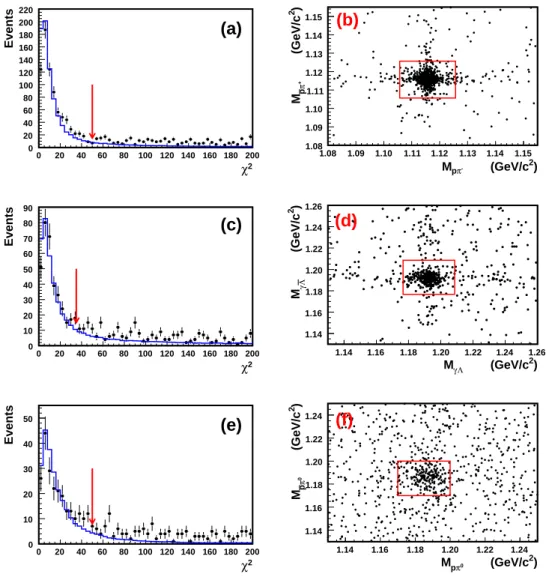
events and B is the number of background events based on the MC simulation. Figure 1 (a)
shows the comparison of χ2
4C between data and MC simulation, which is normalized with the
number of events satisfying the χ2 requirement. Figure 1 (b) shows the scatter plots of M
pπ−
versus Mpπ¯ + from the data. Clear Λ¯Λ signals can be seen. The square around the Λ nominal
mass with a width of 20 MeV/c2 is taken as the signal region, which is also determined by
maximizing the F OM. From events with two or more photons, additional selection criteria
are applied to suppress backgrounds from Σ0Σ¯0 decays. The ψ′ → Σ0Σ¯0 candidates are
selected by minimizing p(MγΛ− MΣ0)2+ (Mγ ¯Λ− MΣ¯0)2 from all combinations. However,
some backgrounds remain in the signal region from ψ′ → Σ0Σ¯0 events in which one photon
from the Σ0decays is not reconstructed. To remove these, events falling into |M
γΛ−MΣ0| < 6
MeV/c2 and |M
γ ¯Λ− MΣ¯0| < 6 MeV/c2 have been discarded.
B. χcJ →Σ0Σ¯0
Candidate events have at least two positively-charged tracks, two negatively-charged
tracks and three photons. The charged track selection and Λ(¯Λ) reconstruction are the
same as described above for the χcJ → Λ¯Λ decay. The mass window of Λ(¯Λ) is optimized
to be |Mpπ − MΛ| < 7 MeV/c2. The candidate photons and the Λ¯Λ pair are subjected
to a 4C kinematic fit under the hypothesis of ψ′ → γγγΛ¯Λ to reduce background and
combinations are looped over, the one with the smallest χ2
4C is kept, and χ24C < 35 is
required to suppress the dominant background from ψ′ → Σ0Σ¯0. Figure 1 (c) shows the
comparison of χ2
4C between data and MC simulation, which is normalized with the number
of events satisfying the χ2 requirement. The Σ0Σ¯0 candidates are chosen by minimizing
p(MγΛ− MΣ0)2 + (Mγ ¯Λ− MΣ¯0)2. Figure 1 (d) shows the scatter plot of MγΛ versus Mγ ¯Λ
from the data. Clear Σ0Σ¯0 signals can be seen. The square around the Σ0 nominal mass
with a width of 32 MeV/c2 represents the signal region.
C. χcJ →Σ+Σ¯−
Candidate events contain at least one positively-charged, one negatively-charged tracks and five photons. We impose a 4C kinematic fit to the selected tracks and photons under
the ψ′ → 5γp¯p hypothesis and keep the one with the smallest χ2
4C, and χ24C < 50 is required
to suppress the dominant background from ψ′ → Σ+Σ¯−. Figure 1 (e) shows the comparison
of χ2
4C between data and MC simulation, which is normalized with the number of events
satisfying the χ2 requirement. The π0 candidates are reconstructed by selecting the
com-bination which minimizes q
(Mγγ(1)− Mπ0)2+ (Mγγ(2) − Mπ0)2. The Σ+Σ¯− pair is selected by
minimizingp(Mpπ0 − MΣ+)2+ (Mpπ¯ 0 − MΣ¯−)2. Figure 1 (f) shows the scatter plot of Mpπ0
versus Mpπ¯ 0 from the data. Clear Σ+Σ¯− signals can be seen. The square of 1.17 GeV/c2
< Mpπ0 < 1.20 GeV/c2 and 1.17 GeV/c2< Mpπ¯ 0 < 1.20 GeV/c2 denotes the signal region.
IV. BACKGROUND STUDY
A. Continuum backgrounds
The events collected at Ecm = 3.65 GeV, whose integrated luminosity is more than 1/4
of ψ′ samples, are analyzed to estimate the contribution from the continuum process. No
events are survived in the Λ¯Λ, Σ0Σ¯0 and Σ+Σ¯− signal regions. Therefore, backgrounds from
2 χ 0 20 40 60 80 100 120 140 160 180 200 Events 0 20 40 60 80 100 120 140 160 180 200 220 (a) ) 2 (GeV/c -π p M 1.08 1.09 1.10 1.11 1.12 1.13 1.14 1.15 ) 2 (GeV/c+ π p M 1.08 1.09 1.10 1.11 1.12 1.13 1.14 1.15 (b) 2 χ 0 20 40 60 80 100 120 140 160 180 200 Events 0 10 20 30 40 50 60 70 80 90 (c) ) 2 (GeV/c Λ γ M 1.14 1.16 1.18 1.20 1.22 1.24 1.26 ) 2 (GeV/c Λγ M 1.14 1.16 1.18 1.20 1.22 1.24 1.26 (d) 2 χ 0 20 40 60 80 100 120 140 160 180 200 Events 0 10 20 30 40 50 (e) ) 2 (GeV/c 0 π p M 1.14 1.16 1.18 1.20 1.22 1.24 ) 2 (GeV/c0π p M 1.14 1.16 1.18 1.20 1.22 1.24 (f)
FIG. 1. (a) the χ24C distribution and (b) Mpπ− versus Mpπ¯ + (data) for the ψ′ → γχcJ, χcJ → Λ¯Λ
candidates; (c) the χ24C distribution and (d) MγΛversus Mγ ¯Λ(data) for the ψ′→ γχcJ, χcJ → Σ0Σ¯0
candidates; (e) the χ2
4C distribution and (f) Mpπ0 versus Mpπ¯ 0 (data) for the ψ′ → γχcJ, χcJ →
Σ+Σ¯− candidates.
B. Dominant backgrounds in Λ ¯Λ, Σ0Σ¯0 and Σ+Σ¯− final states
By using 106 million inclusive MC events, we find that the dominant background for
χcJ → Λ¯Λ comes from the decay ψ′ → Σ0Σ¯0 in which one photon is missing. The
non-Λ¯Λ background from the decay χcJ → π+π−p¯p is negligibly small due to the low efficiency
near the mass threshold. For χcJ → Σ0Σ¯0, the dominant background is also found to arise
the Σ0Σ¯0 invariant mass. In addition, a few background events come from ψ′ → π0π0J/ψ
and ψ′ → Ξ0Ξ¯0. For χ
cJ → Σ+Σ¯−, the backgrounds are small, they are from the decay
ψ′ → Σ+Σ¯−, ψ′ → π0π0J/ψ and J/ψ → p¯p (or γp¯p). The contributions of all backgrounds
mentioned above are estimated by MC simulation according to their branching fractions.
V. FIT TO THE SIGNAL OF χcJ
The invariant mass of the baryon pairs MB ¯B for all selected events are shown in Figs. 2
(a), (b), and (c) for χcJ → Λ¯Λ, Σ0Σ¯0 and Σ+Σ¯−, respectively. Clear χc0,1,2 signals can be
seen in Λ¯Λ final state, and a clear χc0 signal is seen in both Σ0Σ¯0 and Σ+Σ¯− final state,
while the χc1,2 signals are not significant in Σ0Σ¯0 and Σ+Σ¯− final state. We fit the invariant
mass spectra of baryon pairs, MB ¯B, to extract the numbers of χcJ signal events, where
the signals are represented by Breit-Wigner functions convolved with a Crystal Ball (CB) function to account for the detector resolution, a second order Chebychev polynomial is used to describe non-peaking backgrounds, and the dominant background events, estimated by MC simulation, have been directly subtracted from the data. The widths of the Breit-Wigner functions were fixed according to the known values [4], the parameters of the CB function are fixed based on MC simulation, and these parameters are varied by ± σ for the determination of systematic uncertainties. To determine the goodness of fit, we bin the data
so that the number of events in each bin is at least ten. The calculated χ2/d.o.f is 1.03, 1.53
and 1.71 for the Λ¯Λ, Σ0Σ¯0 and Σ+Σ¯− final states, respectively. The numbers of χ
c0,1,2signal
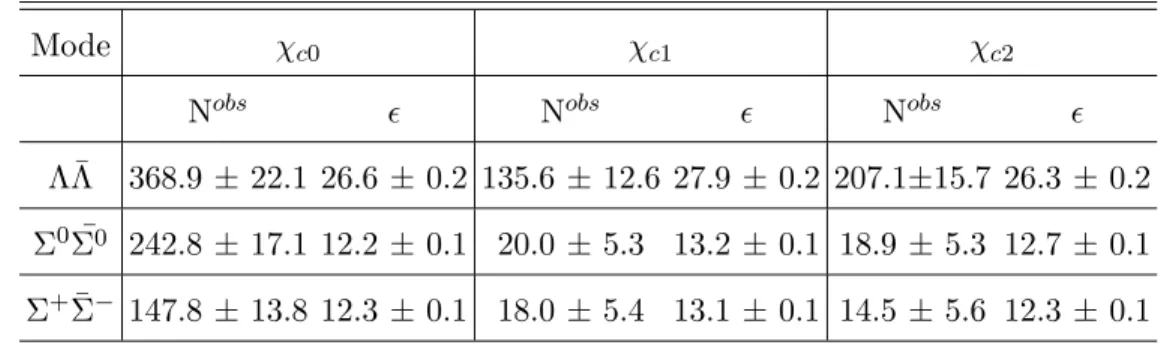
events from the fits are listed in Table I. For the decay χc1,2 → Σ0Σ¯0, Σ+Σ¯−, the upper limits
of the branching fractions at the 90% C.L. are also determined with a Bayesian method [16].
The statistical significances of the signals are calculated as √−2∆ ln L, where ∆ ln L is the
difference between the logarithmic maximum likelihood (ML) values of the fit with and
without the corresponding signal function. They are 4.3σ and 4.6σ for χc1,2 → Σ0Σ¯0, and
4.4σ and 3.0σ for χc1,2 → Σ+Σ¯−, respectively. The signal efficiencies determined from MC
simulation are also listed in Table I, where the proper angular distributions for photons
emitted in ψ′ → γχ
cJ are used [17]. The decay of χcJ → B ¯B and the decay of baryons are
mes 0 20 40 60 mes 0 20 40 60
Λ
Λ
mes 2Events/3.0 MeV/c
0 10 20 30 40 mes 2Events/3.0 MeV/c
0 10 20 30 400
Σ
0
Σ
3.30 3.35 3.40 3.45 3.50 3.55 3.60 0 5 10 15 20 3.30 3.35 3.40 3.45 3.50 3.55 3.60 0 5 10 15 20-Σ
+
Σ
M
B ¯B(GeV/c
2)
FIG. 2. The fit to the invariant mass MB ¯B. Dots with error bars are for data. Solid line is the fit results. Dashed-line is other background. The parameters of signal function are fixed to those obtained from MC simulation.
TABLE I. Efficiencies (ǫ in %) obtained from MC simulation, and the signal yields Nobsdetermined
from fit.
Mode χc0 χc1 χc2
Nobs ǫ Nobs ǫ Nobs ǫ
Λ¯Λ 368.9 ± 22.1 26.6 ± 0.2 135.6 ± 12.6 27.9 ± 0.2 207.1±15.7 26.3 ± 0.2 Σ0Σ¯0 242.8 ± 17.1 12.2 ± 0.1 20.0 ± 5.3 13.2 ± 0.1 18.9 ± 5.3 12.7 ± 0.1
VI. SYSTEMATIC ERROR
The systematic errors mainly originate from the uncertainties of the tracking efficiency,
Λ(¯Λ) reconstruction efficiency, the photon efficiency, 4C kinematic fit, the branching fractions
of the intermediate states, fit range, the angular distribution of χc1,2 → B ¯B, background
shape, signal lineshape, MC resolution and the total number of ψ′ events.
1. The decay ψ′ → Λ¯Λ with Λ → pπ− and Λ → ¯pπ− is employed to study the Λ(¯Λ)
re-construction efficiency. The selection criteria of charged tracks are the same as before except we use particle identification information to suppress background. Candidate events have at least one positively-charged and one negatively-charged tracks, which
are required to be identified as a π+(π−) track and an ¯p(p) track, respectively. Also,
the invariant mass of π+p(π¯ −p) must be within 10 MeV/c2 of the nominal ¯Λ mass.
Furthermore, the momentum of ¯Λ(Λ) candidates is required to be within 20 MeV/c
of its nominal value in two-body decay of ψ′ → Λ¯Λ. The number of Λ signal events,
N0
Λ, is extracted by fitting the recoiling mass spectrum of ¯Λ, M
¯ Λ
recoil. Then two
addi-tional oppositive charged tracks, a π−(π+) and a p(¯p), are required to reconstruct Λ
and are constrained to the secondary vertex. The number of Λ signal events, N1
Λ, is
extracted by fitting MΛ¯
recoil after requiring a Λ secondary vertex constraint. The Λ(¯Λ)
reconstruction efficiency is determined as ǫΛ =
N1 Λ
N0
Λ. The difference of the efficiencies
between data and MC simulation is found to be 2.0% for a Λ and 5.0% for a ¯Λ, which
are taken as the systematic error due to Λ(¯Λ) reconstruction efficiency.
2. Since the decay length for Σ+( ¯Σ−) is small, the decay J/ψ → π+π−p¯p is used to study
the MDC tracking efficiency for the proton and anti-proton of the Σ+Σ¯− final state.
It is found that the efficiency for MC simulated events agrees with that determined from data within 1.0% for each charged track. Hence, 2.0% is taken as the systematic
error for the proton and anti-proton of the Σ+Σ¯− final state.
3. The uncertainty due to photon detection efficiency is 1% per photon, which is deter-mined from the decay J/ψ → ρπ [18].
4. Five decays, J/ψ → Λ¯Λ, J/ψ → Σ0Σ¯0, J/ψ → Ξ0Ξ¯0, ψ′ → π0π0J/ψ (J/ψ → p¯p) and
fits. The signal events are selected from data and inclusive MC events without the 4C fit information. The remaining background is found to be negligible according to the studies of the inclusive MC events. The efficiency of the 4C kinematic fit is
defined as N1
N0, where N0 is the the number of signal events, N1 is the number of events
survived the. For the χcJ → Λ¯Λ, where the final state is ψ′ → γΛ¯Λ, two decays,
J/ψ → Λ¯Λ, and J/ψ → Σ0Σ¯0, are used to investigate the systematic error due to the
4C kinematic fit. The final states of these two control samples contain one photon less or more than the signal channel. Conservatively, the larger difference observed in the two control samples, 2.4%, is taken as the systematic error. Similarly, the larger
difference in J/ψ → Σ0Σ¯0 and J/ψ → Ξ0Ξ¯0, 2.9%, is taken as the systematic error of
the χcJ → Σ0Σ¯0 channel, and the larger difference in ψ′ → π0π0J/ψ (J/ψ → p¯p) and
ψ′ → π0π0J/ψ (J/ψ → p¯pπ0), 1.3%, is taken as the error of χ
cJ → Σ+Σ¯−.
5. When changing mass ranges in fitting MB ¯B signals to 3.30-3.62 GeV/c2 or to 3.25-3.62
GeV/c2, the fitted numbers of χ
c0,1,2 have some changes for data and MC simulation.
Taking the Λ¯Λ channel as an example, the results in the range of 3.30 GeV/c2 to 3.60
GeV/c2 are taken as central values, when the fit range is changed to 3.32-3.60 GeV/c2,
the changes relative to central values are found to be 2.7%, 3.6% and 2.2% for the χc0,1,2 decays, respectively, while in the range 3.25-3.62 GeV/c2, the changes are found to be 2.2%, 0.9%, 4.3%. Conservatively, we take the larger ones, 2.7%, 3.6% and 4.3%,
as the systematic errors for the Λ¯Λ final state. With the same method, the systematic
errors for the other two channels are determined to be 1.4%, 6.7%, 4.3% for the Σ0Σ¯0
final state, and 1.4%, 3.0%, 7.2% for the Σ+Σ¯− final state.
6. In the fits to the MB ¯B invariant mass, the signals are described by a parameterized
shape obtained from MC simulation in which the widths of χcJ are fixed since we only
observe a small number of signal events in χc1,2 → Σ0Σ¯0 and Σ+Σ¯−. When changing
the parameters of χcJ widths in this MC simulation by ± σ, it is found that the
difference of the numbers of fitted χc1,2 events between data and MC is 1.2%, 0.0%,
0.0% for the Λ¯Λ final state; 1.9%, 0.0%, 3.7% for the Σ0Σ¯0 final state and 1.0%, 0.5%,
2.0% for the Σ+Σ¯− final state. Hence, we take the difference as the systematic error
due to the χcJ widths.
the radiative photon energy (E3
γ), which leads to a diverging tail in the lower mass
region. Two damping factors have been proposed by the KEDR [19] and the CLEO [20] collaborations and have been included to describe the signal lineshape. Differences in the signal yields with respect to the fit not taking into account this damping factor
are observed, and the greater differences are 0.7%, 2.1%, 2.7% for the Λ¯Λ final state;
1.4%, 1.0%, 2.2% for the Σ0Σ¯0 final state and 0.0%, 2.7%, 5.5% for the Σ+Σ¯− final
state, which are taken as the systematic error associated with the signal lineshape.
8. From the decay J/ψ → Λ¯Λ, it is found that the average resolution is 7.90 ± 0.09
MeV/c2 for the data, and 7.08 ± 0.04 MeV/c2 for MC. Differences in fitting the χ
cJ signal with and without fixing the MC parameters are found to be 1.5%, 0.5% and
2.4% for the Λ¯Λ final states, which are taken as the systematic error of the resolution.
However, from the decays J/ψ → Σ0Σ¯0 and J/ψ → Σ+Σ¯−, one can found that the
resolutions between data and MC are consistent. Therefore, the systematic errors of
the resolution for the Σ0Σ¯0 and Σ+Σ¯− final state are neglected.
9. To estimate the uncertainty of the angular distribution, we use another model in which
the angular distribution of χc1,2 → B ¯B is taken into account according to the helicity
amplitude [21]. When the two independent helicity amplitudes, B1
2,− 1 2 and B− 1 2, 1 2, are
set to be 1.0, the efficiencies are found to be (28.8 ± 0.2)% and (27.9 ± 0.2)% for the
χc1,2 → Λ¯Λ final state, respectively. The differences from phase space are 3.2% and
6.0%. Similar comparisons are also done for the Σ0Σ¯0 and Σ+Σ¯− final states, and the
differences are smaller. Conservatively, we take the difference of the Λ¯Λ final state as
the systematic error of the angular distribution for all B ¯B final states.
10. In Fig. 2, the combinatorial background curves are fitted with a second order Cheby-chev polynomial. The background function is changed to first and third order polyno-mials, and the largest difference is taken as the systematic error due to the uncertainty in the description of the background shape.
11. The total number of ψ′ events are obtained by studying inclusive hadronic ψ′ decays
with uncertainty of 0.81% [9].
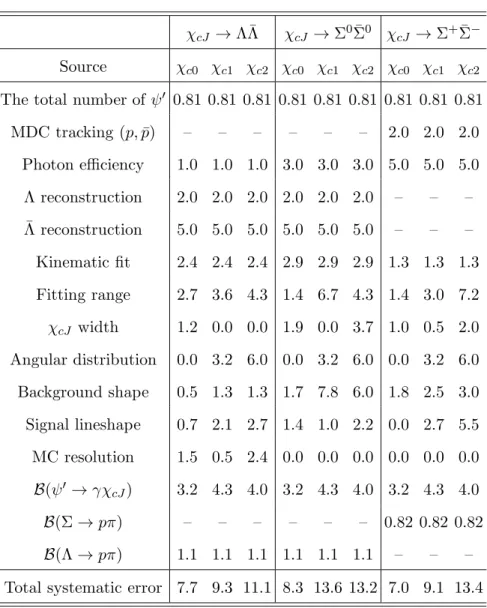
Table II lists all systematic error contributions, and the total systematic error is obtained by adding the individual contributions in quadrature.
TABLE II. Systematic errors in the branching fraction measurements (%) .
χcJ → Λ¯Λ χcJ → Σ0Σ¯0 χcJ → Σ+Σ¯−
Source χc0 χc1 χc2 χc0 χc1 χc2 χc0 χc1 χc2
The total number of ψ′ 0.81 0.81 0.81 0.81 0.81 0.81 0.81 0.81 0.81
MDC tracking (p, ¯p) – – – – – – 2.0 2.0 2.0 Photon efficiency 1.0 1.0 1.0 3.0 3.0 3.0 5.0 5.0 5.0 Λ reconstruction 2.0 2.0 2.0 2.0 2.0 2.0 – – – ¯ Λ reconstruction 5.0 5.0 5.0 5.0 5.0 5.0 – – – Kinematic fit 2.4 2.4 2.4 2.9 2.9 2.9 1.3 1.3 1.3 Fitting range 2.7 3.6 4.3 1.4 6.7 4.3 1.4 3.0 7.2 χcJ width 1.2 0.0 0.0 1.9 0.0 3.7 1.0 0.5 2.0 Angular distribution 0.0 3.2 6.0 0.0 3.2 6.0 0.0 3.2 6.0 Background shape 0.5 1.3 1.3 1.7 7.8 6.0 1.8 2.5 3.0 Signal lineshape 0.7 2.1 2.7 1.4 1.0 2.2 0.0 2.7 5.5 MC resolution 1.5 0.5 2.4 0.0 0.0 0.0 0.0 0.0 0.0 B(ψ′→ γχcJ) 3.2 4.3 4.0 3.2 4.3 4.0 3.2 4.3 4.0 B(Σ → pπ) – – – – – – 0.82 0.82 0.82 B(Λ → pπ) 1.1 1.1 1.1 1.1 1.1 1.1 – – – Total systematic error 7.7 9.3 11.1 8.3 13.6 13.2 7.0 9.1 13.4
VII. RESULTS
The branching fraction of χcJ → B ¯B is determined by
B(χcJ → B ¯B) = Nobs[χ cJ] Nψ′ · ǫ · Q iBi ,
and if the signal is not significant, the corresponding upper limit of branching fraction is set with B(χcJ → B ¯B) < Nobs U L[χcJ] Nψ′ · ǫ ·QiBi· (1.0 − σsys.) ,
where, Nobs is the number of observed signal events and Nobs
U Lis the upper limit of the number
of events, ǫ is the detection efficiency shown in Table I, σsys. is the relative the systematic
error, Nψ′ is the total number of ψ′ events [9], and QiBi is the product of the branching
fractions taken from the world average [4] for the ψ′ → γχ
cJ and the other decays that are
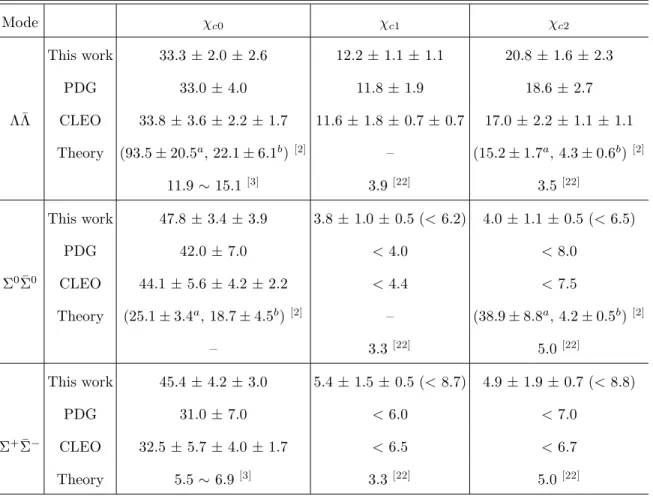
involved. With the numbers listed in Table I and the branching fractions for the relevant
baryon decays, the branching fractions or the upper limits at the 90% C.L. for χcJ decays
are determined, as listed in Table III.
TABLE III. Branching fractions (or their upper limits) of χcJ → Λ¯Λ, Σ0Σ¯0 and Σ+Σ¯−(in units of
10−5). The first error is statistical and the second is systematic.
Mode χc0 χc1 χc2 This work 33.3 ± 2.0 ± 2.6 12.2 ± 1.1 ± 1.1 20.8 ± 1.6 ± 2.3 PDG 33.0 ± 4.0 11.8 ± 1.9 18.6 ± 2.7 Λ ¯Λ CLEO 33.8 ± 3.6 ± 2.2 ± 1.7 11.6 ± 1.8 ± 0.7 ± 0.7 17.0 ± 2.2 ± 1.1 ± 1.1 Theory (93.5 ± 20.5a , 22.1 ± 6.1b )[2] – (15.2 ± 1.7a , 4.3 ± 0.6b )[2] 11.9 ∼ 15.1[3] 3.9[22] 3.5[22] This work 47.8 ± 3.4 ± 3.9 3.8 ± 1.0 ± 0.5 (< 6.2) 4.0 ± 1.1 ± 0.5 (< 6.5) PDG 42.0 ± 7.0 <4.0 <8.0 Σ0Σ¯0 CLEO 44.1 ± 5.6 ± 4.2 ± 2.2 <4.4 <7.5 Theory (25.1 ± 3.4a , 18.7 ± 4.5b )[2] – (38.9 ± 8.8a , 4.2 ± 0.5b )[2] – 3.3[22] 5.0[22] This work 45.4 ± 4.2 ± 3.0 5.4 ± 1.5 ± 0.5 (< 8.7) 4.9 ± 1.9 ± 0.7 (< 8.8) PDG 31.0 ± 7.0 <6.0 <7.0 Σ+Σ¯− CLEO 32.5 ± 5.7 ± 4.0 ± 1.7 <6.5 <6.7 Theory 5.5 ∼ 6.9[3] 3.3[22] 5.0[22] VIII. SUMMARY
Three χcJ decays to the baryon pairs are observed, and their branching fractions are
the decay of χcJ → Λ¯Λ, the experimental results are still inconsistent with theoretical
predictions [2, 3, 22], which are helpful to check the theoretical model of decays of χcJ → Λ¯Λ.
For the decays of χc1,2 → Σ0Σ¯0 and Σ+Σ¯−, the significances are improved relative to the
previous measurments, but the comparisons of their branching fractions between experiments and theoretical predictions are inconclusive due to the limited experimental precision.
IX. ACKNOWLEDGEMENT
The BESIII collaboration thanks the staff of BEPCII and the computing center for their hard efforts. This work is supported in part by the Ministry of Science and Technology of China under Contract No. 2009CB825200, 2009CB825206; National Natural Science Foun-dation of China (NSFC) under Contracts Nos. 10625524, 10821063, 10825524, 10835001, 10935007, 10975143, 10975047, 10979008, 11125525, 11275057; Joint Funds of the National Natural Science Foundation of China under Contracts Nos. 11079008, 11079027, 11179007; the Chinese Academy of Sciences (CAS) Large-Scale Scientific Facility Program; CAS under Contracts Nos. KJCX2-YW-N29, KJCX2-YW-N45; 100 Talents Program of CAS; Istituto Nazionale di Fisica Nucleare, Italy; Ministry of Development of Turkey under Contract No. DPT2006K-120470; U. S. Department of Energy under Contracts Nos. DE-FG02-04ER41291, DE-FG02-91ER40682, DE-FG02-94ER40823; U.S. National Science Founda-tion; University of Groningen (RuG) and the Helmholtzzentrum fuer Schwerionenforschung GmbH (GSI), Darmstadt; WCU Program of National Research Foundation of Korea under Contract No. R32-2008-000-10155-0.
[1] G. T. Bodwin, E. Braaten and G. P. Lepage, Phys. Rev. D 51, 1125 (1995). [2] R. G. Ping, B. S. Zou and H. C. Chiang, Eur. Phys. J. A 23, 129 (2004). [3] X. H. Liu and Q. Zhao, J. Phys. G G38, 035007 (2011).
[4] K. Nakamura et al. (Particle Data Group), J. Phys. G 37, 075021 (2012). [5] J. Z. Bai et al. (BES Collaboration), Phys. Rev. D 67, 112001 (2003). [6] M. Ablikim et al. (BES Collaboration), Phys. Rev. D 73, 052006 (2006). [7] P. Naik et al. (CLEO Collaboration), Phys. Rev. D 78, 031101 (2008).
[8] S. J. Brodsky and G. P. Lepage, Phys. Rev. D 24, 2848 (1981). [9] M. Ablikim et al. (BESIII Collaboration), arXiv:1209.6199 [hep-ex].
[10] M. Ablikim et al. (BESIII Collaboration), Nucl. Instrum. Meth. A 614, 345 (2010). [11] S. Agostinelli et al. (GEANT4 Collaboration), Nucl. Instrum. Meth. A 506, 250 (2003). [12] J. Allison et al., IEEE Trans. Nucl. Sci. 53, 270 (2006).
[13] S. Jadach, B. F. L. Ward and Z. Was, Comput. Phys. Commun. 130, 260 (2000), S. Jadach, B. F. L. Ward and Z. Was, Phys. Rev. D 63, 113009 (2001).
[14] R. G. Ping et al., Chinese Physics C 32, 599 (2008).
[15] J. C. Chen, G. S. Huang, X. R. Qi, D. H. Zhang and Y. S. Zhu, Phys. Rev. D 62, 034003 (2000).
[16] Y. S. Zhu et al., Chinese Physics C 32, 363 (2008). [17] W. M. Tanenbaum et al., Phys. Rev. D 17, 1731 (1978),
G. Karl, S. Meshkov and J. L. Rosner, Phys. Rev. D 13, 1203 (1976), M. Oreglia et al., Phys. Rev. D 25, 2259 (1982).
[18] M. Ablikim et al. (BESIII Collaboration), Phys. Rev. D 83, 112005 (2011). [19] V. V. Anashin et al. (KEDR Collaboration), arXiv:1012.1694 [hep-ex].
[20] R. E. Mitchell et al. (CLEO Collaboration), Phys. Rev. Lett. 102, 011801 (2009). [21] G. R. Liao, R. G. Ping and Y. X. Yang, Chin. Phys. Lett. 26, 051101 (2009). [22] S. M. H. Wong, Eur. Phys. J. C 14, 643 (2000).