ï S l ï P C i·■№ S i ;¿M v¿ f< q*іГ^ ;'*f^ p. μ ^ It Ш s T il à'â !3 3* ág AM U A 4 3 ^ J.
вивштіш.!
то таи 02s^^2i*iMS№' ·α«Η
АЖ^
^^S¿!ii£-'f^JTá!i Ш* Ш^КШЖЗШіШШ iJÆD ЗСЖИЖЯ®
CS'“ ВНЖЖіШ? n H F /S3 í.@ T Y Ш P iS?2!láJu JïKSHâLSgEÈ^··· O F ТШВ Ш Ж рЛ Ш М ЕЖ ШЖЖ ш т іШМіШШ OF
CÆ CïïOii m - ш ш ж ш шЩц
9l
·/М Ш
4 V ¿<i * J W f 3 Jl W j Ι δ υδ Π ; ? « Ϊ < Γ;ίϋ í i C v í ,■ Q e i t O Z . S ‘ A ' < S 6POLYHEDRAL APPROACHES TO HYPERGRAPH
PARTITIONING AND CELL FORMATION
A THESIS
SL'BMITTED TO THE DEPARTMENT OF INDUSTRIAL ENGINEERING
AND THE INSTITUTE OF ENGINEERING AND SCIENCE
OF BILKENT UNIVERSITY
IN PARTIAL FULFILLMENT OF THE REQUIREMENTS FOR THE DEGREE OF
DOCTOR OF PHILOSOPHY
By
Levent Kandiller
December 1994
q v )
U o o .^ ) K l( ^
1QO
I certify that I have read this thesis and that in my opin ion it is fully adecjuate, in scope and in quality, as a dissertation for the degree of Doctor of Philosophy.
I certify that I have read this thesis and that in my opin ion it is fully adequate, in scope and in quality, as a dissertation for the degree of Doctor of Philosophy.
1
Ömer Benli. Associate Professor
I certify that I have read this thesis and that in my opin ion it is fully adequate, in scope and in quality, as a dissertation for the degree of Doctor of Philosophy.
I certify that I have read this thesis and that in my opin ion it is fully adequate, in scope and in quality, as a dissertation for the degree of Doctor of Philosophy.
Cevdet Aykan&t, Associate Professor
I certify that I have read this thesis and that in my opin ion it is fully adequate, in scope and in ([uality, as a dissertation for the degree of Doctor of Philosophy.
Canan Sepil, .Associate Professor
.Approved for the Institute of Engineering and Science:
Prof. Dr. Mehmet Bara^
Acknowledgement
I am inclepted to Assoc. Prof. Mustafa .Akgiil for his supervision, development of this thesis. I am grateful to Assoc. Prof. Ömer Benli, Asst. Prof. Osman Oğuz, Assoc. Prof. Cevdet Aykanat, Assoc. Prof. Canan Sepil and Assoc. Prof. Barbaros Tansel for their valuable comments.
I would like to extend my deepest gratitude and thanks to my parents and my brother for their morale support. It is to them that this study is affectionally dedicated, without whom it would not be possible.
I would like to express my appreciation to Assoc. Prof. Ülkü Gürler for her sug gestions and encouragement throughout the thesis especially at times of despair and hardship. I would like to offer my sincere thanks to my friends Nureddin Kirkavak, Nezih Agan and Oguzhan .A.ygiin who provided morale support and encouragement.
Flak'tan gelen şerbeti içtik elhamdülillâh Şol kudret denizini Geçtik elhamdülillâh
Şol karşıki dağlan Meşeleri bağlan Sağlık safâlık ile Aştık elhamdülillâh
Kuru idik yaş olduk Kanatlandık kuş olduk Birbirimize eş olduk Uçtuk elhamdülillâh
Vardığımız illere Şol safâ gönüllere Halka Tapduk mânâsın Saçtık elhamdülillâh
Beri gel barışalım Yâd isen bilişelim Atımız eğerlendi Eştik elhamdülillâh
indik Rûm'u kışladık Çok hayr ü şer işledik Uş bahar geldi geri Göçtük elhamdülillâh
Derildik pınar olduk irkildik ırmak olduk Aktık denize dolduk Taştık elhamdülillâh
Tapduk’un tapusunda Kul olduk kapusunda
Yûnus miskin çiğ idik Piştik elhamdülillâh Yunus Emre
Abstract
POLYHEDRAL APPROACHES TO HYPERGRAPH
PARTITIONING AND CELL FORMATION
Levent Kandiller
Pli.D. in Industrial Engineering
Supervisor: Mustafa Akgiil, Associate Professor
December 1994
H\ pergraphs are generalizations of graphs in the sense that each hypereclge can connect more than two vertices. Hypergraphs are used to describe manu facturing environments and electrical circuits. Hypergraph partitioning in man ufacturing models cell formation in Cellular Manufacturing systems. Moreover, hypergraph partitioning in VTSI design case is necessary to simplify the layout problem. There are various heuristic techniques for obtaining non-optimal hy pergraph partitionings reported in the literature. In this dissertation research, optimal seeking hypergraph partitioning approaches are attacked from polyhedral combinatorics viewpoint.
There are two polytopes defined on r-uniform hypergraphs in which every hyperedge has exactly r end points, in order to analyze partitioning related prob lems. Their dimensions, valid inequality families, facet defining inequalities are investigated, and experimented via random test problems.
Cell formation is the first stage in designing Cellular Manufacturing systems. There are two new cell formation techniques based on combinatorial optimization principles. One uses graph approximation, creation of a flow equivalent tree by successively solving maximum flow problems and a search routine. The other uses the polynomially solvable special case of the one of the previously discussed polytopes. These new techniques are compared to six well-known cell formation algorithms in terms of different efficiency measures according to randomly gen erated problems. The results are analyzed statistically.
Keywords: Combinatorial Optimization, Polyhedral Combinatorics, Hyper graph Partitioning, Cellular Manufacturing Systems.
özet
HİPERÇİZGE PARÇALAMA PROBLEMİNE
POLYHEDRAL YAKLAŞIMLAR VE HÜCRE
BELİRLENMESİ
Levent Kandiller
Endüstri Mühendisliği Doktora
Tez Yöneticisi: Doç. Dr. Mustafa Akgül
Aralık 1994
Hiperçizgeler, ^'izgelerin ayrıtların birleştirdiği düğümlerin sayılarının ikiden fazla olabildiği daha genel durumlarıdır. Hiperçizgeler imalat sistemlerinin ve elektrik devrelerinin ifade edilmesinde kullanılırlar. Hücre Tipi İmalat sistem lerinde hiperçizge parçalaması hücre belirleme problemine dönüşür. Hiperçizge parçalama entegre devre tasarımında yerleşim problemini kolaylaştırmak için gereklidir. Literatürde çeşitli optirnal olmayan çözümler veren sezgisel yöntemler vardır. Bu doktora çalışmasında hiperçizge parçalama problemi için tasarlanmış optimali arayan polihedral kombinatoriks temelli yaklaşımlar tanıtılmıştır.
Hiperçizgeleri ikiye ayırma problemini incelemek için r-düzenli hiperçizgeler üzerinde iki politop tanımlanmıştır. R-düzenli hiperçizgelerde her ayrıt r düğümü bağlar. Bu politoplarm boyutları, geçerli eşitsizlik aileleri ve yüzey tanımlayan eşitsizlikleri araştırılmış ve bu eşitsizliklerin etkinlikleri rastsal problemler yardı mıyla denenmişlerdir.
Hücre belirleme aşaması Hücre Tipi imalat sistemlerinin tasarımındaki ilk aşamadır. Yeni iki kornbinatoryal optimizasyon temelli hücre belirleme tekniği geliştirilmiştir. Birinci teknik bir çizge ile hiperçizgeye yakınlaşmayı, ma.xinıurn akış problemlerini arka arkaya çözme yoluyle elde edilen akış eşdeğer ağacı yarat mayı ve bir tarama yordamını kullanmaktadır, ikinci teknik ise daha önce bah sedilen politopun polinom zamanda çözülebilen özel halini kullanmaktadır. Bu iki yeni teknik tanınan altı hücre belirleme algoritması ile değişik ölçüler bazında rassal problemlerde karşılaştırıirmştır. Bulgular istatistiksel analizlerle yorum lanmıştır.
Anahtar kelimeler: Kornbinatoryal Optimizasyon, Polihedral Kombinatoriks, Hiperçizge Parçalama, Hücre Tipi imalat Sistemleri.
Contents
1 INTRODUCTION
1.1 General Background and Summary 1.2 Notation and Preliminarv Results .
■) 9
2 PARTITIONING: DEFINITIONS, C O M PLEXITIES and TEC H
NIQUES
2.1 Preliminaries ... Partitioning Techniques ... 2.2.1 Local Search H euristics... 2.2.2 Network Flow Based A p p ro ach es... 2.2.-3 Nonlinear Optimization Based M ethods... 2.2.4 Clustering M ethods... 2.2..5 Polyhedral Approaches...
10
10
13 13 14 16 17 183 PO LYH ED RA L APPROACHES TO PARTITIONING
21
3.1 Partitioning Related P o ly h e d ra ... 22 3.2 Cut P o ly t o p e ... 23
4 BOOLEAN R-ATIC PO LYTO PE
31
4.1 P re lim in a rie s ... 31
4.2 Definition and Dimension .34
4.3 Facet Defining Inequalities... 36 4.4 Clique and Cut In e q u a litie s... 40 4.5 Computational R e s u lts ... 48
4.6 A Special Case ,52
5 R-UN IFO RM H YPERG RA PH CUT PO LYTO PE
55
0.1 Dimension ... ,
5,5
5.2 Complete Subhypergraph Inequalities... 64
5.3 Trivial In e q u a litie s... 65
5.4 Generalized Triangle Inequalities 66 5.5 Congestion Inequalities... 71
5.6 Computational R e s u lts ... 74
6 CELL FORMATION PROBLEM
78
6.1 Hypergraph R ep resen tatio n ... 796.2 .A Generic Cell Formation Algorithm 81 6.2.1 Hypergraph .Approximation 81 6.2.2 Gornory - Hu Cut T r e e ... 84
6.2.3 Generic Algorithm ... 88
6.3 Sequential Identifying the Best Manufacturing Cell 91 6.4 Efficiency M easures... 95
6.5 Other Cell Formation Techniques E v a lu a te d ... 106
6.6 Problem G enerator...117
6.7 Experimental D e s ig n ...122
6.8 Results and D iscussion... 125
7 CONCLUSIONS
144
7.1 C on trib u tion s... 1447.2 Future R esearch... 147
A
149
A .l Graph T h e o ry ...149A.2 Linear and Integer P ro g ram m in g ...150
V ita
162
List of Figures
1.1 E.xarnple complete r-uniform hypergraphs of order 5. 6
1.2 A cut S{S) in a hypergraph... 7
1..3 Union operation in ... 9
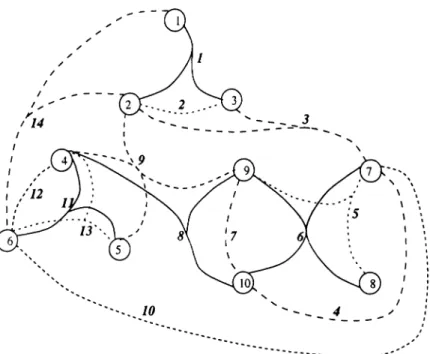
3.1 A bicycle 5-wheel and its inequality... 24
3.2 -A C W j and its ineciuality... 29
4.1 An instance of the problem on an example hypergraph represen tation... 32
4.2 The same instance of the problem on the transformed 5-uniforrn hypergraph... 34
5.1 A cut in region 1... 57
5.2 A cut in region III... 58
5.3 Situations defining homogeneous triangular inequalities... 67
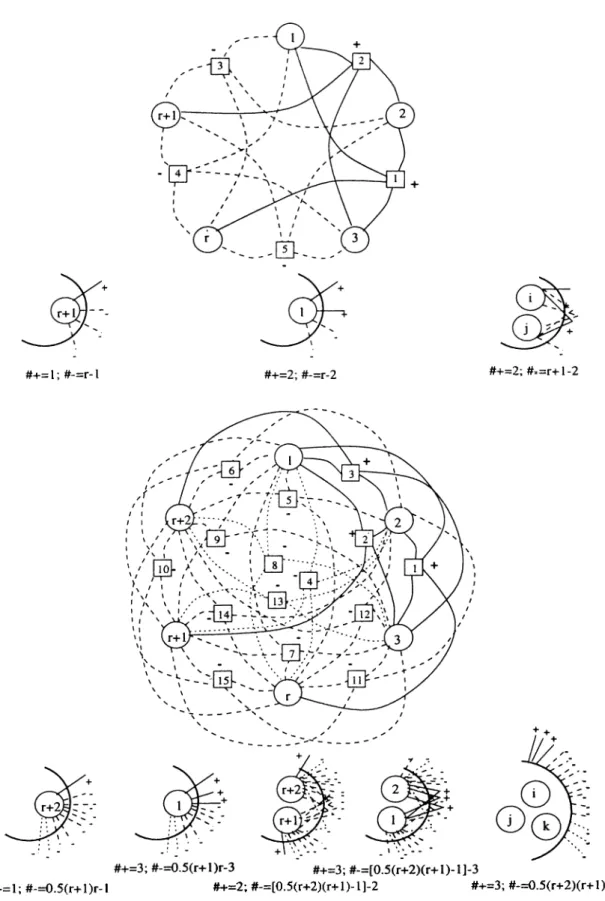
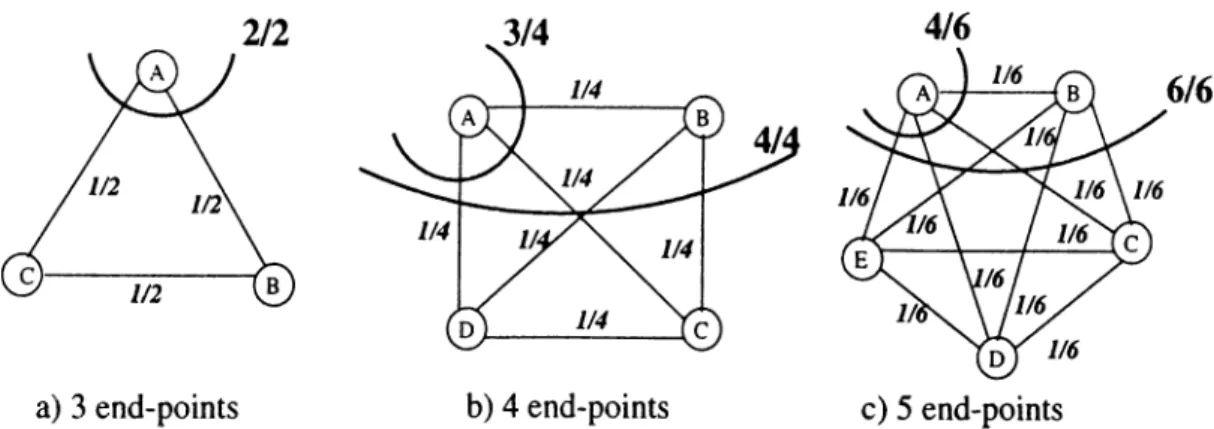
5.4 Congestion inequalities, r = 4... 72
6.1 The associated hypergraph of the example cell formation situation. 81 6.2 The two representations... 82
6.3 Donath - Hadley approximation of the hyperedges in various sizes. 83 6.4 The clique approximation of the example hypergraph... 84
6.5 The star approximation of the example hypergraph... 85
6.6 First iteration of Gomory-Hu algorithm... 85
6.7 First link of tree diagram... 86
6.9 Second link of tree diagram... ST 6.10 -A. Gomory-Hu cut tree of the cliciue approximation of the example
problem... ST 6.11 A Gomory-Hu cut tree of the star approximation of the example
problem... 88
6.12 HAP-CUT{Example,clique,maximize number of partitions,80%}. . 90
6.13 HAP-GUT{Example,star,any-criterion,60%}... 91
6.14 First iteration of SIBC{Exam ple,netflo,2/3}... 95
6.15 Second iteration of SIBC{Exam ple,netflo.2/3}... 96
6.16 Some examples of efficiency values...103
6. IT Effect of part and machine type weights on grouping efficiency values. 104 6.18 Effect of work-loads on balance and under-utilization measures. . 105
6.19 Effect of clurnpine.ss on generated incidence matrices...120
6.20 Effects dumpiness, density, number of parts and algorithms on grouping efficiencies...136
6.21 Effects dumpiness, density, number of parts and algorithms on work-load balances... 13T 6.22 Effects dumpiness, density, number of parts and algorithms on under-utilizations...138
List of Tables
2.1 .A. 2 x 2 contingency table... 17
2.2 Similarity-density functions in clustering binary data... 18
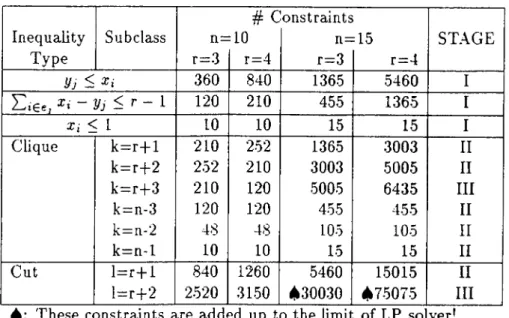
4.1 The stages of computation... 49
4.2 The results of the first set of the computational study on RP(//^) for n=10,15 and r= 3,4... .50
4.3 The results of the second set of the computational study on RP( ) for n=10,15 and r= 3,4... 51
5.1 The stages of computation... 74
5.2 The results of the computational study on PciH ^) for n=10,lo and r= 3,4... 76
6.1 Part information of the example problem... 80
6.2 Machine type information of the example problem... 80
6.3 Time comparison of the four alternative methods in Cplex3.0. . . 94
6.4 Effect of shape parameters on inner-cell and off-diagonal densities. 119 6.5 Factors of the experiment... 124
6.6 The best fine tuning values of cell formation techniques... 124
6.7 .Analysis of Variance table for inter-cell flow... 126
6.8 .Analysis of Variance table for inner-cell density... 127
6.9 Analysis of Variance table for work-load balance... 128
6.10 Analysis of Variance table for under-utilizations... 129
6.11 Estimated mean differences for the factor levels...135
6.12 Best cell formation techniques in terms of grouping efficiencies. . . 1.39 6.13 Best cell formation techniques in terms of work-load balance and
under-utilizations... 140
Chapter 1
INTRODUCTION
1.1
G en eral B ack grou n d and S u m m ary
A hypergraph [11] on a set V = { l . . . . , n } is a family H = of nonempty subsets tj of V’. The elements of V’ are vertices of H and e_,’s are hy
peredges of H. The elements of e_, are end points of hyperedge. Hypergraphs
are generalizations of graphs in which each hyperedge may be incident to more than two vertices (nodes).
Hypergraphs are very useful structures in representing incidence relationships of two sets, V and E . The set V is taken as the verte.x set and for each element
j of the other set E a hyperedge ej is constructed by connecting vertices which have an incidence relation to the selected element j . That is, ej — { i E V :
i is related to j }.
Hypergraphs can be used to represent manufacturing environments. The ma chine set may constitute the vertex set of this representation and the parts may form the hyperedges. In this case, each hyperedge ej connects the vertices which represent the machines through which the part j is routed. Hypergraphs are also powerful data structures for abstract representation of physical connections. For instance, wires in an electrical circuit usually connect more than two components. Each hyperedge in the hypergraph then corresponds to one electrical connection whereas circuit components are represented by nodes.
CHAPTER 1. INTRODUCTION
Hypergraph partitioning can be used both in grouping the elements of two sets V and E into distinct clusters, and in breaking some physical connections to have disconnected parts. An example of the former case arises in Cellular Manufacturing design, whereas VLSI layout is an instance of the latter case.
Cellular Manufacturing is an application of Group Technology philosophy to the manufacturing environment [4, 97]. In Cellular Manufacturing, parts are identified as families such that design and manufacturing functions can take the advantage of the similarities in a family [96]. Cell formation is the first phase of the design process of Cellular Manufacturing systems. This initial decision on the top of design hierarchy influences all other decisions in Cellular Manufacturing. During this stage, machine groups of functionally dissimilar types are placed together and dedicated to the fabrication of part families.
The cell formation problem can be defined via hypergraphs. The machine types are represented by vertices of its associated hypergraph, and hyperedges represent parts, or vice versa. Various weights can be tagged to the hypergraph representation of the situation. Machine types differ from each other by their operating cost values. Parts are different in their unit profits. The cell formation problem can be defined as the minimum cost hypergraph partitioning when the nodes of the associated hypergraph are machine types, it is the minimum cost (vertex) separation problem when the parts are represented by vertices. In the former case, the associated hypergraph is partitioned into pieces by deleting hy peredges. In a sense, the original manufacturing shop is divided into machine groups by subcontracting removed parts. Here the objective is to subcontract least valuable parts. In the latter case, the separation set made up of nodes di vides the hypergraph into parts that are connected only to that separation set. In other words, the conflicting machinery is duplicated so that no part is sub contracted. The objective in this case is to duplicate machinery in the cheapest wav.
Another application of hypergraph representation arises from VLSI circuits. In V LSI circuit design, it is assumed that the description of the circuit to be laid out is given in any convenient form. The circuit components are represented by
CHAPTER 1. INTRODUCTIO.\
vertices of the associated hypergraph. The wires are represented by hyperedges. Moreover, one can associate weights with the hypergraph representation of a VXSI circuit. For instance, verte.x weights can be the estimated area requirement of the corresponding circuit element. Also, the hyperedges may have wiring costs as weights.
The VLSI layout problem formulations given in the literature [53, 68, 74] are both theoretically and practically intractable. One and the most common heuris tic method is to break up the VLSI layout problem into sequential subproblems in such a way that the solution of a subproblem is fed as an input to the ne.xt one. Unfortunately, these subproblems are still yVP-Hard. The most common [53, 74, 91] way of breaking up the VLSI layout problem is the following: par titioning
1
-^ placement i-^· global routing and topological compaction i-)· detailed routing and geometric compaction. In the partitioning phase, the huge hyper graph representing a VLSI circuit is divided into a number of subhypergraphs by cracking the hyperedges having minimum total weights. Since partitioning pha.se stays on the top of the hierarchy that produces a solution, the final layout is influenced most by the quality of partitioning.In this dissertation, partitioning problems are defined via a generic mathemat ical programming formulation. An immediate analysis shows that all hypergraph partitioning problems belong to j\'V class. The main motivation in the thesis is to design methods for obtaining optimal solutions to the hypergraph partitioning problems using the principles of polyhedral combinatorics which are proved to be an effective tool for graph partitioning. A detailed analysis of polyhedral tech niques for graph partitioning points out the ways to generalize graph partitioning polytopes to hypergraph partitioning polytopes.
Graphs are generalized by r-uniform hypergraphs in which every hyperedge has exactly r end-points. There are two polytopes related with hypergraph par titioning, which are defined on r-uniform hypergraphs. The first polytope, the Boolean R-atic polytope, is investigated for obtaining the best portion of a given hypergraph. A simple transformation from a general hypergraph to an r-uniform hypergraph is detected for which respective solutions are invariant. Therefore
CHAPTER 1. INTRODUCTIOiX
the Boolean R-atic Polytope can be used to solve the problem of picking the best portion for all hypergraphs. This polytope is properly defined, its dimension and facet defining ineciualities are investigated. The valid inequalities are tested by means of random problems using both simplex and interior point codes. The results state that more than 90 percent of the cases an integer solution is found before branch and bound. A polynomially solvable special case of this problem is identified, which yields a new problem in Cellular Manufacturing systems: identi fying the best manufacturing cell. This leads to a new heuristic for cell formation problem.
The second polytope, the R-uniform Hypergraph Cut polytope, is investigated for solving maximum cut and bipartitioning problems on r-uniform hypergraphs. This polytope is proved to be full dimensional. Families of valid inequalities, some of which define facets are found. The effectiveness of these inequalities are tested for both of the above problems by means of interior point and simplex based procedures. The integer optimal solutions obtained by using these inequalities only are more than 91 percent for the maximum cut problem and more than 76 percent for bipartitioning.
Two new cell formation techniques are developed. One is based on the spe cial case mentioned above on the Boolean R-atic polytope which is proved to be polynomially solvable. The manufacturing cells are sequentially created by solving the problem of identifying the best cell one after another. The second technique involves a graph approximation of the hypergraph that represents the manufacturing environment. A special tree which is flow equivalent to the graph approximation is constructed next. Cells are formed by sequentially deleting the edges in this tree. These new techniques are analyzed and compared to six well- known cell formation techniques. Four different efficiency measares are developed. All the techniques are compared in terms of efficiency values obtained from solv ing random problems. Algorithms, part demand and operating cost variations, density and manufacturing environment, and number of parts in the system are the considered factors in the experimental design. The statistical analyses state that our measures are effective in evaluating cell formation solutions and each
CHAPTER 1. INTRODUCTION
technique has a region of superiority indicated by the sensitive factors.
The manuscript is organized as follows: In the rest of this chapter hyper graphs are introduced and the basic properties are developed. In Chapter 2, the partitioning problems are defined on a mathematical programming formulation and a literature review of partitioning techniques is presented. Recent polyhe dral approaches to graph partitioning problems are analyzed in Chapter .3, with a special treatment of the cut polytope of graphs. Chapters 4 and 5 are devoted to the study of the two polytopes defined for hypergraph partitioning. The two new cell formation algorithms are illustrated and compared with the other cell formation techniques in Chapter 6, which is followed by the conclusions presented in Chapter 7.
1.2
N o tatio n and P relim in ary R esu lts
The basic concepts of hypergraph theory and the notation used throughout the thesis are introduced in this section. The conventions used in graph theory, polyhedral theory and linear programming cire included in Appendix A.
Let S Ç V, then 7(5') is the set of internal hyperedges contained in 5'. If
^ ^ S\ T C V and 5" n T = 0, then 6 {S ;T ) is the set of hyperedges that have
at least one end point from each set. A cut S(S) in a hypergraph H is the set of hyperedges which have at least one end point in 5 , i.e., S{S) = 6{V \ S). We write 8(v) instead of ¿ ({u }), call it as star of v. The cardinality of the star of a node V is termed as its degree and denoted by deg{v).
There are weights associated with nodes and hyperedges. Nodes are differen tiated by means of c,’s, in the node weight associated with i G V. On the other hand, hyperedges are discriminated via d j’s, in the edge weights associated with
t j . Let c{S ) denote the total weight of the nodes in S, and d ( 7 ( 5 ) ) denotes the
total weight of the edges inside 5.
■A hypergraph H is simple if no hyperedge contains any other. The order of
H is \ V \= n, its m aximal rank is r{H ) = max,-i,...,m | Ci |, and its minimal
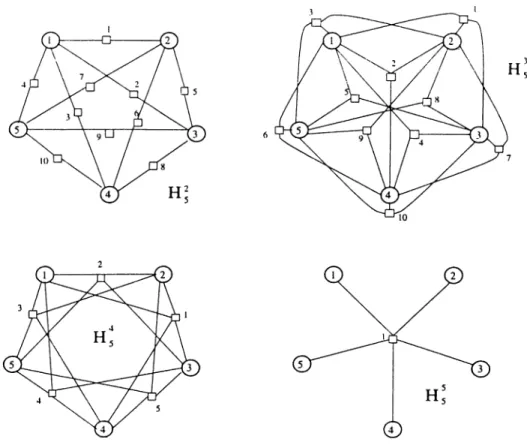
Figure 1.1: Example complete r-uniform hypergraphs of order 5.
is a simple hypergraph such that | e, |= r, Vi = In an r-uniform hypergraph, a hyperedge can be represented by a sequence of r vertices. .An ordinary graph with no isolated vertex is a 2-uniform hypergraph. If there is a hyperedge for every subset of V of size r, then the resultant hypergraph is called
com plete r-uniform , and denoted by There are m=^"^ hyperedges in an
complete r-uniform hypergraph Without loss of generality we may assume that hyperedges of a complete r-uniform hypergraph are lexicographically ordered. So, the first edge of is the edge 12 · · · r whereas the last edge is the edge (n — r -|- l)(n — r -f 2) · · · n.
Four complete r-uniform hypergraphs of n = -5 vertices are illustrated in Figure 1.1. In illustrating hypergraphs, circles represent vertices and squares represent hyperedges. This representation leads to the following observation: each hypergraph is actually a bipartite graph with n + m vertices such that one part is the vertex set of the hypergraph and the other part is the set of hyperedges.
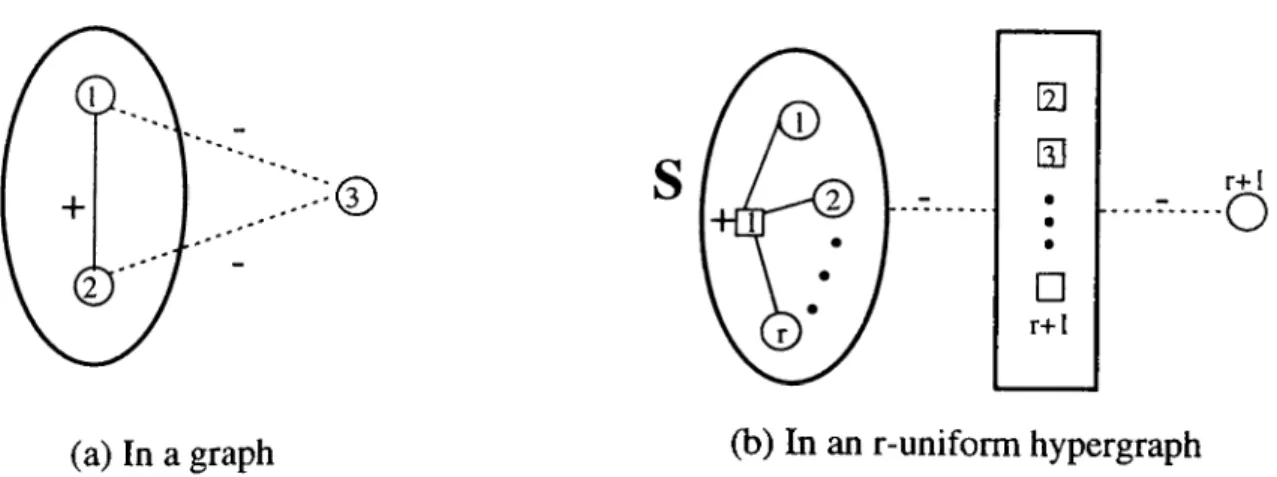
Any cut 6{S) in can be represented by means of five sets as illustrated in Figure 1.2. Two of these sets are node sets: S and V \ S. The remaining sets
CM AFTER 1. INTRODUCTION
contain hyperedges. A cut divides all hyperedges into three sets: one set for the hyperedges in the cut, and two sets of hyperedges inside of the two parts S and K \ 5 .
Let Cffr denote the set o f all cuts 6{S) in such that I S 1= s. Clearlv, Clir is equivalent to Thus, we are interested in CffUs where 1 <
5
< . For instance, CffF is the set of stars in the hypergraph. The cardinality o f Cffr C )· The number of hyperedges cut by an element of Cf^r is denoted byIn ¿ (5 ), there are m in { r - l , s } subsets ¿i{S) as illustrated in Figure 1.2. Each
6i{S) includes the set of hyperedges in the cut whose exactly / endpoints are in
S. Then, the cardinality of Si{S) is (^fj (" I* )· Thus inin{r —l,s} min{r-l,
5
}c :., =16‘(S) 1=
I ¿,(5)1=
£
/=1 /=1
Tl — . r - I
On the other hand, there are hyperedges inside 5, and ("p*) hyperedges inside V \ S. Thus
C* =n , r
n — 3 '
< r J
T h e o re m 1.1 C® ^ is strictly increasing u'hen 1 < < [|J (and is strictly de
creasing when [|J + l < - 5 < n — 1^. C®p is increasing while n is increasing.
V-S
Y (S) 5 (S ) Y (V -S)
CHAPTER 1. INTRODUCTION
Proof:
Let 1 < . < Lfj. c j ; · = ( ;) - (■:■) - and a , = { : ) (;) -Recall that ( j) + = ( " « ) . Then,
f a i ' - C · '. . =
- f
+r
'n — s — l\ in — st r J \ r .
^ n - s - l
t r -
1
, , r —1
,>
0
.
Thus 1 < 5 < [|J. This completes the first part.C U i.r = ( " t ') - (;) - ( ”" “ ). and C ',, = ( ;) - (;) - Recall that, t o = ( : : 0 + - " + ( r - 7 ) + ( “-")■ Then, pS _ ^1S _ n + ··· + f n + l \ _ K ^ J + I — +
1
- .s' ^ r 'n' i 'r J n — s ' ri - 1 \ n -, C - 1 ' + 1 - 1 , >0
. — 1/ y r — IThe above inequality is from the fact that each term on the left is grater than each term on the right respectively, i.e., n + 1 — i > n — i, Vi = 1 , . . . , s. Thus,
<^a+l.r > Q .r , Vn. □ C o ro lla ry 1.1 F or 1 < 5 < n — 1, n r 'l = {
M
< C" < I r - l i - \r LtJ^ r r t l2 I 1 ^ - ^ n,r ·2 \An incidence vector A’{S) of a set 5 C K is a binary vector of length n whose component is 1 if i G 5 , and 0 otherwise. Similarly, an incidence vector A '(7(5)) of a 7 (5 ) of 5 C K is a binary vector of length ( " j whose component is 1 if e, C and 0 otherwise. Let X {Cffr) be the incidence matrix o f cuts o f
size s in This incidence matri.x has rows and columns. Both rows
and columns of <T(C|/r) are ordered lexicographically. Rows are indexed by s[i], i.e., s[i] is the set 5 whose incidence vector of the cut A!{S{S)) is the row of
We denote by R the set of real numbers. The set of natural (respectively, bi nary) numbers are denoted by N (respectively, ®). Let R", N'^, be the set of vec tors with n components. Let u,· € be a canonical unit vector whose first n
CHAPTER 1. INTRODUCTION
Figure 1.3: Union operation in
components are and others are zero. Similarly, let Vj G be a vector whose first n components are A'{ej) and last components form a canonical unit vector A '(
7
(ej) = e^·). Let = (^^’( 5 ) , A '(7 (5 ))), and2
^ = (A’( r ) , ,U(7
( r ) ) ) . Then, the union operation is defined as2
·^ l+l2
^ = { A!{S U T ) , ^ '(7 (5
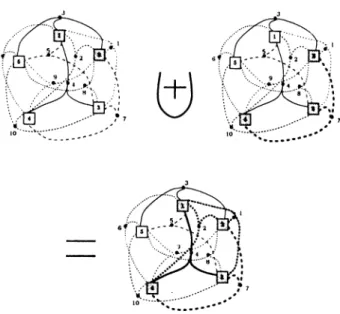
U T ) )). The union operation in is illustrated in Figure 1.3:2
I = ( l , l , 0 , 0 , 0 f 0 , 0 , 0 , 0 , 0 , 0 , 0 , 0 , 0 , 0 ) 2^ = ( 0 , 1 , 1 , 1 , 0 | 0 , 0 , 0 , 0 , 0 , 0 , 1 , 0, 0, 0) 2i(±)22 = ( l , 1 , 1 , 1 , 0 1 1 , 1 , 0 , 1 , 0 , 0 , 1 , 0 , 0 , 0 )If /1 is an n X m matrix, then A{ denotes row of A, A^ denotes column of A, and A\ denotes element of A. 1 is a matrix whose elements are all equal 1. Similarly, e is the vector whose components are all ones, and e,, tij, tijk are appropriate canonical unit vectors. 0 is a matrix whose elements are all ecjual 0. In is the identity matrix of size n. A" is an operation similar to taking a transpose: [A For instance,
(hr =
0 0 1
0 1 0
1 0 0
Chapter 2
PARTITIONING:
DEFINITIONS,
COMPLEXITIES and
TECHNIQUES
2.1
P relim in aries
In this section, a family of partitioning problems is defined from a combinato rial optimization viewpoint. A partitioning problem is referred as hypergraph partitioning when the underlying structure is a hypergraph. It is called graph partitioning when the associated data structure is a (simple) graph.
The partitioning of a (hyper) graph is obtained either by deleting (hyper) edges, or deleting vertices and their incident (hyper) edges. The former opera tion is known as partitioning whereas the latter one is called separation. In our ta.xonomy, there are three kinds of partitioning: bipartitioning, multiple parti tioning and free partitioning. The cost of the partition operation is the total costs of the removed elements. Another criterion is the balance criterion which tries to make subparts to have equal number of vertices as much as possible.
Definition of some symbols are needed before defining separation and the
three kinds of partitioning: A (hyper) graph G = (V, E) consisting of n = \V\ vertices is used to represent the circuit to be partitioned into p e H parts. For each edge e G E , the incident vertices are denoted by u(e). There is an edge cost function c : E H, a vertex weight function w : V H. There are also size limits for parts: s { j) € N is the lower limit and S {j) G N is the upper limit for part j =
In m u ltip le p a rtitio n s, the node set V is partitioned into p > 1 disjoint nonempty sets satisfying the size limits s(i) and S {i). In order to formulate this as a mathematical program, a binary decision variable is needed to be defined;
1, if vertex is assigned to part; 0, otherwise.
Multiple partitioning problem is formalized by the following mathematical for mulation:
CHAPTER 2. PARTITIONING: DEFINITIONS, COMPLEXITIES AND TECHNIQUESl
M ax im ize n j=l cGE iGt'('s) (
2
.1
) subject to: !=1 E = ‘ i=i Vi, = 1,. .. ,n (2.2) < S (j) V; = l ,. . . , p (2.3) Xi,j - 0,1 V i= 1,. . . , n Vi = l , . . . , p (2.4) The objective of the multiple partitioning formulation is to minimize the total cost of the (hyper) edges that are in the cut set. In the formulation, a comple mentary objective is used. The objective is to maximize the total weight of the (hyper) edges not cut by the partition. The product in the objective function identifies whether the edge has all of its incident vertices inside a part. The con straints (2.2) satisfy the partition criterion. That is, every vertex is assigned to only one part, and the disjoint parts span all vertices. The constraints (2.3) are size constrains and the constraints (2.4) are integrality constraints.CHAPTER 2. PARTITIONING: DEFINITIONS. COMPLEXITIES AND TECHNIQEESl
Not surprisingly, the multiple partition problem is A'”'P-Hard, even if it is severely restricted. For instance, the multiple partition problem in which
G
is a graph, w = 1, c = 1, s{i) = 1 and S {i) = n, is strongly A''"P-Complete [74].The special case of the multiple partition problem in which p=2 is called the
bipartition
problem. The additional restrictions - n is even, s{i) = 1,S {i) = |, te = 1, define the bisection problem. The hypergraph bipartitioning
is also A/*P-Hard. In fact, the bisection problem restricted to graphs is strongly ./V’P-Complete [74].
There is a variant of the multiple partition problem in which p is not specified. In this case, s(7) values forcing balanced partitions cannot be defined, and usually upper limits on part sizes S {i) are the same S. This variant is called the
free
partition problem. The free partition problem is also A'"'P-Hard. Actually, The associated decision problem is strongly A”P-Complete [74] even if
S >
3 is fi.xed, re = 1, c = 1.The
separation
problem is to remove as few vertices (the setC)
as possible such that the (hyper-)graph is disconnected into two sides (the sets L and R), each of which has a total vertex weight not exceeding S. The separation problem belongs to A^'P-Hard class [74]..Multiple partitioning restricted to planar graphs where te = 1, c = 1, s(i) = l, and S { i)—n, for p —'i and vertex degree of at most 4 can be solved in polynomial time. The bipartition problem for trees can be solved in quadratic time using dy- na.mic programming techniciues. The complexity of bisection problem restricted to planar graphs is open. It is also not known whether the separation problem for planar graphs is A/"P-Complete. Lipton and Tarjan [76] presented a linear time algorithm for separating planar graphs with a separator of size 0{\ /n). The tree partition problem is weakly A/’P-Complete. If all vertex weights are the same, the free partition problem of planar graphs is in V.
The approaches reported in the literature has focused mainly on the graph bi partitioning problem. There are very powerful iterative improvement heuristics, bounding schemes, and network flow based approaches. The methods proposed to solve the bipartitioning problem are modified to handle the multiple partitioning problem. On the other hand, the node separation problem has not attracted the re.searches’ interest much. Furthermore, the free partitioning problem remains almost untouched.
CM AFTER 2. PA RTITIONING: DEFINITIONS. COMPLEXITIES AND TECHNIQ UESl
2.2 Partitioning Techniques
2.2.1
Local Search Heuristics
The most famous local search technique designed to solve the graph bisection problem is due to Kernighan and Lin [6-3]. This technique has served as a com parison base for the last 20 years. It starts with an initial bisection, and tries to exchange pairs of vertices across the cut of bisection. Kernighan and Lin proposed to calculate the gains (reduction in the cost) of all possible pair interchanges and to select the one with the maximum gain or the one with the smallest increase, to reduce the chance of being trapped in a local optima. Then the selected pair is locked, and a second vertex pair whose exchange improves the cut of the bisection is searched, and so on.
Although this heuristic in its original version is quite simple and effective, there are some disadvantages as reported in [74]. The Kernighan-Lin heuris tic handles only unit weights, operate on exact bisection, cannot process hyper graphs, myopic and greedy, and finally one pass is not linear. Later on, Schweikert and Kernighan [88] discussed the ways of extensions to handle the hypergraphs by approximating hypergraphs via cliques.
Ten years later, Fiduccia and Mattheyses come with the idea of moving only a single vertex across the cut in a single move [37], and updating the gain calcu lations to handle the hypergraphs. They used buckets to make their algorithm run in linear time. Krishnamurty [67] introduced more look ahead mechanisms into this heuristic.
Kernighan and Lin [63] suggested a way to achieve balanced multiple parti tions by applying the heuristic to pairs of multiple subsets to improve the par tition. However, this method seems not promising because of computational intractability, that is the time it takes until a stabilization occurs is too long.
The analogy between a combinatorial optimization problem and the prob lem of determining lowest energy ground state of a physical system with many interacting atoms was first observed by Kirkpatric tt al. [66] in 1983. They developed a local search technique called simulated annealing using a very early result of Metropolis tt al. [78]. .Johnson et al. tailored general simulated an nealing algorithm for the bipartitioning problem [55] by moving a single vertex at a time across the cut. They penalized the squared difference between sizes of parts, added to the objective function, and performed a local search on this objective function. Penalizing the imbalance in this way is quite similar to a triv ial Lagrange relaxation method. They reported on detailed experiments using appropriate search strategies to bipartition graphs with unit vertex weights. The results seem not promising.
CHAPTER 2. PARTITIONING: DEF IN IT IONS, COMPL EXITIES A ND TECHNIQ EES
2.2.2 Network Flow Based Approaches
Network optimization approaches to the partitioning problem are usually based on the maximum flow - minimum cut theorem. These approaches attempt to solve underlying maximum flow between specified pair of nodes yielding a minimum cut. This cut bipartitions the node set in such a way that each node of the pair lies in different parts. The above method has two main disadvantages. It is very difficult to adjust the sizes of each part, and fixing the terminal pair of nodes is troublesome.
Bui et al. [18] suggested the following method for bisections to take care of size restrictions. After fixing a pair of distinguished nodes, shrink the neigh borhood of size s around these nodes. That is, shrink all vertices that can be reached from the distinguished node along the paths of length at most s edges. Consequently, assign infinite capacities to the edges of the resulting graph that
CHAPTER 2. PARriTIONING: DEFINITIONS, COMPLEXITIES AND TECHNIQ UESl
are incident to the shrunk nodes, and make a maximum flow computation. Out put the smallest minimum cut over all vertex pairs that is a bisection. Kahng [56] extended this idea to treat hypergraph bisections.
The idea of flow equivalent cut tree [41] is used in the partitioning problem. The crude ideas appeared first in [54]. Recently Vanelli and Hadley represented the same idea [93]. This idea is used to reduce the time complexity of solving a maximum flow problem for each distinct pair of vertices of the graph to be partitioned.
Garbers et al. [38] suggested to use another approach for free partitioning, using A:-/-connectedness. Two vertices ri and w are called ^"-/-connected if and only if there exists k edge disjoint paths connecting u and w such that each of these paths has length at most /. They suggested to cluster vertices that are A’-/-connected to each other as a part. Unfortunately, they did not investigate the ways of performing such an operation. However they only indicate that this kind of partition can be obtained in polynomial time when k and / are fi.xed.
Multi-commodity flow techniques can be used to assist graph bipartition ing [74]. A special commodity is assigned to each pair of vertices having de- rnands/supplies of |. The edge costs of the multi-commodity problem are ig nored and capacities are kept equal to edge costs of the partitioning problem. The objective is to maximize
2
. For each bipartition (U '.U "), the minimum multi-commodity flow across the cut is .: · ]U'] · \ V \. On the other hand, it is nec essary to have some nonnegative slack in the arc capacities for a multi-commodity flow to exist; that is C{V',,V") — z ■ \V'\ ■ \V"\ < 0, where C {V \V ") is the ca pacity of the cut [V \V "). The above argument creates an upper bound to the maximum flow:. . C {V \V ")
" " ]U'] · \V"\ ■
The term at the right hand side is called the sparsity of a cut. A cut with the minimum sparsity is the sparsest cut. Since only one direction of the maximum flow minimum cut theorem holds for the multi-commodity flows, the maximum value of a multi-commodity flow is only a lower bound on the minimum sparsity over all cuts.
The notion of the sparsest cut relaxes the balance criterion. Cuts of any bal ance are allowed; however, the more balanced a cut is, the higher the denominator is, and the sparsest a cut is. Thus, the sparsest cut is likely to be an attractive cut for balanced bipartitioning. The investigation of the connections between partitioning and multi-commodity flow is still in its infancy as reported in [74].
CHAPTER 2. PARTITIONING: DEFINITIONS, COMPLEXITIES AND TECHNIQUES]
2.2.3
Nonlinear Optimization Based Methods
number of lower bounds are developed on the minimum cut sizes of the multiple graph partitioning problem formulated as a quadratic assignment problem. The bounds are stated in terms of eigen values { A,(C), г = 1 , . . . , n) of the cost matrix (C ) that are sorted in decreasing order. The bounds are usually based on the Hoffman-Wieland inequality: Let A and B are two real symmetric matrices, then
T ra ce(A ■ B^) < YCi=\ ^¡(^) · where A,(·) is the largest eigen value o f
(■)■
Barnes [9] suggested the following lower bound: c{E ) — | Z L i5 '( 0 ’
where c( E) is the sum of the costs of all edges. Recall that p denotes number of parts and 3(1) denotes upper bound on the size of part in the multiple partition. Barnes [10] reported a procedure to obtain tight low'er bounds on the number of edges that must be cut when the nodes of a given graph are multiple partitioned into the parts that are sorted in decreasing order of their fixed sizes. The procedure substitutes the decision variables of the quadratic assignment formulation by orthonormal decision variables, and constraints by orthogonal eigenvectors.
Donalth and Hoffman [36] suggested a more general lower bound using a diagonal matrix U such that T race(U ) = 2c(£') — | S {i) ·· X,(C — U). They observed that this bound is a concave function of the diagonal entries of the matrix U . This fact helps to employ nonlinear optimization methods to maximize the bound family by a good choice of the diagonal entries of U. Boppana [13] extended this lower bounding scheme to derive tight bounds on the cutsize of bisections.
Clustering is grouping objects such that the groups have objects that are close to each other in certain specified properties. If the node set of a (hyper)graph is viewed as the set of objects and the edges in between them are treated as properties, or vice versa, the multiple partitioning is a special kind of clustering.
A hypergraph can be represented by its incidence matrix. A specific element
{ i , j ) of the incident matrix A identifies whether the node i is incident to the
hyperedge j { A( i , j ) - 1) or not { A{ i , j ) — 0). Either the columns of A can be viewed as objects to be clustered or the rows are to be clustered. In any case, there are a number of binary vectors to be grouped.
There is a large amount of work in the area of clustering [1, 62]. .A. clus tering algorithm depends on two factors; the distance function and the method of representing clusters. When computing a similarity ¿ (
01
,02
) or dissimilarity (distance) ¿ (01
,02
) between two objects Oi and02
that take two values (0,1) in variables denoting existence properties, one draws a 2 x 2 contingency table such as in Table 2.1. Here a is the number of variables that are equal to 1 for both objects. .Similarly, 6, c, and d are defined. Obviously, a + b + c + d = t, the total number of variables. The values a, h, c, and d are combined in a coefficient describing to what extent objects Oi and02
agree with regard to the collection of binary variables. Table 2.2 gives a number of similarity and distance functions reported so far in the clustering literature.The method of identifying a specific cluster usually names itself. If a rep resentative object in a cluster is selected, the technique is called representative
CHAPTER 2. PARTITIONING: DEFINITIONS, COMPLEXITIES AND TECHNIQUESl
2 .2 .4
C lu ste rin g M eth o d s
object 0\ object
02
1
0
a b c d a-|-c b-j-d aTb c-fd tCHAPTER 2. PARTITIONING: DEFINITIONS, COMPLEXITIES AND TECHNIQUESl
N ame dioi^02) a+6+c-|-'i _____ g+c/_____ (g-|-ci)+2(6-|-c) 2{a-\-d) 2(g+ci)+(6+c) { a ^ d )- { b + c ) ad —be ad+bc _____a-j-d_____ (6
-j-c)-f-2
(g+(i) d(oi,o-2)Zubin (1938), Dumas (1955), Sokal and Michener (1958) Sneath (1962), Hill et al. (1965).
Rogers and Tanimoto (1960).
Sokal and Sneath (1963), Duran and Odell (1974). Hamrnan Yule Back, Romezburg I E g+64-c-f ___
6
+c___ (g+(i)-|-2(6+c) (<>+c) 2(a+ d)+ (6+ c)Table 2.2: Similarity-density functions in clustering binary data.
partitioning. If the centroid of a cluster is used, the underlying method is named partitioning around medoids, and so on.
In measuring inter-cluster similarity (distance), there are again several ways. Group average is the average of similarities (distances) inbetween every pair of objects. The similarity (distance) between the nearest neighbor pair [single link age methods] and the similarity (distance) between the furthest pair [complete linkage methods] are other ways of measuring similarities (distances) between clusters that are used in hierarchical clustering methods.
Kwatera and Simeone [72] developed a clustering based technique first to solve a graph related combinatorial optimization problem. They proposed clustering methods as a new class of set covering heuristics. In the meantime, Simeone with Antenucci and Nicoloso applied elementary clustering heuristics in hypergraph partitioning [2]. Feo and Khellaf [74] investigated the relationship between clus tering, matching (a special case of clustering in which the size of each cluster is fixed at
2
) and partitioning.2.2.5 Polyhedral Approaches
Polyhedral approaches are based on the determination of the minimal repre sentation of the constraint set via facet defining inequalities provided that the
CHAPTER 2. PARTITIONING: DEFINITIONS, COMPLEXITIES AND TECHNIQUESl
associated polyhedra is full dimensional, .^fter determining the set of '‘easy-to- list" facet defining equalities, one can find a solution to that constraint set and checks whether the solution satisfies all facet defining inequalities.
Works on cut polytope has begun with the appearance of the max-cut problem: Given a graph G =(V ,E) and a weight function w:Ei-+ z, the problem of finding a cut 6{S ) such that its weight Eee
5
(S) is as large as possible. Yannakakis [98] showed that this problem is A ÎP-R ârd even for graphs having degree at most three. On the other hand, Hadlock [49] proved that the max-cut problem can be solved polynomially for planar graphs. It is also polynomial for weakly bipartite graphs [46], and for graphs without odd long cycles [45].Barahona [
6
] used the decomposition schema [95] for graphs not contractible to the complete graph with 5 nodes A's, and facial description of bipartite sub graph polytopeP
bİG)
[44], to derive a polynomial algorithm for the graphs not contractible to A',· His procedure is quite similar to that of Cornuejols et al. s [27] which is designed for solving Travelling Salesman Problem in graphs with 3-edge cutsets. He also proved that the max-cut problem in graphs with no sub graph contractible to A'g is .V'P-Hard. Later. Barahona and Mahjoup [8
] gave complete polyhedral description of the cut polytopePc{G)
for the graphs not contractible to A'5
. They argued that some facet defining inequalities ofP
b{G)
work in describing
Pc{G).
Furthermore they developed a facet defining pro cedure to characterize facets associated with edges and cycles and proved that these facets uniquely define the cut polytopePciG)
for graphs not contractibleto A '5 . Based on the above partial characterization of the cut polytope for gen
eral graphs, Barahona et al. [7] designed a cutting plane algorithm and report on computational experience with it. Boros and Hammer [14, 15], Deza and Laurent [33, 34] presented a class of valid inequalities as well as a class of facets for the cut poly tope of the complete graph Pc{K n)·
If the set to be clustered X is made up of a finite number of points in a Eu clidean space, the partition o i X\, X 2, . . . , Xp of X into p groups which maximizes the sum of unsimilarities of all those pairs which do not belong to the same group is studied by Boros and Hammer [16]. They discussed that there are cases that
CHAPTER 2. PARTITIO^TNG: DEFINITIONS, COMPLEXITIES AND TECHNIQUES·!
the optimal partition has special properties which make the optimization prob lem easier. They reported two cases. One such case consists of the minimization of the objective function which is a quasi-convex function depending on the sum of the coordinates of the points in each set of the partition. In this case, the unsimilarity function has no influence on the problem: conv D conv X j = ih for i ^ j . Another case is that the non-negative real valued dissimilarity function is defined between all pairs of points in X . In this case, there exists an optimal partition such that the intersection of Xj with the convex hull of A', is empty for all i < j .
Grotschel and Wakabayashi [42] transformed the clustering problem to a clique partitioning problem. A set A of edges in a graph C = {V .E ) is called a clique
partitioning of G if there is a partition of V=Wy U W2 U · · · U U p upon the removal
of A such that the subgraph induced by Wi is a clique for
/= 1
... p. In case G is complete, every partition of the node set of G induces a clique partitioning. The clique partitioning problem is then defined as follows: Given a complete graphi\n = (VnCEn) with weights rce ^ Z ' ie ^ En, find a clique partitioning A C E,i
such that iy(A) is as small as possible. Grotschel and Wakabayashi [
43
, 47] investigate facet defining inequalities of the clique partitioning polytopeThey proposed a cutting plane algorithm and reported on its applications and computational results [42].
Chapter 3
POLYHEDRAL APPROACHES
TO PARTITIONING
Polyhedral Com binatorics deals with the interactions between linear (affine) al
gebra, linear programming and combinatorial optimization. .A. problem of com
binatorial optimization generally has the following form. There is a finite ground
set G, a family J- of "feasible'’ subsets of G and associated with each element e € G. The aim is to find an optimal set 5 ’ among all feasible sets S ^ J-, for which u’e is maximized/minimized over all members of T . A fundamental theorem in polyhedral theory state that every poly top e is the solution set o f a
finite system o f linear inequalities and equations. If one is successful to find such
a system, then it is sufficient to solve the combinatorial optimization problem at hand by using a linear programming technique.
A technique based on polyhedral combinatorics usually employs a five step process:
51. Represent the members of IF by vectors, usually 0-1 incidence vectors of the sets S £ fF\
5
2
. Define the polyhedron P to be the convex hull of the vectors of S i; 53
. Obtain a linear system sufficient to determine P]5
4
. Apply linear programming duality to obtain optimality criteria special to the problem at hand;CH APrER
3. POLYHEDRAL APPROACHES TO PARTITIONIYG
99So. Develop an algorithm using the optimality criterion as a stopping condition. In this chapter, studies on cut polytope induced by the max-cut problem are reviewed. In Section .3.1, a polytope family related with the graph partitioning problem is introduced. In the last section, current results on the cut polytope are presented.
3 .1
P artitio n in g R e la te d P o ly h ed ra
In this section, various polytopes related with graph partitioning are listed to gether with their intersection pattern. These are cut polytope, bipartite sub graph polytope, equipartition polytope, clique partitioning polytope, multi-cut polytope, free cut polytope and boolean quadratic polytope.
The bipartite subgraph polytope
P
b{G)
is the convex hull of incidence vectors of bipartite subgraphs ofG
={ \ ■ E)
[44]. Similarly, the cut polytopePc{Cr)
is the convex hull of incidence vectors of bipartitions of G' [8
]. Since any bipartition or cutS{S)
defines a bipartite subgraph ofG
which is (5,V \ S,6(S}). Pc{G)
ÇPb[G)· However, in general
Pc[G)
^P
b{G).
Equipartition polytopeP
e(G)
is the convex hull of incidence vectors of bisections ofG
[2
-5
, 26]. Clearly,P
e[G)
ÇPciG ).
The multi-cut polytope P c iG ) is the convex hull of incidence vectors of multiple partitions of G when the number of parts is exactly k [24]. Thus,
P c iG ) = P t \ G ) .
The convex hull of the incidence vectors of clique partitionings (H’l , . . . , Wp) of G is called the clique partitioning polytope [4.3] and is denoted by P^-iG). By the above definition, P^-iG) Ç P^~^iG). In particular, P^ iK n) = Pc~^iEn)·
The free cut polytope P riG ) is the convex hull of free partitionings of G [30]. Hence, P^iG ) Ç Pf(G'), Yk =
2
, 3 , . . . , n.The boolean quadratic polytope B Q iG ) is the convex hull of boolean vectors
iz , y) € such that = ZiZj [83]. B Q iG ) is actually the image of P c iG +
CHAPTER 3. POLYHEDRAL APPROACHES TO PARTITIONING
233 .2
C u t P o ly to p e
The cut polytope
Pc{G)
is investigated in detail in this section. It is the most studied partitioning related polyhedra since early 19S0s. Works on cut polytope has begun with the appearance of the max-cut problem: Given a graphG
={ V ,E ) and a weight function w:Ei-^ Z, the problem of finding a cut 6{C) such
that its weight tu{e) is as large as possible. Yannakakis [98] showed that this problem is TYP-Hard even for graphs having degree at most three. On the other hand, Hadlock [49] proved that the max-cut problem can be solved polynomially for planar graphs. It is also polynomial for weakly bipartite graphs [46], and for graphs without odd tong cycles [
45
].VV^agner developed a decomposition schema [95] for graphs not contractible to the complete graph with 5 nodes A's which can be expressed by planar graphs and a special cycle with eight vertices and three chords Vg. Barahona [
6
] gave a polynomial algorithm that uses this decomposition to reduce the max-cut problem for graphs not contractible to IG to a sequence max-cut problems in planar graphs and in Vg. His procedure is quite similar to that of Cornuejols et al. ’s [27] which is designed for solving Travelling Salesman Problem in graphs with 3-edge cutsets. Barahona also proved that the max-cut problem in graphs with no subgraph contractible to Kg is A'P-Hard.Barahona, Grotschel and Mahjoup [44] showed that
Pc{G)
is full dimensional. We know from polyhedral theory that if F C K"* is a full dimensional (dim P — rn) polyhedron, a linear system Ax <b
that definesP
is minimal if and only if the inequalities define all the facets ofP.
Barahona, Giotschel and Mahjoup stated that some of the facet defining inequalities of
P
b{G)
are also facet defining inequalities ofPc{G):
F a c e t
1
(/u- in e q u a litie s) Let I\k={W^F) be a com plete subgraph o f order ko f G. Then the K k inequality
l { F ) = Y , x , <
e€F
'k' k
2
2
CHAPTER 3. POLYHEDRAL APPROACHES TO PARTITIONING
2412
+ 'r23 + 'i’:34 + '3^4o + ^15+-i'67 + 3’l6 + ^26+.r36+'i’46 + ‘C56 + -ri7+;Z^27+-i^37+i47+.l‘57 <10
.Figure 3.1: .4 bicycle -5-wheel and its inequality.
F a c e t
2
(B ic y c le (2
k + l)-w h e e l inequ alities) LetG ={V,E)
be a graph andlet (W ,F ) be a bicycle (2k+ l)-w heel, k >
1
, contained inG.
Then the inequalityx {F ) <2(2A: +
1
)defines a fa cet o f PciG ).
-An e.xample is illustrated in Figure 3.1.
F a c e t 3 (G en eralized /u in eq u alities) LetH ={\\\F) be a complete subgraph
o f order q where l'F = {l, 2 , . . . , ^}. Let positive integers ¿,
(1
< i < q) satisfyL = 2k + I, k > 3 and ti < k - 1. Set aij : — t f j , I < i < j < q,
0
, { i , ; } ^ W. Then defines a fa cet o f Pc{G). aTx < a := k{k -f1
)Barahona and Mahjoup [
8
] gave complete polyhedral description of the cut polytopePc{G)
for the graphs not contractible tolif.
They reported facets associated with edges and cycles:CHAPTER 3. POLYHEDRAL APPROACHES TO PARTITIONING
25F a cet 4 (U n it h y p ercu b e eq u alities) Given a graph G = {V ,E ), an incidence
vector X must verify the inequalities
0 < x(e) <
1
, Ve € E .The unit hypercube inequalities define a fa cet o f P c{G ) if and only if e does not belong to a triangle.
F a ce t 5 (O dd cy cle in eq u alities) Let C C E be a cycle and F C C , \ F \ odd, then
x { F ) - x { C \ F ) <
1
defines a facet o f P c{G ) if and only if C is a cordless cycle.
Furthermore, Barahoria and Mahjoup proved that the facets 4 and
5
uniquely define the cut polytope P c(G ) for graphs not contractible to K^.Grotschel, Lovasz and Schrijver [77] reported that one can use the ellipsoid method to optimize a linear function over a polyhedron P in a polynomial time, if there is a polynomial algorithm to solve the so called separation problem: Given a vector x, prove that x G F or else find an hyperplane that separates x from
P. The knowledge of an efficient method to solve separation problem gives an answer to some theoretical and practical questions. It proves that a problem is polynornially solvable, and it permits the design of linear programming based cutting plane algorithms.
Barahona and Mahjoup stated that the separation problem can be solved in polynomial time by a polynomial algorithm designed to solve max-cut problem for graphs not contractible to A'