ABSTRACT: In this research, toxicities of methanol extracts from the eight plants; Cuminum cyminum L., Foeniculum vulgare Miller, Pimpinella anisum L. (Umbelliferae), Lavandula angustifolia Miller, Thymus vulgaris L. (Lamiaceae), Achillea millefolium L., Artemisia absinthium L. (Asteraceae) and Hypericum perforatum L. (Hypericaceae), were evaluated under laboratory conditions using two test methods (topical application and spraying) on adult stage of the European Sunn pest, Eurygaster maura L. (Hemiptera: Scutelleridae), one of the most important cereal pests. The experiments were conducted in conditions at 26±1°C, 60±10% RH and 16/8 hours light/dark. Percent mortalities were recorded 24, 48 and 96 h after treatment. The results from the both assays showed that all of the plant extracts tested had a toxic effect in varying degrees. After 96 h, F. vulgare extract was the most toxic extract in both tests. After 48 h, the ranking of extracts with regard to toxic effects (LC50 values) obtained from the both assays was as follows; F. vulgare > L. angustifolia > C. cyminum > A. millefolium > P. anisum > A. absinthium > T. vulgaris > H. perforatum at the topical, and F. vulgare > C. cyminum > T. vulgaris > H. perforatum > L. angustifolia > A. absinthium > P. anisum > A. millefolium at the spraying assays. Over all the results suggest that the plant extracts tested, especially F. vulgare extract, have a potential in the control adults of E. maura.
Keywords: Eurygaster maura, plant extract, sunn pest, toxic effect
ÖZET: Bu çalışmada, 8 bitki [Cuminum cyminum L., Foeniculum vulgare Miller, Pimpinella anisum L.
(Umbelliferae), Lavandula angustifolia Miller, Thymus vulgaris L. (Lamiaceae), Achillea millefolium L., Artemisia absinthium L. (Asteraceae) ve Hypericum perforatum L. (Hypericaceae)]’den elde edilen methanol ekstraktlarının toksik etkileri laboratuvar koşullarında iki test yöntemi (topikal aplikasyon ve püskürtme) kullanılarak en önemli tahıl zararlılarından biri olan Avrupa sünesi Eurygaster maura L. (Hemiptera: Scutelleridae)’nın ergin dönemine karşı araştırılmıştır. Denemeler, 28±1°C sıcaklık %60±5 orantılı nem ve 16/8 aydınlık/ karanlık şartlarında iklim odasında yürütülmüştür. Uygulamadan 24, 48 ve 96 saat sonra ölüm oranları kaydedilmiştir. Her iki testten elde edilen sonuçlar test edilen tüm bitki ekstraktlarının değişen düzeylerde toksik bir etkiye sahip olduğunu göstermiştir. Uygulamadan 96 saat sonra, F. vulgare ekstraktı her iki testte de en toksik ekstrakt olmuştur. Uygulamadan 48 saat sonra LC50 değerleri göz önüne alınarak toksik etki durumuna göre bitki ekstraktlarının sıralanması topikal uygulamada, F. vulgare > L. angustifolia > C. cyminum > A. millefolium > P. anisum > A. absinthium > T. vulgaris > H. perforatum şeklinde iken, püskürtme uygulamasında F. vulgare > C. cyminum > T. vulgaris > H. perforatum > L. angustifolia > A. absinthium > P. anisum > A. millefolium şeklinde olmuştur. Tüm bu sonuçlar, test edilen bitki ekstraktlarının, özellikle F.vulgare ekstraktının, E. maura’nın mücadelesinde kullanılabilecek potansiyele sahip olduğunu göstermiştir.
Anahtar Kelimeler: Avrupa sünesi, bitki ekstraktı, Eurygaster maura, toksik etki
Toxicities of Some Plant Extracts to Adults of European Sunn Pest,
Eurygaster maura L. (Hemiptera: Scutelleridae)
*Bitki Ekstraktlarının Avrupa Sünesi, Eurygaster maura L.
(Hemiptera: Scutelleridae)’nın Erginine Toksisitelerinin Belirlenmesi
Fatma Nur ELMA1, Özdemir ALAOĞLU1Iğdır
Üniversitesi Fen Bilimleri Enstitüsü Dergisi
Iğdır University Journal of the Institute of Science and T
echnology
1 Fatma Nur ELMA (0000-0003-0985-0338), Özdemir ALAOĞLU (0000-0003-3657-5204), Selçuk Üniversitesi, Bitki Koruma,
Bitki Koruma, Konya, Türkiye
Sorumlu yazar/Corresponding Author: Fatma Nur ELMA, [email protected] * This study is a part of the first author’s Ph.D. thesis
Cilt/ Volume : 8, Sayı/ Issue : 1, Sayfa/ pp : 45-51, 2018
INTRODUCTION
Wheat, one of cool climate cereals, is an important cultivated plant that contributes to the national economy as well as being an indispensable nutrient in our daily nutrition. Cereals constitute a major part of the present cultivated areas in our country. In Turkey, according to the data for 2016, wheat constitutes 20 600 000 tonnes of 35 281 164 tonnes of cereals produced (TUIK, 2017).
Sunn pest (Hemiptera: Scutelleridae) is among the most important pests in our country that affect the cereal production negatively in terms of yield and quality. Among the species belonging to Eurygaster species, E. integriceps (Put), E. maura (L) and E. austriaca (Schrk) are the species that cause a major damage economically (Critchley, 1998; Koçak ve ark., 2007; Özkan ve Babaroğlu, 2015). Among them, E. maura is reported to be the sunn pest species that pervades Central Anatolia (Koçak and Babaroğlu, 2005). Up to the present, sunn pest management in our country has been carried out by a chemical control considering the activity of egg parasitoids. Chemical control poses some risks in terms of environment and human health with the development of pesticide resistance in pests and pesticide residues in the crop produced. For the purpose of its becoming an alternative to chemical pesticides, the use of extracts obtained from various plants in the pest management has gained quite an importance in recent years. While botanical pesticides obtained from plants do not harm nature because they are present in nature, they also do not cause environmental pollution by decomposing in a short time and do not form residues in the product (EPA, 2016). In this regard, it has been put forward by many researchers that plants both around the world and in our country and the compounds obtained from them are important potential resources in developing insecticides (Kumral et al., 2010; Soummane et al., 2011; Bashır et al., 2013; Sagheer et al., 2014; Güdek ve Çetin, 2016). However, the literature on the effects of plant extracts on sunn pest is very limited (Zibaee and Bandani, 2009; 2010; Elma, 2014; Elma ve Alaoğlu, 2014). In the light of
all this information, when the flora diversity of Turkey is also taken into consideration, the need to benefit from these treasures in the most efficient way emerges. Our country has an important resource in terms of botanical richness with nearly 3000 endemic plant species (Avcı, 2005). In this regard, the studies carried out with plant extracts should be sustained and the usability of promising ones in pest control should be investigated. In this study, it was aimed to contribute to the studies on developing environmentally friendly plant-derived insecticides bearing a low risk in terms of human and environmental health which can be used in the sunn pest control. In this study, the toxicities of the methanol extracts of 8 different plants to the adult stage of European sunn pest were evaluated.
MATERIALS AND METHODS Insect Material
The adult sunn pests used in the study were collected from the bottom of the plants and among the leaf waste of oaks in Karaman-Karadağ winter area which is the most intensive winter area in Konya at the end of April and May. The adult sunn pests collected were brought to the laboratory in plastic storage containers on a daily basis and their adaptation was enabled by making them wait at room temperature for 24 h and later by sorting out the dead sunn pests among the overwintered adults the living ones were taken into cylindrical plastic containers with the diameters of 20 and 30 cm in height on the sides of which holes were made for ventilation to feed them in the climate chambers. Approximately 100 sunn pests and enough amount of fresh wheat stem for their feeding were placed in the cultivating containers and by covering them with a cheese cloth, they were used in the experiments by placing them in a climate chamber with the temperature of 26±1°C, 60±10% humidity and 16 h of the light exposure period. Their nutrition was changed once in 2-3 days.
Plant Material and Extraction
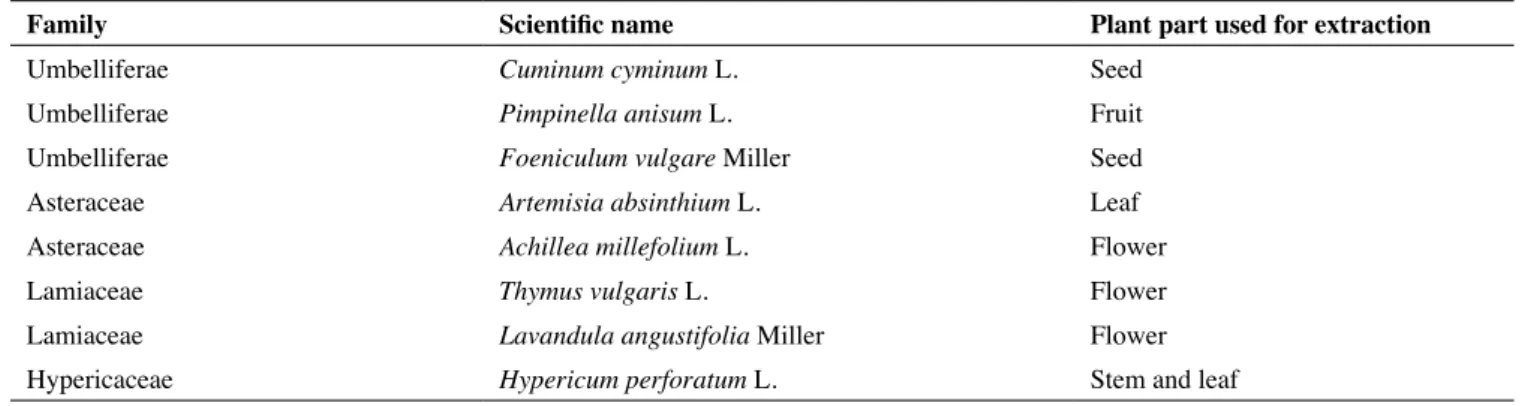
The plant materials used in the present study and specific information on them are presented in Table 1.
Table 1. Specific information on the plants used in the study
Family Scientific name Plant part used for extraction
Umbelliferae Cuminum cyminum L. Seed
Umbelliferae Pimpinella anisum L. Fruit
Umbelliferae Foeniculum vulgare Miller Seed
Asteraceae Artemisia absinthium L. Leaf
Asteraceae Achillea millefolium L. Flower
Lamiaceae Thymus vulgaris L. Flower
Lamiaceae Lavandula angustifolia Miller Flower
For the preparation of the methanol extracts of the plants used in the study, 50 g of each dried plant material crumbled by grinding were weighed and transferred into glass jars and 500 ml of methanol was added to them. The mouth of the jar was covered with aluminium foil and the mixture was waited for 7 days at room temperature by shaking occasionally. At the end of this period, the mixture was filtered through Whatman (no 1) filter paper. By evaporating the methanol of the suspensions in the liquid form obtained with the help of a rotary evaporator, the pure extracts of the plants were obtained. Later, 40% (w/w) stock solutions were prepared from the extracts and by diluting them with 10% acetone (v/v), five concentrations to be used in the study as 5%, 10%, 20%, 30% and 40% (w/w) were made ready. The distilled water containing 10% acetone was used as a control.
Toxicity Studies
In determining the toxicities of plant extracts, 2 different methods, topical application and spraying, were used to the sunn pest adults. In the topical application test, 5 different concentrations prepared from each plant extract were applied to the sternum of the 3rd thorax segment of
sunn pest adults with the help of a microsyringe as 2 µl for each concentration (Zibaee and Bandani, 2009).
It was ensured that the insects remained still during the application by keeping the sunn pest adults at 4°C for 5 min before the extract application. After the topical application, 20 adult individuals along with fresh-leaved wheat stem were placed in the plastic containers (18 x 25 cm) over the cover part of which a transparent cheese cloth was mounted. The experiments were carried out in the climate chamber with the temperature of 26±1°C and 60±10% rate. At the end of 24, 48 and 96 h, the number of the dead and alive adults was recorded. To be able to distinguish the insects pretending to be dead, whether they were alive or not was observed by stimulating the suspected insects with a brush. The accuracy of the counting was made certain by making the dead adult individuals that were taken into a separate container from the trial containers wait for another day. In the spraying assay, 5 concentrations were prepared and sprayed over the 20 adults of the pest in each Petri dish with a spray pressure of 0.8 bar in a way that it would be 2 ml for each concentration with the help of a spray tower (Burkard Manufacturing Co. Ltd. Uxbridge, U.K.). Later, treated adults were transferred to the plastic storage container including fresh wheat, and then the container was placed in the climate chamber. In the counts made after 24, 48 and 96 h, the dead and alive insects were recorded separately. The experiments were replicated for three times.
Data Analysis
The data obtained from the both assays with sunn pest adults were subjected to the probit analysis by using
Polo-PC packaged software (Le Ora Software, 1994) and the LC50 and LC90 values (w/w) and the confidence intervals were determined.
RESULTS AND DISCUSSION
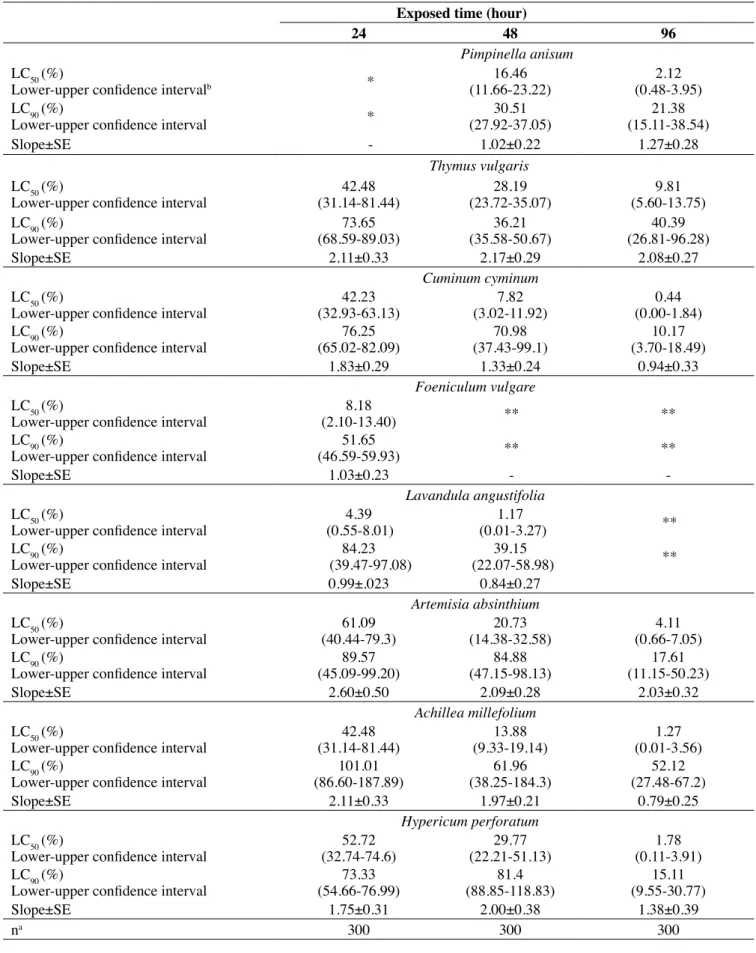
Mortalities of sunn pest adults exposed to the plant extracts in the topical application are presented in Table 2. The rate of mortality increased in parallel with the increasing application time and the increase in the concentration applied. Twenty-four hours after application, L. angustifolia extract demonstrated the lowest LC50 value with 4.39%.
F. vulgare extract occupied the second place and its LC50
value was 8.18%. At the end of 48 h, the lowest LC50 value was calculated to be 1.17% in L. angustifolia extract in topical assays and C. cyminum extract followed it (7.82%).
F. vulgare extract demonstrated high toxicity but its LC50
value could not be calculated. In the study conducted by Ikeura et al. (2012), they reported that the toxicity of the ethanol extract of lavender (Lavandula intermedia L.) plant in the assays with Myzus persicae Sulzer was weak yet its repellent effect was stronger. Their results were different from ours. This could be attributed to different insect species (afid versus sunn pest), as well as different plant species, solvent, concentration and time were used in both studies. Since the contents of the extracts obtained with different solvents are also different, their effects may be different from each other even for the same pest. The LC values were not calculated for F. vulgare extract at the two highest concentrations because of being 100% mortality in topical application after 96 h. The same was also valid for
L. angustifolia extract (Table 2). Taking into toxicities of F. vulgare and L. angustifolia extracts, we can say that these
two plant extracts occupy the first and the second places. Top (2005) reported that F. vulgare extract caused 100% mortality in Anopheles superpictus (Diptera: Culicidae) larvae 2 days after application, and the same extract caused 59.00 and 63.35% mortalities in Culex pipiens (Diptera: Culicidae) and Aedes aegypti (Diptera: Culicidae) larvae, respectively, after 3 days. Al Qahtani et al. (2012) reported that the dry powder extract of F. vulgare had toxic effect against the adults of Oryzaephilus surinamensis (L.) (Coleoptera: Silvanidae) and found its LC50 value to be
0.7 mg g-1. Although F. vulgare extract contains various
compounds, particularly in the phytochemical analysis of the methanol extract of F. vulgare seed, terpenoids, phenolic compounds, flavonoids, saponins, tannins, and amino acids were determined to be the main and effective compounds (Manonmani, 2011). There are various studies on the effects of some of these compounds against various pests (Kim and Ahn, 2001; Kim et al., 2002; Lee, 2004; Conti et al., 2010).
Table 2. LC50 and LC90 values of the test plant extracts against the adults of E. maura after the topical application Exposed time (hour)
24 48 96
Pimpinella anisum LC50 (%)
Lower-upper confidence intervalb * (11.66-23.22)16.46 (0.48-3.95)2.12
LC90 (%)
Lower-upper confidence interval * (27.92-37.05)30.51 (15.11-38.54)21.38
Slope±SE - 1.02±0.22 1.27±0.28
Thymus vulgaris LC50 (%)
Lower-upper confidence interval (31.14-81.44)42.48 (23.72-35.07)28.19 (5.60-13.75)9.81 LC90 (%)
Lower-upper confidence interval (68.59-89.03)73.65 (35.58-50.67)36.21 (26.81-96.28)40.39
Slope±SE 2.11±0.33 2.17±0.29 2.08±0.27
Cuminum cyminum LC50 (%)
Lower-upper confidence interval (32.93-63.13)42.23 (3.02-11.92)7.82 (0.00-1.84)0.44 LC90 (%)
Lower-upper confidence interval (65.02-82.09)76.25 (37.43-99.1)70.98 (3.70-18.49)10.17
Slope±SE 1.83±0.29 1.33±0.24 0.94±0.33
Foeniculum vulgare LC50 (%)
Lower-upper confidence interval (2.10-13.40)8.18 ** **
LC90 (%)
Lower-upper confidence interval (46.59-59.93)51.65 ** **
Slope±SE 1.03±0.23 -
-Lavandula angustifolia LC50 (%)
Lower-upper confidence interval (0.55-8.01)4.39 (0.01-3.27)1.17 **
LC90 (%)
Lower-upper confidence interval (39.47-97.08)84.23 (22.07-58.98)39.15 **
Slope±SE 0.99±.023 0.84±0.27
Artemisia absinthium LC50 (%)
Lower-upper confidence interval (40.44-79.3)61.09 (14.38-32.58)20.73 (0.66-7.05)4.11 LC90 (%)
Lower-upper confidence interval (45.09-99.20)89.57 (47.15-98.13)84.88 (11.15-50.23)17.61
Slope±SE 2.60±0.50 2.09±0.28 2.03±0.32
Achillea millefolium LC50 (%)
Lower-upper confidence interval (31.14-81.44)42.48 (9.33-19.14)13.88 (0.01-3.56)1.27 LC90 (%)
Lower-upper confidence interval (86.60-187.89)101.01 (38.25-184.3)61.96 (27.48-67.2)52.12
Slope±SE 2.11±0.33 1.97±0.21 0.79±0.25
Hypericum perforatum LC50 (%)
Lower-upper confidence interval (32.74-74.6)52.72 (22.21-51.13)29.77 (0.11-3.91)1.78 LC90 (%)
Lower-upper confidence interval (54.66-76.99)73.33 (88.85-118.83)81.4 (9.55-30.77)15.11
Slope±SE 1.75±0.31 2.00±0.38 1.38±0.39
na 300 300 300
*: The assessed LC is very high (The death data obtained are low) **:100% mortality occurred
a :The total number of individuals tested
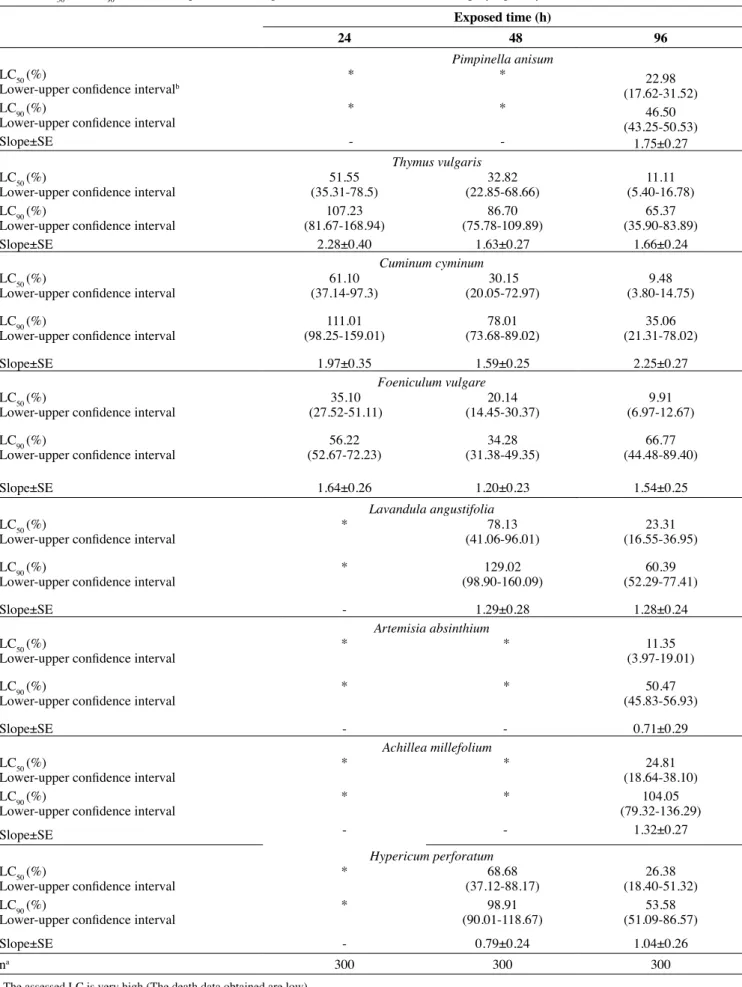
Table 3. LC50 and LC90 values of the plant extracts against the adults of E. maura in the spraying assays Exposed time (h)
24 48 96
Pimpinella anisum
LC50 (%)
Lower-upper confidence intervalb * * 22.98
(17.62-31.52) LC90 (%)
Lower-upper confidence interval * * (43.25-50.53)46.50
Slope±SE - - 1.75±0.27
Thymus vulgaris
LC50 (%)
Lower-upper confidence interval (35.31-78.5)51.55 (22.85-68.66)32.82 (5.40-16.78)11.11 LC90 (%)
Lower-upper confidence interval (81.67-168.94)107.23 (75.78-109.89)86.70 (35.90-83.89)65.37
Slope±SE 2.28±0.40 1.63±0.27 1.66±0.24
Cuminum cyminum
LC50 (%)
Lower-upper confidence interval (37.14-97.3)61.10 (20.05-72.97)30.15 (3.80-14.75)9.48 LC90 (%)
Lower-upper confidence interval (98.25-159.01)111.01 (73.68-89.02)78.01 (21.31-78.02)35.06
Slope±SE 1.97±0.35 1.59±0.25 2.25±0.27
Foeniculum vulgare
LC50 (%)
Lower-upper confidence interval (27.52-51.11)35.10 (14.45-30.37)20.14 (6.97-12.67)9.91 LC90 (%)
Lower-upper confidence interval (52.67-72.23)56.22 (31.38-49.35)34.28 (44.48-89.40)66.77
Slope±SE 1.64±0.26 1.20±0.23 1.54±0.25
Lavandula angustifolia
LC50 (%)
Lower-upper confidence interval * (41.06-96.01)78.13 (16.55-36.95)23.31
LC90 (%)
Lower-upper confidence interval * (98.90-160.09)129.02 (52.29-77.41)60.39
Slope±SE - 1.29±0.28 1.28±0.24
Artemisia absinthium
LC50 (%)
Lower-upper confidence interval * * (3.97-19.01)11.35
LC90 (%)
Lower-upper confidence interval * * (45.83-56.93)50.47
Slope±SE - - 0.71±0.29
Achillea millefolium
LC50 (%)
Lower-upper confidence interval * * (18.64-38.10)24.81
LC90 (%)
Lower-upper confidence interval * * (79.32-136.29)104.05
Slope±SE - - 1.32±0.27
Hypericum perforatum
LC50 (%)
Lower-upper confidence interval * (37.12-88.17)68.68 (18.40-51.32)26.38
LC90 (%)
Lower-upper confidence interval * (90.01-118.67)98.91 (51.09-86.57)53.58
Slope±SE - 0.79±0.24 1.04±0.26
na 300 300 300
*: The assessed LC is very high (The death data obtained are low)
a : The total number of individuals tested
The LC values of the test plant extracts against the adults of European sunn pest and their confidence intervals obtained from the spraying application are presented in Table 3. It was also observed that the mortality rate increased depending on the increasing application time in the spraying application similarly to the topical application. When the mortalities caused by the plant extracts applied with the spraying method 24 h after application were taken into consideration,
F. vulgare extract demonstrated the lowest LC50 value
with 35.10% and T. vulgaris and C. cyminum followed this with 51.55% and 61.10%, respectively.
At the end of 48 h, F. vulgare extract again demonstrated the lowest LC50 value with 20.14% value and this was followed by C. cyminum and T. vulgaris extracts, respectively (30.15%; 32.82%). At the end of 96 h, differently from other application times, the lowest LC50 value was observed in C. cyminum with 9.48% and F. vulgare extract followed this with the value of 9.91%. According to the results of the test carried out by Taş et al. (2015) to determine the contact effect of the methanol extracts of 4 different plant species on the adults of Callosobruchus maculatus (F.) (Coleoptera: Bruchidae) by using the topical application method, the highest mortality ratio was 98.21% in the 16% concentration of C. cyminum extract at the end of 48 h. Although the insect species tested are different, there
is a similarity between these results and the results obtained in our study.
It was observed that F. vulgare extract was quite toxic towards the adults of E. maura in general and demonstrated the insecticidal effect in both application methods. This result shows similarity with the results of the researchers who have previously tested F. vulgare extract on different pests (Kim et al., 2003a; b; Top, 2005; Han et al., 2006; Conti et al., 2010; Zoubiri and Baaliouamer, 2011).
CONCLUSION
As a result of this study, it was put forward that F.
vulgare extract was the most efficient extract in both
application methods in European sunn pest adults. By taking these data into consideration, in the following studies it is necessary to determine the active agent(s) in F. vulgare plant, which have better insecticidal activity, to determine their mode action in the mortality of pests, to develop the formulation type convenient for use, to try it in the field conditions and to carry out studies similar to this. These results will contribute to the development of biopesticides with low or no toxicity to the environment and humans, which can be used instead of synthetic chemicals.
REFERENCES
Al Qahtani AM, Al-Dhafar ZM, Rady MH, 2012. Insecticidal and biochemical effect of some dried plants against Oryzaephilus
surinamensis (Coleoptera-Silvanidae). The Journal of Basic
and Applied Zoology, 65: 88–93.
Avcı M, 2005. Çeşitlilik ve endemizm açısından Türkiye’nin bitki örtüsü. İstanbul Üniversitesi Edebiyat Fakültesi Coğrafya Dergisi, 13: 27-55.
Bashır MH, Gogı MD, Ashfaq M ,Afzal M, Khan MA, Ihsan M, 2013. The efficacy of crude aqueous extracts of some plants as grain protectants against the stored grain mite, Rhizoglyphus
tritici. Turkish Journal of Agriculture and Forestry, 37:
585-594.
Conti B, Canale A, Bertoli A, Gozzini F, Pistelli L, 2010. Essential oil composition and larvicidal activity of six Mediterranean aromatic plants against the mosquito Aedes albopictus (Diptera: Culicidae). Parasitology Research, 107:1455–1461. Critchley BR, 1998. Literature review of sunn pest Eurygaster
integriceps Put. (Hemiptera, Scutelleridae). Crop Protection,
17 (4): 271–287.
Elma FN, 2014. Screening of some medicinal and aromatic plant extracts for their insecticidal efficacies. II. International Conference on Environmental Science and Technology (ICOEST), May 14-17 2014, Antalya.
Elma FN ve Alaoğlu Ö, 2014. Bazı bitki ekstraktlarının Avrupa Sünesi [Eurygaster maura L. (Heteroptera: Scutellaridae)]’nin farklı dönem nimflerine toksik etkileri. Türkiye Entomoloji Dergisi, 38 (2): 181-188.
EPA, 2016. http://www.epa.gov/ingredients-used-pesticide-products/biopesticide-active-ingredients. (Erişim tarihi: 16 Aralık 2016).
Güdek M, Çetin H, 2016. Rosmarinus officinalis L. (Lamiales: Lamiaceae) uçucu yağının Callosobruchus maculatus (Fabricius, 1775) (Coleoptera: Chrysomelidae)’un ergin öncesi dönemlerine karşı fumigant toksisitesi. Türkiye Entomoloji Dergisi, 40 (4): 455-466.
Han MK, Kim S, Ahn YJ, 2006. Insecticidal and antifeedant activities of medicinal plant extracts against Attagenus
unicolor japonicus (Coleoptera: Dermestidae). Journal of
Ikeura H, Kobayashi F, Hayata Y, 2012. Repellent effect of herb extracts on population of wingless Green peach aphid,
Myzus persicae Sulzer (Hemiptera: Aphididae). Journal of
Agricultural Science, 4 (5): 139-144.
Kim DH, Ahn YJ, 2001. Contact and fumigant activities of constituents of Foeniculum vulgare fruit against three coleopteran stored-product insects. Pest Management Science, 57 (3): 301-306.
Kim DH, Kim SI, Chang KS, Ahn YJ, 2002. Repellent activity of constituents identified in Foeniculum vulgare fruit against
Aedes aegypti (Diptera: Culicidae). Journal of Agricultural
and Food Chemistry, 50 (24): 6993-6996.
Kim SI, Park C, Ohh MH, Cho HC, Ahn YJ, 2003a. Contact and fumigant activities of aromatic plant extracts and essential oils against Lasioderma serricorne (Coleoptera: Anobiidae). Journal of Stored Products Research, 39: 11-19.
Kim SI, Roh JY, Kim DH, Lee HS, Ahn YJ, 2003b. Insecticidal activities of aromatic plant extracts and essential oils against
Sitophilus oryzae and Callosobruchus chinensis. Journal of
Stored Products Research, 39: 293-303.
Koçak E, Babaroğlu N, 2005. Orta Anadolu Bölgesi kışlaklarındaki
Eurygaster (Heteroptera: Scutelleridae) türleri [Eurygaster
(Heteroptera: Scutelleridae) species in the winter quarters of the Central Anatolia Region]. Türkiye Entomoloji Dergisi, 29 (4): 301-307.
Koçak E, Çetin G, Hantaş C, 2007. Güney Marmara İlleri Hububat Alanlarındaki Süne (Eurygaster spp., Heteroptera: Scutelleridae) Türleri ve Mücadele Durumu. Uludağ Üniversitesi Ziraat Fakültesi Dergisi, 21(1):43-50.
Kumral NA, Çobanoğlu S, Yalçın C, 2010. Acaricidal, repellent and oviposition deterrent activities of Datura stramonium L. against adult Tetranychus urticae (Koch). Journal Pest Science, 83:173–180.
Lee HS, 2004. Acaricidal activity of constituents identified in
Foeniculum vulgare fruit oil against Dermatophagoides spp.
(Acari: Pyroglyphidae). Journal of Agricultural and Food Chemistry, 52 (10): 2887-2889.
Le Ora Software, 1994. Polo-PC a user’s guide to probit or logit analysis, 1119 Shattuck Avenue, Berkeley, CA, 94707. Manonmani R, 2011. Antibacterial Evaluation and Phytochemical
Analysis of the seed extract of Foeniculum vulgare Mill. Journal of Pharmacy Research, 4(11):4035-4037.
Özkan M, Babaroğlu NE, 2015. Süne. Gıda ve Kontrol Genel Müdürlüğü Yayınları, Ankara. 208 s.
Sagheer M, Hasan M, Najam-ul-Hassan, Farhan M, Ahmad Khan FZ, Rahman A, 2014. Repellent effects of selected medicinal plant extracts against Rust-Red Flour Beetle, Tribolium
castaneum (Herbst) (Coleoptera:Tenebrionidae). Journal of
Entomology and Zoology Studies, 2 (3):107-110.
Soummane H, Larhsini M, Naamani K, Coll J, 2011. Studies of larvicidal and adulticidal activities of some halophyte plant extracts against Ceratitis capitata Wiedemann. Journal of Entomology, 8 (6): 548-556.
Taş MN, Uysal M, Çetin H, 2015. Bazı bitki ekstraktlarının
Callosobruchus maculatus (F.) (Col.:Bruchidae)’e olan
kontakt toksisiteleri. Bitki Koruma Bülteni, 55 (3): 195-205. Top M, 2005. Türkiye’de yetişen bazı bitkilerin biyo-pestisit
özellikleri üzerine araştırmalar. Hacettepe Üniversitesi Fen Bilimleri Enstitüsü, Yüksek lisans tezi, 59s.
TUIK, 2017. www.tuik.gov.tr/PreTablo.do?alt_id=1001, istatistiksel tablolar, tahıllar. (Erişim tarihi: 03 Mart 2017).
Zibaee A, Bandani AR, 2009. Effect of five different type pesticides on the sunn pest, Eurygaster integriceps. Munis Entomology & Zoology, 4 (2):542-550.
Zibaee A, Bandani AR, 2010. A study on the toxicity of a medicinal plant, Artemisia annua L. (Asteracea) extracts to the sunn pest, Eurygaster integriceps Puton (Hemiptera: Scutellaridae). Journal of the Plant Protection Research, 50(1): 79-85. Zoubiri S, Baaliouamer A, 2011. Potentiality of plants as source of