Address for Correspondence: Ceyla Konca Değertekin, Ufuk University Faculty of Medicine,
Department of Endocrinology and Metabolism, Ankara, Turkey
Phone: +90 312 2044000 E-mail: [email protected]
Received: 25/09/2018 Received in revised form: 29/11/2018 Accepted: 12/12/2018 Available online: 20/03/2019
®Copyright 2019 by Turkish Journal of Endocrinology and Metabolism Association Turkish Journal of Endocrinology and Metabolism published by Türkiye Klinikleri
A Bibliometric Analysis of Turkey’s Contribution to
Bone Health Literature from
an Endocrinologist Perspective
Türkiye’nin Kemik Hastalıkları Literatürüne Katkısını
Endokrinolojik Çerçeveden Değerlendiren Bibliyometrik Bir Analiz
Department of Endocrinology and Metabolism, Ufuk University Facuty of Medicine, Ankara, Turkey *Department of Endocrinology and Metabolism, Başkent University Facuty of Medicine, Ankara, Turkey **Department of Endocrinology and Metabolism, Marmara University Facuty of Medicine, İstanbul, TurkeyD O I: 10 .2 51 79 /t je m .2 01 8-62 92 1
Objective: To analyze the trend of Turkish publications
re-lated to bone health with respect to global publications and to determine the relative contribution of endocrinologists to metabolic bone disease literature.
Material and Methods: Publications related to bone health
up to and including the year 2017 were retrieved from the “Web of Science” (WoS) and “Türkiye Atıf Dizini” (TAD) data-base using metabolic bone disease related MeSH terms. Excel (v15.30) and Endnote X8 were used to summarize the bib-liometric features, including the number of publications, au-thors, their affiliations, and contributing countries. Keywords were divided, for a detailed analysis, into three clusters: os-teoporosis, parathyroid, and vitamin D-related.
Results: A total of 1.880.666 papers were retrieved from
WoS globally and, of those, 21.165 (1.13%) were published from Turkey. Of the papers published from Turkey, 3.0% were primarily contributed by endocrinologists. The relative con-tribution of endocrinology to osteoporosis-related (4.6% vs. 1.5%), parathyroid-related (23.7% vs. 5.3%), and vitamin D-related (23.7% vs. 5.3%) publications was higher for arti-cles originating from Turkey compared to the global data. En-docrinology was among the top five specialties contributing to Turkish metabolic bone disease literature indexed in WoS and TAD.
Conclusion: Turkey has a less than expected rate of research
output in terms of metabolic bone disease. The relatively higher contribution of endocrinology to that effort is promising. Sup-porting bone research might accelerate the efforts of Turkish researchers in the field of metabolic bone health.
Keywords: Metabolic bone disease; bibliometric analysis;
Turkey; endocrinology; osteoporosis
Amaç: Bu çalışmada, metabolik kemik hastalıkları konusunda
Türkiye’den yapılmış olan araştırmaların dünya literatürü ile kıyaslandığındaki durumunun ve bu bilimsel üretimde endok-rinologların yerinin değerlendirilmesi amaçlanmıştır.
Gereç ve Yöntemler: 2018 yılına kadar “Web of Science” (WoS)
ve “Türkiye Atıf Dizini” (TAD) veri tabanlarında indekslenmiş yayınlar, metabolik kemik hastalıkları ile ilgili olan MeSH anahtar kelimeleri kullanılarak tarandı. Elde edilen bibliyometrik verileri analiz etmek için Excel (v15.30) and Endnote X8 programları kul-lanıldı ve yayın sayısı, yazar bilgisi, yazarların branş ve kurumları, yayının yapıldığı ülke verileri değerlendirmeye alındı. Anahtar ke-limeler alt gruplara ayrılarak; osteoporoz, paratiroid ve vitamin D ile ilişkili yayınlar olarak da ayrıca incelendi.
Bulgular: WoS veri tabanında tüm dünyadan 1.880.666 yayın
bulunduğu ve bunların 21,165 (%1,13)’inin Türkiye’den yapıldığı ve Türkiye’den yapılan yayınların %3,0’ının da endokrinologlar tarafından yönetildiği bulundu. Osteoporoz (%4,6’ta karşı %1,5), paratiroid (%23,7’ye karşı %5,3) ve vitamin D ilişki (%23.7 vs. %5.3) olarak tanımlanan yayınlarda endokrinologların katkısının Türkiye için tüm dünya rakamlarının üzerinde olduğu görüldü. Hem WoS hem de TAD veri tabanlarında endokrinolojinin, me-tabolik kemik hastalıkları literatürüne en çok katkı yapan ilk beş branş içerisinde olduğu saptandı.
Sonuç: Türkiye’den metabolik kemik hastalıkları konusunda
yapılan toplam yayın sayısının beklenenin altında olduğu düşünülmektedir. Bu bilimsel üretimde endokrinologların hatırı sayılır bir katkısı var gibi durmakla birlikte, metabolik kemik hastalıkları araştırmalarına endokrinoloji camiası başta olmak üzere ilgili tüm branşların vereceği bilimsel desteğin artırılmasının yayın sayısı ve kalitesinin yükseltilmesinde önemli rol oynayacağı görüşündeyiz.
Anahtar kelimeler: Metabolik kemik hastalıkları;
bibliyometrik analiz; Türkiye; endokrinoloji; osteoporoz
The content of this manuscript had been presented as an oral presentation at the 40thTurkish Congress of Endocrinology and Metabolism (09-13.05.2018)
Introduction
Metabolic bone health is an important but often neglected area in daily medical prac-tice. The growing burden of osteoporosis due to the aging of the population and very high prevalence of hypovitaminosis-D alarm that proper steps should be taken for the benefit of public health. The data for this ac-tion plan are derived from the research lit-erature. Thus, the structured knowledge of the current literature on bone health is cru-cial for planning future scientific efforts. Bibliometric analysis is a helpful tool for ob-taining information regarding the current state of research in different areas of medi-cine. It could reveal the research trend in a certain field and evaluate academic produc-tion of a country or certain specialty or even individual researchers(1).
Owing to the multifunctional dynamics of the bone tissue, the term “metabolic bone disease” covers a broad spectrum of dis-eases that are related to many different spe-cialties in medicine. We, as endocrinologists, are one of the core specialists working in the field of metabolic bone health.
Therefore, in this study, we aimed to analyze the scientific output on metabolic bone dis-eases in our country (Turkey), along with the subspecialty, endocrinology, in comparison to global trends through a bibliometric approach. Material and Methods
A bibliometric analysis was performed using the ISI Web of Science (WoS) and “Türkiye Atıf Dizini” (TAD). Endnote X8 was used for WoS database analysis. The time period for data analysis was considered up to and including 2017. The publications from 2018 were not in-cluded due to incomplete availability at the time of analysis. The search terms were based on Medical Subject Headings (MeSH) terms on WoS and the corresponding Turkish transla-tions for TAD. The MeSH terms were inserted into the search field to perform a ‘‘topic’’ search. The search terms were as follows:
theme=(“Bisphosphonate” [MeSH] OR
“Bone” [MeSH] OR “Bone fracture” [MeSH] OR ”Bone mineral density” [MeSH] OR “Cal-cium” [MeSH] OR “Denosumab” [MeSH] OR “Hyperparathyroidism” [MeSH] OR “Hy-poparathyroidism” [MeSH] OR “Hypophos-phatemia” [MeSH] OR “Osteoblast” [MeSH] OR “Osteocalcin” [MeSH] OR “Osteoclast”
[MeSH] OR “Osteogenesis imperfecta” [MeSH] OR “Osteomalacia” [MeSH] OR “Os-teoporosis” [MeSH] OR “Osteoprotegerin” [MeSH] OR “Paget disease of bone” [MeSH] OR “Parathyroid” [MeSH] OR “RANK” [MeSH] OR “Rickets” [MeSH] OR “Teri-paratide” [MeSH] OR “Vitamin D” [MeSH])
The topic search was then subdivided into three clusters for theme MeSH terms for a detailed analysis for “osteoporosis-related”, “parathyroid-related” and “vitamin D-re-lated” papers as follows:
Osteoporosis-related: theme= (”Osteo-porosis” [MeSH] OR “Bone mineral density” [MeSH] OR “Calcium” [MeSH] OR “Teri-paratide” [MeSH] OR “Bisphosphonate” [MeSH] OR “Denosumab” [MeSH] OR “Bone fracture” [MeSH])
Parathyroid-related: theme=
(”Hyper-parathyroidism” [MeSH] OR “Hypoparathy-roidism” [MeSH] OR “Hypophosphatemia”
[MeSH] OR “Parathyroid” [MeSH])
Vitamin D-related: theme= (”Vitamin D” [MeSH] OR “Osteomalacia” [MeSH] OR “Rickets” [MeSH])
We refined the search for Turkey by using “Turkey” in the country keyword followed by the aforementioned MeSH terms as a search topic.
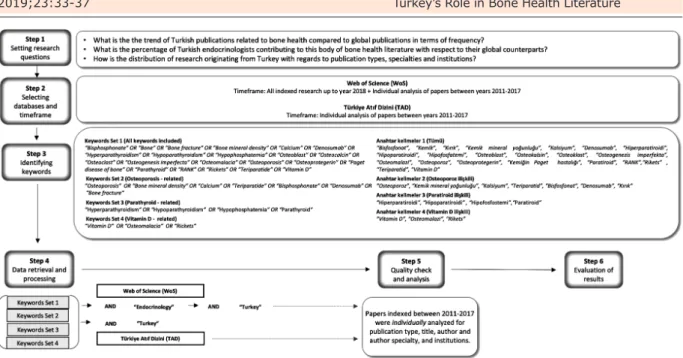
All types of publications were included in the analysis. For simplification of categorization, publications were classified into four groups: original articles, reviews, case reports and short reports (including editorials, letter to the editors, others…). No language restric-tions were employed. The outcome variables included document type, country of origin, publication date, source title, authors and authors’ specialty, and institutions. The data were retrieved from WoS and TAD databases were imported into Microsoft Excel for analy-sis. The researchers manually cleaned and analyzed the data in Excel and compiled the following information: (a) total number of papers published globally and from Turkey; (b) relative contribution of endocrinologists to research productivity globally and from Turkey; (c) detailed analysis of specialties’ contributions to papers indexed in WoS and from Turkey between years 2011–2017. A flowchart summarizing the production steps is given in Figure 1. The study was carried out in accordance with the principles of the Declaration of Helsinki.
Figure 1: The stepwise approach applied in this study.
Results
The total number of documents retrieved from WoS in the field of metabolic bone dis-ease up to and including the year 2017 was 1,880,666, without specifying the name of any country. When “Turkey” was used as a county code, the number of articles re-trieved at the same time period was 21,165, which was 1.13% of the global research pro-ductivity related to metabolic bone disease. The first article published globally on meta-bolic bone disease was in 1784 at London Medical Journal and the oldest Turkish arti-cle dated back to 1987 and was published in Archives of Otorhinolaryngology.
Among the documents published globally, 20,699 (1.1%) were leaded by specialists in endocrinology, while 644 (3.0%) of the pa-pers published from Turkey were leaded by endocrinologist. Clustering of the keywords retrieved that, of the 817,007 “osteoporo-sis-related” publications worldwide, 12,376 (1.5%) were primarily led by endocrinolo-gists while the relative contribution of endocrinology was higher for parathyroid-related [2,532 (5.3%) out of 47,892) and vitamin D-related [4,405 (5.3%) out of 83,514] publications. When the same analy-sis was applied to papers from Turkey, the relative contribution of endocrinologists was 4.6% (330 out of 7,146) for
osteoporosis-related, 23.7% (129 out of 545) for parathy-roid-related, and 18.4% (207 out of 1,127) for vitamin D-related publications.
When the research output from Turkey in-dexed in WoS between years 2011–2017 was examined in more detail, we had a clear picture on the distribution of specialties and types of articles. The top five research spe-cialties in the 1334 documents on metabolic bone diseases published from Turkey were Internal Medicine (n=241, 18.0%; including Internal Medicine subspecialties such as en-docrinology), Dentistry (n=217, 16.3%), Pediatrics (n=214, 16.0%), Orthopedics (n=112, 8.4%), and Physical Therapy and Rehabilitation (n=98, 7.4%) while the stand-alone contribution of Endocrinology was 6.8% (n=90). The majority of the arti-cles published from Turkey during that time period were original articles (n=1,058, 78.8%), followed by case reports (n=192, 14.3%), short reports (n=64, 4.8%), and reviews (n=28, 2.1%).
We performed a similar kind of analysis for TAD for publications originating from Turkey between years 2011-2017 and retrieved 628 publications. The top five research special-ties were Physical Therapy and Rehabilita-tion (n=151, 24.0%), Pediatrics (n=89, 14.2%), Endocrinology (n=79, 12.6%), Bio-chemistry (n=31, 4.9%), and Orthopedics
(n=30, 4.8%). The type of article distribu-tion was as follows: original articles (n=319, 50.8%), reviews (n=201, 32.0%), and case reports (n=108, 17.2%).
Discussion
In this study, we investigated the global and local trends in metabolic bone disease liter-ature with respect to the role of endocrinol-ogy. We preferred WoS database owing to its high volume and coverage for mining worldwide data and TAD for analyzing local publication trends. Although the quality and quantity of research indexed might differ from one database to another, WoS remains one of the best available tools for analyzing global data.
Bibliometric analysis is one of the ways to evaluate the research performance on a specific area of medicine or to analyze the rate and quality of scientific output of a cer-tain group of researchers. We believe that it is vital for the medical authorities of a country to know where they stand in the area of scientific production in order to re-fine where they should head to in the fu-ture. That information gained from the bibliometric analysis may even be used to formulate policy regarding research fund-ing (1).
Our analysis showed that Turkey has a sta-ble but low level of contribution to meta-bolic bone disease literature. To the best of our knowledge, this is the first bibliometric study from Turkey on metabolic bone health. A comprehensive bibliographic analysis by Sweileh et al. analyzed the re-search trends in the field of osteoporosis in 21 Arab countries and 3 Middle Eastern non-Arab countries, including Israel, Turkey, and Iran (2). They found that the leading country in osteoporosis research was the United States of America, which contributed to 33.82% of all publications. They also found that Turkey ranked 16th while Israel and Iran ranked 24th and 31st, respectively, in terms of rate of total publi-cation in osteoporosis research. It is well known that the rate and quality of scientific research is a direct reflection of gross do-mestic product (GDP) per capita of a coun-try and the share of GDP spent on research and development(3). Thus, funding issues, scarcity of translational laboratory setups,
and lack of scientific collaborations might be the underlying issues responsible for the less-than-expected publication production rate in our country.
We also investigated to what extend the Turkish endocrinologists have contributed to the analyzed field of research. The rate of Turkish endocrinologist leading the publica-tions was similar to the global rates.
How-ever, when the publications were
sub-classified, the contribution of endocri-nologist was higher for osteoporosis-related articles and even higher for parathyroid-re-lated and vitamin D-reparathyroid-re-lated articles.
A more detailed analysis showed that the most frequent article type submitted from Turkey was original articles and specialties as dentistry and physical therapy and reha-bilitation made significant contributions.
Study Limitations
Since the detection of publications was MeSH term based, inappropriate choices of keywords might misclassify the papers. Most of the publications involved a collabo-ration of researchers from different special-ties. To enable a specialty classification for publications, only the first author’s specialty was considered in the analysis. Incomplete description of the affiliation might have led to errors of specialty classification.
Articles published in non-WoS and non-TAD journals were not included.
Conclusion
Turkey has a low rate of research output in terms of metabolic bone disease. The rela-tively higher contribution of endocrinology to that effort is promising. We would like to suggest that supporting research with inter-national and inter-national collaborations and yielding higher impact articles might accel-erate the efforts of Turkish researchers in the field of metabolic bone health.
Source of Finance
During this study, no financial or spiritual support was received either from any phar-maceutical company that has a direct con-nection with the research subject or from a company that provides or produces medical instruments and materials which may nega-tively affect the evaluation process of this study.
Conflict of Interest
There is no conflict of interest to disclose be-tween the authors and/or family members of the scientific and medical committee members or members of the potential con-flicts of interest, counseling, expertise, working conditions, shareholding and similar situations in any firm.
Authorship Contributions
Idea/Concept: Ceyla Konca Değertekin, Özlem Turhan İyidir, Dilek Gogas Yavuz; De-sign: Ceyla Konca Değertekin, Özlem Turhan İyidir, Dilek Gogas Yavuz; Control/Supervi-sion: Ceyla Konca Değertekin, Özlem Turhan İyidir, Dilek Gogas Yavuz; Data Collection and/or Processing: Ceyla Konca Değertekin, Özlem Turhan İyidir, Dilek Gogas Yavuz; Analysis and/or Interpretation: Ceyla Konca Değertekin, Özlem Turhan İyidir, Dilek Gogas Yavuz; Literature Review: Ceyla Konca Değertekin, Özlem Turhan İyidir, Dilek Gogas
Yavuz; Writing the Article: Ceyla Konca Değertekin, Özlem Turhan İyidir, Dilek Gogas Yavuz; Critical Review: Ceyla Konca Değertekin, Özlem Turhan İyidir, Dilek Gogas Yavuz; References and Funding: Ceyla Konca Değertekin, Özlem Turhan İyidir, Dilek Gogas Yavuz; Materials: Ceyla Konca Değertekin, Özlem Turhan İyidir, Dilek Gogas Yavuz. References
1. Brüggmann D, Mäule LS, Klingelhöfer D, Schöffel N, Gerber A, Jaque JM, Groneberg DA. Groneberg. World-wide architecture of osteoporosis research: density-equalizing mapping studies and gender analysis. Climacteric. 2016;19:463-470.[Crossref] [PubMed]
2. Sweileh WM, Al-Jabi SW, Zyoud SH, Sawalha AF, Ghanim MA. Osteoporosis is a neglected health pri-ority in Arab World: a comparative bibliometric analysis. Springerplus. 2014;3:427. [Crossref] [PubMed]
3. Jamjoom BA, Jamjoom AB. Impact of country-spe-cific characteristics on scientific productivity in clin-ical neurology research. eNeurologicalSci. 2016;4:1-3.[Crossref] [PubMed]