A.
V.
Veteriner FakültesiSu (Jrünleri, Balıkçılık ve Av Hayvanları Kürsüsü Prof. Dr. Zihni Erençin
INVESTIGATION OF FISH PARASıTES AS AN IMPORTANT
SOURCE OF INFORMATION ABOUT THE BIOTOP OF
THE FISHES*.
Gü1ten Köksal
**
Summary: In summer 1978, a total of 66fish specimens were exa-mined parasitologıcally which were rainbow trout, brown trout and chub.
Totaly 16species
OJ
parasites were found. The dependence of the diffe-rent parasite species on the biotop of their Izosts were discussed.Özet: Balıkların yaşadığı alanların (biyotop) özellikleri açısından balık parazitleri üzerinde incelemeler.
1978 yılının yazında Yukarı Avusturya bölgesindekifarklı su ünitelerinde (göl, gölet, kanal, çay) bulunan bazı balık türleri üzerinde parazitolojik in-celemeler yapılmıştır. Bu balık türleri: Gökkuşağı alası (Salmo gairdneri Richardson, 1836), dere alası (Salmo trutta formo fario LiNNE, 1758),
göl alası (Salmo trutta formo lacustris LiNNE, 1758) ve tatlı su kefali (Leuciscus cephalus L1NNE, i758) dır.
Toplam 66 balık açılmış, i6 paradt türü saptanmıştır. Bazı parazit invasyonlarının, bu balık türlerinin, yafadığı ortama-biyotop alanına-bağlı i olduğu gö'rülmüf ve bıı parazitlerin konak(ının yaşadığı alanın (biyotop) özel-liklerini belirtebileceği üzerined tartışmalar yapılmı~.tır.
* This study was carried out in Federal Institute of Freshwater Research and Fis. heries during the Intemationale Post-Craduate Limnology Course in i978-Austria.
** Dr., Department of Water Products, Fishery and Wild Life. Yetermary of Fa. culty, Ankara Üniversİt , Turkey.
274 Gültcn Köksal
Introduction
Parasitation was represented among the three fish speeies ın this survey. These three fish species, chub, rainbow trout and brown trout (lake and river form) have a wide ecological range whieh ref-Icct~ on the parasite fauna of fishes.
Brown trout (Salmo trutta formo fario LINNE, 1758) oceurs in rivers, brooks and streams witlı steep gradients and rapid-incons-tant currents. Strcam bed is rocky and sandy. The width and depth are variable, often quite shalIow. The waters are eool, oIigotrophie and saturated wİth oxygen (trout zones). l\1acroinvertebrate faurıa of the trout zones are Eplıemeroptera, Coleoptera, Triehoptcra, Diptera, MolImea, Hirudinea and Nematada (2 ı).
Rainbow trout (Salmo gairdneri Richardson, 1836) also oeeurs in cIear rivers and stream, partieularly near the outIets of lakes and below watcrfalIs or tlıe rapids (trout zones). Adult rainbow trauts feed mainıyon aquatie inseets larvae (black fIies), Molluses, Crusta-eeans and oeeasionall y smail fishes (14, 2i ) .
Brown trout can tolerate the water quality II-III and rainbow trout can tolerate the water quality up to III. GeneralIy rainbow trouts are more resistant to a variety of environmental stress and 01'-ganie poIlution than brown traut (20).
Chub (Leueiscus eephalus LtNNE, 1758) lives in lakes and in low land river systems (barbel zone). The charaeteristie features of this zone: Volume of the water is high, redueed current, wide tem-perature range and relatively low oxygen conditions and depasition of silt on the river bed. Mainly macroinvertebrate fauna of this re-gion are Ephemera (MayfIy), OEgoehaeta worms, Molluses, Crus-taeeam (21).
Chub feeds mainıyon invertebrate food whieh is taken from the substrate. Generally ehub is adaptable in its feeding habits. They have a wide range eoneerning food items but vegetable materials and aquatie insect larvae are predominant. Composition of the food of ehub changes with age and season. Young ehub prefers plants
Investıgalıon Of Fısh Parasitcs As An Important ... 275
and insect larvae (Trichoptera) and aerial insects. Older chub con-sumes less vegetation and more fish, frogs and crayfish (7, 15). They can tolerate the water quality III (20).
Materials And Methods
Fİsh speeimens were eollected from different plaees in the Up-'per and Lower Austria by cleetrofiseher. Fish from Almsee and
Mond-see were eaught by angling.
MONDSEE is an cutrophie lake İn the pre-alpine area of the Upper Austria (Altitude: 481 m.; surfaee arca: 14.21 km2;
maxi-mum depth: 68 m.). Fish fauna consists mainly of eyprinids and salmonicls. The main macroinvertebrate fauna of Mondsee are Amp-hipods (Gammarus sp., Asellus sp.) Oligochaeta, Triehoptera, Psi-dium sp., Planorbis sp.) (9, 12).
ALMSEE is a sm all lake in the Upper Austria (Altitudc: 589 m.; surfaee area: 0,7 km2; maximum depth: 5-6 m.). Almsee is not
a lake in the limnologieal meaning of word. There is no stratificati-on and the water body changes about every three days. This lake is oligotrophie with water quality i. The fish fauna of this lake consist mainly salmonids (18).
SCHARFLİNGER BACH has a slowly runing water. The wa-ter discharge is about 3-4 i/see minumum and 200 i "see maximum. Water quality is I-II. This brook has a high food capaeity such as amphipods and inseet larvae (mainly Trichoptera). Salmonids li-ves 111 the middle part and eyprinids (mainly chub) especially 111 the lower part of this brook (I 8).
INNBACH is a tributary of the Danube in the Upper Austria. The water is rather polluted with domestic sewage. Water quality ranges between II-III. The fish fauna of this river are mainly eyp-rinids, although we found two brown trouts (Salma trutta formo lacustris) in our catching period. These two fish came obviously from the backwater of the power plant OTTENSHEIM on the Da-nube which is stoeked with this speeies. All exarrıined fish were ca-ught in the lower part of Innbach (within 500 m. from the mouth
276 Gülten Köksal
of the Danube). The maeroİnvertebrate fauna of this river consists mainly of Gammarus sp., Ephemeroptera and Trichoptera (18).
TRAISENWERKSKANAL is an old mill strcam in the lower Austria. It is polluted with domestie sewage and industrial waste water. Water quality İs II-III. It has a high food eapaeity for trout. The macroinvertebrate fauna of this river is eomposed mainly of Gammarus sp. and Trichoptera larvae (18).
WANGAUAR ACHE is a small river in the Upper Austrİa, quite shallow and runs İnto the Mondsee. Water yuality is I-II. The fish produetion is rather high. The maeroinvertebrate fauna is eom-posed mainly of Gammarus sp., Ephemeroptera, Trİchoptera, Bithy-nia and Leptoeerus sp. (3). The fİsh fauna of this brook eonsists ma-İnly of trout and Cottus gobİo. Chub is found in the lower part of this brook (18). They were caught about 50-100 meters far from the Mondsee.
Fİrst, all fİshes wcre controlled for external parasİtes. At the same time skin-scrapİng was examined microscopically. Internal or-gans and giIls were remove d and put in 0.75
%
NaCl solution sepa-ra'tely. They were examined under the binocular mieroscope as a fresh material.The stomaeh contents were analysed at several levels magnifİ-cation and food items present were identifİed.
For identification of parasites spccics the following techniques were used:
Octomitus, Ichthyophthirİus, Gyrodactylus sp., Dactylogyrus sp. were identified İn natiye preparation. Acanthocephala, Nemato-da and Argulus were transferred to glyeerine-alcohol.
Myxobulus spores were stained in Lugol solution.
Representative specimens of the Digenea, Castoda and Aean-thocephala were stained (Digenea and Aeanthoeephala in GRENAC-HER'S borax earmine, Cestodes in alanin earmine) and mounted in Canada balsam.
Investıgatıon Of Fısh Parasites As An Important ..•
Result An Discussion
277
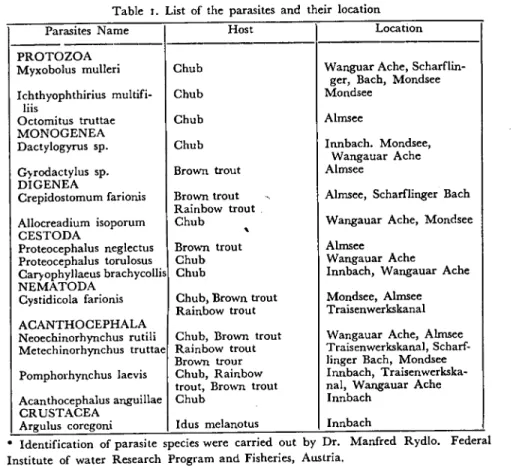
The results have been summarized in following table. Totally 16 parasite species were identifİed. and recorded.
Table i. List of the parasites and their location
Parasites Name Host Location
PROTOZOA
Myxobolus muııeri Chub Wanguar Ache, Scharflin-ger, Baclı, Mondsee Ichthyophthirius multifi- Chub Mondsee
liis
Octomitus truttae Chub Almsee
MONOGENEA
Dactylogyrus sp. Chub Innbach. Mondsee, Wangauar Ache Gyrodactylus sp. Brown trout Almsee
DIGENEA
Crepidostomum farionis Brown trout , Almsee, Scharflinger Bach Rainbow trout
Aııocreadium isoporum Chub Wangauar Ache, Mondsee
CESTODA
,
Proteocephalus neglectus Brown trout Almsee
Proteocephalus torulosus Chub Wangauar Ache
Caryophyııaeus brachycollis Chub Innbach, Wangauar Ache NEMATODA
Cystidicola farionis Chub, Brown trout Mondsee, Almsee Rainbow trout TraisenwerkskanaI ACANTHOCEPHALA
Neoechinorhynchus rutili Chub, Brown trout Wangauar Ache, Almsee Metechinorhynchus truttae Rainbow trout Traisenwerkskanal,
Scharf-Brown trour linger Bach, Mondsee Pomphorhynchus Iaevis Chub, Rainbow Innbach,
Traisenwerkska-trout, Brown trout nal, Wangauar Ache Acanthocephalus anguillae Chub Innbach
CRUSTACEA
Argulus corcgoni Idus mclanotus Innbach
• Identification of parasite spccies were carried out by Dr. Manfred Rydlo. Federal Institute of water Research Program and Fisheries, Austria.
Some classes of parasites such as Flagellata, Ciliate, most Sporo-zoa, Monogenea and Crustacea have a direct development without intermediate host (14.). They show no-dependence on the food com-pasition of their host.
The parasite species of the class Digenea, Cestoda Nematoda and Acanthocephala have one or two intermediate hosts within their life cycle (I, 4)' Therefore the occurance of these parasites shows dependence on the invertebrate fauna within the host biotop.
Thus the occurance and degree of the infestation with these parasite sııecies can serve as an aux.iliary indicator of the host'sbiology.
278 GüItcn Köksal
The incidenee of Crepidostomum farionis in brown trout and rainbow trout shows some indieations of the host biotop.
In our study this parasite was found only in dear and oligot-rophie water bodies such as Almsee and Seharflinger Baeh, The inter-mediate hosts of this parasite are molluses (Pisidium amnium, Sp-haerium eomeum) and amphipods (Gammarus pulex). First inter-mediate hosts, molluses oeeurs in the trout and grayling reagion (4, 2ı). They can tolcrate water guality II and III (20). The second intermediate host, G. pulex is the eommon speeies in streams, lakes oecasionally in subterranean habitats. Its distribution extends to mountain streams. It can toIerate water quality i to III (20).
Thus the great intensity of infestation with Crepidestomum farionis in brown trout and rainbown trout showcd the importanee of G. pulcx as a food item in Almsee and Seharflinger Baeh.'
On the other hand the stomaeh~ eontent of fishes from Scharf-linger Baeh eonsisted mainly of Gammarus sp., Inseets, Oligoeha-etes, Gordius and snails. The examined fish from Almsee had empty stomaeh. Beeause they had to be kept in the ehanneI after eatehing in two days.
MargoI:s (I 6) also informed that the incidence of Crcpidosto-mum farionis in young soekeye salmon indieates uptake of benthie organisms by young soekeye salmon.
According to Scott (ıg) the incidenee of trematode (Dcroge-nes varieus) parasites of American plaiee (flat fish) has increased due to change of diet within the host's lifetime.
In our study, Pomphorhynehus lacvis and Meteehinorhynehus truttae were found in ehub, brown trout and rainbow trout from different loealities. The intermediate host of these parasites is G. pu-lex (4). Therefore, the oeeurence of these parasites showed dep en-denee on the G. pulcx within the host biotop.
Hine and Kennedy (8) informed that dispersion of P. laevis within the fish population was rclated to host feeding behaviour (hig-her rate of infestation in older fish).
Alloereadium isoporum was found in the ehub whieh lives in lakes and slowly running water (outlet to the Mondsee). The inter-mediate host of this parasite is moIluse (Sphaerium sp.) and mayfl)' larvae (Ephemera) (I 7). MayfIy larvae, living along the shores of
InnstıgnllOn Of F.,h Parasites As An Imporlont ... 279
lakes and in stream (sandy and silted bottom) are the food items of the chub (I ı). More like that A. isopoÇum may show also seaso-nality incidence depending on mayfly larvae.
The infestation of Proteocephalus torulosus in chub from vVan-gauar Ache (running water) indicated that the host had spent at least a part of its life in Mondsee ,ince the intel'mediate host, eope-pod (Diaptomus castor, Cyelops strenuus, eyelops serrulatııs) is restricted to a lake biotop (Io, ı7).
Margolis, (ı6) informs that Proteocephalus sp. oeeurs eommonly in soekeye salmon. These parasitologieal charaeteristics refleet the imporüı.nee of planktonic eopepods in the diet of young soekeye sal-mon during their lake res;dencc sinee these parasites utilize cyelo-pid and diaptomid eopepods as interınediate host.
In our study, Caryophyllaeus brachyeoııis was found only in chub from Innbaeh and Wangaııar Achc. The intermediate host, oligoehaeta (Limnodrilus hoffmeisteri) is the eommon speeies and abundant in ffeshwater, but often in pollııted water together with Tubifex tubifex (2). It can tolerate water qııality III to LV (20).
Thus this parasite was faund Innbach whieh is rather polluted by domestic sewage. Water quaiity ranges between II to III. Sto-mach content of fishes from Wangauar Aehe and Innbach consis-ted mainly rest of the aquatic earthworms, imeet larvae (Ephemera, Trichoptera) and water plants.
Cystidieola farionis is rather ubiquitoııs due to a great ecolo-gical range of its intermediate host vvhich İs G. pulex.
N. rutili was found in brown trout from Almsee and in chub from Wangauar Ache. The intermediate host of this parasite is the larvae of Sialis sp. (17). The Sialis 5p. larvae lives in littoral, sublit-toral and sametimes in the profundal zones of lakes, pands, slııggish streams and rivers where silt is abundant (S). It can tolerate water guality II to III (20). Thefefore this parasite mainly were found in fishes from slowly running water bodİes with muddy bottom such as Wangauar Aehe and Almsee.
Acanthocephalus anguillae was found in chub from Innbaclı. The intermedİate host, Asellus aquaticus lives İn elear runnİng wa-ter and also stagnant polluted water (6, 17), but espeeİally livcs abun-dantly in water quality III such as Innbaeh.
280 Gülten Köksal
As a result the occurence of the most parasites in different fish spceies showed dependence on the food composition and ecological factors of host biotop.
References
1- Bauer, O. N. (1965): Parasites of Freshwater Fish end the Biological Basis for Their Control. Israel Program for Scientific Translation, .Jerusalem.
2- Brınkhurst, R. O. (I971): A Guide for Idelltijication of British
Aquatic Oligochaeta. Freshwater Biol. A5S. Scientific Pub. No. 22.
3- Butz, I. (I 978): Personel Communication. Federal Institute of Water Reserach Program and Fisheries, Austria.
4- Bykhovskaym-Pavlovskaya, I. E. et aI. (1964): Key to Para-sites rif Freshwater Fish
Q!
the U.S.S.R. Isracl Program for Scien-tific Translation,J
arusalem.5- Ellıot, J. M. (1977): A Key to British Freshwater Megaloptera and Neuroptera. Freshwater Biol. Ass. Scientific Pub. No. 35. 6- Gledhıll, T. et aI. (1976): Key to British Freshwater Crustacea:
Malawstraca. Freshwater Biol. Ass. Scientific Pub. No. 32.
7- HellaweII, J. M. (I97I): The Autecology rif the Chub, Squalis cep-halus (L) of the River Lugg and the Afon Llynfi. Freshwat. BioL. 3, 369-387.
8- Hıne, P. M., C. R. ~ennedy. (1974): The Population Biology of the Acallthocephalan and Pomphorhynchus laevis (Müller) in River Avon.
J.
Fish Biol. 6 (5), 665-679.9- Jagsch, A. (1978): Personel Communication. Federal Institute of Water Research Program and Fisheries, Austria.
10- ~ıefer, F. (1960): Rudeifuss Krebse (Copepoden). Kosmos-Ver-lag, Franckh-Stuttgart.
i1- ~ınnııns, D. E. (1972): A Revisu! Key to the Adults of the Bri-tish Species of Ephemeroptera with Notes on Their Ecology. Freshwater Biol. Ass. Scientific Pub. No. 15.
12- Lıepolt, R. (I935): Limnologische Unter Suchungen der ufer und Tiifen fauna des Mondsee dessen stellung zur Seetypenfrage. Intema-tİonale Revue der Gesamten Hydrobiologie und Hydrophie Band. 32.
Investıgatıon Of Fısh Parasites As An Important ... 281
13- Macan,
T. T.
(1963): Freshwaler Ecology. Grcat Britain. 14- McPhall,J.
D., C. C. Lmdsey. (1970): Freshwaler Fish ojNorth-weslern Canada and Alaska.
J.
Fish. Res. Board Can. Bulletin 173. 15- Mann, R. H. K. (1975): Observation on the Age, Growth,Repro-duction andjooe ojChub Squalis cephalus (L) in the River Stour, Dor-set.
J.
Fish BioI. 8, 265-268.16- Margolls, L. (I 965) :Parasites as an Auxilliary Source oj lıiforma-tion about the Biology oj Pacific Salmons (Genus Oncorhynchus).
J.
Fish. Res. Board Can. 22, 6.17- Markevıch, A. P. (1951): Parasitic Fauna oj Freshwater jish oj the Ukrainian SSR. Academy of Sciencc of Urainian.
18- Rydlo, M. (1978): Personel Communication Federal Institute of Water Research Program and Fisheries, Austria.
19- Scott,
J.
S. (1975): Incidence of trematode parasites oj American pla-ice (Hippoglossioides platessoides) oj the Scotian Shelj and Gulj~f
St. Lawrence in relation to jish length and jooe. Fish. Res. Board Can.32 (4), 479-483'
20- Sladecek, V. (1973): System oj Water Ouality from the Biological Point oj View. Arch. Hydrobiologie. Beiheft 7. Ed. by Elster, H.J. and Ohle, W.
21- Whıtton, B. A. (1975): River Ecology. Blackwell Scientific Publications, Oxford.