Screening effects on the confined and interface polarons in cylindrical quantum wires
B. Tanatar and K. Gu¨venDepartment of Physics, Bilkent University, Bilkent, 06533 Ankara, Turkey C. R. Bennett and N. C. Constantinou
Department of Physics, University of Essex, Colchester, CO4 3SQ, England ~Received 6 November 1995!
We study the contribution of confined and interface phonons to the polaron energy in quantum-well wires. We use a dispersionless, macroscopic continuum model to describe the phonon confinement in quantum wires of circular cross section. Surface phonon modes of a free-standing wire and interface phonon modes of a wire embedded in a dielectric material are also considered. Polaron energy is calculated by variationally incorpo-rating the dynamic screening effects. We find that the confined and interface phonon contribution to the polaron energy is comparable to that of bulk phonons in the density range N5105–107 cm21. Screening effects within the random-phase approximation significantly reduce the electron-confined phonon interaction, whereas the exchange-correlation contribution tends to oppose this trend at lower densities.
I. INTRODUCTION
The study of quasi-one-dimensional ~Q1D! semiconduc-tor structures has been an intense field of study in recent years. As the carrier motion is quantized in the transverse directions, these systems exhibit one-dimensional character-istics along the free direction. Their restricted phase space gives rise to many interesting physical phenomena and opens up possibilities for high-speed device applications. Progress and developments in the fabrication techniques such as molecular-beam epitaxy and lithographic deposition have made possible the realization of such Q1D systems.1
In low-dimensional semiconducting structures, the inter-action strength of electrons with LO phonons is strongly af-fected by phonon confinement, as well as by the changes in the electronic wave function brought about by the confining potential. Phonon confinement causes changes in the electron-phonon interaction, modifying properties such as scattering and relaxation rates compared with the bulk pho-non case. Similarly, phopho-non modes such as those that occur in the interfaces of heterostructures are also found to exhibit properties different from those of the bulk. Stroscio and co-workers2have applied the dielectric continuum model to describe the confined LO phonons in rectangular quantum wires. The application of the dielectric continuum model to rectangular wires is, however, rather more involved leading to ‘‘edge’’ modes, which are important in electron-phonon interactions~see Ref. 3 for a more detailed discussion!. For wires with circular and elliptical cross sections Laplace’s equation is separable and standard techniques can then be employed to discuss both interface and confined modes within the dielectric continuum model.3,4Confined and inter-face phonon modes in cylindrical quantum wires were treated by Constantinou and Ridley5and Wang and Lei6with various continuum models. Confined and interface phonon scattering rates taking the finite potential barrier into account and multisubband nature in quantum wires were presented by Jiang and Leburton.7Microscopic calculation for rectan-gular wires are reported by Rossi et al.,8 Fasol et al.,9 and
Watt et al.1 have found experimental evidence of phonon confinement in semiconductor structures.
The energy and the effective mass of an electron in a quantum wire including the subband effects was calculated in the presence of electron–LO-phonon interaction by De-gani and Hipo´lito.10 The ground-state energy of the Q1D polaron gas in a rectangular quantum-well wire has been calculated by Campos, Degani, and Hipo´lito11 and very re-cently by Hai et al.12 The latter group has investigated the polaron energy in different quantum-well wire models and the effects of screening. In most previous works, LO phonons were treated in the bulk, neglecting the phonon-confinement effects. Effects of phonon phonon-confinement in a quantum-well wire were considered by Zhu and Gu,13 De-gani and Farias,14 Li et al.,15 and most recently by Klimin, Pokatilov,and Fomin16using various models and approxima-tions. We have reported17the influence of screening and con-fined phonons on the polaron energy in a quantum wire with a rectangular cross section. In the present calculation, the electrons are coupled to the confined and interface phonon modes of a cylindrical quantum wire and we are interested in the combined effect of phonon confinement and carrier screening. We note that the polaron energy is not a directly observable quantity in itself, but the results of our calculation will provide insight about the relative contribution of the various LO-phonon modes in quantum wires. Inelastic light scattering measurements of Klein18and Tsen et al.19suggest the importance of confined phonon and interface modes. Hot-electron energy-loss studies20 offer a possibility to dis-tinguish the phonon modes involved in polar semiconductors of reduced dimensionality. The experimentally more relevant problem of magnetopolarons, especially in connection with the cyclotron resonance measurements, were explored by several groups.21
The main purpose of this paper is to investigate the con-tribution of confined and interface phonon modes to the ground-state energy of an electron-phonon system in Q1D structures and in particular to assess the role played by screening effects. It has been known22that screening plays a 53
very important role in the polaronic properties of low-dimensional semiconductor structures. In Q1D systems, ef-fects of screening on the bulk electron-phonon interaction were considered by Hai et al.12 Phonon confinement and screening in rectangular quantum wires were studied by Tanatar and Gu¨ven.17In this paper we present a comparative study of screening effects on the Q1D confined and interface polarons. Many-body effects in the form of exchange and correlation are included in our description of the interacting electron system. Many-polaron effects in the bulk LO-phonon approximation were also calculated by Campos, De-gani, and Hipo´lito11 using the self-consistent field approxi-mation of Singwi and Tosi23~STLS!.
We treat the confined and interface optical phonons of a cylindrical wire within the dielectric continuum model.24The actual spectrum for phonon modes in confined structures is more complicated than those described by the macroscopic models. In fact, comparisons between the microscopic calculations25and the dielectric continuum model in layered structures show that for calculating the electron-phonon scat-tering strengths, the dielectric continuum model gives very good results. The reason the dielectric continuum model works so well in describing the electron-phonon interaction is due to a sum rule first discussed by Mori and Ando26 for undoped 2D systems. In the electrostatic model, the standard boundary conditions are applied to the electrostatic potential. This gives rise, for the LO phonons, to traveling waves in the direction of the wire and standing waves in the confined, transverse directions. We employ a variational approach to estimate the confined and interface phonon contribution and investigate the effects of screening, which includes exchange and correlation.
For the Q1D system of electrons we consider a cylindrical quantum wire of radius R with infinite barriers. It may be built, for instance, by embedding a thin wire of GaAs in a barrier material of AlAs. We restrict our attention to the extreme quantum limit, where only the first subband is oc-cupied. This approximation will hold as long as the subband separation remains much larger than the phonon energy in quantum wires. Furthermore, we assume for simplicity a complete, confined phonon picture.
II. THEORY
We study the Q1D polaron gas using the Lee-Low-Pines unitary transformation approach as introduced by Lemmens, Devreese, and Bosens27and Wu, Peeters, and Devreese28in application to 3D and Q2D systems. Since the treatment of dynamical screening within the perturbation theory22 is rather intractable we employ the variational method. We fol-low the usual procedure11,12,17,27,28 of assuming that the ground state may be written as a product of the phonon vacuum state and the ground-state wave function of elec-trons, and minimizing the energy with respect to the varia-tional parameter, we arrive at the ground-state energy of the polaron gas
Ep52
(
q(
nuMn~q!u2S2~q!
v~q!S~q!1q2/2m, ~1! where the sum over the discrete label is due to confined or interface phonon modes, v(q) is the confined or interface
phonon dispersion, and the wave vector q is along the wire direction. In the above expression, S(q) is the static structure factor determining the screening properties of the electron-phonon system. Setting S(q)51, in the unscreened limit, we recover the perturbation theory result for the polaron energy. In the extreme quantum limit, when the electrons are in the lowest subband, the Q1D electron-phonon interaction matrix element, for bulk phonons of an infinite potential, circular cross-section quantum-well wire, is11,12
uM~q!u25 2avLO 2
A
2m*vLOF~q!, ~2!
where F(q) is the form factor of the Q1D system describing the Coulomb potential. a is the Fro¨hlich coupling constant and m* is the effective mass for electrons. We use the ex-pression obtained by Gold and Ghazali29appropriate for cy-lindrical wires. The matrix elements for the confined phonons are evaluated in the dielectric continuum model by matching the appropriate boundary conditions, yielding
uMn~q!u25 2avLO2
A
2m*vLO 2uPnu2 J12~x0n!R2~q21q0n 2 !, ~3! where the form factor evaluated in the Gold-Ghazali29 ap-proximation to the wave functions is given by5,6,24Pn(q)5(48/x0n3 )J3(x0n). The matrix element for the inter-face phonon modes is described by4
uM~q!u25 2e 2uP~q!u2 qRI0~qR!I1~qR!
U
e2 e2 ]e1 ]v2e1 ]e2 ]vU
v I , ~4!where P(q)548I3(qR)/(qR)3. The subscripts 1 and 2 refer to the wire ~GaAs! and embedding material ~AlAs!, respec-tively. If the AlAs-like interface phonon modes are sought, we need to interchange the indices. Finally, the surface modes of a free-standing, circular, quantum wire are ob-tained by lettinge251 in the above expression, and in this case we only have GaAs-like surface phonons. We have used dispersionless LO phonons in the description of confined phonon modes for simplicity, but retained the full wave-vector dependence in the case of lowest-order interface and surface modes24 vI~q!5 1 2~11kh! „v2LO~1!1vTO2 ~2!1kh~v2LO~2!1vTO2 ~1!! 6$@v2LO~1!2vTO2 ~2!1kh~v2LO~2!2vTO2 ~1!!#2 14kh~vLO2 ~2!2v2LO~1!!~vTO2 ~2!2vTO2 ~1!!%1/2… ~5!
in which we have defined k5e2`/e1` and h(q) 5I0(qR)K1(qR)/@K0(qR)I1(qR)#. The upper and lower signs in the above formula refer to the AlAs-like and GaAs-like interface modes, respectively. In general, there is an in-finite number of interface modes, as in the case of confined phonon modes as discussed by Enderlein24 and Knipp and Reinecke.30
The static structure factor S(q), which enters the polaron energy, is obtained from the full frequency-dependent
dielec-tric function«(q,v) by integrating over all frequencies; thus it inherently carries dynamic information. For Q1D electron systems the collective excitations ~plasmons! have a strong wave-vector dependence without damping. Thus, along with the single-particle excitations, contributions due to plasmons have to be taken into account explicitly in the calculation of
S(q). We use the computationally efficient expression
S~q!5 rs qp2
E
0 ` dv lnU
v 21v 1 2 v21v 2 2U
112F~q! pq @12G~q!#lnU
v21v 1 2 v21v 2 2U
, ~6!where rs5p/(4kFaB) is the 1D electron gas parameter, v65q262qkF, and we have expressed in Eq. ~6! wave
vectors in units of the effective Bohr radius aB5(e2m*)21
and energies in units of Rydbergs @1 Ry51/(2m*aB2)#.
G(q) is the local-field factor describing the
exchange-correlation effects to be discussed later. III. RESULTS AND DISCUSSION
We illustrate our calculations of confined and interface phonon contributions to the ground-state energy of a quan-tum wire by choosing a GaAs system embedded in an AlAs medium for which the relevant material parameters may be found in the literature.31 In the following we consider two cases. The first one is GaAs wire surrounded by AlAs mate-rial, for which one gets confined phonon modes and GaAs-like and AlAs-GaAs-like interface modes. In the second case we have a free-standing wire made up of GaAs and only con-fined and GaAs surface modes exist.
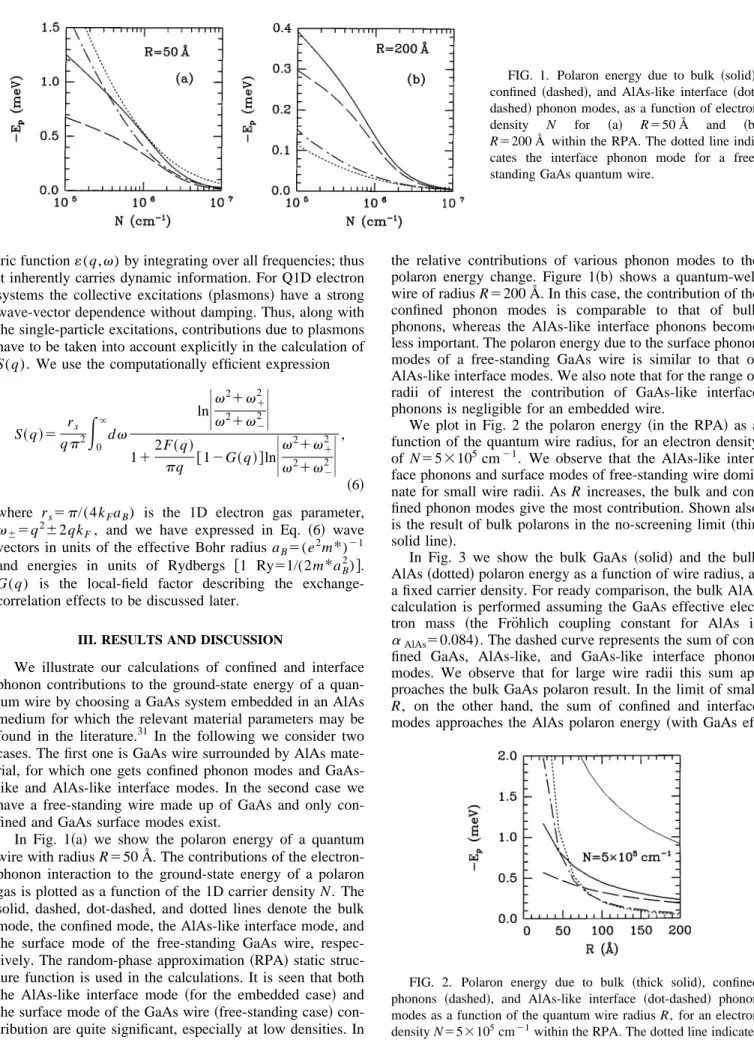
In Fig. 1~a! we show the polaron energy of a quantum wire with radius R550 Å. The contributions of the electron-phonon interaction to the ground-state energy of a polaron gas is plotted as a function of the 1D carrier density N. The solid, dashed, dot-dashed, and dotted lines denote the bulk mode, the confined mode, the AlAs-like interface mode, and the surface mode of the free-standing GaAs wire, respec-tively. The random-phase approximation ~RPA! static struc-ture function is used in the calculations. It is seen that both the AlAs-like interface mode ~for the embedded case! and the surface mode of the GaAs wire~free-standing case! con-tribution are quite significant, especially at low densities. In general, screening reduces the electron-phonon interaction as the carrier density increases. As the wire radius is increased,
the relative contributions of various phonon modes to the polaron energy change. Figure 1~b! shows a quantum-well wire of radius R5200 Å. In this case, the contribution of the confined phonon modes is comparable to that of bulk phonons, whereas the AlAs-like interface phonons become less important. The polaron energy due to the surface phonon modes of a free-standing GaAs wire is similar to that of AlAs-like interface modes. We also note that for the range of radii of interest the contribution of GaAs-like interface phonons is negligible for an embedded wire.
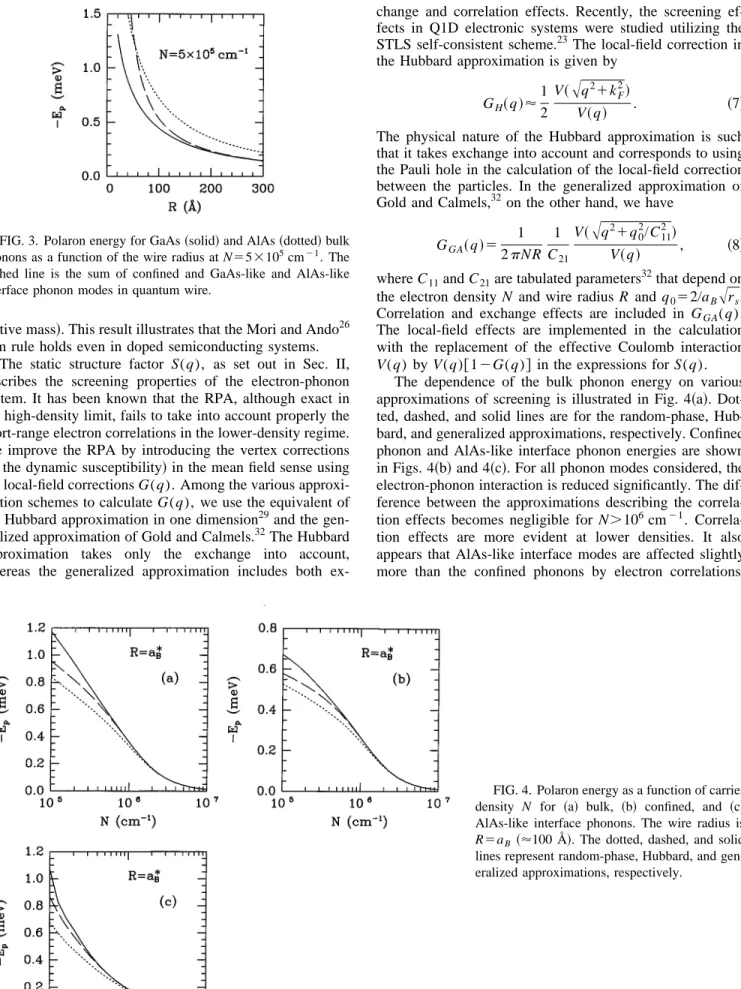
We plot in Fig. 2 the polaron energy ~in the RPA! as a function of the quantum wire radius, for an electron density of N553105cm21. We observe that the AlAs-like inter-face phonons and surinter-face modes of free-standing wire domi-nate for small wire radii. As R increases, the bulk and con-fined phonon modes give the most contribution. Shown also is the result of bulk polarons in the no-screening limit~thin solid line!.
In Fig. 3 we show the bulk GaAs ~solid! and the bulk AlAs~dotted! polaron energy as a function of wire radius, at a fixed carrier density. For ready comparison, the bulk AlAs calculation is performed assuming the GaAs effective elec-tron mass ~the Fro¨hlich coupling constant for AlAs is
aAlAs50.084). The dashed curve represents the sum of con-fined GaAs, AlAs-like, and GaAs-like interface phonon modes. We observe that for large wire radii this sum ap-proaches the bulk GaAs polaron result. In the limit of small
R, on the other hand, the sum of confined and interface
modes approaches the AlAs polaron energy ~with GaAs ef-FIG. 1. Polaron energy due to bulk ~solid!, confined ~dashed!, and AlAs-like interface ~dot-dashed! phonon modes, as a function of electron density N for ~a! R550 Å and ~b! R5200 Å within the RPA. The dotted line indi-cates the interface phonon mode for a free-standing GaAs quantum wire.
FIG. 2. Polaron energy due to bulk ~thick solid!, confined phonons ~dashed!, and AlAs-like interface ~dot-dashed! phonon modes as a function of the quantum wire radius R, for an electron density N553105cm21within the RPA. The dotted line indicates the interface phonon modes of a free-standing GaAs quantum wire, whereas the thin solid line shows the unscreened limit.
fective mass!. This result illustrates that the Mori and Ando26 sum rule holds even in doped semiconducting systems.
The static structure factor S(q), as set out in Sec. II, describes the screening properties of the electron-phonon system. It has been known that the RPA, although exact in the high-density limit, fails to take into account properly the short-range electron correlations in the lower-density regime. We improve the RPA by introducing the vertex corrections
~to the dynamic susceptibility! in the mean field sense using
the local-field corrections G(q). Among the various approxi-mation schemes to calculate G(q), we use the equivalent of the Hubbard approximation in one dimension29 and the gen-eralized approximation of Gold and Calmels.32The Hubbard approximation takes only the exchange into account, whereas the generalized approximation includes both
ex-change and correlation effects. Recently, the screening ef-fects in Q1D electronic systems were studied utilizing the STLS self-consistent scheme.23 The local-field correction in the Hubbard approximation is given by
GH~q!'
1 2
V~
A
q21kF2!V~q! . ~7!
The physical nature of the Hubbard approximation is such that it takes exchange into account and corresponds to using the Pauli hole in the calculation of the local-field correction between the particles. In the generalized approximation of Gold and Calmels,32on the other hand, we have
GGA~q!5 1 2pNR 1 C21 V~
A
q21q02/C112 ! V~q! , ~8!where C11and C21are tabulated parameters32that depend on the electron density N and wire radius R and q052/aB
A
rs. Correlation and exchange effects are included in GGA(q).The local-field effects are implemented in the calculation with the replacement of the effective Coulomb interaction
V(q) by V(q)@12G(q)# in the expressions for S(q).
The dependence of the bulk phonon energy on various approximations of screening is illustrated in Fig. 4~a!. Dot-ted, dashed, and solid lines are for the random-phase, Hub-bard, and generalized approximations, respectively. Confined phonon and AlAs-like interface phonon energies are shown in Figs. 4~b! and 4~c!. For all phonon modes considered, the electron-phonon interaction is reduced significantly. The dif-ference between the approximations describing the correla-tion effects becomes negligible for N.106cm21. Correla-tion effects are more evident at lower densities. It also appears that AlAs-like interface modes are affected slightly more than the confined phonons by electron correlations.
FIG. 4. Polaron energy as a function of carrier density N for ~a! bulk, ~b! confined, and ~c! AlAs-like interface phonons. The wire radius is R5aB~'100 Å!. The dotted, dashed, and solid
lines represent random-phase, Hubbard, and gen-eralized approximations, respectively.
FIG. 3. Polaron energy for GaAs~solid! and AlAs ~dotted! bulk phonons as a function of the wire radius at N553105cm21. The
dashed line is the sum of confined and GaAs-like and AlAs-like interface phonon modes in quantum wire.
Qualitatively similar results were found by Campos, Degani, and Hipo´lito11 for bulk phonons in quantum-well wires, where they have used the self-consistent field approximation in S(q).
It has been noted22that the static screening has a stronger effect in the renormalization ~of polaron energy and mass! than the dynamic screening because in the static approxima-tion only the long-time response of the system is taken into account. Similar conclusions were reached by Hai et al.12in their calculation that takes into account the dynamic screen-ing effects~only in the RPA! for Q1D systems. We have not attempted a perturbative calculation that includes dynamical screening, but expect the polaron energy Ep to increase in magnitude if such an approach is considered.
For the Q1D electron system we have used the infinite barrier, cylindrical wire model. There are various other mod-els of the quantum-well wire structures making use of para-bolic confining potentials and geometrical reduction of dimensionality.12 The general trends obtained here for the carrier density and screening dependence should be valid ir-respective of the details of the model chosen. Interactions of electrons in a Q2D structure with interface and bulk LO phonons were considered by Degani and Hipo´lito.33 They found that interface phonons give a significant contribution
to the polaron energy and effective mass. Our results indicate the importance of interface modes in Q1D structures.
IV. CONCLUSION
In summary, we have calculated the polaron energy in a Q1D GaAs quantum-well wire, using the bulk, confined, and interface phonons. We have included the screening effects within the RPA. Corrections to the RPA using model local-field corrections are also employed to investigate the impor-tance of electron correlations on the polaron energy. We find that the local-field effects, which include electron correla-tions, tend to change the magnitude of the polaronic correc-tions significantly at low densities.
ACKNOWLEDGMENTS
We gratefully acknowledge the partial support of this work by the Scientific and Technical Research Council of Turkey ~TUBITAK! and the Academic Link Scheme of the British Council. Financial support from EPSRC is gratefully acknowledged by C.R.B. and N.C.C. We thank Professor A. Gold for letting us use his tabulated data for the generalized approximation to the local-field factor.
1M. Watt, C. M. Sotomayer-Torres, H. E. G. Arnot, and S. P.
Beaumont, Semicond. Sci. Technol. 5, 285 ~1990!; A. Schmeller, A. R. Go˜ni, A. Pinczuk, J. S. Weiner, J. M. Calleja, B. S. Dennis, L. N. Pfeiffer, and K. W. West, Phys. Rev. B 49, 14 778~1994!.
2M. A. Stroscio, Phys. Rev. B 40, 6428~1989!; M. A. Stroscio, K.
W. Kim, and S. Rudin, Superlatt. Microstruct. 10, 55~1991!.
3P. A. Knipp and T. L. Reinecke, Phys. Rev. B 45, 9091~1992!. 4C. R. Bennett, N. C. Constantinou, B. K. Ridley, and M. Babiker,
J. Phys. Condens. Matter 7, 9819~1995!.
5N. C. Constantinou and B. K. Ridley, Phys. Rev. B 41, 10 622
~1990!; 41, 10 627 ~1990!; 49, 17 065 ~1994!.
6X. F. Wang and X. L. Lei, Solid State Commun. 91, 513~1994!;
Phys. Rev. B 49, 4780~1994!.
7
W. Jiang and J. P. Leburton, J. Appl. Phys. 74, 1652~1993!.
8F. Rossi, C. Bungaro, L. Rota, P. Lugli, and E. Molinari, Solid
State Electron. 37, 761~1994!.
9G. Fasol, M. Tanaka, H. Sakaki, and Y. Horikosh, Phys. Rev. B
38, 6056~1988!.
10M. H. Degani and O. Hipo´lito, Solid State Commun. 65, 1185
~1988!.
11V. B. Campos, M. H. Degani, and O. Hipo´lito, Solid State
Com-mun. 79, 473~1991!.
12G. Q. Hai, F. M. Peeters, J. T. Devreese, and L. Wendler, Phys.
Rev. B 48, 12 016~1993!.
13K. D. Zhu and S. W. Gu, Solid State Commun. 80, 307~1991!; J.
Phys. Condens. Matter 4, 1291~1992!.
14M. H. Degani and G. A Farias, Phys. Rev. B 42, 11 950~1990!;
41, 3572~1990!.
15W. S. Li, S. W. Gu, T. C. Au-Yeung, and Y. Y. Yeung, Phys.
Rev. B 46, 4630~1992!; Phys. Lett. A 166, 377 ~1992!.
16S. N. Klimin, E. P. Pokatilov, and V. M. Fomin, Phys. Status
Solidi B 184, 373~1994!.
17B. Tanatar and K. Gu¨ven, Semicond. Sci. Technol. 10, 803
~1995!.
18M. V. Klein, IEEE J. Quantum Electron. 22, 1760~1986!. 19K. T. Tsen, K. R. Wald, T. Rof, P. Y. Yu, and H. Morkoc¸, Phys.
Rev. Lett. 67, 2557~1991!.
20See, for example, Hot Carriers in Semiconductor Nanostructures:
Physics and Applications, edited by J. Shah~Academic, Boston, 1992!; Proceedings of the 7th International Conference on Hot Carriers in Semiconductors, edited by C. Hamaguchi and M. Inoue~Hilger, Bristol, 1992!.
21L. Wendler, A. V. Chaplik, R. Haupt, and O. Hipo´lito, J. Phys.
Condens. Matter 5, 4817 ~1993!; H. Y. Zhou and S. W. Gu, Solid State Commun. 88, 291~1993!; T. Q. Lu¨ and S. W. Gu, Phys. Status Solidi B 174, 427 ~1992!; E. P. Pokatilov, S. N. Klimin, S. N. Balaban, and V. M. Fomin, ibid. 189, 433~1995!.
22X. L. Lei, J. Phys. C 18, L731 ~1985!; S. Das Sarma and M.
Stopa, Phys. Rev. B 36, 9595~1987!.
23For a general discussion see K. S. Singwi and M. P. Tosi, Solid
State Phys. 36, 177~1981!.
24R. Enderlein, Phys. Rev. B 47, 2162~1993!.
25H. Rucker, E. Molinari, and P. Lugli, Phys. Rev. B 44, 3463
~1991!; 45, 6747 ~1992!.
26N. Mori and T. Ando, Phys. Rev. B 40, 6175~1989!.
27L. F. Lemmens, J. T. Devreese, and F. Brosens, Phys. Status
Solidi B 82, 439~1977!.
28X. G. Wu, F. M. Peeters, and J. T. Devreese, Phys. Status Solidi
B 133, 229~1986!.
29A. Gold and A. Ghazali, Phys. Rev. B 41, 7626~1990!. 30P. A. Knipp and T. L. Reinecke, Phys. Rev. B 41, 7627~1990!. 31S. Adachi, J. Appl. Phys. 58, R1~1985!.
32A. Gold and L. Calmels, Solid State Commun. 92, 619~1994!;
93, 9i~E! ~1995!.