501 Turkish Journal of Geriatrics
DOI: .... 2020; 23(): ...-... CORRESPONDANCE 1 E Phone: +90 e-mail: Received: Accepted:
Turkish Journal of Geriatrics DOI: 10.31086/tjgeri.2020.188 2020; 23(4): 501-508
CORRESPONDANCE
1 Van Yuzuncu Yil University Faculty of Medicine, Department of
Anesthesiology and Reanimation, Van, Turkey
2 Istanbul Medipol University Mega Hospitals Complex, Department of
Anesthesiology and Reanimation, Istanbul, Turkey
3 Recep Tayyip Erdogan University Faculty of Medicine, Department
of Anesthesiology and Reanimation, Rize, Turkey
4 Private OFM Antalya Hospital, General Intensive Care Unit, Antalya,
Turkey
5 Biruni University Faculty of Medicine, Department of Anesthesiology
and Reanimation, Istanbul, Turkey
6 Sakarya University Faculty of Medicine, Anesthesiology and
Intensive Care Unit, Sakarya, Turkey
7 Private Corlu Vatan Hospital, General Intensive Care Unit, Tekirdag,
Turkey
8 Van Yuzuncu Yil University Faculty of Medicine, Department of
General Surgery, Van, Turkey
9 Van Yuzuncu Yil University Faculty of Medicine, Department of
Neurology, Van, Turkey
10 Hatay Mustafa Kemal University Tayfur Ata Sokmen Faculty of
Medicine, Department of Anesthesiology and Reanimation, Hatay, Turkey
11 Van Yuzuncu Yil University Faculty of Medicine, Department of
Cardiology, Van, Turkey
12 Kutahya Health Sciences University Evliya Celebi Training and
Research Hospital, Internal Medicine Critical Care Unit, Kutahya, Turkey
13 Gaziantep Provincial Directorate of Health Gaziantep Sehitkamil
State Hospital, General Intensive Care Unit, Gaziantep, Turkey
14 Harran University Faculty of Medicine, Department of
Anesthesiology and Reanimation, Sanliurfa, Turkey
15 Izmir Katip Celebi University Ataturk Training and Research Hospital,
Internal Medicine Critical Care Unit, Izmir, Turkey
16 Van Health Sciences University Van Training and Research Hospital,
Anesthesiology Intensive Care Unit, Van, Turkey
17 Van Yuzuncu Yil University Faculty of Medicine, Department of
POPULATION IN TURKEY
1Hilmi DEMİRKIRAN
Van Yuzuncu Yil University Faculty of Medicine, Department of Anesthesiology and Reanimation, Van, Turkey
Phone: +905336676188 e-mail: [email protected] Received: Aug 29, 2020 Accepted: Nov 24, 2020
Objectives: The definition of chronic critical illness in the elderly has not yet
been determined. The aim of the study is to determine the prevalence and clinical features of chronic critical illness in the elderly population in Turkey.
Materials and Methods: Data from 16 intensive care units of public and private
hospitals in Turkey were evaluated. Patients staying in the intensive care units for at least eight days between 2015 and 2017 and having at least one of the additional criteria were accepted as chronic critical illness and they were divided into two groups by age, those 65 and older and those under 65.
Results: The chronic critical illness patient rate in the intensive care units was
10.7%. Of chronic critical illness patients in the intensive care units, 60.9% were 65 years of age and older, and the mortality rate of patients 65 years and older was 70%. The frequencies of ischemic stroke and sepsis, the number of patients with comorbidities, and the mortality rate were higher in patients over 65 years of age, while the frequency of traumatic brain injury, presence of a major wound, tracheostomy, length of hospital stay and cost of care were higher in patients under 65 years of age.
Conclusion: We determined that prolonged mechanical ventilation, traumatic
brain injury, tracheostomy and major wound presence in intensive care units patients 65 years and older increased hospital stay and costs. More work is needed to define chronic critical illness more clearly in elderly.
Keywords: Chronic Disease; Critical Illness; Intensive Care Unit; Aged; Turkey
A
BSTRACT Hilmi DEMİRKIRAN1 Emine UZUNOGLU2 Başar ERDİVANLI3 Ulaş KARADAMAR4 Suna KOÇ5 Yakup TOMAK6 Mustafa ÖZMEN7 Necat ALMALI8 Aydın ÇAĞAÇ9 Mehmet Selim ÇÖMEZ10 Mustafa TUNCER11 Murat Emre TOKUR12 Sinem BAYRAKCI13 Orhan BİNİCİ14 Turkan BAHADIR5 Arzu Esen TEKELİ1 İlhan BAHAR15 Buğra KARAKAŞ16 Sıddık KESKİN17 Hafize ÖKSÜZ18
INTRODUCTION
As a result of improvements in treatment in the intensive care unit (ICU), more patients survive acute critical illness. However, some of these patients have to live with long-term dependence on mechanical ventilation and other intensive care treatments (1). These patients who survive in the ICU and subsequently face a complex healing trajectory are described as chronic critical illness (CCI). It is increasingly recognized that patients with CCI are prone to psychological, physical, and cognitive dysfunction both during their stay in the hospital and after discharge (2). As a result of a recent consensus, patients who remained in the ICU for at least eight days and exhibited at least one of the following five conditions were defined as CCI: prolonged mechanical ventilation (PMV) >96 hours extended; tracheostomy; serious injuries and / or multiple organ failure; sepsis or others serious infections; ischemic stroke, intracerebral bleeding, or traumatic brain injury (TBI)(3).
The presence of various risk factors such as chronic kidney failure, frailty, repeated admissions to the ICU, and older age are indicators of poor prognosis in CCI patients (3). There has been an increase in the elderly population admitted to the ICU annually for the last two decades (4). The definition of CCI in the elderly has not yet been determined, thus preventing accurate analysis of elderly people with CCI.
Although there has been a comprehensive discussion of CCI in the elderly population worldwide, CCI in the elderly has not been studied much in Turkey. The aim of this multicenter study is to determine the prevalence, clinical features, and characteristics of CCI in the elderly population in Turkey.
MATERIALS AND METHODS
A retrospective crossectional study was conducted in five different regions of Turkey between July
2017 and June 2018. The study was approved by the Non-Interventional Van Yuzuncu Yil University Clinical Ethics Committee (June 20, 2017; No. 08). In addition, approval was obtained from the official administrations of the researchers they worked with who agreed to participate in the study. The medical records of patients treated in the ICU between 2015 and 2017 were evaluated. The study was registered at ClinicalTrials.gov (identifier: NCT03262883).
Patients staying in the ICU for at least eight days and having at least one of the additional criteria were accepted as CCI (PMV, tracheostomy, sepsis, major wound, stroke, or TBI). CCI patients included in the study were also divided into two groups, 65 years and older and under 65 years. Patients with illnesses other than CCI, length of ICU stay of ≤7 days, and age <18 years were excluded from the study.
Statistical Analysis
The data were evaluated in the IBM SPSS Statistics Standard Concurrent User V 25 (IBM Corp., Armonk, New York, USA) statistical program. For descriptive statistics, unit number (n), percent (%), mean ± standard deviation (x̅ ± ss), median
(M), smallest value (min), largest value (max), first quartile (Q1) and third quartile (Q3) and interquartile distance (IQR –Interquartile range) are given as values. Pearson Chi-square test was used to compare categorical variables between groups. In case of a difference in Pearson Chi-square test, two proportion z tests with Bonferroni correction were used. The normal distribution of data of numerical variables was evaluated by Shapiro–Wilk normality test and Q-Q graphs. Since the data did not show normal distribution, two groups were compared with Mann–Whitney U test and three groups were compared with Kruskal–Wallis analysis. A p <.05 value was considered statistically significant.
RESULTS
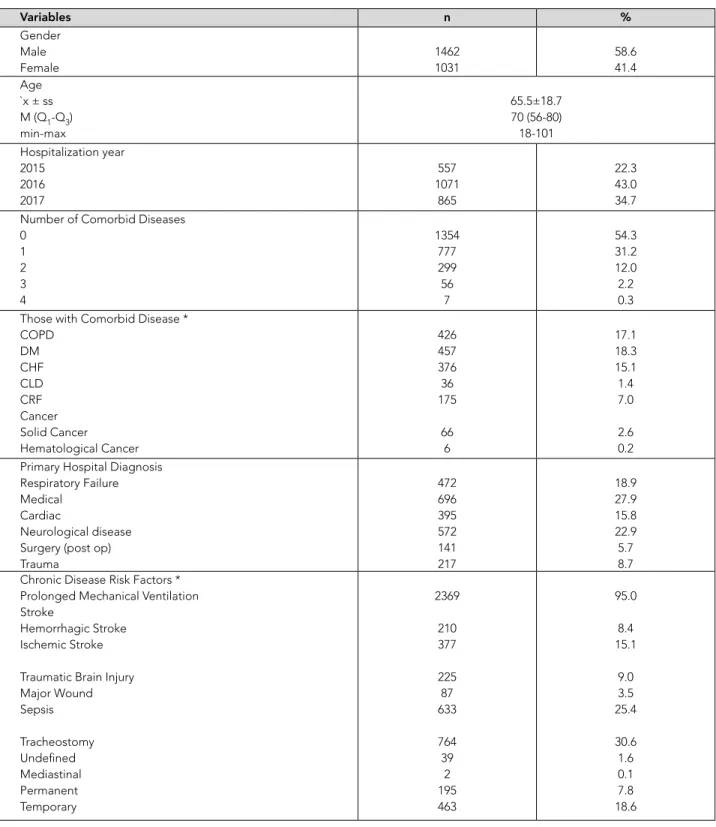
Among 23,272 patients admitted to ICUs during the study period, 2,493 (10.7%) were CCI. Demographic characteristics and the clinical features of the CCI patients are presented in Table 1.
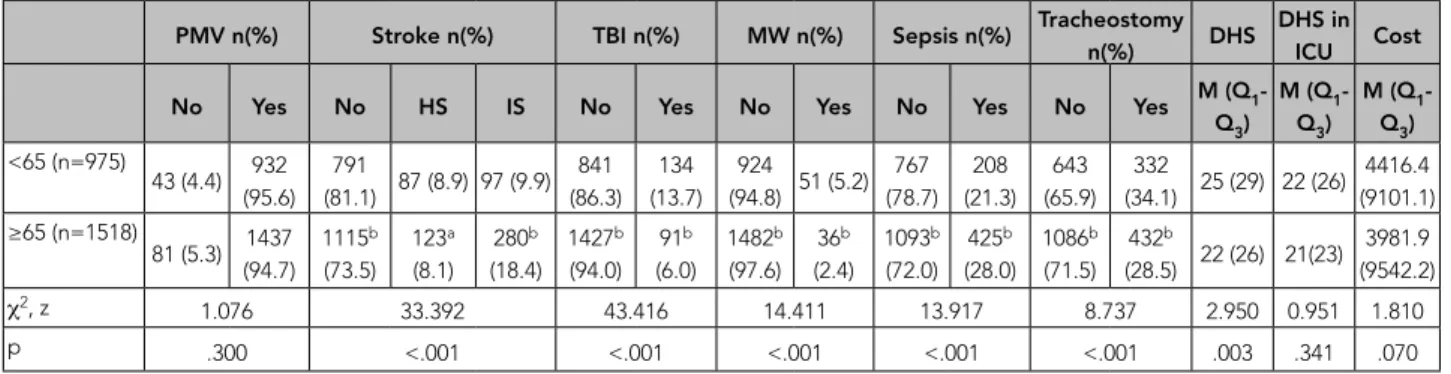
PMV rate is high in both groups and shows similar distribution between groups (p = .300). The frequencies of ischemic stroke (p < .001) and sepsis (p < .001) in patients 65 years and older were significantly higher than in patients under 65 years (Table 2).
The number of patients with one, two, or three comorbid diseases in the 65 and older age group was significantly higher than in the under 65 age group. The mortality rate was higher in the 65 and older group (Table 3).
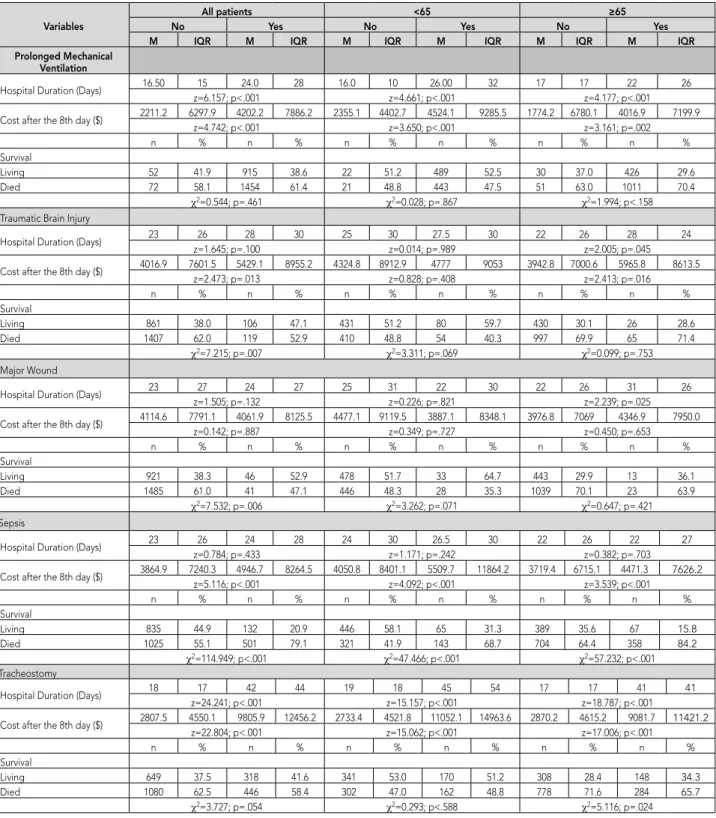
Comparison of PMV, TBI, major wound, sepsis and tracheostomy with mortality, duration of hospitalization and cost are given in table 4. The duration of hospitalization with PMV, sepsis and tracheostomy were significantly higher in both groups. The duration of hospital stay for those with TBI and major wound in the 65 and older age group was significantly longer. The mortality rate of patients with sepsis, tracheostomy and without TBI in the overall patient group were significantly higher.
DISCUSSION
There are no clear criteria for defining the transition of patients with CCI from the acute phase to the chronic phase (3). In this study, we have determined the CCI criteria as a stay in the ICU of eight or more days and at least one of the six clinical causes (major wound, sepsis, stroke, PMV, tracheostomy, or TBI) in accordance with the literature. Among 23,272 patients admitted to ICUs during the study period, 2,493 (10.7%) were CCI. The rate of CCI seen in our study is similar to the rates reported by other authors (5% to 15%) (5, 6). CCI-associated hospital mortality rates were 61% in the this study, 65% in a
multicenter study in Brazil in 2015, and 50% in a study conducted in Mexico (7). The in-hospital mortality rate was 10% in a study conducted in New Zealand and Australia (8). In the US, which is a developed country, CCI-associated in-hospital mortality rate was 31% (9). Our mortality results are higher than those of developed countries and similar to those of developing countries.
Elderly patients account for 10 to 20% of all ICU admissions, and this number is growing steadily (10). In another study, the percent of patients over 65 years of age in the ICU was 53%, according to data from training hospitals (11). In our study, the rate of elderly CCI patients staying in the ICU was 60.9%, slightly higher than in other studies. PMV distribution was high in both groups and showed similar distribution between groups. The frequency of ischemic stroke and sepsis in patients 65 years and older was significantly higher than in patients under 65 years. The frequency of TBI, major wound presence, and tracheostomy was significantly higher in patients under 65 years of age. According to an observational study on the mortality rates of critically ill elderly patients admitted to the ICU, in-hospital mortality rates are between 24% and 40%, three-month mortality rates are between 39% and 41%, six-month mortality rates are between 37% and 51%, and one year mortality rates are between 44% and 68% (10). The one-year mortality rate was 73% in patients who had undergone mechanical ventilation for more than 14 days or underwent tracheostomy (12). In our study, the mortality rate of patients 65 years and older was 70%, and this rate was significantly higher than in those patients under 65 years old (47.6%).
PMV accounts for a large part of ICU costs (13). It is known that that elderly people are more sensitive to lung damage caused by PMV and the incidence of acute respiratory failure (ARF) increases significantly with age. Many studies have shown that age of patients requiring mechanical ventilation and ARF are independently associated with mortality (14, 15). In our study, the number of patients with chronic
Table 1. Chronic critical illness (CCI) Characteristics Variables n % Gender Male Female 1462 1031 58.6 41.4 Age `x ± ss M (Q1-Q3) min-max 65.5±18.7 70 (56-80) 18-101 Hospitalization year 2015 2016 2017 557 1071 865 22.3 43.0 34.7 Number of Comorbid Diseases
0 1 2 3 4 1354 777 299 56 7 54.3 31.2 12.0 2.2 0.3 Those with Comorbid Disease *
COPD DM CHF CLD CRF Cancer Solid Cancer Hematological Cancer 426 457 376 36 175 66 6 17.1 18.3 15.1 1.4 7.0 2.6 0.2 Primary Hospital Diagnosis
Respiratory Failure Medical
Cardiac
Neurological disease Surgery (post op) Trauma 472 696 395 572 141 217 18.9 27.9 15.8 22.9 5.7 8.7 Chronic Disease Risk Factors *
Prolonged Mechanical Ventilation Stroke
Hemorrhagic Stroke Ischemic Stroke Traumatic Brain Injury Major Wound Sepsis Tracheostomy Undefined Mediastinal Permanent Temporary 2369 210 377 225 87 633 764 39 2 195 463 95.0 8.4 15.1 9.0 3.5 25.4 30.6 1.6 0.1 7.8 18.6
Discharge Status No Yes 2146 347 86.1 13.9 Referral to a More Comprehensive Hospital
No Yes 2445 48 98.1 1.9 Referral to the Same Comprehensive Hospital
No Yes 2491 2 99.9 0.1 Transfer to Palliative Unit
No Yes 2455 38 98.5 1.5 Transfer to Service No Yes 2466 27 98.9 1.1 Hospitalization Status In Intensive Care
No Yes 2438 55 97.8 2.2 Refuse Treatment No Yes 2416 77 96.9 3.1 Survival Living Died 967 1526 38.8 61.2 Time on Mechanical Ventilator (Days)
`x ± ss M (Q1-Q3) min-max 27.2±30.8 17 (10-33) 0-355 Time spent in intensive care (Days)
`x ± ss M (Q1-Q3) min-max 31.4±32.4 21 (13-37) 8-384 Length of hospital stay (Days)
`x ± ss M (Q1-Q3) min-max 34.9±36.4 23 (14-41) 8-384 Cost after the 8th day ($)
`x ± ss M (Q1-Q3) min-max 7774.8±12444.1 4104.6 (1655.9-9449.3) 0.61-304252.9 Money Paid by Insurance ($)
`x ± ss M (Q1-Q3) min-max 10116.2±11252.8 6358.6 (3753.4-12242.1) 526.5-12242.1
* Each disease was evaluated separately. COPD: Chronic Obstructive Pulmonary Disease, DM: Diabetes Mellitus, CHF: Chronic Heart Failure, CRF: Chronic Renal Failure, CLD: Chronic Liver Disease
obstructive pulmonary disease (COPD), longer PMV duration, and mortality were higher in the group over 65 years old. These findings confirm the results of previous studies.
Sepsis is common in ICUs and is associated with high morbidity rates. Development of sepsis is higher in patients with CCI remaining in the ICU (16). In our study, the cost values after the eighth day and the mortality rates of the patients with sepsis in both groups were significantly higher than for those without CCI. While the percentage of patients with sepsis younger than 65 years who died was 68.7%, this percentage was 84.2% in the 65 and older group.
It is known that the number of comorbid diseases increases with age. Patients with comorbidities in the
Table 3. Comparison of Number of Comorbidities, Types of Comorbidities, and Mortality by Age
CD n(%) COPD n(%) DM n(%) CHF n(%) CLD n(%) CRF n(%) Cancer n(%) Mortality n(%)
0 1 2 3 4 No Yes No Yes No Yes No Yes No Yes No SC HC No Yes
< 65 (n=975) 665a %68.2 221a %22.7 78a %8.0 10a %1.0 1a %0.1 870a %89.2 102a %10.8 855a %87.7 120a %12.3 904a %92.7 71a %7.3 959 %98.4 16 %1.6 931a %95.5 44a %91.4 937a %96.1 33a %3.4 5a %0.5 511a %52.4 464a %47.6 ≥ 65 (n=1518) 689b %45.4 556b %36.6 221b %14.6 46b %3.0 6a %0.4 1197b %78.9 321b %21.1 1181b %77.8 337b %22.2 1213b %79.9 305b %20.1 1498 %98.7 20 %1.3 1387b %4.5 131b %8.6 1484b %97.8 33a %2.2 1b %0.1 456b %30.0 1062 %b70.0 χ2 127.755 45.123 38.808 76.068 0.437 15.417 8.383 125.135 p <.001 <.001 <.001 <.001 .509 <.001 .015 <.001
χ2: Chi-square test; a and b superscripts show the difference between age groups between categories. COPD: Chronic Obstructive Pulmonary Disease. DM:
Diabetes Mellitus. CHF: Chronic Heart Failure. CRF: Chronic Renal Failure, CLD: Chronic Liver Disease
Table 2. Comparison of Chronic Critical Illness Risk Factors, Hospitalization Times and Costs by Age.
PMV n(%) Stroke n(%) TBI n(%) MW n(%) Sepsis n(%) Tracheostomy n(%) DHS DHS in ICU Cost
No Yes No HS IS No Yes No Yes No Yes No Yes M (Q1
-Q3) M (QQ3)1- M (QQ3)1 -<65 (n=975) 43 (4.4) 932 (95.6) 791 (81.1) 87 (8.9) 97 (9.9) 841 (86.3) 134 (13.7) 924 (94.8) 51 (5.2) 767 (78.7) 208 (21.3) 643 (65.9) 332 (34.1) 25 (29) 22 (26) 4416.4 (9101.1) ≥65 (n=1518) 81 (5.3) 1437 (94.7) 1115b (73.5) 123a (8.1) 280b (18.4) 1427b (94.0) 91b (6.0) 1482b (97.6) 36b (2.4) 1093b (72.0) 425b (28.0) 1086b (71.5) 432b (28.5) 22 (26) 21(23) 3981.9 (9542.2) χ2, z 1.076 33.392 43.416 14.411 13.917 8.737 2.950 0.951 1.810 p .300 <.001 <.001 <.001 <.001 <.001 .003 .341 .070
PMV, Prolonged Mechanical Ventilation; TBI, Traumatic Brain Injury; DHS, Duration of Hospital Stay (days); ICU, Intensive care unit; Cost, Cost after the 8th Day ($); HS, Hemorrhagic Stroke; IS; Ischemic Stroke. z: Mann–Whitney U test, χ2: Chi-square test; The superscripts a and b indicate the difference of age
groups between categories.
ICU have higher in-hospital and long-term mortality rates (17). In our study, the number of patients with one, two, or three comorbid diseases in the 65 and older age group was significantly higher than in the group younger than 65 years old. The high mortality rate in the over 65 age group may be related to comorbid diseases as mentioned above. Studies have reported that PMV, age, presence of comorbidity, and sepsis increase mortality (18). The findings of this study reaffirm the results of previous studies.
In conclusion, this is the first study that describes the characteristics of CCI in the elderly population in Turkey. In this study, we observed that the mortality rate in ICU was high and mortality increased at the age of 65 and above. Moreover, we determined that
Table 4. Comparisons for Prolonged Mechanical Ventilation, Traumatic Brain Injury, Major Wound, Sepsis and Tracheostomy.
Variables No All patients Yes No <65 Yes No ≥65 Yes
M IQR M IQR M IQR M IQR M IQR M IQR
Prolonged Mechanical Ventilation
Hospital Duration (Days) 16.50 15 24.0 28 16.0 10 26.00 32 17 17 22 26
z=6.157; p<.001 z=4.661; p<.001 z=4.177; p<.001
Cost after the 8th day ($) 2211.2 6297.9 4202.2 7886.2 2355.1 4402.7 4524.1 9285.5 1774.2 6780.1 4016.9 7199.9
z=4.742; p<.001 z=3.650; p<.001 z=3.161; p=.002 n % n % n % n % n % n % Survival Living 52 41.9 915 38.6 22 51.2 489 52.5 30 37.0 426 29.6 Died 72 58.1 1454 61.4 21 48.8 443 47.5 51 63.0 1011 70.4 χ2=0.544; p=.461 χ2=0.028; p=.867 χ2=1.994; p<.158
Traumatic Brain Injury
Hospital Duration (Days) 23 26 28 30 25 30 27.5 30 22 26 28 24
z=1.645; p=.100 z=0.014; p=.989 z=2.005; p=.045
Cost after the 8th day ($) 4016.9 7601.5 5429.1 8955.2 4324.8 8912.9 4777 9053 3942.8 7000.6 5965.8 8613.5
z=2.473; p=.013 z=0.828; p=.408 z=2.413; p=.016 n % n % n % n % n % n % Survival Living 861 38.0 106 47.1 431 51.2 80 59.7 430 30.1 26 28.6 Died 1407 62.0 119 52.9 410 48.8 54 40.3 997 69.9 65 71.4 χ2=7.215; p=.007 χ2=3.311; p=.069 χ2=0.099; p=.753 Major Wound
Hospital Duration (Days) 23 27 24 27 25 31 22 30 22 26 31 26
z=1.505; p=.132 z=0.226; p=.821 z=2.239; p=.025
Cost after the 8th day ($) 4114.6 7791.1 4061.9 8125.5 4477.1 9119.5 3887.1 8348.1 3976.8 7069 4346.9 7950.0
z=0.142; p=.887 z=0.349; p=.727 z=0.450; p=.653 n % n % n % n % n % n % Survival Living 921 38.3 46 52.9 478 51.7 33 64.7 443 29.9 13 36.1 Died 1485 61.0 41 47.1 446 48.3 28 35.3 1039 70.1 23 63.9 χ2=7.532; p=.006 χ2=3.262; p=.071 χ2=0.647; p=.421 Sepsis
Hospital Duration (Days) 23 26 24 28 24 30 26.5 30 22 26 22 27
z=0.784; p=.433 z=1.171; p=.242 z=0.382; p=.703
Cost after the 8th day ($) 3864.9 7240.3 4946.7 8264.5 4050.8 8401.1 5509.7 11864.2 3719.4 6715.1 4471.3 7626.2
z=5.116; p<.001 z=4.092; p<.001 z=3.539; p<.001 n % n % n % n % n % n % Survival Living 835 44.9 132 20.9 446 58.1 65 31.3 389 35.6 67 15.8 Died 1025 55.1 501 79.1 321 41.9 143 68.7 704 64.4 358 84.2 χ2=114.949; p<.001 χ2=47.466; p<.001 χ2=57.232; p<.001 Tracheostomy
Hospital Duration (Days) 18 17 42 44 19 18 45 54 17 17 41 41
z=24.241; p<.001 z=15.157; p<.001 z=18.787; p<.001
Cost after the 8th day ($) 2807.5 4550.1 9805.9 12456.2 2733.4 4521.8 11052.1 14963.6 2870.2 4615.2 9081.7 11421.2
z=22.804; p<.001 z=15.062; p<.001 z=17.006; p<.001 n % n % n % n % n % n % Survival Living 649 37.5 318 41.6 341 53.0 170 51.2 308 28.4 148 34.3 Died 1080 62.5 446 58.4 302 47.0 162 48.8 778 71.6 284 65.7 χ2=3.727; p=.054 χ2=0.293; p<.588 χ2=5.116; p=.024
REFERENCES
1. Polastri M, Comellini V, Pisani L. Defining the prevalence of chronic critical illness. Pulmonology 2020;26(3):119-20. (PMID: 31812701)
2. Herridge MS, Tansey CM, Matte A, et al. Functional disability 5 years after acute respiratory distress syndrome. N Engl J Med 2011;364(14):1293-304. (PMID: 21470008)
3. Carson SS. Definitions and epidemiology of the chronically critically ill. Respir Care 2012;57(6):848-56; discussion 56-8. (PMID: 22663962)
4. Laake JH, Dybwik K, Flaatten HK, et al. Impact of the post-World War II generation on intensive care needs in Norway. Acta Anaesthesiol Scand 2010;54(4):479-84. (PMID: 19930244)
5. Boniatti MM, Friedman G, Castilho RK, Vieira SR, Fialkow L. Characteristics of chronically critically ill patients: comparing two definitions. Clinics (Sao Paulo) 2011;66(4):701-4. (PMID: 21655767)
6. Nelson JE, Meier DE, Litke A, et al. The symptom burden of chronic critical illness. Crit Care Med 2004;32(7):1527-34. (PMID: 15241097)
7. Vásquez-Revilla HR, Revilla-Rodríguez E, Raymundo-Aguilar CA, Gaytan-Sánchez BM, Terrazas-Luna V. Epidemiological characteristics of patients with chronic critical illness. An ambispective observational study. Medicina Interna de México 2017;33(2):168-76. (in Spanish)
8. Iwashyna TJ, Hodgson CL, Pilcher D, et al. Timing of onset and burden of persistent critical illness in Australia and New Zealand: a retrospective, population-based, observational study. Lancet Respir Med 2016;4(7):566-73. (PMID: 27155770) 9. Kahn JM, Le T, Angus DC, et al. The epidemiology of
chronic critical illness in the United States*. Crit Care Med 2015;43(2):282-7. (PMID: 25377018)
10. Guidet B, Leblanc G, Simon T, et al. Effect of Systematic Intensive Care Unit Triage on
Long-term Mortality Among Critically Ill Elderly Patients in France: A Randomized Clinical Trial. JAMA 2017;318(15):1450-9. (PMID: 28973065)
11. Kwak SH, Jeong CW, Lee SH, Lee HJ, Koh Y. Current status of intensive care units registered as critical care subspecialty training hospitals in Korea. J Korean Med Sci 2014;29(3):431-7. (PMID: 24616595) 12. Heyland D, Cook D, Bagshaw SM, et al. The Very
Elderly Admitted to ICU: A Quality Finish? Crit Care Med 2015;43(7):1352-60. (PMID: 25901550)
13. Milbrandt EB, Eldadah B, Nayfield S, Hadley E, Angus DC. Toward an integrated research agenda for critical illness in aging. Am J Respir Crit Care Med 2010;182(8):995-1003. (PMID: 20558632)
14. Bellani G, Laffey JG, Pham T, et al. Epidemiology, Patterns of Care, and Mortality for Patients With Acute Respiratory Distress Syndrome in Intensive Care Units in 50 Countries. JAMA 2016;315(8):788-800. (PMID: 26903337)
15. Esteban A, Anzueto A, Frutos F, et al. Characteristics and outcomes in adult patients receiving mechanical ventilation: a 28-day international study. JAMA 2002;287(3):345-55. (PMID: 11790214)
16. Westphal GA, Vieira KD, Orzechowski R, et al. [Analysis of quality of life following hospital discharge among survivors of severe sepsis and septic shock]. Rev Panam Salud Publica 2012;31(6):499-505. (PMID: 22858817)
17. Stavem K, Hoel H, Skjaker SA, Haagensen R. Charlson comorbidity index derived from chart review or administrative data: agreement and prediction of mortality in intensive care patients. Clin Epidemiol 2017;9:311-20. (PMID: 28652813)
18. Rordorf G, Koroshetz W, Efird JT, Cramer SC. Predictors of mortality in stroke patients admitted to an intensive care unit. Crit Care Med 2000;28(5):1301-5. (PMID: 10834669)
PMV, TBI, tracheostomy, and major wound presence in the 65 and older age group increased hospital stay and costs. More work is needed to define CCI more clearly in elderly.
Acknowledgements
We would like to all clinician for this manuscript. There are no conflicts of interest in connection with this paper and the study was not use any sources of financial assistance.