Full Terms & Conditions of access and use can be found at
http://www.tandfonline.com/action/journalInformation?journalCode=lsst20
Download by: [Bilkent University] Date: 13 November 2017, At: 00:00
Separation Science and Technology
ISSN: 0149-6395 (Print) 1520-5754 (Online) Journal homepage: http://www.tandfonline.com/loi/lsst20
Chromium(VI) Biosorption and Bioaccumulation
by Live and Acid-Modified Biomass of a Novel
Morganella morganii Isolate
Zeynep Ergul-Ulger, Alper Devrim Ozkan, Evren Tunca, Sibel Atasagun &
Turgay Tekinay
To cite this article: Zeynep Ergul-Ulger, Alper Devrim Ozkan, Evren Tunca, Sibel Atasagun &
Turgay Tekinay (2014) Chromium(VI) Biosorption and Bioaccumulation by Live and Acid-Modified Biomass of a Novel Morganella morganii Isolate, Separation Science and Technology, 49:6, 907-914, DOI: 10.1080/01496395.2013.866681
To link to this article: http://dx.doi.org/10.1080/01496395.2013.866681
Accepted author version posted online: 31 Dec 2013.
Published online: 31 Dec 2013.
Submit your article to this journal
Article views: 163
View related articles
View Crossmark data
ISSN: 0149-6395 print / 1520-5754 online DOI: 10.1080/01496395.2013.866681
Chromium(VI) Biosorption and Bioaccumulation by Live and
Acid-Modified Biomass of a Novel Morganella morganii Isolate
Zeynep Ergul-Ulger,
1Alper Devrim Ozkan,
2Evren Tunca,
3Sibel Atasagun,
1and Turgay Tekinay
4,5 1Ankara University, Department of Biology, Faculty of Science, Ankara, Turkey2Bilkent University, UNAM-Institute of Materials Science and Nanotechnology, Bilkent, Ankara, Turkey 3Fatsa Faculty of Marine Science, Ordu University, Ordu, Turkey
4Gazi University, Life Sciences Application and Research Center, Ankara, Turkey 5Gazi University, Polatlı Science and Literature Faculty, Ankara, Turkey
Conventional methods of chromium removal are often insuf-ficient for the remediation of chromium-contaminated natural environments, necessitating the development of alternative strate-gies. In this paper, we report the isolation of a novel Morganella morganii strain capable of reducing hexavalent chromium to its less-toxic and less-soluble trivalent form. Cr(VI) reduction by this strain was evaluated in both acidic environments and conditions reflecting natural freshwater sources. The isolate achieved equi-librium within 3 h and displayed a specific uptake rate of 24.30 ± 1.67 mg Cr(VI)/g biomass following HCl treatment. Without acid treatment, a reduction of over 90% was recorded within 72 h for an initial Cr(VI) concentration 20 mg/L, corresponding to a Cr(VI) removal capacity of 19.36± 1.89 mg/g. Absorption data of acid-treated STB5 biomass most closely followed the Toth and Langmuir models. FTIR results indicate that hydroxyl groups and extracellular or cell membrane polysaccharides may be potential adsorption sites for hexavalent chromium. Our results suggest that the isolate may be used in situ for treatment of polluted freshwater environments.
Keywords chromium (VI); heavy metal bioremediation;
Morganella morganii; biosorption; bioaccumulation;
Enterobacteriacea
INTRODUCTION
Chromium is utilized in many important industrial appli-cations, including steel production, electroplating, leather tan-ning, nuclear power production, textile industries, wood preser-vation, anodizing of aluminum, water-cooling, and chromate preparation (1). Chromium exists in valence states ranging from −2 to +6; the trivalent and hexavalent forms are the most com-monly encountered. Cr(VI) is a stable and non-essential form (2) and is approximately 100 times more toxic and 1,000 times
Received 9 November 2012; accepted 13 November 2013. Address correspondence to Turgay Tekinay, Gazi University, Life Sciences Application and Research Center, Ankara 06830, Turkey. E-mail:[email protected]
more mutagenic than Cr(III) (3). Cr(VI) compounds are highly soluble in water, can permeate through biological membranes, and act by binding to intracellular proteins and nucleic acids (4). Cr(III) is relatively inert and can be tolerated in moder-ate concentrations by many living organisms, but due to the highly detrimental effects of Cr(VI), chromium has been desig-nated as a priority pollutant by the United States Environmental Protection Agency (EPA) (5).
Chemical precipitation, chemical oxidation or reduction, ion exchange, filtration, electrochemical treatment, reverse osmo-sis, membrane technologies, and evaporation recovery are known methods for removing heavy metals from industrial effluents (6). However, a wide host of problems are associated with these methods, including high operating and mainte-nance costs, low efficiency, operational complexity, high energy requirements, incomplete metal removal, and the production of secondary waste products during treatment (5). Therefore, research on cleaner and more efficient metal remediation tech-nologies is crucial (7), and bacterium-, alga-, or fungus-based bioremediation methods have received considerable attention as alternative ways to remove hazardous metals from industrial and natural waters (5,7).
Bioremediation of Cr(VI) is generally conducted in acidic pH, as the excess of hydrogen ions in the environment gener-ally leads to higher removal efficiencies. Cells used in low-pH studies are either killed by heat, acid, or base treatment prior to use as biosorbants, (8) or perish rapidly during the process, since the organisms in question are not acidophiles and cannot tolerate the modified environment for extended periods of time. However, a substantial volume of work also exists on the use of live, unmodified bacteria as remediation agents, either by direct inoculation into contaminated environments or by use alongside a substrate colonized by one or more bacterial species.
Morganella is a genus of gram-negative bacteria belonging
to the family Enterobacteriaceae, members of which were pre-viously proposed as a candidate in bioremediation of uranium (VI) and chromium (VI) (9,10) In this study, we report the 907
908 Z. ERGUL-ULGER ET AL.
isolation and characterization of freshwater bacteria capable of effective Cr(VI) removal with and without pH modification, and describe the characterization of a M. morganii strain capa-ble of reducing Cr(VI) efficiently at pH 7-8 and in acidified conditions.
MATERIALS AND METHODS
Culture Medium, and Bacterial Isolation
M1 broth, containing 10 g/L peptone, 2 g/L meat extract, 1 g/L yeast extract, and 5 g/L NaCl, was utilized as the cul-ture medium throughout the study. All reagents were purchased from Sigma-Aldrich (US).
Freshwater samples were collected downstream of a chromium processing industrial facility from Ankara River and inoculated (1% v/v) in M1 medium containing 0, 50, 100, 150, 200, 500, and 1000 mg/L Cr(VI). Upon visible growth, sam-ples were streaked on M1 agar plates and incubated for 24 h at 30◦C. 27 morphologically distinct colonies were isolated in total.
Determination of Cr(VI) Biosorption Capacity
All isolated strains were tested for chromium resistance and reduction capacity in M1 medium containing 10, 20, 50, and 100 mg/L Cr(VI). Cr(VI) concentrations were measured at 0, 24, 48, and 72 h with 1,5-diphenylcarbazide, follow-ing the EPA protocol for hexavalent chromium detection (EPA method 7196a). Samples were diluted hundredfold prior to measurement (corresponding to a Cr(VI) concentration of up to 1 mg/L), and a standard curve was constructed with known concentrations of 0 to 2.5 mg/L Cr(VI). This concentration range demonstrated the highest linearity, and was therefore cho-sen for the evaluation of experimental samples. The conversion formula is as follows:
Cr(VI) concentration (mg/L) = OD540/0.88 (1) As the medium otherwise did not include chromium, the Cr(VI) concentration obtained at 0 h was accepted as the initial total chromium concentration. The difference between the Cr(VI) concentration at a given time and this initial chromium concentration was assumed to be chromium reduced by STB5 into the trivalent form, such that for a medium volume V, initial Cr(VI) concentration Cr(VI)0 and Cr(VI) concentration at a given time t Cr(VI)t, the biosorbed Cr(VI) amount at time t is:
Biosorbed Cr(VI)= (Cr(VI)0 − Cr(VI)t)∗V (2) The veracity of this assumption was substantiated by cell membrane disruption of STB5 samples in a Branson 2510 Ultrasonic Cleaner (Branson Ultrasonics, US) at a 40 kHz frequency for 1 h, followed by the measurement of total
chromium using the above-described method. No major dif-ference could be observed between the Cr(VI) concentra-tions measured before and after sonication, suggesting that STB5 does not display any mechanism (such as intracellular storage) by which Cr(VI) concentrations might be rendered undetectable and that all decreases in Cr(VI) concentrations are indeed due to reduction. As Cr(II), Cr(IV), and Cr(V) are unsta-ble in biological systems, we infer that the removed Cr(VI) is reduced entirely to Cr(III).
A formula to convert OD600 values to bacterial dry weight was established by serially diluting overnight cultures with known OD600 values, oven-drying the samples, and measur-ing their mass. The formula used for the M. morganii isolate is as follows:
Dry weight (g/L) = 0.979∗OD600− 0.304 (3) This formula was used throughout the study to deter-mine Cr(VI) biosorption capacities, in the form of mg Cr(VI) biosorbed or removed per gram dry bacterium.
Identification of the Chromium-Reducing Isolate
The identity of the isolate displaying the highest chromium reduction capacity, henceforth called STB5, was determined via 16S rRNA sequencing. DNA isolation was performed using the DNeasy Blood & Tissue Kit (QIAGEN, Germany). PCR amplification (initial denaturation at 96◦C for 5 min, 30 cycles of denaturation at 96◦C for 30 s, annealing at 55◦C for 30 s, elongation at 72◦C for 30 s, and final elongation at 72◦C for 5 min) was carried out in 50µL volumes containing 1.25 U Taq polymerase, 0.2 mM dNTP, 0.4 pmol 27-Forward and 1492-Reverse primers, 1.5 mM MgCl, and 1x Taq buffer. Samples were sequenced using a 3130xl Genetic Analyzer and a BigDye Terminator v3.1 Cycle Sequencing Kit (Applied Biosystems, US); sequence analysis was performed by a ABI 3130 XL Genetic Analyzer. Related sequences were identi-fied via nucleotide-nucleotide BLAST. A phylogenetic tree was constructed and visualized using Phylogeny.fr, a web service incorporating several bioinformatics algorithms for phyloge-netic tree construction (11–17).
Cr(VI) Removal Studies using STB5
Removal by Untreated STB5
All tests were performed in triplicate. STB5 samples incu-bated overnight (105 rpm, 30◦C) in Cr(VI)-free M1 medium were inoculated in M1 medium containing 20 mg/L Cr(VI). Growth (in form of OD600 values) and Cr(VI) concentra-tions were determined intermittently for 72 h. All reduction in hexavalent chromium was attributed to the STB5 biomass, as sterile M1 medium was found not to display any capacity to reduce chromium within 72 h without acid treatment (data not shown).
Removal by Acid-Treated STB5
All tests were performed in triplicate. STB5 samples incu-bated overnight in Cr(VI)-free M1 medium were treated with 6 M HCl to obtain a final pH of 2.0 (pH prior to adjust-ment = 8.0, bacterial dry weight = 2.11 ± 0.19 g/L). One hour after acid treatment, a potassium dichromate solution containing 10,000 mg/L Cr(VI) was added to the media in appropriate volumes to obtain final concentrations of 25, 50, 75, and 100 mg/L Cr(VI). Samples were incubated at 30◦C and 105 rpm for 3 h. Cr(VI) concentrations were determined via 1,5-diphenylcarbazide at 0 min, 5 min, 15 min, and every 15 min afterwards until the end of this time period. While ster-ile M1 medium was found to reduce Cr(VI) following acid treatment (data not shown), the organic content of the culture broth at the end of the incubation period consisted primar-ily of STB5 biomass and its exudates, and all reduction in hexavalent chromium was consequently attributed to STB5 biomass.
FTIR Analysis
STB5 was inoculated in 50 mL M1 medium with and with-out 20 mg/L Cr(VI), and incubated for 72 h at 105 rpm and 30◦C. At the end of the incubation period, aliquots of five milliliters were taken from each sample and centrifuged at 10,000 g for 5 min; the supernatant was decanted and the remaining pellet was dried in a convection oven, mixed with KBr in a 1% (m/m) ratio, and analyzed with a Nicolet 6700 FT-IR Spectrometer (Thermo-Scientific, US).
Scanning Electron Microscopy
STB5 was inoculated in 50 mL M1 medium with and without 20 mg/L Cr(VI) and incubated for 72 h at 105 rpm and 30◦C. Following the incubation period, aliquots of five milliliters were taken from each sample and centrifuged at 10,000 g for 5 min; the supernatant was decanted and the pellet was prepared for SEM imaging as described by Greif et al. (18). Images were taken using a Quanta 200 FEG scanning electron microscope (FEI Instruments, US).
Adsorption Isotherms
Data obtained from the low-pH biosorption study were com-pared to seven isotherm models (Langmuir, Langmuir with linear partitioning, Freundlich, Freundlich with linear partition-ing, Generalized Langmuir–Freundlich, Toth, Linear) using the isotherm parameter fitting software IsoFit (19).
RESULTS
Isolation and Preliminary Characterization of STB5
A total of 27 different colonies were isolated from freshwa-ter samples collected downstream of Ankara River and tested for their chromium resistance (for up to 1500 mg/L K2Cr2O7)
and removal capacity (for 10 mg/L, 20 mg/L, 50 mg/L, and 100 mg/L Cr (VI)). The maximum Cr(VI) removal capacity displayed by any isolate was 82% within 48 h for 20 mg/L Cr (VI); the maximum resistance observed was to 1000 mg/L K2Cr2O7 (not shown). There was no correlation
between chromium resistances and reduction rates, suggesting that chromium resistance may be caused by the inhibition of chromium transfer into bacterial cells, or the selective trans-portation of chromium from the cytosol to the external envi-ronment. Of the samples tested, STB5 displayed the highest capacity for chromium removal and was chosen as the focus of this paper. STB5 growth was marked by a notable change in pH; after 48 h pH had increased to 8.0 (from an initial pH of 7.0) and remained stable at 8.0 afterwards. This pH matches the freshwater environment from which STB5 was iso-lated. STB5 cells were determined to be short rods under light microscopy.
16S rRNA sequencing was performed in order to discern the identity of STB5. The isolate was found to be a strain of
Morganella morganii, a gram negative bacillus belonging to the
family Enterobacteriaceae. 16S sequence of STB5 displayed 99% identity to that of the known strain M. morganii M11. The phylogenetic tree constructed from sequencing data is shown in
Fig. 1. The 16s rRNA sequence of STB5 is publicly available in GenBank (GenBank ID: JX134642.1).
Cr(VI) Removal Studies using Viable M. Morganii STB5
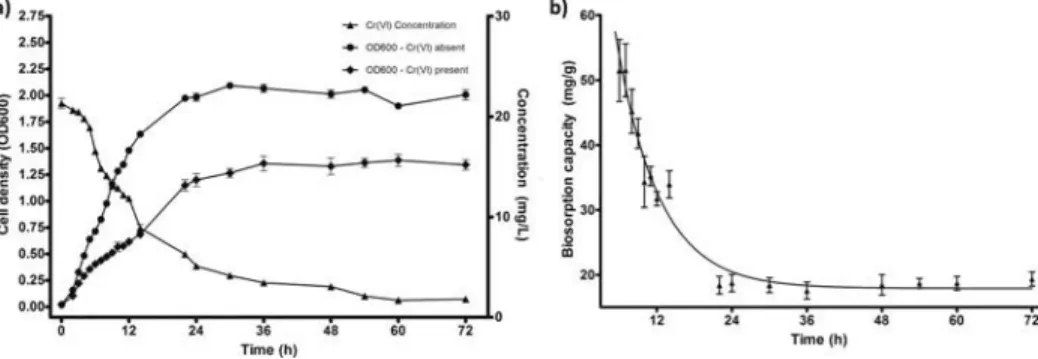
STB5 could proliferate in up to 50 mg/L Cr(VI), but dis-played optimal chromium removal capacity in 20 mg/L Cr(VI). While the isolate’s rate of growth decreased in the presence of Cr(VI), it could nonetheless reduce over 90% of 20 mg/L Cr(VI) within 72 h, corresponding to a removal capacity of 19.36 ± 1.89 mg/g at the end of this time period. Both Cr(VI) concentration and total biomass changed little during the final 24 h. STB5 growth correlated with Cr(VI) removal; the maximum reduction in Cr(VI) concentration was observed between 6 h – 12 h and coincided with the log phase of STB5 growth (Figure 2A). The stationary phase was reached after 36 h, and was marked by a decrease in the Cr (VI) removal rate. Cr(VI) sorption capacity of growing STB5 was initially high (e.g. 51.49± 8.31 mg/g at 6 h), but displayed a rapid decrease inversely proportional to bacterial growth before remaining stable for the last 48 h, corresponding to growth plateau experienced by Cr(VI)-exposed STB5 at the stationary phase (Figure 2B). A similar trend is also reflected in Cr(VI) removal rates, where the first 24 h is characterized by a rapid decrease in Cr(VI) concentration, followed by small decreases over the remaining 48 h (Figure 2A).
Cr(VI) Removal Studies using Acid-Treated STB05
The absorption capacities of acid-treated STB5 biomass under varying initial Cr(VI) concentrations are listed inTable 1. HCl-treated STB5 did not display a markedly higher chromium
910 Z. ERGUL-ULGER ET AL.
FIG. 1. 16S rRNA analysis data of STB5. The isolate was found to be most closely related to Morganella morganii M11, with 99% identity.
FIG. 2. (a) Growth rate (with and without 20mg/L Cr(VI) presence) and chromium reduction capacity of untreated STB5. T = 30◦C, agitation rate: 105 rpm. (b) Biosorption capacity of live STB5 biomass under the same conditions.
TABLE 1
Absorption capacity of acid treated STB5 at equilibrium under varying Cr(VI) concentrations, measured at the end of the 3 h test period. T= 30◦C, agitation rate: 105 rpm
Initial concentration (C0) Absorbed Cr(VI) concentration Absorption capacity at equilibrium (Q) Percentile Absorption
26.48 mg/L 26.48 mg/L 12.84± 1.81 mg/g 100.00%
50.07 mg/L 41.89 mg/L 21.26± 1.44 mg/g 83.38%
78.48 mg/L 54.43 mg/L 24.96± 3.91 mg/g 69.35%
97.50 mg/L 51.06 mg/L 23.01± 2.88 mg/g 53.81%
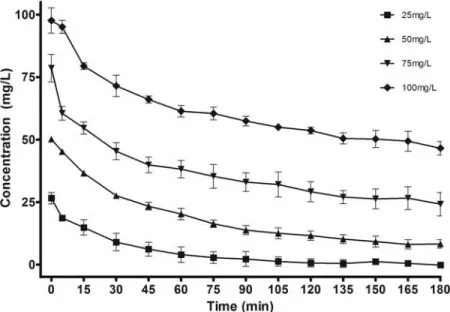
biosorption capacity compared to live biomass. Equilibrium was reached within 3 h for all concentrations tested, and 100% removal was observed in the trial utilizing an ini-tial Cr(VI) concentration of 25 mg/L. Initial Cr(VI) con-centrations did not have a marked effect on total absorption capacity (Figure 3). While Cr(VI) biosorption capacity did increase upon treatment with HCl, this increase was not par-ticularly drastic, and the Cr(VI) removal capacity (19.36 ± 1.89 mg/g) of live bacteria at the end of a 72h growth period was comparable to that of the acid treated bacteria exposed to 50 mg/L Cr(VI) (21.26 ± 1.44 mg/g), despite the lower initial Cr(VI) concentration of the former. The 25 mg/L samples displayed an even lower biosorption capac-ity (12.84± 1.81 mg/g). However, this should be attributed to Cr(VI) depletion observed in this sample, as the metal bind-ing had presumably not reached the saturation point in those samples.
Scanning Electron Microscopy (SEM) Imaging
The general morphology of STB5 cells was observed to be short rods under scanning electron microscopy, confirming our light microscopy observations. SEM images further revealed that the bacterial cells display a distinctively ragged surface fol-lowing long-term exposure to Cr(VI) (Figure 4Avs.Figure 4B). Chromium-induced STB5 shows no other difference in cell morphology compared to uninduced STB5 cells.
FTIR (Fourier Transform Infrared Spectroscopy) Analysis
Infrared band characteristics of STB5 grown in media incor-porating 0 mg/L and 20 mg/L Cr(VI) were measured; notable bands are annotated inFigure 5. Cr(VI) presence is marked by the appearance of a band near 570 cm−1, assigned to a Cr – OH translational mode (20). Likewise, the band near 900 cm−1 in the Cr(VI) exposed samples is indicative of the chromate anion
FIG. 3. Chromium reduction capacity of acid-treated STB5. T= 30◦C, agitation rate= 105 rpm, pH = 2, t = 3 h biomass concentration: 2.11 ± 0.19 g/L. Legend denotes initial Cr(VI) concentrations.
FIG. 4. SEM images of (a) Cr(VI)-induced STB5, displaying altered cell morphology. (b) non-Cr(VI)-induced STB5. STB5 cells exposed to Cr(VI) display a more irregular cell morphology, characterized by “bumps” on the cell surface.
FIG. 5. FTIR spectra (4000 – 400 cm−1) of 1% STB5 inoculated in media containing 0 and 20 mg/L Cr(VI), at T = 30◦C and agitation rate= 105 rpm after a growth period of 72h. Number of scans= 56.
912 Z. ERGUL-ULGER ET AL.
(21). The band near 3350 cm−1 in the Cr(VI)–free spectrum can be assigned to the hydroxyl group (22,23) and vanishes upon exposure to chromate, suggesting that hydroxyl groups may play a role in chromium sorption. The band at near 1975, assigned to C–O bond stretching, displays a shift for the Cr(VI)-exposed sample; the band around 1130 cm−1 reflects C–O–C bond stretch of polysaccharides (24) and is also shifted in the presence of Cr(VI).
The band near 3000 cm−1, assigned to aromatic ring C–H, stretches and likewise displays a shift following Cr(VI) expo-sure; the peak at 2925 cm-1 is another CH stretch peak and increases in intensity in the Cr(VI) exposed sample (25). Bands at 1674 and 1180 cm−1, corresponding to amide I and amide III regions, respectively, are modified in the Cr(VI) exposed sample, suggesting that Cr(VI) exposure may cause changes in protein expression or folding. This conclusion is supported by electron microscopy images displaying morphological changes in Cr(VI) exposed STB5 cells, suggesting that STB5 may actively respond to Cr(VI) stress.
Absorption Isotherms
Absorption kinetics parameters and statistical parameters of all isotherms tested are listed inTable 2. The 25 mg/L sample was omitted for the purposes of absorption isotherm construc-tion, as Cr(VI) was completely reduced in this group. No linear component was found in Cr(VI) absorption of STB5; both Langmuir and Freundlich isotherms with linear partitioning reduced to their non-linear counterparts (Kp≈ 0). The Toth
gen-eralized isotherm was found to be the best fit among the models
TABLE 2
Absorption kinetics coefficients of Cr(VI) biosorption by acid treated STB5 for each isotherm model
Isotherm Parameters Estimate Ry2value
Freundlich Kf 18.914 0.994 1/m 0.058 F-P Kf 18.902 0.994 1/m 0.059 Kp 2.57× 10⁻⁶ Langmuir b 0.872 0.995 Qmax 24.304 L-F Qmax 24.304 0.995 b 0.872 1/n 1.000 Linear Kp 0.738 0.138 L-P b 0.873 0.995 Qmax 24.302 Kp 1.04× 10⁻⁶ Toth b 0.1304 0.996 Qmax 23.704 n 5.000
tested, with high correlation between experimental observations and isotherm-derived predictions (Ry2 = 0.996) Despite the irregular nature of bacterial cell surfaces and the capacity of the Toth isotherm to account for heterogenous, multilayer absorption, the high correlation between experimental results and the Langmuir model suggests that Cr(VI) absorption is monolayeric in STB5. In addition, the Generalized Langmuir-Freundlich isotherm reduced to the Langmuir isotherm, which may also indicate the lack of surface irregularities for Cr(VI) biosorption. Nonetheless, all models tested were suitable fits for STB5 absorption behavior, except for the linear isotherm. The maximum absorption capacity (qmax) of STB5 is predicted to be 24.30 ± 1.67mg Cr(VI)/g bacterium under the Langmuir model.
DISCUSSION
We hitherto described a novel strain of M. morganii (STB5) capable of reducing chromium both as living biomass and after acid treatment. While the use of M. morganii in chromium bioremediation has not been documented in current literature, high chromium biosorption capacity is known from other members of Enterobacteriaceae (10). Morganella species are not widely used in bioremediation; to our knowledge there are no previous studies on the capacity of M. morganii strains to reduce hexavalent chromium. However, previous studies have shown that M. morganii may be used for bioremediation of textile dyes, degradation of microcystin from water, and biodegradation of explosives (26–28).
A great volume of work exists on the chromium reduction capacities of various organisms (e.g., bacteria (5,7,8,29-32) algae (33), and fungi (2,34)). While the use of non-modified live bacteria for bioremediation efforts has been documented, Cr(VI) removal efforts often focus on use of acidified environ-ments and/or acid treated biomass. Sorption and reduction of chromium is expected to be more efficient at low pH, owing to the fact that protonated functional groups have a greater affinity towards chromate anions (23). As such, bioremediative agents display higher Cr(VI) biosorption capacities if exposed to acids prior to treatment, or if Cr(VI) reduction is performed in an acidified environment. However, such an approach is not suitable for use in natural environments, and is econom-ically unfeasible for the treatment of large bodies of water. Strains capable of effectively reducing Cr(VI) at neutral or near-neutral pH are therefore advantageous, as those bacteria readily eliminate the need to acidify the cultivated biomass (or the polluted environment) for bioremediation. Further, live cells are capable of sequestering chromium both by biosorb-ing it on the cell surface and by accumulatbiosorb-ing it within the cells themselves, allowing for continuous chromium reduction capacity. As Cr (VI) reduction by STB5 occurs in pH matching the pH of the natural freshwater source from which it was iso-lated, this strain is feasible for use in freshwater bioremediation efforts.
In studies with the yeast Yarrowia lipolytica, Cr (VI) biosorption was determined to be 63 mg/g at optimal pH = 1 (2). Likewise, pH = 2 was found to be optimal in studies with red algae Ceramium virgatum, (33) with a maximum biosorption capacity of 26.5mg/L. While those results are higher compared to the Cr(VI) removal capacity of live STB5, it must be noted that low pH contributes significantly to the biosorption process (23). Likewise, use of high temperatures and chemical-modified cells accounts for many of the high biosorption capacities reported in current literature; for exam-ple, in a study with the gram-negative bacterium Aeromonas
hydrophila, highly effective (185 mg/g Cr(VI)/dry biomass)
biosorption was observed with dried cells at 60◦C and pH= 1.5. Biosorption studies on live biomass are also documented in the literature, and are more in line with our results. The use of live cells for Cr(VI) bioremediation was previously reported in a study with Bacillus megaterium and B. circulans (35). The removal capacity observed was 30.6 mg/g for B. megaterium and 33.1 mg/g for B. circulans for 25 mg/L initial Cr(VI), which is comparable to our result of 19.36 ± 1.89 mg/g by live M. morganii. However, we must note that we were unable to find information regarding the pH of the medium used in this bioaccumulation study.
It is curious that live STB5 cells displayed a chromium reduction capacity comparable to that of acid-modified STB5 biomass, as biosorption is expected to be greater in acidified environments (23). The isolate might be capable of enzymatic reduction of Cr(VI), which would account for the unusually high reduction capacity of live bacteria compared to the acid-treated biomass. The relatively high Cr(VI) removal capacity of live STB5 may also be attributed to the longer con-tact period in live bacterial studies (72 h vs. 3 h). Nonetheless, absorption capacity did not display a notable increase when the initial Cr(VI) concentration was increased (e.g., 21.26± 1.44 mg/g for C0 = 50.07 mg/L and 23.01 ± 2.88 mg/g for 97.50 mg/L, seeTable 1), which may suggest that acid-treated STB5 bears a relatively high affinity to Cr(VI), such that all available binding sites can be occupied even at low concentra-tions. However, it is also possible that STB5 bears a low total number of available binding sites, which would account for the low absorption capacity of acid-treated biomass compared to other records in the literature. If that is the case, STB5 cannot be utilized for applications requiring the partial removal of high Cr(VI) concentrations, and should be applied as live biomass where low concentrations of Cr(VI) must be removed with high efficiency and over large volumes of water.
It was previously noted that exposure to Cr(VI) can induce expression of chromium transporters and contribute to chromium resistance (36). Likewise, Cr(VI) presence was found to result in the upregulation of several genes involved in chromium reduction in Shewanella oneidensis MR-1 (37). Our results are in line with such observations, as STB5 dis-plays an increase in growth rate between 12 h-24 h compared to the relatively slow growth observed between 8 h-12 h.
This change might be attributed to the expression of pro-teins involved in chromate transport and reduction upon Cr(VI) exposure, such that proteins expressed during the first few hours in the presence of Cr(VI) can partially alleviate the stress associated with this heavy metal and allow for comparatively higher growth rates after this time period. Absorption might also have been facilitated by the production of cell exudates on the cell surface, which would be supported by shifts in polysaccharide-associated peaks in our FT-IR measurements. Unlike the heterogeneous environment present within bacterial cells, exudates could also present a relatively homogenous and monolayeric sorption surface, resulting in a good fit between our experimental results and the Langmuir model (Table 2).
STB5 biomass could effectively reduce chromium with-out heat or acid modification and at pH matching the natural environment from which it was isolated (pH 8.0), making the strain suitable for bioremediation of freshwater environments where altering the pH is not feasible. The ability of STB5 to effectively reduce Cr(VI) at concentrations up to 20mg/L at non-acidic pH makes this strain an attractive alternative for current treatment methods. In addition, while previous studies have documented organisms with greater maximum absorption capacity than STB5, the acid-treated biomass of this isolate is able to reach its maximum absorption capacity at relatively low Cr(VI) concentrations and may therefore be effective where complete removal of Cr(VI) from water sources containing low Cr(VI) concentrations is required.
Our Cr(VI) removal capacity experiments with live STB5 biomass suggest a relatively high Cr(VI) reduction by live STB5 at pH = 8. This may provide an advantage in remediation efforts since no pH and temperature adjustment is required for effective bioaccumulation and biosorption by STB5. Further, STB5 was capable of growing in the pres-ence of Cr(VI) and was a natural constituent of freshwater bacterial fauna, suggesting that it may be effective in in situ bioremediation of Cr(VI)-contaminated freshwater sources.
ACKNOWLEDGEMENTS
We would like to thank Tolga Tarkan Ölmez for his com-ments and corrections on the manuscript draft, and Selma Bulut, Meltem Atay, and Merve Ezgi Özmen for their technical assistance.
FUNDING
This work is supported by grants from the State Planning Organization of Turkey (Devlet Planlama Te¸skilatı, DPT).
REFERENCES
1. Quintelas, C.; Fonseca, B.; Silva, B.; Figueiredo, H.; Tavares, T. (2009) Treatment of chromium(VI) solutions in a pilot-scale bioreactor through a biofilm of Arthrobacter viscosus supported on GAC. Bioresour Technol., 100: 220–226.
914 Z. ERGUL-ULGER ET AL. 2. Bankar, A.V., Kumar, A.R., Zinjarde, S.S. (2009) Removal of chromium
(VI) ions from aqueous solution by adsorption onto two marine isolates of
Yarrowia lipolytica. J Hazard Mater., 170: 487–494.
3. Polti, M.A., Amoroso, M.J., Abate, C.M. (2010) Chromate reductase activity in Streptomyces sp. MC1. J Gen Appl Microbiol., 56: 11–18. 4. Kiliç, N.K., Dönmez, G. (2008) Environmental conditions affecting
exopolysaccharide production by Pseudomonas aeruginosa, Micrococcus sp., and Ochrobactrum sp. J Hazard Mater., 154: 1019–1024.
5. Mishra, S., Doble, M. (2008) Novel chromium tolerant microorgan-isms: Isolation, characterization and their biosorption capacity. Ecotoxicol Environ Saf.
6. Zahoor, A., Rehman, A. (2009) Isolation of Cr(VI) reducing bacteria from industrial effluents and their potential use in bioremediation of chromium containing wastewater. J Environ Sci (China)., 21: 814–820.
7. Quintelas, C., Fernandes, B., Castro, J., Figueiredo, H., Tavares, T. (2008) Biosorption of Cr(VI) by three different bacterial species supported on granular activated carbon: A comparative study. J Hazard Mater., 153: 799–809.
8. Velásquez, L., Dussan, J. (2009) Biosorption and bioaccumulation of heavy metals on dead and living biomass of Bacillus sphaericus. J Hazard Mater., 167: 713–716.
9. Chabalala, S., Chirwa, E.M. (2010) Uranium(VI) reduction and removal by high performing purified anaerobic cultures from mine soil. Chemosphere., 78: 52–55.
10. Martins, M., Faleiro, M.L., Chaves, S., Tenreiro, R., Santos, E., Costa, M.C. (2010) Anaerobic bio-removal of uranium (VI) and chromium (VI): Comparison of microbial community structure. J Hazard Mater., 176: 1065–1072.
11. Anisimova, M., Gascuel, O. (2006) Approximate likelihood-ratio test for branches: A fast, accurate, and powerful alternative. Syst Biol., 55: 539–552.
12. Castresana, J. (2000) Selection of conserved blocks from multiple align-ments for their use in phylogenetic analysis. Mol Biol Evol., 17: 540–552. 13. Chevenet, F., Brun, C., Bañuls, A.L., Jacq, B., Christen, R. (2006) TreeDyn: Towards dynamic graphics and annotations for analyses of trees. BMC Bioinformatics., 7:439.
14. Dereeper, A., Audic, S., Claverie, J.M., Blanc, G. (2010) BLAST-EXPLORER helps you building datasets for phylogenetic analysis. BMC Evol Biol., 10:8.
15. Dereeper, A., Guignon, V., Blanc, G., Audic, S., Buffet, S., Chevenet, F., Dufayard, J.F., Guindon, S., Lefort, V., Lescot, M., Claverie, J.M., Gascuel, O. (2008) Phylogeny.fr: Robust phylogenetic analysis for the non-specialist. Nucleic Acids Res., 36: W465–W469.
16. Edgar, R.C. (2004) MUSCLE: Multiple sequence alignment with high accuracy and high throughput. Nucleic Acids Res., 32: 1792–1797. 17. Guindon, S., Gascuel, O. (2003) A simple, fast, and accurate algorithm
to estimate large phylogenies by maximum likelihood. Syst Biol., 52: 696–704.
18. Greif, D., Wesner, D., Regtmeier, J., Anselmetti, D. (2010) High resolu-tion imaging of surface patterns of single bacterial cells. Ultramicroscopy., 110: 1290–1296.
19. Wagner, H., Siebert, T., Ellerby, D.J., Marsh, R.L., Blickhan, R. (2005) ISOFIT: A model-based method to measure muscle-tendon properties simultaneously. Biomech Model Mechanobiol., 4: 10–19.
20. Kloprogge, J.T., Hickey, L., Frost, R.L. (2005) The effect of varying syn-thesis conditions on zinc chromium hydrotalcite: A spectroscopic study. Materials Chemistry and Physics., 89: 99–109.
21. Tagliaferro, F.S., Fernandes, E.A.N, Bacchi, M.A., Campos, E.A. (2006) INAA for the validation of chromium and copper determination in copper chromite by infrared spectrometry. Journal of Radioanalytical and Nuclear Chemistry., 269: 403–406.
22. Ruan, B., Kong, L.Y., Takaya, Y, Niwa, M. (2007) Studies on the chemical constituents of Psoralea corylifolia L. J Asian Nat Prod Res., 9: 41–44. 23. Park, D., Yun, Y.S., Park, J.M. (2005) Studies on hexavalent chromium
biosorption by chemically-treated biomass of Ecklonia sp. Chemosphere., 60: 1356–1364.
24. Vinod, V.T., Sashidhar, R.B., Sreedhar, B. (2010) Biosorption of nickel and total chromium from aqueous solution by gum kondagogu (Cochlospermum gossypium): A carbohydrate biopolymer. J Hazard Mater., 178: 851–860.
25. Aravindhan, R., Madhan, B., Rao, J.R., Nair, B.U., Ramasami, T. (2004) Bioaccumulation of chromium from tannery wastewater: An approach for chrome recovery and reuse. Environ Sci Technol., 38: 300–306. 26. Patil, P., Phugare, S., Jadhav, S., Jadhav, J. (2010) Communal action
of microbial cultures for Red HE3B degradation. Journal of Hazardous Materials: 263–270.
27. Eleuterio, L., Batista, J.R. (2010) Biodegradation studies and sequenc-ing of microcystin-LR degradsequenc-ing bacteria isolated from a drinksequenc-ing water biofilter and a fresh water lake. Toxicon., 55: 1434–1442.
28. Kitts C.L., Cunningham D.P., Unkefer, P.J. (1994) Isolation of three hexahydro-1,3,5-trinitro-1,3,5-triazine-degrading species of the family Enterobacteriaceae from nitramine explosive-contaminated soil. Appl Environ Microbiol., 60: 4608–4611.
29. Maiti S.K., Bera, D., Chattopadhyay, P., Ray, L. (2009) Determination of kinetic parameters in the biosorption of Cr (VI) on immobilized
Bacillus cereus M(1)(16) in a continuous packed bed column reactor. Appl
Biochem Biotechnol., 159: 488–504.
30. Hasan S.H., Srivastava, P., Ranjan, D., Talat, M. (2009) Biosorption of Cr(VI) from aqueous solution using A. hydrophila in up-flow col-umn: Optimization of process variables. Appl Microbiol Biotechnol., 83: 567–577.
31. Ranjan, D., Srivastava, P., Talat, M., Hasan, S.H. (2009) Biosorption of Cr(VI) from water using biomass of Aeromonas hydrophila: Central composite design for optimization of process variables. Appl Biochem Biotechnol., 158: 524–539.
32. Caravelli A.H., Giannuzzi, L., Zaritzky, N.E. (2008) Reduction of hex-avalent chromium by Sphaerotilus natans a filamentous micro-organism present in activated sludges. J Hazard Mater., 156: 214–222.
33. Sari A., Tuzen, M. (2008) Biosorption of total chromium from aque-ous solution by red algae (Ceramium virgatum): Equilibrium, kinetic and thermodynamic studies. J Hazard Mater., 160: 349–355.
34. Das, S.K., Guha, A.K. (2009) Biosorption of hexavalent chromium by Termitomyces clypeatus biomass: Kinetics and transmission electron microscopic study. J Hazard Mater., 167: 685–691.
35. Srinath, T., Verma, T., Ramteke, P.W., Garg, S.K. (2002) Chromium (VI) biosorption and bioaccumulation by chromate resistant bacteria. Chemosphere., 48: 427–435.
36. He, M., Li, X., Guo, L., Miller, S.J., Rensing, C., Wang, G. (2010) Characterization and genomic analysis of chromate resistant and reducing
Bacillus cereus strain SJ1. BMC Microbiol., 10:221.
37. Bencheikh-Latmani R., Williams S.M., Haucke L., Criddle C.S., Wu L., Zhou J., Tebo B.M. (2005) Global transcriptional profiling of Shewanella
oneidensis MR-1 during Cr(VI) and U(VI) reduction. Appl Environ
Microbiol., 71: 7453–7460.